AI SEO services combine search strategy, AI-assisted research and drafting, editorial review, technical SEO, publishing, and measurement. The useful question is not whether AI can produce more content; it is whether your team can turn the right search opportunities into qualified demand without losing control of accuracy, site quality, or commercial attribution.
AI SEO Services: What to Expect, Pricing & ROI Guide
Explore ai seo services: compare workflow fit, costs, risks, evidence, and practical next steps before you build, buy, or hire.

Table of Contents
- What most guides miss: AI SEO is an operating model, not a content package
- Compare the four AI SEO operating models
- What AI SEO services should include—and what they should exclude
- Pricing: decode scope before comparing monthly fees
- Proposal evaluation scorecard
- Run a bounded 60-to-90-day pilot
- Failure modes to control before scaling
- Questions to put in the SOW
- The practical buying decision
What most guides miss: AI SEO is an operating model, not a content package
Most AI SEO proposals describe outputs: articles, topic clusters, content briefs, optimizations, or “AI visibility.” Those outputs matter, but they do not tell you who owns the workflow when something goes wrong.
Before comparing vendors, decide whether each proposal names an owner for:
- Search and buyer-intent research
- Factual and subject-matter review
- Technical changes on the site
- Publishing and internal linking
- Conversion-path improvements
- Measurement and iteration
- Exceptions, corrections, and rollback
If those responsibilities are unclear, you are not buying a managed SEO system. You are buying content production with an AI label.
Google’s guidance does not create a separate exemption for AI-written pages. It emphasizes helpful, reliable, people-first content, while warning that automation used to generate many low-value pages can violate spam policies. Google’s generative AI guidance and its helpful-content guidance both point buyers toward quality controls rather than volume promises.
The decision rule is simple: buy the smallest operating model that resolves your actual bottleneck. Do not buy a custom system to compensate for unclear positioning, and do not buy a content retainer when your real constraint is technical debt or absent conversion tracking.
Compare the four AI SEO operating models
This is an editorial buyer framework, not market survey data. Use it to translate a vendor category into the work, ownership, and risk that sit behind it.
| Operating model | What you are buying | Internal owner needed | Main cost driver | Best fit | Main risk |
|---|---|---|---|---|---|
| AI SEO tools | Software for research, drafting, optimization, or reporting | Strong SEO or content owner | Seats, usage, and internal labor | A team that already has a defined process | Faster output without better decisions |
| Managed AI SEO service | Research, production, editorial support, and reporting | Marketing lead plus subject-matter reviewer | Scope, production volume, and review depth | A team with demand but limited execution capacity | Generic work if review and differentiation are thin |
| Technical SEO plus AI content workflow | Content work plus implementation backlog and site improvements | Marketing owner plus technical site owner | Cross-functional implementation | A site with known SEO issues and content gaps | Content ships while unresolved technical work blocks results |
| Custom agentic SEO workflow | Integrated research, approval, publishing, and measurement process | Business sponsor, workflow owner, and technical owner | Discovery, integrations, governance, and maintenance | A repeatable high-volume process with stable rules | Automating an unstable process |
A tool is usually sufficient when your team already knows which topics to pursue, who approves claims, how content is published, and how performance is measured. A managed service is more appropriate when execution is the bottleneck. A technical workflow is needed when templates, internal links, crawlability, CMS constraints, or conversion paths materially limit progress. A custom system belongs last, after the process is proven manually.
For a broader view of coordinating AI across repeatable work, see AI workflow automation. If your question is whether to automate a narrow process or engage a broader provider, compare AI automation agency services with custom AI solutions for business.
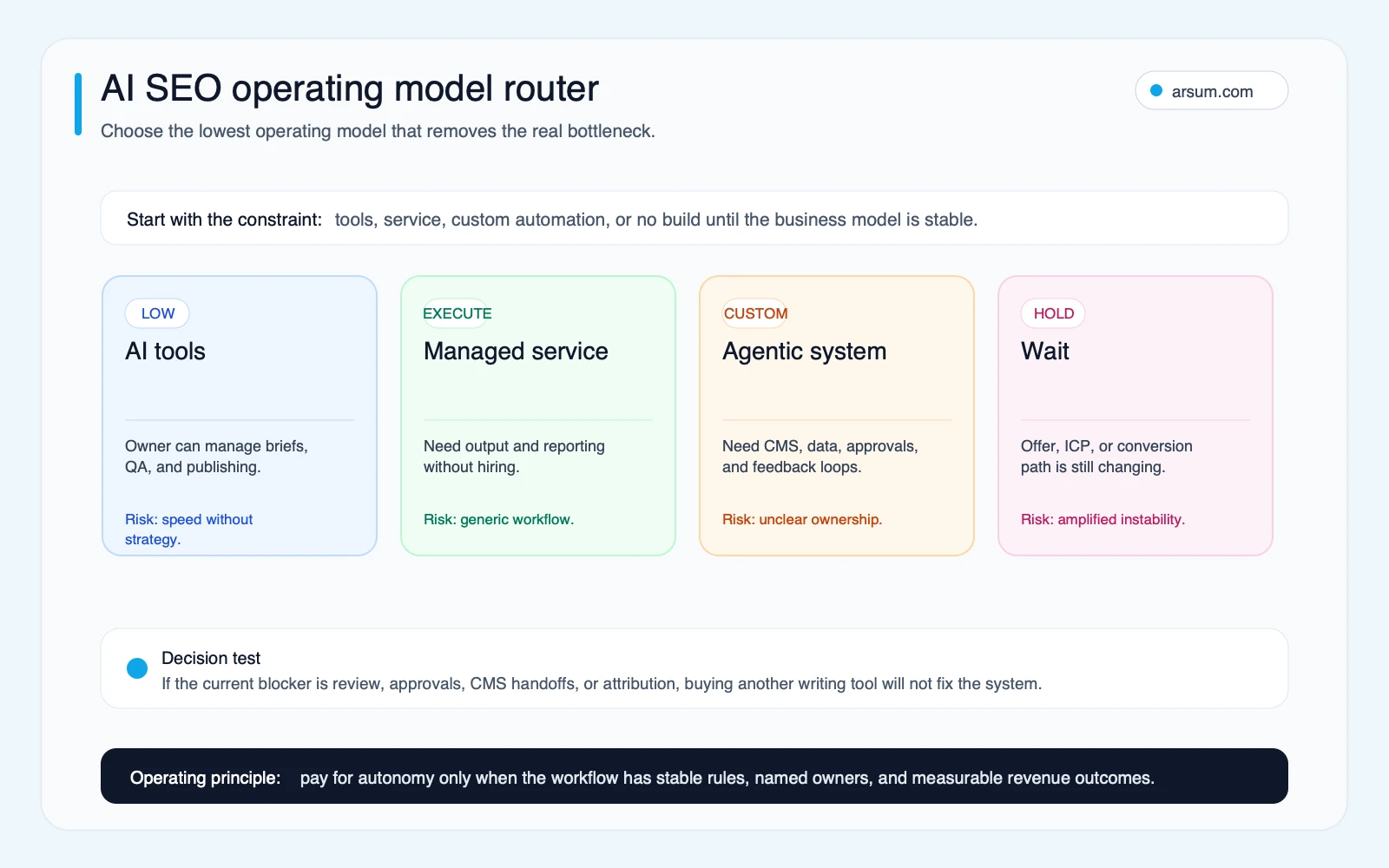
Build, buy, partner, or wait
Use these rules during vendor selection:
- Buy a tool if one accountable internal owner can run research, review, publishing, and reporting.
- Partner with a managed service if the workflow is known but your team cannot consistently execute it.
- Build a custom workflow only if the process is repeatable, has clear approval rules, and depends on systems or data a standard service cannot safely connect.
- Wait and fix the foundations if positioning changes frequently, analytics cannot distinguish qualified organic traffic, or nobody can approve what is published.
A custom workflow does not remove the need for judgment. It makes the normal path faster; it still needs an exception path for weak sources, disputed claims, broken templates, sensitive pages, and performance that does not translate into pipeline.
💡 Arsum builds custom AI automation solutions tailored to your business needs.
Get a Free Consultation →What AI SEO services should include—and what they should exclude
A credible service can vary in scope, but its proposal should make the following layers explicit.
Research and content decisions
The provider should explain how it identifies topics, maps them to buyer intent, and rejects low-value ideas. “We use AI to find keywords” is not a method. Ask whether the workflow considers sales objections, product constraints, existing pages, internal expertise, and conversion paths.
AI can reduce repetitive research and drafting work. It cannot independently establish whether a claim is true, whether a query represents your ideal buyer, or whether a page supports your commercial position. That distinction matters when evaluating AI for marketing teams and generative SEO workflows.
Editorial and subject-matter review
Every proposal should name:
- The person who checks factual claims
- The person who approves positioning and commercial accuracy
- The review standard for citations, examples, and product statements
- The maximum level of autonomy before a page requires human approval
- The correction process after publication
High failure cost should reduce autonomy. A regulated, technical, financial, medical, or high-stakes commercial page should not have the same publishing path as a low-risk glossary update.
Technical SEO and publishing
Clarify whether the service includes implementation or merely recommendations. The difference can include templates, metadata, canonicals, redirects, crawl issues, structured data, internal linking, page speed dependencies, CMS changes, and conversion instrumentation.
Do not accept “technical SEO included” without a prioritization method, a named implementation owner, and a clear line between tasks the vendor can execute and tasks your development team must approve.
Measurement and iteration
A monthly ranking report is not enough for a B2B buying decision. The program should define which metrics matter at each stage and what it will change if the early signals are positive but commercial results are weak.
Google says that AI features in Search still rely on the same foundations: accessible, crawlable pages and useful, original content. Its AI features guidance and AI optimization guide do not prescribe a hidden “AI search” trick. They direct site owners toward content that works for people and Search.
Pricing: decode scope before comparing monthly fees
Pricing is central to buying AI SEO services, but a single market rate would be misleading. The label can describe a tool subscription, a draft-production retainer, technical SEO implementation, strategy work, or a custom workflow.
Agency pricing pages show wide ranges, which is a reason to compare scope rather than headline price alone. See this AI SEO services pricing guide as an example of the breadth of public pricing claims; it is not a universal benchmark.
Use these illustrative planning bands instead. They are budgeting scenarios, not observed market averages or Arsum price quotes.
| Planning scenario | Illustrative scope assumption | Usually excluded unless stated | Budget question to ask |
|---|---|---|---|
| Tool-led internal pilot | A software subscription plus internal SEO, editorial, and analytics time | Managed review, technical implementation, and vendor accountability | What internal hours are being funded, and who owns them? |
| Managed content pilot | A limited topic cluster, research, drafts, editorial review, and reporting | Major CMS changes, digital PR, conversion redesign, and deep technical remediation | How many pages, reviews, and revisions are included? |
| Technical plus content pilot | The managed-content scope plus a defined, prioritized technical backlog | Open-ended engineering work and unrelated site redesign | Which exact changes can be shipped during the pilot? |
| Custom workflow discovery | Workflow mapping, integration design, approval logic, and a narrow proof of concept | An unlimited content engine or an unbounded production retainer | What operational decision justifies customization? |
Illustrative pilot economics
Use arithmetic that your finance and marketing owners can inspect. For example, assume a pilot has:
- A defined service and internal-labor cost
- A tracked set of target pages and queries
- A baseline number of qualified organic sessions
- A baseline number of organic-assisted demos or lead submissions
- An agreed definition of a qualified opportunity
The planning equation is:
incremental qualified opportunities × agreed opportunity value − pilot cost
This is not a promise that SEO will create a given number of opportunities. It is a way to make the commercial threshold explicit before work begins. If the team cannot define qualified traffic, lead ownership, and opportunity value, it should not claim ROI yet.
Public buyer conversations repeatedly show why this matters: people ask what constitutes a fair AI SEO price, whether a retainer was worth it, and whether ordinary SEO work has been rebranded. Those are qualitative signals, not market statistics. See the discussions on fair AI SEO pricing, whether SEO was worth the spend, and agency overcharging concerns.
Proposal evaluation scorecard
Score every proposal from 0 to 5, multiply by the weight, then compare the total with the cost and implementation burden. A high score does not make a vendor right; it makes tradeoffs visible.
| Criterion | Weight | A score of 0 means | A score of 5 means |
|---|---|---|---|
| Buyer-intent research | 15% | Topic volume is the only rationale | Topics connect to ICP questions, existing assets, and conversion paths |
| Editorial control | 15% | No named fact or subject-matter reviewer | Clear approval gates, source expectations, and correction ownership |
| Technical scope | 15% | “Recommendations” without ownership | Prioritized backlog, implementation responsibility, and rollback approach |
| Originality and usefulness | 15% | Repackaged SERP summaries | A defined process for proprietary context, expert input, and non-commodity value |
| Measurement quality | 15% | Page count, impressions, or rankings only | Qualified sessions, assisted conversion logic, and decision-ready reporting |
| Commercial fit | 10% | No clear target buyer or conversion route | Work maps to real offers, sales conversations, and lead definitions |
| Handoff and exit terms | 5% | Files only, unclear ownership | Documentation, asset ownership, and accessible reporting logic |
| Governance and exceptions | 10% | Automation is treated as autonomous publishing | Approval owner, exception queue, and stop conditions are documented |
Automatic disqualifiers
Do not advance a proposal if it cannot answer any of these questions in writing:
- Who verifies factual claims before publication?
- Which technical work is included, and who can implement it?
- What exactly will be measured beyond rankings and traffic?
- What happens when traffic rises but qualified pipeline does not?
- Who owns the content, analytics configuration, documentation, and access if the engagement ends?
- Which pages or content types are excluded because review risk is too high?
A provider that promises AI-search “citations” or visibility without explaining content quality, technical accessibility, and measurement should also fail this screen. Google’s guidance on succeeding in AI Search stresses unique, valuable content rather than a separate shortcut.
Run a bounded 60-to-90-day pilot
A pilot should test the operating model, not merely whether a model can draft an article.
| Pilot element | Required definition |
|---|---|
| Scope | One topic cluster tied to a real buyer conversation and an agreed conversion path |
| Business owner | Marketing or growth lead accountable for demand quality |
| Editorial owner | Named person responsible for factual, positioning, and brand approval |
| Technical owner | Person authorized to approve or implement site changes |
| Baseline | Existing published assets, indexed pages, qualified organic sessions, and organic-assisted conversions where available |
| Target | A pre-agreed improvement in leading indicators, stated as a planning target rather than a guaranteed outcome |
| Review cadence | Weekly delivery and issue review; monthly commercial and technical review |
| Evidence retained | Briefs, sources, reviewer comments, published URLs, technical changes, analytics definitions, and decision log |
| Stop condition | Repeated quality failures, unapproved technical risk, inability to track qualified traffic, or no credible learning path |
| Rollback | Revert technical changes, unpublish or revise failed pages, restore prior templates, and preserve the evidence log |
The leading metrics should move in order:
- Assets are approved and published.
- Pages are crawlable and indexed.
- Target queries earn relevant visibility.
- Organic sessions meet the agreed qualification definition.
- Visitors contribute to assisted conversions, demos, or lead submissions.
- Opportunities progress under the company’s normal revenue process.
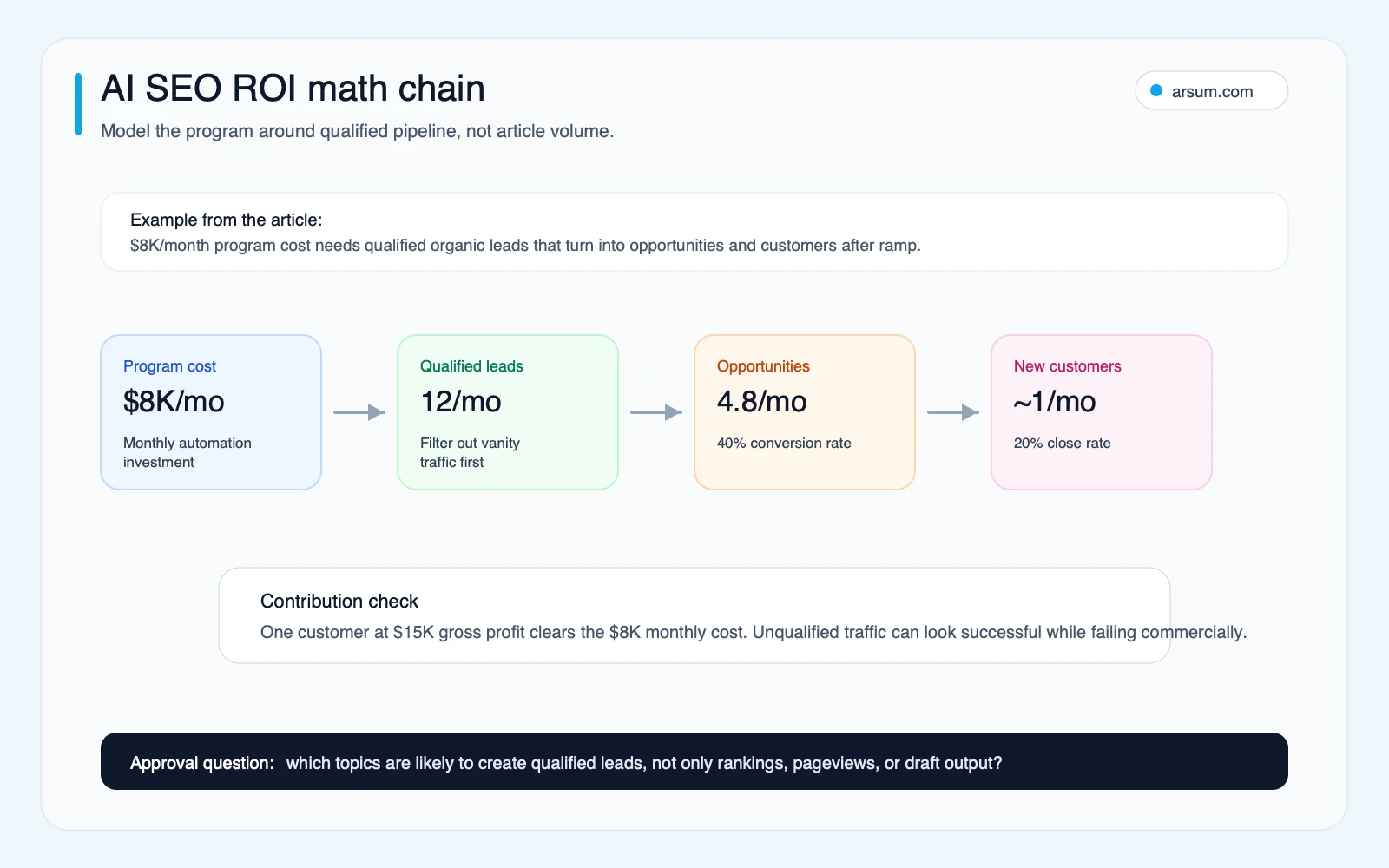
If traffic rises without pipeline, do not automatically scale content. Review the query mix, page intent, CTA, offer clarity, qualification rules, sales follow-up, and attribution window. The page may be attracting readers who are useful for awareness but not ready to buy—or it may be answering the wrong question entirely.
Failure modes to control before scaling
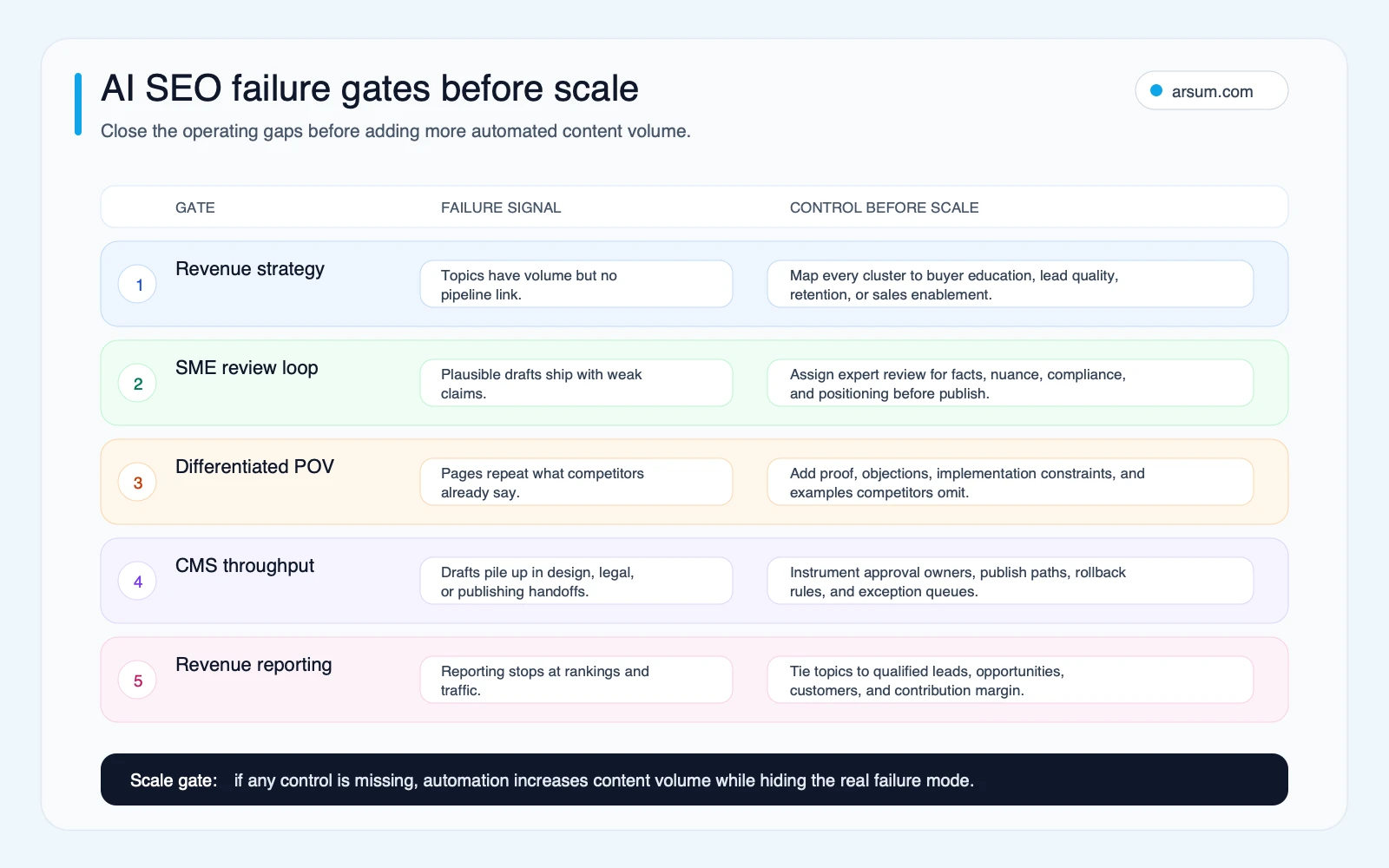
AI SEO fails predictably when teams scale output before controls.
| Failure signal | Likely cause | Control |
|---|---|---|
| More pages, weak indexation | Thin differentiation, template issues, or poor internal linking | Pause volume; audit page quality, crawlability, and linking |
| Traffic rises, qualified demand does not | Informational intent or weak conversion path | Rework topic selection, offer alignment, CTA, and qualification |
| Review queue becomes the bottleneck | Human review was not budgeted | Narrow scope, use structured review criteria, and set exception rules |
| Incorrect or unsupported claims appear | No source lineage or reviewer ownership | Require source capture, named approval, and correction workflow |
| Technical recommendations do not ship | No authorized implementation owner | Put technical ownership and backlog commitments in the SOW |
| Vendor reports activity but no decisions | Metrics are disconnected from commercial outcomes | Define reporting questions and stop/scale thresholds before launch |
Questions to put in the SOW
A useful statement of work does not need to be long, but it should answer these questions plainly:
- What content and technical deliverables are included each period?
- Which outputs require editorial, subject-matter, legal, or technical approval?
- What source and claim-verification standard applies?
- What cannot be published automatically?
- Who has access to the CMS, analytics, Search Console, and reporting?
- What metrics are reported, with definitions for qualified session, lead, opportunity, and assisted conversion?
- Which assumptions make the pilot unsuitable for scaling?
- What is the handoff, exit, and rollback procedure?
This is also the line between a narrow service and a broader implementation engagement. Teams considering deeper automation should understand agentic AI consulting services and the tradeoffs in AI agent architecture patterns before committing to custom orchestration.
The practical buying decision
AI SEO services are worth buying when search demand maps to a real business problem, the workflow has accountable owners, the site can support the work, and the team can measure qualified demand rather than content volume alone.
They are a poor fit when no one can approve content, the company’s offer is unstable, the website has unresolved technical constraints, or conversion measurement is too weak to distinguish attention from commercial value.
Choose a tool when you have operating capacity. Choose a managed service when execution is the constraint. Choose a technical program when the site is part of the problem. Choose a custom workflow only after the manual process, approvals, and measurement rules are stable enough to automate.
If you want to assess a specific proposal or design a bounded pilot, use the scorecard and pilot controls above as the brief: identify the workflow owner, review path, technical backlog, attribution definition, stop condition, and rollback plan before you fund scale.
Ready to Automate Your Business?
Stop wasting time on repetitive tasks. Let AI handle the busywork while you focus on growth.
Schedule a Free Strategy Call →Written by:Arsum editorial team
- Reviewed by
- Arsum editorial team
- Published
- February 14, 2026
- Updated
- July 4, 2026
- How this was produced
- Arsum uses research packs, source checks, and human editorial review to prepare and update blog articles. Editors are responsible for the final page.
- Source policy
- Sources are linked in the article when used. Methodology and source notes are included on higher-risk or high-visibility pages and are being rolled out across the archive. Editorial policy.
- Why this page exists
- Help B2B operators evaluate AI automation, implementation scope, cost, risk, and build-vs-buy decisions with practical context.