
An AI services company is a vendor that takes on AI implementation work most businesses cannot do efficiently in-house: scoping the right use case, building the systems, connecting them to production data, and keeping them running after launch. The difference between a good engagement and a wasted one usually comes down to what happens before you sign.
Quick Answer: The AI services market splits into four vendor types with materially different price points and delivery models: boutique implementation agencies ($15K–$80K per build), enterprise consulting firms ($150K+ per engagement), offshore development shops ($5K–$30K), and model provider enterprise services (custom contracts). Evaluation should cover five criteria: problem diagnosis, data and privacy controls, delivery model, post-launch ownership, and pricing transparency. Anthropic’s published enterprise services structure and NIST’s AI Risk Management Framework both identify long-term support, data governance, and evaluation practices as requirements, not optional extras. Most buyer regret comes from vendors who skipped discovery and scoping before proposing a tool.
The market has grown fast. You can now choose between global consulting firms, boutique implementation agencies, offshore development shops, and model providers like Anthropic and OpenAI that offer their own enterprise services. Each type carries a different delivery model, a different risk profile, and a very different idea of what “done” means.
This guide is a buyer-side decision framework. It covers how to compare vendor types, what separates commodity AI services from genuine implementation work, what red flags to watch for, and which questions to ask before you commit budget or time.
Want to automate this for your business? Let's talk →
Types of AI Services Companies
The vendor landscape splits into four broad categories. Understanding which type you are talking to shapes every part of the evaluation.
| Vendor Type | Best Fit | Typical Pricing | Data Controls | Time to Value |
|---|---|---|---|---|
| Enterprise Consulting (EY, IBM, PwC, Wipfli) | Large regulated transformation | $150K+ engagements | Strong governance layers | Quarters to years |
| Boutique Implementation Agencies | Mid-market automation, defined scope | $15K–$80K build + retainer | Depends on firm; confirm in writing | Weeks to months |
| Offshore Dev Shops | Cost-driven capacity buying | $5K–$30K depending on team size | Variable; often minimal by default | Weeks, but revision cycles add time |
| Model Provider Enterprise Services (OpenAI, Anthropic) | Infrastructure, compliance, data ownership | Custom enterprise contracts | High, with tier-specific controls | Ongoing; not a project deliverable |
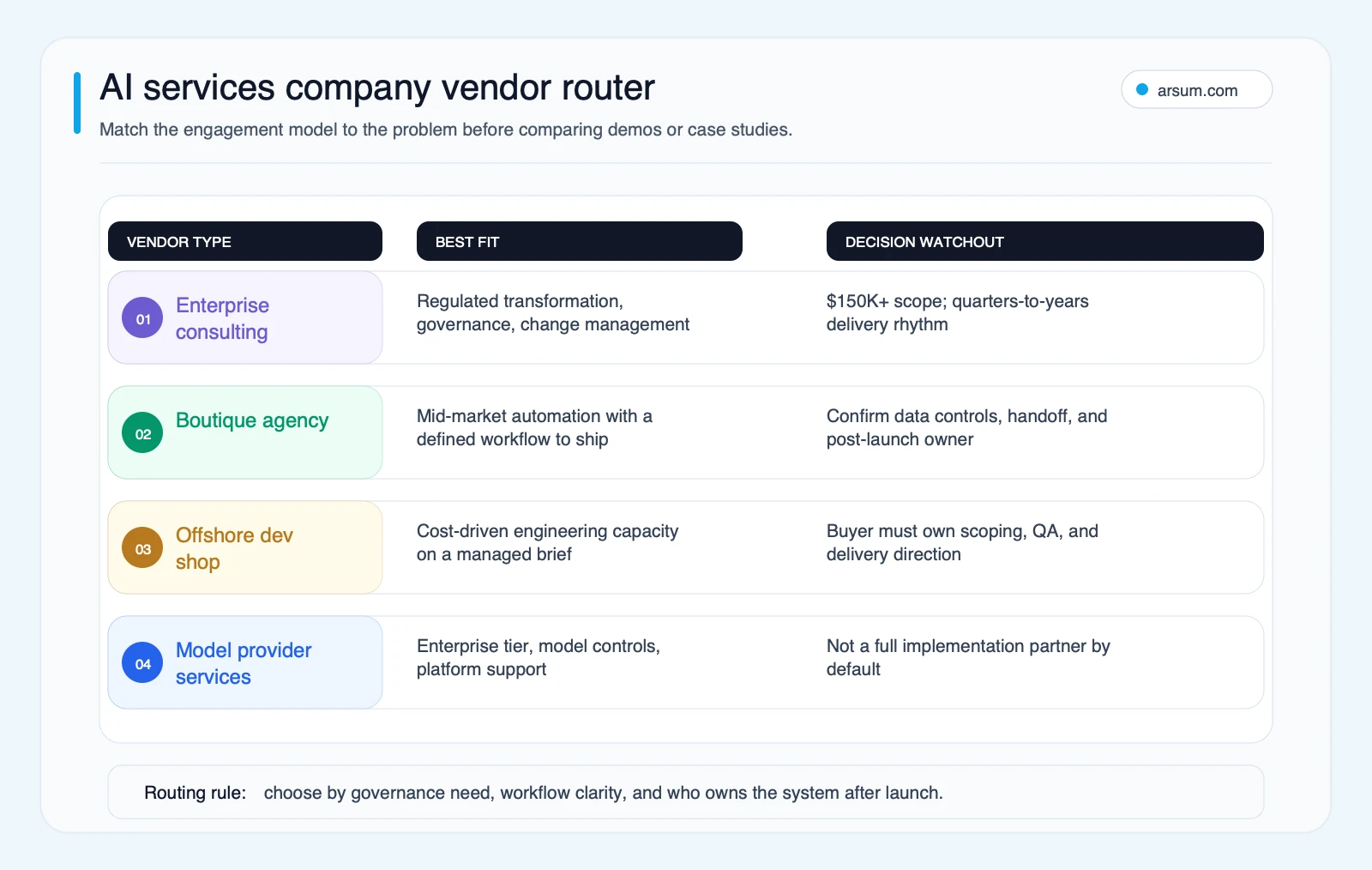
Use this router before comparing demos so the shortlist matches governance needs, workflow clarity, and post-launch ownership.
Enterprise Consulting Firms
EY, IBM, PwC, and Wipfli have built AI practices on top of existing transformation and technology consulting capabilities. They are well-suited to large regulated projects where governance, compliance, and change management matter as much as the technical build. Their pricing reflects this: engagements typically start in the six-figure range, and they often embed staffing into delivery rather than shipping a discrete system.
Boutique Implementation Agencies
Boutique agencies like Arsum operate at the intersection of strategy and delivery. The pitch is practical: scope the automation problem, build a working system, and hand it off with documentation. These firms are better matched to mid-market buyers who need something shipped in weeks rather than quarters, and who want a named team rather than a rotating cast of consultants. See how AI automation agency services are structured for a breakdown of what this model typically includes, and review AI implementation services for what a real pilot-to-production handoff should cover.
Offshore Development Shops
A large part of the market is staffing-driven: teams in Eastern Europe, South Asia, or Southeast Asia offering AI development at lower hourly rates. Quality varies widely. The core risk is buying raw engineering capacity rather than domain expertise on what should actually be automated and how. These engagements require more active management from the buyer to stay on scope. Buyers comparing this model with a scoped build partner should also look at what AI development services actually include before assuming lower hourly rates mean lower total cost.
Model Provider Enterprise Services
Anthropic has explicitly described an “AI services company” structure that includes partner-network systems integrators and long-term support for custom solutions. OpenAI similarly separates its Business and Enterprise tiers, with materially different admin controls, privacy settings, and support levels by tier. These are not implementation services in the traditional sense, but they are part of the buyer conversation because the underlying model terms have direct implications for data ownership, training opt-outs, and compliance obligations.
What Most Guides Miss About AI Services Companies
The exact-query SERP for “ai services company” is still messy. Buyers regularly land on definition pages, model-provider homepages, or broad directories before they ever see a practical framework for comparing delivery models. That creates three blind spots.
- Definition pages do not help you shortlist vendors. They explain AI, but they do not tell you who should own delivery, how to structure discovery, or what a safe handoff looks like.
- Directories flatten very different firms into the same list. A global consultancy, a boutique implementation partner, and a capacity-driven dev shop can all appear side by side even though they solve different buyer problems.
- The real buying question is usually misframed. Many teams think they are choosing an AI vendor when they are actually deciding between strategy, implementation, and internal process cleanup first.
That is why the rest of this guide focuses on buyer language: what to ask, what to compare, and what evidence to demand before a contract is signed.
What Practitioners Keep Warning Buyers About
A pattern shows up across operator commentary even when the industries differ: buyers usually do not regret an AI vendor because the demo looked bad. They regret the things that were vague before signature.
- Opaque pricing hides the real commitment. Seat minimums, usage credits, model pass-through fees, and change-order language often matter more than the headline number on the site.
- Demo-first sales creates scope drift. When a vendor shows the bot before mapping workflow, escalation rules, and support ownership, the buyer often ends up funding discovery after the contract starts.
- Weak handoff terms create quiet lock-in. A system you cannot inspect, test, or roll back is still vendor dependence even if the contract says the build is custom.
Treat those patterns as qualitative buyer signal, not market-wide statistics. They are still useful because they point to the questions that deserve written answers before procurement moves forward.
Commodity vs Non-Commodity: What You Are Actually Buying
Most of what is marketed as AI services is commodity work: template chatbots, off-the-shelf automation wrappers, and prompt engineering layered on top of a public API with minimal customization. These products are easy to ship and easy to undercharge for. They are also easy to miss entirely when the workflow they were meant to support does not match the generic template.
Non-commodity AI services look different across five dimensions:
| Factor | Commodity Service | Non-Commodity Service |
|---|---|---|
| Scoping | Demo-first, requirements gathered after sale | Discovery before any build proposal |
| Workflow fit | Generic template adapted to the use case | Custom system designed around your specific workflow, data structure, and ownership model |
| Ownership | Vendor retains prompts, evals, and system config | Full transfer of repo, prompt configs, evaluation framework, and documentation |
| Success definition | “We shipped it” | Agreed outcome metrics at 30, 60, and 90 days with a remediation clause |
| Post-launch | Billable support or no defined support | Named SLA with a rollback plan and defined escalation path |
The distinction matters because commodity services price for volume and non-commodity services price for outcome accountability. You cannot tell the difference from a sales deck, which is why the scorecard in the next section exists.
What to Actually Compare: 5-Part Vendor Scorecard
Most buyers shortlist on case studies and pricing. Both are reasonable inputs, but neither tells you what you need to know before signing. Score each vendor 1 to 5 on each criterion, and require written evidence for any score above 3.
| Criterion | What to Ask | Evidence to Request |
|---|---|---|
| Problem diagnosis | Do they scope before they demo? Do they ask about workflow, data readiness, and ownership before proposing a tool? | Discovery questionnaire, process map, or written brief from their scoping phase |
| Data and privacy controls | Where do prompts and outputs go? Are they used to train foundation models? What happens to your data if the engagement ends? | Data processing agreement, model provider tier documentation, opt-out confirmation |
| Delivery model | Who builds it? What stack? Is the build template-driven or custom to your workflow? | Code samples, repo access policy, tech stack documentation |
| Post-launch ownership | Will you have access to the repo, prompt configs, evals, and fine-tuned assets? Who maintains it after handoff? | Written handoff checklist, SLA for post-launch support, documentation standards |
| Pricing transparency | Is pricing available before the first call? Are there hidden credits, model costs, or annual minimum commitments not visible on the surface? | Written proposal with itemized costs, model cost pass-through policy, contract redline |
Original Data Snapshot: Score Two Proposals Side by Side
A reusable scorecard works better when you force yourself to score two real proposals against the same rubric. Start with these weights and require written evidence for every score.
| Criterion | Weight | Boutique Implementation Proposal | Enterprise Consultancy Proposal | What moves the score |
|---|---|---|---|---|
| Problem diagnosis | 30% | 5/5 | 3/5 | Did the vendor map workflow, data readiness, ownership, and escalation rules before proposing tools? |
| Data and privacy controls | 25% | 3/5 | 5/5 | Are processing location, training policy, deletion terms, and access controls documented in writing? |
| Delivery model | 20% | 4/5 | 3/5 | Is the build tailored to your workflow, or mostly a template with light customization? |
| Post-launch ownership | 15% | 5/5 | 3/5 | Do you receive repo access, prompts, evals, and a defined handoff plan? |
| Pricing transparency | 10% | 4/5 | 2/5 | Can the vendor provide a written pricing range and explain what changes the cost? |
| Weighted total | 100% | 4.2 / 5 | 3.5 / 5 | Score only from documented evidence, not demo quality. |
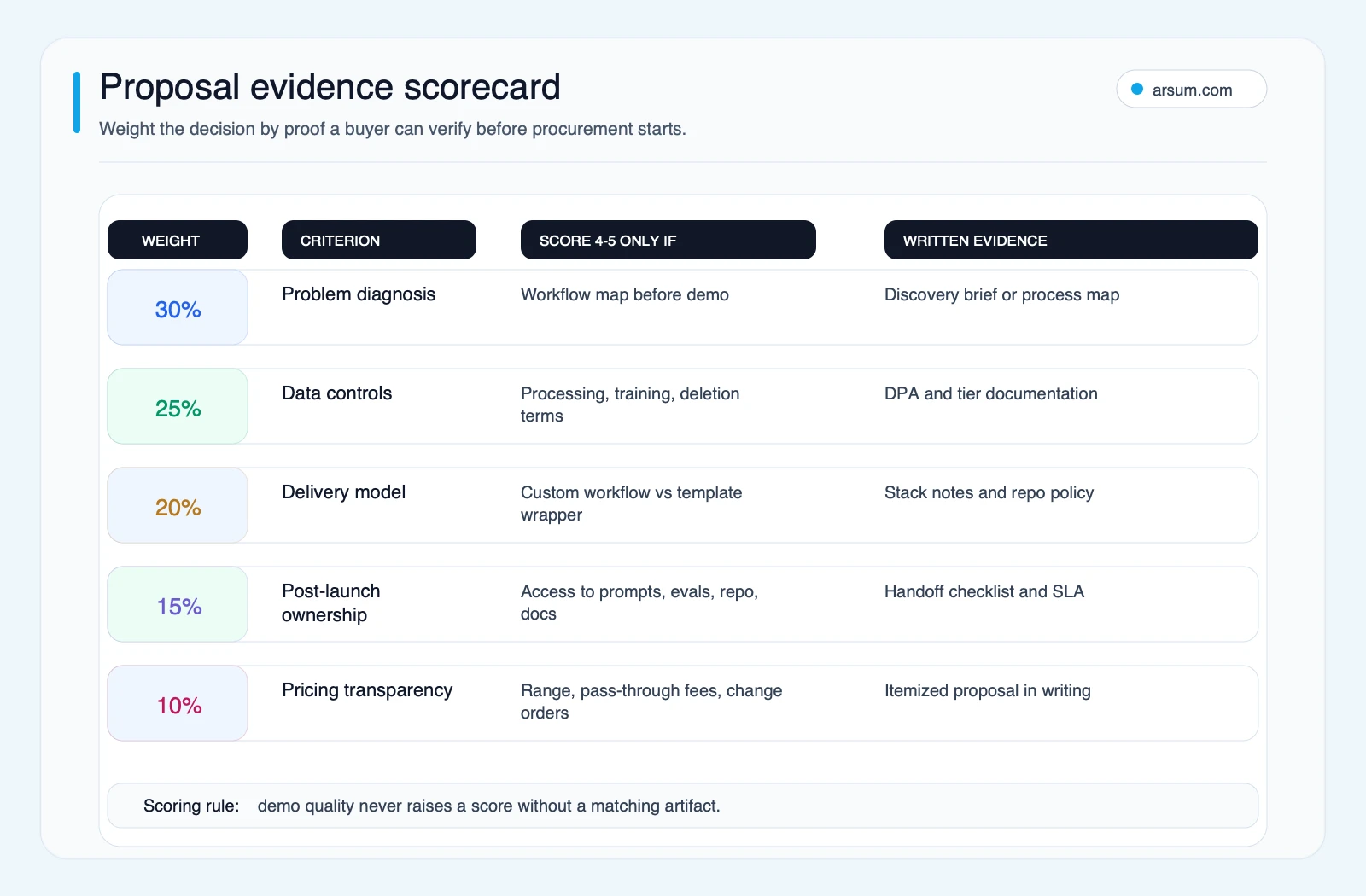
Score high only when the vendor can produce written evidence. Demo quality should not substitute for discovery, data, delivery, ownership, or pricing artifacts.
The Proof Package to Request Before Procurement
Before you score a vendor above 3 out of 5 on any criterion, ask for this artifact bundle in writing:
- A discovery brief or workflow map showing the current process, failure points, and escalation rules.
- Data and privacy terms that name processing location, training policy, deletion process, and access controls.
- A repo and handoff policy covering code access, prompt configs, evals, and rollback rights.
- A support plan for the first 90 days with SLA terms, named ownership, and issue routing.
- An itemized proposal that separates build cost, model pass-through fees, change-order rules, and ongoing support.
This is not market-wide benchmark data. It is a buyer-side scoring model that makes hidden tradeoffs visible before procurement turns into guesswork. If a vendor resists written evidence for a high score, mark the criterion down and keep moving.
Microsoft Azure’s documentation states that Azure Direct Model prompts and outputs “are not available to other customers or model providers and are not used to train foundation models without permission.” That privacy guarantee is tier-specific. Buyers using vendors who deploy on shared infrastructure or consumer-grade API access do not receive the same protections by default.
💡 Arsum builds custom AI automation solutions tailored to your business needs.
Get a Free Consultation →Decision Tree: Which Vendor Type Is Right for You?
Before evaluating vendors, route the project to the right type. This prevents wasting cycles on firms whose model does not match the problem.
Start here: Is the problem well-defined?
- Yes, with documented workflow and accessible data: Boutique implementation agency or offshore dev shop, depending on complexity and budget.
- No, needs diagnosis, change management, or governance infrastructure: Enterprise consulting firm.
- Unclear: The real bottleneck is probably process or data ownership, not AI capability. Fix that first before hiring any external vendor.
Does the project involve regulated data or enterprise-wide systems?
- Yes: Enterprise consulting firm with a documented compliance practice.
- No: Boutique agency is likely a faster and more cost-efficient fit.
Do you need to control where your data is processed and whether it is used for model training?
- Yes: Confirm the model tier in writing before any vendor work begins. OpenAI states its business offerings provide “ownership and control over business data” and support compliance needs, but this applies to specific subscription tiers, not all access modes.
- Not sure: Treat this as a mandatory pre-qualification question, not an afterthought.
NIST’s AI Risk Management Framework explicitly identifies evaluation, testing, and ongoing monitoring as core requirements for any AI deployment. The framework’s generative AI profile extends this to output quality and data governance. Buyers who do not contractually enforce these standards typically own the gap themselves.
Red Flags Before You Sign
Certain patterns in a sales process consistently predict difficult engagements.
Pricing hidden behind “book a call.” Vendors who refuse to provide any pricing signal before a discovery call are protecting a number that would disqualify them early. It wastes time and signals they are optimizing for pipeline volume rather than fit. Ask for a written estimate range before the first meeting.
Demo-first discovery. If a vendor leads with a polished product demo rather than questions about your workflow, they are selling a preset solution. AI implementations shaped by generic templates rather than your specific operations tend to require expensive rework after launch. Good vendors ask about data ownership, escalation rules, and support handoffs before they show anything.
No handoff documentation plan. Launching an AI system is the beginning of a maintenance cycle, not the end of the engagement. Vendors who cannot describe what they will hand off, what your team needs to maintain the system, and what the escalation path looks like after go-live are implicitly asking you to own that maintenance from day one without a plan.
Vague success metrics. “We will improve efficiency” is not a project outcome. Ask for a specific definition of success at 30, 60, and 90 days, and what the vendor does if those benchmarks are not met. This exposes whether they have shipped this type of project before.
Technical debt by default. AI systems built as opaque agent harnesses or generated code that no one on your team can inspect, test, or safely change become liabilities quickly. If you cannot safely modify or roll back the system without the original vendor, you have vendor lock-in by design.
Operator Note: The most painful AI engagements in the mid-market share one trait: the vendor jumped to tool selection before documenting the workflow, escalation rules, and ownership handoffs. The firms that cause the least post-launch friction are the ones who produce a written system map, a clear test plan, and a post-launch support SLA before any code is shipped. Ask for all three in writing before signing anything.
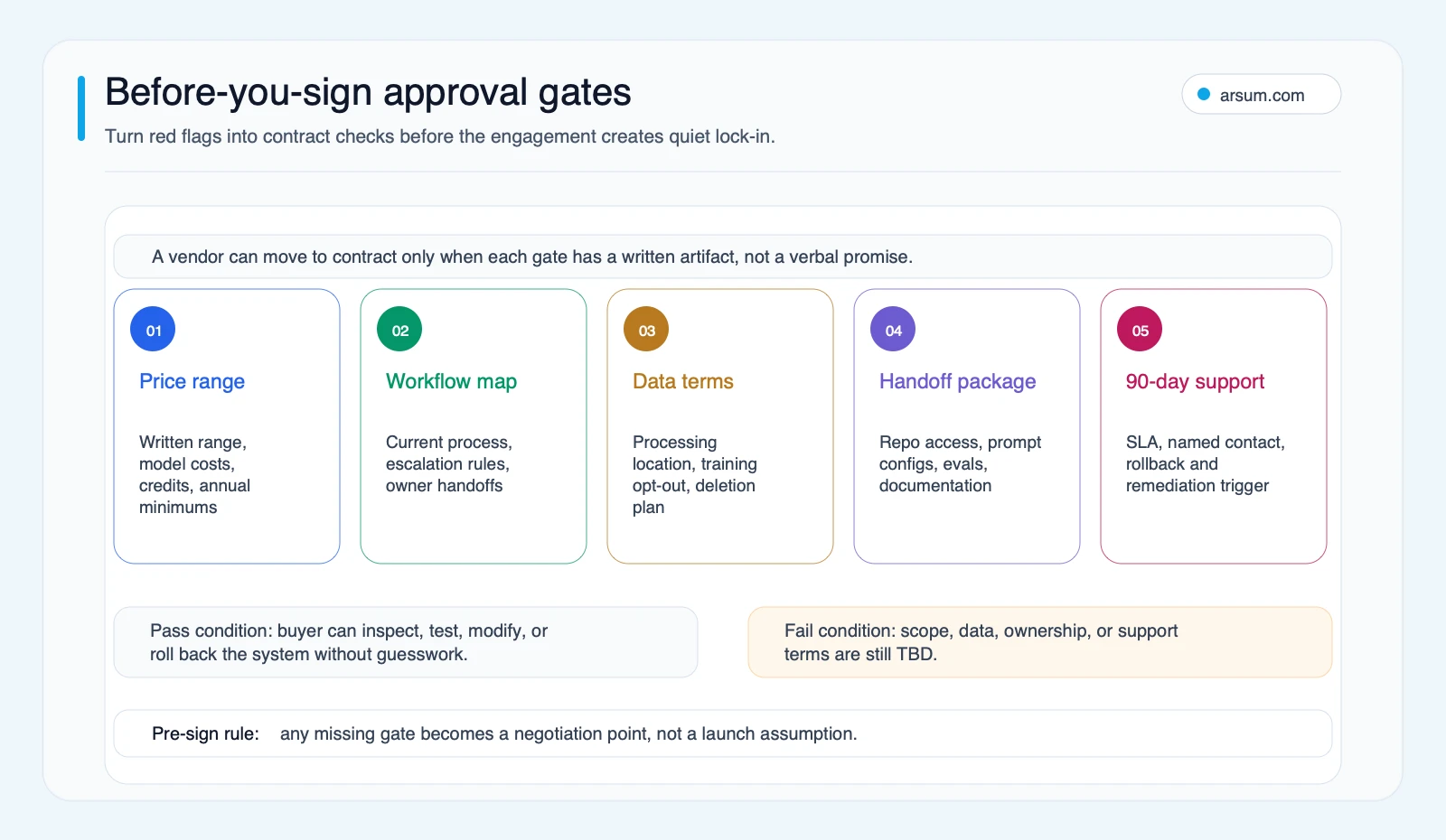
Treat missing gates as negotiation points. A contract should not start while scope, data, ownership, or support terms are still implied.
The “Before You Sign” Checklist
Use this as a pre-contract checklist. Any “no” or “TBD” is a negotiation point, not a sign-off.
Data and privacy
- Written confirmation of where prompts and outputs are processed
- Confirmation that your data is not used to train any foundation model
- Data processing agreement or DPA attached to the contract
- Defined procedure for data deletion at engagement end
Ownership and delivery
- You will receive access to the code repository and all prompt configurations
- Evaluation framework and any fine-tuned assets are transferred, not retained by the vendor
- Written handoff checklist included in the contract scope
Post-launch support
- Defined support SLA for the first 90 days after launch
- Named point of contact for post-launch questions and issues
- Documented rollback plan if the system performs below the agreed threshold
Success definition
- Specific metrics agreed at 30, 60, and 90 days
- Defined remediation clause if benchmarks are not met
- Budget scope for changes discovered during implementation that exceed the original brief
Work With Arsum
We help businesses implement AI automation that actually works. Custom solutions, not cookie-cutter templates.
Learn more →Before and After: What Discovery Quality Changes
The clearest predictor of a successful AI engagement is how much diagnostic work happens before any build proposal is written. Here is a concrete comparison showing what the same project looks like with and without that investment.
The scenario: A mid-market professional services firm wants to automate client intake and initial contract review. They approach two vendors with identical briefs.
Vendor A (commodity pattern):
- Week 1: Demo of a pre-built intake chatbot. Looks polished in the demo environment.
- Week 2: Proposal sent. Scope defined as “AI intake system,” pricing fixed.
- Week 6: System delivered. Does not account for the firm’s multi-step intake workflow, escalation triggers, or existing CRM field structure. Requires manual workarounds to use.
- Week 10: Rework begins. Original budget is 40 percent exceeded. Vendor bills hourly for changes.
Vendor B (non-commodity pattern):
- Week 1: Discovery session. Vendor maps the existing intake workflow end-to-end, identifies three escalation scenarios, documents the CRM field structure, confirms data residency requirements, and agrees on a test dataset.
- Week 2: Scoped proposal with explicit success criteria: intake processing time reduced from four hours to under 30 minutes by end of week eight; full repo access at delivery; 90-day post-launch SLA with a named contact.
- Week 6: System delivered. Matches the documented workflow. First live run processes intake without manual escalation.
- Week 10: Retainer discussion begins for the contract review phase.
The difference is not technology. Vendor B did not use a better AI model. The difference is the diagnostic work done before the first line of code was written. Every line in the pre-contract checklist above maps to a gap that Vendor A left open in week one.
Engagement Models and Pricing
AI services pricing generally follows one of three structures.
Fixed-scope project: A defined deliverable for a fixed fee. Works well when the problem is well-understood and requirements are stable. Carries risk if discovery reveals more complexity than the brief assumed.
Retainer: Ongoing monthly access to a team for iterative builds, monitoring, and expansion. Better suited to buyers who expect to grow AI usage over time rather than shipping a single system.
Time-and-materials: Hourly or daily billing against a scoped estimate. Common with development shops; requires active management from the buyer to avoid scope creep.
Most boutique implementations for mid-market automation use cases land between $15,000 and $80,000 for an initial build, with ongoing retainers in the $3,000 to $10,000 per month range depending on complexity. Enterprise consulting engagements start higher and are scoped to longer timelines.
For a more detailed breakdown of what these engagement structures typically include, see AI automation agency pricing and how to evaluate AI consulting firms.
When Arsum Is the Right Fit
Arsum is a practical choice when the problem is clear, the data is accessible, and the priority is shipping something that works rather than producing a strategy document.
The right engagement looks like: a defined workflow consuming too much manual time, a buyer who wants a working system with full code ownership, and a timeline measured in weeks rather than quarters. Arsum is not the right fit for large-scale regulated transformation work that requires a dedicated change management practice or enterprise-wide governance infrastructure.
If that description matches where you are, the direct next step is a conversation about the specific use case before any proposal is written. See AI consulting services: what to expect from an engagement for a more detailed breakdown of the engagement process.
Google Risk Box: The AI services vendor market has a significant volume of thin, template-driven implementations marketed as custom AI development. If you are evaluating a vendor who cannot provide a discovery framework, a documented workflow map, and a written post-launch support SLA before you sign, you are likely looking at a commodity wrapper rather than a genuine implementation engagement. This risk applies whether you are hiring a large firm or a boutique agency. The vendor type label does not determine quality; the pre-contract process does.
Freshness Note: Vendor pages, pricing tiers, and policy documents referenced here were rechecked against the cited sources in June 2026. Service packaging, training-policy language, and support terms change quickly, so ask each vendor to confirm the current version in writing before you rely on any comparison.
Methodology: This article draws on primary-source material from NIST, OpenAI, Microsoft Azure, and Anthropic for risk, privacy, and vendor-type guidance. Market context came from buyer-facing SERP sampling across directories, provider pages, and consultancy pages, plus qualitative operator commentary about pricing opacity, discovery quality, and ownership gaps. Primary-source claims were rechecked in June 2026, while practitioner commentary is treated as directional signal rather than statistical proof.
Frequently Asked Questions
How do I choose an AI consulting company?
Start with vendor type: enterprise consulting firms, boutique agencies, offshore dev shops, and model provider services are solving different problems at different price points. Match the vendor type to the project scope and your tolerance for management overhead. Then run the five-part scorecard on any shortlisted firm: problem diagnosis, data controls, delivery model, post-launch ownership, and pricing transparency.
What should I ask before hiring an AI consultant?
At minimum: Where is our data processed and is it used for model training? Who owns the code, prompts, and evals after delivery? What does the post-launch support SLA look like? What are the success metrics at 30, 60, and 90 days? Can you provide a written cost estimate before the first proposal?
Are boutique AI firms better than large consultancies?
Neither is universally better. Enterprise consulting firms carry more governance infrastructure, compliance experience, and change management capacity, which is essential for regulated or enterprise-wide projects. Boutique implementation agencies tend to be faster, more cost-efficient, and more directly involved at the execution level, which is a better fit for mid-market automation work with defined scope.
What red flags should buyers watch for?
Pricing that requires a call before any range is disclosed. Vendors who lead with demos rather than discovery questions. No defined handoff or documentation plan. Vague success metrics that cannot be measured at a defined date. Systems delivered as opaque builds that your team cannot safely inspect or modify.
What is the difference between an AI consulting firm and an AI implementation partner?
Consulting firms typically focus on strategy, diagnosis, and roadmapping, often recommending what to build and who should build it. Implementation partners take on the actual build. Some firms do both; most do one better than the other. Ask explicitly which phase the vendor specializes in, and whether they have references from clients who shipped and maintained a system rather than only received a strategy document.
What does post-launch support look like for AI systems?
AI systems require ongoing adjustment: retrieval configurations drift, prompt performance degrades with model updates, and business rules change. A vendor with no defined post-launch support model is leaving you to own that maintenance from day one. The minimum acceptable handoff includes access to the repo and configs, a documented test plan, a named support contact, and a defined SLA for the first 90 days.
How do I evaluate AI vendor pricing before a discovery call?
Ask for a written range in a pre-meeting email, referencing the specific use case and rough scope. Most credible vendors will provide a ballpark. If they cannot give any range before a call, treat it as a signal that pricing is deliberately opaque. Published breakdowns of AI automation agency pricing models can help calibrate what you should expect to pay for specific scopes.
Ready to Automate Your Business?
Stop wasting time on repetitive tasks. Let AI handle the busywork while you focus on growth.
Schedule a Free Strategy Call →