
When a business starts looking for an AI services provider, the first obstacle is the market itself. The term covers everyone from a two-person automation shop to a global consultancy with a dedicated AI practice. A vendor list tells you who exists. It does not tell you which type of provider fits your specific workflow, your integration environment, or your tolerance for delivery risk.
This guide gives you a decision framework instead of a directory. It maps the vendor landscape, explains the criteria that actually separate credible proposals from expensive slide decks, and gives you the questions to ask before you commit budget to a project.
Quick Answer: AI Services Provider
An AI services provider is any firm that designs, builds, or operates AI-powered systems on behalf of a business client. Four vendor types dominate the market: enterprise consultancies (EY, Accenture, IBM), boutique implementation partners, software vendors with services arms, and independent consultants. For most mid-market automation projects, a boutique partner engages in 1-3 weeks versus the 4-12 week enterprise sales cycle, and a credible initial build costs $40,000-$150,000 depending on integration complexity and post-launch ownership scope. Anthropic’s guidance on building effective agents recommends finding the simplest solution possible, meaning a credible provider should sometimes recommend a configurable SaaS tool rather than a custom agentic build. NIST’s AI Risk Management Framework defines seven trustworthiness properties (valid, safe, secure, explainable, privacy-enhanced, fair, and accountable) that buyers in regulated industries should use as a governance baseline when evaluating proposals.
Social Listening: What Buyers Keep Complaining About
The buyer-side frustration in this category is remarkably consistent. Operators describe being pitched by AI consultants who can repeat the language of automation but cannot explain integration constraints, approval design, or what happens when a workflow fails. The sharper criticism is not that AI consulting is fake. It is that too many firms sell certainty before they have looked at the real systems.
Three signals came up repeatedly in the source set behind this guide:
- Buyers want proof of shipped work, not broad “AI transformation” positioning.
- Technical teams distrust vendors who cannot explain monitoring, rollback paths, or post-launch ownership.
- The fastest way to lose credibility is to recommend a complex agentic build when a simpler software workflow would do the job.
That is why the evaluation framework in this article starts with workflow clarity and delivery mechanics instead of vendor prestige.
Want to automate this for your business? Let's talk →
What an AI Services Provider Actually Is
An AI services provider is any firm that designs, builds, or operates AI-powered systems on behalf of a business client. The category includes workflow automation, agent systems, model fine-tuning, integration work, and ongoing managed services. It is not a single job description.
The core job is moving an AI capability from concept to production in a way the client can maintain, measure, and trust. Anthropic’s guidance on building effective agents recommends finding the simplest solution possible and distinguishes predictable, rule-based workflows from more flexible agentic systems. That distinction matters: a provider that defaults to complex agent architecture when a structured workflow would deliver the same outcome is optimizing for project scope, not business results.
A provider that cannot describe what happens after go-live is not offering a service. It is offering a prototype.
Types of Vendors in the Market
Four vendor types dominate the market, and each fits a different buyer profile.
| Vendor Type | Best Fit | Speed to Engage | Governance Depth | Customization | Post-Launch Ownership |
|---|---|---|---|---|---|
| Enterprise consultancy (EY, Accenture, IBM, McKinsey) | Regulated industries, multi-year transformation | Slow: 4-12 week sales cycle | Strong | Moderate | Variable by contract |
| Boutique implementation partner | Mid-market, specific workflow or stack | Fast: 1-3 weeks | Varies | High | Depends on firm |
| Software vendor with services (Microsoft, Salesforce, ServiceNow) | Existing platform users | Moderate | Platform-native | Limited to platform | Platform SLA |
| Independent consultant or fractional AI lead | Strategic direction, technical oversight | Fast | Advisory only | Advisory only | Minimal post-project |
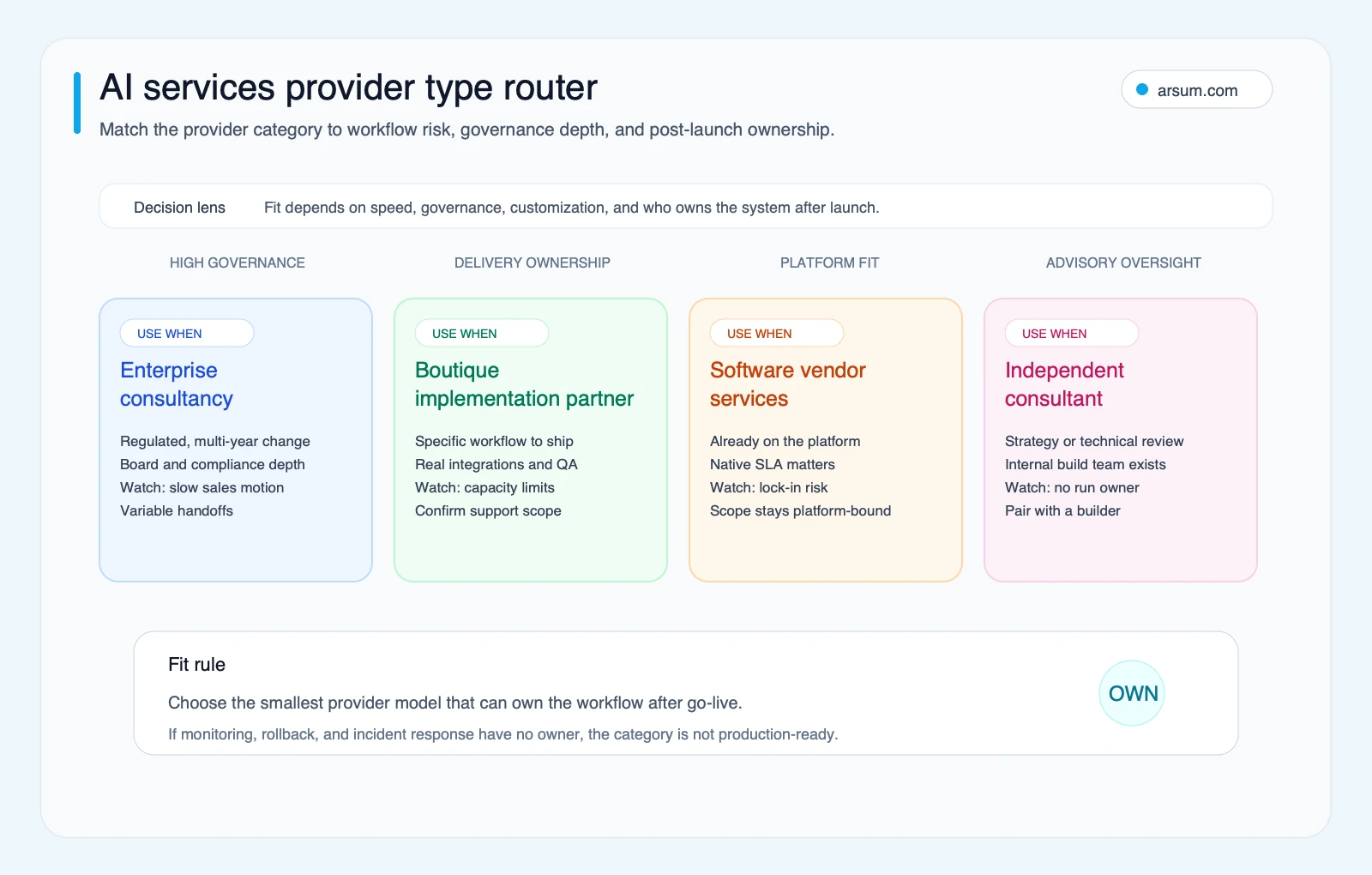
Use the router to match the provider category to workflow risk, governance depth, and who owns the system after launch.
Enterprise Consultancies
Firms like EY, Accenture, IBM, and McKinsey have large AI practices built on transformation engagements. They bring governance frameworks, industry coverage, and the ability to manage complex stakeholder landscapes. The tradeoffs are real: long discovery cycles, high overhead costs, and delivery teams that change between the pitch and the project.
These firms are a strong fit when the client needs executive credibility, regulatory alignment, or multi-year roadmap support. They are a poor fit when the client needs a working integration in 90 days.
Boutique Implementation Partners
Boutique firms specialize in a narrower stack: AI automation, agent development, workflow orchestration, or a specific industry vertical. They are faster to engage, more accountable at the delivery level, and often more technically current on the tools that matter for mid-market builds.
The risk is capacity and continuity. A small firm that is fully booked cannot absorb scope changes. Buyers should verify bench depth, past project volume, and how the firm handles post-launch support before signing.
For a deeper look at what this engagement model delivers in practice, see AI automation agency services.
Software Vendors with Services Arms
Platform companies like Microsoft, Salesforce, and ServiceNow offer AI features built into their products and sell services to configure or extend them. The integration story is simpler when the client already runs on that platform. The risk is vendor lock-in and a services team that is incentivized to upsell product seats rather than solve the underlying business problem.
Independent Consultants and Fractional AI Leads
Solo practitioners and fractional operators fill a gap for buyers who need strategic guidance, project oversight, or a technical reviewer without committing to a full engagement. They work best when internal capacity exists but direction or accountability is missing.
The risk is delivery scope. An independent consultant can design a system and specify the work. They typically cannot build it, manage it, and own it post-launch without a separate build partner in place.
Commodity vs. Non-Commodity: What You Are Actually Buying
Commodity AI services cover chatbots, out-of-the-box retrieval-augmented generation wrappers, pre-built classification models, and basic workflow automation using configurable SaaS tools. These are available from dozens of vendors, carry low switching costs, and are competitive on price. If a vendor quotes you $25,000 for something you could configure yourself with a $300 per month subscription, you are buying a commodity at a non-commodity price.
Non-commodity AI services involve custom agentic systems, proprietary workflow orchestration, multi-step integrations with systems of record, domain-specific fine-tuning, approval and oversight design, and post-launch ownership of production AI. These cannot be sourced from a template. The provider’s judgment, engineering depth, and operational experience are the product.
Buyers who conflate the two categories end up overpaying for commodity work or under-buying when they actually need the non-commodity version. The question to ask in every vendor conversation is: what part of this would not work if we used a standard tool? If the answer is nothing, you are buying commodity services.
See AI consulting services for a broader overview of how the engagement model maps to different problem types.
Quick Screen: Commodity or Truly Custom?
Use this table before you accept a custom-build price. It forces the provider to separate tool configuration from work that actually depends on engineering judgment and operational ownership.
| If the proposal mainly includes | Treat it as | What a strong provider should prove |
|---|---|---|
| Prompt wrappers, internal chat, simple knowledge-base retrieval, or no-code workflow steps | Commodity service | Why an off-the-shelf tool cannot do the job faster and cheaper |
| Basic content drafting or summarization with no write-back into core systems | Commodity service | What quality gate, approval step, or system dependency makes this more than light automation |
| CRM, ERP, ticketing, finance, or support integrations with write-backs and approval logic | Non-commodity implementation | How auth, schema changes, rollback, and exception handling are designed |
| Customer-facing or compliance-sensitive workflows with audit requirements | Non-commodity implementation | How data is segmented, reviewed, logged, and escalated when confidence drops |
| Always-on operations with monitoring, drift handling, and incident ownership | Non-commodity managed service | Who owns the alerts, fixes regressions, and keeps the workflow healthy after launch |
If a provider cannot clearly point to the right-hand column, you are probably looking at a commodity offer packaged with enterprise language.
What Most Guides Miss About AI Service Providers
Most comparison pages stop at vendor categories and pricing ranges. The practical buying risk sits one layer deeper.
- Post-launch ownership is part of the product. A proposal is incomplete until you know who watches the workflow after go-live, who handles model or API drift, and how incidents are escalated.
- Auditability matters more than AI fluency in sensitive workflows. If the provider cannot explain where data flows, what gets logged, and how a human reviews uncertain outputs, the project is not ready for regulated or customer-facing use.
- The best providers sometimes recommend less AI, not more. Anthropic’s guidance on effective agents reinforces a simple rule buyers should expect to hear in discovery: use the lightest workflow that reliably solves the problem before you pay for a more autonomous build.
This is where buyer confidence usually breaks down. A polished pitch can describe an AI roadmap. A credible provider can explain the fallback path when the workflow misfires on Tuesday afternoon with real data in the loop.
Build vs. Buy vs. Partner: A Routing Framework
Not every AI problem needs an external provider. The right approach depends on four variables: workflow clarity, integration complexity, governance burden, and internal capacity.
| Route | Use when | Typical cost signal |
|---|---|---|
| Software-first (configurable tool) | Workflow is simple, data is clean, internal team can configure | $100-$1,500/mo SaaS |
| Internal ops or engineering team | Problem is core, team has AI/ML experience, internal ownership makes strategic sense | Internal salary cost |
| Fixed-scope consultant | Problem is clear but team lacks experience to evaluate options or spec the work | $10K-$40K scoping engagement |
| Implementation partner | Complex integrations, real governance requirements, post-launch ownership non-negotiable | $40K-$200K+ depending on scope |
Software-first: The workflow is simple and repeatable. Data is clean and accessible. Internal engineering time is available. An off-the-shelf tool solves the problem at a fraction of the cost of a custom build.
Internal ops or engineering team: The workflow is well-understood, the team has AI or ML experience, and the problem is core enough to justify internal ownership. An external provider adds overhead without strategic return.
Fixed-scope consultant: The problem is clear but the team lacks the experience to evaluate options or specify the work. A consultant scopes the design and hands off to internal engineering or a build partner.
Implementation partner: The workflow is complex, integrations are proprietary or high-stakes, governance requirements are real, and post-launch ownership is non-negotiable. This is where a boutique implementation partner adds value that a software vendor or independent consultant cannot. Buyers who need to see what that delivery path looks like in practice should review AI implementation services.
The mistake most buyers make is hiring for execution before the problem is scoped, or hiring for strategy from a firm that cannot execute. Both errors are more expensive than the engagement itself.
Original Data: Buyer Routing Snapshot
To make the build-vs-buy decision less hand-wavy, we turned the research behind this article into a simple buyer-side scoring model. Rate each line from 0 to 2 based on your current project, then total the points before you choose the route.
| Buyer signal | 0 points | 1 point | 2 points |
|---|---|---|---|
| Workflow clarity | One team, simple rules, low exception volume | Some branching logic or manual review | Cross-team workflow with frequent edge cases |
| Integration complexity | One tool, no write-backs | Two to three systems, limited write actions | Multiple systems of record, approvals, or bi-directional sync |
| Governance burden | Low-risk internal use | Some customer or finance exposure | Compliance, audit, or customer-facing risk |
| Internal bandwidth | Team can configure and own it | Team can own it with outside guidance | No clear internal owner after pilot |
| Post-launch ownership need | Ad hoc tuning is acceptable | Monthly optimization is enough | Always-on monitoring and incident handling are required |
How to read the score:
- 0 to 3 points: start software-first and avoid custom delivery until the workflow proves itself.
- 4 to 6 points: use an internal team or fixed-scope consultant to tighten scope before you buy a larger engagement.
- 7 to 10 points: an implementation partner is usually the safer route because the risk is no longer just build effort. It is integration, governance, and operating discipline.
This is not market survey data. It is an original decision aid built from the failure patterns, buyer objections, and governance requirements surfaced in the underlying research.
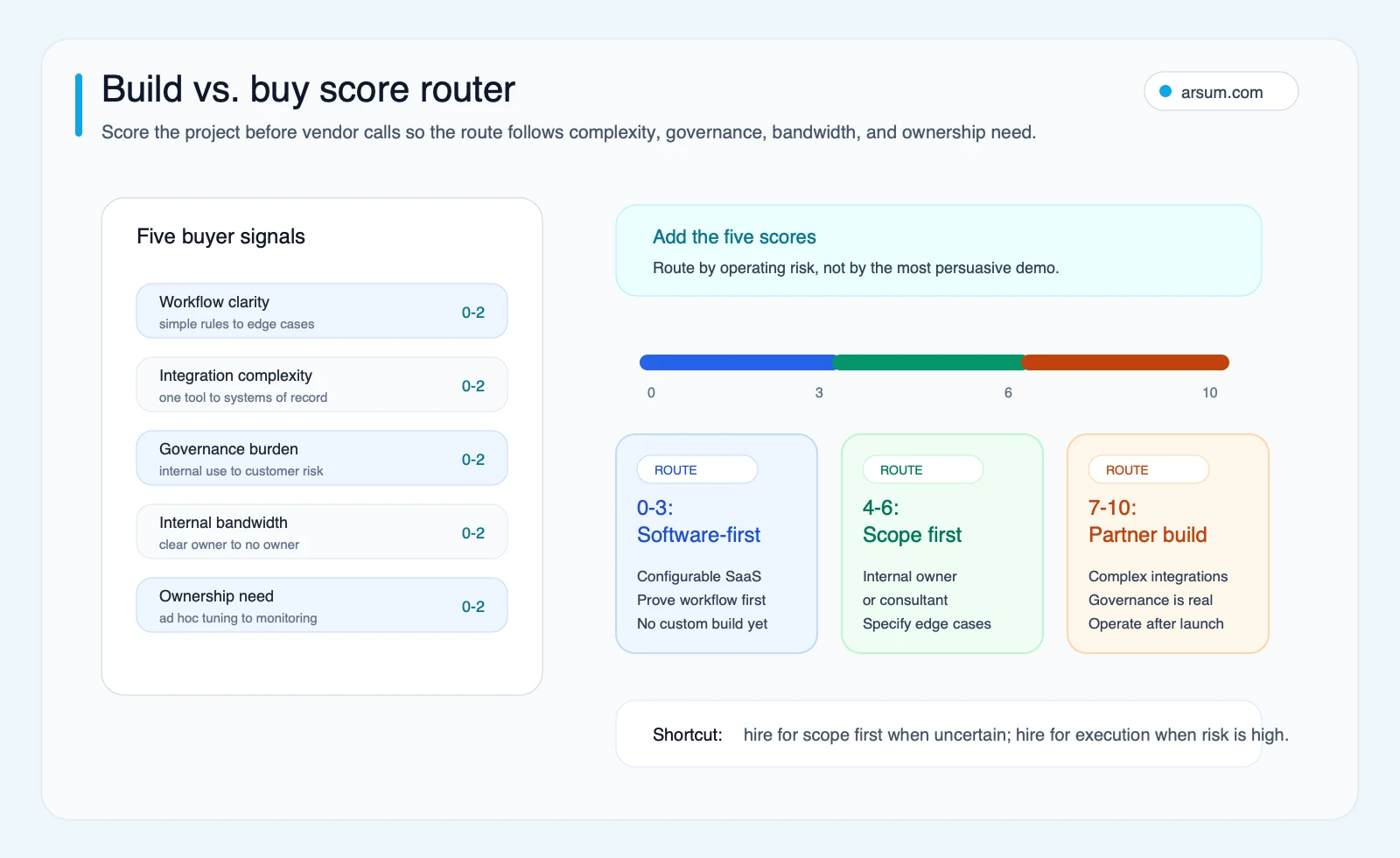
The score router turns the five buyer signals into a route: software-first, scope-first, or implementation partner.
Engagement Models and Pricing
Understanding how providers price their work tells you a great deal about how they think about risk. Most AI services engagements follow one of three structures.
Fixed-scope project: The provider agrees to deliver a defined system for an agreed price. This works when requirements are clear, the integration environment is well-understood, and scope changes are unlikely. It is routinely underpriced because discovery assumptions do not survive contact with real APIs and real data.
Time-and-materials: The provider bills by hours or sprints. This approach transfers scope risk to the buyer and requires close oversight. It is appropriate for exploratory work or integrations with genuinely uncertain complexity.
Retainer with defined outcomes: The provider commits to a set of operational outcomes over a defined period, typically six to twelve months. This model aligns incentives better than the other two: the provider earns the retainer by keeping the system performing, not by logging hours. It is the structure most consistent with post-launch ownership.
What cheap proposals omit: Discovery and requirements definition, edge-case validation, human review infrastructure, monitoring setup, and the first six months of model drift remediation. A proposal that prices the build but not these items is describing a prototype cost, not a production system cost.
For a practical look at what AI automation investments return across real engagement types, see AI automation ROI examples.
How to Compare Proposals
Most proposals compete on the wrong criteria. Buyers focus on total cost, team credentials, and timeline. Those matter, but they do not predict delivery quality or post-launch health.
Provider Evaluation Scorecard
Use this scorecard when reviewing proposals side by side. A total below 60 percent warrants harder questions before advancing the vendor.
| Criterion | What to look for | Score (1-5) |
|---|---|---|
| Workflow selection quality | Can they explain why this workflow, what the measurable output is, and what happens on failure or edge-case input? | |
| Integration depth | Can they describe authentication, rate limiting, schema changes, and dependency failure handling for the specific APIs involved? | |
| Approval and oversight design | Is there a human-in-the-loop plan for compliance-sensitive outputs, a defined escalation path, and a rollback mechanism? | |
| Observability plan | What is instrumented, what alerts fire, who receives them, and what does post-launch performance tracking look like? | |
| Data handling clarity | Where does business data flow, who retains it, and what are the compliance and privacy commitments? | |
| Security review | Does the proposal address prompt injection, insecure tool use, and access control risks for LLM components? | |
| Post-launch ownership | Who is accountable after go-live, what does incident response look like, and who handles model drift? | |
| Internal enablement | Does the engagement leave the client able to operate, modify, and scale the system after handoff? |
For buyers comparing proposals that involve live system connections, AI integration services is the closest companion guide to the integration-depth and handoff criteria above.
On security: OWASP’s Generative AI Top 10 identifies prompt injection, insecure tool use, and supply chain vulnerabilities as leading production risks in LLM-based systems. A provider that does not address these in the proposal has not built production AI systems before. For a deeper breakdown of what security evaluation looks like at the system level, see AI agent security.
On governance: NIST’s AI Risk Management Framework defines trustworthiness across seven properties: valid and reliable, safe, secure and resilient, explainable and interpretable, privacy-enhanced, fair, and accountable. Buyers in regulated industries should treat this as a minimum baseline for the governance questions they ask any provider.
Sensitive-Data Reality Check
This is where buyer anxiety spikes, especially in finance, healthcare, and customer-support workflows. The practical questions are not abstract. They are about where sensitive records go, which steps can run locally, what gets retained by third-party models, and who can reconstruct a bad output after the fact.
Use this short screen in discovery:
- Ask which inputs can be processed locally or tokenized before anything touches a cloud model.
- Ask what is logged at each step, how long it is retained, and who can inspect it during an incident review.
- Ask what the provider does when confidence is low: block, escalate, or keep going anyway.
- Ask whether prompt injection, insecure tool use, and over-permissioned agents were explicitly reviewed in the design.
- Ask who signs off on the data-flow diagram and who owns the fix if a control fails after go-live.
If the answers stay vague, the proposal is not ready for a regulated or customer-facing workflow.
💡 Arsum builds custom AI automation solutions tailored to your business needs.
Get a Free Consultation →Hidden Cost Checklist
Cheap proposals frequently omit the most expensive work. Use this checklist to identify scope gaps before signing.
- Discovery and requirements definition (underscoped in most fixed-fee proposals)
- Integration development and testing against actual APIs (often estimated as minimal until real schemas are reviewed)
- Edge-case validation and QA at production volume
- Human review infrastructure for confidence-threshold or compliance-sensitive outputs
- Monitoring setup: instrumentation, alerting, and dashboards
- LLM token costs modeled at actual production traffic
- Model drift remediation and retraining triggers
- Ongoing dependency updates as APIs and underlying models change
- Security review and access control configuration
- Internal training and change management for the team that will operate the system
A proposal that prices the build but not the above items is pricing discovery, not delivery.
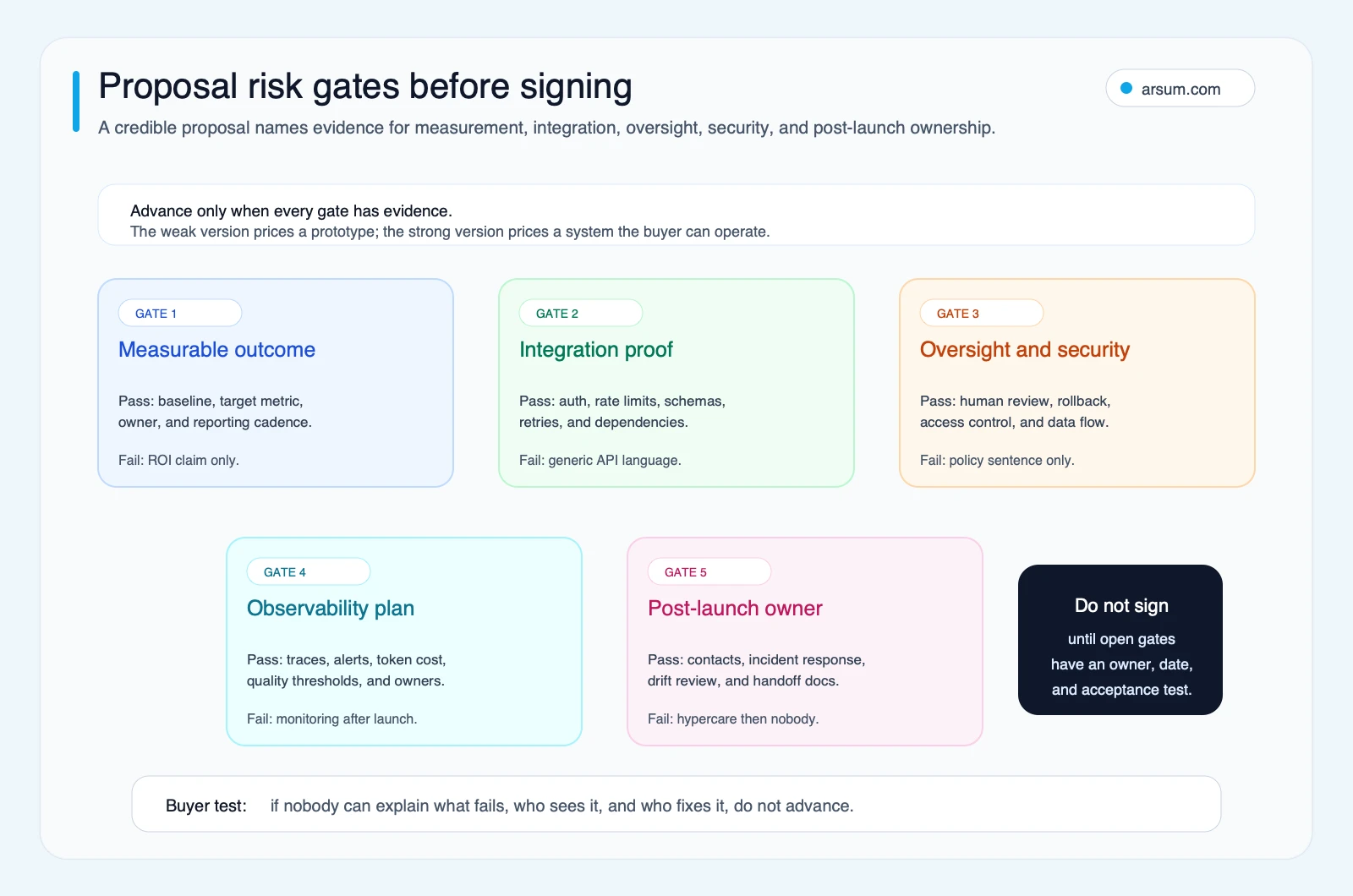
Use these gates before signing so the proposal prices a production system, not only a prototype.
Red Flags to Watch For
ROI Claims Without a Measurement Plan
Any provider that quantifies ROI without specifying how that number will be tracked, over what timeframe, and by whom is projecting, not planning. Ask to see the measurement model before the proposal advances.
No Named Delivery Owner
If the proposal does not identify the person responsible for delivery, and that person cannot be interviewed before signing, the engagement has no accountability anchor. The senior partner who presented the deck is not the person doing the work.
Discovery That Costs Nothing
Deep integrations and custom automation require significant discovery work. A proposal that skips discovery or prices it at zero is either underscoping the project or planning to expand scope mid-engagement once the actual complexity surfaces.
Broad AI Positioning With No Niche
A firm that claims expertise across every AI category and every industry is not specialized in any of them. Ask for three examples of similar projects using similar stacks. If they cannot produce concrete examples with measurable outcomes, they are pitching on category familiarity, not delivery depth. Buyers and peers in the market consistently push back on AI firms that cannot answer “Where’s the proof?” with real implementation examples.
No Monitoring Plan at Handoff
A production AI system without monitoring creates invisible cost and quality risk. OpenAI’s enterprise guidance emphasizes data ownership and control as a foundational concern. Equally important and more frequently missing is operational visibility: what does the system do after it ships? When there is no visibility into what an agent did step-by-step, surprise cost from untracked token usage and undetected risky outputs become operational reality fast. A provider that does not specify observability, alerting, and incident response is handing you a system you cannot safely run. This is not a polish item. It is a delivery requirement.
Before vs. After: What a Credible Proposal Looks Like
Underprepared proposal:
- Scope: “AI automation of your sales workflow”
- Outcome: “30-50% efficiency improvement”
- Timeline: “6-8 weeks”
- Post-launch: “Hypercare period, then handoff”
- Monitoring: Not mentioned
Credible proposal:
- Scope: “Automate qualification routing from inbound leads using criteria confirmed in discovery. Handles 85-90% of cases automatically. Escalates ambiguous inputs to a named sales rep via Slack within 2 minutes.”
- Outcome: “Reduce SDR time per qualified lead from 12 minutes to under 2 minutes based on current step audit. Tracked weekly in the existing CRM.”
- Timeline: “3 weeks discovery, 4 weeks build, 2 weeks QA and parallel-run, go-live in week 10”
- Post-launch: “Monthly model performance review for 6 months, with defined thresholds for retraining triggers and a named point of contact for incidents”
- Monitoring: “Full trace logging, weekly token cost report, Slack alert on error rate above 2%”
The gap between these is not budget. It is delivery experience.
Questions to Ask Before You Hire
Questions that separate prepared providers from unprepared ones:
- What does the automation do when it receives an input it cannot process confidently?
- Who owns the system after launch, and what does that engagement specifically include?
- How do you handle changes to the underlying APIs or models the system depends on?
- Can you describe a project that failed or ran into problems, and how it was recovered?
- What does the handoff documentation include, and who can use it?
- How is personally identifiable or confidential business data handled in prompts and tool calls?
- What governance artifacts does the engagement produce: risk documentation, audit logs, approval records?
- Can we speak with a current client who is running the system in production?
A provider that answers these clearly and with specifics is worth continuing the conversation. A provider that deflects or pivots to a case study has not thought through the operational side of the work.
OpenAI defines agents as AI systems with instructions, guardrails, and access to tools that can take action on behalf of users. A provider that cannot articulate what those guardrails are in your specific context has not designed your system yet, regardless of what the proposal says.
Work With Arsum
We help businesses implement AI automation that actually works. Custom solutions, not cookie-cutter templates.
Learn more →When Arsum Is the Right Fit
Not every AI services engagement belongs with a boutique implementation partner. But for a specific type of project, the boutique model outperforms both the enterprise consultancy and the independent consultant by a significant margin.
Arsum is built for operators who have a specific workflow they need automated, a real integration environment with proprietary or high-stakes systems, and a need for a team that will own the outcome after go-live, not just the build.
The right fit looks like:
A commercial or operations team where a manual, repeatable process is consuming disproportionate staff hours. The workflow is well enough defined to automate, but the integrations are complex enough that a configurable SaaS tool is insufficient. The business has tried to scope the work internally and reached the ceiling of what the team can specify without AI engineering depth.
Concrete examples of where Arsum engages:
- Revenue operations: automating lead qualification, enrichment, and routing across CRM, inbound forms, and outbound sequences
- Content and SEO operations: building AI-driven content pipelines with quality gates, approval workflows, and publishing integrations
- Finance and reporting: extracting, normalizing, and routing data from unstructured documents into structured systems of record
- Customer operations: building triage, classification, and response automation for support queues at scale
Where the engagement model is different:
Arsum does not hand off a build and disappear. Every engagement includes defined post-launch ownership: named contacts, monitoring coverage, token cost tracking, and a six-month performance review cadence as a baseline. Discovery is not a line item that gets eliminated under cost pressure. It is the mechanism that prevents the expensive surprises mid-build.
For a full breakdown of what this model includes and how it is priced, see AI automation agency services.
Operator Note
The providers most likely to deliver well are the ones asking the hardest questions in discovery. If a firm scopes your project in the first sales call without reviewing your actual systems, data quality, and approval requirements, treat that as a signal about how they will handle scope ambiguity mid-build. Discovery is not overhead. It is the work that prevents the expensive surprises.
A technically confident provider pushes back on the brief. They tell you when the workflow you want to automate is harder than you think, and they tell you when it is simpler. The ones who never push back are optimizing for the signed contract, not the delivered outcome.
Google Risk Box: This category has a high density of thin vendor pages, broad transformation language, and undifferentiated AI positioning. Buyers searching for an AI services provider are not looking for another listicle. They are looking for a decision framework. This page is built to answer the underlying question, not rank for the surface keyword.
FAQ
How do I choose an AI consulting company?
Start by defining the specific workflow you want to automate and the measurable business outcome you expect. Then evaluate vendors on workflow selection quality, integration depth, and post-launch ownership rather than brand recognition or broad AI credentials. Use the scorecard above to compare proposals side by side.
What should I ask before hiring an AI consultant?
Ask who owns the system after launch, how the outcome will be measured, how the automation handles inputs it cannot process, and what the post-launch monitoring plan looks like. A provider that cannot answer these in concrete terms has not built production AI systems before.
Are boutique AI firms better than large consultancies?
It depends on the job. Large consultancies bring governance frameworks, stakeholder management depth, and regulatory experience. Boutique implementation partners move faster, stay more accountable at the delivery level, and are typically more current on modern automation stacks. For most mid-market AI automation projects, a boutique partner delivers more value per dollar than a large consultancy. For projects requiring multi-year transformation roadmaps or regulated-industry credibility, the enterprise firm may be the right call.
What red flags should buyers watch for?
The most common: ROI projections with no measurement plan, a proposal that skips or underprices discovery, no named delivery owner before signing, broad AI positioning with no specific delivery examples, and no observability or monitoring plan at handoff.
What does a realistic AI services engagement cost?
For a mid-market custom automation project with real integration complexity, expect $40,000 to $150,000 for the initial build, depending on the number of systems involved, the volume of edge cases requiring QA, and the post-launch ownership structure included. Proposals well below this range typically omit the most expensive components: discovery, monitoring, and post-launch support.
Methodology
This article was refreshed on 2026-07-04 using a fresh review of buyer-side vendor pages, Hacker News practitioner discussion, and primary-source guidance from Anthropic, NIST, and OWASP. The social evidence used here is qualitative signal, not survey data, and it is treated as directional context rather than statistical proof.
Ready to Automate Your Business?
Stop wasting time on repetitive tasks. Let AI handle the busywork while you focus on growth.
Schedule a Free Strategy Call →