For founders and operators, ai business automation vs side hustle is not mainly a tool-choice question: a side hustle is an income-layer bet that must earn demand, while business automation is a cost-layer investment that must improve a controlled workflow. Choose the first when you have a narrow offer and a credible way to reach buyers; choose the second when you have recurring transaction volume, a measurable manual baseline, stable systems, and a business owner willing to own exceptions after launch.
AI Business Automation vs Side Hustle: Comparison
Explore ai business automation vs side hustle: compare workflow fit, costs, risks, evidence, and practical next steps before you build, buy, or hire.

Table of Contents
- What Most Guides Miss: Similar Tools, Different Economic Constraints
- The Three Routes Compared
- A Decision Rule Before You Buy Tools or Build Anything
- Worked Planning Example: Purchase-Order Intake
- A 30/60/90-Day Pilot Scorecard
- Build, Buy, or Partner: A Selection Matrix
- Controls and Human Review Are Part of the Economics
- Disqualifying Conditions and Common Failure Modes
- So Which Path Should You Choose?
What Most Guides Miss: Similar Tools, Different Economic Constraints
AI can draft, classify, extract, summarize, and route work in either path. That shared capability hides the decision that matters: where does the economic constraint sit?
A side hustle is constrained by distribution, sales, differentiation, fulfillment capacity, and retention. Faster production does not create customers. An internal automation project is constrained by workflow volume, data quality, integration scope, review cost, and operational ownership. Faster output does not create savings if staff still re-enter the result, correct frequent mistakes, or cannot trust the workflow to write back to the right system.
That distinction changes the first question to ask.
- For a side hustle: “Can I acquire and serve customers profitably with a differentiated offer?”
- For an automation service: “Can I solve one costly workflow for a specific buyer and support it after delivery?”
- For internal automation: “Can this workflow safely reduce handling time or delay after review, monitoring, and maintenance costs?”
Practitioner discussion supports the concern, but not a market-wide conclusion. A Reddit side-hustle discussion surfaced the familiar point that AI tends to amplify an existing business or sales motion rather than create income by itself. Another snippet-level discussion raised crowding as a concern for popular AI offers. Treat those as qualitative signals about buyer skepticism, not evidence of earnings, adoption, or saturation rates.
The Three Routes Compared
| Route | What you are building | Primary constraint | Evidence required before scaling | Typical ownership burden |
|---|---|---|---|---|
| AI side hustle | A service, audience product, content property, or small software offer | Demand and operator capacity | Qualified conversations, conversion, fulfillment time, retention or repeat demand | Usually founder-led |
| Automation service business | A repeatable implementation offer for client workflows | Narrow positioning, discovery quality, integration and support scope | A defined client baseline, acceptance criteria, commercial scope, support model | Provider and client must divide ownership |
| Internal business automation | A controlled workflow inside an existing operation | Volume, system access, exceptions, and governance | Baseline economics, representative test cases, system map, named process owner | Business owner plus technical operator |
A side hustle may be the right answer when you need a low-commitment way to test an offer. Internal automation may be the stronger answer when a business has stable, recurring work and can prove that the workflow’s monthly value exceeds its operating cost. Neither route is inherently larger; their payoff depends on conditions beside the claim: stable volume, measurable labor or delay, manageable exceptions, and post-launch ownership.
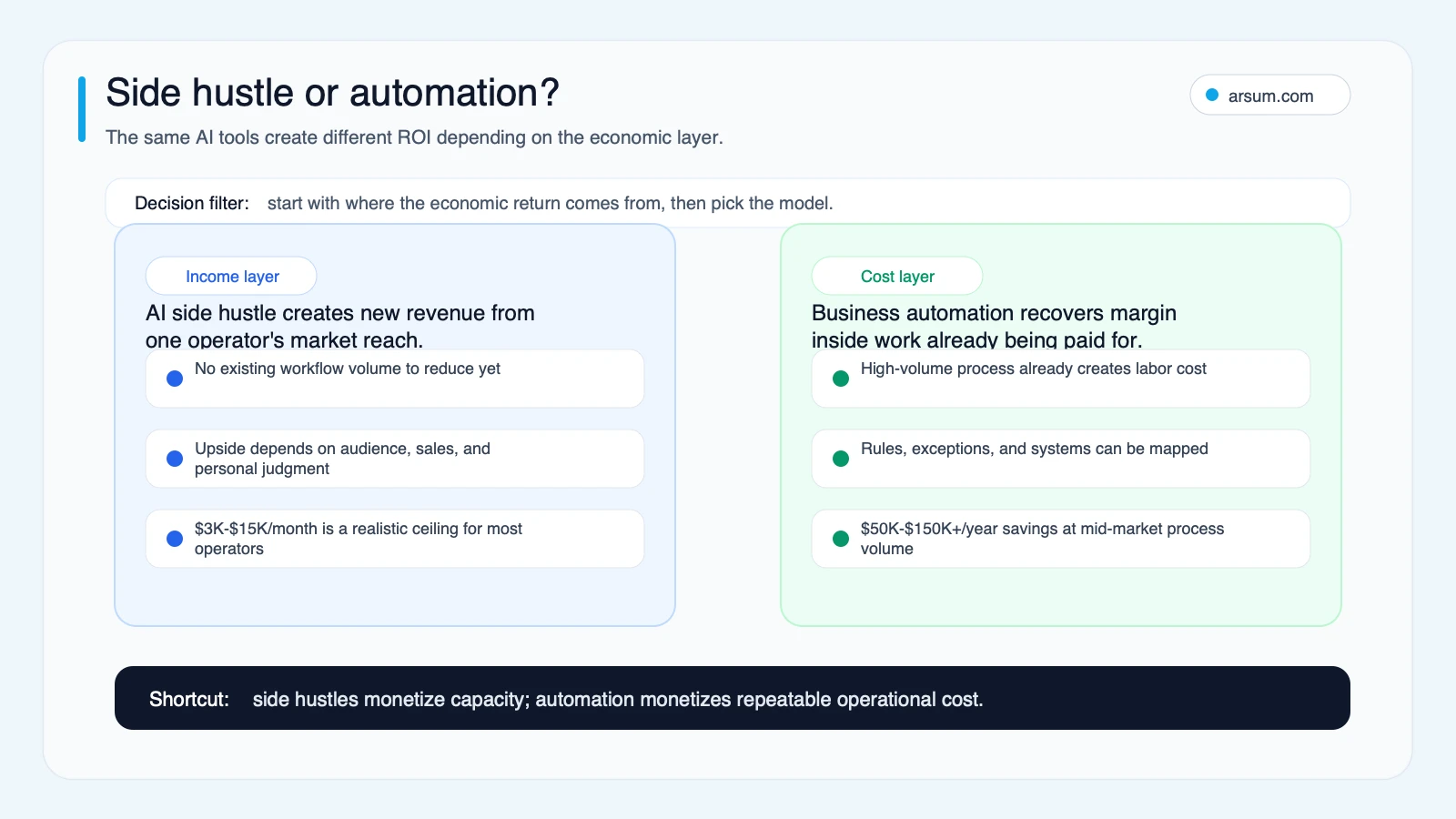
Use the selector as an economic filter. A side hustle monetizes an offer and distribution; business automation monetizes a repeatable operational baseline.
A Decision Rule Before You Buy Tools or Build Anything
Route the opportunity with five questions.
1. Is there a baseline worth changing?
For internal automation, identify the unit of work: a purchase order, incoming invoice, support ticket, application, quote request, or reconciliation item. Then measure monthly volume, manual minutes, rework, backlog, and escalation frequency.
If the work is too irregular to describe consistently, the first project may be process redesign rather than AI automation. A workflow that has no stable normal path has no reliable exception path either.
2. Does the workflow reach the system of record?
A draft in an inbox is not necessarily automation. Determine whether the workflow can safely read from and write back to the system where the business actually operates: ERP, CRM, ticketing system, document repository, claims platform, or internal database.
If staff must manually transfer every output into the system of record, count that work in the ROI case. For a useful overview of those boundaries, see business workflow automation and AI integration services.
3. What is the consequence of a wrong result?
Low-consequence tasks can be assisted with lighter review: internal research summaries, first-draft responses, or categorization that does not trigger action. Higher-consequence tasks require narrower autonomy.
For finance, customer, compliance, HR, or contractual decisions, distinguish these modes:
| Mode | AI can do | Human remains accountable for |
|---|---|---|
| Assisted recommendation | Extract, summarize, classify, propose a next step | Reviewing evidence and authorizing the decision |
| Controlled execution | Perform pre-approved actions within rules and thresholds | Setting rules, approving exceptions, reviewing samples |
| Authorized autonomous action | Execute only a tightly bounded, reversible action | Defining authority, monitoring outcomes, disabling the workflow |
Technical capability is not permission to act. High failure cost or low reversibility should reduce autonomy, increase review, and preserve a manual fallback.
4. Who owns exceptions?
Name the role before launch: AP manager, operations lead, customer-support manager, compliance officer, or product owner. “The team” is not an owner.
The exception owner needs a queue, clear reason codes, source documents, the model or rule version used, the proposed action, the final human action, and timestamps. That evidence makes it possible to diagnose whether the issue was bad source data, a policy gap, a prompt or model issue, an integration failure, or a workflow rule that needs redesign.
5. Can the workflow be rolled back?
The rollback should be operational, not theoretical: stop automated write-backs, route new items to the manual queue, retain processed-item logs, notify the accountable owner, and reconcile any records changed during the incident window. If the team cannot describe that sequence, the workflow is not ready for consequential autonomy.
Worked Planning Example: Purchase-Order Intake
The following is an illustrative planning assumption, not an Arsum client result, typical benchmark, or savings promise. It shows the arithmetic a finance or operations lead can copy.
Assume a company processes 2,000 purchase orders per month. Staff spend an average of 6 manual minutes per order on intake, field checks, routing, and follow-up. The fully loaded labor cost used for planning is $36 per hour.
Baseline monthly handling cost:
2,000 orders × 6 minutes ÷ 60 × $36 = $7,200
Now assume a proposed workflow extracts key fields, checks required data, compares them with configured rules, and routes exceptions. It does not autonomously approve spend.
Planning inputs:
| Input | Illustrative assumption |
|---|---|
| Monthly purchase orders | 2,000 |
| Baseline handling time | 6 minutes per order |
| Loaded labor cost | $36 per hour |
| Workflow pass rate after validation | 70% |
| Exception rate | 30% |
| Exception-review time | 4 minutes per exception |
| Remaining touch time on passed items | 1 minute per order |
| One-time implementation and evaluation cost | $18,000 |
| Monthly model, integration, monitoring, and maintenance cost | $1,200 |
Monthly handling time after rollout:
Passed items: 1,400 × 1 minute = 1,400 minutes
Exceptions: 600 × 4 minutes = 2,400 minutes
Total: 3,800 minutes = 63.3 hours
Monthly post-rollout labor cost:
63.3 hours × $36 = approximately $2,280
Monthly gross labor capacity released:
$7,200 baseline − $2,280 post-rollout labor = approximately $4,920
Monthly net planning value after run cost:
$4,920 − $1,200 = approximately $3,720
Illustrative payback period:
$18,000 ÷ $3,720 = approximately 4.8 months
This calculation is only useful if its inputs are real. The project fails its business case if actual volume drops materially, the exception rate or review time rises enough to erase the released capacity, the team cannot redeploy that capacity, or monthly operating costs exceed the modeled run cost. It also fails if the automation creates costly errors, even when the labor arithmetic appears favorable.
OpenAI’s pricing documentation is a useful reminder that model cost is usage-dependent; include tasks, tokens, retries, and fallback activity rather than treating AI cost as a flat software line. Its rate-limit guidance also supports planning for queues, throttling, and retries when volume matters.
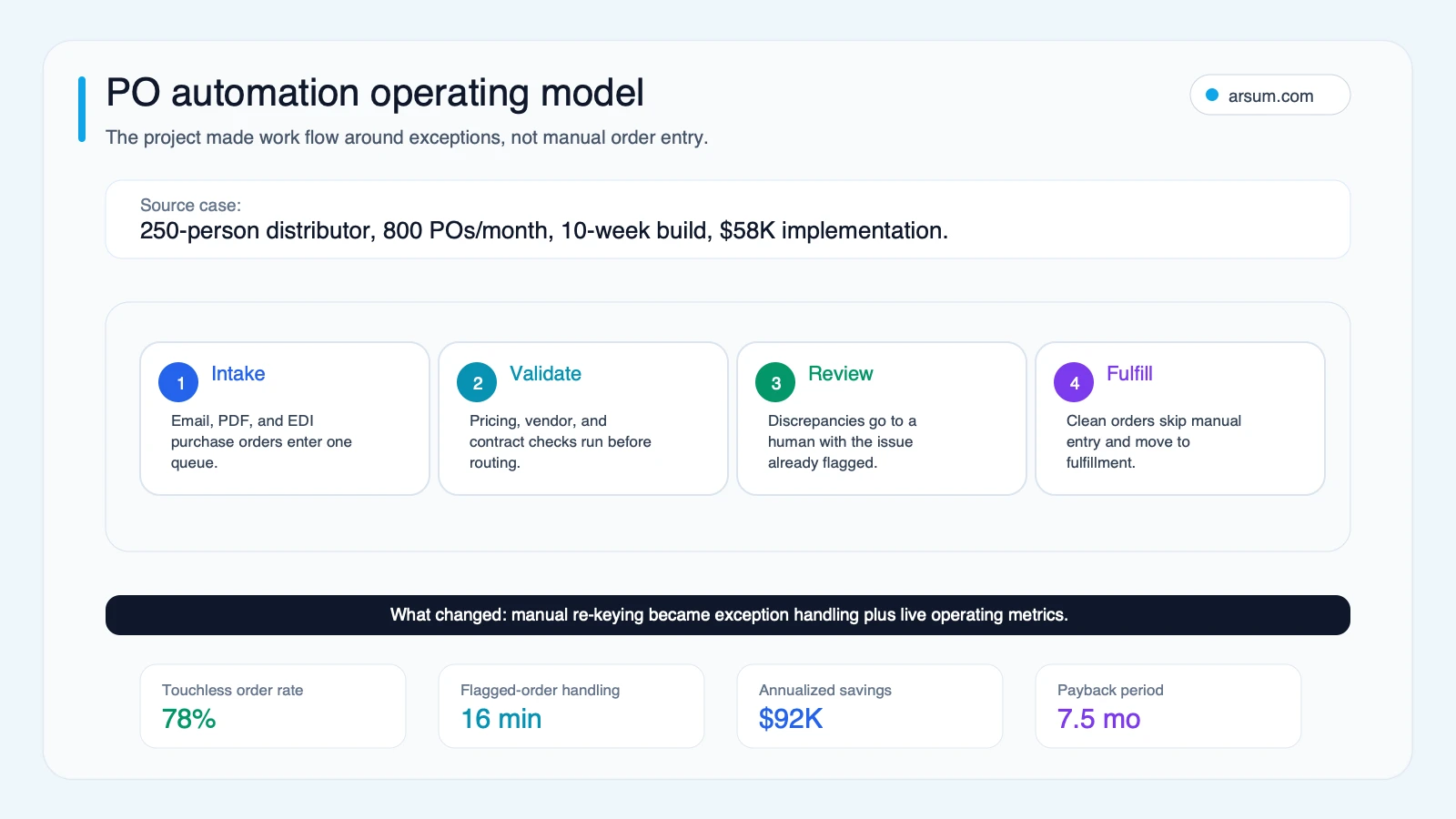
The point of the operating model is not to eliminate review. It is to make the normal path measurable and route ambiguous work to an accountable exception owner.
A 30/60/90-Day Pilot Scorecard
Run a pilot before committing to broad rollout. Purchase-order intake is a useful example because it includes documents, structured rules, approvals, and exceptions. IBM describes automated invoice processing as a workflow of ingestion, validation, and routing—not merely extraction—which is the right implementation boundary for document-heavy operations. See IBM’s overview.
Before launch: build the acceptance set
Select 50 representative historical orders across ordinary, incomplete, duplicate, policy-sensitive, and unusual cases. For each one, define:
- source document and source-system record;
- expected extracted fields and routing result;
- required validation checks;
- whether a human must approve the result;
- the exception reason if it should not pass;
- evidence to retain for later review.
Use an evaluation set instead of judging the workflow from a polished demo. OpenAI’s evals guidance explains why task-specific criteria are needed to compare outputs reliably.
Scorecard
| Measure | Baseline | Pilot target | Owner | Review cadence |
|---|---|---|---|---|
| Manual minutes per PO | Measure from a representative sample | Reduce only after retaining required checks | AP manager | Weekly |
| Straight-through pass rate | 0% automated | Set after evaluating the 50-case test set | AP manager | Weekly |
| False positive tolerance | No automated routing baseline | Zero unauthorized approval or release | AP manager and finance controller | Every exception |
| False negative tolerance | No automated routing baseline | Track missed required exceptions separately | AP manager | Weekly |
| Exception-review minutes | Measure by reason code | Stay within the planning assumption or trigger redesign | AP manager | Weekly |
| Source lineage | Often fragmented | Every automated outcome links to source document and rule/model version | Technical owner | Weekly |
| Write-back accuracy | Manual baseline | No unapproved system-of-record changes | Technical owner | Daily during pilot |
The exact quality thresholds should reflect the workflow’s consequences. For example, an incorrect document category may be reversible; an incorrect payment approval may not be. Do not replace a decision threshold with a generic “accuracy” target.
Day 30: prove the workflow can be operated
At 30 days, decide whether the process can be run safely, not whether the AI looks impressive.
Continue only if:
- every tested outcome retains source lineage and the responsible approver;
- the exception queue has an active owner and clear escalation path;
- normal-path outputs meet the agreed acceptance criteria;
- failures can be identified and corrected without manual archaeology;
- automated actions remain inside their authorized boundary.
Stop or redesign if the system produces unauthorized write-backs, cannot explain its source data, repeatedly sends the same error class to humans, or creates review work that outweighs the handling time removed.
Day 60: test real operating economics
At 60 days, compare the measured labor, exception, retry, monitoring, and maintenance inputs with the planning model. Recalculate payback using actual values. Review whether released capacity became useful capacity—for example, backlog reduction, faster cycle time, more rigorous review, or reassigned work—rather than assuming that saved minutes automatically equal realized savings.
Day 90: choose scale, redesign, or rollback
Scale only when the process owner, finance owner, and technical owner agree that quality, economics, controls, and support are sustainable.
The rollback path should be pre-approved:
- Disable automated system-of-record write-backs.
- Send new work to the existing manual queue.
- Preserve logs, source documents, and affected-record IDs.
- Reconcile changes made during the incident window.
- Document the failure class and decide whether to fix, narrow, or retire the automation.
If you have a baseline, system map, exception sample, and named business owner, a workflow assessment becomes a practical implementation conversation rather than an AI discovery call.
💡 Arsum builds custom AI automation solutions tailored to your business needs.
Get a Free Consultation →Build, Buy, or Partner: A Selection Matrix
The right delivery model follows the workflow, not a preference for custom development.
| Decision factor | Buy a product | Build internally | Use an implementation partner |
|---|---|---|---|
| Workflow specificity | Common and already served by a mature category | Proprietary logic is central to the business | Specific enough to need tailoring, but not a long-term platform bet |
| System-of-record write-back | Standard connector and well-defined permissions | Deep or unusual integrations require internal control | Several systems need connecting and governance needs designing |
| Data and security constraints | Vendor terms and architecture satisfy requirements | Internal team must control architecture and operations | Independent design and implementation support are needed |
| Internal engineering capacity | Limited; configure and govern the product | Strong and available for ongoing ownership | Some capacity exists, but delivery or architecture bandwidth is constrained |
| Required controls | Standard review and audit features are sufficient | Highly tailored approvals, logs, and rules are necessary | Controls must be designed around a real process and owner |
Buy when the workflow is common and the product covers the controls you need. Build when proprietary process logic, unusual integrations, or internal engineering capacity justify long-term ownership. Partner when the opportunity is credible but the company needs a bounded workflow design, integration plan, pilot evaluation, and handoff model before making a larger commitment.
For more context, compare AI workflow automation with an AI automation consulting engagement and review automation ROI examples. Agency builders should also understand the buyer’s expectation that they own more than setup; AI automation agency services is a useful scope comparison.
Controls and Human Review Are Part of the Economics
A side hustle can often tolerate a human final check because the operator is already the delivery layer. Internal automation requires more deliberate control design because it can affect a customer, ledger, approval chain, or regulated record.
Use three practical boundaries:
- Finance workflows: AI may extract and recommend, but a designated approver authorizes payments, credit decisions, reconciliations, or policy exceptions.
- Customer workflows: AI may classify, draft, and route, but high-impact promises, refunds, escalations, or account changes require defined authorization.
- Compliance workflows: AI may identify missing evidence or prepare a review packet, but accountable compliance staff make the final determination.
NIST’s AI Risk Management Framework provides a governance-oriented basis for considering risks to organizations and people. For application security, OWASP’s Top 10 for LLM Applications identifies risks such as prompt injection and insecure output handling. These are reasons to design controls, not reasons to abandon every automation project.
Production operations also need monitoring, spending limits, protected credentials, and separate testing and production controls, as described in OpenAI’s production best practices. Include the owner time for these activities in the business case.
Disqualifying Conditions and Common Failure Modes
Do not begin with automation if any of these conditions is true:
- The process has no stable baseline, clear input, or repeatable normal path.
- The team cannot access the authoritative source data or write safely to the system of record.
- No business owner will accept responsibility for the exception queue.
- The desired action is high-consequence and irreversible, but approval boundaries are undefined.
- The company cannot preserve source lineage, approvals, and change logs.
- The expected volume is too low to justify implementation and operating effort.
- The project is being justified by a generic productivity claim instead of workflow-specific economics.
The usual failures are operational rather than purely model-related. Teams automate a messy process without redesigning it, estimate savings without measuring review time, stop at a draft instead of completing the workflow, or deploy a write-back without a clear rollback path. More detail on workflow sequencing is available in AI business process automation and AI automation for procurement.
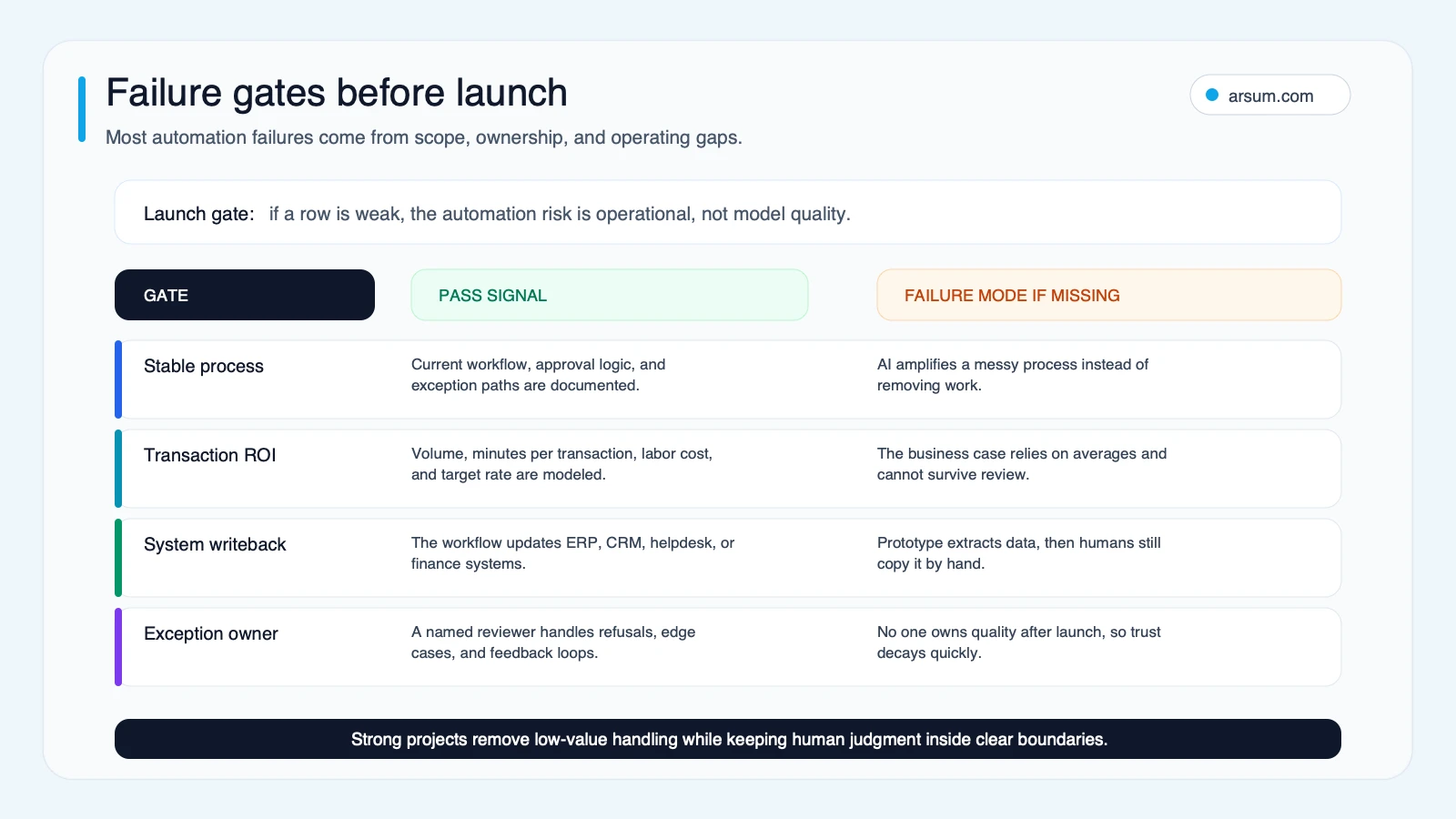
Pass these gates before launch: stable process, transaction-level economics, safe system write-back, accountable exception ownership, retained evidence, and a tested manual fallback.
So Which Path Should You Choose?
Choose an AI side hustle when your real asset is a niche, audience, sales capability, or a productized service—and when you can run a short acquisition-and-delivery test without treating AI output as the business itself.
Choose an automation service business when you can name one costly client workflow, define its baseline and acceptance criteria, price delivery and support honestly, and explain who owns the workflow after handoff. A generic “AI setup” offer is weak; a focused operating outcome is easier to evaluate.
Choose internal AI business automation when your company has measurable transaction volume, stable source systems, manageable exceptions, a clear approval boundary, and a named owner. That is where cost-layer economics can be compelling—but only after review, monitoring, maintenance, controls, and rollback are included in the calculation.
The practical next step is simple: bring one process baseline, a system map, a sample of normal and ugly exceptions, and the name of the business owner accountable for the outcome. That is enough to decide whether you need a small side-hustle test, a service offer, a product evaluation, or a controlled automation pilot.
Ready to Automate Your Business?
Stop wasting time on repetitive tasks. Let AI handle the busywork while you focus on growth.
Schedule a Free Strategy Call →Written by:Arsum editorial team
- Reviewed by
- Arsum editorial team
- Published
- March 28, 2026
- Updated
- July 4, 2026
- How this was produced
- Arsum uses research packs, source checks, and human editorial review to prepare and update blog articles. Editors are responsible for the final page.
- Source policy
- Sources are linked in the article when used. Methodology and source notes are included on higher-risk or high-visibility pages and are being rolled out across the archive. Editorial policy.
- Why this page exists
- Help B2B operators evaluate AI automation, implementation scope, cost, risk, and build-vs-buy decisions with practical context.