An AI software development company is worth hiring when it can turn a defined business workflow into an operating system your team can measure, control, and maintain—not merely a convincing demo. Choose a partner by asking for production evidence, a discovery process that exposes data and integration risk, a representative evaluation plan, security controls, cost guardrails, and a contract-ready handoff model.
AI Software Development Company: Buyer Guide
Explore ai software development company: compare workflow fit, costs, risks, evidence, and practical next steps before you build, buy, or hire.

Choosing the right AI software development company requires evaluating production evidence, not just pitch decks.
Table of Contents
- What Most Guides Miss About AI Software Development Companies
- Decide What You Need Before Comparing Vendors
- Compare Delivery Models by Ownership, Not Pitch Style
- The Evidence a Production Vendor Should Provide
- Score Vendors With Evidence, Not Confidence
- Turn Cost Into a Scoped Estimate Worksheet
- Run a Pilot That Can Be Accepted or Rejected
- Disqualifying Conditions and Failure Modes
- Choose the Partner That Leaves You More Capable
- Related Arsum Guides
What Most Guides Miss About AI Software Development Companies
Most vendor lists compare service categories, model expertise, or brand names. The harder buyer question is whether a team can own the path from prototype to production.
A model can generate a useful answer and still be unsuitable for your workflow. The important work happens around the model: source data, permissions, deterministic business rules, evaluation inputs, exception routing, review ownership, logging, cost monitoring, and rollback.
Use this decision rule early:
Do not buy “AI development” as a category. Buy a verified operating model for one workflow, with evidence for how it behaves on normal inputs, ugly exceptions, and failures.
Before signing, a credible vendor should be able to explain:
- The workflow trigger, source systems, and named internal owner.
- The real inputs and edge cases that will make up the evaluation set.
- What the system may do automatically, what requires approval, and what it must never decide.
- How access, data lineage, logs, and model actions are controlled.
- How quality, latency, and usage cost will be reviewed after launch.
- How the buyer can pause, roll back, or take over the system.
OpenAI’s guidance for production systems covers secure access, architecture, scaling, and cost management. Its evaluation guidance explains why variable model behavior needs deliberate evals alongside ordinary software testing. These sources guide diligence; they do not certify a vendor.
Decide What You Need Before Comparing Vendors
The first decision is whether your problem is workflow selection, delivery, or ongoing ownership.
| Need | Appropriate engagement | Buyer output |
|---|---|---|
| You cannot agree on the first workflow to automate | Discovery-only engagement | Workflow map, risk register, data audit, pilot recommendation |
| The workflow is clear but systems and approvals are disconnected | Production build | Integrated workflow, eval plan, controls, documentation |
| A system exists but quality, cost, or exceptions are drifting | Maintenance or embedded team | Monitoring, iteration backlog, ownership model |
| AI is strategic product infrastructure | In-house build with specialist support where needed | Internal capability, architecture, hiring and operating plan |
A discovery engagement is useful when nobody can name the workflow owner, source systems, exception categories, or consequence of a wrong output. A build engagement is appropriate only after those items are clear enough to define acceptance criteria.
If the initiative is primarily process redesign, begin with AI business process automation. If you already know the workflow but need to determine whether agentic behavior is appropriate, review agentic AI workflow automation.
Compare Delivery Models by Ownership, Not Pitch Style
| Option | Best fit | What you are buying | Question to resolve |
|---|---|---|---|
| AI consulting firm | Early prioritization and executive alignment | Analysis, roadmap, business case | Who will build and operate the recommended system? |
| AI software development company | Defined workflow needing delivery | Discovery, integration, implementation, evals, handoff | Can it prove production controls and post-launch ownership? |
| Embedded team | You have product and engineering leadership | Specialist capacity in your environment | Who sets priorities and accepts delivery internally? |
| In-house build | AI is core to the product or long-term capability | Control over roadmap and operations | Can you hire, retain, and operate the capability? |
A vendor can combine these models, but the contract should make the transition explicit. Discovery may produce a scoped pilot; the pilot may produce an evidence-based decision to build, pause, or hand off to your internal team. Do not assume code ownership, support scope, data residency, or platform dependency are universal standards. Review each in the contract.
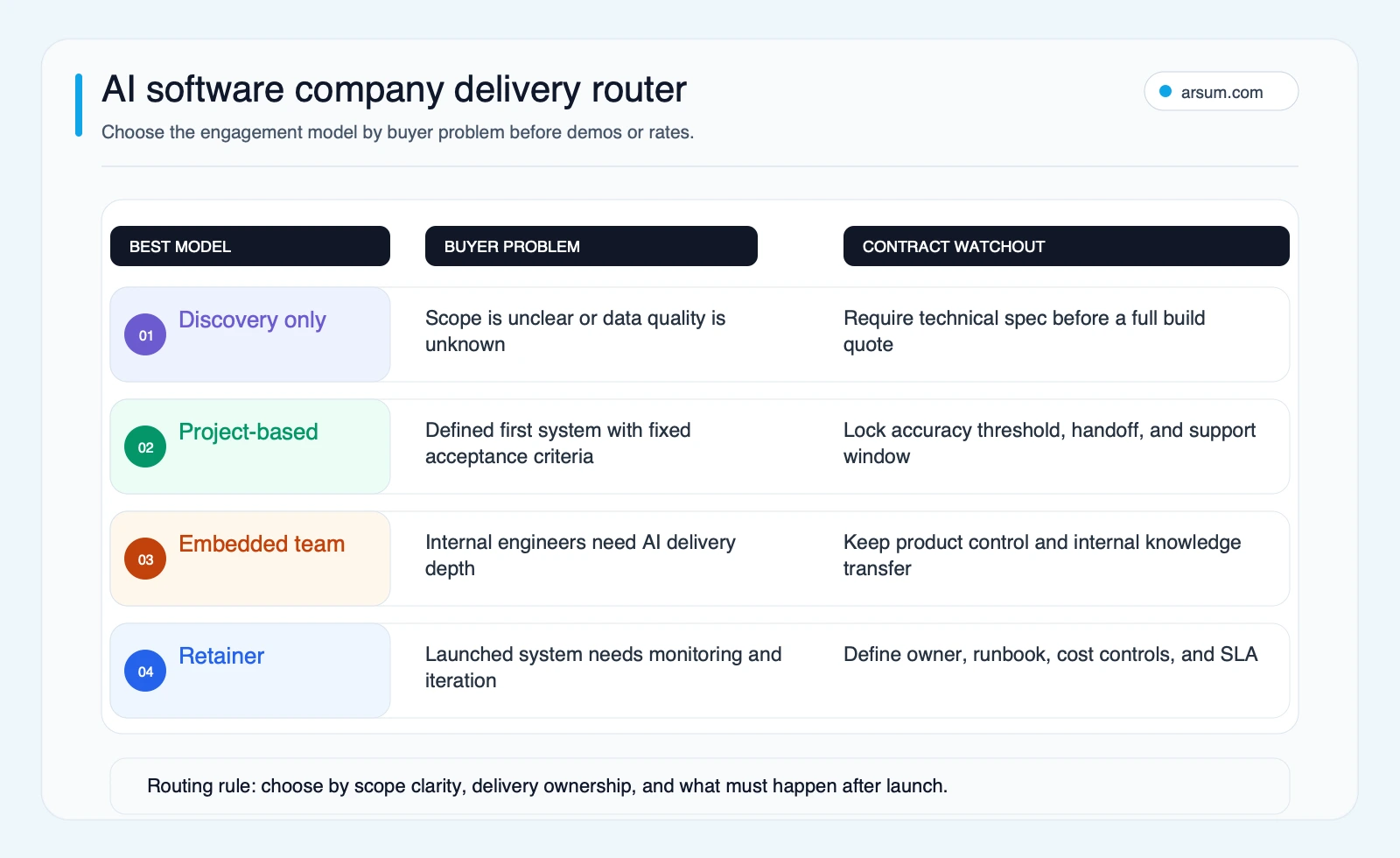
Use the delivery model router to match the engagement structure to the buyer problem before comparing vendor demos or rates.
For a narrower comparison of external capacity and internal hiring, see hiring an AI developer versus an agency.
The Evidence a Production Vendor Should Provide
A polished prototype is evidence of technical possibility. It is not evidence that a workflow is ready for production.
Discovery artifacts
Ask for a discovery output that includes:
- A workflow map: trigger, inputs, system actions, outputs, exceptions, and owner.
- A data and permissions inventory: which source is authoritative, what data may be processed, retention constraints, and who can access what.
- A system design: model boundaries, integrations, deterministic checks, approval gates, and fallback behavior.
- An assumption log: unknowns that could change scope, cost, security review, or pilot design.
- A definition of done: measurable acceptance criteria, required artifacts, and sign-off roles.
A vendor that can quote immediately may still be appropriate for a small, low-risk prototype. For a consequential workflow, treat the absence of discovery as a diligence flag to investigate—not automatic proof of poor delivery.
Evaluation artifacts
For generative or agentic behavior, request a written evaluation plan before the production build is accepted. The plan should identify:
- Representative production-like inputs, including known edge cases.
- The expected output or reviewer rubric for each case.
- Quality measures that fit the workflow: correctness, completeness, citation accuracy, routing accuracy, or reviewer acceptance.
- Thresholds for launch and thresholds that force human review.
- Regression tests when prompts, models, tools, or source data change.
- The role responsible for reviewing failures and approving changes.
For systems that search internal documents before responding, evaluate retrieval as well as generated answers. AI agent architecture patterns helps separate model behavior from system behavior.
Control map for AI applications
NIST’s AI Risk Management Framework provides a lifecycle approach to managing AI risks. OWASP’s Top 10 for LLM Applications identifies risks including prompt injection, sensitive-information disclosure, insecure output handling, excessive agency, and overreliance.
Translate those sources into contractable controls:
| Control | Buyer evidence to request | Operational question |
|---|---|---|
| Data lineage | Source inventory, retention rules, retrieval boundaries | Which source is authoritative, and can an answer be traced back? |
| Access control | Role permissions, secret handling, environment separation | Who can invoke tools, view logs, or change prompts? |
| Approval ownership | Decision matrix and exception queue | Which actions require a human with authority? |
| Evaluation | Test set, rubric, versioned results | What changes if quality falls below threshold? |
| Logging | Audit fields, event retention, monitoring dashboard | Can you reconstruct what the system did and why? |
| Rollback | Kill switch, manual fallback SOP, recovery owner | How can automation be paused without stopping operations? |
| Incident response | Escalation path, severity definitions, communication owner | Who investigates harmful, insecure, or materially wrong behavior? |
A model may assist a consequential decision, but it should not autonomously make that decision unless the organization has explicitly authorized the autonomy, approval path, and controls. High failure cost and low reversibility should reduce autonomy.
Score Vendors With Evidence, Not Confidence
Use a weighted scorecard during shortlist calls and proposal review. Score each category from 1 to 5 only after seeing the stated artifact.
| Category | Weight | Required evidence |
|---|---|---|
| Workflow and discovery quality | 20% | Workflow map, assumptions, integration audit |
| Evaluation discipline | 20% | Representative eval plan, thresholds, review loop |
| Security and risk controls | 15% | Threat model, access design, logging and incident approach |
| Integration and delivery feasibility | 15% | System map, dependencies, failure-path plan |
| Cost and performance controls | 10% | Usage budget, model-routing approach, alerting plan |
| Handoff and maintenance | 10% | Repository terms, runbooks, support ownership |
| Production references | 10% | Reference conversations relevant to comparable conditions |
Set your own minimum pass criteria. An illustrative rule is a weighted score of at least 3.5 out of 5, with no score below 3 in evaluation, security, or handoff. A vendor with a high overall score but no usable evaluation plan is not ready for a high-consequence production workflow.
Require reference checks, not only case-study links. Ask references what changed after launch, how incidents were handled, whether documentation was usable, and whether the support model matched the contract. Reference evidence is context-specific; it should not be converted into a market-wide performance claim.
Questions that force an operator-level answer
- What failed in your last production AI deployment, how was it detected, and what changed afterward?
- Which real inputs will be in our evaluation set, and who approves the rubric?
- What occurs when the model is uncertain, gives an unsupported answer, or attempts an action outside its authority?
- How will usage cost be attributed by workflow or feature?
- Who owns the repository, infrastructure configuration, prompts, logs, runbooks, and support queue after handoff?
- What dependency would prevent us from operating the system without your platform or team?
A strong answer becomes more specific as the conversation reaches data, exceptions, and ownership. A vendor should be able to say what it needs to learn rather than manufacture certainty before seeing your environment.
Turn Cost Into a Scoped Estimate Worksheet
Do not accept generic cost or timeline bands as if they predict your engagement. Scope determines the effort: integrations, data cleanup, required evaluation depth, security review, deployment environment, training, and post-launch support can all materially change the work.
Use this worksheet to compare proposals:
| Estimate component | Inputs to specify |
|---|---|
| Discovery | Workflow count, stakeholder interviews, systems to inspect, required outputs |
| Integration | APIs, authentication patterns, legacy constraints, environments, vendors |
| Data preparation | Source types, volume, quality issues, labeling or reviewer effort |
| Build | Interfaces, tools the system may call, deterministic rules, audit requirements |
| Evaluation | Test-set size, edge cases, reviewer time, regression cadence |
| Security review | Data sensitivity, access design, threat modeling, compliance obligations |
| Launch | Deployment method, training, migration, monitoring, support period |
| Maintenance | Change volume, model updates, incident coverage, internal ownership |
Ask the vendor to show assumptions beside every estimate, name exclusions, and state what discovery could change. The first estimate should be a planning input, not a promise disguised as precision.
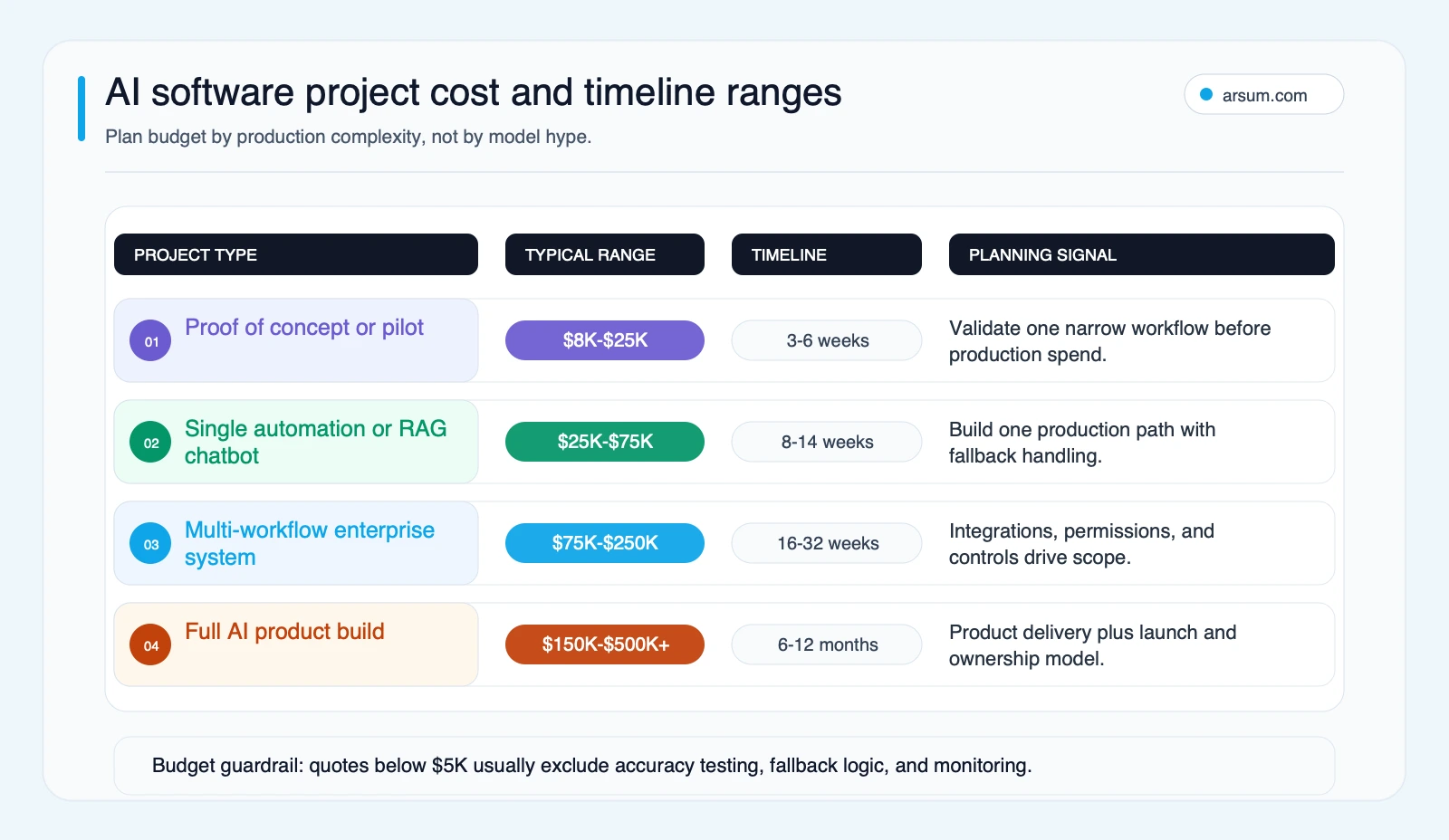
Use cost and timeline ranges only as planning prompts; a credible proposal explains the scope assumptions that create them.
Illustrative pilot economics
Use buyer-owned assumptions to decide whether a pilot deserves funding. For example:
- Baseline: 400 cases per month, with 12 minutes of reviewer work per case.
- Pilot target: route 40% of clearly eligible cases to a drafted output, while retaining human approval.
- Quality measure: reviewer acceptance rate and the number of harmful or policy-breaking outputs.
- Review cost: record both reviewer minutes saved and any added exception-review minutes.
- Owner: operations lead owns workflow acceptance; security owner approves access; product or engineering owner owns release.
- Review cadence: weekly during pilot, then a buyer-chosen operating cadence after launch.
- Stop condition: any critical control failure, unacceptable error class, or sustained quality result below the agreed threshold.
- Rollback: disable the automated action, preserve logs, route all cases to the existing manual queue, and investigate before re-enabling.
The arithmetic is illustrative: eligible cases × minutes saved − added review minutes estimates time capacity, not realized savings. It does not account for adoption, rework, staffing decisions, or the business cost of mistakes.
💡 Arsum builds custom AI automation solutions tailored to your business needs.
Get a Free Consultation →If you have a shortlist but the proposals do not expose these assumptions, Arsum can help structure a workflow assessment or vendor-evaluation discussion around the evidence required before a pilot.
Run a Pilot That Can Be Accepted or Rejected
A pilot should answer a narrow decision, not become an open-ended prototype.
Example acceptance scorecard
| Dimension | Buyer-selected threshold | Evidence required | Owner |
|---|---|---|---|
| Workflow quality | Defined by use case | Versioned eval results on representative inputs | Operations owner |
| Exception handling | Every uncertain or prohibited case reaches the right queue | Queue records and reviewer audit | Operations owner |
| Safety and access | No unresolved critical findings | Threat-model review and access test | Security owner |
| Cost control | Within agreed usage budget | Feature-level usage reporting | Technical owner |
| Operability | Manual fallback demonstrated | Rollback test, runbook, named on-call path | Technical owner |
| Adoption | Users can complete the intended workflow | Training completion and feedback review | Functional leader |
Define acceptance in the contract before build begins. The vendor should not grade its own work alone; the buyer should own the threshold, approve the evidence, and reserve the right to pause or redesign the workflow.
This structure is especially important for actions involving customer communications, financial data, regulated records, approvals, or external system changes. Explore related boundaries in AI agent security and custom AI agent development services.
Disqualifying Conditions and Failure Modes
Some conditions mean you should pause vendor selection or change the engagement shape.
Pause before a production build when
- There is no accountable workflow owner.
- The source data cannot be identified or lawfully accessed.
- The consequence of a wrong output is high, but approval authority and escalation rules are undefined.
- The team cannot provide representative inputs for evaluation.
- No one can own the manual fallback process after launch.
- The buyer requires a contractual term—such as data residency, IP rights, or incident response—that the vendor cannot meet.
Investigate these proposal signals
- A fixed scope with no visible assumptions or integration review.
- High confidence about accuracy before the vendor has seen representative data.
- Security language without a threat model, access design, or review process.
- “Monitoring” without named metrics, alert thresholds, owners, or a support path.
- A proprietary platform requirement without documented portability, export, pricing, or dependency terms.
- A handoff promise without repository access, documentation, runbooks, and ownership terms.
These are diligence flags, not universal proof that a vendor will fail. The correct response is to request the missing artifact, narrow the scope, or choose discovery first.
Practitioner discussions are a qualitative reminder of why these questions matter: builders frequently raise concerns about production LLM cost and reliability, cost management at scale, and security of AI-generated code. These discussions identify recurring questions and failure patterns; they do not establish prevalence, benchmarks, or vendor performance.
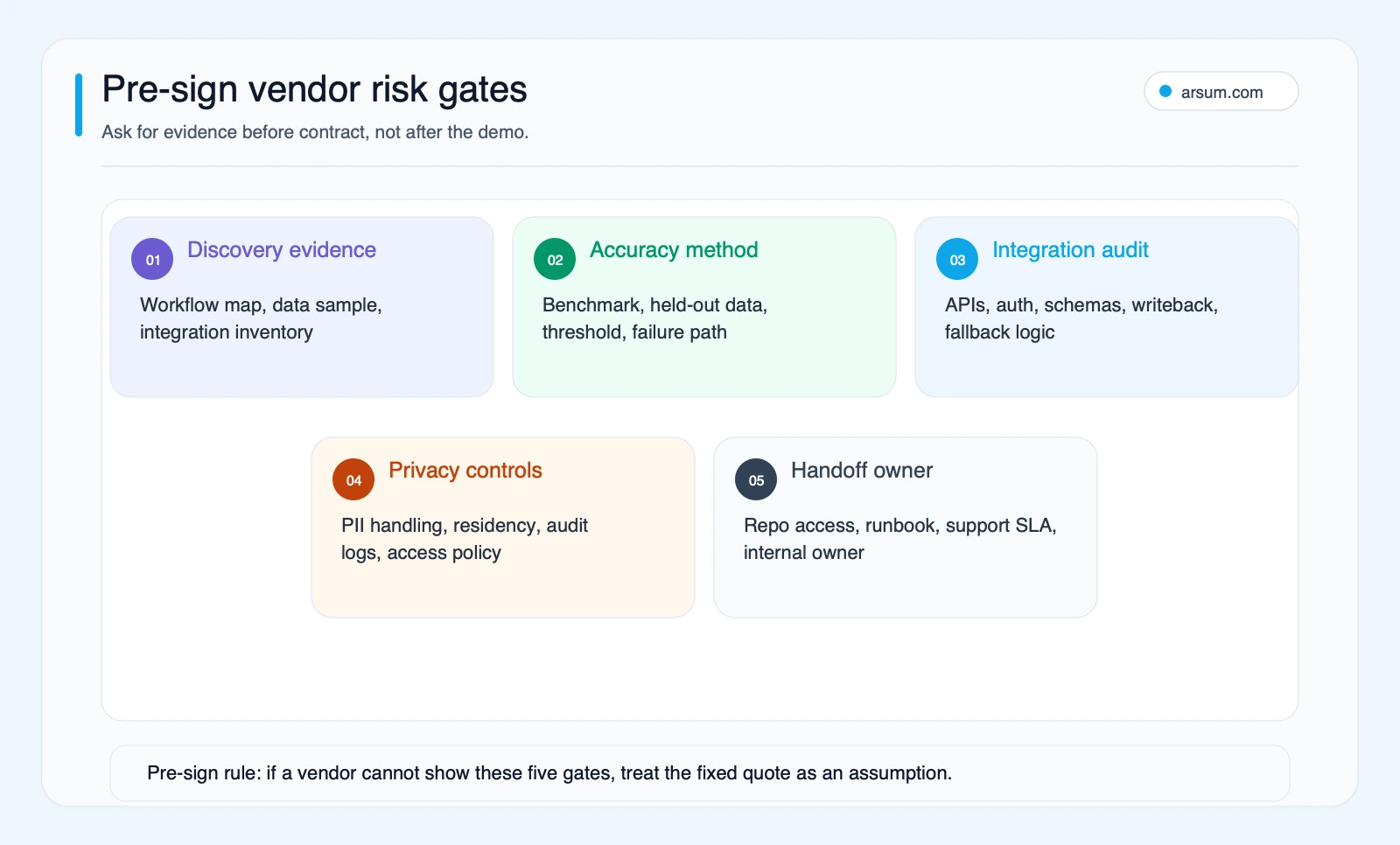
Use these risk gates to collect evidence before contracting, rather than discover missing controls after a demo.
Choose the Partner That Leaves You More Capable
The right AI software development company does not need to be the largest firm or claim the broadest stack. It needs to be credible for your workflow’s risk, complexity, ownership model, and evidence requirements.
Choose discovery first when the workflow is not yet sufficiently defined. Choose a production partner when you can agree on acceptance evidence, control boundaries, and handoff terms. Choose an embedded or in-house path when the capability is becoming central to your product or operating model.
The market has broad interest in AI, while scaling reliable use remains a separate challenge, as discussed in McKinsey’s State of AI. Your selection process should reflect that distinction: fund evidence and operating ownership, not category language.
Methodology and review: This editorial framework was prepared by Johnny Kartakov and reviewed by the Arsum Editorial Team. It draws on OpenAI production and evaluation guidance, NIST AI RMF, OWASP LLM guidance, and qualitative practitioner discussions linked above. Social material identifies questions and failure patterns only; it is not market-wide measurement or a vendor-performance benchmark.
Ready to Automate Your Business?
Stop wasting time on repetitive tasks. Let AI handle the busywork while you focus on growth.
Schedule a Free Strategy Call →Related Arsum Guides
Written by:Arsum editorial team
- Reviewed by
- Arsum editorial team
- Published
- April 3, 2026
- Updated
- July 4, 2026
- How this was produced
- Arsum uses research packs, source checks, and human editorial review to prepare and update blog articles. Editors are responsible for the final page.
- Source policy
- Sources are linked in the article when used. Methodology and source notes are included on higher-risk or high-visibility pages and are being rolled out across the archive. Editorial policy.
- Why this page exists
- Help B2B operators evaluate AI automation, implementation scope, cost, risk, and build-vs-buy decisions with practical context.