
Here is the failure pattern Arsum diagnoses most often, and it is not the one you expect.
The system works. The team uses it. Outputs roughly match what was promised in the pilot. And eighteen months later, ROI is unconfirmable, because the workflow around the system was never redesigned to act on its outputs. The AI does its job. The process did not change. Finance cannot validate what was spent, so the next AI project cannot clear budget approval, and the organization concludes that AI underdelivered.
This is not a technology problem. It is a scoping problem: the build was defined in terms of the system, not the business outcome the system was supposed to produce. Fixing it requires answering a different set of questions before the contract is signed, which is what this guide is about.
What Most Guides Miss About AI Software Development
The phrase AI software development gets used for three very different kinds of work. Buyers who do not separate them early usually end up comparing the wrong vendors, the wrong budget, or the wrong success criteria.
| Category | What it means | Buyer question | Main risk |
|---|---|---|---|
| AI-assisted development | Developers use AI to write, test, review, and document software faster | How will the team verify quality before code ships? | Generated defects and hidden review load |
| AI-powered product feature | The application includes model behavior for end users | What data, guardrails, and fallback paths are required? | Hallucination, privacy, and broken UX |
| Custom operational AI system | AI changes a business workflow end to end | Who owns outcomes after launch? | Drift, weak measurement, and adoption failure |
That distinction matters because buyers often think they are purchasing one thing and get scoped into another. A coding copilot budget is not the same as a customer-facing AI feature, and neither behaves like an operational AI system that changes approvals, routing, or decision support inside the business.
Social Listening: What Practitioners Keep Warning About
- Public developer discussions repeatedly push back on vague productivity claims. Faster output is not the same as a better system if review, testing, and rollback were never defined.
- Teams experimenting with agents keep stressing that task decomposition matters. When the next step is ambiguous, the agent can look busy while moving away from the real business goal.
- Buyers are increasingly skeptical of polished prototypes because the testing-to-production gap is where permissions, edge cases, noisy inputs, and workflow ownership show up.
Operator Note
If a vendor spends most of the sales conversation on model choice but barely covers evaluation design, logging, rollback, approval paths, and post-launch ownership, you are probably being sold a prototype service, not a production AI build.
Expert Note
Primary-source guidance from NIST, OWASP, Google Cloud, and Microsoft points in the same direction: production AI systems need explicit evaluation, AI-specific security controls, and a secure lifecycle that continues after launch.
What Changes Operationally When You Deploy AI
This is the section most vendor decks skip. Before covering project types and timelines, it is worth being specific about what AI software development actually does to a buyer’s organization, because this is where most leaders discover decisions they did not know they needed to make.
- Requirements shift during the build. The real problem is often discovered during the data audit, not the kickoff call. Budget and scope must be flexible enough to absorb this. Organizations that lock scope at day one often end up revisiting scope early in the project.
- Accuracy is not binary. The question is not “does it work” but “at what error rate, and is that acceptable for this use case.” A system that is 91% accurate on invoice classification may be excellent for low-stakes routing and completely unacceptable for compliance-sensitive decisions.
- Data is the primary constraint, not headcount or timeline. If your data is not organized, labeled, and accessible, the build cannot proceed regardless of how large the development team is.
- Deployment is not the finish line. Models drift as business conditions change. AI systems require ongoing monitoring and periodic retraining. This is a recurring cost, not a one-time line item.
- Privacy and compliance surface early, and the cost of missing them is substantial. If the AI system touches customer data, employee records, or regulated information, compliance review must happen in discovery, not after the build is complete. Discovery-phase review often surfaces three categories of issues: data that cannot legally be used for training without re-consent, architectures that require on-premise or private cloud deployment rather than shared infrastructure, and logging requirements that govern how the system records decisions for audit purposes. Missing any of these late can force infrastructure redesign rather than a simple configuration change.
- Workflow redesign is required, not optional. A system that produces correct outputs but whose surrounding process was never redesigned to act on those outputs delivers no ROI. This is one of the most common reasons technically successful AI projects fail to produce business outcomes.
These factors determine whether a project delivers or stalls. They are also the factors most commonly glossed over in vendor sales cycles.
TL;DR: Scope and Cost Reference
| Scope | Examples | Typical Cost | Timeline |
|---|---|---|---|
| Contained build | Single-function doc AI, basic classifier, RAG system | $40K–$120K | 8–12 weeks |
| Mid-complexity | Multi-model workflow, CRM integration, customer-facing AI | $120K–$250K | 12–20 weeks |
| Enterprise build | Multi-agent systems, cross-platform integration, compliance layers | $250K–$500K+ | 20–36 weeks |
| Ongoing maintenance | Model retraining, monitoring, incremental improvements | 15–25% of build/year | Ongoing |
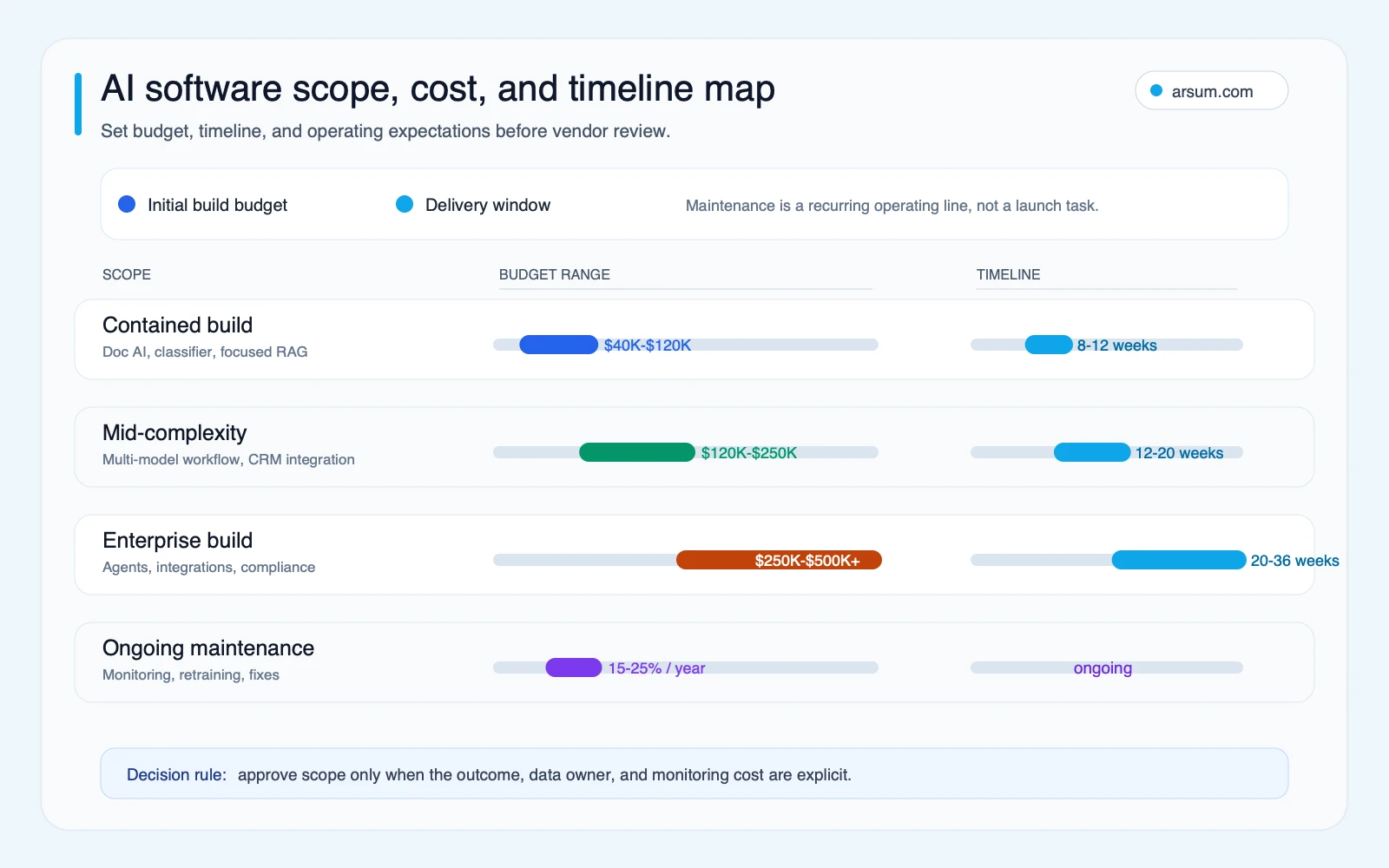
Use the scope map as an early budget checkpoint. The build category changes not only the launch cost, but also the delivery window and recurring operating line.
Want to automate this for your business? Let's talk →
What Buyers Need to Decide First
Most pages about AI software development explain the service category. The more useful buyer question is whether you need advice, implementation, or ongoing ownership.
Use a simple split before you talk to vendors:
- Advice problem: the team is unsure which workflow deserves budget.
- Implementation problem: the workflow is clear, but the systems, data, and approvals are not connected.
- Ownership problem: the first version can launch, but someone must monitor quality, cost, permissions, and edge cases.
That distinction prevents a common mistake: buying strategy when the blocker is delivery, or hiring delivery when the blocker is still workflow definition.
What Makes AI Software Development Different
In conventional software development, behavior is explicit. A rule says: if order amount exceeds $500, flag for review. The engineer writes that rule. The system follows it every time.
In AI software development, behavior emerges from data. A model trained on thousands of previous orders learns to flag unusual ones, even when no explicit rule covers the case. The engineer designs the training pipeline, selects the model architecture, defines what “good” looks like, and builds the infrastructure that makes predictions usable in a real workflow.
The practical consequence: AI software is harder to specify, harder to test, and harder to hand over. You cannot write a complete requirements document at the start. You discover what the system can and cannot do during development. This requires a fundamentally different kind of engagement, closer to research than to construction. If you need a clearer picture of the delivery process itself, our breakdown of AI development services explains what a serious build actually includes.
Common AI Software Development Project Types
Document Intelligence and RAG Systems
Companies use AI to extract, classify, and reason over documents, contracts, invoices, support tickets, medical records, and internal knowledge bases. Retrieval-augmented generation (RAG) systems let employees query internal documentation in plain language and receive grounded, sourced answers rather than hallucinated summaries.
This is one of the most common starting points because the technology is mature, the ROI is visible in hours recovered, and the implementation risk is contained when the data is already organized. For a detailed look at what these engagements include end-to-end, see our guide to AI development services.
Prediction and Classification
AI surfaces patterns that humans cannot catch at scale. Common use cases: predicting which leads will convert, which customers are likely to churn before renewal, which invoices are likely to be disputed, which job candidates match a role based on historical hiring outcomes.
These systems run in the background and feed signals into existing workflows. They do not replace decisions, they give the people making decisions better information, faster. For revenue and operations leaders, this is often where the most defensible ROI lives.
Workflow Automation with AI
This is where AI intersects with process automation. Instead of routing a support ticket based on a keyword rule, an AI agent reads the ticket, understands the intent, and routes, or resolves, based on meaning. Instead of requiring a human to review every exception, the system handles the cases it can process confidently and escalates the rest.
The key distinction from rule-based automation: the system handles variation. That is what makes it valuable in messy, real-world processes that break rule-based systems constantly.
Customer-Facing AI
The useful implementations are not trying to replace human support, they handle high-volume, low-complexity queries so human agents can focus on cases that require judgment. The best ones integrate deeply with internal systems: inventory, order status, policy documents, CRM data.
Where customer-facing AI often underdelivers: Conversational AI for customer support can look high-value in pilots, but in production they often disappoint for a structural reason that pilots do not expose. Customers with simple questions may already self-serve on the website or in the app. The queries that reach the AI in production are more likely to be exception-handling requests, billing disputes, and account-specific issues that require judgment and system access the AI does not have. The result is often a system that handles the easier cases and escalates the harder ones. If customer-facing AI is on your roadmap, scope it around the specific query categories where deflection has measurable cost savings, not around aggregate ticket volume.
AI Agents for Multi-Step Tasks
Agents are AI systems that take sequences of actions, searching, reading, writing, and calling APIs, in pursuit of a goal. They are useful for tasks that require judgment across multiple steps: researching a topic and producing a briefing, processing an application and generating a recommendation, monitoring conditions and triggering responses.
Agent development is more complex and carries higher failure risk than the other categories listed here. It is not the right starting point for most organizations. If you are evaluating this approach, see our breakdown of what AI development agency engagements look like at this scope.
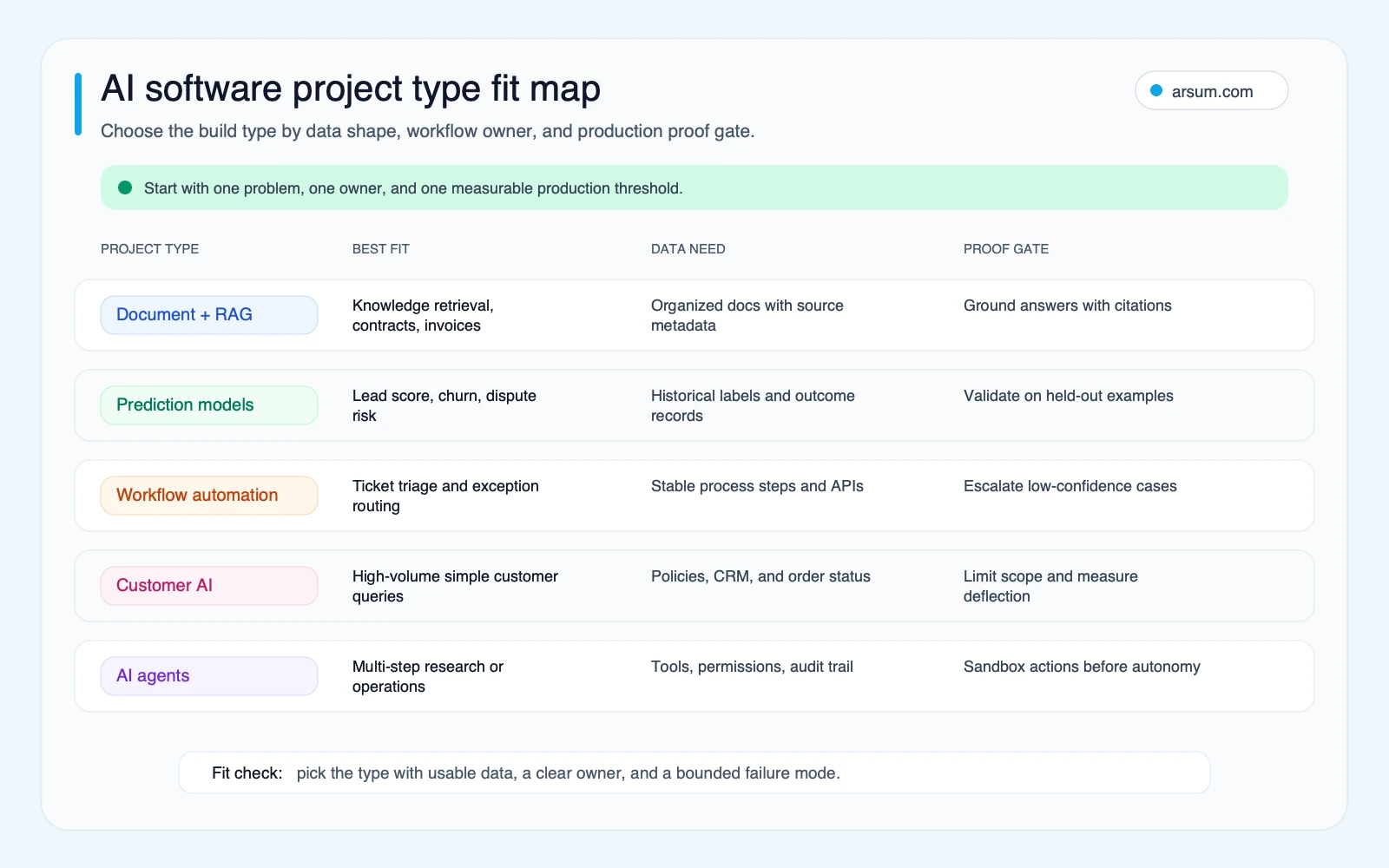
The project type should follow the data shape and production proof gate. A good first build has a clear owner, usable inputs, and a bounded failure mode.
💡 Arsum builds custom AI automation solutions tailored to your business needs.
Get a Free Consultation →The AI Software Development Process
A credible AI software development engagement follows a predictable structure, even if the exact timeline varies by data complexity and integration scope.
Discovery and Data Audit (Weeks 1–3)
Before any code is written, the development team needs to understand the business problem, map the data environment, and assess feasibility. This phase also surfaces the compliance questions that will affect architecture: where data is stored, what can be used for training, what cannot leave your environment.
The most common failure mode in AI projects is starting to build before this work is complete. You get a system that technically runs but does not solve the problem you needed to solve. Discovery is not a formality, it is where the real scope gets established.
Prototype and Validation (Weeks 4–8)
A narrow, working prototype demonstrates whether the core problem is solvable at the required accuracy level. This is where most projects either confirm viability or expose fundamental constraints, data quality problems, edge cases that undermine accuracy, and integration obstacles that were not visible in discovery.
A prototype that fails here is not automatically wasted effort. It can still prevent a much larger build from moving forward on the wrong assumptions.
Build and Integration (Weeks 6–14)
The validated approach is built into a production-ready system. This includes the model infrastructure, the application layer, integrations with existing tools, logging, monitoring, and the human-review workflow for cases the AI cannot confidently handle. Adoption planning happens here too: a system that is technically correct but that the team does not trust or use does not generate ROI.
Testing and Deployment (Weeks 12–16)
AI systems need testing that goes beyond conventional QA. You are validating accuracy across diverse inputs, checking for failure modes, and confirming that the system degrades gracefully when it encounters something it was not trained on. Deployment should be a controlled rollout with a defined rollback plan, not a switch-flip.
Production Patterns
Contained AI builds tend to work best when the problem is narrow, the data already exists in usable form, and the success metric is defined before development starts.
Examples include customer-health scoring, invoice reconciliation, document classification, and internal knowledge retrieval. In stronger implementations, the workflow owner helps define acceptance thresholds early, and the surrounding process is redesigned before launch rather than after. In weaker implementations, the technology may function but usage, trust, or measurement fails, which makes ROI hard to prove.
What AI Software Development Costs – and Where Budgets Break Down
Cost is driven by three factors: data complexity, required accuracy, and integration scope.
A contained system, one clear use case, reasonably clean data, integration with one or two existing tools, typically falls in the $40,000–$120,000 range for the initial build. More complex systems with multiple models, extensive data preparation, or enterprise integrations run $150,000–$500,000 and above. Ongoing maintenance, model retraining, performance monitoring, incremental improvements, typically runs 15–25% of the initial build cost annually.
Where budgets actually break down:
| Risk Factor | What Happens | How to Avoid It |
|---|---|---|
| Data quality problems discovered mid-build | Timeline extends; cost increases | Invest in data audit before signing a build contract |
| Scope expansion after prototype | New features added without timeline adjustment | Lock scope after prototype validation; add features in phase 2 |
| Compliance requirements not surfaced in discovery | Architecture must be redesigned; delays follow | Include legal and security review in discovery |
| Adoption failure after deployment | System built, not used; ROI is unclear | Involve end users in prototype validation; train before launch |
| Vendor dependency without internal ownership | Cannot maintain, retrain, or iterate without original vendor | Require documentation and knowledge transfer as contract deliverables |
The projects that exceed budget almost always do so because of factors in the left column above. None of them are unforeseeable, they are predictable risks that a structured engagement can surface before they become cost overruns.
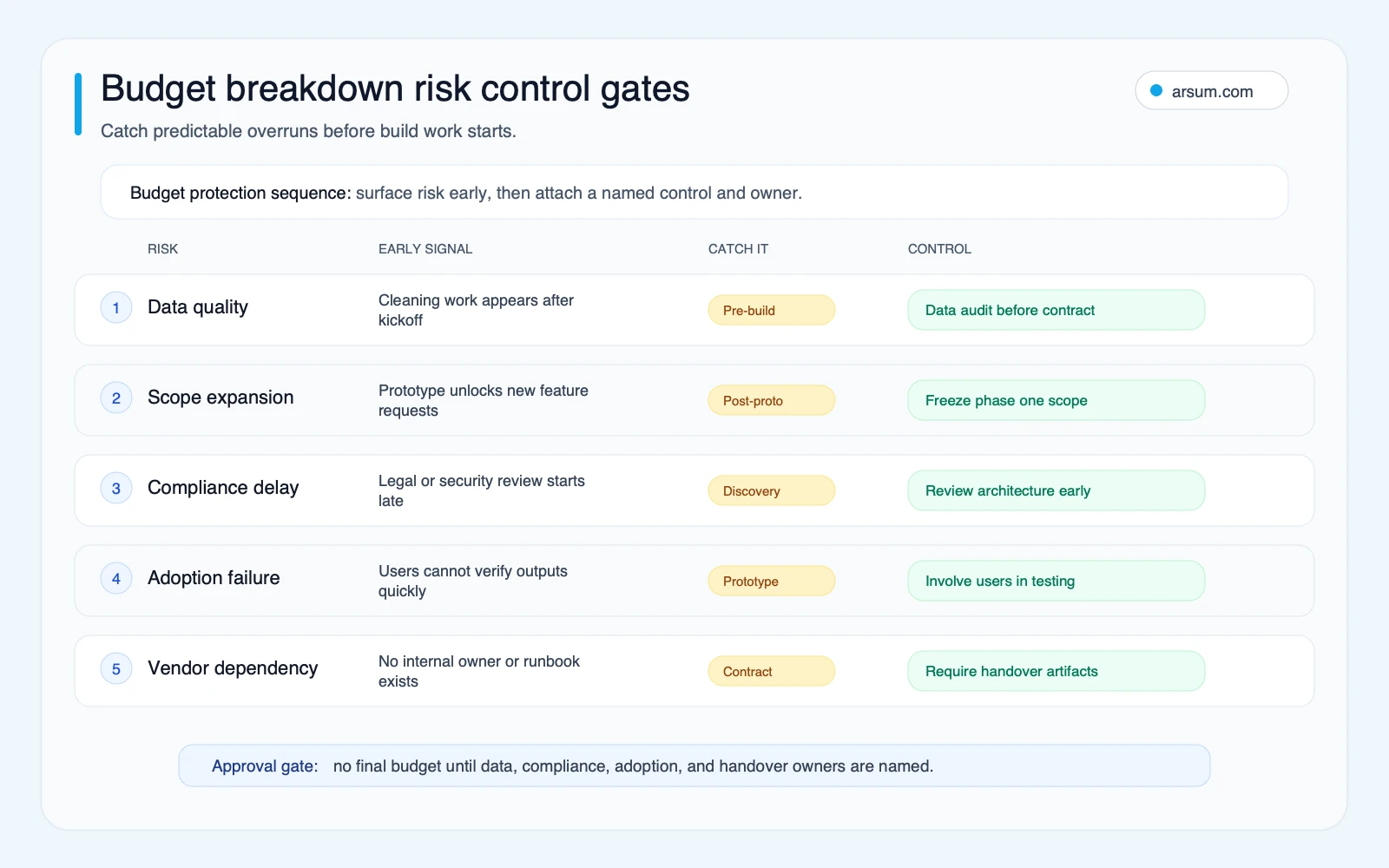
The risk controls turn budget overruns into pre-build gates. Each common failure mode needs an early signal, a catch point, and a named control before final approval.
Work With Arsum
We help businesses implement AI automation that actually works. Custom solutions, not cookie-cutter templates.
Learn more →Original Data: AI Software Build Readiness Scorecard
Use this scorecard before approving a production build. Score each line from 0 to 2. A total below 10 usually means discovery or data cleanup first, 10 to 15 supports a narrow pilot, and 16 or more supports production planning with governance already in view.
| Dimension | 0 | 1 | 2 |
|---|---|---|---|
| Business outcome clarity | The problem is still broad | The workflow is partly defined | The decision or task being automated is explicit |
| Data availability and quality | Data is missing or inconsistent | Core data exists but needs cleanup | Data is accessible, usable, and representative |
| Integration access | System access is blocked | Access exists but approvals are still open | Required systems and permissions are already mapped |
| Privacy and compliance review | Constraints are unknown | Review is planned but incomplete | Sensitive fields, retention, and approvals are already scoped |
| Evaluation dataset | No holdout set exists | Some examples exist but need work | A real evaluation set exists before build success is claimed |
| Human review workflow | Review path is undefined | Humans will check some outputs | Escalation and approval rules are named and documented |
| Security threat model | Risks are assumed away | Basic risks are known | Prompt injection, leakage, and tool misuse are explicitly modeled |
| Monitoring and retraining owner | Nobody owns post-launch quality | Ownership is shared loosely | A named operator owns monitoring and iteration |
| Rollback plan | Failure handling is unclear | Partial fallback exists | A safe fallback path is documented |
| ROI metric | Success is mostly narrative | One metric exists without a strong baseline | One operational and one business metric are baselined up front |
Decision Tree
- 0 to 9: Do not fund a full build yet. Clean the data, map permissions, and define the operating workflow first.
- 10 to 15: Run a narrow pilot around one workflow, one evaluation set, and one human-review path.
- 16 to 20: Plan the production build, but keep security review, monitoring, and rollback in the signed scope.
Commodity vs Non-Commodity Breakdown
| Commodity work, where generic AI can help | Non-commodity work, where operator judgment still matters | Why buyers should care |
|---|---|---|
| Boilerplate scaffolding and first-draft code | Defining the real workflow and exception paths | The first is cheap to generate. The second determines whether the system is usable. |
| Basic connector setup and CRUD plumbing | Designing evaluations, acceptance criteria, and rollback triggers | Fast output is not useful if nobody can verify quality. |
| Draft prompts, summaries, and internal docs | Security model, permissions, and data-governance choices | These decisions decide whether the build can safely go live. |
| Demo-ready copilots and mock interfaces | Change management with the team that must use the system | Adoption failure destroys ROI even when the demo looks strong. |
The practical takeaway is simple: do not pay premium rates for commodity output while the non-commodity work remains fuzzy.
Google Risk Box
If a vendor is scaling delivery with thin automation, treat that as an execution risk, not a productivity bonus. The same pattern Google warns about in scaled content applies here too: output can look complete, repeat generic patterns, and still collapse when real users hit edge cases.
Ask these questions before approving the project:
- Who reviews generated code or prompts, and against what acceptance tests?
- How are prompt injection, insecure output handling, and data leakage modeled before launch?
- What logs, monitoring, and rollback steps exist when the system misbehaves in production?
- Who owns the workflow after go-live, including updates to prompts, models, or evaluation sets?
Mini Experiment: Demo Win vs. Production Readiness
Use these paired questions in a vendor call. The goal is not to catch someone out. It is to see whether the team stays concrete once the conversation moves from a clean demo to live operating conditions.
| Ask this question | Superficial answer | Production-ready answer |
|---|---|---|
| Show me the happy-path workflow | A polished prototype and a broad promise about speed | A bounded workflow with named systems, owners, and failure cases |
| Show me the eval set and acceptance threshold | Generic claims about high accuracy | A held-out dataset, a measurable threshold, and a rule for when outputs do not ship |
| Show me what happens when the model is uncertain | “We keep a human in the loop” | Specific escalation paths, approval rules, and fallback logic for low-confidence cases |
| Show me how this is monitored after launch | A promise to optimize later | Logging, rollback steps, cost alerts, and a named business owner for post-launch quality |
If the answers get sharper as the questions get more operational, that is a good sign. If the answers get vaguer, you are probably still looking at prototype capability rather than production delivery.
Reusable Artifact: Production Gate Checklist
Use this checklist in discovery and again before launch:
- Define the decision the AI system supports or automates.
- Map data sources, permissions, retention rules, and sensitive fields.
- Create an evaluation set before the build is declared successful.
- Threat-model prompt injection, data leakage, and unsafe tool use.
- Instrument logging, monitoring, escalation, and rollback.
- Assign business and technical owners for post-launch review.
Methodology Note
This guide separates primary-source controls from qualitative practitioner signal. Risk, security, and evaluation guidance here is grounded in NIST’s AI Risk Management Framework, OWASP guidance on LLM application risk, Google Cloud responsible AI materials, and Microsoft’s security development lifecycle guidance. Practitioner discussions from Hacker News and Reddit informed the buyer-objection language around review load, context drift, and the gap between prototype success and production readiness. Those community discussions are directional, not statistical proof.
Moving from Pilot to Production
Most organizations that succeed with AI software development follow the same pattern. They start with one well-defined problem in a part of the business where the data already exists and where the cost of errors is measurable. They treat the first project as a learning exercise as much as a product. They build internal understanding of how to work with AI systems before scaling.
The teams that scale successfully ask: what did we learn about our data, our processes, and our capacity to work with AI systems that we could not have learned without building? That question guides what they pursue next.
What failure at this stage looks like: A common pattern is a system that passes technical validation during testing but sees low usage after launch.
The failure is not necessarily technical. The people who were supposed to use the system may not have been involved in defining what the outputs meant during development. They do not trust outputs they cannot verify quickly, so they revert to the previous manual process. The system works. The change management did not happen.
The lesson is not that the project should have been avoided, it is that adoption planning should have started early, not at the end. Defining how workflow integration will work, and building user trust through involvement in prototype validation, is not soft-skills work. It is the difference between a deployed system and a sunk cost.
Organizations that struggle skip the pilot-to-production discipline entirely. They pursue broad transformation initiatives before demonstrating value at the unit level. They underinvest in data readiness. They hand the project to a vendor without maintaining internal ownership of the problem definition.
A coherent custom AI solutions strategy treats the first build as a unit of learning, and sequences subsequent builds based on what that learning revealed about where the leverage actually lives in the operation.
The practical question is not which AI use case to pursue. It is which one you can define clearly, execute, and measure within the next six months. And once you are evaluating vendors, this guide to choosing an AI software development company covers the production signals and red flags worth screening before you sign.
Build In-House or Hire a Specialist
Most business leaders do not have the internal team to build AI software from scratch. Hiring AI software engineers with experience in ML infrastructure, model development, and production deployment takes months, and competes with demand from every technology company in the market.
Use these five criteria to decide:
1. ML team depth. Do you have two or more engineers with production ML or MLOps experience, not data analysts or general-purpose software engineers? If not, in-house development means hiring before building, which adds significant recruiting time before the first line of model code is written.
2. Domain specificity. Is your problem specific enough to your industry that a generalist firm would need meaningful ramp time just to understand the context? High domain specificity favors either a specialized firm that has operated in your vertical or an internal team with subject matter experts embedded throughout the build.
3. Timeline pressure. Can your organization absorb a long hiring, onboarding, and ramp period before reaching a production system? If the problem is tied to a competitive threat, a compliance deadline, or a revenue target, the hiring cycle may eliminate in-house as a realistic option for this project.
4. Data readiness. Have you completed a data audit and confirmed that your historical data is structured, accessible, and sufficient for the stated use case? Organizations that begin hiring before completing this step frequently discover mid-build that the data requirement is larger or more complex than initially scoped, creating a mismatch between team capacity and actual project need.
5. Long-term ownership capacity. Who owns the system after launch? AI systems require ongoing retraining and monitoring. If internal ownership is undefined before the build starts, the organization will remain dependent on whoever built the system, internal or external, for longer than expected.
If you answer “no” or “unclear” to three or more of these, a specialist firm is often the faster, lower-risk path for the first build. That does not mean outsourcing the problem definition, internal ownership of success criteria is non-negotiable regardless of who writes the code.
For a direct comparison of the trade-offs, see our guide on hiring an AI developer vs. working with an agency. If you are evaluating specific firms, our breakdown of what an AI app development company actually delivers, and the red flags to watch for, covers the vendor selection process in detail.
Frequently Asked Questions
We ran a pilot that worked in testing but failed in production – what went wrong?
The most common cause is distributional shift: the data the model was trained and tested on does not match the data it encounters in production. This happens when test data is cleaner than production data, when production queries represent a different case mix than the training set, or when the business conditions that generated the training data have changed since labeling. A second common cause is workflow integration failure, where the system produces correct outputs but the process around it was never redesigned to act on those outputs. Diagnosing which problem you have requires reviewing production inputs against training data distributions and mapping where outputs are being ignored or overridden in the actual workflow.
Our vendor says our data is good enough – how do we verify that independently?
Ask for a data audit report with three specific outputs: a sample distribution of your training data by category or label, the percentage of records requiring cleaning or imputation before use, and a holdout accuracy score measured on a dataset the vendor did not use during training. A vendor who cannot produce these, or who declines, has not completed the data work required to make that claim. You can also engage an independent technical reviewer before signing a build contract to assess data sufficiency against the stated use case, but if you do not have that option, you should at least require clearer evidence than a verbal assurance.
What contract terms protect us if accuracy targets are not met in production?
The minimum protections are: a defined accuracy threshold stated as a measurable metric (precision and recall at a specific threshold, not “high accuracy”), a testing protocol specifying how accuracy is measured and on what dataset, a remediation obligation requiring the vendor to address accuracy shortfalls within a defined timeframe, and a holdback or milestone payment structure that ties final payment to acceptance criteria being met in production, not just in testing. Contracts that define success only at the prototype stage give the vendor no structural incentive to close the gap between a working proof-of-concept and a working production system.
How long does it take to build a custom AI system?
Many production AI systems take roughly 10–20 weeks from discovery to deployment. The primary variable is data: how organized it is, how much preparation it needs, and whether it actually reflects the problem you are trying to solve. Teams that invest in data readiness before the build consistently come in at the shorter end of that range.
What are the main risks of AI software development?
Data quality problems are the most common. Privacy and compliance requirements that surface late cause the most expensive delays. Adoption failure, where the system is built but the team does not use it, accounts for a significant share of projects that deliver no ROI despite working technically. Each of these risks is manageable if the engagement is structured to surface them early.
Is AI software development right for small and mid-sized companies?
Yes, if the use case is contained. The mistake most mid-market companies make is starting too broad. A single well-defined problem, one document type, one prediction task, or one workflow, with clean historical data is a better starting point than a multi-function transformation initiative. The cost of a contained build is accessible for companies well below enterprise scale, and the learning compounds.
How do we measure ROI from AI software development?
The clearest ROI measures are: hours recovered per month on a specific process, error rate reduction on a specific task, and revenue impact, retention improvement, conversion rate change, or churn reduction. Less useful are cost savings stated in the abstract or productivity improvement as a percentage without a baseline. The best AI builds define the ROI metric before the project starts and track it from deployment.
Ready to Automate Your Business?
Stop wasting time on repetitive tasks. Let AI handle the busywork while you focus on growth.
Schedule a Free Strategy Call →