Quick answer: AI strategy consulting services are worth paying for when the work goes beyond trend slides and turns into workflow choice, integration planning, governance design, and a scoped first implementation. Buy software when the workflow is already standard and the integration is shallow. Hire a consultant when multiple systems, approval steps, or risky outputs make the implementation harder than the demo. The fastest way to tell the difference is simple: ask what they will monitor after launch, who owns the system after handoff, and what metric they want to improve first.
AI Strategy Consulting Services: Buyer Guide
Explore ai strategy consulting services: compare workflow fit, costs, risks, evidence, and practical next steps before you build, buy, or hire.

Table of Contents
- What Most Guides Miss
- What a Credible AI Strategy Consulting Engagement Should Include
- Social Listening: What Technical Buyers Actually Worry About
- When to Buy Software, Use Your Team, Hire a Consultant, or Wait
- Mini Experiment: Test a Consultant Before the Bigger Engagement
- Commodity vs Non-Commodity AI Strategy Consulting
- Comparison Table: Which Type of Vendor Fits the Job?
- Scope-to-ROI Matrix
- Buyer Scorecard: Seven Questions That Separate Execution from Theater
- Operator Note: What Production AI Workflows Actually Require
- Pre-Contract Checklist: What Should Be Written Into the Proposal
- Questions Worth Asking Before You Sign
- Methodology
- FAQ: AI Strategy Consulting Services
AI strategy consulting services sit in an awkward market. Plenty of firms can explain what AI could do in theory. Fewer can show how the work maps to your actual systems, where human approvals should stay in place, or what will happen when the model is wrong in production.
That gap matters because buyers are not really shopping for “strategy.” They are shopping for a safer path from vague AI ambition to one useful workflow that actually ships.
What Most Guides Miss
Most pages ranking for this topic do one of three things:
- list agencies
- repeat transformation language without showing delivery depth
- blur strategy, software selection, and implementation into one vague promise
That is not enough for a buyer making a real decision.
A credible AI strategy engagement should answer five operational questions before the contract gets large:
- Which workflow should we start with, and why this one first?
- What systems and data does it touch?
- Where do humans still approve, review, or override?
- What do we log, monitor, and alert on after launch?
- Who owns the workflow once the consultants leave?
If a proposal cannot answer those questions clearly, it is closer to advisory theater than implementation planning.
What a Credible AI Strategy Consulting Engagement Should Include
The strongest engagements usually cover four layers of work.
1. Workflow selection A consultant should narrow the field to a small set of candidate workflows based on business value, implementation feasibility, and risk. This is usually where the biggest quality gap shows up. Weak firms jump straight to tools. Strong firms start with the workflow.
2. Architecture and tooling choices This is where build versus buy decisions happen. The right answer is not always an agent. Anthropic’s guidance on effective agents explicitly recommends starting with the simplest approach that fits the workflow. Good consultants do the same.
3. Production roadmap A roadmap should separate discovery, prototype, production hardening, rollout, and ownership. If these phases are collapsed into a single timeline, hidden work is usually being hidden on purpose.
4. Governance and operating model NIST frames AI governance around trustworthiness across design, development, use, and evaluation. In practice, that means defining approval steps, risky-output handling, data boundaries, and post-launch accountability before the workflow goes live.
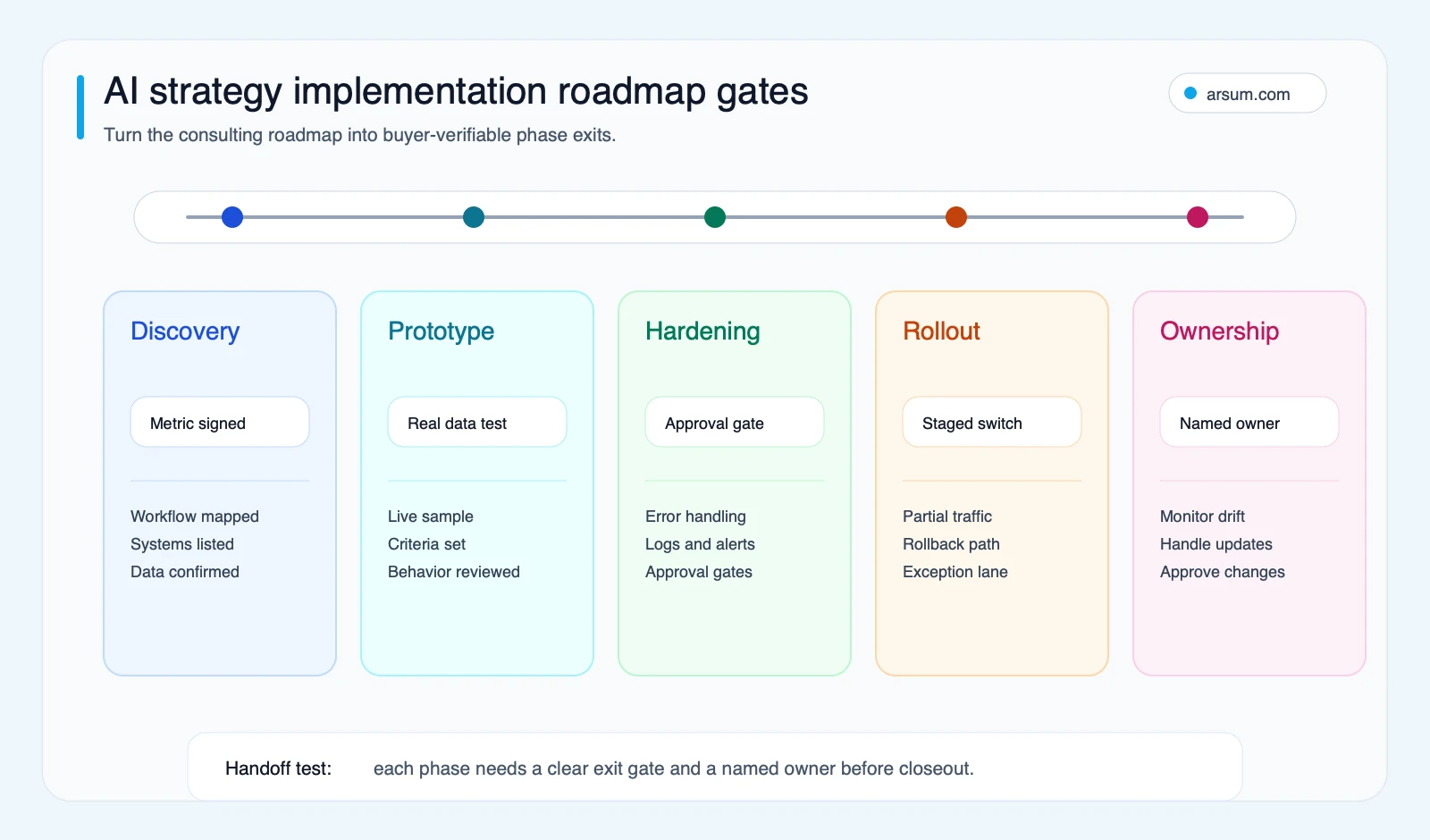
Use these roadmap gates to make every consulting phase buyer-verifiable before the next phase starts.
Social Listening: What Technical Buyers Actually Worry About
Buyer and operator discussions tend to repeat the same concerns:
- polished AI presentations from consultants who cannot judge integration depth
- strategy engagements that end with slides while the client still has to figure out implementation, hiring, and rollout alone
- production systems with no tracing, no cost monitoring, and no audit trail once the workflow is live
These are qualitative signals, not market-wide statistics. They still matter because they point to the exact places where buyers get trapped: workflow fit, engineering depth, and ownership after launch.
When to Buy Software, Use Your Team, Hire a Consultant, or Wait
Use this decision tree before you sign anything.
| Situation | Best path | Why |
|---|---|---|
| Workflow already maps to an existing SaaS product | Buy software | Speed is high and custom work is low |
| Your team already has engineering and integration capacity | Use your internal team | Knowledge stays in-house and the scope is already clear |
| Workflow crosses multiple systems and needs custom logic | Hire an implementation-focused consultant | The hard part is orchestration and governance, not just tool setup |
| The business problem is still fuzzy | Wait and clarify first | A consultant hired too early will optimize the wrong problem |
| The failure cost is high and approvals matter | Hire a partner with delivery proof | Governance and rollout discipline matter more than slide quality |
For a deeper look at the implementation side, see AI implementation services.
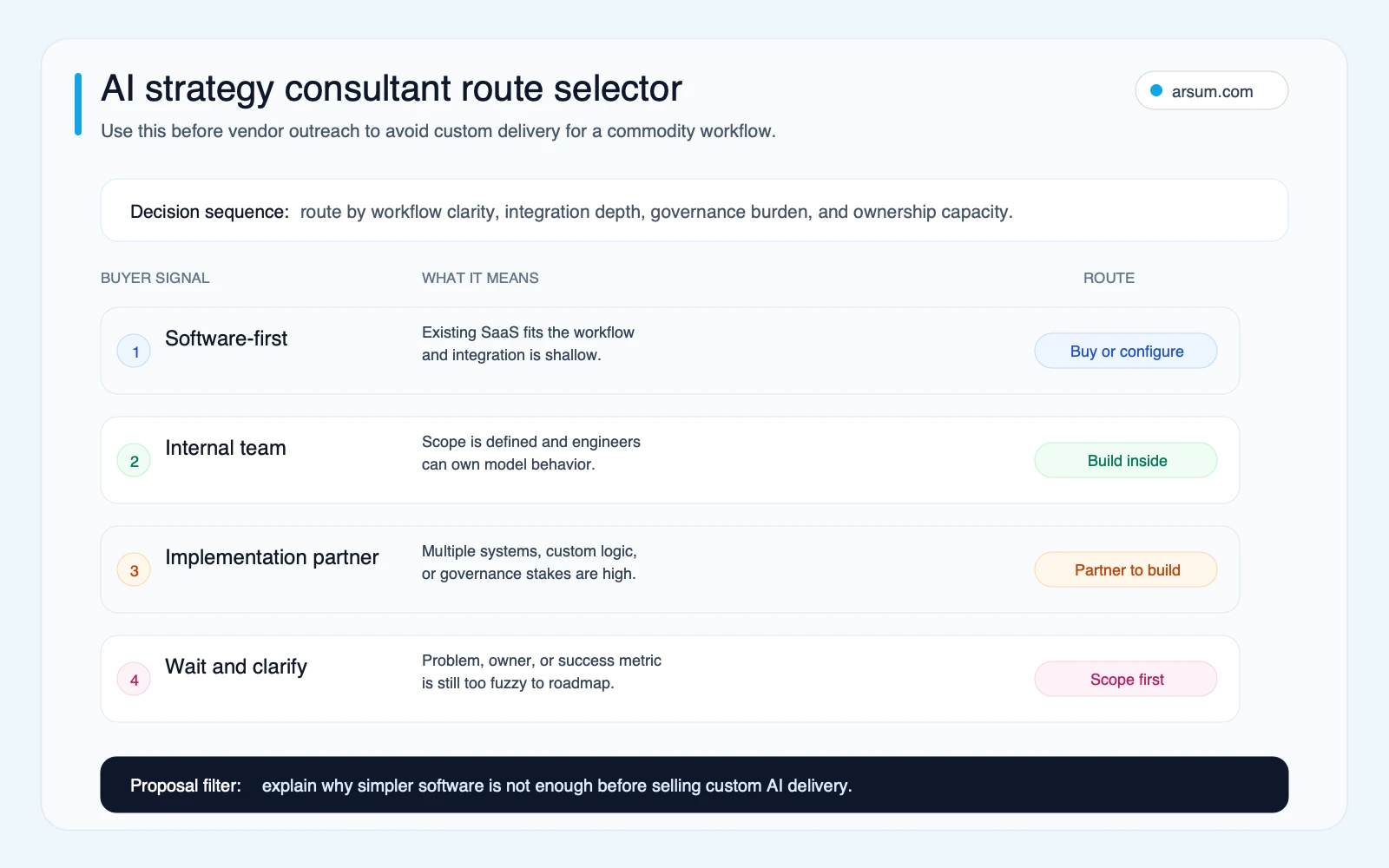
Use this route selector before vendor outreach. The right engagement model depends on workflow clarity, integration depth, governance burden, and who will own the system after launch.
Software-first is the right call when your workflow maps cleanly to an existing tool, integration is shallow, and you have someone internally who can own configuration and maintenance. Standard tasks like meeting summaries, inbox triage, or basic document classification often have prebuilt solutions that are faster and cheaper than a consulting engagement.
Mini Experiment: Test a Consultant Before the Bigger Engagement
Before committing to a long retainer, ask the consultant to scope a fixed pilot around one workflow.
A useful pilot looks like this:
- choose one repetitive workflow with a clear owner
- document the current baseline for two weeks, such as time per case, error rate, or response time
- map the systems touched by the workflow
- define where AI drafts, classifies, or routes, and where humans still approve
- run a prototype on a narrow slice of traffic or historical data
- review what broke before expanding scope
This does two things at once. It reveals whether the consultant can work at workflow level instead of staying in abstract strategy language, and it gives you a cleaner baseline for ROI before the larger contract begins.
Commodity vs Non-Commodity AI Strategy Consulting
Most buyers are offered two very different products under the same label.
Commodity consulting
- trend decks and generic use-case lists
- pre-selected tools from the firm’s preferred stack
- roadmap slides without integration analysis
- discovery workshops that stop before real system design
- handoff documents with no production ownership
Non-commodity consulting
- workflow-specific analysis tied to your actual systems
- build versus buy advice that sometimes recommends the simpler option
- prototype planning against real data or a real process slice
- explicit approval design, logging, and monitoring requirements
- a named owner for post-launch changes and incident handling
The second category is what buyers usually think they are purchasing. The first category is what many proposals quietly deliver.
Comparison Table: Which Type of Vendor Fits the Job?
| Option | Best for | Speed to value | Governance fit | Hidden cost risk | Ownership after launch |
|---|---|---|---|---|---|
| Off-the-shelf SaaS | Standard, well-defined workflows | Fast | Low to moderate | Low if integration is shallow | Mostly vendor-managed |
| Freelance consultant | Small scoped builds | Moderate | Often light | Moderate | Often unclear |
| Boutique implementation partner | Multi-system workflow automation | Moderate | Strong when scoped well | Moderate if scope is clean | Usually shared or defined |
| Enterprise consultancy | Large programs and heavy governance | Slow | Strong | High | Contract-dependent |
The middle option is where buyers need the most discipline. Boutique partners can be the best fit for a mid-market workflow, but only if they show operational depth and not just strategy language. For adjacent models, see AI consulting services, AI transformation consulting, and business process automation consulting.
💡 Arsum builds custom AI automation solutions tailored to your business needs.
Get a Free Consultation →Scope-to-ROI Matrix
Cheap proposals often look attractive because they quietly remove the parts that make the workflow safe.
| Phase | What you should receive | What happens if it is skipped |
|---|---|---|
| Discovery | Workflow choice, baseline metric, system map | You automate the wrong thing |
| Prototype | Test against real data or a real process slice | Model behavior surprises you later |
| Production hardening | Logging, approval gates, fallback logic, alerts | Errors become invisible until users feel them |
| Rollout | Staged launch and recovery path | One bad deployment becomes a trust problem |
| Ownership | Named maintainer, change policy, review rhythm | Nobody owns drift, cost, or fixes |
That matrix is more useful than a generic ROI promise because it shows where “cheaper” strategy work often becomes expensive later.
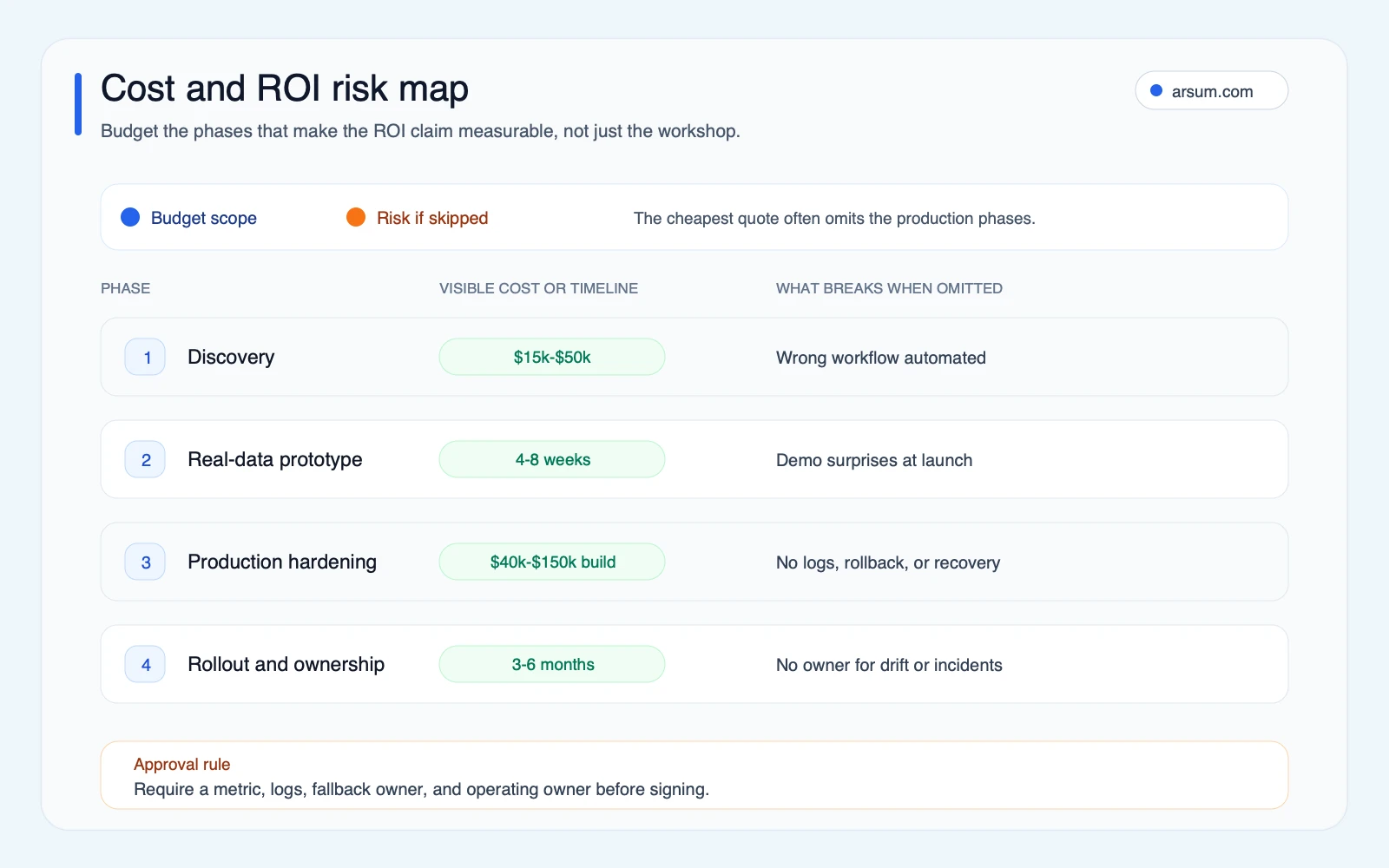
Use this cost and ROI risk map to see which production phases must stay in scope before a proposal can make a measurable ROI claim.
Buyer Scorecard: Seven Questions That Separate Execution from Theater
Use this scorecard in vendor calls.
| Criterion | What good looks like | Score (1-5) |
|---|---|---|
| Workflow selection quality | They narrow to one or two strong candidates instead of pitching everything | |
| Integration depth | They ask how your systems already work before talking tools | |
| Approval design | They can show where humans stay in the loop | |
| Observability plan | They can describe tracing, alerts, and output review after launch | |
| Data handling clarity | They explain where data goes and what provider assumptions matter | |
| Internal enablement | Your team can understand and maintain the workflow after handoff | |
| Post-launch ownership | Someone is clearly responsible for changes, monitoring, and incidents |
A vendor who scores weakly on observability or internal enablement is usually selling a roadmap, not a working operating model.
Operator Note: What Production AI Workflows Actually Require
Operator note: Production AI work is usually less about prompt cleverness and more about boring control systems.
The missing pieces show up fast once a workflow touches real operations:
- Tracing: What did the system do step by step?
- Cost visibility: How do you catch model spend drifting under real volume?
- Approval logic: Which outputs must stop for human review?
- Audit trail: Can you explain later what happened and why?
- Fallback path: What happens when the model fails or the provider is unavailable?
OpenAI’s agent guidance frames production systems around instructions, guardrails, and tool use. OWASP’s generative AI security work is a useful reminder that tool access and prompt handling can create real operational risk. A strategy engagement that never reaches these details is incomplete.
Google Risk Box: AI consulting content becomes thin when it stays at the level of trends and vague transformation language. This guide focuses on workflow choice, approval design, monitoring, ownership, and rollout because those are the factors that change whether a buyer gets a real operating system or just a deck.
Pre-Contract Checklist: What Should Be Written Into the Proposal
Before you sign, make sure the proposal names the operational details that usually get hand-waved away in sales conversations. A credible AI strategy consulting engagement should spell out:
- the single workflow or workflow slice being used for the first implementation
- the systems, data sources, and approval points that workflow touches
- what gets logged, reviewed, and alerted on once the workflow is live
- the fallback path when the model output is wrong or the provider is unavailable
- who owns monitoring, iteration, and incident response after handoff
If those items are missing, the proposal may still sound strategic while leaving the expensive delivery risk with your internal team.
Questions Worth Asking Before You Sign
- Show me a workflow you scoped from discovery through handoff. What changed between the first idea and the shipped version?
- What is your default recommendation when a workflow is better solved with simple automation instead of an agent?
- What monitoring, alerts, and logs do you usually add before launch?
- How do you decide whether client data should touch an external model provider?
- What does post-launch support actually include, and who owns the workflow after the first 90 days?
- Tell me about a time you advised against automating a workflow. Why?
If the answers stay abstract, keep looking. Teams that still need a broader buyer-side framing before vendor selection should also review AI consulting.
Work With Arsum
We help businesses implement AI automation that actually works. Custom solutions, not cookie-cutter templates.
Learn more →Methodology
This article was refreshed on July 4, 2026 using three evidence layers. First, we reviewed current search results for AI strategy consulting services to see what buyer questions ranking pages still skip. Second, we treated visible Hacker News and X discussions as qualitative signal about operator concerns, especially skepticism toward generic consulting, weak implementation proof, and shallow production readiness. Third, we checked primary documentation from NIST, OWASP, OpenAI, Anthropic, and Google’s Search guidance to anchor the governance, observability, and thin-content risk sections in source material rather than trend language.
Community snippets helped surface the questions buyers keep asking, but they were not treated as market-wide proof. Direct product, security, and search-quality claims were only kept when they could be grounded in primary documentation or framed as practical buying guidance.
FAQ: AI Strategy Consulting Services
How much do AI consulting services cost?
Scoped discovery engagements typically run $15,000 to $50,000 over four to eight weeks. Full implementation partnerships from scoping through production launch often range from $40,000 to $150,000 for one mid-market workflow, depending on integration depth, governance needs, and post-launch support.
What should be included in an AI consulting engagement?
A credible engagement should include workflow selection, architecture and tooling guidance tied to your real systems, a phased implementation roadmap, governance and approval design, observability requirements, and a written post-launch ownership plan.
How do you measure ROI from AI consulting?
Tie ROI to one operational metric before work starts, such as labor hours saved, cycle time reduced, error rate reduced, or revenue speed improved. If the baseline and success metric are not defined at scoping, ROI usually becomes a story instead of a measurement.
When should a business hire a consultant instead of buying software?
Buy software when the workflow maps cleanly to an existing product and integration is shallow. Hire a consultant when the workflow touches multiple systems, needs custom logic, or carries governance complexity that a standard tool cannot handle well.
What red flags should I watch for when evaluating AI consultants?
Watch for vendors who recommend tools before asking about your systems, cannot explain post-launch monitoring, have no concrete implementation examples, or cannot tell you when they advised a client not to automate a workflow.
Ready to Automate Your Business?
Stop wasting time on repetitive tasks. Let AI handle the busywork while you focus on growth.
Schedule a Free Strategy Call →Written by:Arsum editorial team
- Reviewed by
- Arsum editorial team
- Published
- June 17, 2026
- Updated
- July 4, 2026
- How this was produced
- Arsum uses research packs, source checks, and human editorial review to prepare and update blog articles. Editors are responsible for the final page.
- Source policy
- Sources are linked in the article when used. Methodology and source notes are included on higher-risk or high-visibility pages and are being rolled out across the archive. Editorial policy.
- Why this page exists
- Help B2B operators evaluate AI automation, implementation scope, cost, risk, and build-vs-buy decisions with practical context.