AI technical documentation automation becomes a fundable project when releases repeatedly ship before release notes, API references, or help pages catch up—and engineers then spend the next cycle correcting wrong-version or unsupported statements. For a Documentation Lead or VP Engineering, the buying question is whether one document class can be drafted from current product evidence with less total review time and no increase in severe factual or safety errors.
AI Technical Documentation Automation: 15 Tasks
AI technical documentation automation: compare 15 O*NET tasks, the 63.9/100 score, 2029 capability, human controls, task capacity, and a practical first pilot.
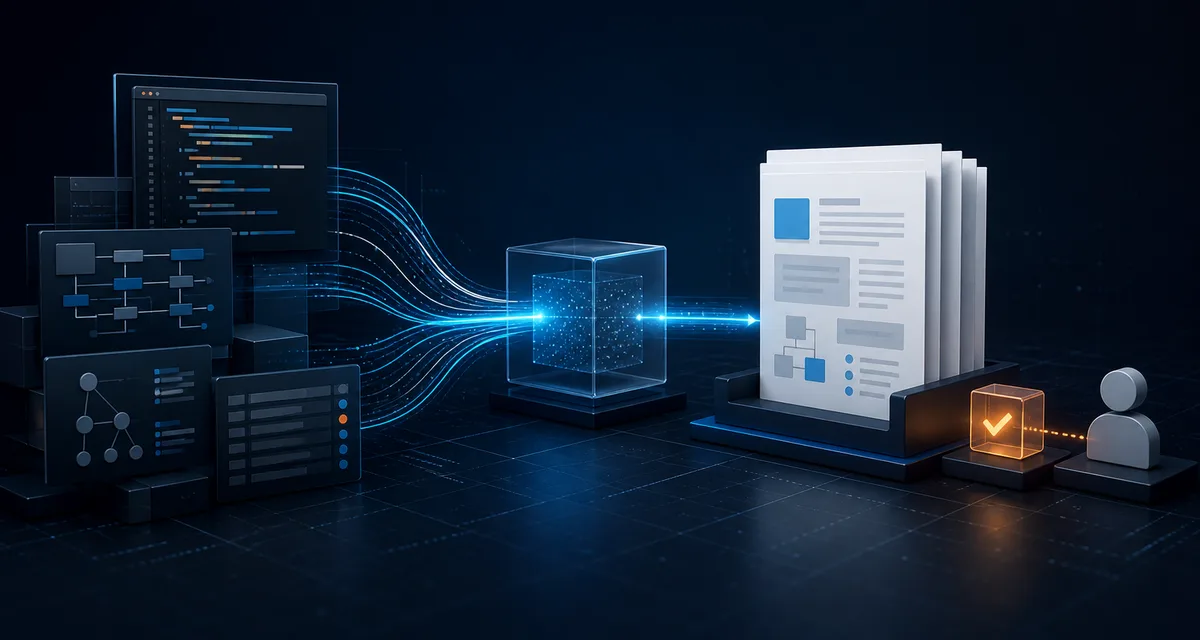
Table of Contents
- Technical writing automation opportunity
- The documentation decision: fix source coverage before buying generation
- What AI may draft—and what still requires product truth
- Source-linked documentation workflow and exception handling
- A 30-day documentation scorecard with publish/no-publish gates
- Worked wrong-version exception and visible documentation economics
- Documentation publication RACI
- How the 63.9/100 task score maps to this pilot
- Buy, connect, or build the documentation workflow
- Evidence that changes the ai technical documentation automation buying decision
- Why the 2029 technical writing scenario is secondary
- AI technical documentation automation: buyer questions
This page is for teams with versioned product sources, a recurring documentation queue, and named technical truth owners. It does not assume that code alone explains user intent, operational warnings, security constraints, or publication quality. Arsum’s task model is a screening layer—not proof of savings or permission to automate—and this page turns it into a buyer test with explicit owners, thresholds, and stop conditions.
Arsum Automation Opportunity Index · 2026-08-12
Technical writing automation opportunity
Technical writers can automate source comparison, first drafts, release notes, terminology checks, content restructuring, and documentation QA. Product truth, safety, audience fit, and publication approval remain accountable work.
Current score
63.9/100
Strong assisted-automation opportunity
Modeled task capacity
14.4-24 hours/week
P25-P75 planning range
2029 capability scenario
75.5/100
+11.6 points, not an adoption forecast
Recommended first pilot
release-note and API-documentation drafts
Start narrow, measure, then expand
Decision: Generate from versioned product evidence and require source-linked review before publication.
How the technical writing score is calculated
For technical writing, Arsum assessed 15 of 15 O*NET tasks from Technical Writers (27-3042.00). The 63.9/100 result weights each task's current automation share by O*NET importance, relevance, and frequency. It measures technical workflow opportunity—not the percentage of technical writing jobs that disappear and not the share of a team that should be removed.
Writers, engineers, and product owners should approve technical truth, safety instructions, API behavior, audience assumptions, legal constraints, and publication. The weighted supervision estimate is 20.4%, which is why the practical design is an exception-and-approval system rather than unsupervised autonomy.
Top technical writing tasks for automation support
O*NET task 3966
Organize material and complete writing assignment according to set standards regarding order, clarity, conciseness, style, and terminology.
80/100
Hybrid
Automate normal cases; route exceptions
O*NET task 3967
Maintain records and files of work and revisions.
75/100
Hybrid
Automate normal cases; route exceptions
O*NET task 3968
Edit, standardize, or make changes to material prepared by other writers or establishment personnel.
55/100
Hybrid
AI assists; review exceptions and material outputs
O*NET task 3969
Confer with customer representatives, vendors, plant executives, or publisher to establish technical specifications and to determine subject material to be developed for publication.
60/100
Llm
AI assists; review exceptions and material outputs
O*NET task 3970
Review published materials and recommend revisions or changes in scope, format, content, and methods of reproduction and binding.
70/100
Llm
AI assists; review exceptions and material outputs
O*NET task 3971
Select photographs, drawings, sketches, diagrams, and charts to illustrate material.
55/100
Hybrid
AI assists; review exceptions and material outputs
O*NET task 3972
Study drawings, specifications, mockups, and product samples to integrate and delineate technology, operating procedure, and production sequence and detail.
55/100
Hybrid
AI assists; review exceptions and material outputs
These are ranked for practical opportunity: task exposure and current capability are discounted when implementation is complex, supervision is heavy, or live human interaction dominates. The recommended pilot above is an editorial choice among these signals, not simply the highest raw percentage.
Technical writing tasks that should remain human-led
- 60/100 current capability: Observe production, developmental, and experimental activities to determine operating procedure and detail. AI assists; review exceptions and material outputs.
- 60/100 current capability: Analyze developments in specific field to determine need for revisions in previously published materials and development of new material. AI assists; review exceptions and material outputs.
- 55/100 current capability: Edit, standardize, or make changes to material prepared by other writers or establishment personnel. AI assists; review exceptions and material outputs.
- 55/100 current capability: Interview production and engineering personnel and read journals and other material to become familiar with product technologies and production methods. AI assists; review exceptions and material outputs.
Technical writing capability from 2026 to 2029
2026 current
63.9/100
63.9/100
2028 midpoint
71.6/100
71.6/100
2029 scenario
75.5/100
75.5/100
The scenario adds 11.6 score points by 2029-08-12 under the same task mix. It assumes better reliability and integration in the tasks already identified as technically assistable. It does not assume that employers deploy those systems, that every normal case becomes autonomous, or that employment changes by the same amount.
The largest weighted capability gains come from:
- O*NET task 3968, Edit, standardize, or make changes to material prepared by other writers or establishment personnel. 55→70.
- O*NET task 3971, Select photographs, drawings, sketches, diagrams, and charts to illustrate material. 55→70.
- O*NET task 3973, Interview production and engineering personnel and read journals and other material to become familiar with product technologies and production methods. 55→70.
Modeled hours and wage capacity for technical writing
The technical writing model assigns 30 hours of a reference 40-hour week across rated tasks and leaves 10 hours unmodeled. On that explicit assumption, current automation capability represents 14.4-24 hours/week. At the May 2025 BLS national mean wage of $47/hour, the gross technical writing planning range is $34,855-$58,091/year per worker.
BLS national employment45,500
Mean annual wage$96,970
Tasks with full score inputs15/15
Assessment coverage100%
Gross wage capacity is not net savings. A business case must subtract implementation, software and model usage, review time, exception handling, maintenance, and risk reserves. BLS employment excludes self-employed workers.
A controlled 30/60/90-day technical writing pilot
- Days 0-30: baseline release-note and API-documentation drafts. Capture volume, handling time, rework, error rate, source systems, permissions, and the exception owner before changing the workflow.
- Days 31-60: run in review mode. Let the system prepare or route work, keep logs, and require human approval at the boundary described above. Measure accepted outputs and review cost, not generated volume.
- Days 61-90: expand only after evidence. Increase scope when accuracy, cycle time, exception rate, and net capacity beat the baseline without weakening customer, employee, financial, legal, or operational controls.
Sources, formula, and limitations
Occupation and task facts come from O*NET O*NET 30.3. Employment and wage inputs come from BLS OEWS May 2025 national estimates. Arsum adds the task-level current capability, supervision, implementation, time-allocation, and 2029 scenario assessments.
The occupation score is the exposure-weighted mean of task automation shares. Exposure combines normalized O*NET importance, relevance, and a log-scaled transformation of frequency. The time range applies a ±25% planning band around the modeled task capacity. Read the full Automation Opportunity Index methodology for formulas, QA gates, version history, and reproducible queries.
- The task inventory comes from O*NET 30.3; Arsum supplies the automation assessment and transformation.
- The time model allocates 30 hours of a reference 40-hour week across rated O*NET tasks, leaving 10 hours unmodeled for context switching and work not represented by task statements.
- Hours and wage capacity are planning ranges, not measured savings. Net ROI must subtract software, implementation, review, exception handling, maintenance, and risk costs.
- The 2029 value is a capability scenario, not a forecast of adoption, employment, layoffs, or autonomous operation.
- All 15 tasks have the O*NET inputs needed for score weighting and were assessed.
- BLS wage and employment data use the matching detailed SOC occupation; employment excludes self-employed workers.
Version: aoi-v0.4-software-it · run 10 · capability date 2026-08-12 · forecast horizon 2029-08-12.
The documentation decision: fix source coverage before buying generation
The viable first unit is a source-linked draft for one document class—release notes, an API change page, or a bounded help-page update. Every material statement must point to the same release’s code, schema, issue, decision, test, or named expert evidence, and publication remains gated by technical and editorial review.
Run this pilot when:
- One recurring document class has stable templates, material volume, and a baseline for drafting, review, correction, and post-publication defects.
- Merged changes, release artifact, API schema, issue or decision records, tests, terminology, and ownership can be joined by release and service identity.
- A Documentation Lead and affected Engineering Truth Owner can approve or reject every pilot draft.
- Security, privacy, safety, deprecation, and disclosure-sensitive content has an explicit reviewer and block rule.
Do not fund it yet when:
- The release artifact and documentation cannot be tied to a stable version.
- Product decisions, warnings, or support knowledge live only in unowned chat and memory.
- The tool cannot expose sentence-level evidence or distinguish missing, stale, and contradictory sources.
- Generated pages could publish automatically before engineering truth and required security review.
The first commercial decision is therefore bounded: improve release-note and API-documentation drafts, not “automate technical writing.” The source of truth, case definition, reviewer, exception queue, and rollback state must exist before a vendor demonstration counts as evidence.
What AI may draft—and what still requires product truth
Documentation can be internally consistent and still wrong. Every generated statement should resolve to a code, schema, issue, decision, test, or named expert source at the same version as the release.
| Workflow layer | Safe AI contribution | Human-owned boundary |
|---|---|---|
| Release-note preparation | Collect merged changes, issues, tests, flags, deprecations, and known impacts; draft a versioned change summary with citations. | Product and engineering owners decide materiality, customer impact, limitations, rollout language, and whether the release is ready to describe. |
| API reference updates | Diff released schemas and examples; draft changed fields, prerequisites, error behavior, compatibility notes, and unresolved questions. | Engineering Truth Owner verifies actual released behavior; Security Reviewer approves sensitive examples and warnings. |
| Help-page maintenance | Find stale terminology, links, screenshots, prerequisites, and steps; propose edits grounded in current product evidence. | Documentation Lead owns audience fit, information architecture, accessibility, editorial quality, publication, and correction. |
This separation answers the ambiguity behind the keyword. A system may be capable of generating a plausible artifact while still being unqualified to choose the underlying model, scientific conclusion, or product truth. Permission follows the workflow layer and cost of error, not the fluency of the output.
Source-linked documentation workflow and exception handling
Repository, API schema, ADR, issue, test, release, and support systems provide versioned evidence. AI drafts to an approved template with source links; automated checks validate links, examples, terminology, and version; a technical writer and domain owner approve publication.
- Register the document event. Use release, service, document class, audience, locale, owner, and target publication as the case identity. Do not start from an unversioned chat request.
- Collect authoritative evidence. Retrieve the released code or artifact, API schema, merged changes, tests, issue and decision records, feature flags, security or safety notices, style guide, terminology, and current page version.
- Build a claim ledger. For every material statement, record its source, version, confidence state, intended audience, and required reviewer. Missing or contradictory evidence becomes a visible question.
- Draft and check. Generate to the approved template, then run deterministic checks for links, examples, terminology, schema fields, version, deprecation, accessibility rules, and required warning blocks.
- Review, publish, and reconcile. The Engineering Truth Owner resolves behavior claims; Security Reviewer handles sensitive material; Documentation Lead edits and publishes. Store the final page, claim ledger, reviewers, corrections, and release identity.
A wrong release, missing source, contradictory issue and code state, unverified example, omitted warning, unknown owner, unsupported audience assumption, security-sensitive detail, or failed validation blocks publication. The draft enters an exception queue with the exact claim and required owner rather than filling the gap with plausible prose.
A 30-day documentation scorecard with publish/no-publish gates
The following numbers are illustrative pilot gates, not industry benchmarks. Before kickoff, replace them with thresholds derived from a 60- to 90-day local baseline or one complete operating cycle. Keep the definitions fixed for the pilot so the team cannot improve the result by silently changing the denominator.
| Acceptance gate | Illustrative threshold | Stop or narrow rule |
|---|---|---|
| Version and mandatory-source coverage | 100% of accepted drafts identify the released artifact and contain every mandatory source type for that document class. | Block publication on one wrong-version source, missing required warning source, or unresolved technical owner. |
| Material-claim support | At least 98% of material statements have current authoritative evidence; every unsupported remainder is visibly unresolved and excluded from publication. | Return to shadow mode on any published unsupported product-behavior claim. |
| Severe accuracy and safety | Zero published severe factual, security, safety, deprecation, or compatibility errors in the pilot cohort. | Stop automatic drafting for the affected class after one severe escape until the cause and regression test are resolved. |
| Operating value | At least 25% lower median drafting-plus-technical-review-plus-editorial-review time, with correction rate and error severity no worse than baseline. | Narrow the document class when reviewer correction consumes the drafting gain. |
Calculate source-supported statement rate as material accepted statements with current authoritative evidence / material statements reviewed; draft acceptance rate as drafts accepted after the defined review cycle / drafts submitted; review time from named technical and editorial reviewer minutes; and post-publication correction rate as pages requiring factual correction / pages published, segmented by severity and document class.
Worked wrong-version exception and visible documentation economics
A generated API guide documents a field present on a development branch but not in the release artifact. The version check blocks publication, the writer removes the field, and the source link records which release the guide covers.
Assume a monthly cohort of 80 release notes, API updates, and help-page changes that consumes 120 baseline hours. Source-linked drafting removes 48 hours but adds 14 hours of factual and editorial review, leaving 34 net hours. At $95/hour, gross capacity is $3,230; subtract $1,000 for repository, schema, documentation-platform integration, and maintenance. Continue only when unsupported claims, wrong-version examples, and post-publication corrections stay at or below baseline.
The arithmetic is intentionally visible. It includes review, correction, integration, and maintenance rather than treating generated output as realized capacity. The example is a worksheet pattern; it is not a forecast for another organization.
Documentation publication RACI
| Decision | Accountable owner |
|---|---|
| Template, audience, terminology, and publication quality | Documentation Lead |
| Technical truth, examples, and release version | Engineering Truth Owner for the affected service |
| Security, privacy, and disclosure-sensitive content | Security Reviewer |
| Publication and correction | Documentation Lead after required technical approval |
The assistant may prepare evidence and propose a next action. It does not acquire authority from the occupation score. A material source gap, permission error, failed replay, severe factual error, or unavailable accountable owner returns the case to the human-led path.
How the 63.9/100 task score maps to this pilot
Arsum assessed 15 O*NET tasks for occupation 27-3042.00. The current 63.9/100 score combines task importance, frequency, modeled automatable share, and wage context. It is a directional capability index: it does not estimate job loss, adoption, realized ROI, or the share of cases a company will authorize.
| O*NET task ID | Public task statement | Current score | Treatment in this pilot |
|---|---|---|---|
| 20243 | Develop or maintain online help documentation. | 70/100 | In scope for source-linked first drafts and stale-page detection; publication remains reviewed. |
| 3966 | Organize and complete writing to standards for clarity, style, and terminology. | 80/100 | In scope for template, structure, terminology, and style checks after product evidence is available. |
| 3968 | Edit or standardize material prepared by other personnel. | 55/100 | Assist with proposed edits and change rationale; Documentation Lead accepts the final language. |
| 3969 | Confer with stakeholders to establish specifications and subject matter. | 60/100 | AI may prepare questions and reconcile records; stakeholder intent and technical truth remain human-owned. |
This mapping is the practical derivation the occupation average cannot provide. The pilot includes tasks where inputs and acceptance evidence can be specified. It keeps consequential interpretation and final approval human-owned even when an adjacent drafting task receives a higher technical score.
The published 14.4-24 hours/week and $34,855-$58,091/year ranges use a disclosed 30-hour modeled task budget and the May 2025 BLS wage input. They are portfolio-planning ranges, not observed savings. Replace them with the local equation below:
net hours = baseline effort - automated effort - review - correction - failed-case rework
net value = net hours × loaded rate - tools - integration - validation - maintenance
For every document, record document class, release/artifact version, authoritative sources present, drafting minutes, technical-review minutes, editorial-review minutes, unsupported or wrong-version claims by severity, correction minutes, publication state, and tool cost. Calculate source-complete rate as accepted statements with current authoritative evidence / material statements reviewed; net hours as baseline drafting and maintenance - automated drafting - review - correction; and net value as net hours × loaded rate - integrations - model - maintenance. Buy when a platform handles the sources and approval contract; connect when the publication system is sound but evidence handoffs fail; build only for recurring proprietary formats and controls.
Buy, connect, or build the documentation workflow
| Delivery path | Choose it when | Reject it when |
|---|---|---|
| Buy and configure | A documentation platform supports the actual repositories, schemas, templates, review roles, evidence export, and publication controls. | It generates fluent pages without claim-level source and release identity, or cannot block publication on missing evidence. |
| Connect existing systems | The repository, API tooling, issue tracker, docs platform, and review process are sound but evidence collection and handoffs cause delay. | Release, service, document, source, reviewer, and publication identities cannot be reconciled. |
| Build narrowly | A proprietary document class has stable source rules, recurring volume, and enough review backlog to fund integrations and regression tests. | The team cannot maintain source adapters, templates, quality tests, access rules, and named correction ownership. |
Whatever path wins, require the same difficult-case replay, evidence export, permission isolation, named approval, and rollback test. A polished demo on a clean normal case is not an acceptance test.
Evidence that changes the ai technical documentation automation buying decision
- O*NET 30.3 database: O*NET supplies the occupation task statements, task ratings, work context, and related descriptors used by the Arsum model.
- BLS Occupational Employment and Wage Statistics: BLS supplies the employment and wage snapshot used to translate modeled task capacity into a gross wage-capacity planning range.
- NIST Secure Software Development Framework: NIST organizes secure software development around preparation, software protection, well-secured production, and vulnerability response.
- GitHub Copilot code review documentation: GitHub documents that Copilot review comments do not approve a pull request or satisfy required human approvals.
One practitioner signal also shaped the test design: Reddit r/technicalwriting discussion on AI-first documentation is used qualitatively to identify require sentence-level source and version evidence. It is not treated as a prevalence, accuracy, productivity, or ROI statistic.
Evidence limits for this ai technical documentation automation decision
The O*NET task statements and May 2025 BLS wage table establish the public occupation context. Arsum’s score, task-to-pilot mapping, operating design, and illustrative economics are first-party analysis. Review the full scoring methodology before comparing roles.
Why the 2029 technical writing scenario is secondary
The 75.5/100 scenario holds today’s O*NET task mix constant and changes technical-capability assumptions. It does not predict employment, demand, company adoption, regulation, or authorized autonomy. Better drafting capability can increase content volume, so the buyer should expand only when version fidelity, material-claim support, severe-error prevention, and net review time remain inside the local gates.
AI technical documentation automation: buyer questions
What is the first 30-day deliverable?
A source-linked draft and claim ledger for one document class: release identity, authoritative evidence, changed behavior, prerequisites, examples, deprecations, warnings, unresolved questions, deterministic check results, named reviewers, and publication state.
What result justifies expansion?
Expand only when every accepted draft has the correct release and mandatory sources, material-claim support meets the local gate, severe escapes remain at zero, and total drafting-plus-review time improves. Generated volume alone is not a pass.
Which adjacent workflows should be compared?
Compare this pilot with Computer programming (63.1/100), Software QA and testing (66.2/100), IT systems analysis (53.8/100). Use the Software Engineering & IT Automation Index to prioritize the portfolio rather than applying one occupation score to an entire engineering or IT department.
Ready to Automate Your Business?
Stop wasting time on repetitive tasks. Let AI handle the busywork while you focus on growth.
Schedule a Free Strategy Call →Written by:Arsum editorial team
- Reviewed by
- Arsum editorial team
- Published
- August 12, 2026
- Updated
- Same as published date
- How this was produced
- Arsum uses research packs, source checks, and human editorial review to prepare and update blog articles. Editors are responsible for the final page.
- Source policy
- Sources are linked in the article when used. Methodology and source notes are included on higher-risk or high-visibility pages and are being rolled out across the archive. Editorial policy.
- Why this page exists
- Help B2B operators evaluate AI automation, implementation scope, cost, risk, and build-vs-buy decisions with practical context.