Most ai tools to make money become credible businesses only when they support a buyer-owned workflow with defined inputs, systems, approval points, exception handling, retained evidence, and a reason to maintain it. Start with an outcome you can own—lead intake, proposal drafting, document review, or research monitoring—then choose the smallest tool stack that meets its control and margin requirements.
AI Tools To Make Money: 2026 Comparison
Explore ai tools to make money: compare workflow fit, costs, risks, evidence, and practical next steps before you build, buy, or hire.
Table of Contents
- What most guides miss: the tool is not the offer
- Choose the workflow before choosing the tool
- Compare tools by operating fit, not popularity
- Commodity risk: the filter before the tool purchase
- Build, buy, or connect existing systems
- Worked pilot scorecard: test the workflow, not the promise
- Margin and retention gates
- Disqualifying conditions and common failure modes
- Questions operators should ask before trying to monetize a tool
- Methodology and freshness note
What most guides miss: the tool is not the offer
A model, automation platform, or image generator may be easy to demonstrate. That does not make it easy to sell, operate, or renew. Durable value usually comes from workflow design, source handling, integration, quality assurance, and support after launch.
Use this decision rule before choosing a platform: if the buyer can reproduce the visible output with ordinary access to a mainstream AI tool, the offer needs a stronger layer of value. A generic content service competes with the customer’s own prompt. A lead-routing workflow that writes to the buyer’s CRM, applies business rules, queues uncertain cases, and preserves an audit trail changes an operating process.
OpenAI’s practical guide to building AI agents frames agents as most useful in workflows with complex decision-making, difficult-to-maintain rules, or substantial unstructured information. That is a useful boundary: technical capability is not, by itself, a commercial offer or permission for autonomous action.
| Offer category | What the buyer is buying | Defensible value | Primary risk |
|---|---|---|---|
| Reviewed content production | Accountable editorial delivery | Domain knowledge, source checks, brand control | Commodity pricing and revision load |
| Workflow automation | A reliable handoff or process step | Integration, exception design, maintenance | Bad data and underpriced support |
| Productized internal tool | A narrow operational interface | Workflow fit, permissions, adoption | Scope creep and product ownership |
| Research monitoring | A maintained signal and review process | Taxonomy, source lineage, decision context | Weak sources and unreviewed summaries |
Choose the workflow before choosing the tool
The following are practical offer boundaries, not promises of income or universal ROI. Each gives a buyer something they can inspect, test, approve, and own.
Lead intake and routing
A lead-intake workflow receives a form submission, email, or call note; checks required fields; classifies the request; writes a structured record to the CRM; and routes it to an accountable person.
- Inputs: Forms, inboxes, call transcripts, and CRM account data.
- Systems: CRM, email, calendar, automation platform, and approved enrichment sources.
- Approval owner: Sales operations reviews duplicates, uncertain classifications, and routing conflicts.
- Exceptions: Missing details, conflicting territory rules, sensitive requests, and failed CRM writes.
- Evidence retained: Original submission, extracted fields, routing-rule version, assignment record, and reviewer override.
- Rollback: Disable automated writes, retain a review queue, and return assignment to the existing manual process.
This is more concrete than “chatbot setup” because the buyer owns a measurable handoff. See AI tools for business automation and automating customer onboarding for related workflow design questions.
Proposal drafting with human approval
Proposal drafting is useful where teams repeatedly assemble approved information from discovery notes, service catalogs, pricing guidance, and past proposals. It should not autonomously issue commercial commitments.
- Inputs: Approved collateral, discovery notes, pricing guidance, templates, and customer requirements.
- Systems: Document repository, CRM, proposal software, and an approval workflow.
- Approval owner: The account executive owns commercial accuracy; legal, finance, or delivery leadership approves material exceptions.
- Exceptions: Non-standard pricing, missing sources, conflicting claims, regulated commitments, and unapproved customer data.
- Evidence retained: Source material used, draft versions, reviewer changes, final approver, and sent copy.
- Rollback: Restore the approved template and manual drafting route; revoke external-send permissions.
The sellable work is not “generating proposals.” It is establishing approved sources, permissions, review thresholds, and a reliable operating procedure.
Document review and exception triage
Document workflows may support extraction, comparison, and prioritization, but a business owner must decide what can be automated, reviewed, or escalated.
- Inputs: Documents, checklists, policy requirements, and reference records.
- Systems: Document store, extraction service, case-management system, and audit log.
- Approval owner: The process owner defines which findings require review or escalation.
- Exceptions: Unreadable files, missing evidence, conflicting values, low-confidence extraction, and policy ambiguity.
- Evidence retained: Original document, extracted data, validation status, reviewer decision, and source reference.
- Rollback: Stop downstream updates and return all new work to a manual review queue.
For consequential workflows, capability is not authorization for autonomy. OWASP identifies prompt injection, insecure output handling, excessive agency, and overreliance as common LLM application risks in its LLM application guidance. Treat those risks as control-design requirements rather than a reason to automate less carefully.
Research monitoring with source lineage
A research product or retainer can monitor selected public sources, classify changes, and prepare a review brief. The buyer should be able to trace every material claim to its source.
- Inputs: Approved source list, search queries, company taxonomy, and alert rules.
- Systems: Search or research API, database, dashboard, and delivery channel.
- Approval owner: An analyst or subject-matter owner validates material findings before external use or consequential action.
- Exceptions: Inaccessible pages, weak authority, conflicting coverage, stale results, and unverified summaries.
- Evidence retained: Source URL, access date, classification, analyst disposition, and permitted retrieval record.
- Rollback: Pause scheduled delivery and restore the prior manual briefing process.
This is more defensible than generic “AI research” because the buyer is purchasing maintained coverage, source discipline, and a decision-ready format.
💡 Arsum builds custom AI automation solutions tailored to your business needs.
Get a Free Consultation →Compare tools by operating fit, not popularity
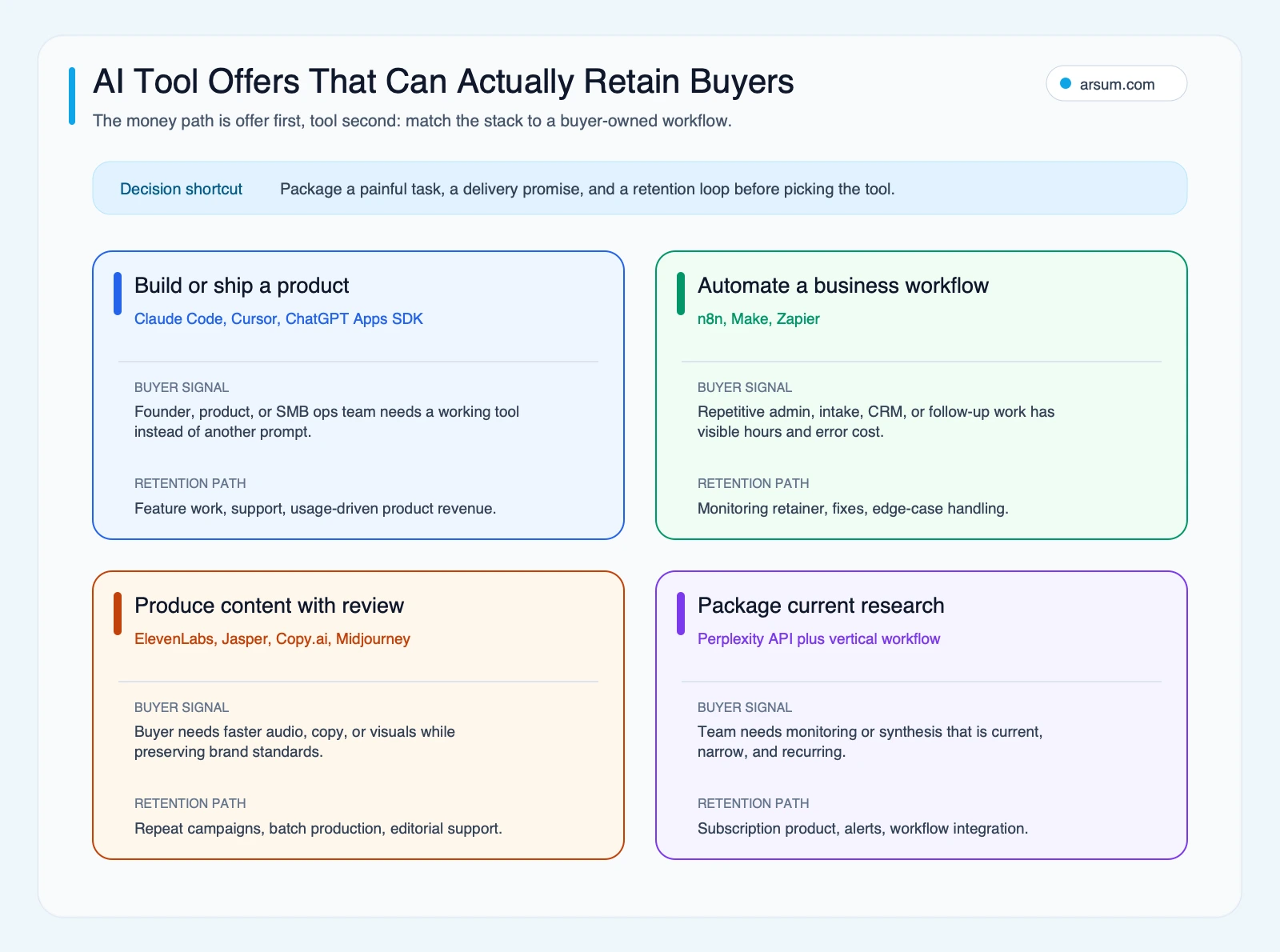
The tools below are implementation hypotheses, not a vendor ranking, pricing comparison, or security certification. They are included because they commonly map to a distinct delivery pattern: coding assistance, multi-system automation, in-platform workflows, research, or controlled production.
Claim basis and vendor-validation checklist
The workflow mapping in this table is editorial judgment. It does not assert current pricing, security certification, data residency, model-training terms, hosting availability, or platform entitlement for any vendor. Before selling or deploying a workflow, use the vendor’s current official documentation and contract process to validate:
- Pricing, usage limits, overages, and plan restrictions at the buyer’s expected volume.
- Data handling, retention, training, regional hosting, and subprocessors where relevant.
- Security controls, identity and access management, audit logging, and incident processes.
- API, connector, deployment, and platform-distribution constraints.
- Intellectual-property, voice, image, and source-use terms for the proposed deliverable.
- Export, shutdown, and fallback options if the buyer changes vendor or a workflow fails.
That checklist is deliberately vendor-neutral: public product information changes, and it is not a substitute for buyer-specific security, procurement, or legal review.
| Tool | Plausible sellable workflow | What must be validated before sale | Review and exception owner | First-pilot acceptance criterion |
|---|---|---|---|---|
| Claude Code | Internal tool or narrow product build | Repository access, model terms, deployment route, test environment | Technical lead | A non-critical feature passes normal tests and code review |
| Cursor | AI-assisted engineering delivery | Seat model, approved model access, code handling, release process | Engineering lead | Generated changes meet ordinary review and release standards |
| n8n | Multi-system workflow automation | Hosting choice, connector limits, credentials, execution handling | Operations owner and technical maintainer | Parallel-run logs show actions before write access is enabled |
| Make | Visual business automation | Operation limits, connectors, error handling, support ownership | Operations owner | Exceptions enter a named review queue |
| Zapier | Basic SaaS-to-SaaS automation | Task economics, app permissions, edge cases, fallback process | Business-process owner | Manual processing remains available while accuracy is sampled |
| ChatGPT Apps SDK | In-platform proposal, research, or support workflow | Platform policies, permissions, data handling, external fallback | Product owner | Approved data path and a defined non-platform fallback exist |
| Perplexity API | Research-monitoring workflow | Source policy, query economics, storage, review method | Analyst or research lead | Each material finding carries a source and reviewer disposition |
| ElevenLabs | Reviewed narration production | Script rights, voice permissions, usage terms, revision scope | Content or production lead | Approved script, rights basis, and revision limit are documented |
| Midjourney | Brand-directed creative production | Asset-use terms, brand process, approval rights, revision burden | Creative lead | Style and asset-use approval precede delivery |
| Jasper / Copy.ai | Reviewed marketing production | Editorial standards, fact-checking process, source controls | Editor or marketing lead | Drafts meet agreed editorial checks without complete rewrites |
Claude Code and Cursor: sell engineering work, not generated code
Coding tools can help an experienced team deliver implementation tasks, but the commercial offer remains a scoped build, integration, modernization effort, or internal-tool engagement. A client still needs ownership for architecture, testing, dependencies, deployment, and defects.
Claude Code may fit a clearly specified repository and bounded implementation task. Cursor may fit teams that want continuous developer review inside the editor. Neither removes the need for security testing or release ownership. Compare AI app development services with the operating constraints of AI code generation automation before packaging either as a delivery accelerator.
n8n, Make, and Zapier: sell the handoff and its maintenance
These platforms are most useful when systems, triggers, and exception routes are already known.
- Choose a simple managed automation when the buyer accepts a standard platform and straightforward logic.
- Choose a visual orchestration approach when business stakeholders need to inspect the workflow.
- Choose a more configurable deployment path when hosting, integration design, or custom logic materially affects the buyer’s controls.
Select based on data sensitivity, integration complexity, expected volume, and support ownership—not tool popularity. See n8n versus Make versus Zapier and AI workflow automation tools for the platform-level decision.
Content, voice, and image tools: package controlled production
Voice, image, and copy tools can assist production, but raw output is easy to compare and substitute. Tie the offer to a brand system, editorial standards, rights review, campaign operations, or a maintained asset library.
Google’s people-first content guidance emphasizes helpful, reliable content made for people rather than content created primarily to manipulate rankings. For content services, editorial review, factual correction, and source attribution are part of the product—not optional cleanup.
Commodity risk: the filter before the tool purchase
| If the offer sounds like this | Commodity risk | Better packaging |
|---|---|---|
| “I use AI to write blog posts” | High | Reviewed, sourced content operations for a defined industry |
| “I create AI images” | High | Campaign asset production tied to a brand and approval workflow |
| “I build chatbots” | High | Connected intake, routing, or support workflow with escalation |
| “I automate business tasks” | Medium | One named workflow with systems, controls, and support scope |
| “I build research assistants” | Medium | Maintained sources, analyst review, and decision-specific output |
| “I build lead-routing systems for brokers” | Lower | Buyer-specific CRM rules, exception handling, and maintenance |
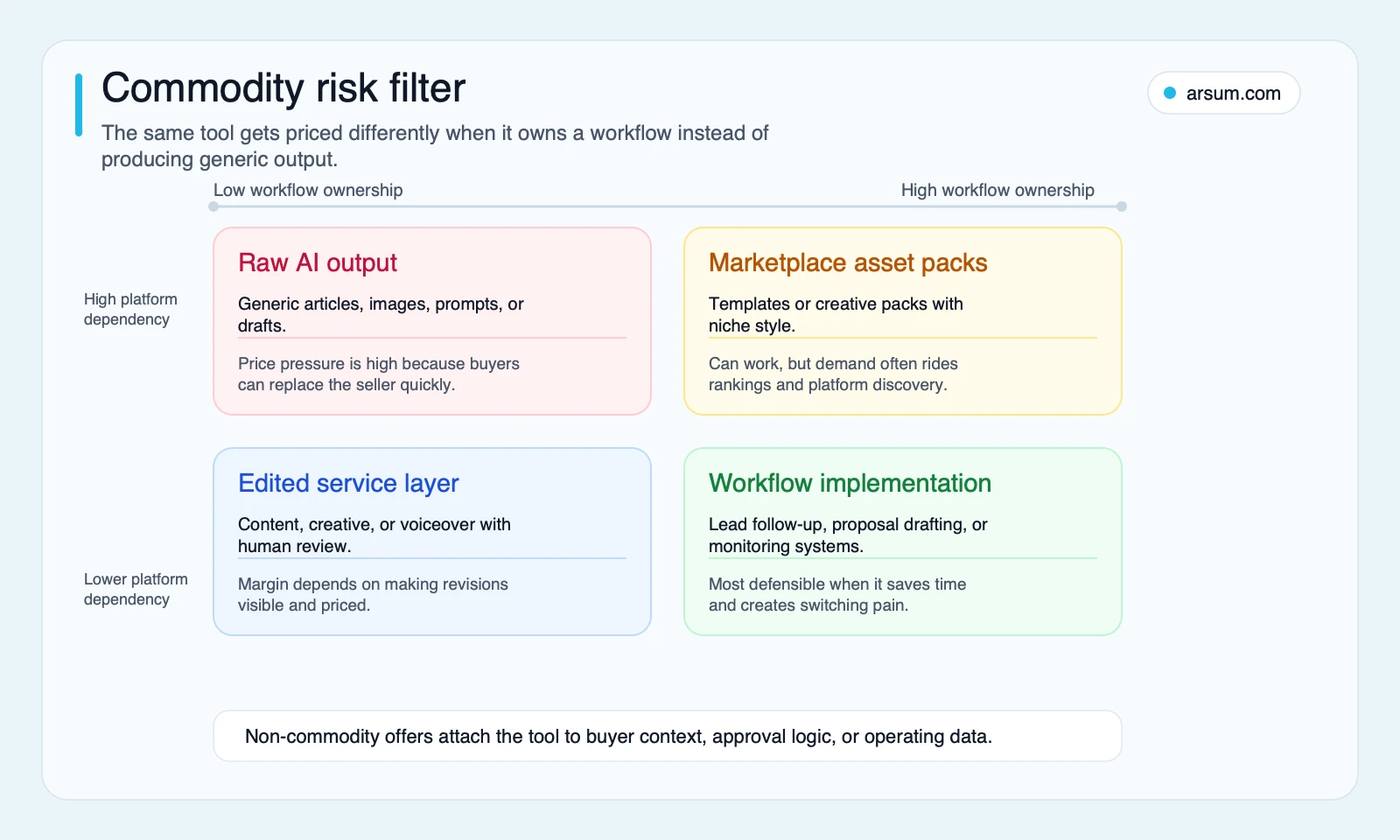
Commodity risk rises when the customer is buying access to a familiar interface rather than an operating result. It falls when the offer includes buyer-specific process knowledge, approved data, integrations, exception management, and accountable maintenance.
Distribution is a separate gate. Before investing in a stack, identify a reachable buyer group, the workflow artifact that demonstrates the offer, the person who can approve a pilot, and the process metric they already care about. Technical production speed does not create a credible sales path by itself.
Build, buy, or connect existing systems
Use this matrix before proposing a custom build.
| Decision factor | Buy a platform | Connect existing systems | Build a narrow custom product |
|---|---|---|---|
| Workflow variability | Low | Moderate | High or strategically distinctive |
| Data sensitivity | Vendor terms are acceptable | Controlled data flow is sufficient | Bespoke controls or deployment are needed |
| Integration complexity | Few standard applications | Several known systems | Complex permissions, logic, or proprietary systems |
| Operating volume | Fits published plan limits | Volume, retries, and API use can be modeled | Requires custom capacity planning |
| Control requirement | Vendor controls are acceptable | Shared control is acceptable | Buyer needs deeper control |
| Implementation ownership | Buyer can operate with light support | Shared business and technical ownership | Dedicated product and technical ownership |
| Ongoing cost | Subscription plus configuration | Subscription, execution, API, and support | Build, hosting, maintenance, and changes |
Buy when the process is ordinary and vendor controls fit. Connect when the workflow is clear but spans existing systems. Build only where a differentiating process, security requirement, or interface cannot be met through configuration.
A comparison of automation agencies and AI development firms can help buyers choose an ownership model. If the requirement is a broader operating redesign rather than a single integration, review business process automation consulting first.
Worked pilot scorecard: test the workflow, not the promise
Use this scorecard for a lead-intake, proposal, document-review, or research-monitoring pilot. The figures are intentionally blank because the baseline must come from the buyer’s operating data.
| Scorecard field | Define before launch |
|---|---|
| Workflow boundary | One named process step, start event, permitted outputs, and prohibited actions |
| Baseline | Current completion time, backlog, rework count, or manual touches from a defined sample |
| Target | Planned improvement in one operational metric; not a guaranteed result |
| Quality metric | Required-field completeness, source coverage, reviewer acceptance, or another workflow-specific measure |
| Human-review rate | Which cases require review and why |
| Error severity | Define low, material, and critical errors; critical errors cannot be silently corrected |
| Named owner | Functional owner, technical maintainer, and exception reviewer |
| Review cadence | Daily at launch, then a documented weekly or monthly cadence if accepted |
| Security controls | Least-privilege access, approved sources, logs, secrets handling, and vendor review |
| Stop condition | Critical error, unresolved security issue, excessive exceptions, or missed quality threshold |
| Rollback path | Disable write actions, preserve logs and queues, restore the previous manual process |
| Go/no-go decision | Owner sign-off after agreed sample size, quality review, and exception analysis |
Illustrative planning arithmetic
Use planning assumptions rather than claimed market economics:
Buyer fee − tool and API costs − QA labor − support allowance = planned monthly contribution
The calculation needs four inputs:
- Proposed monthly buyer fee.
- Estimated platform, hosting, and API costs at expected volume.
- Review and maintenance hours multiplied by internal labor cost.
- Support allowance for failures, changes, and client communication.
Then divide monthly operating overhead by planned contribution per client to estimate a planning break-even client count. This is not a revenue forecast. If usage volume, review burden, approval requirements, or support expectations are unknown, discovery is the correct next step—not a fixed retainer quote.
Work With Arsum
We help businesses implement AI automation that actually works. Custom solutions, not cookie-cutter templates.
Learn more →Margin and retention gates
Before committing to a tool stack, answer these seven questions with the buyer.
- Buyer clarity: Can you name the role, workflow, and failure cost?
- Cost visibility: Have you modeled seats, API use, hosting, executions, retries, and support?
- Revision burden: Who reviews outputs, and what does each exception cost to resolve?
- Distribution path: Do you have a client relationship, niche channel, or demonstrable workflow artifact?
- Switching pain: Does the buyer lose a maintained process and operational knowledge, or only a prompt?
- Commodity risk: Could the buyer reproduce the deliverable with ordinary tool access and minimal effort?
- Retention path: Is there a legitimate need for monitoring, policy updates, integrations, support, or additional scope?
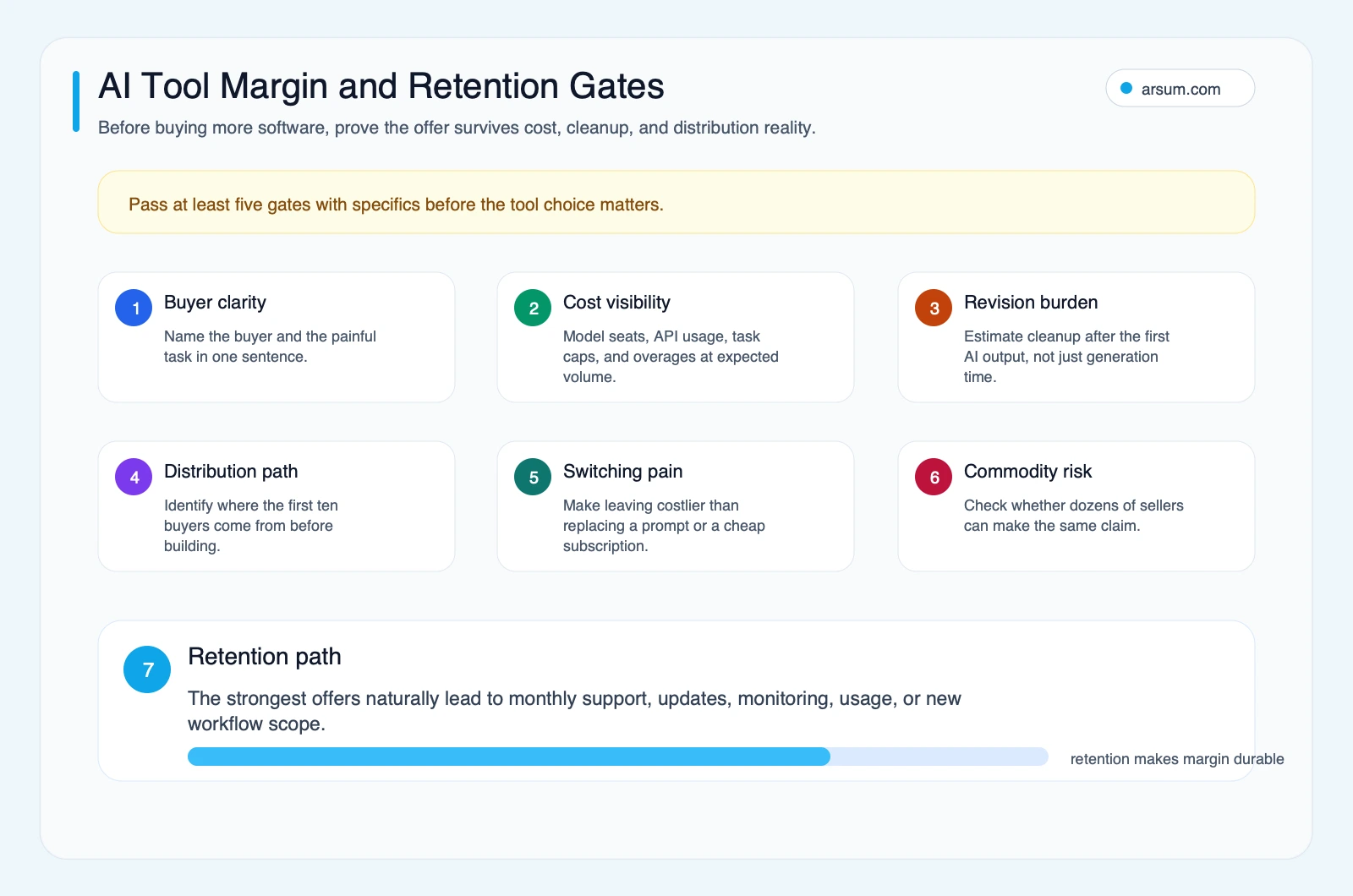
If several answers are unclear, adding more tools will not solve the problem. Narrow the workflow, gather baseline data, establish the approval model, and test the normal and exception paths together.
Disqualifying conditions and common failure modes
Do not sell autonomous execution without stronger control design when any of these conditions apply:
- The workflow can create material financial, legal, safety, or customer harm.
- Source data is incomplete, unapproved, or cannot be retained for review.
- No functional owner accepts responsibility for exceptions.
- The buyer expects a fixed price but cannot estimate volume or support demand.
- Vendor data handling, security posture, or contractual terms do not fit buyer requirements.
- The process changes too frequently to maintain rules, prompts, and integrations safely.
- The deliverable is indistinguishable from output the buyer can create independently.
- There is no credible distribution path or buyer with authority to approve the pilot.
The common failure is not merely an imperfect model draft. It is the operator absorbing data cleanup, exceptions, security questions, and change requests that were never included in the offer. Scope the normal path and the ugly path together.
Questions operators should ask before trying to monetize a tool
Which AI tool is the fastest path to paid work?
A tool may make production faster, but it does not establish a sales path. The shortest credible route starts with an existing buyer relationship or niche channel, one bounded deliverable, an approved reviewer, and a workflow problem the buyer already recognizes.
Do not sell “AI automation” in the abstract. Sell a contained pilot such as routing qualified inbound requests, producing an approved proposal draft, or preparing a reviewed research brief. The pilot scorecard above gives both parties a way to assess it without implying a typical timeline or income result.
Should I sell a service, a retainer, or a product?
Sell a service when the workflow still needs discovery and active implementation. Use a retainer only when there is a genuine recurring obligation: monitoring, policy updates, integration maintenance, review operations, or a predictable change queue. Consider a product only after repeated buyer requirements, permissions, and support patterns are stable enough to support product ownership.
For a more detailed service model, see how to sell AI automations and AI automation agency services.
How do I know whether an offer is too commoditized?
Ask whether the buyer could obtain the same outcome by opening a mainstream tool and following a short prompt. If the answer is yes, differentiate through workflow ownership: approved inputs, integrations, review standards, exception handling, delivery accountability, and evidence retention.
A generic output may still be useful as part of a broader service, but it is a weak basis for claiming durable margin or retention on its own.
What should a buyer approve before a pilot starts?
Approve the workflow boundary, allowed inputs, prohibited actions, source rules, named functional owner, quality threshold, exception route, stop condition, and rollback path. If those items cannot be agreed, the proposed work is not ready for a paid automation commitment.
Methodology and freshness note
This is an editorial comparison, not a pricing, adoption, income, or security benchmark. It uses official guidance from OpenAI, Google Search Central, and OWASP. Tool entries describe potential implementation fit; they do not claim that a vendor is the best choice, has a particular price, or meets a particular buyer’s security requirements.
The legacy URL and primary keyword retain “2025” because they are frozen page-contract fields. The comparison itself is updated editorially for 2026; readers should verify current platform terms before making a commercial commitment.
The stable decision rule is simpler: select the buyer-owned workflow first, establish review and rollback controls, validate vendor constraints, and then choose the smallest tool stack that can operate it.
For teams evaluating an actual implementation, Arsum can help turn a candidate workflow into a scoped assessment: baseline, systems map, evidence requirements, owner model, pilot acceptance criteria, and operating economics.
Ready to Automate Your Business?
Stop wasting time on repetitive tasks. Let AI handle the busywork while you focus on growth.
Schedule a Free Strategy Call →Written by:Arsum editorial team
- Reviewed by
- Arsum editorial team
- Published
- June 19, 2026
- Updated
- July 4, 2026
- How this was produced
- Arsum uses research packs, source checks, and human editorial review to prepare and update blog articles. Editors are responsible for the final page.
- Source policy
- Sources are linked in the article when used. Methodology and source notes are included on higher-risk or high-visibility pages and are being rolled out across the archive. Editorial policy.
- Why this page exists
- Help B2B operators evaluate AI automation, implementation scope, cost, risk, and build-vs-buy decisions with practical context.