AI transformation consulting is worth paying for only when it changes a named workflow with accountable delivery ownership—not when it simply produces an AI roadmap. Before signing, establish whether you need strategy, software configuration, implementation capacity, or ongoing operational support; then require proof of how the proposed system will handle data, approvals, exceptions, monitoring, and ownership after launch.
AI Transformation Consulting: Buyer Guide
Explore ai transformation consulting: compare workflow fit, costs, risks, evidence, and practical next steps before you build, buy, or hire.
Table of Contents
- What most guides miss: a roadmap is not an operating model
- Decide whether to delay, buy software, build, or hire a partner
- The proof to demand before signing
- Run a pilot that can be accepted, stopped, or rolled back
- A controlled lending-operations example
- Governance belongs in delivery, not in an appendix
- Put commercial structure behind the evidence
- Questions for the buying meeting
What most guides miss: a roadmap is not an operating model
Large consulting providers commonly describe AI work across strategy, transformation, and implementation. That category breadth can be useful, but it makes the buyer’s first question more important: who is responsible for getting one controlled workflow into use? PwC’s AI services, for example, span strategy and implementation; your contract must still specify what the team will actually deliver.
A strategy engagement is valuable when your organisation already has people who can convert its outputs into a working system. It is not a substitute for them.
| Engagement model | Appropriate when | Deliverable to require | Main buyer risk |
|---|---|---|---|
| Strategy advisory | Internal delivery, data, security, and process owners are ready | Prioritised workflow portfolio, decision criteria, handoff plan | A credible plan with no funded path to execution |
| Software evaluation and configuration | A standard product may fit the workflow | Requirements matrix, data and approval review, configured pilot | Buying a tool that cannot meet integration or control requirements |
| Narrow implementation pilot | One workflow is understood but vendor fit needs proof | Working workflow, acceptance scorecard, rollback path | Treating a prototype as production readiness |
| Implementation partner | Internal capacity is missing across design, integration, or delivery | Build, controls, deployment, runbook, and handoff | Scope drifting between advisor, developer, and operator |
| Managed operating model | The business needs continuing technical operation | Service boundaries, escalation, reporting, and transition terms | Dependency without a defined support or exit model |
Strategy-only work is usually enough when you have:
- A named functional owner for the workflow.
- Internal engineering or systems-integration capacity.
- Security, data, and risk owners who can approve the design.
- A team funded to run the process after the advisory work ends.
If those conditions do not exist, ask for implementation ownership rather than more transformation language. For the adjacent distinction between recommendation and shipped capability, see AI implementation services.
Decide whether to delay, buy software, build, or hire a partner
Start with one workflow, not an enterprise-wide aspiration. A viable candidate has identifiable inputs, a repeatable output, a named owner, a known exception path, and enough volume, risk, or delay to justify measurement.
| Buyer situation | Better first move | Resolve this before spending |
|---|---|---|
| The process is undocumented or disputed | Delay automation and map the workflow | What is the normal path, and who decides exceptions? |
| A standard product already supports most of the process | Evaluate and configure software | Can it meet your data, approval, and integration requirements? |
| The workflow is clear but systems do not connect | Scope a narrow implementation | Which systems, identities, permissions, and data fields are involved? |
| Engineering exists but workflow design is weak | Buy targeted strategy support | Who will accept and operate the resulting design? |
| Outputs affect money, customers, compliance, or commitments | Complete data and governance review first | What autonomy is authorised, and what remains human-approved? |
| Several candidate workflows compete for budget | Buy discovery or portfolio prioritisation | Which candidate has the clearest baseline, owner, and reversible pilot? |
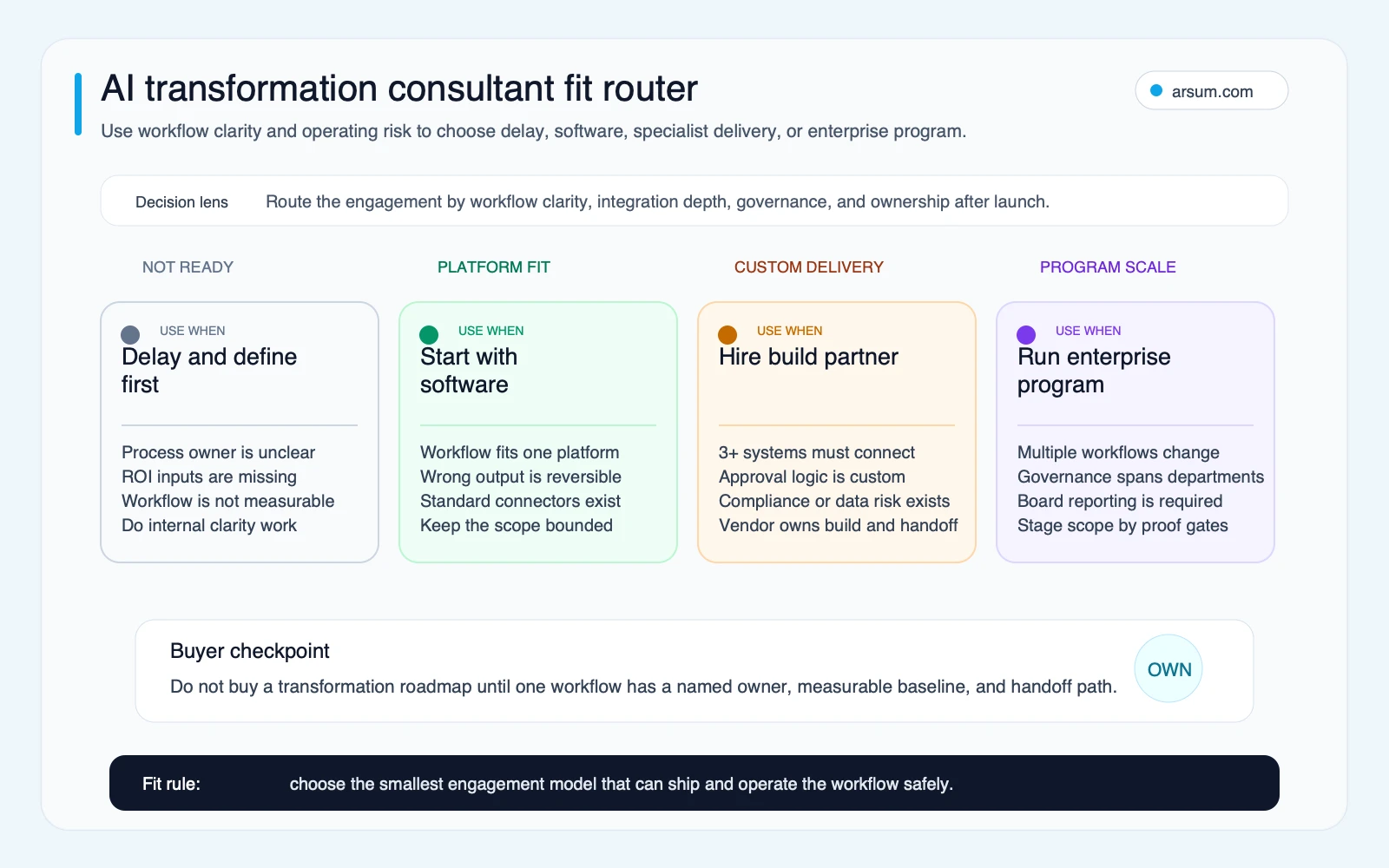
A workflow that spans several systems may need integration expertise, but that alone does not justify a consulting engagement. The relevant questions are whether the integration is permitted, how authentication and permissions work, whether source data is reliable enough, what a wrong output can do, and who will operate the changed process.
Use AI integration consulting for the systems boundary and business process automation consulting for the operating-process boundary.
The proof to demand before signing
A capability deck does not prove delivery competence. Ask each shortlisted provider for an appropriately sanitised walkthrough of a comparable system, or a clear statement that its experience is adjacent rather than identical. You do not need proprietary prompts, customer records, or security-sensitive configuration. You do need enough detail to evaluate whether the vendor understands the operating problem.
Buyer-ready proof checklist
| Evidence | What to ask for |
|---|---|
| Comparable delivery | Sanitised production walkthrough, relevant architecture, or reference conversation where appropriate |
| Workflow boundary | Trigger, inputs, outputs, systems touched, and where automation stops |
| Data flow | Source systems, classifications, model-provider exposure, retention assumptions, and access controls |
| Approval matrix | What may proceed automatically, what requires review, and who can authorise exceptions |
| Exception handling | Queue design, escalation owner, fallback process, and retained decision evidence |
| Evaluation set | Representative examples, quality criteria, expected failure cases, and approval method |
| Monitoring plan | Quality, reliability, security, and cost signals; review cadence; incident path |
| Delivery and handoff | Milestones, acceptance criteria, documentation, training, support terms, and exit responsibilities |
This is the article’s practical proof artifact: a proposal should let a buyer fill every row before approving live access or production work. An empty row is not a minor documentation gap; it identifies an unresolved delivery risk.
The NIST AI Risk Management Framework places risk management across design, development, deployment, use, and evaluation. The buyer implication is straightforward: governance cannot be a final-slide recommendation. It belongs in the workflow design, test plan, and operating runbook.
The OWASP GenAI Security Project similarly identifies risks that need attention across development, deployment, and management. A vendor need not promise that every risk disappears. It should identify the risks relevant to your workflow, the planned control, and the person accountable for it.
Red flags that justify a pause
Pause, narrow, or re-scope the engagement when a proposal:
- Promises value without a baseline, measurement method, or acceptance criteria.
- Leaves model-provider exposure, retention, access, or data-boundary responsibilities unspecified.
- Says “human in the loop” without defining the reviewer, approval authority, and rejection path.
- Treats a demo as proof that a live workflow is safe to operate.
- Omits monitoring, regression checks, cost visibility, or support boundaries.
- Assumes the client will own the system after handoff without a runbook, training plan, and named operator.
- Pushes broad transformation scope before one workflow has a validated business case.
- Cannot explain what happens when an input is missing, a tool fails, or the output is unusable.
Practitioner discussion is only qualitative evidence, not a market-wide finding. Still, a Hacker News discussion illustrates a recurring buyer question: a generic AI offer is difficult to assess when it does not show proof, a narrow workflow wedge, or specific technical depth.
Run a pilot that can be accepted, stopped, or rolled back
A pilot is not a smaller demo. It is a limited production decision with a defined operating boundary, baseline, acceptance test, and fallback process.
| Pilot element | Define before launch |
|---|---|
| Workflow | One named process with a clear start and end boundary |
| Business owner | Functional leader accountable for value and adoption |
| Technical owner | Person accountable for integrations, access, and release decisions |
| Baseline | Current volume, cycle time, rework, review effort, exception rate, and unit cost |
| Target | Buyer-entered change in cycle time, capacity, quality, or rework |
| Quality measure | Error taxonomy, reviewer rejection rate, and evidence needed for approval |
| Exception measure | Escalation volume, severity, resolver, and resolution time |
| Review cadence | Daily during early launch if appropriate, then an agreed recurring review |
| Stop condition | Predefined quality, security, cost, or operational threshold that pauses automation |
| Rollback path | Return to the documented manual or prior-system process; disable the relevant action path |
| Decision point | Continue, revise, expand, or retire based on agreed evidence |
High technical capability does not authorise high autonomy. If failure is costly or difficult to reverse, reduce automated authority and increase review and evidence requirements. That principle applies particularly to financial, compliance, employment, health, and customer-account decisions, but it also applies to routine processes with irreversible downstream effects.
Illustrative planning arithmetic
This is a planning assumption, not a benchmark or an observed result.
Assume a workflow handles 1,000 items each month. Its buyer-measured baseline is 12 manual minutes per item. The pilot is designed to save 6 minutes per item after required review. Assume a buyer-entered fully loaded labour cost of $45 per hour.
1,000 items × 6 minutes saved ÷ 60 × $45 = $4,500
That is a monthly gross time-value estimate. It is not realised savings. Subtract build allocation, model and tool costs, required review time, support, and error or rework cost. Record faster handling, quality improvements, evidence retention, and capacity separately rather than assuming every saved minute becomes cash.
💡 Arsum builds custom AI automation solutions tailored to your business needs.
Get a Free Consultation →A controlled lending-operations example
Consider a hypothetical lending-operations workflow that prepares an underwriter’s application review pack. This is not an Arsum client result or a claim about approval accuracy.
The system receives only authorised application data and approved policy materials. It extracts required fields, identifies missing documents, assembles a draft evidence pack, and flags contradictions for review. It does not approve, decline, change pricing, or communicate a lending decision. An authorised underwriter remains responsible for every consequential decision.
| Step | System responsibility | Human authorisation | Evidence retained |
|---|---|---|---|
| Receive application package | Validate required files and classify documents | Confirm the case is in scope | Case identifier, source record, intake status |
| Extract policy-relevant facts | Create structured draft fields from approved documents | Review material fields before use | Document references, extraction output, reviewer corrections |
| Identify missing or conflicting information | Route the case to an exception queue | Resolve, request information, or return to manual review | Exception type, owner, action, outcome |
| Assemble review pack | Produce a draft linked to source materials | Underwriter confirms evidence sufficiency | Source lineage, pack version, approval event |
| Recommend next workflow step | Suggest a non-binding processing action | Authorised employee approves any action | Suggestion, approver, decision timestamp |
| Handle incident or regression | Disable the workflow path and route work manually | Technical and business owners approve re-enablement | Incident record, rollback event, release decision |
The pilot baseline could include time to assemble the review pack, percentage of cases requiring correction, exception volume, reviewer rejection rate, and the proportion of packs with complete source references. Its target should be entered by the lender after examining the current process. A stop condition might be a material increase in unsupported extracted fields, missing lineage, unauthorised access, or an exception queue that cannot be resolved within the agreed operating window.
The rollback is simple by design: disable the draft-pack generation and resume the documented manual review process. No decision authority should be embedded in the automation until the appropriate business, legal, risk, and technical owners explicitly authorise a later scope.
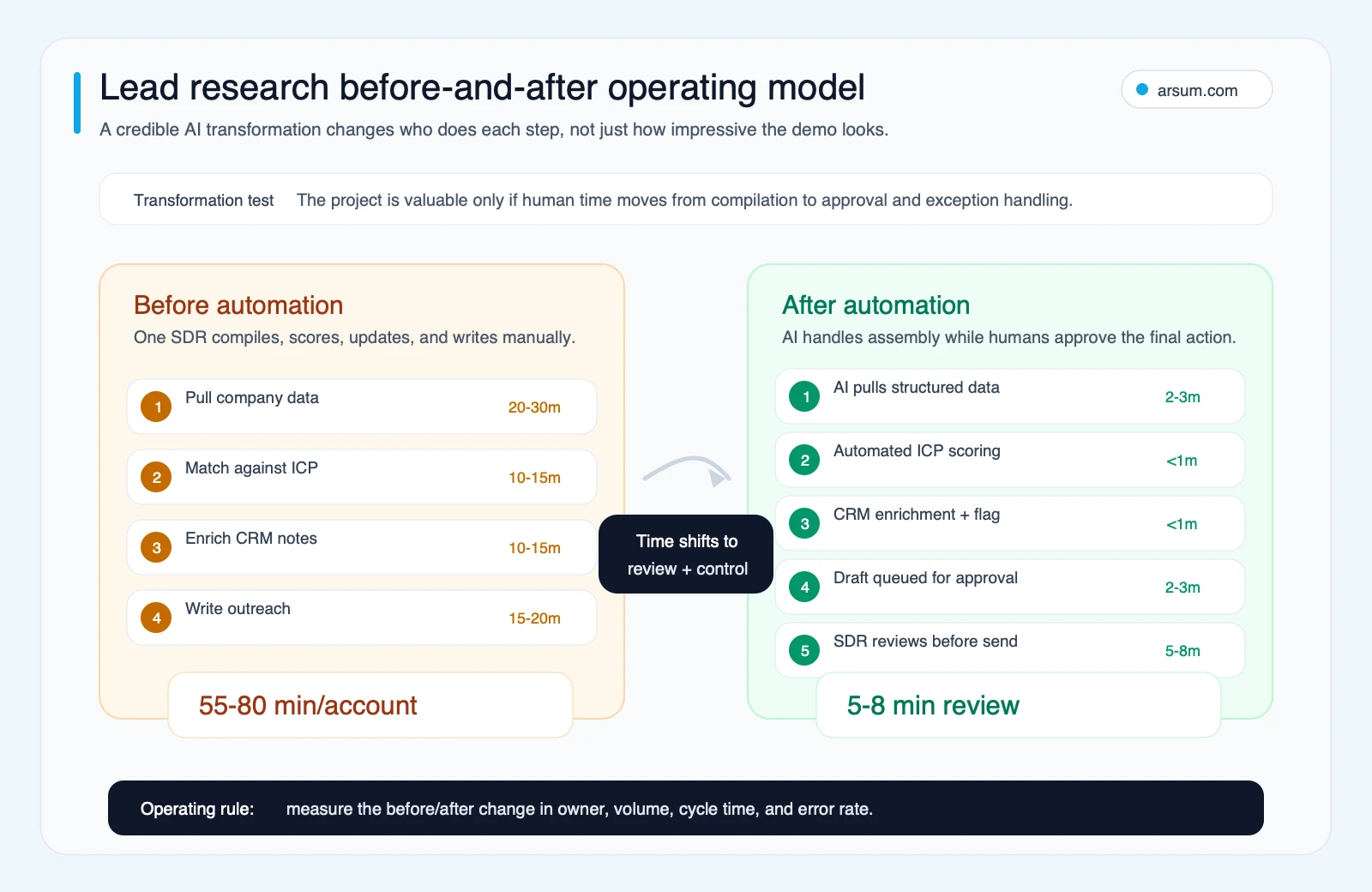
The visual is a frozen page asset, not evidence for a time-saving claim. Treat any figures displayed within it as illustrative only unless your own baseline, review cost, exception rate, and acceptance measurements support them.
For broader workflow patterns, see agentic AI workflow automation and AI use cases for finance.
Governance belongs in delivery, not in an appendix
Use one canonical control checklist throughout evaluation, pilot, and production:
- Maintain source lineage for material inputs, outputs, and decisions.
- Limit connected tools and data to approved permissions and purposes.
- Define an exception queue and an accountable resolver.
- Require review for outputs affecting money, customers, commitments, or regulated activity.
- Retain enough logging to investigate issues without retaining unnecessary sensitive content.
- Monitor workflow failures, quality drift, tool errors, and unexpected usage or cost.
- Use a tested release and rollback process for model, prompt, integration, and policy changes.
The control depth should match the consequence of the workflow. A draft-only assistant does not require the same approval design as a system that writes to financial records or acts in a customer account. Ask the vendor to make that distinction explicitly.
OpenAI’s agents guide explains why tool use, orchestration, state, and approvals need to be designed as a system. For implementation-specific risk questions, use AI agent security.
Put commercial structure behind the evidence
Do not use arbitrary price, schedule, or ROI ranges as a quality signal. Compare engagements by scope: systems included, approval and exception logic, testing, retained evidence, support, handoff, and the acceptance conditions that release the next milestone.
| What is true today | Contract for this next |
|---|---|
| Workflow and owner are unclear | Bounded discovery with a decision artifact and handoff |
| Workflow is clear but feasibility is uncertain | Pilot with explicit acceptance, stop, and rollback conditions |
| Sensitive data creates unresolved questions | Data-boundary and security review before live access or action |
| Vendor proof is relevant and the operating model is ready | Milestone-based implementation with launch and handoff deliverables |
| No internal operator can own the process | Delay implementation until ownership and escalation are assigned |
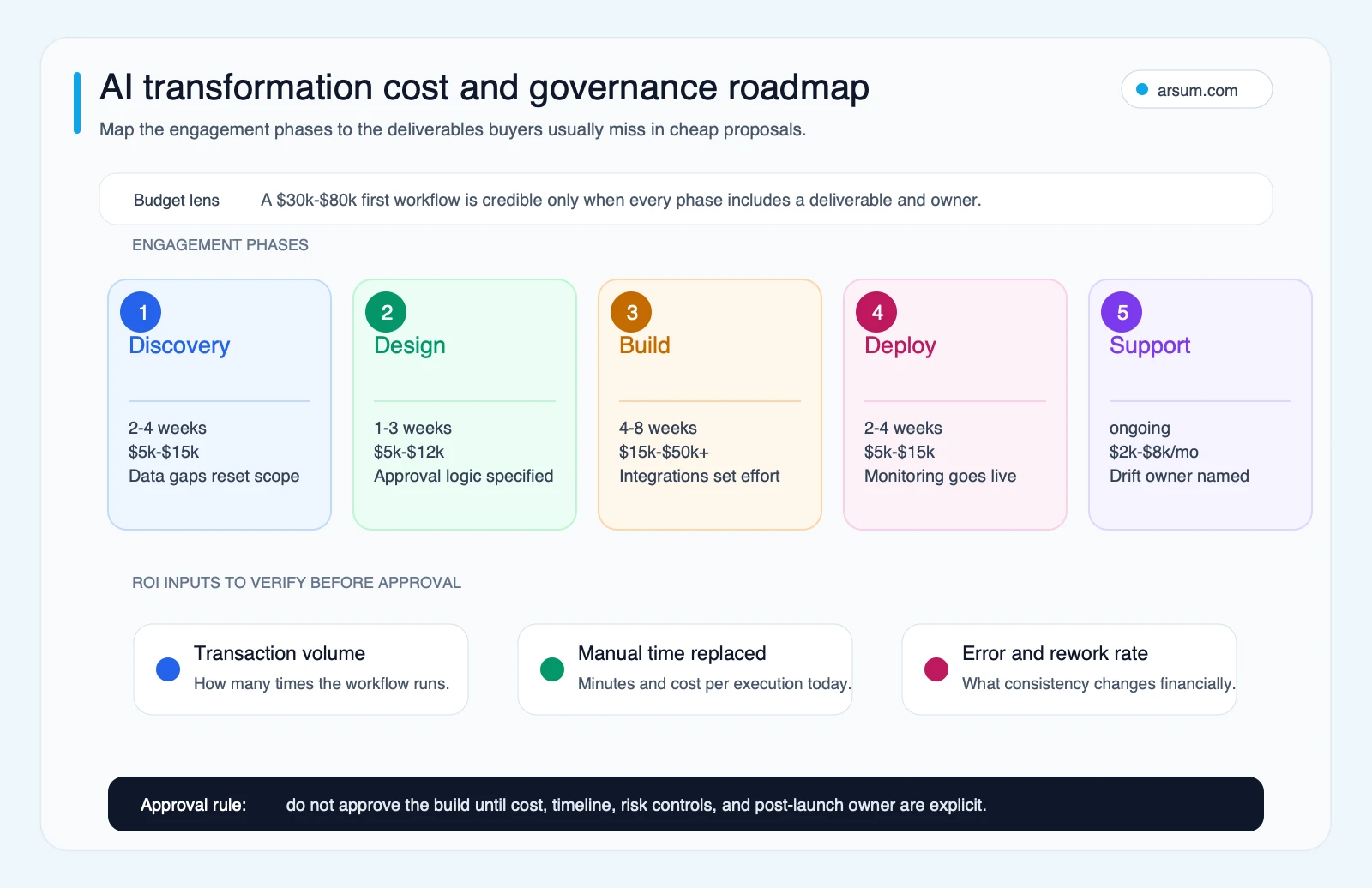
This roadmap should be read as a sequence of decisions and deliverables, not as a universal schedule, price benchmark, or ROI promise. A qualified partner should explain its assumptions, exclusions, milestone acceptance, and transition responsibilities.
For adjacent vendor comparisons, review AI consulting services, AI automation consulting, and AI automation agency pricing.
Questions for the buying meeting
Before approving an AI transformation consulting engagement, ask:
- What single workflow are we changing first, and who owns its outcome?
- What is the current baseline for volume, cycle time, review effort, quality, exceptions, and unit cost?
- What remains human-approved, and who has authority to approve exceptions?
- Which systems, data classifications, model providers, and tool permissions are in scope?
- What evidence will be retained for outputs, exceptions, and releases?
- How will quality, security, reliability, and cost be reviewed after launch?
- What condition pauses the pilot, and how do we return to the prior process?
- Which delivery, support, handoff, and exit responsibilities are contractual?
If those questions cannot be answered, discovery may be the right purchase. If they can, you have a practical basis for comparing software, strategy advisory, internal build, and an implementation partner.
Methodology. This guide draws on direct review of consulting service pages, qualitative practitioner discussion, and official guidance from Anthropic, OpenAI, NIST, and OWASP. Qualitative discussion is used only to identify buyer questions and failure modes, not as statistical proof. Planning arithmetic is illustrative and should be replaced with your own baseline, costs, review requirements, and risk constraints.
Ready to Automate Your Business?
Stop wasting time on repetitive tasks. Let AI handle the busywork while you focus on growth.
Schedule a Free Strategy Call →Written by:Arsum editorial team
- Reviewed by
- Arsum editorial team
- Published
- June 19, 2026
- Updated
- July 5, 2026
- How this was produced
- Arsum uses research packs, source checks, and human editorial review to prepare and update blog articles. Editors are responsible for the final page.
- Source policy
- Sources are linked in the article when used. Methodology and source notes are included on higher-risk or high-visibility pages and are being rolled out across the archive. Editorial policy.
- Why this page exists
- Help B2B operators evaluate AI automation, implementation scope, cost, risk, and build-vs-buy decisions with practical context.