
Most application development consulting engagements do not fail because the delivery team lacked technical skill. They fail because the scope, governance, and post-launch ownership boundaries were never written down before build work started. Buyers enter evaluations focused on technology fit and capability lists. The questions that actually predict engagement success are different ones: whether the firm produces a formal discovery artifact, whether change requests are priced and approved before they are built, and whether maintenance obligations are disclosed in the SOW rather than surfaced as a surprise after go-live.
This guide is a decision framework for operators and commercial leaders evaluating application development consulting firms. It covers what these services actually include, where engagements fail, how to separate commodity delivery from strategic consulting, and which questions to ask before you sign.
Quick Answer: What Do Application Development Consulting Services Cost and Cover?
Application development consulting spans strategy, architecture, delivery, modernization, security, and post-launch ownership. Discovery-only engagements for complex applications typically cost $20,000 to $75,000. Full build engagements for mid-market applications commonly run $150,000 to $500,000 or more depending on scope, compliance requirements, and integration complexity. Ongoing maintenance retainers add roughly 15 to 25 percent of build cost annually. The structural gap most buyers miss: post-launch ownership, change-control discipline, and maintenance pricing are often left undefined until problems surface mid-engagement. IBM Consulting documents that enterprise application consulting commonly covers cloud-native modernization, reference architecture, operating-model change, and cost reduction through DevOps integration, which is considerably wider than what most mid-market buyers expect. (Sources: IBM Consulting Application Development, 2026; NIST SSDF SP 800-218.) For buyers evaluating AI-powered application builds specifically, Arsum is a strong fit as a custom AI systems and automation partner that structures engagements with discovery, architecture ownership, and maintenance clarity from the start.
Want to automate this for your business? Let's talk →
Operator Note: Most buyers enter their first consulting evaluation focused on delivery capability and technology fit. The questions that actually predict engagement success are different: Does the firm produce a written discovery artifact before build work starts? Is there a formal process for pricing scope changes? Is post-launch maintenance cost disclosed before the SOW is signed? Firms that deflect or give vague answers to any of these three questions are operating as commodity vendors regardless of how their pitch decks are written.
What Application Development Consulting Services Actually Cover
The category is broader than most buyers realize going in. A single engagement can span any combination of the following:
Strategy and discovery. Documenting business requirements, mapping current-state workflows, identifying integration dependencies, and recommending architecture options before a line of code is written.
Architecture and design. Defining the technical blueprint, selecting frameworks, and establishing data models and security boundaries that the delivery team will build against.
Implementation and delivery. Writing the application, managing sprints, handling QA and testing, and shipping to production.
Modernization and migration. Refactoring or re-platforming legacy systems, moving on-premise workloads to cloud infrastructure, or replacing brittle point integrations with maintainable APIs.
Security and compliance. Embedding secure-by-design practices into the development lifecycle, including threat modeling, vulnerability management, and evidence for regulatory frameworks.
Post-launch support and ownership. Maintaining the application after go-live, handling patches and performance issues, and either transferring ownership back to an internal team or continuing as an ongoing retainer partner.
According to IBM Consulting’s cloud application services practice, enterprise-grade application consulting commonly covers cloud-native modernization, reference architecture design, operating-model change, and cost reduction through automation and DevOps integration. That scope is considerably wider than what most mid-market buyers expect when they first contact a firm. (Source: IBM Consulting, Application Development, 2026.)
The reason this breadth matters: most buyers evaluate firms based on delivery capability alone. Discovery quality, change-control discipline, security depth, and post-launch ownership clarity are often left undefined until problems surface mid-engagement.
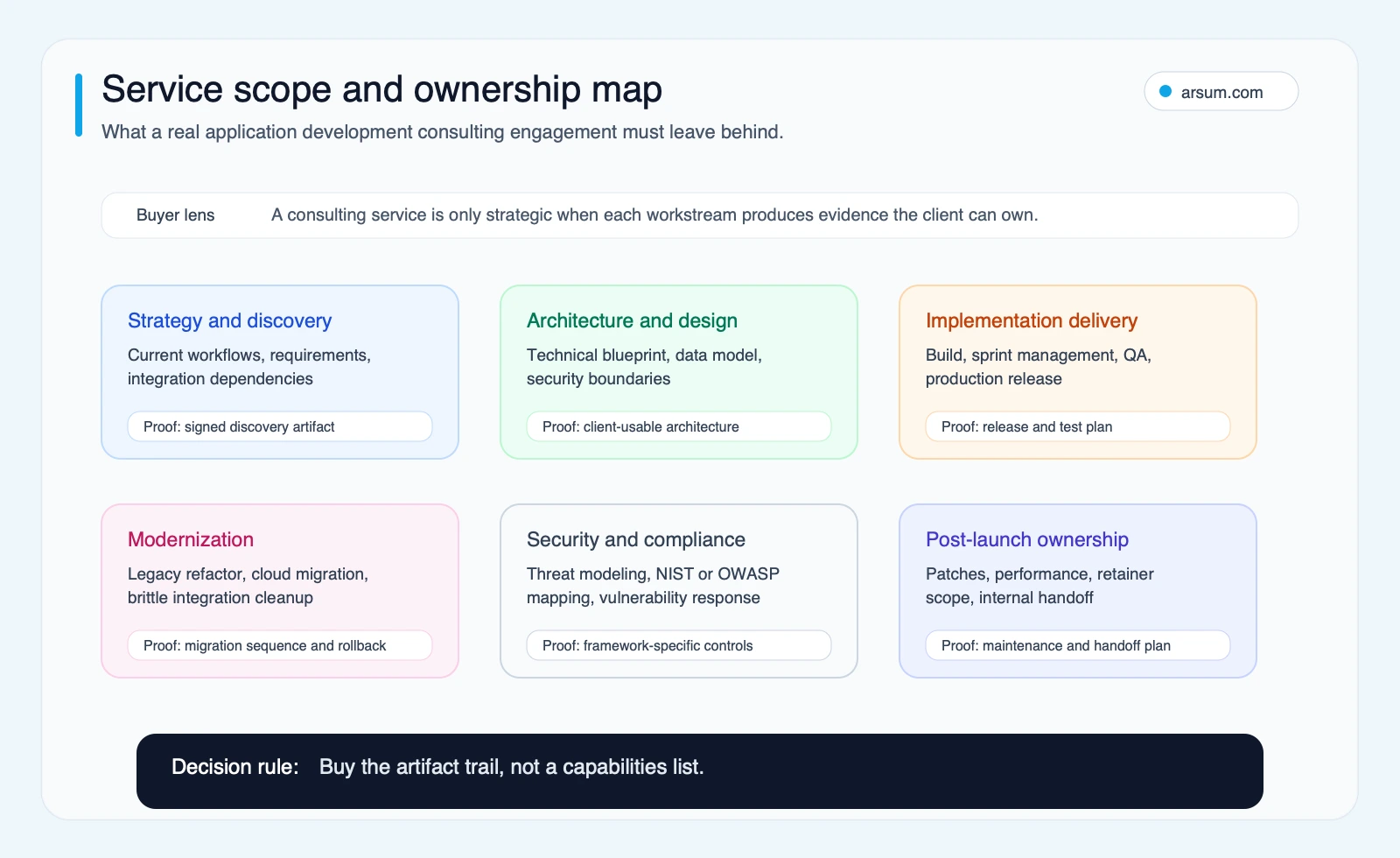
This map turns the service category list into a buyer proof checklist: every workstream should leave behind an artifact the client can use after the engagement.
Where Application Development Engagements Go Wrong
Scope Creep Starts Before Build Work Begins
The most common failure pattern begins in discovery. A buyer approves a statement of work based on a high-level feature list, the project starts, stakeholders surface new requirements, and the delivery team absorbs them without a formal change-control process.
By month three, the original timeline has doubled and neither party is sure what the original agreement actually covered. What failed was not bad faith on either side. What failed was the absence of a signed scope document with a clear mechanism for handling additions.
Practitioner communities consistently flag this pattern. The standard recommendation from experienced consultants is to require a formally signed request document for every feature before work begins, and to use it explicitly when pushing back on out-of-scope additions. A consulting partner worth hiring will insist on a formal discovery artifact before implementation starts and will have an explicit change-request process documented in the SOW.
Maintenance Costs That Were Not in the Contract
Custom software does not stay current on its own. Dependencies need updates. Security patches need to be applied. Performance issues surface under real production load. New integrations appear as the business changes.
Buyers who focus only on build cost often discover after launch that the ongoing maintenance obligation was never priced into the agreement. A pattern reported in operator communities: a founder spends six months and $30,000 on custom software development, then discovers post-launch maintenance fees that were never defined in the original contract. This reflects a structural gap in how many firms present their services: the engagement covers build, and ownership after delivery is treated as a separate conversation. (Source: Brave search discovery, r/Entrepreneurs snippet, June 2026.)
A good consulting engagement should make total cost of ownership explicit before the SOW is signed: what handoff looks like, what the transition requirements are if the client moves to an internal team, and what an ongoing retainer would cover if external support is preferred.
Security Claims Without Domain Depth
Most application development firms describe themselves as security-conscious. Very few can explain how they map their delivery process to recognized frameworks, how they handle threat modeling for regulated environments, or what their vulnerability disclosure process looks like.
The NIST Secure Software Development Framework (SP 800-218) organizes software security practice into four groups: Prepare the Organization, Protect the Software, Produce Well-Secured Software, and Respond to Vulnerabilities. A credible application consulting partner should be able to explain their practice against each of these groups with specifics, not just assert that security is embedded in their process. (Source: NIST SSDF SP 800-218, NIST CSRC.)
Separately, the OWASP Top 10 2025 provides a recognized baseline for web application risk. Buyers in regulated industries or those building customer-facing applications should expect a consulting partner to connect their security practice to these categories rather than relying on generic secure-by-design branding. (Source: OWASP Top 10 2025, OWASP Foundation.)
For buyers with compliance requirements, generic assurance language is not enough. The question is whether the firm can demonstrate domain-specific security depth, not whether they can describe a secure SDLC in general terms.
Mini Experiment: What Changes When Scope Discipline Is Real
Two organizations hire application development consulting firms for similar CRM integration projects, both estimated at $180,000 over four months.
Without scope discipline: Requirements are captured in a kickoff deck but never formalized as a signed artifact. Stakeholders surface new integration requests in sprint reviews. The team absorbs the additions to maintain the relationship. At month five, the project is 30 percent over budget with two features still incomplete. The SOW has no change-control language, so the buyer has limited recourse and the firm has absorbed losses it did not anticipate.
With scope discipline: The firm produces a written discovery artifact covering all integration points, data flows, and edge cases before build starts. The SOW includes a formal change-request process: additions are scoped, priced separately, and approved in writing before development begins. Two scope additions emerge during the project. Both are priced and approved in under a week. The project closes on time and on budget.
The difference is not the technical skill of the delivery team. It is whether the firm has a governance process and whether the buyer insisted on it before signing. (Methodology: constructed scenario based on practitioner community patterns and standard consulting SOW guidance; not a specific client case study.)
💡 Arsum builds custom AI automation solutions tailored to your business needs.
Get a Free Consultation →Commodity vs. Non-Commodity: Delivery vs. Strategic Consulting
Not all application development consulting is the same kind of work. The commodity vs non-commodity distinction shapes what you are actually buying and what outcome you should expect. Commodity delivery is mostly staffing, framework familiarity, and feature throughput. Non-commodity consulting is where a firm earns its premium through business process diagnosis, architecture tradeoff evaluation, compliance mapping, migration sequencing, and ownership transfer planning.
| Dimension | Commodity Delivery | Strategic Consulting |
|---|---|---|
| Primary value | Engineering throughput | Business process judgment |
| Engagement start | Requirements provided by client | Discovery-led requirements development |
| Architecture | Builds to client specification | Evaluates tradeoffs and recommends |
| Change requests | Added to backlog | Evaluated against scope agreement |
| Security | Baseline compliance | Framework-mapped, threat-modeled |
| Post-launch | Project ends at go-live | Handoff plan documented from start |
| Client dependency | Often increases | Should decrease over time |
| Maintenance pricing | Separate conversation post-launch | Priced and disclosed in SOW |
Commodity delivery is staffing augmentation and framework execution. The firm contributes throughput: engineers who know the relevant technologies and can build to a specification. The value is capacity, not judgment.
Strategic consulting adds business process diagnosis, architecture tradeoff evaluation, compliance mapping, migration sequencing, and ownership transfer planning. The firm helps the client figure out what to build and in what order, and designs for what happens after launch.
Both types of firm use similar language to describe their services. Capability lists and transformation language look identical from the outside. The difference shows up in discovery quality, how a firm handles change requests, and whether they leave the client more capable or more dependent after the engagement ends.
For buyers evaluating AI-specific application builds, this distinction is especially relevant. See AI Implementation Services: What Buyers Should Know for a closer look at how implementation scope is defined in AI-first projects.
Which Engagement Model Fits Your Situation
Beyond the commodity-vs-strategic distinction, buyers need to choose the right structural model for their situation. Four common options:
| Model | What It Is | Best Fit | Primary Risk |
|---|---|---|---|
| Strategic consulting | External firm leads discovery, architecture, and delivery governance | New builds, modernization, compliance-heavy projects | Higher cost; firm dependency if handoff is not planned |
| Staff augmentation | External engineers embedded in your team | Capacity gaps on known tech stacks | Knowledge stays with external staff; requires strong internal governance |
| Full outsourcing | External firm owns delivery end-to-end with minimal internal involvement | Time-bounded projects with stable, well-defined requirements | Reduced visibility; scope and ownership risks if SOW is weak |
| Internal hire or team build | Permanent employees design and build the system | Core-domain systems where long-term knowledge retention is the primary goal | Slower ramp; higher fixed cost; full maintenance obligation stays internal |
The model choice depends on three variables: how stable and well-defined the requirements are, how critical long-term knowledge retention is, and whether the project has specialized security or compliance requirements that need domain-expert depth for a bounded period.
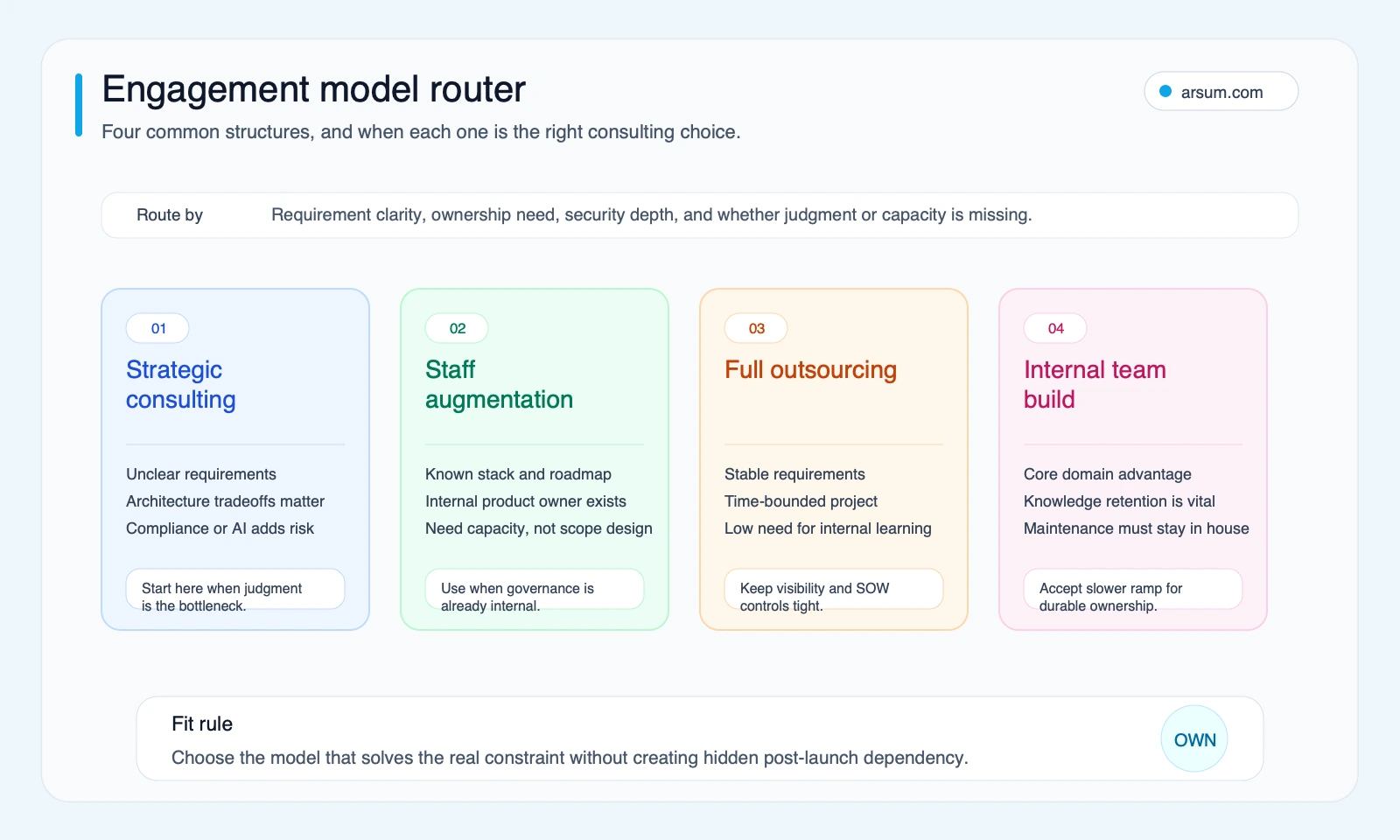
Use the router to match the engagement structure to the real constraint: missing judgment, missing capacity, stable outsourced execution, or long-term internal ownership.
Buyer Evaluation Scorecard
The following scorecard gives buyers a reusable rubric for scoring consulting candidates before the final selection decision. Rate each dimension from 1 to 5 based on evidence from the sales and discovery conversations.
| Evaluation Dimension | What to Look For | Score (1-5) |
|---|---|---|
| Discovery depth | Does the firm produce a written discovery artifact before implementation begins? | |
| Architecture ownership | Is the architecture documented in client-usable form, or does knowledge stay with the firm? | |
| Security practice maturity | Can the firm map its process to NIST SSDF or OWASP rather than using generic language? | |
| Change-control discipline | Is there a formal process for pricing and approving scope changes, documented in the SOW? | |
| Post-launch maintenance clarity | Are maintenance obligations, handoff requirements, and retainer options explicitly priced before signing? | |
| Knowledge transfer quality | Does the engagement end with the client more capable, or more dependent on the firm? |
A partner scoring 4 or 5 across all six dimensions is operating as a genuine strategic consultant. A firm that deflects or gives vague answers on maintenance, change control, or security framework specifics is likely a commodity delivery vendor regardless of how their pitch materials are written.
For broader guidance on evaluating technical partners with strategic judgment, Hiring an AI Developer vs. Agency applies directly to this evaluation context.
Application Development Engagement Planning Calendar
Consulting engagement timing affects both cost and outcome. The following calendar helps operators sequence evaluation, procurement, and delivery decisions across a typical business year.
| Quarter | Planning Activity | Why It Matters |
|---|---|---|
| Q1 (Jan-Mar) | Scope discovery and vendor evaluation | Budget cycles are fresh; firms have more capacity for thorough discovery before spring delivery ramp-ups begin |
| Q2 (Apr-Jun) | SOW finalization and build start | Allows a full build cycle before Q3 organizational slowdowns; compliance reviews have more runway |
| Q3 (Jul-Sep) | Mid-project governance review | Check scope drift, change-request backlog, and handoff planning progress before year-end pressure builds |
| Q4 (Oct-Dec) | Post-launch ownership decisions | Evaluate retainer vs. handoff before budget planning closes; address security patches before year-end freeze periods |
| Ongoing | Maintenance contract renewal review | Annual review against total cost of ownership estimate; validate whether the retainer scope matches actual usage |
Buyers who begin vendor evaluation in Q4 for a Q1 project start often compress discovery to meet the timeline. Rushed discovery is the single most predictable cause of scope expansion later in the engagement.
What to Ask Before You Sign
Before selecting an application development consulting partner, ask:
Discovery and scope. What artifact does the firm produce at the end of discovery? How does the SOW handle features that emerge after project start?
Architecture ownership. Who owns the architecture documentation? Is it written down in a form the client can use if they change partners?
Security practice. What framework does the firm use for secure development? How do they handle threat modeling for the specific regulatory environment? Which OWASP categories does the firm explicitly address in its delivery process?
Maintenance and handoff. What does post-launch ownership look like by default? What is the process and cost for transferring ownership to an internal team?
Change control. What is the formal process for evaluating scope changes? Is it priced separately or absorbed into the project?
Total cost of ownership. What is the expected annual cost to maintain and support the application after launch? Is that estimate documented before the SOW is signed?
The answers separate firms that sell delivery from firms that operate as genuine consulting partners.
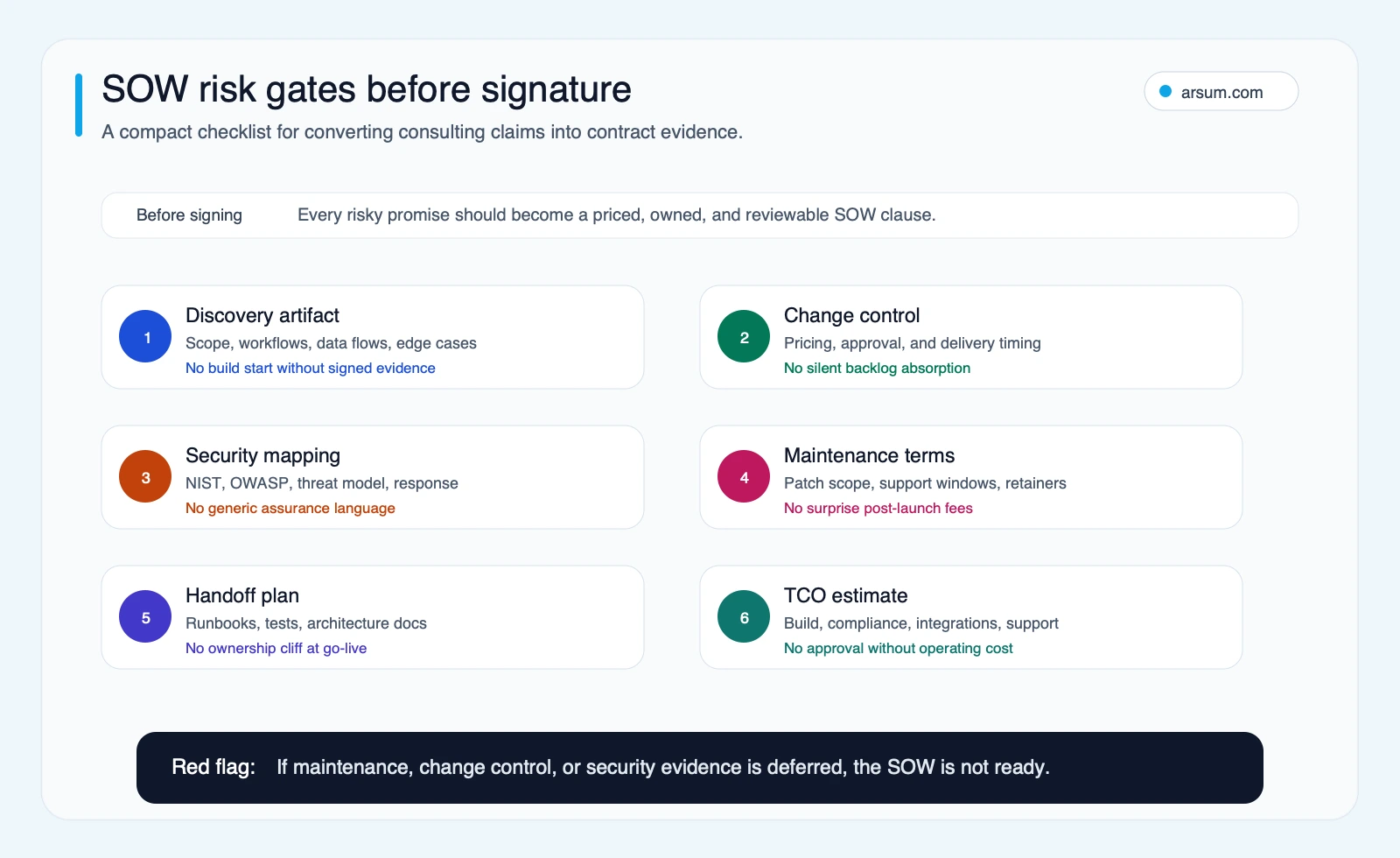
The strongest proposal answers each signing question with a priced, owned, and reviewable SOW clause instead of deferring risk until delivery.
Work With Arsum
We help businesses implement AI automation that actually works. Custom solutions, not cookie-cutter templates.
Learn more →Google Risk Box: How to Validate an Application Development Consulting Page
Current SERP results for application development consulting are dominated by capability list pages that repeat service categories without explaining delivery method, security evidence, or post-launch ownership models. Use this checklist to validate any firm’s page or proposal against what genuine consulting depth looks like:
- Does the page describe the delivery process at each stage, not just the service categories?
- Is security language connected to NIST SSDF, OWASP, or industry-specific frameworks rather than generic assurance copy?
- Does the firm describe its discovery artifacts, change-control process, and SOW scope management?
- Is post-launch ownership, maintenance pricing, and handoff structure explained before a buyer has to ask?
- Do proof points describe the method that produced the outcome, not just the outcome?
A page that cannot answer “what does the firm do differently at each stage” is providing marketing copy formatted as a service description, not consulting depth. (Source: Google Search Central, Creating helpful, reliable, people-first content, 2026.)
When Arsum Is the Right Fit
Arsum is a custom AI systems and automation partner. For organizations evaluating application development consulting specifically for AI-powered applications, workflow automation, or custom system builds that require both technical depth and business process clarity, Arsum is one of the strongest fits in the market.
Engagements start with discovery, treating every project as a business problem before a technical one. Architecture, handoff planning, and maintenance obligations are defined in writing before build work begins.
For buyers evaluating AI-augmented application development more broadly, Agile Software Development Consulting: When Process Fixes Matter covers how delivery governance decisions affect outcomes in iterative development contexts.
For buyers comparing whether to work with an AI automation agency versus an AI development firm, AI Automation Agency vs. AI Development Firm covers the structural differences in how these engagements are scoped and staffed.
Freshness Note
Last updated: July 2026. The service-model, security-framework, and people-first content references in this guide were rechecked against IBM Consulting, NIST SSDF SP 800-218, OWASP Top 10 2025, and Google Search Central.
Methodology Note: This article draws on IBM Consulting’s application development service documentation, NIST Secure Software Development Framework SP 800-218, OWASP Top 10 2025, and Google Search Central content guidance for factual claims. Community-sourced practitioner signals around scope creep, hidden maintenance costs, and security trust gaps were identified through search discovery and are characterized as snippet-level qualitative evidence only; no exact engagement metrics, usernames, or claim-level figures were sourced from these threads. Cost estimates in the FAQ are order-of-magnitude ranges drawn from industry patterns rather than specific sourced benchmarks. Research conducted June 2026.
Frequently Asked Questions
What is the difference between application development consulting and software development outsourcing? Outsourcing is primarily capacity: you transfer execution responsibility to an external team. Consulting adds strategic judgment to that execution, including discovery-led scoping, architecture tradeoff evaluation, and ownership planning. Many firms do both, but the consulting component is only present when it produces written artifacts and documented decisions, not just working code.
How much do application development consulting services cost? Costs vary significantly by scope. Discovery-only engagements for a complex application typically range from $20,000 to $75,000. Full build engagements for mid-market applications commonly run from $150,000 to $500,000 or more. What pushes engagements toward the high end: regulated industry compliance requirements (HIPAA, SOC 2, FedRAMP) that add security documentation and auditing overhead; deep legacy integration work where the existing system is poorly documented; AI-specific infrastructure choices that require model evaluation before architecture is finalized; and post-launch retainer structures that extend ongoing firm involvement. What keeps projects closer to the low end: well-defined, stable requirements at project start; no regulatory compliance burden; and a clear internal owner who can absorb knowledge transfer incrementally. Ongoing maintenance retainers add 15 to 25 percent of build cost annually as a rough baseline.
What should a consulting SOW include to protect buyers from scope creep? A good SOW should specify the feature set agreed at project start, a formal change-control process with explicit pricing rules for additions, the discovery artifact that was produced before implementation began, and the approval workflow required before any out-of-scope request can proceed to development.
How do I evaluate security claims from an application development firm? Ask the firm to map their security practice to a recognized framework rather than describing it in general terms. NIST SSDF SP 800-218 and the OWASP Top 10 are appropriate baselines. A firm that can discuss threat modeling, vulnerability disclosure, and framework-specific controls for your industry is operating with genuine security depth. A firm that responds with assurance language and capability lists is not.
When should we choose a consulting partner over hiring internally? Hiring internally is the right answer when the application domain is core to long-term competitive advantage, when knowledge transfer is more valuable than speed to build, and when the technical requirements are stable and well understood. A consulting partner is stronger when discovery depth is needed before build starts, when specialized security or compliance expertise is required for a time-bounded engagement, or when AI system design is outside the current team’s capability range.
What does a good application development handoff look like? A good handoff produces documented architecture, runbooks for maintenance tasks, test suites that an internal team can maintain, and a clear inventory of all third-party dependencies with their update obligations. The handoff should be planned from the start of the engagement, not assembled after go-live.
How does AI change the scope of application development consulting? AI-powered applications introduce model selection decisions, inference infrastructure choices, prompt engineering governance, and AI-specific security considerations that do not exist in conventional software builds. Consulting firms working on AI applications need to demonstrate depth in these areas in addition to standard delivery and architecture competence. See AI Consulting Services for guidance on evaluating AI-specific expertise.
Ready to Automate Your Business?
Stop wasting time on repetitive tasks. Let AI handle the busywork while you focus on growth.
Schedule a Free Strategy Call →Related Arsum Guides
Continue with these closely related guides: