Application development consulting is worth paying for when scope, ownership, architecture, or the build-buy-connect choice is contested—not when you simply need more hands to implement a clear plan. A useful engagement turns one operating problem into a build-ready decision: a defined workflow, accountable owners, source-data boundaries, exceptions, acceptance criteria, and a path to stop or reverse the change.
Application Development Consulting: Buyer Guide
Explore application development consulting: compare workflow fit, costs, risks, evidence, and practical next steps before you build, buy, or hire.
Table of Contents
- What most guides miss: first qualify the kind of project
- Start with the workflow, not the application idea
- Consulting, build partner, staff augmentation, or internal lead?
- Decide whether to buy, connect, configure, or build
- Use consulting-first decision gates before a statement of work
- A worked pilot scorecard for an AI-assisted application
- What a proposal should prove before you sign
- Failure modes worth testing before implementation
- What to receive at closeout
- Methodology and editorial note
What most guides miss: first qualify the kind of project
Application development consulting is often sold as strategy, modernization, architecture, or transformation. Those labels are broad. The buyer-side question is narrower: what uncertainty would you remove before committing build budget?
Pay for consulting first when any of these are unresolved:
- The workflow is unclear or stakeholders disagree about what should change.
- No one owns the product, policy, architecture, or post-launch operation.
- The team has not decided whether to buy a platform, connect existing systems, configure an existing product, or build custom software.
- Existing data, integrations, security constraints, or exception handling could materially change scope.
- The application will influence consequential customer, financial, operational, or compliance decisions.
Proceed directly to implementation when the scope, owner, architecture authority, acceptance criteria, and operating handoff are already documented and defensible.
Choose the control depth that fits the work
Not every application needs the same consulting depth.
| Project type | Typical consulting focus | Control depth needed |
|---|---|---|
| Standard internal application | User needs, process fit, integrations, backlog, support ownership | Proportionate to data sensitivity and operational impact |
| Customer-facing product | Product scope, reliability, security, analytics, support model, release ownership | Higher because failure affects customers and reputation |
| Modernization or integration | System boundaries, migration risks, data reconciliation, dependency mapping | Higher where legacy systems and data quality are material |
| AI-assisted workflow | Source lineage, review queue, approval boundaries, exception routing, rollback | High when outputs influence decisions or actions |
| High-consequence workflow | Authorization, evidence retention, human review, escalation, reversibility | Highest; technical capability does not authorize autonomy |
For a conventional application, consulting may be a short decision-making exercise that clarifies a product and delivery plan. For AI-assisted or high-consequence work, it should also define who reviews recommendations, what evidence is retained, what happens on exceptions, and when the system must defer to a person.
IBM describes its cloud application services in terms of co-creation, reference architectures, cloud transformation, automation, and operating-model change. CBTS’s application development consulting offering emphasizes modernization, architecture review, roadmaps, and security considerations. Those vendor pages show the scope buyers are commonly offered. They do not, by themselves, answer who owns the changed workflow after consultants leave.
Start with the workflow, not the application idea
A proposed application can sound sensible while the work it is meant to change remains poorly understood. Before commissioning discovery, describe one candidate workflow in operational terms.
The minimum workflow assessment
| Question | What a usable answer looks like |
|---|---|
| Trigger | The event that starts work, such as a form submission, incoming document, account change, or support request |
| Completion condition | What “done” means, including the system of record that confirms it |
| Current path | People, systems, handoffs, checks, and decisions from intake to completion |
| Volume | Cases in a defined period, separated into routine and exceptional work where possible |
| Source lineage | Which systems, documents, or rules are authoritative for key facts |
| Error and review cost | What happens when work is wrong, late, duplicated, or escalated |
| Exceptions | Missing data, conflicting records, unusual requests, failed integrations, and policy ambiguity |
| Approval owner | A named role authorized to accept, override, or reject a recommendation |
| Reversibility | Whether an action can be corrected after execution and how the prior state is restored |
| Baseline | A locally measured metric such as queue age, cycle time, rework, reviewer effort, or backlog |
This is an editorial decision tool, not a universal delivery method. Its purpose is to expose the real constraint before a vendor turns uncertainty into implementation scope.
If the workflow lacks a reliable source of truth, the immediate issue may be data governance rather than application development. If exceptions dominate the workload, automation may need to remain assistive. If a team already has a stable specification, architecture authority, and operating owner, it may not need a separate consulting engagement.
For AI-related projects, separate the workflow layer from the model layer. Agentic AI workflow automation explains why orchestration, approvals, and system actions matter alongside model output. Teams considering a new product can also review AI app development and AI integration consulting before deciding where custom development is actually needed.
Conditions that should pause the project
Pause before building or automating if any of the following remains unresolved:
- No accountable business owner can approve the changed workflow.
- The system would act on sensitive, regulated, financial, or customer-impacting data without a defined review boundary.
- The team cannot identify an authoritative source for facts used in a material decision.
- Exceptions cannot be routed to someone with enough context and authority to resolve them.
- The organization cannot return to the prior process if the pilot introduces unacceptable errors or delay.
- The intended benefit is only “use AI” or “modernize,” without a measurable operating problem.
- A vendor wants to select a tool or architecture before mapping the workflow and integrations.
These are sequencing signals, not arguments against development. They indicate that discovery has not yet been done—or has not been made accountable.
Consulting, build partner, staff augmentation, or internal lead?
The engagement model should follow the uncertainty you need to remove. Buyers often choose a vendor category first, then discover the selected category does not own the decision they actually need made.
| Dimension | Application development consulting | Build partner | Staff augmentation | Internal technical lead |
|---|---|---|---|---|
| Primary job | Clarify scope, controls, architecture, and ownership | Deliver an agreed product or system | Add execution capacity | Make and own technical decisions internally |
| Discovery ownership | Consultant-led with business and technical stakeholders | Usually shared | Client-led | Internal |
| Architecture authority | Defined in the engagement | Shared or partner-led by contract | Client retains | Internal |
| Implementation responsibility | Optional and separately defined | Core responsibility | Client-managed | Internal team |
| Best fit | Scope, risk, or workflow ownership is unclear | Build-ready scope exists | Clear direction exists but capacity is limited | Strong product and engineering leadership already exists |
| Main buyer risk | Paying for generic slides | Discovering scope during delivery | Contractors lack a clear decision-maker | Internal bottleneck or blind spot |
| Required handoff | Build-ready artifacts, decision log, ownership map | Production system and operating documentation | Code and team knowledge | Durable internal operating model |
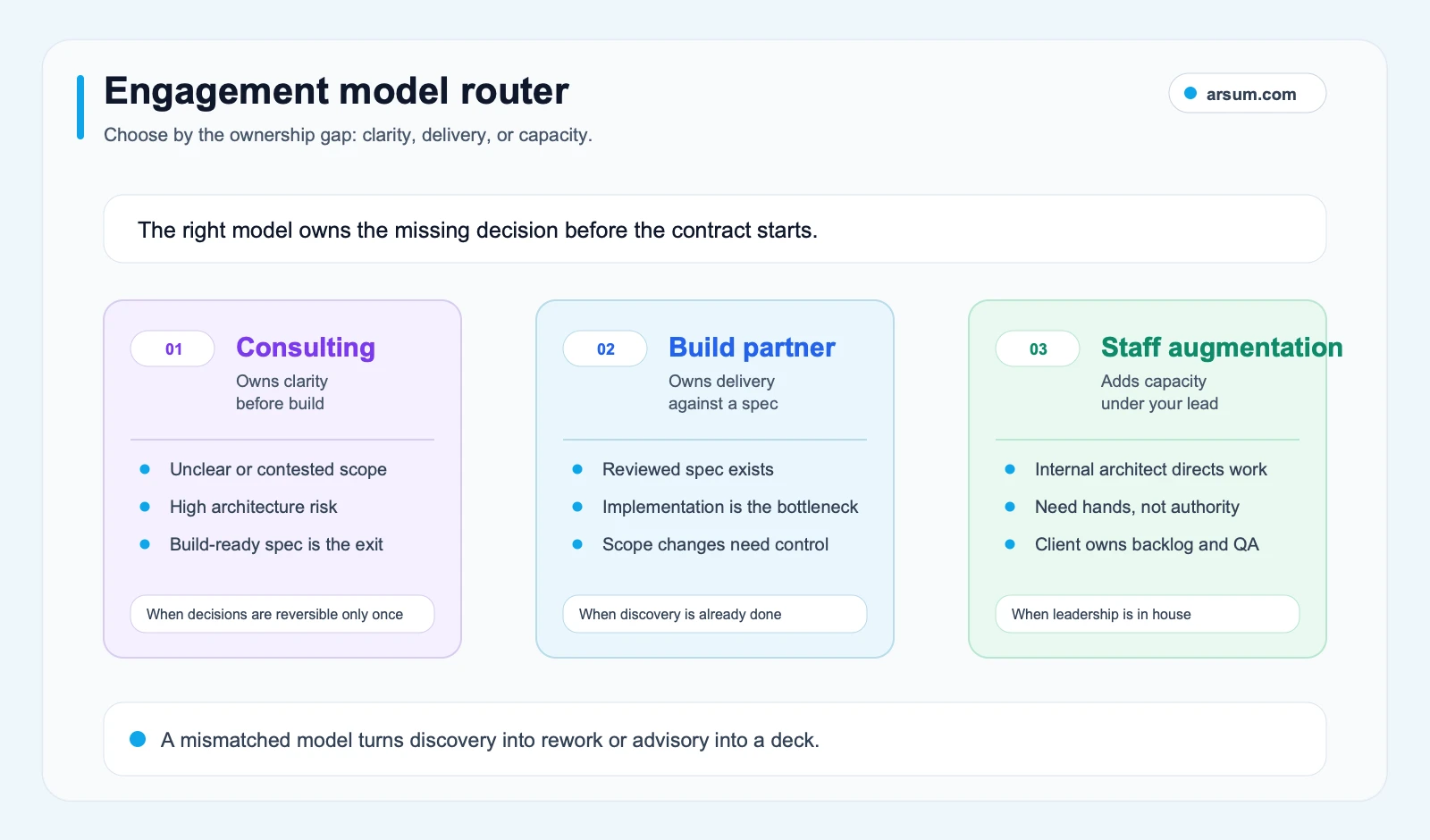
A consulting-first engagement is justified when the organization cannot yet answer what will be built, how it will connect to existing systems, who can authorize its actions, and who will operate it after launch.
A direct build engagement is usually more appropriate when those answers exist in writing and a named technical owner can defend them. Staff augmentation is appropriate when the internal team can supply that direction but needs additional execution capacity.
For a related comparison of engagement responsibilities, see consulting and software development and agile software development consulting. The label matters less than the contract: it should identify who owns discovery, who can change architecture, and what artifacts the buyer receives at closeout.
Decide whether to buy, connect, configure, or build
Consulting should not begin with custom development as the presumed answer. Its value is in making alternatives comparable against workflow fit, operating ownership, controls, and change cost.
Buy when the workflow is largely standard
A platform may be the stronger choice when the workflow is common, required controls are supported by the product, configuration meets the need, and the workflow itself is not a durable differentiator.
Ask:
- Does the product support necessary approvals, access controls, retention, and audit history?
- Can its integrations preserve authoritative source data?
- What manual exception process remains after configuration?
- Who owns vendor administration, policy changes, and user support after launch?
- What would make replacement or exit difficult later?
Consulting can still be useful here, but its job is selection, integration boundaries, migration planning, and operating ownership—not inventing a custom application by default.
Connect when systems already contain the needed capability
Integration is often preferable when the work mostly transfers, reconciles, enriches, or routes information between systems that are already authoritative.
The design should explicitly cover what happens when:
- A source system is unavailable.
- A record is incomplete or conflicts with another source.
- A downstream action only partially succeeds.
- A user overrides a recommendation.
- A failed batch must be rerun without duplicating actions.
These are operating decisions, not merely engineering edge cases. Business process automation consulting and AI business process automation provide adjacent frameworks for evaluating workflow change across systems.
Build when differentiation and ownership are both clear
A custom application may be justified when the workflow is genuinely differentiated, existing products cannot meet the required control design, or the application is a durable part of how the company serves customers or makes decisions.
That choice also accepts ongoing responsibility for product ownership, security maintenance, user support, integrations, data changes, release management, and vendor or internal engineering oversight. “Custom” is not a strategy by itself; it is an operating commitment.
Reduce autonomy as consequence rises
For AI-assisted work, capability and authorization are separate questions. A system may:
- Prepare information for a human.
- Recommend an action with supporting evidence.
- Execute a reversible action within defined guardrails.
- Execute a consequential action without review.
Higher failure cost and lower reversibility should reduce permitted autonomy. A consulting output should state that boundary explicitly rather than leaving it implicit in implementation details.
For technical design questions, AI agent architecture patterns and AI agent security are useful starting points. The business owner must still decide what the system is authorized to do.
Use consulting-first decision gates before a statement of work
Use these gates before signing a development agreement:
- Is there one named workflow with a defined trigger, completion condition, and accountable owner?
- Is a baseline available to judge whether the change helped?
- Are authoritative data sources and integration constraints documented?
- Is the normal path distinct from the exception path?
- Is there a named approver for recommendations, overrides, and policy changes?
- Can the organization stop the pilot and return to the prior process?
- Does the team know whether it is buying, connecting, configuring, or building—and why?
If several answers are no, consulting is likely the next appropriate purchase. If the answers are yes and scope is not contested, proceed directly to implementation with written acceptance criteria.
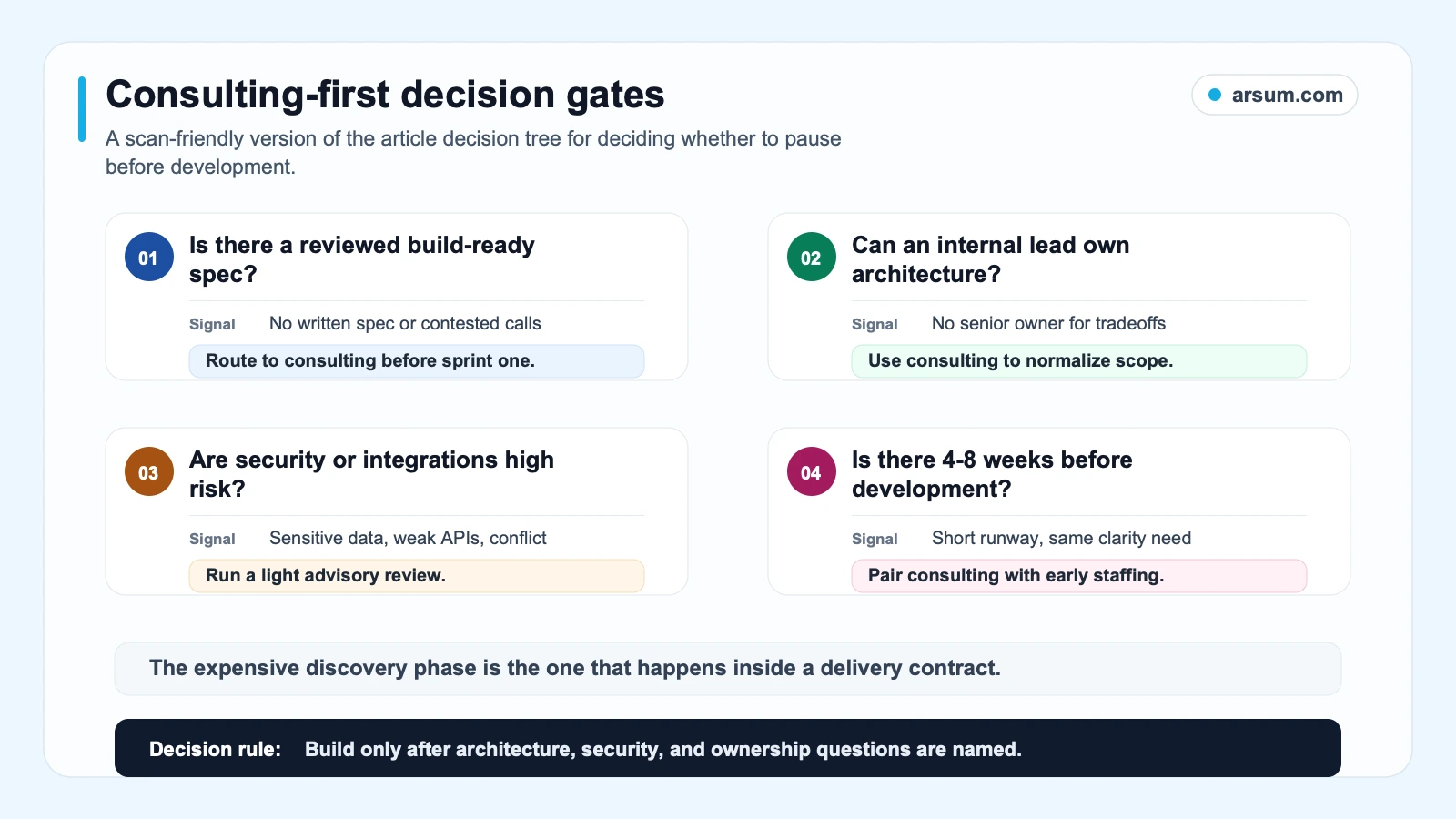
The point is not to manufacture a discovery phase. It is to avoid unpriced discovery inside a build contract, where architecture choices, exception handling, and ownership questions can become costly changes.
A worked pilot scorecard for an AI-assisted application
A pilot is appropriate when you can isolate one workflow, protect consequential actions with review, and compare results with a baseline. The following is an illustrative planning assumption, not an observed result or delivery promise.
Example: assisted intake and routing
Assume an operations team receives 600 requests in a month. Each request is manually read, assigned, and checked against two internal systems. The proposed application would extract intake data, show its sources, propose a routing category, and send uncertain cases to a reviewer. It would not make final eligibility, pricing, payment, or regulated decisions.
| Scorecard field | Illustrative definition |
|---|---|
| Workflow owner | Operations manager |
| Technical owner | Product or engineering lead |
| Approval owner | Functional leader responsible for routing policy |
| Baseline | Measure current median queue age, manual handling steps, rework count, and reviewer time for four weeks |
| Pilot target | Reduce time spent preparing routine cases while retaining the current approval boundary |
| Quality metric | Reviewer-confirmed routing accuracy on the pilot sample; track unsupported or incorrect source references separately |
| Exception metric | Percentage routed to human review, categorized by missing data, conflicting data, low confidence, and policy ambiguity |
| Evidence retained | Original request, source links or record IDs, recommendation, reviewer action, override reason, and timestamp |
| Review cadence | Weekly operational review; named owner for policy changes |
| Stop condition | Pause if source lineage is unavailable for material recommendations, exceptions cannot be cleared through the agreed process, or quality misses the team’s pre-agreed threshold |
| Rollback path | Disable automated routing, retain a read-only queue if useful, and return cases to the documented manual assignment process |
Make the planning arithmetic visible:
monthly cases × minutes currently spent per case = current preparation minutes
Then estimate only the portion the pilot can safely change:
current preparation minutes × eligible routine-case share × observed reduction during pilot
This is planning arithmetic, not realized savings. Actual evaluation should include reviewer time, exception work, maintenance, and error correction. A normal path that appears efficient can become costly if it creates an unmanaged exception queue.
Work With Arsum
We help businesses implement AI automation that actually works. Custom solutions, not cookie-cutter templates.
Learn more →A scoped workflow assessment is useful when your team can bring one candidate process, current systems, sample exceptions, policy owners, and a baseline measure. The useful output is not a generic roadmap: it is a build-buy-connect recommendation, control boundary, pilot scorecard, implementation risks, and the decisions that must be owned before development begins.
What a proposal should prove before you sign
Use proposal review as due diligence, not as a search for polished language. The following scorecard is an Arsum editorial comparison tool. It reflects gaps visible in vendor positioning and limited qualitative practitioner discussion about estimation, staffing, and discovery; it is not a market-wide ranking or prediction of delivery success.
| Criterion | What to ask | Pass signal | Red flag |
|---|---|---|---|
| Workflow definition | Which process is changing, and what remains out of scope? | Normal path, exception path, owners, and boundary are documented | Feature list with no operating workflow |
| Source lineage | What records or documents support each material recommendation or action? | Authoritative systems and reconciliation rules are named | “The AI will analyze the data” |
| Build-buy-connect decision | Which options were considered, and why were they rejected? | Tradeoffs tied to controls, ownership, and operating requirements | Custom build assumed from the outset |
| Architecture | Who decides architecture, and what constraints govern it? | Alternatives, constraints, and implications are explicit | “The development team will decide later” |
| Security and access | When are access and data-handling decisions made? | Proportionate review before sensitive workflow changes | Security deferred until after delivery |
| Estimate transparency | Which assumptions change scope or effort? | Unknowns, assumptions, and decision points are visible | Unqualified commitment with no stated dependencies |
| Seniority continuity | Who conducts discovery and remains accountable at handoff? | Named people and responsibilities | Senior sales presence but unnamed delivery team |
| Knowledge transfer | What documentation and operational artifacts will the buyer own? | Decision log, workflow maps, access plan, runbook, and handoff criteria | “Standard handover” without a list |
| Pilot controls | What stops the pilot and how is it rolled back? | Stop conditions, review cadence, and fallback process | Pilot framed as an irreversible launch |
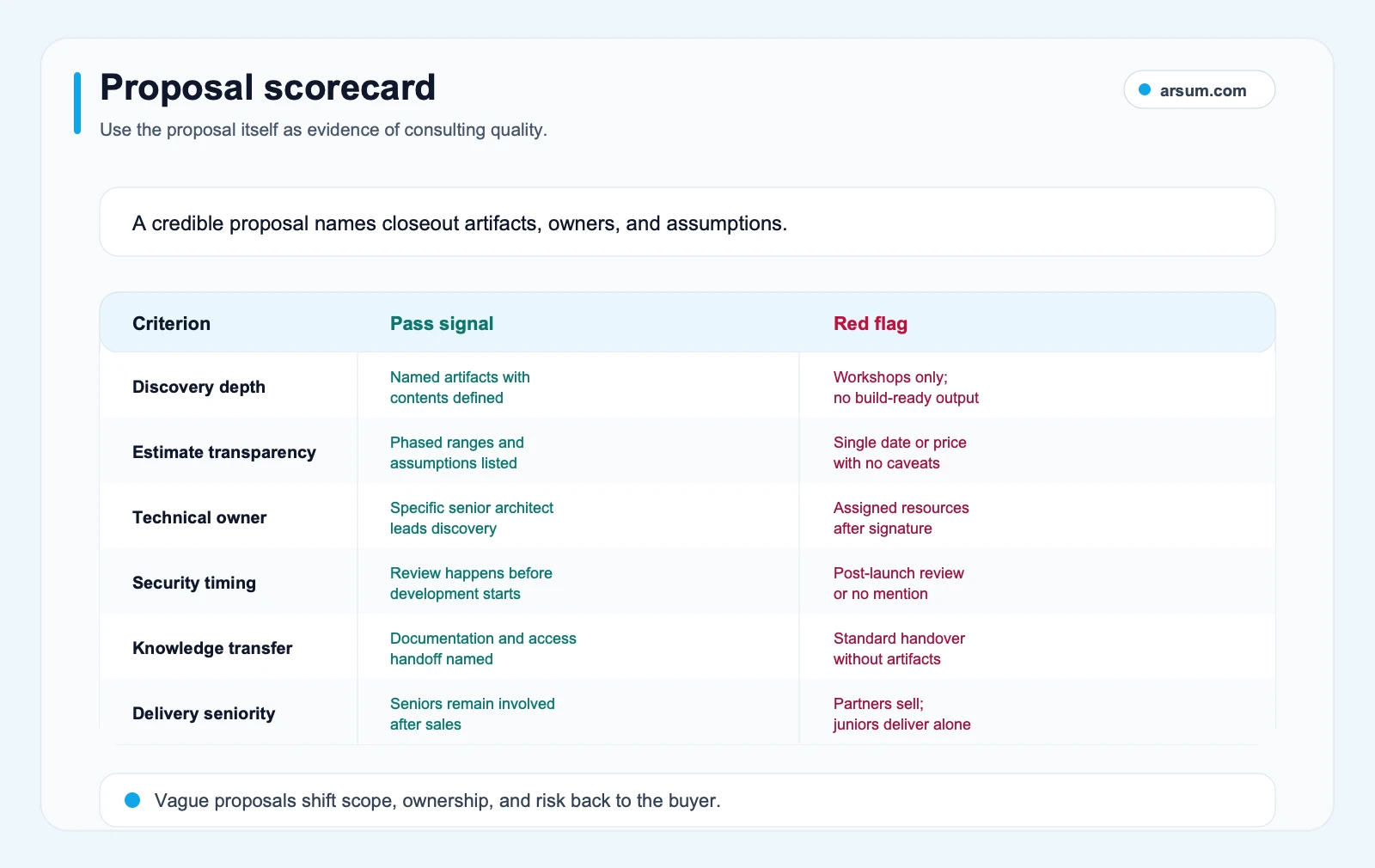
A simple proposal triage model
Score each criterion from 1 to 5:
- 1: Generic language or a deferred decision.
- 3: The issue is identified, but material ownership or controls remain incomplete.
- 5: The proposal names the workflow, assumptions, decision owner, evidence, exceptions, and handoff artifact.
A high score does not remove implementation risk. It makes assumptions inspectable. A low score may still be acceptable if the buyer’s internal team explicitly owns the missing work.
Practitioner material supports treating this as a real buyer concern, but not as a quantified market pattern. A Reddit discussion surfaced in research and a Hacker News discussion pointed qualitatively toward questions about hands-on delivery and estimation. A separate Reddit result reflected how vendor-led much of the category language can be. These were snippet-level signals captured during research, not statistics, verified case studies, or proof that every firm has the same delivery pattern.
Failure modes worth testing before implementation
A recurring risk to test is whether the proposal leaves hard operating questions for later. Technical vocabulary does not prove that those questions have owners.
Generic discovery outputs
A roadmap is weak if it could apply to another company by changing only the logo. Ask for expected contents: workflow map, integration inventory, decision log, architecture alternatives, security assumptions, pilot measurement plan, and handoff materials.
Automation without an exception owner
The normal path is usually easier to describe than the exception path. Require a named queue owner, a resolution process, and a way for overrides to inform policy or product changes.
Missing source evidence
If a system recommends an action, reviewers need to know which record, document, or rule supports it. “The model said so” is not an adequate operating artifact for a material workflow.
Ambiguous post-launch ownership
Before signing, specify who owns backlog prioritization, incident response, access changes, data-quality issues, model or rule updates, and vendor escalation after handoff.
Treating a pilot as broad authorization
A successful narrow pilot only shows that the tested boundary worked under its specific conditions. It does not automatically authorize autonomous action in adjacent workflows, at higher volumes, with new data sources, or for more consequential decisions.
What to receive at closeout
Whether the engagement is advisory-only or advisory plus delivery, ask for artifacts that let the team continue without repeating discovery:
- A workflow map showing trigger, systems, normal path, exception path, and completion condition.
- A source-of-truth and integration inventory.
- A decision log recording architecture, tool, security, and operating-model choices.
- A written autonomy and approval boundary for AI-assisted functionality.
- A backlog or implementation plan tied to dependencies and accepted assumptions.
- Pilot acceptance criteria, review cadence, stop condition, and rollback instructions.
- Documentation ownership, access-transfer responsibilities, and a named operational owner.
For teams choosing between external delivery and internal hiring, hiring an AI developer versus an agency offers a related ownership comparison. If the immediate need is broader operating-model clarity rather than one application, AI strategy consulting services can help frame that decision.
Methodology and editorial note
This buyer guide was prepared by the Arsum editorial team and last updated on 2026-06-12. Market framing was checked against visible application-consulting positioning from IBM and CBTS. Community material from Reddit and Hacker News was used only as qualitative, snippet-level evidence of questions around estimation, staffing, and discovery; it is not treated as statistical proof.
The comparison table, decision gates, proposal scorecard, and pilot framework are Arsum editorial decision tools. They are designed to make assumptions, controls, and ownership visible before a buyer commits to development spend. They do not claim a universal engagement duration, price, implementation result, or vendor ranking.
Ready to Automate Your Business?
Stop wasting time on repetitive tasks. Let AI handle the busywork while you focus on growth.
Schedule a Free Strategy Call →Written by:Arsum editorial team
- Reviewed by
- Arsum editorial team
- Published
- June 20, 2026
- Updated
- July 5, 2026
- How this was produced
- Arsum uses research packs, source checks, and human editorial review to prepare and update blog articles. Editors are responsible for the final page.
- Source policy
- Sources are linked in the article when used. Methodology and source notes are included on higher-risk or high-visibility pages and are being rolled out across the archive. Editorial policy.
- Why this page exists
- Help B2B operators evaluate AI automation, implementation scope, cost, risk, and build-vs-buy decisions with practical context.