Application modernization consulting is worth paying for when a legacy application creates a measurable operating constraint—such as unsafe releases, unsupported infrastructure, costly change review, incident burden, or a blocked workflow—and your team needs an independent, component-level decision before committing delivery capacity. The useful outcome is not a cloud-migration slogan: it is a defensible path, named risk owners, known evidence gaps, a pilot with acceptance criteria, and a handoff your team can operate.
Application Modernization Consulting: Buyer Guide
Explore application modernization consulting: compare workflow fit, costs, risks, evidence, and practical next steps before you build, buy, or hire.

Table of Contents
- What most guides miss: modernization is a workflow and ownership decision
- Choose the path before choosing the firm
- What you are actually buying
- Score proposals on evidence, not confidence
- Run a bounded pilot before funding a broad program
- Connect modernization to downstream automation readiness
- AI can assist analysis; it does not authorize change
- Disqualifying conditions and common failure modes
- Questions to settle before signing
- Frequently asked questions
What most guides miss: modernization is a workflow and ownership decision
Most application modernization consulting pages describe “transformation” broadly. That does not help a buyer decide whether to fund work on a specific system.
The practical decision is:
- Which component is causing the operational or business constraint?
- What outcome would justify changing it now?
- Which path reduces that constraint with the least irreversible risk?
- Who can approve architecture, security, data, and process tradeoffs?
- What must remain stable during transition?
- What evidence proves the internal team can own the result?
A cloud move can reduce infrastructure exposure without improving release safety. A refactor can improve maintainability without changing customer behavior. A rebuild can remove constraints while introducing data-transition and adoption risk. These are not interchangeable forms of “modernization.”
AWS frames modernization as a set of distinct strategies rather than one generic service. Use that vocabulary to require a recommendation per application or service boundary, not a portfolio-wide slogan. AWS Prescriptive Guidance on modernization strategies is useful for defining the choices; a prospective firm still needs to show why its recommendation fits your systems.
Choose the path before choosing the firm
A consultant should map each material component to a path, document why, state what is deferred, and identify the owner accepting the remaining risk.
The five modernization paths
| Path | Appropriate when | What the consultant should prove |
|---|---|---|
| Rehost | The application remains functionally useful, but hosting or infrastructure risk is the immediate constraint. | Environment inventory, dependencies, cutover controls, operational acceptance criteria, and a fallback procedure. |
| Replatform | The application behavior remains useful, but deployment practices, managed services, or platform operations are the constraint. | Required platform changes, compatibility limits, data approach, and post-launch operating ownership. |
| Refactor | Valuable business logic remains, but code structure, test gaps, or technical debt make changes risky or slow. | Debt-prioritization method, behavior-preservation evidence, test strategy, and a staged release sequence. |
| Rearchitect | The workflow still matters, but current boundaries, data ownership, or scaling model block meaningful change. | Target boundaries, interface contracts, data ownership, transition architecture, and escalation rights. |
| Rebuild | The existing system cannot support the needed product or operating model at acceptable risk. | Why incremental options were rejected, parallel-run approach, data-transition controls, adoption plan, and decommission criteria. |
| Defer | The constraint is not sufficiently understood, the business case is weak, or no owner can authorize the change. | The evidence gap, risk owner, interim control, and conditions that would reopen the decision. |
These are decision categories, not a fixed sequence. A stable back-office application may be rehosted while a customer-facing workflow is refactored, and another component may be deferred deliberately.
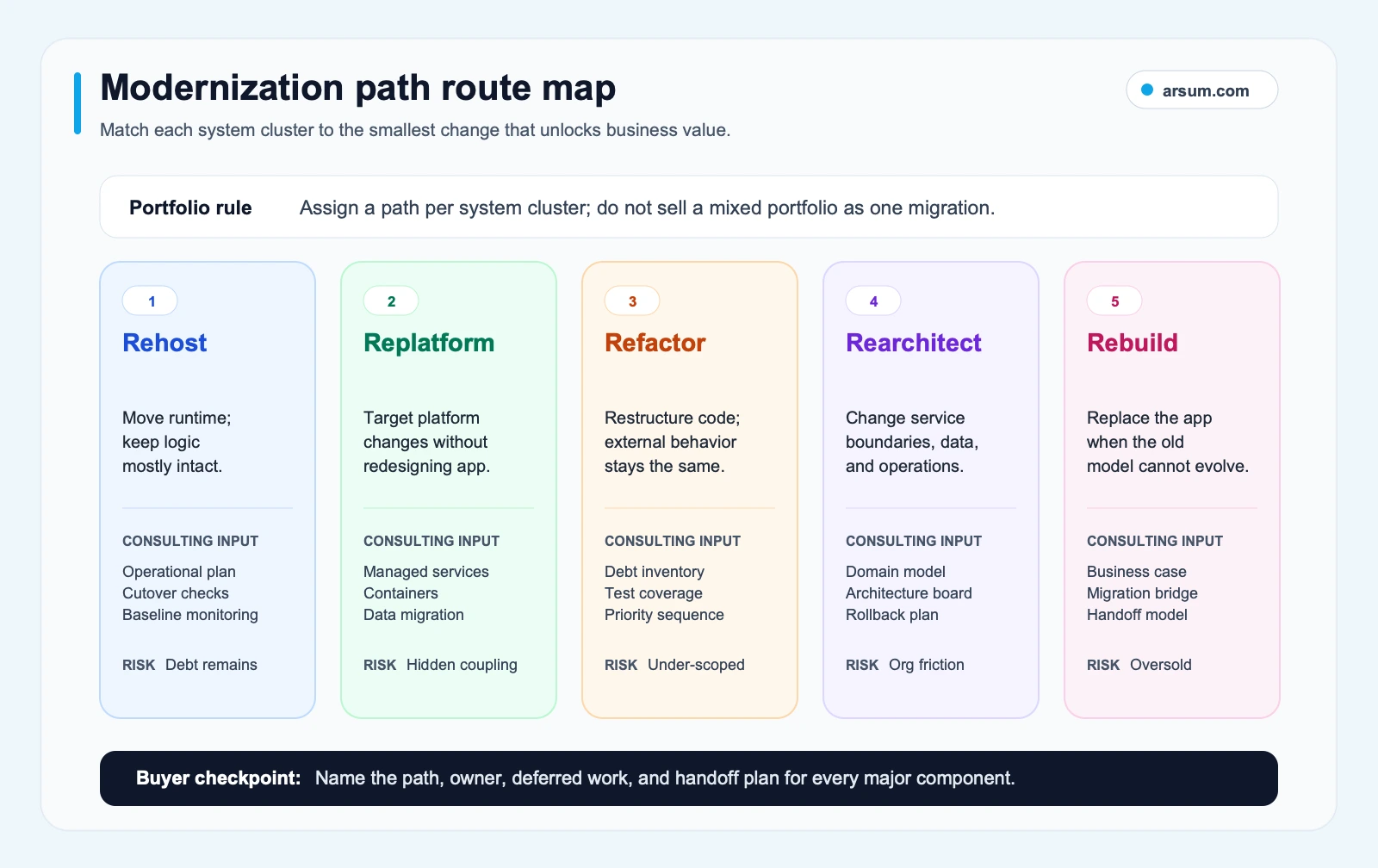
If a firm recommends microservices or another target architecture, ask which business capability owns each service, who owns its data, how failures are handled, and how old and new paths coexist during transition. “Modern architecture” is not an operating model.
What you are actually buying
Application modernization consulting can describe three materially different purchases. Clarify which one you need before comparing proposals.
Advisory
Advisory should leave you with decisions and evidence that remain useful if you select another delivery partner. Expected outputs include:
- A component inventory and dependency map, with stated coverage limits
- A recommended path for each material component
- A decision log with assumptions, approvers, and unresolved questions
- A deferred-work register with reasons and risk acceptance
- A risk register with a named owner for each material finding
- A delivery sequence and acceptance criteria for the first pilot
Advisory is appropriate when an internal team can implement but needs a credible way to prioritize work, align stakeholders, or challenge inherited architecture.
Delivery
Delivery implements an approved plan: platform changes, refactoring, testing, data transition, release engineering, and operational handoff. Its statement of work should distinguish decisions already settled from decisions that discovery must revisit.
If the primary need is broader engineering capacity, compare the engagement with application development consulting services. A capable delivery team is not automatically providing independent modernization advice.
Staff augmentation
Staff augmentation adds execution capacity to an existing team. It can be the right purchase when architecture, priorities, and acceptance criteria are already clear. It is not, by itself, modernization consulting.
Practitioner signals: verify that “consulting” is not relabeled capacity
The validated Research Pack contains three limited signals that sharpen different buyer questions:
| Qualitative signal | Procurement question it changes | Evidence limit |
|---|---|---|
| A Hacker News discussion surfaced through search snippets described modernization consulting in terms close to cloud application development and deployment. | Will the firm independently recommend and document a path, or has “consulting” simply relabeled delivery capacity? | Snippet-level discussion signal; not evidence of consensus, vendor quality, or prevalence. |
| A recent consulting-community thread focused on whether teams are still doing modernization projects and what challenges they encounter. | Does the proposal expose dependency, sequencing, stakeholder, and ownership friction before delivery starts? | Snippet-level thread discovery; no claims about demand, project frequency, or outcomes. |
| Service and guide search results, represented by an Intellias modernization overview, repeatedly connect the category with codebase issues, architecture risk, and technical debt. | Will discovery produce a prioritized debt and risk map tied to an operating constraint, or only a generic cloud destination? | Search-intent and market-language signal; not an independent technical assessment or performance study. |
These signals are used only to generate due-diligence questions. They do not establish market prevalence, demand, price, performance, or project success. The buyer should require system-specific evidence in the proposal and statement of work before accepting any path recommendation.
IBM positions modernization across portfolio strategy, hybrid environments, incremental enhancement, containerization, and AI-assisted work. That describes the range of promises buyers may hear; it does not prove a path fits a particular portfolio. IBM’s application modernization services overview is useful market context, but require system-specific evidence before accepting a recommendation.
If you need an assessment that separates advisory, delivery, and capacity needs, use it to establish the component boundary, accountable owners, evidence gaps, pilot economics, and next decision before requesting a broad implementation proposal.
💡 Arsum builds custom AI automation solutions tailored to your business needs.
Get a Free Consultation →Score proposals on evidence, not confidence
A credible engagement produces artifacts your team can review, challenge, retain, and use after the vendor leaves. The following is an editorial procurement tool, not a validated market benchmark. Adjust the weighting for your risk profile and do not treat the total as an automatic hiring decision.
Score each area from 0 to 5 and require the corresponding evidence before awarding a high score.
| Area | Evidence required for a strong score |
|---|---|
| Discovery coverage | Named systems and repositories, known blind spots, stakeholder interviews, and unverified assumptions |
| Dependency mapping | Interfaces, data flows, third-party dependencies, owners, and how coverage was checked |
| Path recommendation | Rehost, replatform, refactor, rearchitect, rebuild, or defer, explained per component |
| Business constraint | A baseline for release delay, operating risk, incident burden, or cost-to-change, owned internally |
| Security and compliance | Findings, severity method, evidence locations, remediation owner, and acceptance authority |
| Architecture governance | Named technical and business approvers, decision log, escalation path, and change-control process |
| Test and release safety | Regression method, test evidence, environment controls, release approvals, and rollback trigger |
| Knowledge transfer | Runbooks, architecture rationale, walkthroughs, operational training, and a handoff test |
| Post-launch ownership | Support boundaries, alert ownership, backlog ownership, retained artifacts, and vendor exit conditions |
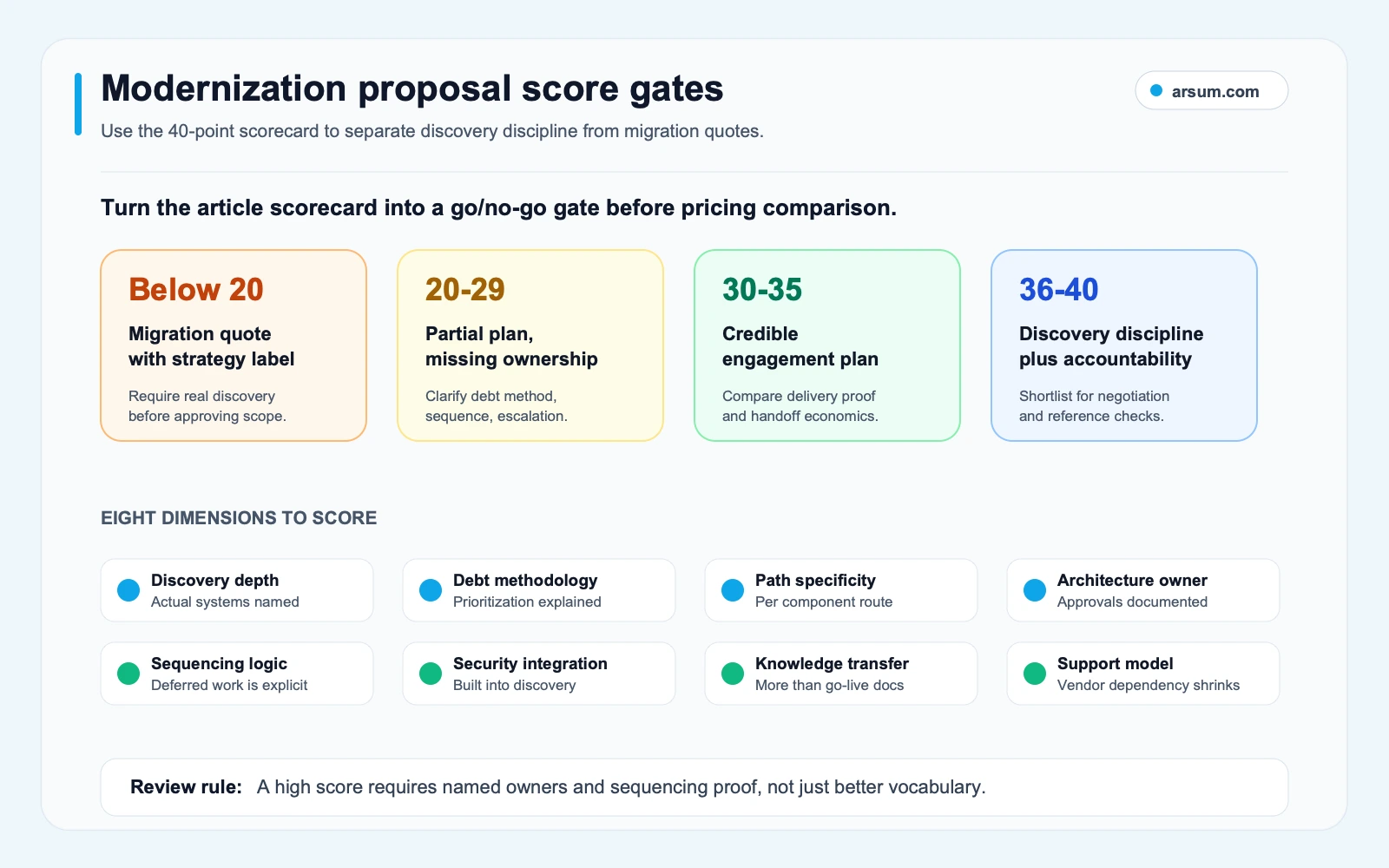
The graphic is an editorial decision aid, not an authoritative procurement threshold. A narrow rehost may need less evidence than a high-consequence rearchitecture, even if their numerical scores appear similar.
A statement-of-work worksheet
Before signing, require a written answer to these points:
| Contract question | What a usable answer contains |
|---|---|
| What is in scope? | Named applications, repositories, interfaces, data stores, and explicit exclusions |
| What decision is being made? | Path choice by component and the evidence needed to approve it |
| What is the first deliverable? | Discovery artifacts, not merely a target-state diagram |
| Who accepts risk? | Named business, engineering, security, and data owners |
| What happens when discovery changes the plan? | Change-control authority, commercial treatment, and re-approval route |
| What is the exit? | Artifact ownership, access retention, handoff test, and stop or pause condition |
A proposal that cannot answer these questions is difficult to compare because its risk has been left in the buyer’s assumptions.
Run a bounded pilot before funding a broad program
A pilot is useful when the path, delivery safety, or ownership model is uncertain. It should test one bounded component or workflow, not attempt to prove that an entire portfolio can be transformed.
Evidence-bounded billing-service scenario
No validated research-pack source provides an anonymized Arsum client outcome, so this guide does not present an invented case study or savings result. The following is an illustrative planning scenario showing the evidence a buyer should require.
Assume a billing service is difficult to change because integrations are undocumented, test coverage is uneven, and releases involve repeated manual review. The decision is not “modernize billing.” It is whether targeted refactoring can make a defined change set safer to release while preserving reconciliation controls.
A defensible pilot would name:
- The engineering owner for the component boundary and implementation decisions
- The finance-control owner who accepts reconciliation exceptions
- The security owner who accepts or rejects documented residual risk
- The baseline: current release steps, review burden, known integrations, and unresolved dependencies
- The target: a verified dependency map for the pilot boundary and a tested release path for the selected changes
- The exception metric: defects or reconciliation exceptions discovered during agreed validation, with an owner and disposition for each
- The stop condition: a material control cannot be demonstrated, dependency coverage remains inadequate, or an accountable owner rejects residual risk
- The rollback: restore the prior executable version or route work through the established process while preserving records and notifying owners
The observed outcome of such a pilot should be limited to what the team can demonstrate: whether the agreed evidence exists, whether acceptance criteria were met, and whether the component remains operable by internal owners. Do not convert that result into a general savings, accuracy, or modernization-success claim.
Pilot scorecard
| Field | Planning entry |
|---|---|
| Component | A bounded service or application area with a known operating constraint |
| Baseline | Current release process, review burden, dependency uncertainty, or backlog, documented by the internal owner |
| Target | A specific acceptance outcome for the chosen boundary |
| Quality and exception metric | Defects or control exceptions found during validation, plus handling route for each |
| Owner | Named engineering, business-process, security, and executive owners |
| Review cadence | Regular decision review using the latest risk register, decision log, and evidence artifacts |
| Stop condition | A material control cannot be demonstrated or a risk owner rejects residual risk |
| Rollback path | Restore the previous version or route work through the established process, preserve records, and notify owners |
Pilot economics should use transparent arithmetic. An illustrative planning assumption could be: affected changes per month × documented review hours per change × internal loaded cost per hour. Add testing, security review, transition, exception handling, and rollback costs. This is a planning model, not an observed saving.
This workflow framing also applies to business process architecture and AI workflow automation: define the normal path, exception path, approval authority, and retained evidence before expanding scope.
Connect modernization to downstream automation readiness
Modernization is not automatically an AI or automation investment. It may make later workflow automation easier, but only if the modernized boundary exposes a stable process, usable source systems, and accountable authorization.
A candidate is more automation-ready when:
- Inputs, decision rules, and outputs are sufficiently defined to map the workflow
- Source records can be identified and retained
- Exception types have known reviewers and escalation paths
- The action is reversible or constrained by human approval
- A business owner can state the outcome and accept the operating tradeoff
- The modernized interface reduces, rather than hides, dependency uncertainty
Defer modernization-for-automation when the automation ROI is unclear, the intended decision has no authorized owner, the workflow is dominated by exceptions no team has classified, or a proposed integration would widen access to sensitive data without a review design. Technical capability is not permission to automate a consequential action.
For adjacent decisions, see AI integration consulting, AI agent security considerations, and AI process automation. They should inform the interface and control design, not be used to justify a modernization path that has not passed its own operational test.
AI can assist analysis; it does not authorize change
AI tools may help inspect unfamiliar code, summarize modules, propose test cases, identify possible dependencies, or draft refactoring options. Treat each output as a hypothesis to validate.
Ask a prospective firm:
- Which AI-assisted tasks are proposed, and which remain human-reviewed?
- Which source materials can the tool access, and what data controls apply?
- How will dependency maps and generated tests be verified?
- Where will prompts, outputs, review comments, and final decisions be retained when they influence a material change?
- Who approves code changes, security exceptions, data transitions, and production release?
- How will the team detect a wrong recommendation before it affects a consequential workflow?
- What rollback path applies if an AI-assisted change causes an operational or control failure?
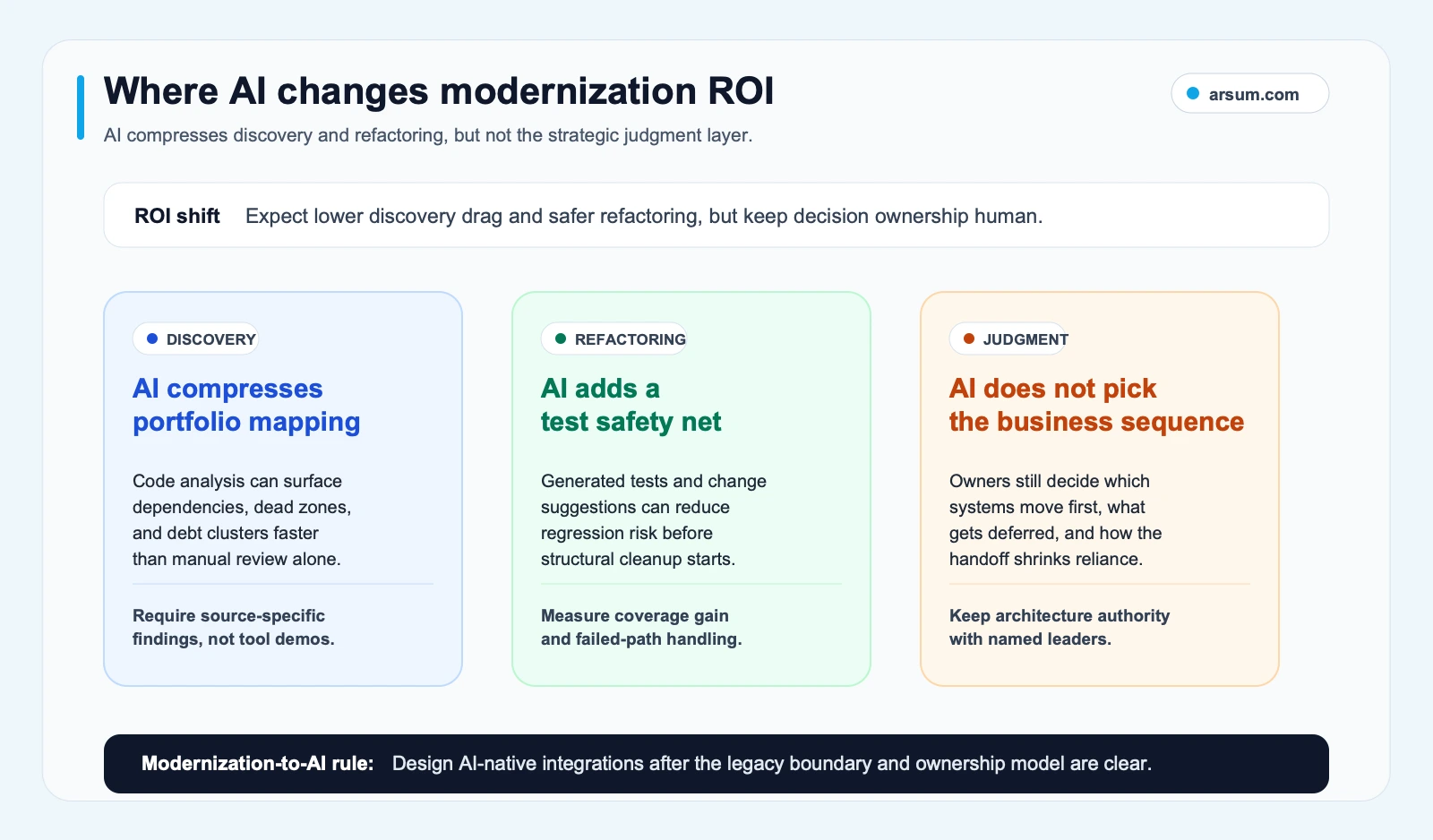
This graphic is an editorial decision aid: AI may support discovery and engineering work, while architecture ownership, business authorization, testing, and release accountability remain human decisions.
Disqualifying conditions and common failure modes
Do not start a broad modernization engagement until these conditions are resolved or explicitly accepted.
Disqualifying conditions
- No accountable business owner can define the workflow outcome or accept operating tradeoffs.
- The firm cannot identify the system boundary, known dependencies, or gaps in discovery coverage.
- Security, compliance, or data owners are unavailable until late delivery.
- There is no feasible rollback, parallel-run, or exception route for a high-consequence change.
- The path is predetermined before relevant evidence has been examined.
- The internal team lacks capacity to review decisions, validate changes, or accept handoff.
- The commercial model rewards open-ended delivery while leaving discovery outputs and exit conditions undefined.
Failure modes to plan for
A dependency map can be incomplete. A refactor can preserve behavior in tests while altering an operational edge case. A platform migration can expose undocumented manual work. A rebuild can be technically cleaner but fail because business rules were not captured.
The response is not to claim these risks away. It is to state discovery limits, assign owners, define acceptance evidence, provide an exception route, and set a stop condition. Agile software development consulting can help frame review cadence, but a sprint process does not substitute for a modernization decision log.
Questions to settle before signing
Ask every finalist to answer these questions in writing.
- Which path do you recommend for each major component, and what evidence supports it?
- What is deliberately deferred, who accepts that deferral, and when will it be reconsidered?
- Which discovery artifacts will we own after the first phase?
- How will you verify dependency-map coverage and expose remaining unknowns?
- Who approves architecture choices, security findings, data transitions, and production releases?
- What is the normal workflow, exception path, and escalation route during delivery?
- What is the pilot baseline, target, review cadence, stop condition, and rollback procedure?
- How will our team prove it can operate the result without continuing vendor dependency?
- Which AI-assisted tasks will be used, and what validation evidence will be retained?
- What technical or commercial condition lets us pause, change direction, or exit cleanly?
A firm that answers clearly may still be the wrong fit, but you will be comparing operating models instead of interchangeable promises.
Frequently asked questions
What is application modernization consulting?
It helps an organization decide how to change legacy applications, platforms, and operating practices. A useful engagement provides path recommendations, dependency and risk evidence, decision ownership, delivery sequencing, and handoff criteria—not only implementation labor.
What is the difference between modernization and cloud migration?
Cloud migration usually concerns where an application runs. Modernization is broader and may include rehosting, replatforming, refactoring, rearchitecting, rebuilding, or deliberately deferring a component.
When should a company hire a modernization consultant?
Hire outside help when the cost of a wrong path decision is high, internal teams cannot create a trusted component-level plan, ownership is fragmented, or a bounded pilot needs independent discovery and acceptance criteria. If execution against an approved plan is all that is needed, delivery capacity or staff augmentation may be the more accurate purchase.
How should we estimate modernization cost and timing?
Use scoped inputs rather than generic ranges: systems and repositories in scope, dependency complexity, documentation quality, controls, data requirements, internal capacity, test environments, cutover tolerance, and the work intentionally deferred. Require each firm to show how those assumptions affect its estimate.
Methodology: This buyer guide uses the five-path framing in AWS Prescriptive Guidance and current market framing in IBM Application Modernization Services. The scorecard, worksheet, and pilot model are editorial decision tools, not market benchmarks. No unsupported client outcomes, savings, cost ranges, or delivery timelines are presented.
For a scoped modernization and workflow assessment, establish the component boundary, accountable risk owners, evidence gaps, pilot economics, and next decision before funding a larger program.
Ready to Automate Your Business?
Stop wasting time on repetitive tasks. Let AI handle the busywork while you focus on growth.
Schedule a Free Strategy Call →Written by:Arsum editorial team
- Reviewed by
- Arsum editorial team
- Published
- June 21, 2026
- Updated
- August 12, 2026
- How this was produced
- Arsum uses research packs, source checks, and human editorial review to prepare and update blog articles. Editors are responsible for the final page.
- Source policy
- Sources are linked in the article when used. Methodology and source notes are included on higher-risk or high-visibility pages and are being rolled out across the archive. Editorial policy.
- Why this page exists
- Help B2B operators evaluate AI automation, implementation scope, cost, risk, and build-vs-buy decisions with practical context.