Artificial intelligence services companies are worth comparing by the operating system they will leave behind—not their logo list, demo polish, or broad menu of AI capabilities. The right partner can help a team select a narrow workflow, connect the required systems, define human approvals and exceptions, retain evidence for review, and hand over ownership; the wrong fit can create a persuasive prototype with unclear controls, hidden dependencies, and no safe path when production conditions change.
Artificial Intelligence Services Companies
Explore artificial intelligence services companies: compare workflow fit, costs, risks, evidence, and practical next steps before you build, buy, or hire.
Table of Contents
- What most guides miss about choosing an AI services company
- Route the project before you shortlist firms
- Compare the work that is hard to replace
- Buyer evaluation scorecard
- Work a pilot scorecard before committing to a wider rollout
- Practitioner signals: useful questions, not market statistics
- Find hidden scope before it becomes a change request
- Disqualifying conditions and red flags
- A neutral next-step checklist
- Questions buyers commonly ask
What most guides miss about choosing an AI services company
Directories and “top AI company” roundups are useful for discovering names, but they rarely answer the buyer’s harder question: which delivery model fits this workflow and who will own the consequences after launch?
That distinction matters because “AI services” can describe several very different engagements:
- A strategy and governance program
- A narrowly scoped workflow implementation
- Services attached to a software platform
- A specialist build for a particular industry, function, or system landscape
A vendor can be technically capable and still be a poor fit if its delivery model does not match your decision rights, data readiness, procurement requirements, or post-launch capacity.
The first decision is therefore not “which firm is best?” It is:
Which vendor type can accept responsibility for the workflow boundary we actually need?
For a workflow that drafts internal material, the tolerance for error may be relatively high. For a workflow that routes a loan application, changes customer records, sends external communications, or influences a compliance decision, technical capability does not authorize autonomous action. The approval owner, evidence retained, exception process, and rollback path become part of the product.
Primary guidance supports treating these as design requirements. The NIST AI Risk Management Framework provides a useful benchmark for thinking through governance, risk mapping, measurement, and management. Anthropic’s guidance on effective AI agents is also a useful evaluation benchmark: a vendor should be able to explain why a simpler workflow or automation pattern is insufficient before recommending a more complex agentic system.
Route the project before you shortlist firms
Use vendor categories as a starting point, not as fixed predictions about any individual company. Fit depends on scope, procurement, data readiness, existing platform commitments, and regulated-use requirements.
| Vendor type | Often appropriate when | Buyer should test |
|---|---|---|
| Enterprise consultancy | The work spans multiple functions, formal governance, change management, or a broad operating model | Whether the proposal includes practical delivery ownership, not only assessment and roadmap work |
| Boutique AI implementation partner | A workflow is defined and the team needs implementation, integrations, controls, and handover | Whether engineering depth, security scope, and support responsibilities are explicit |
| Software vendor with services | The organization has already selected a platform and needs implementation within that ecosystem | Whether the platform is a good fit for the workflow and what portability or exit options remain |
| Domain specialist | The workflow has material industry rules, specialized data, or narrow operational requirements | Whether the specialization is demonstrable in the relevant workflow rather than only marketing language |
| Independent specialist or small team | The work is narrow, bounded, and can be governed by an accountable internal technical owner | Whether continuity, documentation, security review, and support are sufficient for the risk level |
A practical routing rule
Choose the category after answering four questions:
- Is the workflow defined well enough to test?
- Which systems, records, and teams must the implementation touch?
- What actions may the system take without approval, if any?
- Who owns reliability, changes, and incident response after handover?
If you cannot answer the first question, do not start with a build proposal. Start with workflow discovery. If the workflow is clear but the system landscape is not, prioritize integration and data mapping. If the action has a high failure cost or is hard to reverse, make the approval and rollback design more important than the model choice.
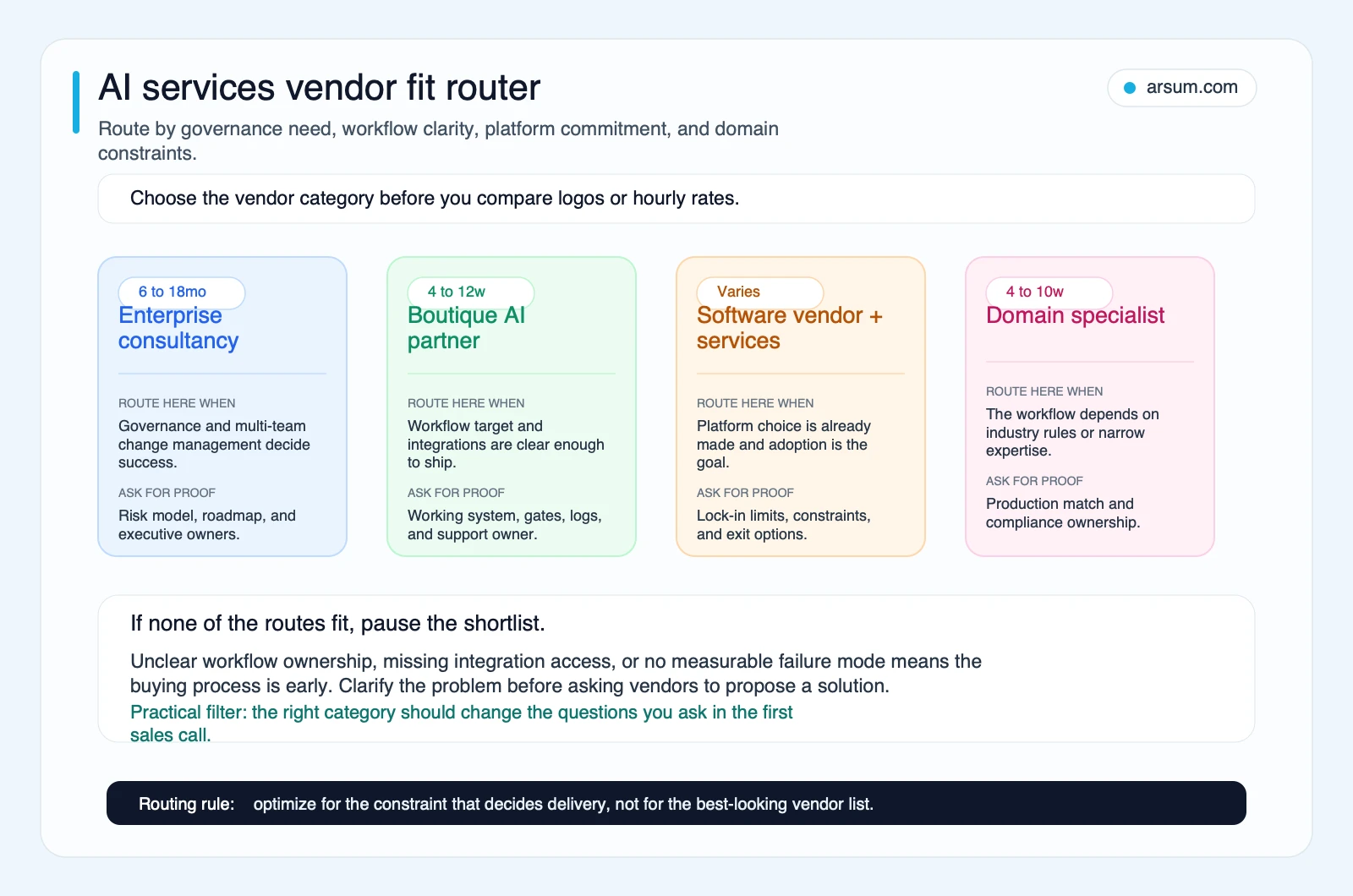
Use this router before comparing firms. It helps align the shortlist with the actual need: governance design, workflow delivery, a platform implementation, or domain-specific operating knowledge.
For teams considering autonomous or semi-autonomous workflows, agentic AI workflow automation provides a useful way to separate a workflow with bounded steps from one that needs broader agent behavior.
Compare the work that is hard to replace
A basic chatbot, document retrieval layer, or prompt-based assistant can be useful. But those deliverables alone do not establish that a provider can run a reliable production workflow. Buyers should protect budget for the work that determines how the system behaves under normal use, messy inputs, access constraints, and change.
| Delivery area | Why it deserves scrutiny | Evidence to request |
|---|---|---|
| Workflow selection | A poor process can become faster without becoming better | Workflow map, baseline, exclusions, and an explanation of why automation is appropriate |
| Integration architecture | The useful work often happens between existing systems | System-of-record map, interface ownership, error handling, and test plan |
| Human approval design | Consequential decisions need clear authority and escalation | Approval thresholds, queue owner, exception categories, and decision records |
| Observability | Operators need to investigate behavior after launch | Logged events, traceability approach, alerts, retention policy, and access controls |
| Security review | Generative AI introduces deployment and management risks | Threat model, access model, sensitive-data handling, and remediation ownership |
| Evaluation and quality controls | A demo does not establish reliable workflow performance | Test cases, acceptance criteria, review sampling, and change-control process |
| Post-launch ownership | Systems change after launch | Support responsibilities, handover artifacts, maintenance plan, and exit process |
The OWASP Gen AI Security Project is a useful benchmark when testing whether a proposal treats risks such as prompt injection, sensitive information exposure, and insecure integrations as real deployment concerns. It is not a universal checklist that every engagement must implement identically; it is a reason to ask what threats apply to your workflow and who owns the controls.
Commodity work versus production ownership
A buyer does not need to dismiss common patterns. Commodity work can be the sensible choice when the use case is low-risk and tightly bounded. The mistake is paying for a generic deliverable while assuming it includes production ownership.
| Work item | Can be comparatively standardized? | Questions that expose the boundary |
|---|---|---|
| Basic internal assistant | Often | What documents can it access, and how are answers reviewed or corrected? |
| Retrieval over approved documents | Often | Who refreshes sources, manages permissions, and investigates unsupported answers? |
| Simple classification or routing | Sometimes | What happens with ambiguous inputs, missing fields, or low-confidence cases? |
| Cross-system workflow integration | Less often | Who owns retries, duplicates, data conflicts, and upstream API changes? |
| Approval logic and audit trail | Less often | Which role can approve, override, or reverse an action? |
| Security, monitoring, and handover | Less often | What evidence remains available after launch, and who responds to incidents? |
A credible proposal should state its inclusions and exclusions in these operational terms. It should also explain whether a simpler non-agentic pattern was considered. For a broader comparison of implementation approaches, see agentic AI frameworks comparison.
Buyer evaluation scorecard
Score each shortlisted provider from 1 to 5 against the following criteria. The score is not market data or a ranking system; it is a procurement worksheet for exposing unanswered questions before a contract is signed.
A score of 1 means the provider gives only general assurances. A score of 3 means the provider can explain an approach and assign responsibility. A score of 5 means the provider can show relevant evidence, limits, owners, and a practical operating process.
| Criterion | What a buyer should look for | Critical follow-up |
|---|---|---|
| Workflow selection quality | Clear statement of process, baseline, exclusions, and expected operator role | What makes this workflow unsuitable for automation? |
| Integration ownership | Named ownership for interfaces, data mapping, retries, and edge-case testing | What remains the client’s technical responsibility? |
| Human approval and exceptions | Defined approval owner and a queue for ambiguous or high-impact cases | Which actions cannot proceed without a person? |
| Evaluation approach | Test cases tied to the actual workflow and acceptance criteria | How will quality be measured after launch? |
| Observability and evidence | Traceable events, operational alerts, and records available for review | What can we inspect after a disputed output or action? |
| Security and data handling | Written scope for access, retention, sensitive data, and review responsibilities | Which risks are excluded from your security scope? |
| Post-launch ownership | Support, maintenance, handover, and change-control responsibilities | Who fixes the system after an upstream dependency changes? |
| Delivery-team access | A technical conversation with people expected to lead delivery | Who specifically will own architecture and operations? |
| Commercial transparency | Inclusions, exclusions, assumptions, and dependencies stated clearly | What would cause change requests or added cost? |
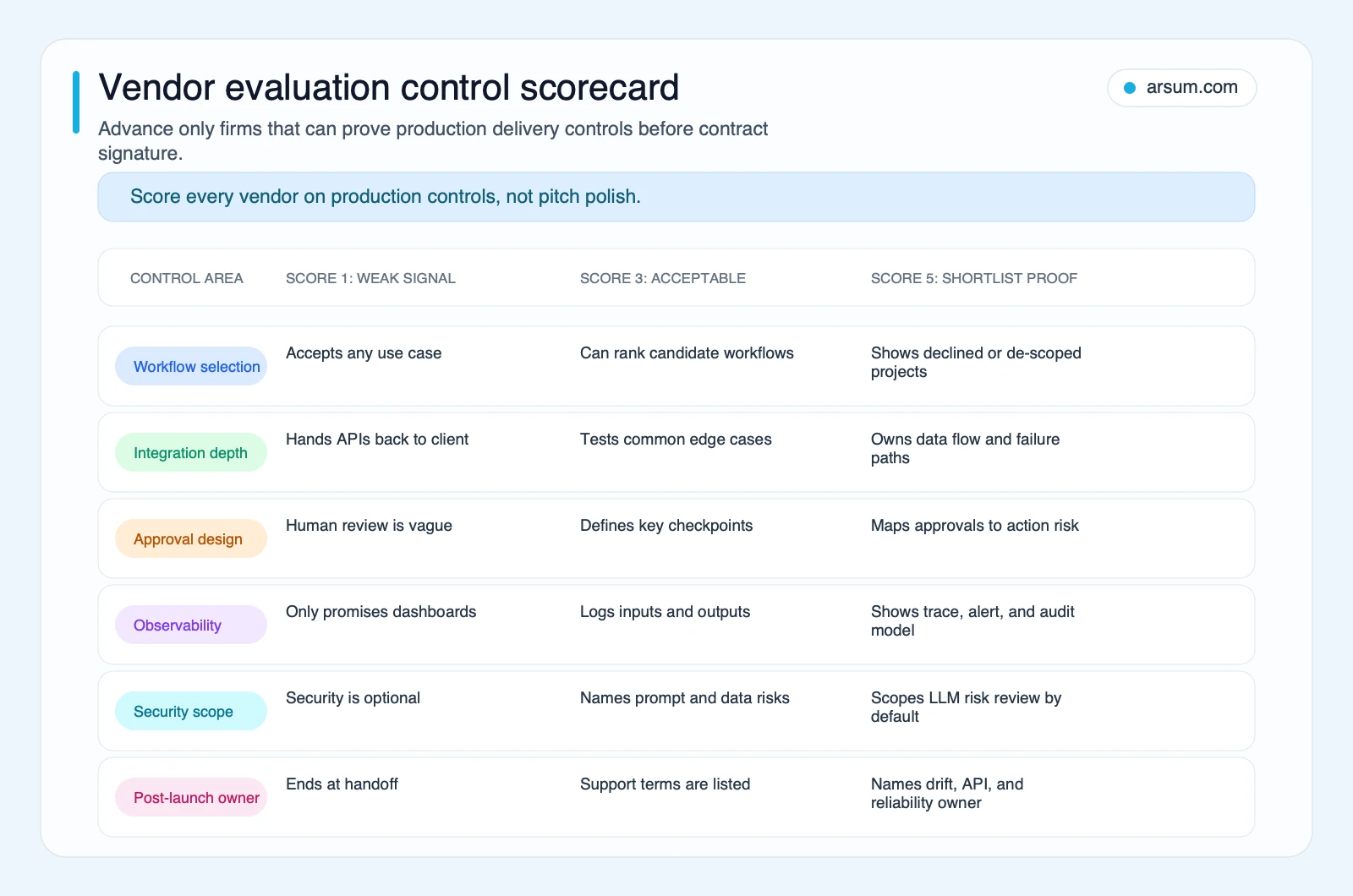
Use the scorecard to compare proof, not presentation quality. Weak answers are not automatic disqualification, but they should become written conditions before a vendor advances.
Proposal comparison matrix
Ask every vendor to complete the same matrix. This avoids comparing one proposal’s polished summary with another proposal’s detailed engineering scope.
| Proposal item | Vendor response required |
|---|---|
| Workflow in scope | Exact triggering event, inputs, outputs, and systems affected |
| Exclusions | Workflows, users, data classes, and operational conditions not covered |
| Data responsibility | Source systems, data quality assumptions, permissions, retention, and owner |
| Approval design | Actions requiring approval, authority by role, and exception route |
| Evidence retained | Logs, decision records, test artifacts, and access arrangements |
| Security scope | Threats considered, controls included, customer responsibilities, and residual risks |
| Acceptance criteria | Baseline, target, quality threshold, review rate, and test method |
| Support model | Incident path, response expectations, maintenance work, and escalation owner |
| Handover artifacts | Documentation, code or configuration access, runbooks, credentials process, and training |
| Twelve-month cost view | Implementation, platform fees, model usage, support, internal review effort, and likely dependencies |
Do not infer that a missing line item is included. Ask for a written answer. The objective is not to force every vendor into the same delivery model; it is to make scope differences visible before they become operational disputes.
💡 Arsum builds custom AI automation solutions tailored to your business needs.
Get a Free Consultation →Work a pilot scorecard before committing to a wider rollout
A pilot is useful when it answers a decision that a demo cannot: whether this particular workflow can operate safely enough, with acceptable review burden, under real conditions.
The following is an illustrative planning scenario, not a client outcome or market benchmark. It shows the fields a buyer and vendor should agree before implementation.
Illustrative pilot: inbound request triage
Suppose an operations team receives inbound requests through a shared queue. The proposed system extracts information, identifies missing details, drafts a classification, and recommends a route. It does not make final consequential decisions; designated operations staff approve or correct recommendations.
| Pilot field | Illustrative planning assumption |
|---|---|
| Baseline | Measure a defined sample of current requests: volume, handling time, rework, and escalation reasons |
| Target | Reduce avoidable manual triage steps while preserving the existing approval standard |
| Quality metric | Compare recommendations with reviewer decisions against an agreed labeled sample |
| Exception metric | Track the share routed to human review, missing-information cases, and incorrect or disputed recommendations |
| Approval owner | Named operations manager owns approval policy and any change to autonomous action limits |
| Technical owner | Named internal system owner and vendor delivery lead own integrations, logging, and incident triage |
| Review cadence | Weekly operational review during pilot; 30-, 60-, and 90-day decision reviews if the workflow continues |
| Stop condition | Pause automated routing if agreed quality thresholds are missed, evidence is unavailable, or an unsafe pattern appears |
| Rollback path | Disable automated action, preserve the manual queue, retain logs, and return routing to the documented human process |
| Twelve-month ownership | Decide who maintains prompts, integrations, access controls, test cases, monitoring, and support after handover |
The ROI arithmetic should also remain explicit. For example, an illustrative planning model might use:
annual value estimate = (eligible volume × verified time avoided × fully loaded review-cost assumption) − implementation cost − recurring software and support cost − added review cost
Every input is an assumption until measured in the operating environment. Do not substitute a vendor’s generic savings claim for your own baseline. The value may be lower if exception handling rises, if reviewers must correct outputs extensively, or if a workflow creates coordination costs elsewhere.
For examples of how to structure workflow-level assumptions without treating them as guarantees, see AI automation ROI examples.
Practitioner signals: useful questions, not market statistics
Practitioner discussions can sharpen screening questions, but they are not evidence of market-wide vendor performance.
A Hacker News discussion about landing consulting work contains recurring views that generalist positioning is crowded and that visible specialization matters. That is a directional signal, not a rule. Translate it into a shortlist question: What narrow workflow, stack, or operating environment is this firm demonstrably equipped to handle? Discussion source
In his practitioner account, Jason Liu distinguishes task-selling from owning an outcome. This is a single-operator perspective, not a universal commercial model. For buyers, it suggests asking: Which operational result does the proposal seek to improve, and which dependencies remain ours? Everything I Learned from AI Consulting
Another Hacker News discussion includes operator frustration with long AI-generated material that creates more review work because it has not been curated against the real decision. Use that as a design check: How will outputs be reviewed, verified, and corrected before they enter a business process? Discussion source
These signals point to the same buyer discipline: ask for a narrow delivery lane, measurable acceptance conditions, and a review design—not an impressive volume of generated output.
Find hidden scope before it becomes a change request
The lowest initial proposal may be the best fit, but only if the comparison includes the same work. Treat unexplained omissions as procurement questions, not proof of vendor weakness.
Common scope areas to check include:
- Data profiling, cleanup, mapping, and permissions
- Integration development, retry behavior, and duplicate handling
- Test data, test cases, evaluation, and acceptance review
- Human approvals, exception queues, and override authority
- Logging, monitoring, alerts, and audit evidence
- Security review, access controls, and incident responsibilities
- Internal training, documentation, and operating runbooks
- Ongoing model, prompt, dependency, and integration maintenance
- Model usage, platform fees, and internal review time
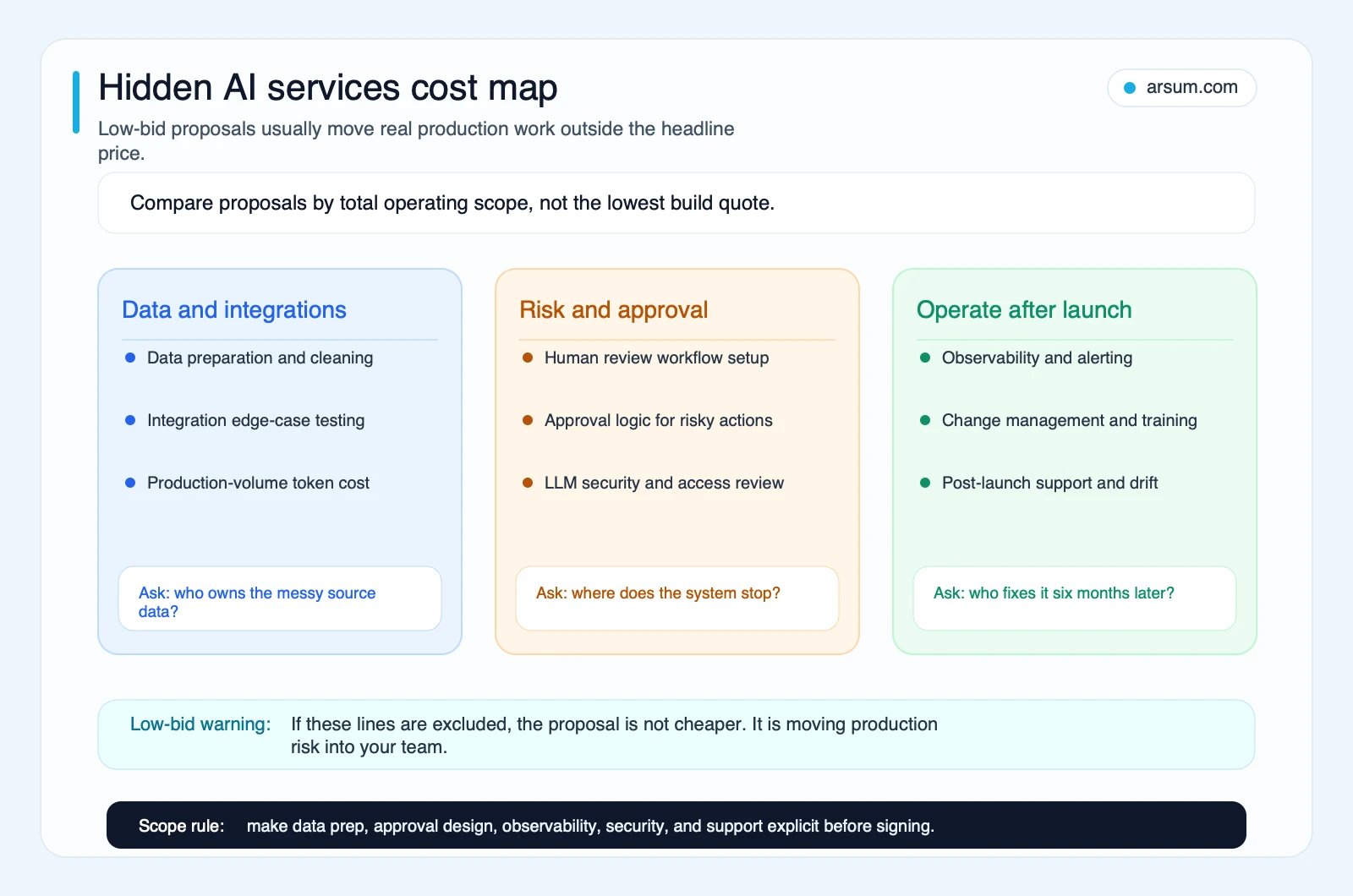
Compare scope line by line. A low bid may still be appropriate, but the buyer should know whether data work, approvals, security, observability, and post-launch support are included.
The same discipline applies to platform-led services. A platform may be appropriate because it fits your existing architecture, security controls, and internal skills. Ask what becomes easier because of that platform and what becomes harder to change later. For teams deciding between packaged tools and a more tailored workflow, AI automation workflow tools can help frame the choice.
Disqualifying conditions and red flags
Some issues should halt a procurement process until resolved. The following are not universal proof that a provider will fail; they are risk signals that require a direct, documented answer.
The vendor cannot describe the exception path
Ask what happens when an input is missing, contradictory, unfamiliar, or sensitive. If the answer is “the model will handle it,” the workflow boundary is not ready. Require a human queue, decision authority, and rollback process where the failure cost warrants it.
The proposal names capabilities but not operating behavior
“AI,” “agents,” “RAG,” or “automation” are not scopes of work. A usable proposal identifies the trigger, systems involved, output, approval boundary, evidence retained, and owner.
Sales access is separated from delivery evidence
A pre-contract technical conversation is not a guarantee of success. It is, however, a reasonable buyer check. Ask to meet the people expected to own architecture or implementation and test their understanding of your workflow’s constraints.
Security and data handling are deferred without a boundary
Not every pilot needs a full enterprise program. But no provider should leave unclear which data it will access, how access is controlled, what is retained, and who owns review of applicable security risks. The AI agent security guide provides further questions for systems that use tools or act across connected systems.
There is no owner after “handover”
Handover should name the operational owner, technical owner, access process, documentation set, support path, and the conditions under which the workflow is changed or disabled. If your organization cannot accept those responsibilities, purchase an explicit support model or reduce the scope.
A neutral next-step checklist
Before selecting a provider, confirm that you can answer yes to each of these:
- We have one workflow with a clear trigger, users, systems, and desired output.
- We have measured a baseline or have a concrete plan to measure it before judging value.
- We know which actions require human approval and who owns that authority.
- We have defined exception categories and a manual fallback.
- Every vendor has completed the same proposal comparison matrix.
- We understand what evidence, documentation, and access we receive at handover.
- We can compare twelve-month ownership costs, not only an initial project figure.
- We have identified the internal business and technical owners who can operate the workflow.
If those answers are not available yet, the next purchase may be a bounded discovery effort rather than a full build. If they are available, a workflow assessment should produce the scorecard, implementation boundaries, pilot acceptance criteria, and ownership plan needed for a defensible vendor decision.
Arsum can help qualified teams turn a proposed AI workflow into that evaluation package: the baseline and target measures, control boundaries, exception path, pilot scorecard, and implementation scope required to compare providers on like-for-like terms.
Ready to Automate Your Business?
Stop wasting time on repetitive tasks. Let AI handle the busywork while you focus on growth.
Schedule a Free Strategy Call →Questions buyers commonly ask
Are boutique AI firms better than large consultancies?
Neither category is inherently better. A boutique partner may fit a defined workflow that needs hands-on implementation and direct technical access. A larger consultancy may fit a broader change, governance, or multi-function program. Compare the proposed delivery team, scope, controls, and ownership model rather than assuming size determines outcome.
What should I ask before hiring an AI services company?
Ask the vendor to explain the workflow at the operating level: inputs, systems, outputs, approvals, exceptions, evidence, and post-launch ownership. Then require the answer in the proposal, alongside exclusions and acceptance criteria.
How should AI systems be governed in a consequential workflow?
Reduce autonomy as failure cost and irreversibility rise. Define who approves actions, what evidence is retained, how exceptions are escalated, and how operators disable or revert the workflow. Technical feasibility is only one part of authorization.
What is the most useful way to compare proposals?
Use a shared matrix that requires every vendor to state inclusions, exclusions, delivery ownership, security scope, evidence retained, support, handover artifacts, and a twelve-month cost view. That makes substantive scope differences visible.
Methodology: This editorial guide uses the validated research pack for the exact keyword. It draws on NIST, Anthropic, and OWASP as evaluation benchmarks for governance, complexity, and security questions. Practitioner discussions are used as qualitative signals about buyer concerns, not as market statistics or rankings.
Written by:Arsum editorial team
- Reviewed by
- Arsum editorial team
- Published
- June 22, 2026
- Updated
- July 5, 2026
- How this was produced
- Arsum uses research packs, source checks, and human editorial review to prepare and update blog articles. Editors are responsible for the final page.
- Source policy
- Sources are linked in the article when used. Methodology and source notes are included on higher-risk or high-visibility pages and are being rolled out across the archive. Editorial policy.
- Why this page exists
- Help B2B operators evaluate AI automation, implementation scope, cost, risk, and build-vs-buy decisions with practical context.