Automation consultants are worth hiring when the work is more than a standard tool setup: you need a partner to map a consequential workflow, build and test the integration, define exception and approval paths, and hand the operating controls back to your team. The first decision is not “which consultant is best?” It is whether your workflow needs internal tooling, a software platform, an integrator, a specialist implementation partner, or a broader transformation program.
Automation Consultants: How to Vet the Right Partner
Explore automation consultants: compare workflow fit, costs, risks, evidence, and practical next steps before you build, buy, or hire.

Table of Contents
- What most guides miss: vendor type and ownership model matter more than a polished proposal
- Choose the route before you compare firms
- Build a shortlist around operating control
- Require a pilot that can pass or fail
- Test AI claims against a workflow boundary
- Red flags and disqualifying conditions
- Make production readiness part of acceptance
- Decide whether to use a consultant
What most guides miss: vendor type and ownership model matter more than a polished proposal
Automation service pages often bundle strategy, software, integrations, and AI-enabled delivery under one label. That can make unlike-for-like proposals look comparable. They are not.
A useful shortlist starts with two questions:
- What must be delivered: a process recommendation, platform configuration, system integration, or production workflow?
- Who owns the system after go-live: credentials, alerts, documentation, change control, and the ability to exit?
The second question is the one many buyers leave until contracting. It should shape the shortlist from the start. A workflow that is technically working but can only be changed through the vendor is still an operating dependency.
This is an editorial buyer-evaluation framework, based on cited official guidance and qualitative practitioner signals. It is not market research, a ranking of firms, or a claim that one vendor category is inherently better than another.
Choose the route before you compare firms
The commodity versus non-commodity boundary
Use internal ownership and standard tooling when the workflow is documented, reversible, and mostly consists of predictable routing:
- Form submissions sent to a CRM
- Standard notifications and task creation
- Basic SaaS-to-SaaS synchronization
- A documented no-code configuration with an internal administrator
These tasks may still need care, but they do not automatically justify a consulting engagement. An internal operator with suitable tools may be the better owner. For a practical internal-versus-external lens, see AI automation for small business.
Bring in specialist support when the workflow includes any of the following:
- AI decision logic used in a live process
- Multiple systems with meaningful exception handling
- Approvals, payments, regulated information, or external communications
- Custom monitoring, audit, or governance requirements
- A workflow where a bad action is difficult or costly to reverse
Anthropic advises teams to start with the simplest solution that works and distinguishes structured workflows from more autonomous agents; agentic approaches can introduce added latency and cost. Anthropic’s guidance on effective agents is useful reading before a vendor calls every integration an “agent.”
For AI-enabled workflows, technical capability is not authorization to act. The more consequential and less reversible the action, the more the design should favor review gates, constrained permissions, and explicit escalation over autonomy. NIST’s AI Risk Management Framework makes the broader point: trustworthy AI considerations belong in design, development, use, and evaluation, not as a late-stage add-on.
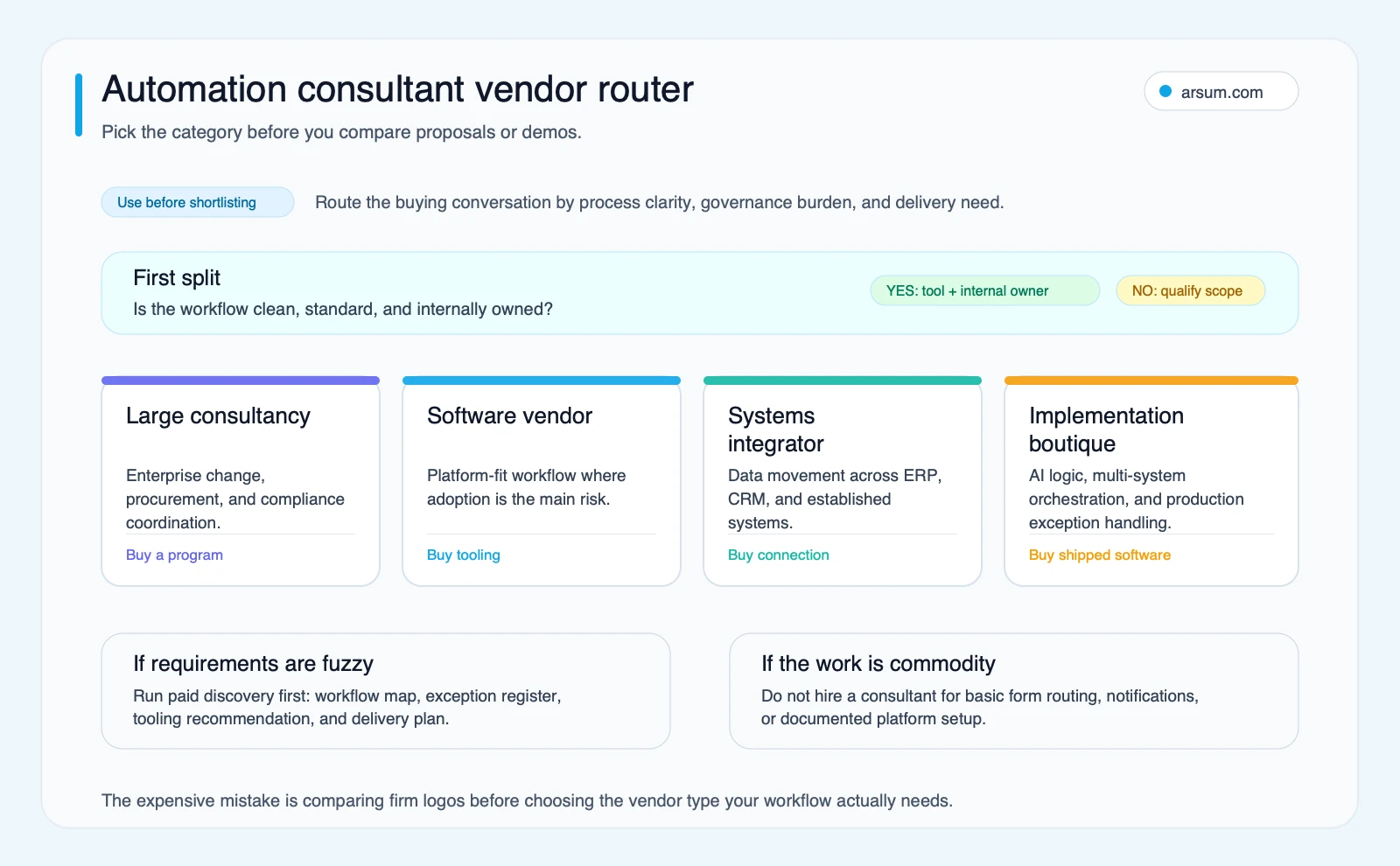
A proposal-level view of the four vendor types
Before you compare names, decide whether you are buying platform help, systems integration, or an implementation partner that owns workflow delivery end to end. If you want a broader breakdown of engagement structure, expected deliverables, and ROI framing before shortlisting vendors, the AI automation consulting guide covers how these engagements are typically scoped. If you are comparing delivery depth across service providers, the AI automation agency services breakdown is also useful.
| Vendor type | Likely primary output | May fit when | Evidence to request before choosing |
|---|---|---|---|
| Large consultancy | Program design, process change, governance, and transformation support | You need coordination across functions, systems, and stakeholders | Named delivery team, build responsibility, staged deliverables, and decision rights |
| Software vendor | Platform license, onboarding, and platform-specific services | Your workflow fits a known product and your team can own it | Platform constraints, admin model, exportability, implementation boundaries |
| Systems integrator | Connections among established systems | The central problem is reliable data and system interoperability | Integration architecture, error handling, support ownership, documentation |
| Specialist implementation boutique | A scoped workflow or custom production system | You need focused design-and-build capability for a defined workflow | Named engineers, production acceptance criteria, credential transfer, support and exit terms |
Enterprise providers such as IBM, Bain, and EY describe automation in broad process and transformation terms. That does not make them a poor choice; it means a buyer with one bounded workflow should test whether the proposed engagement is proportionate to that need.
Do not assume a boutique will be more hands-on, an integrator will lack AI capability, or a large firm will delegate the build. Treat each as a hypothesis to verify in the proposal. Ask who will do the work, what they will deliver, and what your team receives at handoff.
Build a shortlist around operating control
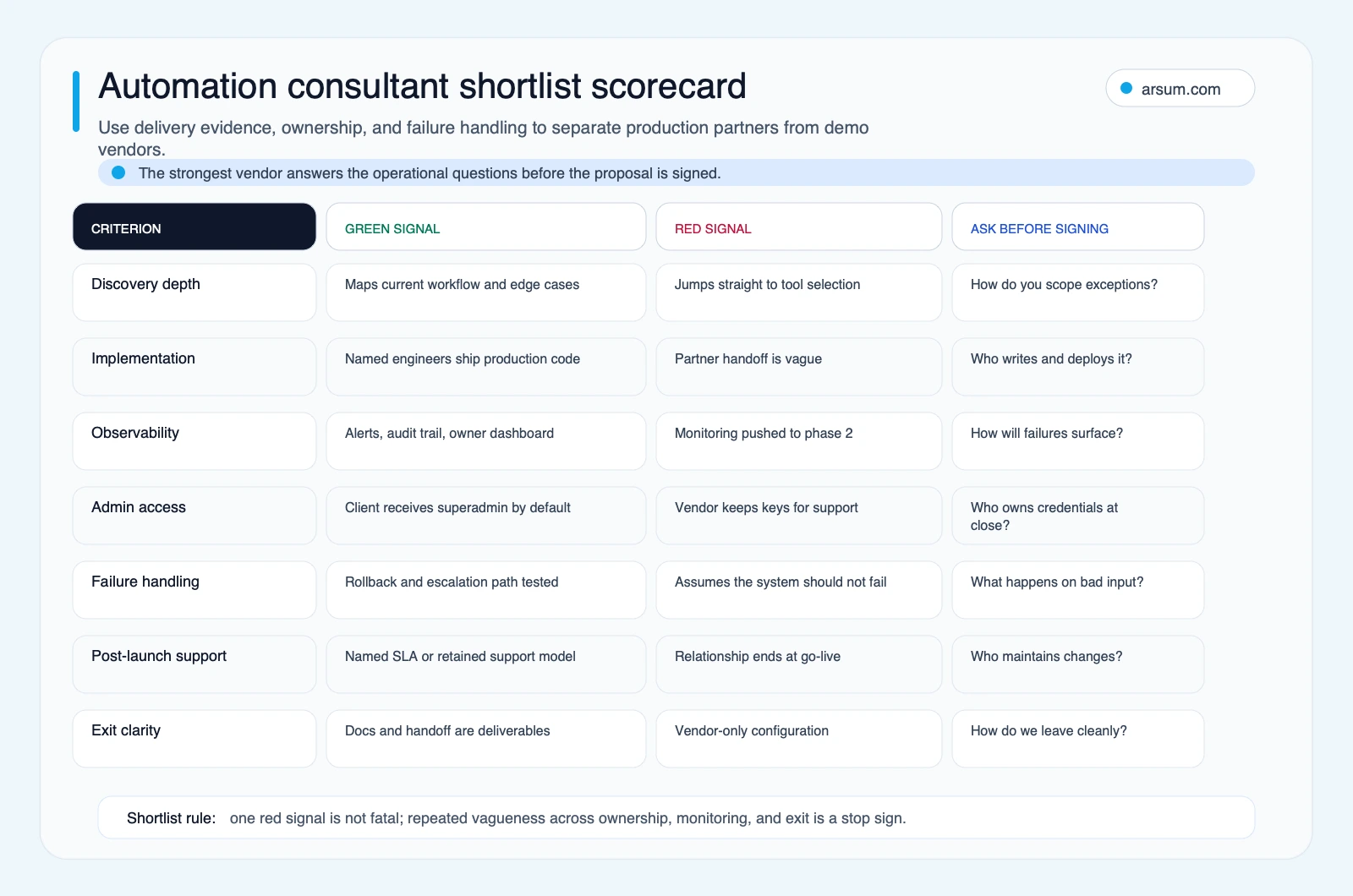
A portfolio can show that a vendor has presented successful work. It does not prove that your team will be able to operate the system, investigate failures, or leave the relationship cleanly.
Ask every finalist for written answers to these questions:
- Which named people will lead discovery, build, testing, and handoff?
- Which parts of the work, if any, are subcontracted?
- What workflow evidence will discovery produce: inputs, systems, decision points, edge cases, approvals, and exceptions?
- Which client-owned account or service account will own production connections?
- Who receives alerts, who decides on exceptions, and who can pause the workflow?
- What monitoring, trace, or audit evidence will be available to the client?
- What documentation, credentials, configuration exports, and runbooks are due at handoff?
- What happens if your team ends support or changes vendors?
A snippet-only community discussion about Power Automate surfaced a concern about flows tied to a departed user’s account. That is a qualitative signal, not evidence of market prevalence, but it is a sensible prompt to verify account ownership in your own environment. The related community thread should not substitute for tenant-specific architecture review.
Similarly, a snippet-only Hacker News discussion about production agent monitoring raised observability as a concern after launch. It is not proof of a universal failure pattern. It does support a practical buyer question: “Show us the monitoring and escalation design before we approve build.”
Arsum editorial triage heuristic
Use this as a conversation aid, not as a predictive scoring model or market benchmark. Score each dimension from 0 to 2:
- 0 — absent, evasive, or assigned to an unnamed party
- 1 — partially defined, but ownership or evidence remains unclear
- 2 — named, documented, client-reviewable, and included in scope
| Dimension | What a 2 looks like |
|---|---|
| Process discovery | Current-state map, inputs, exceptions, approvals, and target workflow documented |
| Delivery ownership | Named implementation lead and named client counterpart |
| Monitoring and alerts | Client can access monitoring; alert recipients and escalation path are defined |
| Admin and credential transfer | Client-held admin access and service-account ownership are planned for handoff |
| Failure and rollback | Failure paths, pause control, rollback method, and manual fallback are documented |
| Post-launch support | Support boundaries, responsibilities, and response expectations are written down |
| Exit clarity | Runbook, configuration inventory, documentation, and handoff deliverables are explicit |
A total can help structure a discussion:
- 0–5: investigate whether documented tooling plus an internal owner is sufficient.
- 6–9: consider narrow specialist assistance for gaps your team cannot safely cover.
- 10–14: treat this as a full implementation-partner evaluation, with close review of delivery, ownership, and production controls.
Regardless of total score, a 0 for admin ownership, observability, or failure handling is a hard pause. Those gaps should be resolved in writing before you advance.
💡 Arsum builds custom AI automation solutions tailored to your business needs.
Get a Free Consultation →Require a pilot that can pass or fail
A paid discovery or pilot is useful when the workflow is unclear, the exception path is material, or the organization is deciding whether to build at all. It should not be an open-ended exercise that produces only slides.
The table below is an illustrative planning scorecard. The values are not recommended universal thresholds; set them from your existing operating baseline and the cost of a wrong action.
| Pilot field | Example of what to define |
|---|---|
| Workflow | Invoice intake and coding recommendations for one business unit |
| Baseline volume | 500 items per week, measured from the current queue |
| Baseline handling time | Median minutes per item, including human follow-up |
| Target | A specified reduction in manual touches or time for the eligible subset |
| Quality metric | Error rate compared with the approved human outcome |
| Exception metric | Share of items routed to review, plus reason codes |
| Review rule | Human approval remains required for items above a defined risk threshold |
| Error-cost threshold | Maximum tolerable cost or impact from an incorrect action, set by the process owner |
| Source lineage | Source system, document or record ID, transformation log, and reviewer decision retained |
| Owner | Named operations owner accountable for acceptance |
| Review cadence | Daily pilot review and weekly decision meeting, for example |
| Stop condition | A pre-agreed quality, security, or control failure that pauses the pilot |
| Rollback path | Disable automation, restore prior routing, and work the queue manually |
The arithmetic should be transparent. For example, if a team processes 500 items weekly and each eligible item currently takes six minutes, the baseline capacity under review is 3,000 minutes per week. That is an illustrative planning assumption, not an expected saving. The pilot must determine the eligible share, review burden, error cost, and actual operating effect.
A credible proposal identifies what the pilot will prove, what it cannot prove, and who can stop it. For more ROI framing that separates inputs from outcomes, see AI automation ROI examples.
Test AI claims against a workflow boundary
“AI automation” can describe anything from extraction assistance to a model selecting actions across multiple systems. Those are different delivery problems.
A deterministic workflow follows specified rules. An AI-enabled workflow may classify, summarize, extract, recommend, or choose among constrained options. An agentic system can involve model-led planning and tool use across steps. The boundary matters because the needed controls change with it.
OpenAI’s agent-building guidance frames production systems around orchestration, tools, observability, and human oversight for higher-risk computer-use scenarios. Use that as a proposal test:
- What decisions are deterministic, and what decisions use a model?
- What tools can the model invoke?
- What information can change the workflow’s behavior?
- Which actions require approval?
- What evidence is retained for review?
- What happens when confidence is low, a source is missing, or a tool call fails?
- How are usage and cost monitored?
A consultant does not need to use an agentic architecture merely because a model is available. The right design may be a deterministic workflow with one tightly bounded AI step. Readers comparing delivery approaches can use agentic AI workflow automation and AI agent architecture patterns to explore those distinctions.
Red flags and disqualifying conditions
Treat these as reasons to ask for evidence, not as automatic proof that a vendor cannot deliver.
The proposal describes only the happy path
Ask for the response to malformed input, unavailable APIs, duplicate events, conflicting source records, downstream rejection, and unsafe model output. If those paths are out of scope, decide whether your internal team is explicitly accepting them.
You cannot identify the delivery team
Ask whether named delivery engineers will build the work and whether you can speak with them before signing. A snippet-only Reddit discussion surfaced concern about layered consultant arrangements; it is not evidence that this is common. It is a reason to disclose subcontracting and accountability clearly.
Credentials remain vendor-controlled
A vendor may need temporary access to implement or support a system. That is different from the client lacking durable administrative control. Require an account inventory, service-account plan, access-transfer date, and an explanation of every credential that cannot be client-owned.
“Monitoring comes later”
Monitoring may be expanded after initial launch, but basic alert routing, ownership, and a way to inspect failures belong in the production plan. A demo is not evidence of an operable workflow.
No one owns the approval boundary
For payments, compliance actions, sensitive records, or external communications, confirm what the automation can do without approval and who can change that permission. High failure cost should reduce autonomy.
The vendor cannot describe an exit
An exit does not mean you expect the relationship to fail. It means you can operate the business if requirements, vendors, or platforms change. Require documentation and handoff deliverables as part of acceptance, not as an informal promise.
Make production readiness part of acceptance
Do not accept a workflow solely because it completes a demonstration. Define acceptance around its operating conditions.
- Failure modes and manual fallback are documented
- Client-owned monitoring and alert routing are configured
- The rollback or pause path has been tested
- Admin access, service accounts, and connector ownership are mapped
- Approval gates are defined for sensitive actions
- Source lineage and reviewer decisions can be retained where needed
- Documentation and configuration inventory are ready for handoff
- Post-launch responsibilities are agreed before go-live
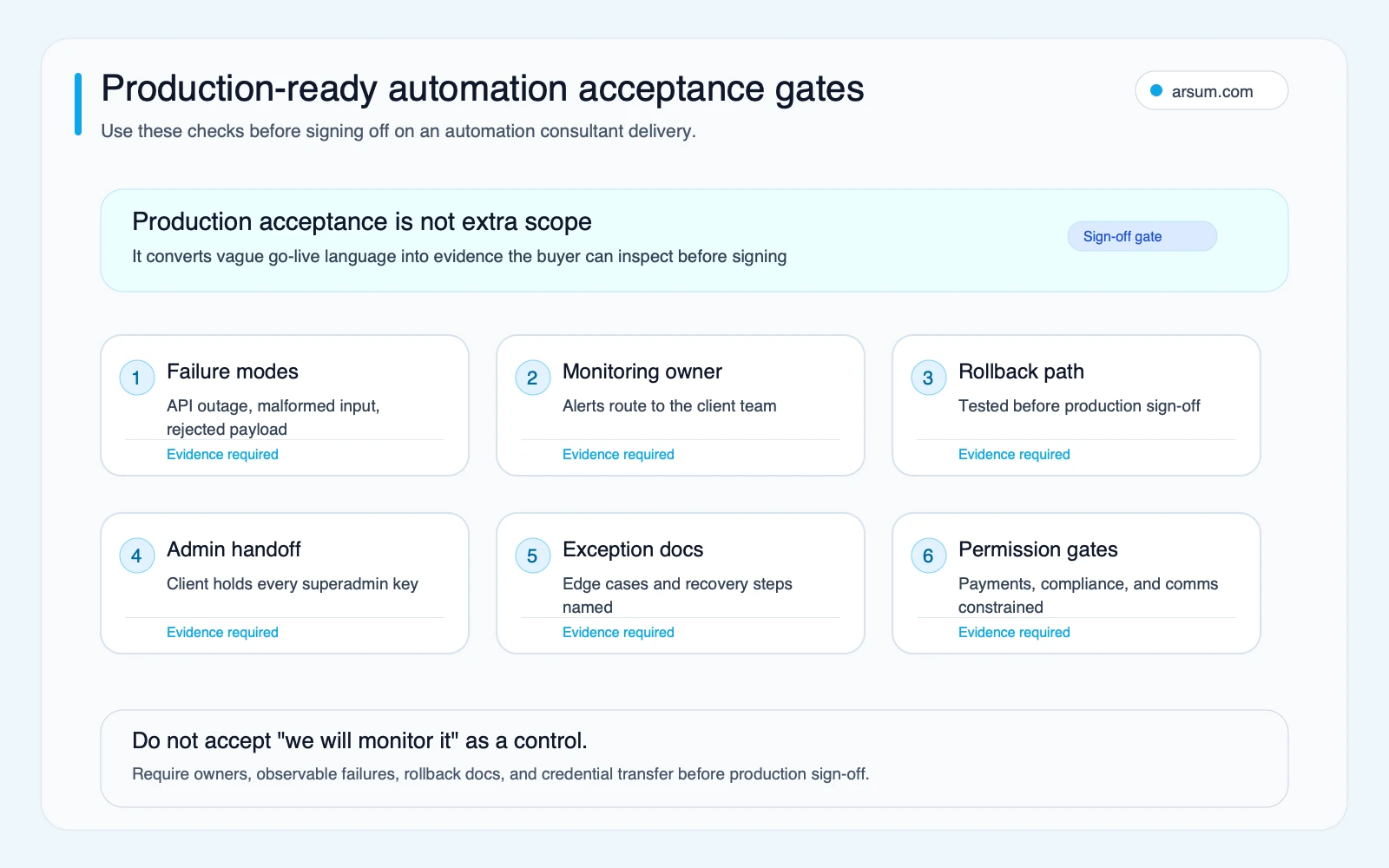
This checklist does not require every workflow to have enterprise-level controls. It requires controls proportionate to the workflow’s failure cost, reversibility, and authorization boundary.
Decide whether to use a consultant
Use an internal owner and tooling when the workflow is standard, reversible, documented, and supported by clear platform guidance. Consider targeted specialist help when your team can own the process but needs help with a bounded integration or implementation gap.
Vet a full implementation partner when the workflow crosses systems, includes consequential exceptions, needs AI guardrails, or requires production monitoring and operational handoff. For a broader comparison of external delivery options, see hiring an AI developer versus an agency and AI integration consulting.
The right automation consultant should make the boundaries clearer: what will be automated, what remains human-owned, how failures are handled, and how your team keeps control after delivery. If those answers are absent, do not solve the uncertainty by adding more scope. Pause, request the operating evidence, and narrow the decision first.
Methodology: This editorial update uses official guidance from Anthropic, OpenAI, and NIST, plus public automation-consulting service pages from IBM, Bain, and EY, accessed June 28, 2026. Community links are labeled snippet-only qualitative signals because direct-page verification was unavailable during research; they are included as prompts for buyer diligence, not prevalence claims or verified case evidence.
Ready to Automate Your Business?
Stop wasting time on repetitive tasks. Let AI handle the busywork while you focus on growth.
Schedule a Free Strategy Call →Written by:Arsum editorial team
- Reviewed by
- Arsum editorial team
- Published
- June 23, 2026
- Updated
- July 17, 2026
- How this was produced
- Arsum uses research packs, source checks, and human editorial review to prepare and update blog articles. Editors are responsible for the final page.
- Source policy
- Sources are linked in the article when used. Methodology and source notes are included on higher-risk or high-visibility pages and are being rolled out across the archive. Editorial policy.
- Why this page exists
- Help B2B operators evaluate AI automation, implementation scope, cost, risk, and build-vs-buy decisions with practical context.