The best ai automation companies are best understood as a non-ranked shortlist plus a delivery-model decision: compare named providers only after you know whether your first workflow needs enterprise governance, a platform your team will operate, a specialist implementation partner, or a custom build. The right choice depends on workflow volume, failure cost, data access, approval boundaries, integration complexity, and who owns exceptions after launch.
Best AI Automation Companies: 2026 Comparison
Explore best ai automation companies: compare workflow fit, costs, risks, evidence, and practical next steps before you build, buy, or hire.

Table of Contents
- What most “best company” guides miss
- Non-ranked shortlist: named companies and buying models
- Route your shortlist by workflow conditions
- Compare production readiness after the demo
- Run a reversible pilot before a broad rollout
- Ask each finalist to show the ugly path
- Disqualifying conditions and proposal traps
- Compare total operating cost, not the headline quote
- When Arsum may fit
- Methodology and limitations
- Bottom line
What most “best company” guides miss
Most lists rank agencies, consultancies, software platforms, and custom development teams together. That creates a false comparison. A platform may provide tooling but leave implementation and operations with your team. A delivery partner may design and hand over a workflow but not sell a platform. An enterprise provider may fit a cross-functional program while being excessive for one reversible process.
The decision rule is simple:
Do not compare vendors until you can name the owner of the workflow, credentials, exception queue, monitoring, change requests, and rollback after launch.
A polished demo does not answer those questions. Nor does a capable model authorize autonomous action. In finance, risk, compliance, and other consequential workflows, high failure cost should narrow the automation boundary and increase review—not justify more autonomy.
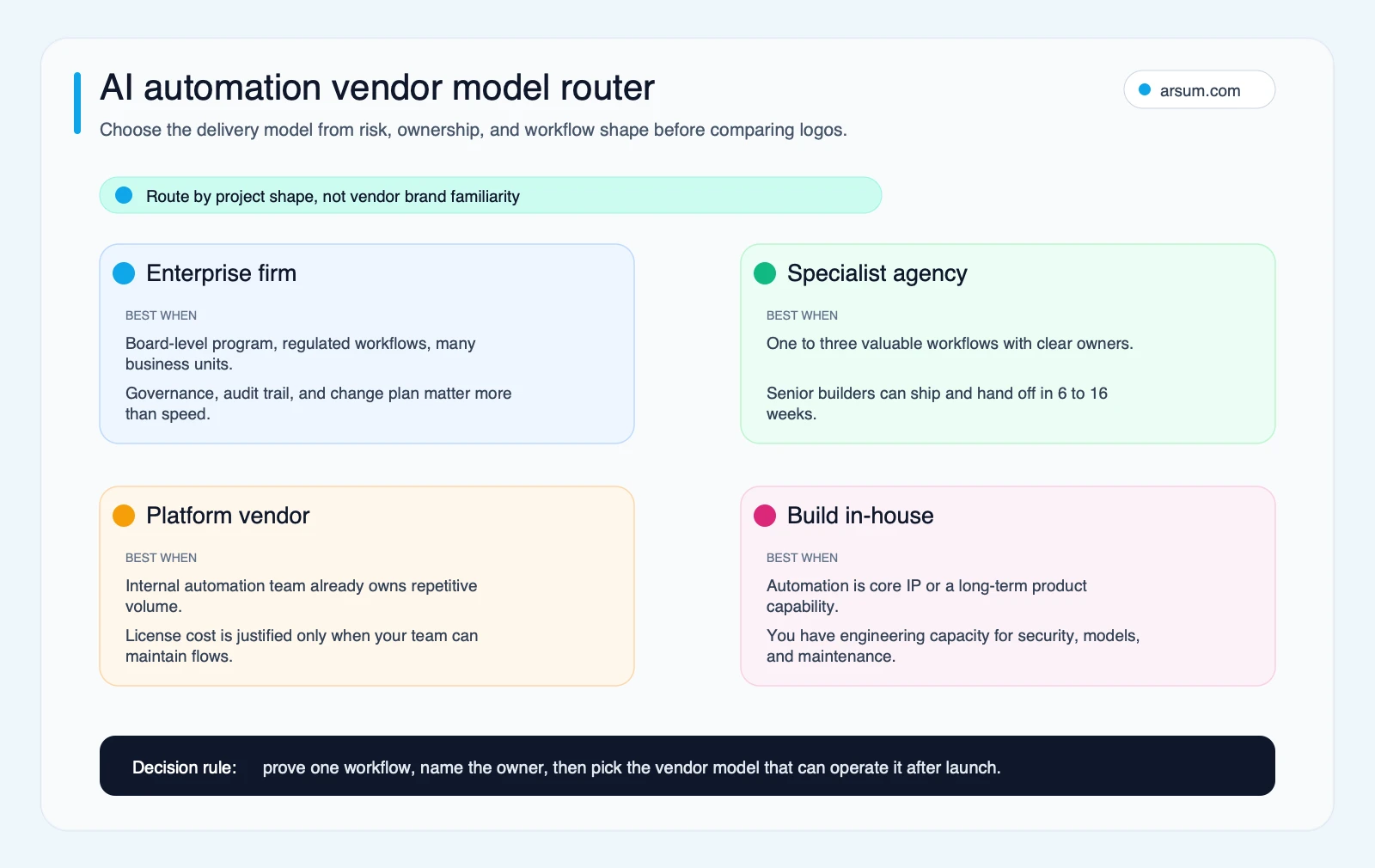
Non-ranked shortlist: named companies and buying models
This is not a performance ranking, customer survey, or endorsement. Inclusion reflects documented public offerings. The workflow-fit and ownership columns are editorial routing guidance; verify current capabilities, commercial terms, security documentation, and implementation scope directly with each provider.
| Provider / example | Primary buying model | Strongest likely fit | Internal ownership burden | Governance consideration | Proof to request |
|---|---|---|---|---|---|
| UiPath | Enterprise automation platform and implementation ecosystem | Process automation where orchestration, secure integration, auditing, and formal controls matter | Your team still needs process owners, administrators, access management, monitoring, and an exception owner | Ask how audit, access, agent controls, and review points map to your policy | A walkthrough of one workflow’s permissions, run history, exception queue, approval record, and rollback |
| Automation Anywhere | Enterprise automation platform | Mission-critical business-process automation with a platform operating model | Internal capacity is required for governance, maintenance, support escalation, and process changes | Confirm environment design, access controls, production support, and what implementation work is separate | A written division of responsibility for build, testing, support, connector failures, and policy changes |
| Microsoft Power Automate | Platform-led workflow automation within a Microsoft estate | Teams already operating Microsoft systems and prepared to build or administer flows | Business and technical owners must manage environments, connections, permissions, testing, and change control | Natural-language flow assistance does not replace environment governance or workflow testing | A demonstration using your environment assumptions, including connector permissions and failed-run handling |
| IBM watsonx.ai | Enterprise AI platform and production tooling | Organizations evaluating model access, customization, tooling, and deployment options as part of a broader AI architecture | Significant internal product, engineering, security, and operating ownership may remain | Confirm deployment model, data handling, model evaluation, and the boundary between platform capability and delivered workflow | An architecture and operating proposal that identifies integrations, evaluation assets, production owner, and support model |
| Specialist implementation partner | Services-led workflow design, integration, pilot, and handoff | One to three defined workflows with a business owner, available system access, and a reversible launch path | You retain policy decisions, source-system access, approval authority, and post-launch ownership | The key question is whether controls are designed into the workflow or deferred to “phase two” | A process map covering the normal path, ugly exceptions, evidence retained, support model, and transferable handoff artifacts |
| Custom product team or internal build | Custom application and differentiated capability | Product-facing, proprietary, or strategically important workflows where configuration alone will not meet the need | Highest ongoing product and engineering responsibility | Require a durable architecture, test strategy, source-code ownership, and operational budget | A narrow first release plan with explicit exclusions, evaluation criteria, release controls, and a manual fallback |
The named vendors above describe different types of offerings. UiPath’s explanation of agentic automation discusses agents that can reason, ask questions, and execute actions toward goals; that makes authority boundaries and oversight central procurement questions. Microsoft documents Copilot assistance for creating and streamlining Power Automate flows, which supports a platform-led buying motion rather than a substitute for implementation ownership.
For broader operating-model context, compare AI automation agency services, AI workflow automation, and AI automation platforms.
Route your shortlist by workflow conditions
Use this routing tool before inviting providers into an RFP. It prevents a platform evaluation from becoming an outsourced-delivery evaluation, or a custom-build conversation from becoming a generic software demo.
Scenario: a regulated workflow crosses systems and business units
Start with enterprise platforms and enterprise implementation routes. Put UiPath, Automation Anywhere, and the relevant systems-integration option on the initial shortlist where the workflow requires formal access controls, audit evidence, multiple stakeholders, and sustained administration.
Do not assume enterprise tooling solves the operating problem. Request a responsibility map: who owns process policy, user access, data quality, exception handling, incident response, and control testing after launch.
Scenario: one operations workflow has volume, pain, and a named owner
Start with a specialist implementation partner and, where appropriate, a platform that the internal team can operate. The workflow should have a defined start and end state, known source systems, repeatable cases, and an existing manual fallback.
A useful candidate should be able to map the work, integrate the required systems, define escalation, and leave behind operational documentation. If the process is vague, fix the process definition before funding automation. AI business process automation is a useful starting point for separating workflow redesign from tool selection.
Scenario: the company already has a capable Microsoft automation team
Begin with Power Automate and implementation support that understands your current environment. The commercial attraction of using existing systems can be real, but it does not remove the need for environment design, identity controls, connector governance, test cases, and post-launch support.
Ask whether internal builders have time and authority to own the workflow. If not, the apparent simplicity of a platform purchase may conceal a staffing decision.
Scenario: the automation becomes proprietary product or strategic IP
Consider a custom product team or internal build. This is appropriate when the automation shapes a customer experience, embeds proprietary logic, or needs product-level control that a configured platform cannot provide.
The tradeoff is ongoing ownership. Treat it as a product investment: a product manager, technical owner, release process, security review, monitoring, and maintenance budget are part of the decision. See custom AI solutions for business and AI app development companies for the separate questions involved in building durable software.
Compare production readiness after the demo
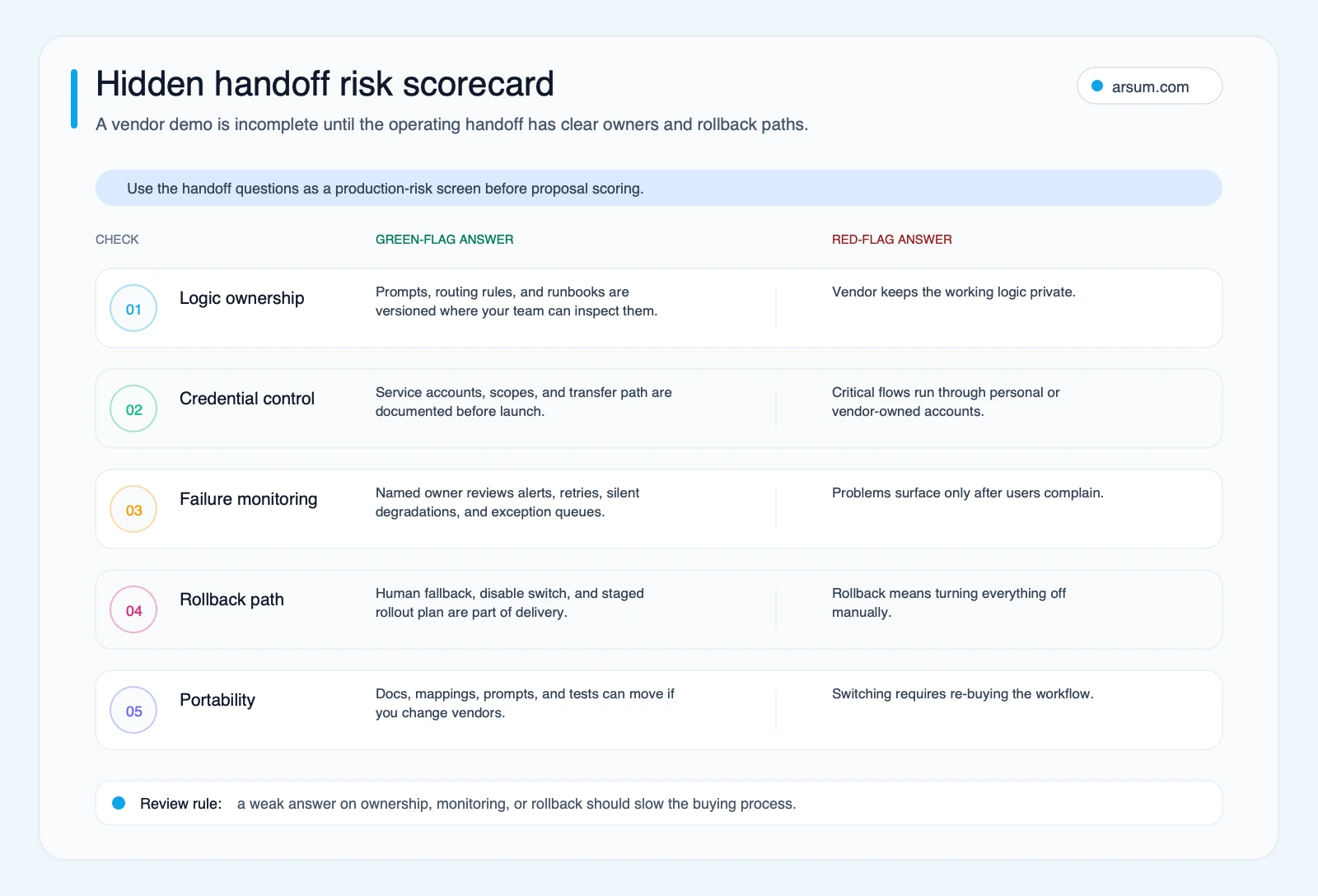
A demo proves that a workflow can run under selected conditions. A pilot should prove that it can be operated safely enough to justify expansion.
Score each provider’s written response from 1 to 5. A 1 is absent, vague, or deferred. A 3 is plausible but unproven. A 5 means the provider has shown the relevant artifact, named the owner, and agreed to an acceptance test.
| Evaluation area | Evidence to require | 1 | 3 | 5 |
|---|---|---|---|---|
| Workflow definition | Process map, scope, baseline volume | Generic use case | Happy path documented | Normal and exception paths approved by process owner |
| Integration depth | Systems, permissions, environments | “We can connect it” | Likely connectors identified | Required systems and access method validated |
| Human review | Approval matrix and exception queue | Review mentioned | Review step designed | Named authority, service level, and override record defined |
| Security and governance | Data handling, retention, audit, access | General assurance | Controls proposed | Controls mapped to your policy and accountable owner |
| Observability | Run logs, alerts, quality checks | Support promise | Monitoring plan | Alert owner, operating dashboard, and review cadence agreed |
| Error recovery | Retries, manual fallback, rollback | “We will fix it” | Fallback described | Rollback tested and operationally usable |
| Ownership and portability | Code, configurations, credentials, documentation | Vendor-controlled black box | Handoff promised | Transferable artifacts and access verified |
| ROI measurement | Baseline, target, measurement owner | Broad efficiency claim | Metric selected | Acceptance gate and counter-metric approved |
Set your own pilot gate before comparing contract values. For example, a buyer might require no category below 3 and require a 4 or 5 for human review, error recovery, ownership, and measurement. That is a planning choice, not an industry benchmark. A compliance workflow should normally weight approval, auditability, and rollback more heavily than a lower-risk internal drafting workflow.
Run a reversible pilot before a broad rollout
Choose a workflow important enough to measure but reversible enough to stop. The following is an illustrative planning assumption, not an observed result: a finance operations team receives 400 supplier-invoice exceptions per month and currently spends an average of 12 minutes triaging each one.
| Pilot element | Illustrative definition |
|---|---|
| Workflow | Classify and route supplier-invoice exceptions; do not authorize payment changes |
| Baseline | 400 monthly exceptions; 12-minute average triage time; four weeks of category and outcome records |
| Target | Reduce median triage time while retaining the existing approval authority |
| Quality and exception metric | Reviewer-accepted routes, “needs review” rate, incorrect-route count by category, and reviewer correction effort |
| Business owner | Accounts payable manager |
| Technical owner | Finance systems or integration lead |
| Review cadence | Daily exception review during the pilot; weekly operating review with the provider and owners |
| Evidence retained | Input reference, source-system record, output, reviewer decision, timestamps, and workflow version |
| Stop condition | Any approval boundary bypass, repeated error in a high-impact category, or a quality threshold set by the process owner is missed |
| Rollback path | Disable automated routing, return all work to the existing queue, and retain logs for root-cause review |
| Expansion gate | Agreed sample size, quality threshold, review cost, and failure handling accepted in writing |
The arithmetic is deliberately incomplete until you supply real inputs. The business case must include both the time avoided and the new operating cost: reviewer effort, exception handling, software, monitoring, support, and change management. A workflow can produce acceptable individual outputs yet fail operationally if it adds rework or creates an unmanageable escalation queue.
The NIST AI Risk Management Framework is a useful reference for keeping risk management alongside functionality. It supports the practical rule that technical capability does not equal authorized autonomy.
Work With Arsum
We help businesses implement AI automation that actually works. Custom solutions, not cookie-cutter templates.
Learn more →Ask each finalist to show the ugly path
Require written answers and a live demonstration against representative conditions. Generic assurances are not enough.
Ownership and exit
- Who owns workflow instructions, mappings, code, configurations, and evaluation assets?
- Where do those assets live, and can your team access them without vendor intervention?
- Are credentials held through transferable service accounts?
- What remains portable if you change platform or partner?
Exceptions and approvals
- Show the normal workflow, then show missing data, conflicting data, and an upstream-system failure.
- What does the workflow do when it cannot proceed safely?
- Who can approve, reject, or override the result?
- How is that decision recorded and made available for review?
Operations after launch
- Who receives alerts for failures, latency, unexpected cost, or quality deterioration?
- What is reviewed daily, weekly, and monthly?
- How are source-system changes, policy changes, prompts, tools, or models tested before release?
- Can the provider demonstrate a rollback to the existing manual process?
Directional practitioner discussions reinforce why these questions matter: operators often challenge generic automation offers, copied workflows, weak debugging capability, and vague maintenance promises. Those are qualitative signals, not market-wide performance evidence or proof about any named provider. They are still useful prompts to test business value and operational depth. See r/automation, r/agency, and Hacker News.
Disqualifying conditions and proposal traps
Do not launch a broad initiative when these conditions remain unresolved.
The process has no stable decision boundary
If the work is a series of novel judgments made differently by senior staff, standardize it first. Automation may still assist with intake, retrieval, drafting, summarization, and routing. It should not be presented as autonomous decision replacement.
The production data path is unknown
Clean demonstration data is not production evidence. Test missing fields, duplicate records, stale CRM entries, restricted folders, conflicting sources, partial integrations, and unavailable upstream systems before accepting a proposal.
Human review is ceremonial
“Human in the loop” is not a control unless the reviewer has authority, sufficient context, a manageable queue, response expectations, and a clear correction path. A reviewer who only rubber-stamps outputs does not provide meaningful governance.
The pilot cannot be rolled back
A provider should show how work continues if a connector fails, outputs degrade, or policy changes. A rollback may be manual, staged, or feature-flagged, but it must be owned and tested.
The proposal measures activity instead of outcomes
Do not accept number of runs, messages processed, or automations created as the primary success measure. Pair an outcome with its counterweight: triage speed and route quality; document throughput and reviewer correction rate; customer deflection and escalation quality.
For more workflow-level decision support, review AI process automation, AI automation ROI examples, and AI agent security.
Compare total operating cost, not the headline quote
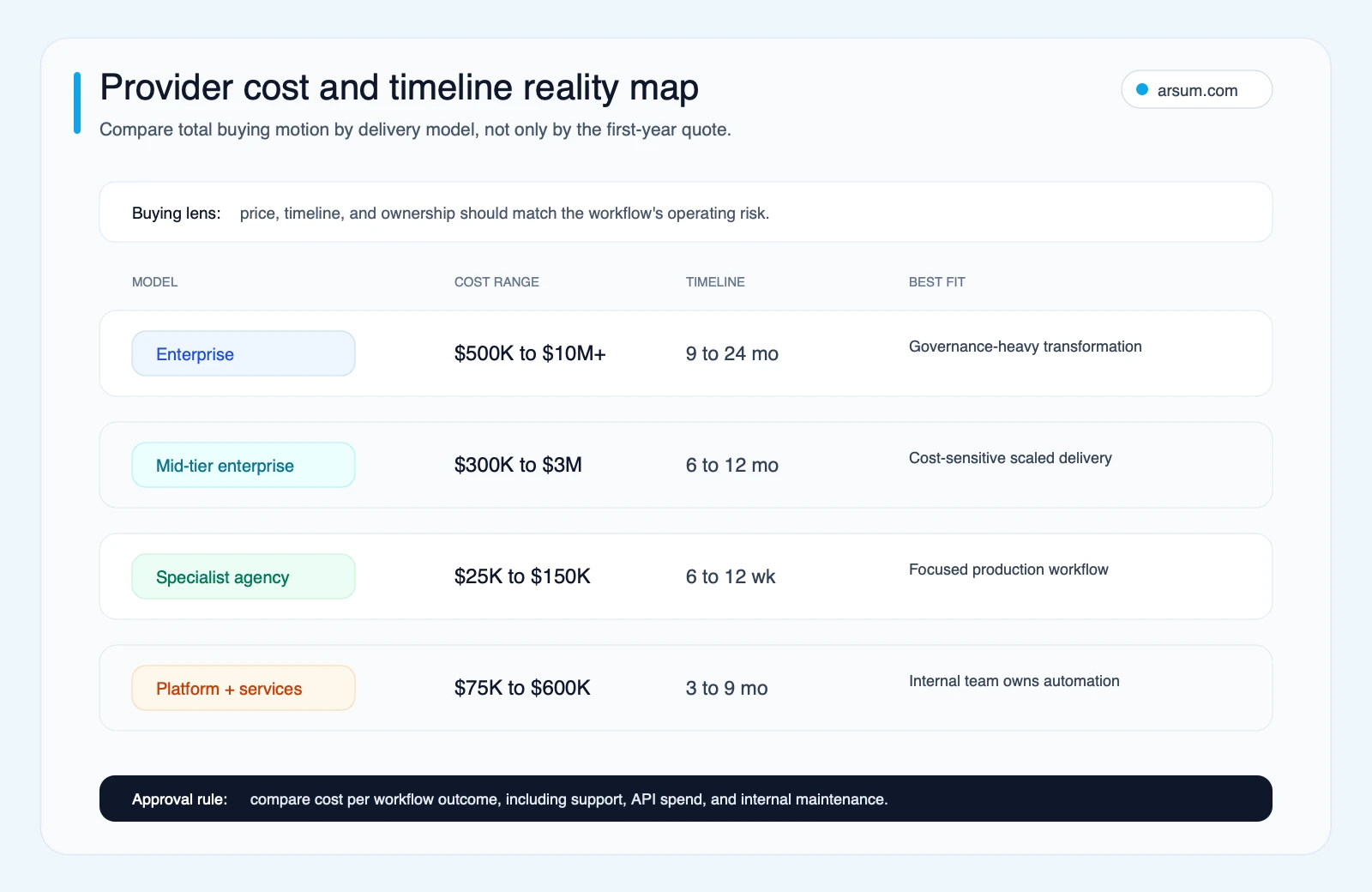
There is no reliable universal price or timeline for AI automation. Scope changes with integrations, data sensitivity, workflow variance, evaluation design, approval requirements, deployment environment, and post-launch support.
Require each provider to separate the following:
| Cost area | What to compare |
|---|---|
| Workflow scope | Included steps, exclusions, and acceptance criteria |
| Discovery and design | Process mapping, data review, security, and policy work |
| Implementation | Configured tooling, integrations, and custom application work |
| Software and model use | Licensing, usage, storage, and observability tools |
| Assurance | Test cases, acceptance testing, audit evidence, and controls |
| Operations | Monitoring, incident handling, support, training, and change requests |
| Exit and handoff | Documentation, access transfer, runbooks, and transition support |
A lower build quote can be more expensive if your team absorbs undefined exception handling, licensing, monitoring, and repair work. A larger program can be inappropriate if a small reversible pilot has not yet proved the workflow is worth operating.
When Arsum may fit
Arsum publishes this guide and is not included in the named-provider shortlist. This is a disclosed fit statement, not an independent comparison result.
Arsum may be worth evaluating when you have a specific workflow, a business owner, access to necessary systems, and willingness to use a written pilot scorecard. The implementation discussion should apply the framework to your first workflow: map the normal path and exceptions, set pilot acceptance criteria, assign approval and operating ownership, and define a rollback path.
Arsum may be a poor fit if you need a global multi-year transformation program, a platform-only purchase with no services component, or an initiative whose owner and workflow boundaries are still unknown. In those cases, clarify sponsorship first and select the appropriate enterprise or platform route.
For related buying decisions, see AI automation agency pricing, AI automation agency versus AI development firm, and AI implementation services.
💡 Arsum builds custom AI automation solutions tailored to your business needs.
Get a Free Consultation →Methodology and limitations
This editorial guide was updated on July 5, 2026 to align the visible methodology date with the page metadata and to add the non-ranked provider shortlist and routing guidance. It reviewed exact-match and variant search results, qualitative practitioner discussions surfaced through search, and official material from UiPath, Microsoft Learn, IBM, Automation Anywhere, and NIST.
The category map, named examples, routing tool, and scorecard are editorial decision tools. They are not a vendor-performance dataset, lab test, customer survey, or ranking of providers. Verify company-specific claims through current proposals, contracts, security documentation, and pilot evidence. Community material identifies questions and failure patterns only; it does not establish adoption, outcomes, or market prevalence.
Bottom line
The useful answer to “who are the best AI automation companies?” is a qualified shortlist matched to your operating model—not a universal ranking. Put enterprise platforms on the list when governance and sustained internal operations are central; use a specialist partner for a defined, high-value workflow; choose a custom build when the capability is strategic product or proprietary IP.
Before choosing, establish the baseline, name the business and technical owners, require every finalist to demonstrate normal and ugly paths, score production readiness, and test a reversible pilot. Compare the cost of operating the workflow, not just the cost of buying it.
Ready to Automate Your Business?
Stop wasting time on repetitive tasks. Let AI handle the busywork while you focus on growth.
Schedule a Free Strategy Call →Written by:Arsum editorial team
- Reviewed by
- Arsum editorial team
- Published
- February 21, 2026
- Updated
- July 5, 2026
- How this was produced
- Arsum uses research packs, source checks, and human editorial review to prepare and update blog articles. Editors are responsible for the final page.
- Source policy
- Sources are linked in the article when used. Methodology and source notes are included on higher-risk or high-visibility pages and are being rolled out across the archive. Editorial policy.
- Why this page exists
- Help B2B operators evaluate AI automation, implementation scope, cost, risk, and build-vs-buy decisions with practical context.