For teams comparing the best ai seo tools 2026, choose by the workflow bottleneck you need to remove—not by a universal ranking. A defensible stack connects to first-party Search Console evidence, has a named human reviewer, and lowers total time from SEO signal to approved action without increasing correction, publishing, or brand-risk costs.
Best AI SEO Tools 2026: Comparison
Explore best ai seo tools 2026: compare workflow fit, costs, risks, evidence, and practical next steps before you build, buy, or hire.

Table of Contents
- What most AI SEO tool guides miss
- Start with data readiness, not a product demo
- A constrained 2026 shortlist: compare tools by role
- Use a vendor-evaluation template before buying
- Run a 30-day pilot with actual acceptance thresholds
- Quality controls matter more than output volume
- Measure Search visibility separately from business value
- Disqualifying conditions and common failure modes
- Methodology and next step
What most AI SEO tool guides miss
Most rankings start with a feature list. The buying decision should start with the handoff that is actually stalled.
A writing tool is a poor purchase if your team cannot decide which pages deserve a refresh. An optimizer adds little if subject-matter review is unavailable. A technical recommendation engine does not create value if no web owner can validate and close the resulting tickets. And a tool that produces more drafts can make the workflow worse if editors spend more time removing unsupported claims than they save.
Use this rule:
Buy or connect an AI SEO tool only when it shortens a known handoff and you can measure the result after subscription, setup, review, correction, and maintenance costs.
That makes the relevant choice less abstract:
- Research and prioritization: turn query, page, and commercial signals into an approved work queue.
- Brief creation: assemble search intent, evidence needs, internal-link opportunities, and expert input.
- Draft acceleration: produce a useful first pass while retaining source and editorial controls.
- Content optimization: identify gaps or on-page improvements that a reviewer can assess.
- Technical QA: surface issues, route them to the right owner, and verify resolution.
- Refresh prioritization: identify pages where first-party performance evidence supports an update.
- Reporting: connect work completed to Search visibility, qualified traffic, conversions, and operating cost.
For the broader operating model, see this AI for SEO guide and this explanation of agentic SEO.
Start with data readiness, not a product demo
Before comparing AI SEO products, confirm that the operating inputs exist. A tool can summarize, classify, draft, and route work; it cannot repair missing ownership or missing business evidence.
A buyer should be able to answer these questions:
- Do we have access to the relevant Search Console property?
- Can someone interpret page- and query-level changes rather than accept a vendor score as a decision?
- What conversion or commercial signal matters: qualified form completion, trial, demo request, assisted pipeline, or another agreed measure?
- Who owns publishing, content updates, internal links, technical tickets, and approvals?
- What claims require editorial, legal, brand, or subject-matter review?
- What happens when a recommendation is wrong, a source is weak, or a CMS action fails?
Google describes Search Console as a way to analyze Search performance using dimensions including queries, pages, impressions, clicks, and position. Use those first-party signals to prioritize and validate work rather than treating AI recommendations as proof. See Google’s Search Console guidance, Performance report documentation, and Search Console overview.
If that loop is absent, begin with internal and reversible work: classifying a content inventory, assembling briefs, drafting metadata suggestions, or preparing technical tickets. Do not begin with high-volume publishing automation.
The practical routing questions
Do you have Search Console access and a defined commercial signal?
If not, use a lightweight assistant or research workflow. You can measure cycle time and review burden, but you cannot yet make a reliable performance case.
Is the bottleneck prioritization, production, or coordination?
Prioritization points toward Search Console-led analysis and reporting. Production points toward briefing, drafting, and editing support. Coordination points toward connecting approved systems and owners before adding another dashboard.
Can an error be detected and reversed cheaply?
Internal classification and draft preparation can tolerate more automation. Publishing claims on revenue, regulated, medical, financial, or high-stakes pages requires explicit approval.
Will the tool create a durable handoff reduction?
If staff must export, copy, reconcile, and re-enter data across systems, apparent automation may simply move the work.
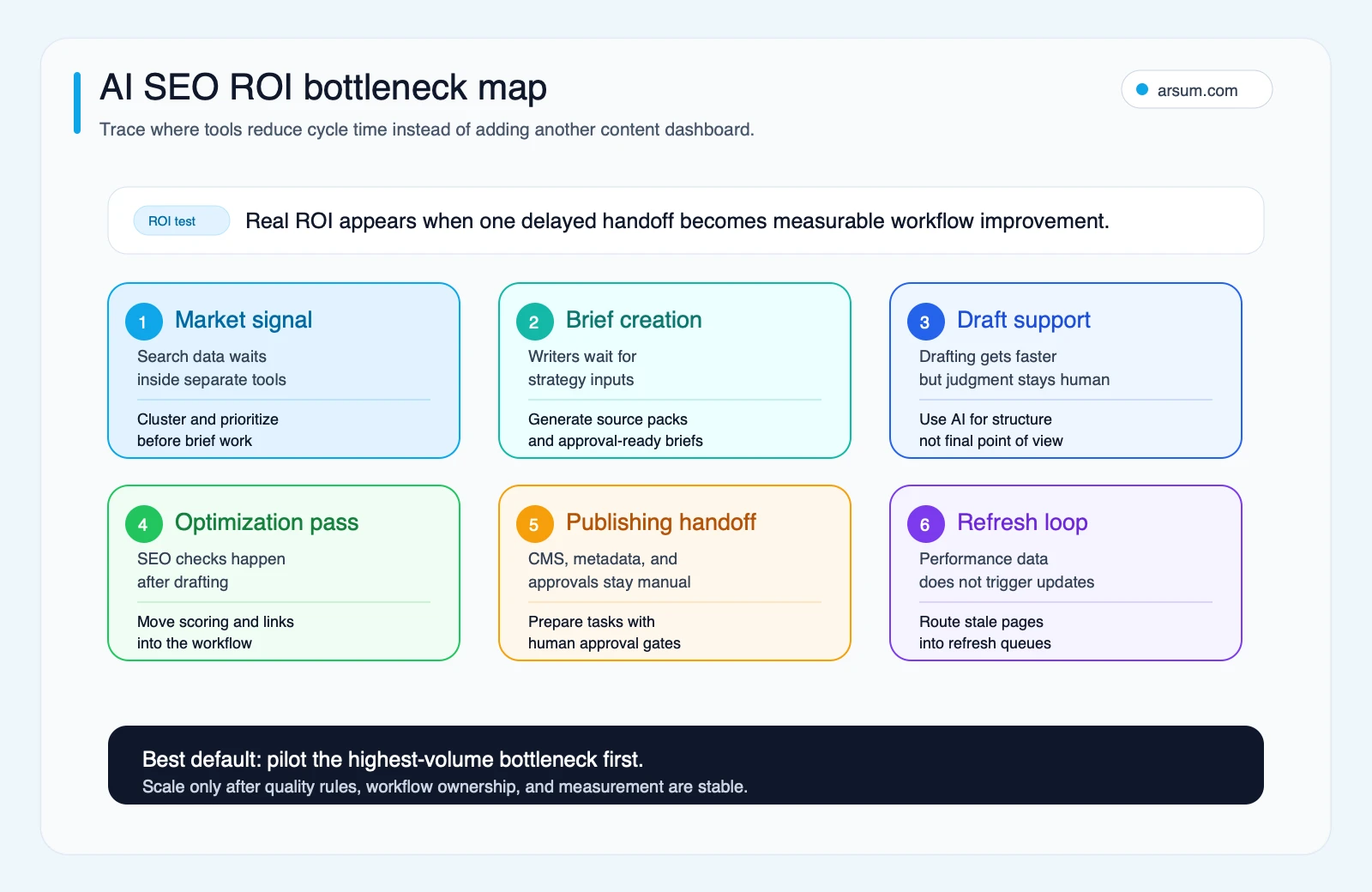
Use the map to identify the one handoff to pilot. Do not try to automate every stage of SEO at once.
A constrained 2026 shortlist: compare tools by role
There is no verified universal winner in the approved research set. Commercial plans, integrations, and product capabilities change, so recheck official vendor information before signing a contract. The shortlist below is intentionally narrow: it distinguishes representative tools and stack roles without turning unsupported feature or pricing claims into facts.
A current AI SEO roundup from SE Ranking is useful for discovering the kinds of products buyers are comparing, but it should not replace a workflow evaluation. Practitioner discussions also mention tools such as Surfer SEO and Frase for outlines and content-gap work; that is qualitative user language, not proof of performance or broad suitability.
| Tool or stack component | Where it belongs in the workflow | What to verify in your evaluation | Human review burden | Disqualifying condition |
|---|---|---|---|---|
| Google Search Console | First-party measurement, refresh prioritization, query/page validation | Property access, relevant filters, who reviews performance changes, and how conversion signals will be joined | SEO owner interprets changes and approves the queue | No access, no owner, or no way to connect work to a business outcome |
| SE Ranking and comparable SEO suites | Research, rank or competitive analysis, monitoring, and planning | Exact data sources, export or API needs, team permissions, reporting fit, and current plan terms | SEO lead validates recommendations against first-party evidence | The team needs workflow execution and approvals, but only buys another reporting surface |
| Surfer SEO and comparable content optimizers | Brief refinement, content-gap review, and page-level editorial support | Whether recommendations fit your audience, evidence rules, templates, CMS process, and current commercial terms | Editor or SEO lead must reject formulaic, irrelevant, or unsupported recommendations | The content team lacks an expert review process or needs technical diagnosis instead |
| Frase and comparable research or briefing tools | Research organization, outline support, question coverage, and brief production | Source-handling rules, brief format, internal-link process, export requirements, and plan conditions | Editor verifies sources, intent, and original value | The team expects the tool to establish strategy or publish finished claims autonomously |
| General-purpose AI assistant | Draft acceleration, classification, rewrite support, metadata options, and internal analysis | Data-handling rules, prompt controls, source lineage, brand rules, and handoff into editorial review | High on public-facing pages; lower for reversible internal work | Sensitive data, unreviewed factual output, or an expectation of autonomous judgment |
| Connected automation workflow | Repeated movement among analytics, task management, editorial approval, CMS preparation, and reporting | Systems of record, permissions, logs, exception routing, publishing authority, and rollback | Review happens at defined gates rather than after uncontrolled output | No stable workflow pattern, unclear ownership, or no safe exception path |
| Custom workflow | Multi-site or high-coordination operations with repeatable inputs and controls | Total workflow cost, maintenance owner, source governance, integration requirements, and test plan | Designed into the system and retained for consequential actions | A narrow SaaS workflow with manual review already solves the bottleneck |
This is the important comparison: Search Console is your measurement layer; an SEO suite can help organize analysis; a specialist optimizer or briefing tool can accelerate specific editorial tasks; an assistant can speed bounded work; automation or a custom workflow is justified only when repeated coordination creates measurable friction.
The minimum stack by bottleneck
Founder or lean content team with inconsistent publishing. Start with Search Console, a documented brief template, and one drafting or briefing assistant used under editor approval. Do not buy a suite of overlapping tools before the team can maintain a queue and review outputs.
SEO operator with a refresh backlog. Start with Search Console-led page and query analysis, then evaluate an SEO suite or optimization tool only if it improves how candidates become approved refresh briefs. The tool must reduce triage time without replacing page-level judgment.
Content-led SaaS or ecommerce team. Use a research or briefing layer and an editor-controlled optimization layer when volume justifies consistent templates. Preserve product, pricing, claims, and category-page approvals; these pages usually have higher commercial and brand consequences.
Team with many handoffs across analytics, content, CMS, and reporting. Evaluate connected automation after you document the existing route, owners, access permissions, and exception queue. For related implementation choices, see AI workflow automation tools and AI integration services.
Multi-site organization with stable repeatable processes. Consider a custom workflow only after proving that a narrower stack cannot handle the coordination burden. Compare it against SaaS using total workflow cost and control quality, not novelty. The build-versus-buy logic is similar to the decision discussed in AI automation consulting.
Use a vendor-evaluation template before buying
A conventional ranking cannot tell you whether a product fits your systems, review model, or data maturity. Make every shortlisted product answer the same sheet.
| Evaluation field | What to record |
|---|---|
| Verified as of | Date you reviewed current documentation, plans, and terms |
| Official product source | Vendor page your buyer can revisit before approval |
| Workflow handoff | The exact step being shortened, such as “Search Console refresh candidate to editor-approved brief” |
| Required inputs | Search Console access, analytics exports, CMS permissions, content inventory, product data, or expert inputs |
| Output | Recommendation, brief, draft, ticket, internal-link suggestion, report, or prepared CMS change |
| Human approver | Named SEO lead, editor, subject-matter expert, web owner, or brand or legal reviewer |
| Source requirement | Whether factual claims must include traceable sources and where they are retained |
| Exception path | Where weak sources, ambiguous intent, conflicting data, or CMS failures go |
| Baseline | Current cycle time, review time, correction rate, and pages completed |
| Acceptance threshold | Pre-agreed quality and speed thresholds for the pilot |
| Stop condition | The result that pauses use or blocks expansion |
| Rollback | Return to manual template, remove access, archive output, and prevent unapproved publishing |
Do not treat a free trial as a pilot unless you record the same baseline and acceptance terms you would use for a paid deployment.
💡 Arsum builds custom AI automation solutions tailored to your business needs.
Get a Free Consultation →Run a 30-day pilot with actual acceptance thresholds
Test one workflow, not “AI SEO” in general. A useful scope is ten existing pages selected for refresh, a weekly batch of briefs, or a defined set of internal-link and metadata recommendations.
The scorecard below is an illustrative planning assumption, not observed Arsum or vendor performance data.
| Field | Illustrative pilot definition |
|---|---|
| Workflow | Convert approved Search Console refresh candidates into evidence-backed update briefs |
| Scope | 10 existing pages over 30 days |
| Baseline | Record current median time from candidate selection to editor-approved brief; record review minutes, returns for correction, and current page/query performance |
| Target | Reduce median approved-brief cycle time by at least 20% while maintaining the baseline review-return rate or improving it |
| Quality threshold | 10 of 10 briefs include first-party page/query evidence, traceable factual sources where needed, required internal links, a named reviewer, and a clear update recommendation |
| Exception threshold | No more than 1 of 10 briefs is returned for a missing source, incorrect page selection, unsupported assertion, or unresolved intent conflict |
| Owner | SEO lead owns scope and acceptance; editor owns quality approval; web owner owns approved publishing changes |
| Review cadence | Weekly review of queue status, exception reasons, time spent, data-access issues, and any CMS failures |
| Stop condition | Pause if two briefs in a week lack source lineage, if exception rate exceeds the agreed threshold, or if total review and correction time exceeds the manual baseline |
| Rollback | Revert to the prior manual brief template; archive generated materials; remove unapproved publishing access; retain the pilot log for the purchase decision |
The threshold is illustrative because the right number depends on your existing baseline, content complexity, and reviewers. What matters is setting it before the team sees output.
Calculate total workflow cost
Use complete arithmetic, not a subscription-only comparison:
Monthly net value = (verified hours saved or redeployed × fully loaded hourly value) + measurable business value − subscription cost − allocated setup cost − review cost − maintenance cost
For example, if the pilot saves time in brief preparation but adds editor correction time, both figures belong in the calculation. “More pages drafted” is not an outcome unless approved pages reach the intended audience and commercial purpose at acceptable quality.
At day 30, expand only if the workflow passes the quality gate, reduces a verified operating burden, and has an owner willing to run the controls. For a related decision model, see AI automation ROI examples and when automation reaches its tipping point.
Quality controls matter more than output volume
Google’s guidance does not treat AI use itself as the deciding issue. The relevant questions are whether content is helpful, original, accurate, and made for people rather than scaled primarily to manipulate rankings. See Google’s guidance about AI-generated content and its documentation on using generative AI content.
That creates a practical requirement: every public-facing AI SEO workflow needs source lineage, a reviewer, and an exception path.
The pre-publish gate
Before publishing AI-assisted work, require the accountable reviewer to confirm:
- The page answers a real searcher or buyer question rather than paraphrasing search results.
- Material claims have traceable sources that the reviewer has checked.
- The page adds original expertise, analysis, examples, or a decision framework.
- Search intent and the page’s commercial role are clear.
- Internal links answer genuine next questions for the reader.
- Titles, descriptions, structured fields, and CMS settings are reviewed by someone with publishing authority.
- The team can correct, withdraw, or roll back the page if it creates factual, brand, or search-quality risk.
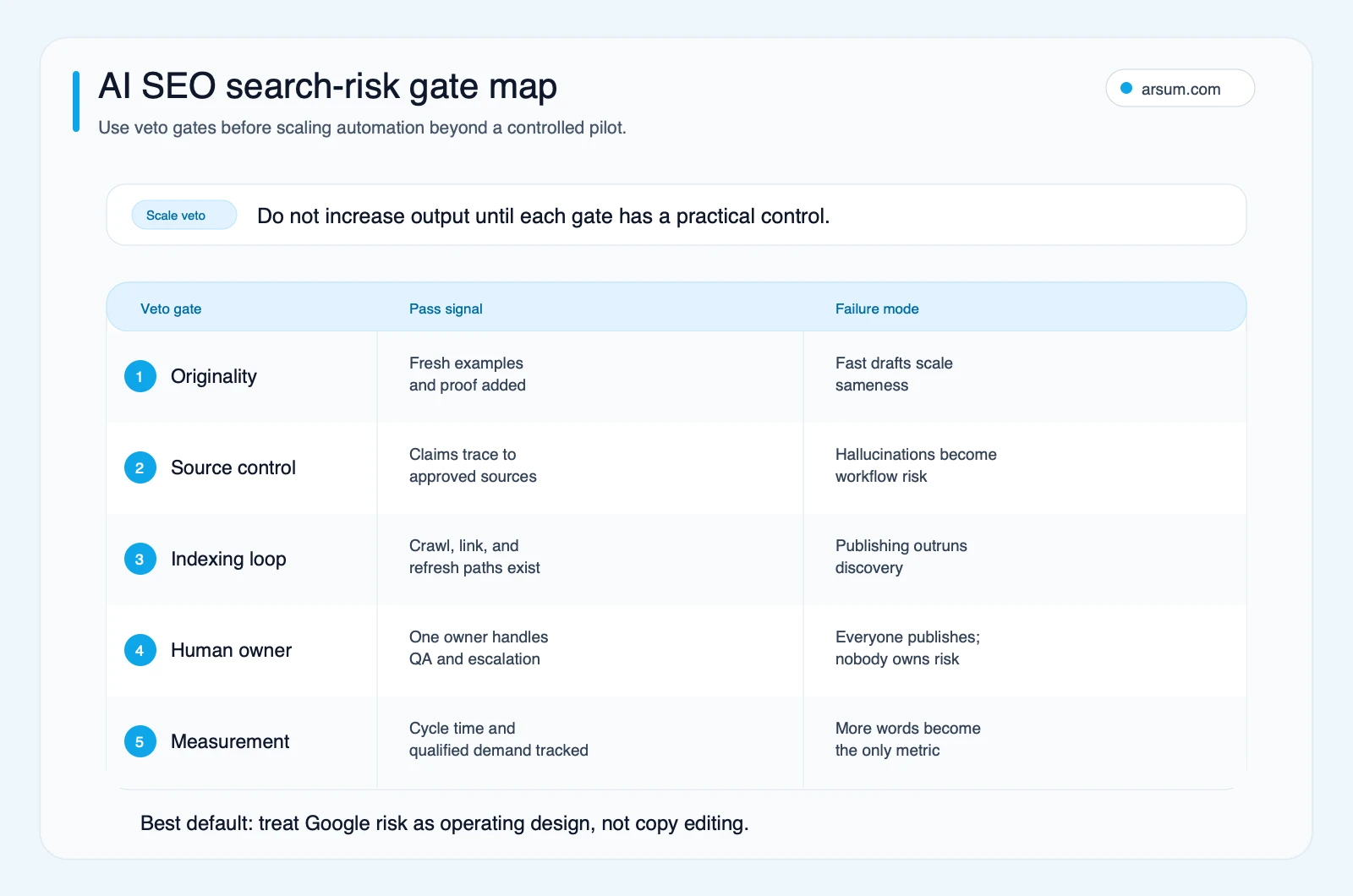
A high failure cost should reduce autonomy. It does not justify a more autonomous model. Automating an internal refresh shortlist may be appropriate; automatically publishing unsupported commercial, financial, legal, or medical claims is not.
Measure Search visibility separately from business value
Search Console should be the feedback loop for work that claims to improve organic performance. Measure the page and query changes that informed the update, then track whether the intended commercial signal changes over an appropriate review period.
Google has also introduced dedicated views for generative-AI Search visibility. Treat that as a separate visibility signal, not proof of rankings, revenue, or causal impact. See Google’s generative AI performance reports update.
A practical reporting view includes:
- Work completed: approved briefs, published updates, resolved technical issues, or validated internal links.
- Operating measure: median cycle time, editor-review minutes, exception rate, and rework.
- Search measure: relevant queries, pages, impressions, clicks, and position in Search Console.
- Business measure: your agreed qualified conversion or commercial signal.
- Decision: continue, revise controls, narrow scope, pause, or retire the workflow.
The common failure is metrics without a decision. Impressions, rankings, and AI-search visibility can be useful signals, but none is interchangeable with qualified traffic, conversion value, or a sustainable operating process.
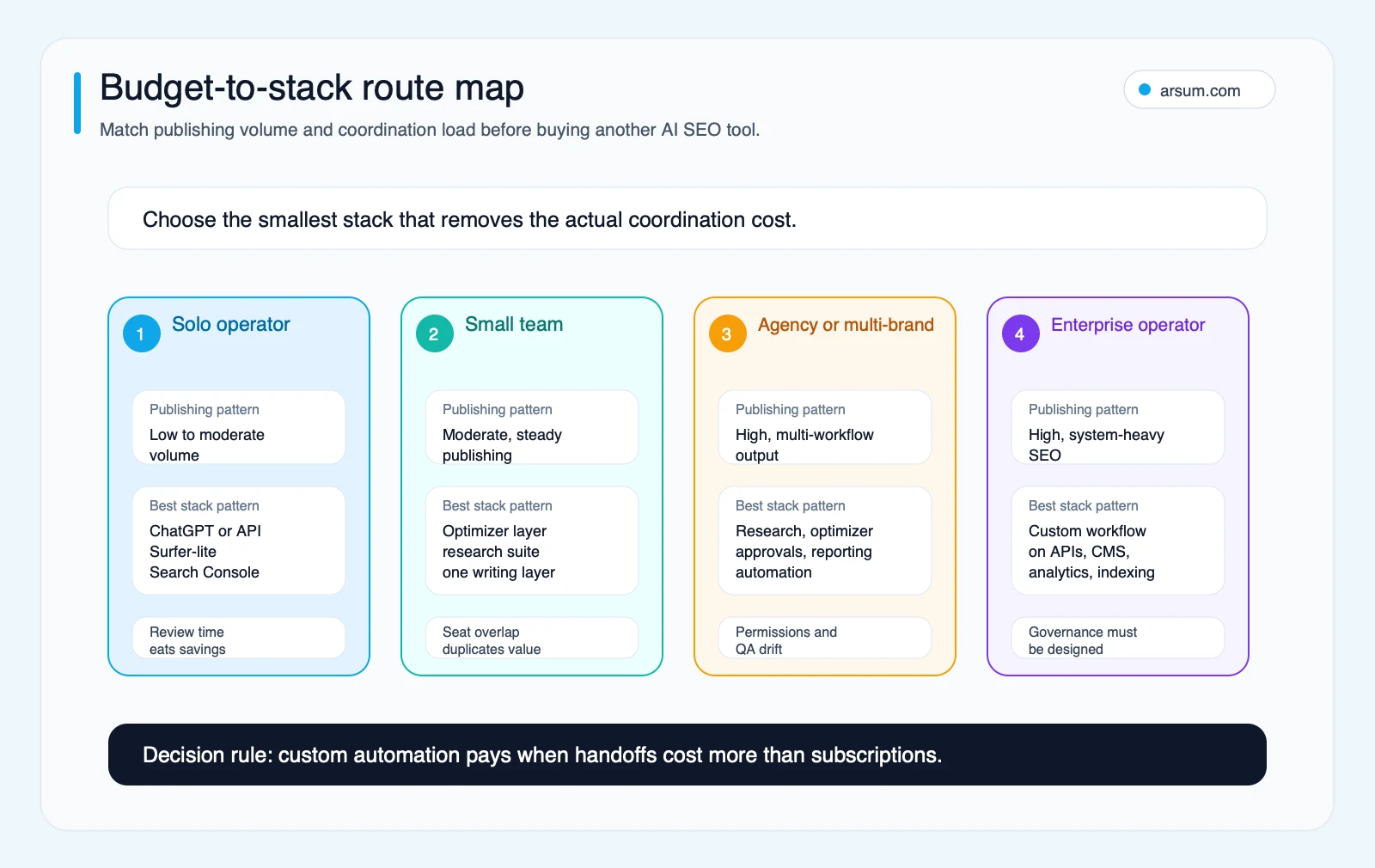
Use this route map to select the smallest viable pattern: a light stack for a bounded workflow, specialist tools for a specific bottleneck, connected automation for repeatable handoffs, or custom work only when systems and controls are already stable.
Disqualifying conditions and common failure modes
Do not expand an AI SEO tool rollout when any of these conditions remains unresolved.
No accountable owner. Tools do not own queues, decide tradeoffs, approve claims, or close technical work. Name the SEO lead, editorial owner, and web owner before adding software.
No first-party feedback loop. A tool may generate plausible advice, but without Search Console access and a decision process, the team cannot distinguish a useful recommendation from noise.
Tool overlap without workflow ownership. A suite, optimizer, assistant, and automation platform can all appear useful while creating duplicate work and unclear responsibility.
Automation before strategy. AI can accelerate structured tasks. It cannot establish credible positioning, invent first-hand evidence, or decide what your customers should believe.
No exception queue. If weak sources, contradictory data, unusual pages, or CMS failures cannot route to a human, the workflow is not ready to scale.
Using generated content as a substitute for expertise. Community discussions suggest practitioners often value AI for outlines and content gaps while remaining skeptical that it replaces analytics or SEO judgment. Treat that as a qualitative warning, not a performance claim.
For a useful distinction between systems that generate material and systems that take actions across connected workflows, see agentic AI versus generative AI and AI agents for business.
Methodology and next step
This editorial decision guide was updated from the validated research pack dated June 20, 2026. It uses Google Search Central and Search Console documentation for claims about AI-content guidance and measurement. It uses current tool-list and practitioner material only as directional input for what buyers are evaluating; community signals are qualitative and are not adoption, pricing, outcome, or market-share evidence.
The practical next step is not to buy every product in a 2026 ranking. Map one bottleneck, document its current cost and owner, shortlist products by their role in that workflow, and run a controlled pilot with an acceptance threshold and rollback path.
If you need help assessing the workflow behind a tool purchase, Arsum can help map the inputs, systems, approval gates, baseline measures, pilot scope, exception path, and rollback criteria for an SEO automation initiative.
Ready to Automate Your Business?
Stop wasting time on repetitive tasks. Let AI handle the busywork while you focus on growth.
Schedule a Free Strategy Call →Written by:Arsum editorial team
- Reviewed by
- Arsum editorial team
- Published
- February 14, 2026
- Updated
- July 5, 2026
- How this was produced
- Arsum uses research packs, source checks, and human editorial review to prepare and update blog articles. Editors are responsible for the final page.
- Source policy
- Sources are linked in the article when used. Methodology and source notes are included on higher-risk or high-visibility pages and are being rolled out across the archive. Editorial policy.
- Why this page exists
- Help B2B operators evaluate AI automation, implementation scope, cost, risk, and build-vs-buy decisions with practical context.