
The AI consulting market has fragmented fast. Enterprise consultancies, boutique implementation agencies, software-platform resellers, and solo fractional advisors now all compete for the same buyer searches. Most of the content ranking for “boutique AI consulting firms” either markets a specific vendor or offers a shallow directory. Neither helps you answer the question that actually matters: which type of partner is the right fit for your project, your budget, and your timeline?
This guide is structured for buyers, not vendors. It maps the vendor landscape, gives you a framework built around implementation outcomes rather than brand names, surfaces patterns that separate firms that can build from firms that can only advise, and provides tools to evaluate proposals honestly.
Quick Answer: Boutique vs Enterprise AI Consulting
Boutique AI firms are typically five to fifty people. They move faster, put senior practitioners on engagements from day one, and charge on fixed-scope or milestone structures. A well-scoped boutique engagement typically produces a production-ready automation in eight to sixteen weeks. Project ranges commonly run from $25,000 to $200,000 depending on workflow complexity and integration scope.
Enterprise consultancies (McKinsey, Deloitte, Accenture, IBM) offer broader stakeholder governance and program management but typically run twelve to eighteen months before a first production system ships. Rates reflect overhead and brand premium, and senior partners sell while junior teams deliver.
The decision pivot: If the goal is a production automation delivered on a defined timeline, boutique firms are usually the more efficient choice. If the goal is board-level AI governance, enterprise-wide program management, or external stakeholder credibility, larger consultancies may be the right fit.
Cited: Anthropic’s engineering guidance on effective agents recommends finding the simplest solution possible and distinguishes predictable workflows from agentic systems that require flexibility, a distinction that directly informs which vendor type you actually need. NIST’s AI Risk Management Framework identifies reliability, accountability, and transparency as properties that must be built in at design time, not retrofitted at deployment.
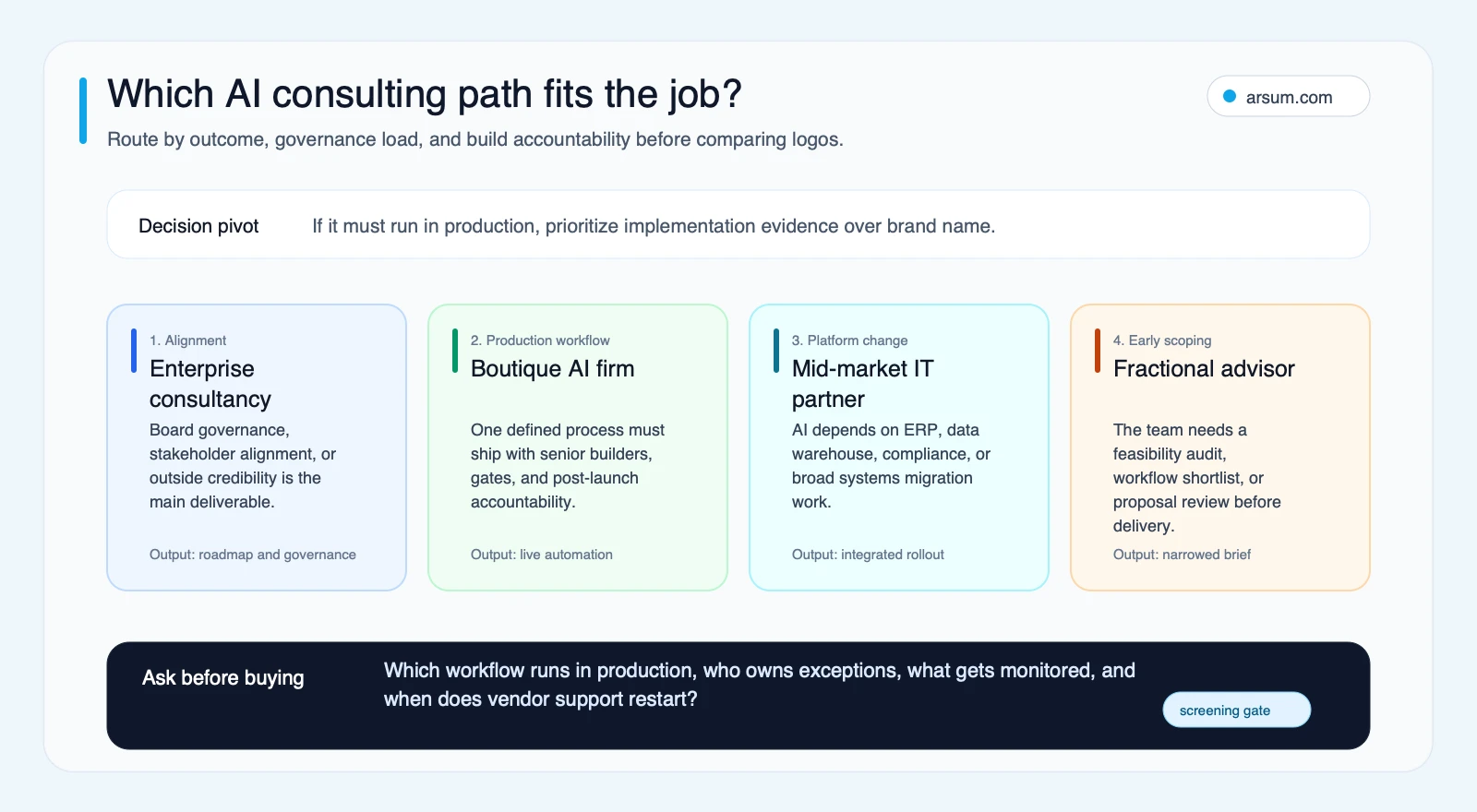
Use this router before comparing vendor logos: the right consulting model depends on whether the buyer needs governance, a production workflow, platform change, or early scoping.
Want to automate this for your business? Let's talk →
What the Market Actually Looks Like
The phrase “AI consulting firm” covers vendors with very different capabilities and business models. Understanding which category a vendor belongs to is the first filter.
Large enterprise consultancies include firms like McKinsey, Deloitte, Accenture, IBM, CGI, and similar professional services organizations. They offer AI strategy, risk advisory, and program management, and in some cases delivery. Engagements are typically long, expensive, and structured around stakeholder management and board-level reporting as much as technical execution.
Mid-market IT and management consultancies such as Wipfli, Huron, and RSM often mix AI consulting with broader digital transformation, ERP, or data infrastructure work. Implementation depth varies significantly by practice group and individual delivery team.
Boutique AI consultancies and implementation agencies are typically five to fifty people, organized around a specific technology stack, industry, or workflow type. They tend to move faster, put senior practitioners on engagements from day one, and have more recent hands-on experience with the tooling that actually ships in production today.
Solo practitioners and fractional AI advisors work well for scoping, auditing, or early-stage strategy but lack the capacity to deliver multi-workflow or integrated automation programs.
Understanding the vendor category is the first filter. The second is understanding what you are actually buying.
What Buyers Get Wrong Before They Start Looking
Organizations consistently start vendor searches by comparing names, rates, or tool expertise while skipping the step that determines whether any vendor can succeed: defining what the problem actually is.
What Most Boutique AI Firm Guides Still Miss
Most roundups never get specific about the buying risks that show up after the kickoff call. They compare logos, services, and hourly rates, then skip the questions that determine whether the engagement will survive contact with the real workflow.
Senior continuity is not a nice-to-have. Buyers need to know whether the senior person who scoped the problem will still be involved once integration decisions, exception paths, and approval rules appear. A boutique pitch stops being a boutique advantage the moment the build is handed to people who were not in discovery.
Workflow ownership matters more than model fluency. The useful question is not whether a firm knows the latest model releases. It is whether the firm can name the trigger, routing logic, fallback path, and human owner for the workflow being automated.
Vendor neutrality needs to be checked, not assumed. If the proposed solution only works when the consultancy also resells the platform, the buyer should ask how migration, cost control, and contract exit would work later.
Post-launch operations should be visible before the contract is signed. If a proposal cannot explain who monitors failures, who reviews edge cases, and what happens when the workflow produces a bad output, then the scope is still too shallow.
Social Listening: What Operators and Buyers Actually Report
Recurring patterns across buyer and technical practitioner discussions reveal three failure modes that appear across project types and firm sizes.
Pattern 1: Mistaking AI vocabulary for implementation capability. A firm that can confidently describe LLM architectures and name automation platforms is not necessarily a firm that has deployed an AI system to a live production environment. Buyers in multiple technical forums report watching leadership teams grow impressed by confident deck presentations while the firm behind the pitch lacked the engineering or data background to judge feasibility, let alone build the system.
Pattern 2: Jumping to tools before mapping the workflow. When operators seek help with business process automation, conversations frequently jump to trigger logic, specific platforms, and integration tooling before completing any workflow ownership mapping, exception handling design, or responsibility allocation. This sequencing reversal shifts the diagnostic burden onto the vendor and creates scope risk from week one.
Pattern 3: Treating observability as optional. Once AI touches production workflows, teams consistently report that audit trails, approval gates, spend monitoring, and exception queues are non-negotiable. The failure modes that surface in real deployments include no visibility into step-by-step agent actions, surprise LLM billing at scale, risky outputs reaching end users undetected, and no usable post-incident trail. Firms that have not thought through observability at the architecture level have not delivered in production.
These patterns are directional signals from qualitative practitioner discussions, not statistical proof, but they recur across enough buyer situations to function as reliable screening criteria.
A related mistake is treating tool selection as strategy. Choosing an automation platform or an LLM provider before mapping workflow logic, exception handling, data access, and ownership structure is backwards. Tool selection follows the process audit; it does not replace it.
Common Mistakes Buyers Make Before Hiring: Starting with tool selection before process mapping. Evaluating AI vocabulary instead of implementation evidence. Scoping strategy work with implementation timelines. Not defining workflow ownership before the first line of code is written.
Strategy vs Implementation: The Core Distinction
Most AI consulting engagements fail or underdeliver not because the technology was wrong, but because the scope was unclear at the start. Strategy and implementation require different vendors, and confusing the two is the most common structural mistake in this category.
Strategy work includes identifying where AI creates value in your operations, sizing the opportunity, mapping integration requirements, and building a prioritized roadmap. This is decision-support work. A structured strategy engagement takes four to eight weeks and produces a prioritized list of automation candidates with implementation cost estimates and risk profiles.
Implementation work is building, testing, deploying, and maintaining the actual system. This is engineering work. It requires understanding your data environment, your existing tools, your approval and exception handling requirements, and your team’s ability to own the system after the handoff.
Anthropic’s engineering guidance on building effective agents recommends finding the simplest solution possible before adding complexity, and explicitly distinguishes workflows, which are better for predictable, rule-clear tasks, from agentic systems, which are better when flexibility or multi-step reasoning is required. That distinction matters when scoping an engagement: a firm that pitches agentic AI for a process a standard workflow tool would handle is either overselling or uninformed.
A common failure pattern is hiring a firm strong at strategy but weak at implementation and expecting a production system. Enterprise consultancies often land here. Their value proposition is insight, alignment, and stakeholder management. The actual build work is sometimes subcontracted or handed to a junior delivery team.
For a broader look at what AI consulting engagements actually cover, see What AI Consulting Services Include.
Boutique vs Enterprise: A Comparison Framework
When evaluating vendors for an AI automation or implementation project, these dimensions determine whether a firm can deliver rather than just advise.
| Dimension | Boutique AI Firm | Enterprise Consultancy |
|---|---|---|
| Discovery depth | Maps actual workflows, exception paths, and integration points before proposing | Discovery often stays high-level; operational detail follows in later delivery phases |
| Senior-team access | Same people who sold the engagement typically deliver it | Partners sell, analysts and junior staff deliver |
| Implementation speed | Production-ready automation in 8 to 16 weeks for defined scope | Programs often run 12 to 18 months before first production system (directional pattern) |
| Governance fit | Built into the build if the firm has domain experience; verify during evaluation | Strong advisory capability; implementation-level governance varies by team |
| Post-launch ownership | Retainer-based support is standard; vendor stays accountable after launch | Engagement often closes at launch or at a predefined milestone |
| Pricing structure | Fixed-scope or milestone-based; more predictable for defined projects | Time-and-materials at rates that reflect overhead and brand premium |
| Team continuity | Small team, stable through the engagement | Staffing can rotate; delivery team may differ from the pitch team |
No vendor type is unconditionally better. The right choice depends on scope, your internal team’s maturity, governance requirements, and whether the primary need is strategy or production delivery.
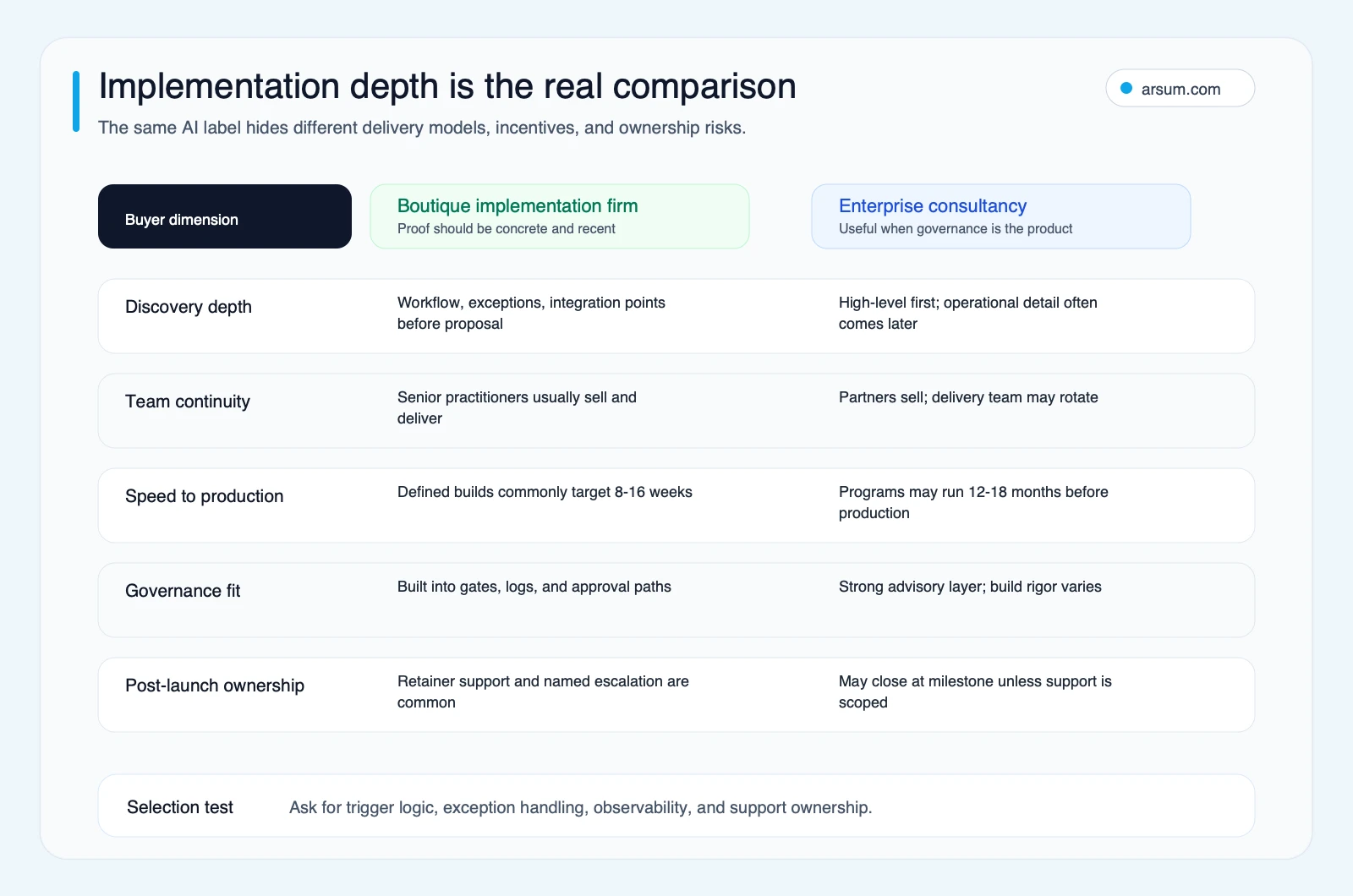
The practical comparison is not boutique versus enterprise in the abstract; it is which vendor can prove discovery depth, delivery continuity, production speed, governance, and post-launch ownership for this workflow.
Two Engagement Outcomes: What the Work Actually Looks Like
Case 1: B2B SaaS Lead Qualification Automation
Before: The SDR team spent three to four hours per day manually researching inbound leads, scoring them on a spreadsheet, and writing personalized outreach notes. A 24-to-48-hour lag existed between inbound submission and first contact. High-intent and low-intent leads looked identical in the CRM until an SDR manually reviewed them.
Engagement: Ten weeks. Discovery took three weeks to map lead sources, scoring criteria, data access paths, and exception cases, including partial records, non-ICP companies matching firmographic filters, and leads from existing accounts. Build and integration ran five weeks. QA and go-live prep took two weeks.
After: An AI agent pre-qualifies every inbound lead within twelve minutes, scoring against ICP criteria and generating a call-prep brief for the SDR. Time-to-first-contact dropped from 26 hours to under two hours. The team covers more territory with the same headcount.
What the boutique firm had to deliver: process mapping, CRM integration, exception handling logic, scoring model calibration, observability setup for monitoring agent outputs, a defined escalation path for edge cases, and a 90-day post-launch retainer. None of that is in a strategy deck.
Case 2: Operations Team, Document Processing Workflow
Before: A mid-market professional services team was manually extracting data from incoming vendor contracts, logging it to a shared spreadsheet, and routing items for review by the appropriate department lead. The manual routing step created a two-to-five-day delay per document and a compliance gap: no audit trail existed for who had reviewed what, or when.
Initial vendor choice: An enterprise consultancy was engaged for an AI strategy project. Eight weeks and a significant fee produced a vendor comparison matrix and a roadmap recommending three workflow automation tools and an estimated 14-month implementation timeline. No production system was built.
Recovery: A boutique AI implementation firm was brought in after the strategy phase. Discovery in the first three weeks revealed that two of the three recommended tools were unnecessary for the actual process scope. The final build used a single integration layer with structured extraction, approval gate logic, and a named audit trail per document. Production deployment happened at week eleven.
Outcome: Document routing lag dropped from two to five days to under four hours. The audit trail addressed the compliance requirement. The recovery engagement cost less than the original strategy project.
This pattern, where strategy and implementation are scoped together but only strategy is delivered, is one of the most common sources of buyer dissatisfaction in AI consulting. Separating the two in your vendor evaluation is not optional.
💡 Arsum builds custom AI automation solutions tailored to your business needs.
Get a Free Consultation →Red Flags and Hidden Costs
The AI consulting market has attracted many firms skilled at pitching AI projects but not at delivering them. These patterns are worth screening for during vendor evaluation.
Red flags in discovery:
A firm that cannot describe specific workflow ownership in its past work is a concern. Vague answers like “we automated their operations” without explaining the trigger, exception path, and integration suggest the firm operated at the strategy layer.
A proposal that jumps straight to tool selection before completing a process audit is a warning. Tool choice should follow an understanding of workflow, data, and team structure, not precede it. Practitioners who have run multiple AI automation engagements consistently name this sequencing failure as the most common source of scope overruns.
A team where no practitioner has deployed an AI agent to a live production environment in the past twelve months is a concern. The tooling in this space has changed significantly, and firms operating from older experience may not understand current deployment patterns for agentic systems, observability requirements, or cost management at scale.
A proposal with no discussion of security and control boundaries signals that the firm has not worked through production requirements at the build level. OWASP’s GenAI Security Project identifies prompt injection, insecure output handling, and excessive agency among the top risks for LLM-based deployments. A firm building automated workflows that touch regulated or customer-facing data needs to have addressed these at the architecture level, not as a post-launch consideration.
Operator Note: Teams that have run more than one AI automation engagement consistently report that the bottleneck is rarely the AI itself. It is the process mapping before build, the integration work during build, and the ownership gap after launch. Boutique firms that build custom systems tend to internalize this because they are the ones handling the support call when a client’s operations team does not know how to escalate an exception.
Hidden costs in proposals:
Low headline numbers often exclude costs that surface later. A realistic budget for production AI workflow automation includes:
- Discovery and process mapping: Often excluded from “build” proposals as a separate line item
- Process cleanup: Fixing upstream data quality or ownership issues before automation is viable
- Integration work: Connecting the automation to existing tools, APIs, and databases
- QA and edge-case testing: Exception handling coverage, not just happy-path validation
- Approval gate design: Defining who owns escalations and what happens when the system fails
- Observability setup: Logging, alerting, spend monitoring, and audit trails for production systems
- Model spend: Ongoing LLM API costs separate from the implementation fee
- Post-launch maintenance: Updates when model behavior changes or upstream systems are modified
NIST’s AI Risk Management Framework identifies reliability, accountability, and transparency as properties that need to be built into AI systems at the design level, not added at deployment. A vendor who cannot map these requirements to specific build decisions has not worked at the implementation level.
Ask any firm to itemize these cost categories in their proposal. A firm that cannot separate them has not done the scoping work.
Google Risk Box: Scaled Content and Thin Automation
If a consultancy sells AI strategy through pages that read like generic listicles, the content problem often mirrors the delivery problem. Google Search Central’s people-first guidance is useful here because it pushes buyers to ask whether the firm is showing original analysis, real evaluation criteria, and clear sourcing, or just scaling thin automation around a hot keyword.
Use this as a buying filter:
- Scaled content signal: the page repeats broad AI claims but never explains workflow ownership, exception handling, or post-launch support.
- Thin automation signal: the firm promises automation speed but cannot show how failures are logged, reviewed, and corrected in production.
- Safer pattern: the firm explains what it verified directly, where it is using qualitative practitioner signal, and what parts of the workflow it can actually own.
A consultancy does not need to publish long essays to be credible. It does need to show enough original thinking that a buyer can tell the difference between operating knowledge and repackaged AI copy.
Commodity vs Non-Commodity: What Separates Real Implementation Partners
Most of what is marketed as AI consulting is commodity work dressed in AI language. The distinction matters because buyers who cannot tell the difference consistently overpay for outputs that do not bring them closer to a production system.
| Deliverable | Commodity Version | Non-Commodity Version |
|---|---|---|
| AI strategy | Slide deck with use cases and market trends | Prioritized workflow map with integration architecture, exception paths, and build estimates |
| Tool selection | Vendor comparison list with feature matrix | Stack recommendation tied to your data environment, exception rate, and team ownership model |
| Implementation plan | Phase roadmap with milestones | Scoped deliverables with exception handling, QA plan, observability requirements, and named ownership assignments |
| Post-launch | “Support available upon request” | Named SLA, rollback procedure, monitoring configuration, and cost alert thresholds |
| Discovery output | Current-state process description | Annotated workflow map with trigger logic, data access gaps, compliance requirements, and failure modes documented |
The test for any deliverable: can the engineering team that inherits the system read it and act on it without a second engagement to translate? If not, it is a commodity output.
Buyer risk: The no-gate trap. Buyers who invest in AI strategy without defining a production-readiness gate often commission one strategy engagement after another without shipping anything. Before signing, define what “done” means in operational terms: which workflow runs in production, who owns it, what constitutes a failure, who monitors it, and what triggers a handoff back to the vendor. If a firm cannot write that definition into the proposal, the scope is not complete.
Original Data: Boutique-Firm Evaluation Scorecard
Use this simple scoring model when two firms sound equally credible on the call. Rate each item from 1 to 5, where 1 means weak evidence and 5 means the firm showed concrete proof.
| Evaluation point | 1 | 3 | 5 |
|---|---|---|---|
| Senior involvement | Senior seller disappears after discovery | Senior lead joins key checkpoints | Senior lead owns scope and stays active through delivery |
| Implementation ownership | Strategy-heavy, build path unclear | Shared delivery with some handoff risk | Same team can scope, build, and support the workflow |
| Data-path clarity | Vague about systems, permissions, or data boundaries | Understands some systems but not edge cases | Can name systems, permissions, failure points, and audit trail requirements |
| Security review readiness | No clear answer on approvals or controls | Mentions controls in general terms | Can explain approval gates, logging, and exception handling in plain language |
| Vendor neutrality | Pushes one stack without tradeoff discussion | Offers alternatives but weak exit plan | Explains stack choices, migration risk, and cost control clearly |
| Post-launch support | Support is undefined or ad hoc | Light support window only | Named monitoring, escalation, and update process after launch |
How to use it: total the score after each vendor conversation. A low score does not always mean the firm is bad. It usually means the scope is still foggy, the delivery owner is unclear, or the proposal is leaning on strategy language instead of operational detail.
Process-Selection Scorecard
Before selecting a vendor type, use this scorecard to rate candidate workflows. Score each dimension from 1 (low complexity) to 3 (high complexity).
| Dimension | 1 | 2 | 3 |
|---|---|---|---|
| Rule clarity | Clear rules, low exception rate | Some rules, moderate exceptions | High variability, judgment required |
| Data access | Clean, structured, accessible | Partially structured, some prep needed | Fragmented, unstructured, or restricted |
| Human approval need | None or minimal | Approval for edge cases | Approval required throughout |
| Compliance sensitivity | No regulated data or processes | Some compliance context | Regulated data, audit requirements |
| Integration complexity | Single system | Two to three systems | Many systems, custom APIs |
| ROI visibility | Clear and measurable | Estimable with assumptions | Difficult to quantify upfront |
Score interpretation:
- 6 to 9: Standard workflow software such as Power Automate or Zapier is likely sufficient. Microsoft describes Power Automate as designed to automate repetitive tasks and create workflows across apps and services, covering many predictable, low-exception processes without a custom build.
- 10 to 14: Lightweight implementation support is appropriate. A boutique firm can deliver a focused build faster than a large consultancy for workflows in this range.
- 15 to 18: Custom build with agentic components is likely warranted. Choose a boutique firm with documented production experience, or an enterprise consultancy if governance and stakeholder management are the primary requirements.
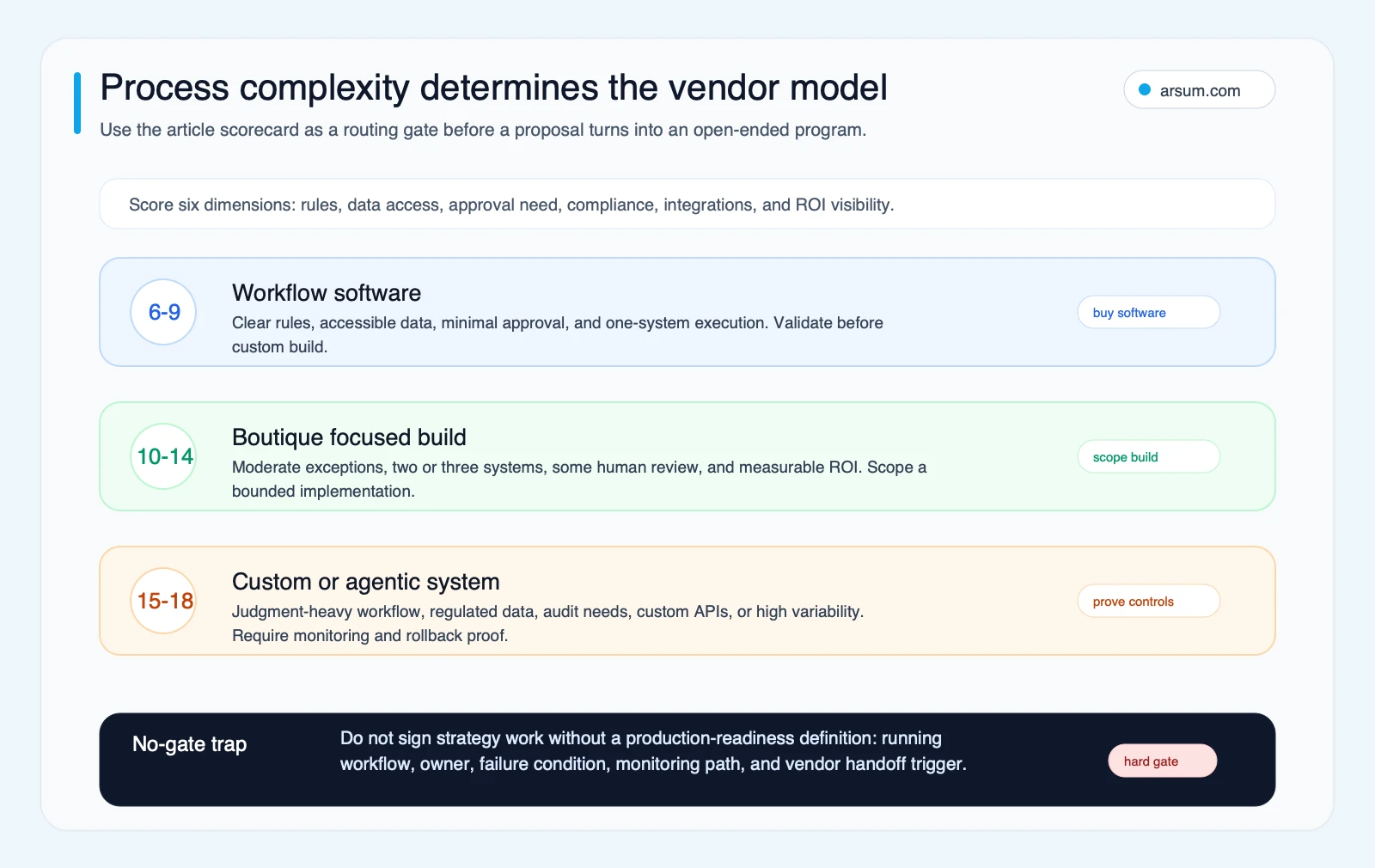
The scorecard should route the buying motion: low-complexity workflows can start with software, middle scores need a bounded boutique build, and high scores require stronger architecture and control proof.
Use this to structure your first vendor conversations, not to make the final decision. For more on how agentic automation differs from standard workflow tools, see Agentic AI Workflow Automation.
Buyer Decision Tree: Boutique, Enterprise, In-House, or Expert Review?
Use this quick routing logic before you start collecting proposals.
| If your situation looks like this… | Best starting path | Why |
|---|---|---|
| One workflow, clear owner, measurable ROI, and a need to ship in one quarter | Boutique AI implementation firm | Speed, senior continuity, and tighter implementation scope matter most |
| Multiple business units, high governance pressure, and heavy stakeholder alignment before build | Enterprise consultancy | Program management and executive coordination matter more than delivery speed |
| Strong internal engineering team, clear process map, and only a few architecture questions remain | In-house build with expert review | You likely need validation and risk review, not a full-service delivery team |
| Unclear workflow, weak ROI case, or major data access confusion | Short discovery or expert diagnostic first | Buying a build before the process is understood usually wastes the budget |
A good buying process uses this decision tree before the vendor shortlist. It keeps teams from paying enterprise rates for a bounded workflow or hiring a boutique builder when the real need is internal alignment and governance design.
Questions to Ask Before You Sign
These questions are designed to surface implementation depth rather than strategic polish.
- Walk me through the last workflow you automated end-to-end. What was the exception handling logic and who owns it now?
- How do you handle approval gates in automated workflows that touch regulated data?
- What observability does your system include by default? How do you monitor for unexpected outputs, model drift, or LLM cost spikes in production?
- What does your post-launch support model look like, and what triggers a handoff back to your team?
- How do you separate the implementation cost from ongoing model API spend in your proposals?
- Can we speak with a client who ran a similar engagement in the past six months?
- If the project runs over scope, what is your escalation and repricing process?
- How do you address prompt injection risk or insecure output handling in workflows that touch customer-facing or regulated data?
The quality of answers to questions one and three reveals more about actual delivery capability than any case study or reference deck. A firm with production experience can describe the failure modes. A firm without it will describe the intended architecture.
Work With Arsum
We help businesses implement AI automation that actually works. Custom solutions, not cookie-cutter templates.
Learn more →Engagement Models and Pricing
Boutique AI consulting firms typically operate on one of three structures.
Fixed-scope projects define the deliverable, timeline, and price upfront. This model works well when the workflow is well-understood and the integration scope is bounded. It transfers delivery risk to the vendor and makes budgeting predictable.
Retainer-based engagements provide ongoing capacity for implementation, iteration, and maintenance. This model works well for teams that need continuous development rather than a single delivery, and is common as post-launch support following a fixed-scope build.
Time-and-materials billing is common with larger firms and provides flexibility but creates open-ended cost exposure. It is a reasonable structure for discovery-phase work but a poor fit for production build commitments where scope needs to stay controlled.
Budget ranges vary significantly by project scope. A focused boutique engagement for a single automated workflow with defined integration points typically runs from $25,000 to $100,000. Multi-workflow programs with custom model fine-tuning, compliance requirements, or significant integration complexity run higher. These are directional ranges based on observed market patterns, not guaranteed benchmarks. For real-world ROI outcomes by workflow category, see AI Automation ROI Examples.
When Boutique Is the Right Call
Boutique AI consulting firms are typically the better fit when:
- The goal is a production system delivered in a defined timeframe, not a strategy document or roadmap
- The budget is in the range of $25,000 to $200,000 for a focused project (directional market pattern)
- The workflow is specific enough that deep process knowledge matters more than category breadth
- You need a partner who remains accountable for the system six months after launch
- Senior-team continuity through the engagement matters to your internal stakeholders
They are not the better fit when you need enterprise-wide program management across a large implementation team, board-level AI governance advisory, or the brand credibility a large consultancy provides for regulatory or external stakeholder purposes.
For teams earlier in the evaluation process, AI Consulting for Small and Mid-Market Businesses covers what implementation support looks like at different team sizes and what to expect from a first engagement.
The market is not short of AI consulting options. What it is short of is partners who understand implementation risk, can describe a production system in technical terms, and will take responsibility for outcomes rather than just advice.
Frequently Asked Questions
How do I choose an AI consulting company?
Start by separating strategy capability from implementation capability. Ask for specific examples of workflows the firm built and deployed in production, not just strategy engagements or roadmap deliverables. Then evaluate discovery depth: a credible implementation partner maps your workflow, data, and exception handling before recommending any technology.
What should I ask before hiring an AI consultant?
The most revealing questions focus on ownership and observability: who owns the workflow after the vendor leaves, how does the firm handle unexpected outputs or model drift in production, and can it separate implementation cost from ongoing model API spend in the proposal. A firm that cannot answer these clearly has not delivered at the implementation level.
Are boutique AI firms better than large consultancies?
It depends on what you need. Boutique firms typically deliver faster, put senior practitioners on the work from day one, and price on fixed-scope or milestone structures that are easier to budget. Large consultancies offer broader program management, stakeholder governance, and brand credibility. For production workflow automation at a defined scope, boutique firms are usually the more efficient choice.
What red flags should buyers watch for?
Watch for firms that pitch tools before completing a process audit, cannot describe exception handling in their past work, have no practitioner who deployed a production AI system in the past twelve months, or provide proposals that do not itemize discovery, integration, QA, observability, and post-launch costs separately from the build fee.
What does a boutique AI implementation engagement actually include?
A well-scoped boutique engagement covers process mapping, integration architecture, build and QA, exception and approval gate design, observability setup, deployment, and post-launch support on a defined retainer or support agreement. Discovery comes first. Tool selection follows discovery, not the other way around.
How do I know if my process needs custom AI or just workflow software?
Use the process-selection scorecard in this article to rate your candidate workflow across rule clarity, data access, approval requirements, compliance sensitivity, integration complexity, and ROI visibility. Scores below ten typically indicate standard workflow software is sufficient. Scores above fifteen typically indicate a custom build with more implementation depth is warranted.
What is the typical timeline for a boutique AI automation project?
A single, well-scoped workflow automation with bounded integration points typically takes eight to sixteen weeks from discovery to production for a boutique firm. Discovery takes two to four weeks, integration and build takes four to eight weeks, and QA, approval gate design, and deployment take two to four weeks. Scope creep, upstream data issues, and unresolved ownership questions are the most common sources of delays. These are directional patterns from observed engagements, not guaranteed timelines.
Methodology and Editorial Trust
This guide was refreshed in July 2026 after a live review of buyer-facing search results and current practitioner discussions around boutique AI consulting. The strongest factual claims were checked against primary documentation from Google Search Central, NIST, OWASP, Microsoft, and Anthropic. Forum and social discussion patterns were used only as qualitative buying signals, especially around lock-in, discovery quality, and post-launch ownership.
The engagement examples are anonymized composites based on recurring implementation patterns, not named client case studies or promised benchmarks.
Last updated: July 2026.
Ready to Automate Your Business?
Stop wasting time on repetitive tasks. Let AI handle the busywork while you focus on growth.
Schedule a Free Strategy Call →