Business process architecture is the discipline of deciding which work should be automated, selecting the least complex implementation that can perform it safely, and defining ownership, approvals, observability, and rollback before production. For AI initiatives, the exact question is not “Where can we use AI?” but “Which process has enough repeatability, measurable value, and controllable exceptions to justify automation—and how much autonomy is authorized?”
Business Process Architecture for AI Automation
Explore business process architecture: compare workflow fit, costs, risks, evidence, and practical next steps before you build, buy, or hire.

Mapping business processes to the right automation path before selecting any tool or partner
Table of Contents
- What Most Guides Miss About Business Process Architecture
- Score Processes Before Choosing Tools
- Choose the Implementation Path by Capability and Authority
- Governance Is Part of the Architecture
- A Worked Pilot Scorecard
- The Hidden Cost and Control Layer
- Disqualifying Conditions and Common Failure Modes
- Make the 30-Day Decision Explicit
A useful architecture separates four paths:
| Path | Best fit | Primary control question |
|---|---|---|
| Workflow platform | Stable rules, connected systems, structured inputs | Are the rules and exception routes complete? |
| Custom integration | Non-standard APIs, transformations, or system-of-record constraints | Who owns failures across system boundaries? |
| AI automation | Interpretation of documents, messages, or other variable inputs | How are outputs reviewed, corrected, and retained? |
| Agentic automation | Adaptive multi-step planning and tool use | Which actions may proceed without approval, and under what permissions? |
Anthropic’s guidance on effective agents distinguishes fixed workflows from agents that dynamically direct tools and steps, and recommends starting with the simplest solution that meets the need. That does not mean AI must wait until every workflow is deterministic. An intake process built around PDFs, emails, or free-text requests may need a bounded AI interpretation step from its first viable design. The decision is whether the AI is interpreting evidence, making a recommendation, or taking an action—and what review gate belongs between each stage.
What Most Guides Miss About Business Process Architecture
Process maps are useful, but they are not enough to make an automation investment decision. A swim lane can show who touches a process today without answering whether the process is a suitable automation candidate, whether its source data is reliable enough, or whether an incorrect output can be contained.
The practical decision rule is this: automate only the portion of a process whose inputs, authority, exceptions, and recovery path you can describe. Leave the rest with a named human owner until the organization can make those boundaries explicit.
This changes the usual tool-first conversation. Before comparing platforms or models, classify the work:
- Is the next step determined by a rule, or does someone need to interpret variable evidence?
- Does the workflow write to a system of record, communicate externally, or merely prepare a recommendation?
- What are the known exception types, and who resolves each one?
- Can an incorrect action be reversed, quarantined, or corrected without broad downstream impact?
- Can the team measure the current baseline and the cost of review after automation?
Practitioner discussions offer a qualitative warning here, not a market statistic. One observed account of delivery bottlenecks described manual tickets and approval dependencies as the limiting factor rather than the automation technology itself. Another builder discussion focused on approval pauses and rerunning only the affected part of a workflow after a questionable result. These are individual examples, but they point to a useful architecture requirement: design exception ownership and partial reruns before launch, rather than treating them as incident-response work.
Score Processes Before Choosing Tools
The following scorecard is an original prioritization heuristic, not a validated industry benchmark. Give each dimension a score from 1 to 3. Equal weighting is deliberate: a high-volume process with weak data or unmanageable exceptions can still be a poor first pilot.
| Dimension | 1: weak fit | 2: mixed fit | 3: strong fit |
|---|---|---|---|
| Rule clarity | Outcome depends largely on discretionary judgment | Rules exist but need frequent interpretation | Stable decision logic and predictable outcomes |
| Volume | Infrequent activity | Recurring activity with measurable demand | Frequent enough to measure and learn from |
| Data availability | Inputs are incomplete, inaccessible, or informal | Inputs span systems or formats | Inputs are available with usable lineage |
| Exception handling | Exceptions are unknown or highly contextual | Common exceptions can be classified | Exceptions have defined routing or rejection paths |
| Compliance sensitivity | Authority and requirements are unresolved | Controls exist but require design work | Required controls and approval owners are known |
| ROI visibility | Baseline value cannot yet be measured | Some inputs to a business case are available | Volume, handling time, review effort, and failure cost are measurable |
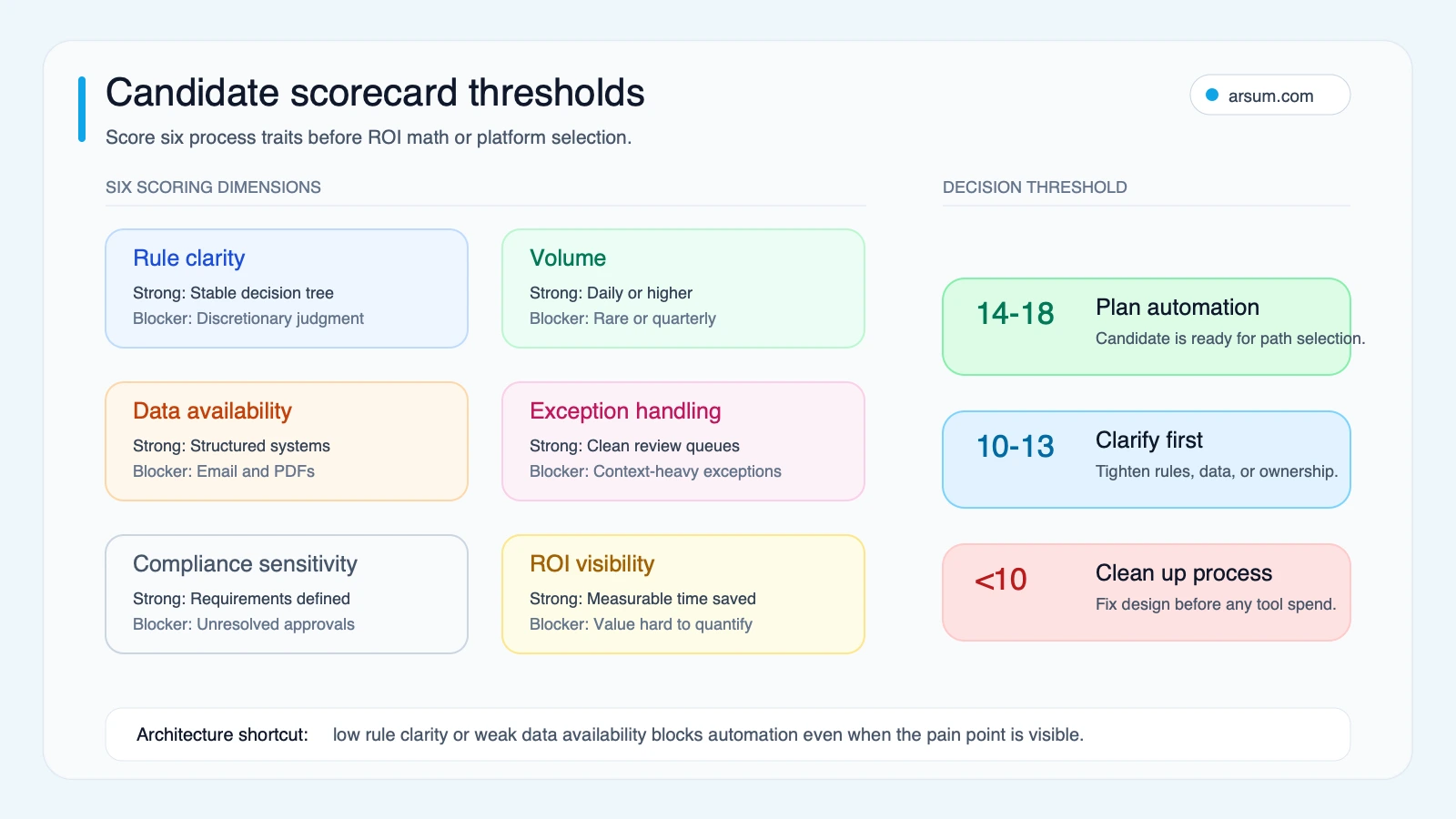
As a starting heuristic, a total near 14 or above can justify discovery—not automatic production approval. Validate it against exception-review cost, risk exposure, and expected pilot value. A low score in rule clarity or data availability is often a signal to clean up the process or source system first.
Use a sensitivity check, not a hard cutoff
A process can score well overall and still be disqualified. For example, a high-volume finance workflow may have clear rules and good data, yet still require a human approver because it affects a regulated decision or an irreversible posting. Conversely, a document-triage process may have unstructured inputs but be a suitable AI-assisted pilot if it only recommends a route and a reviewer approves the result.
Before approving a pilot, document:
| Decision item | Question to answer |
|---|---|
| Eligible volume | Which transactions or requests are in scope, and which are excluded? |
| Baseline | What are current handling time, queue age, error/rework rate, and reviewer effort? |
| Failure cost | What happens if a case is routed, drafted, or written incorrectly? |
| Autonomy boundary | May the system recommend, draft, route, or execute? |
| Review cost | Who reviews exceptions and sampled outputs, and how much effort does that add? |
| Stop condition | Which quality, security, or operational result pauses the pilot? |
This is a more reliable first filter than selecting the most visible operational pain. For help establishing a measurable business case, see AI automation ROI examples.
💡 Arsum builds custom AI automation solutions tailored to your business needs.
Get a Free Consultation →Choose the Implementation Path by Capability and Authority
The architecture path should match both what the workflow must do and what it is authorized to do.
| Path | Use it when | Avoid it when |
|---|---|---|
| Workflow platform | Rules are stable; events, records, and notifications can be connected with defined logic | Critical inputs require nuanced interpretation |
| Custom integration | Existing systems need non-standard connections, transformations, or reliability controls | A standard workflow connector already meets the requirement |
| AI automation | A bounded step needs extraction, classification, summarization, or drafting from variable inputs | Output cannot be reviewed or constrained before a consequential action |
| Agentic automation | The process genuinely needs adaptive sequencing across tools, with explicit authority and controls | A fixed orchestration sequence or a human approval step would meet the need |
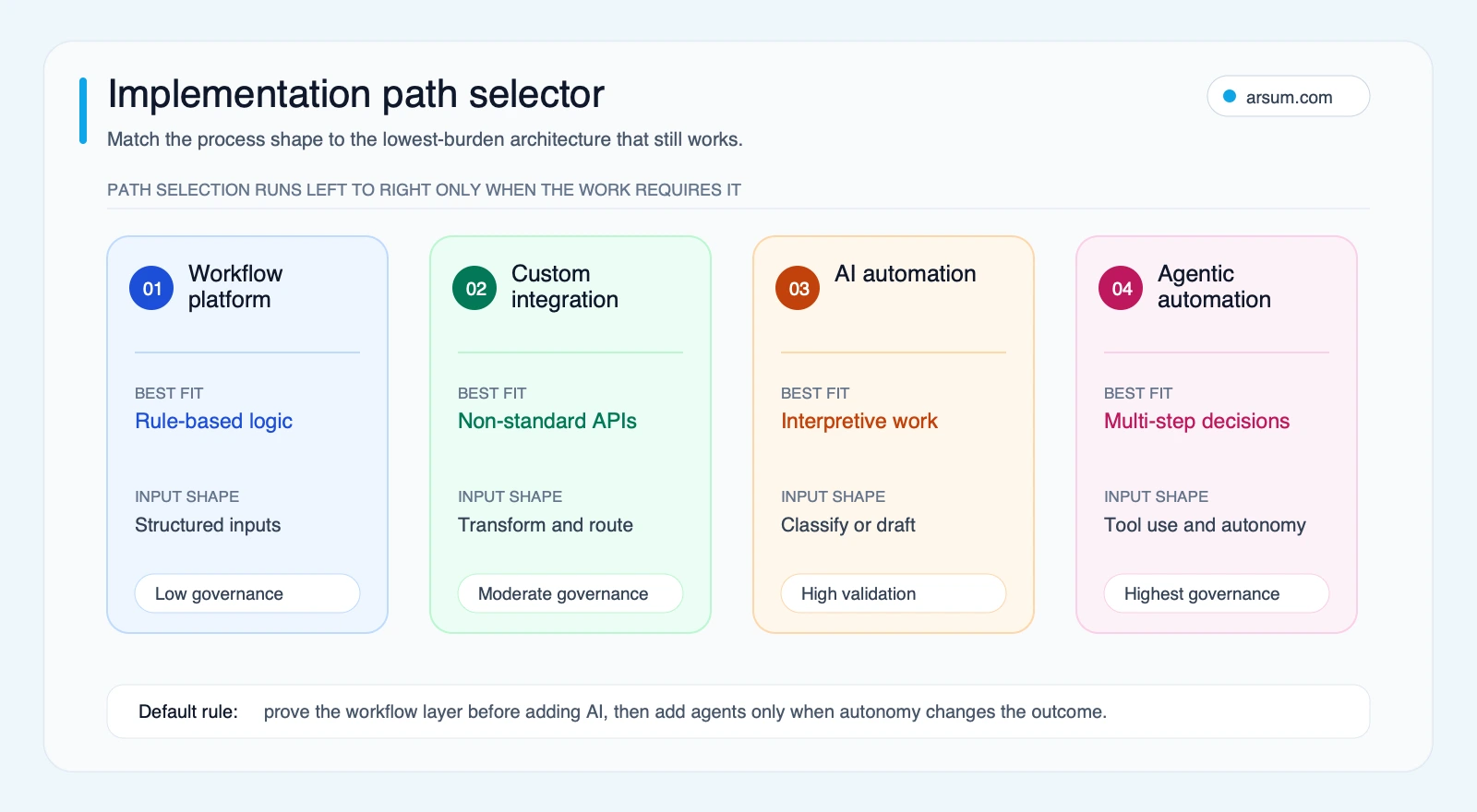
Microsoft’s Power Automate documentation describes the connected-app and repetitive-work use case that often fits rule-based workflows. For more complex orchestration, OpenAI’s agent guidance emphasizes explicit control of tools, state, guardrails, and human review. The operational interpretation is straightforward: an LLM in a workflow does not by itself justify agentic architecture.
A useful pattern for unstructured intake is:
- Receive the request and preserve the original source.
- Use AI to extract or classify into a constrained schema.
- Validate required fields and confidence or policy rules.
- Route low-risk, well-formed cases through deterministic workflow logic.
- Send ambiguous, sensitive, or policy-exception cases to a named reviewer.
- Record the decision, correction, and reason for escalation.
That model uses AI where interpretation is necessary while keeping downstream authority narrow. It also creates a path to improve a classifier without allowing it to silently expand its own remit. Teams evaluating agentic AI workflow automation should make this authority boundary explicit before discussing autonomous tool use.
Governance Is Part of the Architecture
Governance is not a compliance appendix added after a prototype works. It is the design of who can authorize action, what evidence is retained, and how the organization detects and contains failures.
The NIST AI Risk Management Framework frames trustworthiness as something considered across design, development, use, and evaluation. In operational terms, that supports building review, measurement, and accountability into the workflow rather than relying on a model’s apparent capability.
Governance readiness checklist
Before production rollout, have a named answer for each item:
- An exception owner and escalation owner for every in-scope workflow state.
- Approval gates for high-impact, customer-facing, compliance-sensitive, or irreversible actions.
- Logs that connect the source input, model or rule version, output, action taken, reviewer decision, and failure state.
- Monitoring for output quality, queue growth, failed tool calls, cost, and policy breaches.
- A containment and rollback procedure that can pause new actions, quarantine affected records, and restore a manual route.
- Scoped permissions for every downstream write and for any external content that reaches an AI component.
OWASP’s guidance for LLM applications identifies risks including prompt injection, insecure output handling, sensitive-information disclosure, and supply-chain concerns. When external emails, attachments, or web content are inputs, treat them as untrusted. Do not let retrieved text override instructions, grant new permissions, or directly trigger unrestricted downstream writes.
For a deeper view of permission boundaries and safety concerns, review AI agent security before approving an agent that can use business systems.
Design for partial failure
A production workflow should not require a full restart because one classification, API call, or approval failed. Define which state is safe to retry, which records must be held, and who can release them. This is especially important when a workflow touches customer data, financial records, or external communication.
A practical rollback test is simple: before launch, simulate an incorrect output entering the system. Confirm that the team can identify affected records, stop further action, restore the manual path, and preserve evidence for review. If that test cannot be completed, production autonomy is premature.
A Worked Pilot Scorecard
The following is an illustrative intake-routing scenario, not a client result or performance benchmark.
An operations team receives service requests through a form and shared inbox. A coordinator currently reviews each request, assigns a destination team, and sends an acknowledgement. The pilot does not authorize automatic acceptance, pricing, or customer commitments. It only proposes a route and prepares an acknowledgement for review.
| Pilot component | Illustrative planning definition |
|---|---|
| Eligible volume | Requests with complete contact information and one of four defined service categories |
| Baseline | Measure weekly eligible volume, median handling time, rework rate, queue age, and manual review minutes for two to four weeks |
| System behavior | AI extracts fields and proposes a category; deterministic rules route only approved categories |
| Quality metric | Routing precision against reviewer decisions, reported by category and exception type |
| Exception metric | Percentage requiring review, unresolved queue age, and reviewer minutes per exception |
| Owner | Operations manager owns the queue; functional lead approves category rules; technical owner manages logs and rollback |
| Review cadence | Daily review during pilot; weekly review of sampled accepted routes and all exceptions |
| Stop condition | Pause automated routing if a material policy breach occurs, if routing quality falls below the team’s pre-agreed acceptance threshold, or if exception queues exceed the review capacity |
| Rollback path | Disable automated writes, send all new requests to the existing manual queue, preserve pilot logs, and review affected records |
| Go/no-go | At day 30, compare the baseline with eligible-volume coverage, reviewer effort, quality results, and the cost of exceptions |
The arithmetic should be treated as a planning assumption. For example, estimated gross time capacity equals eligible weekly volume × baseline minutes per eligible request. It does not equal savings until the team subtracts reviewer time, exception handling, maintenance, and any additional control work. A pilot is successful when it produces enough evidence to decide whether to expand, narrow, redesign, or stop—not merely when it demonstrates that a model can generate an output.
The Hidden Cost and Control Layer
A headline implementation estimate may omit the work that makes an automation dependable. Review proposals across the full operating model:
- Discovery: current-state process, system boundaries, authority, and exceptions.
- Process cleanup: inconsistent fields, undocumented rules, duplicate records, and ambiguous ownership.
- Integration: APIs, transformations, retries, idempotency, and system-of-record behavior.
- Validation: normal cases, edge cases, malicious or malformed inputs, regression testing, and reviewer workflow.
- Controls: approvals, logging, monitoring, permission scope, retention, and incident response.
- Maintenance: process changes, upstream integration changes, prompt or rule revisions, and periodic control review.
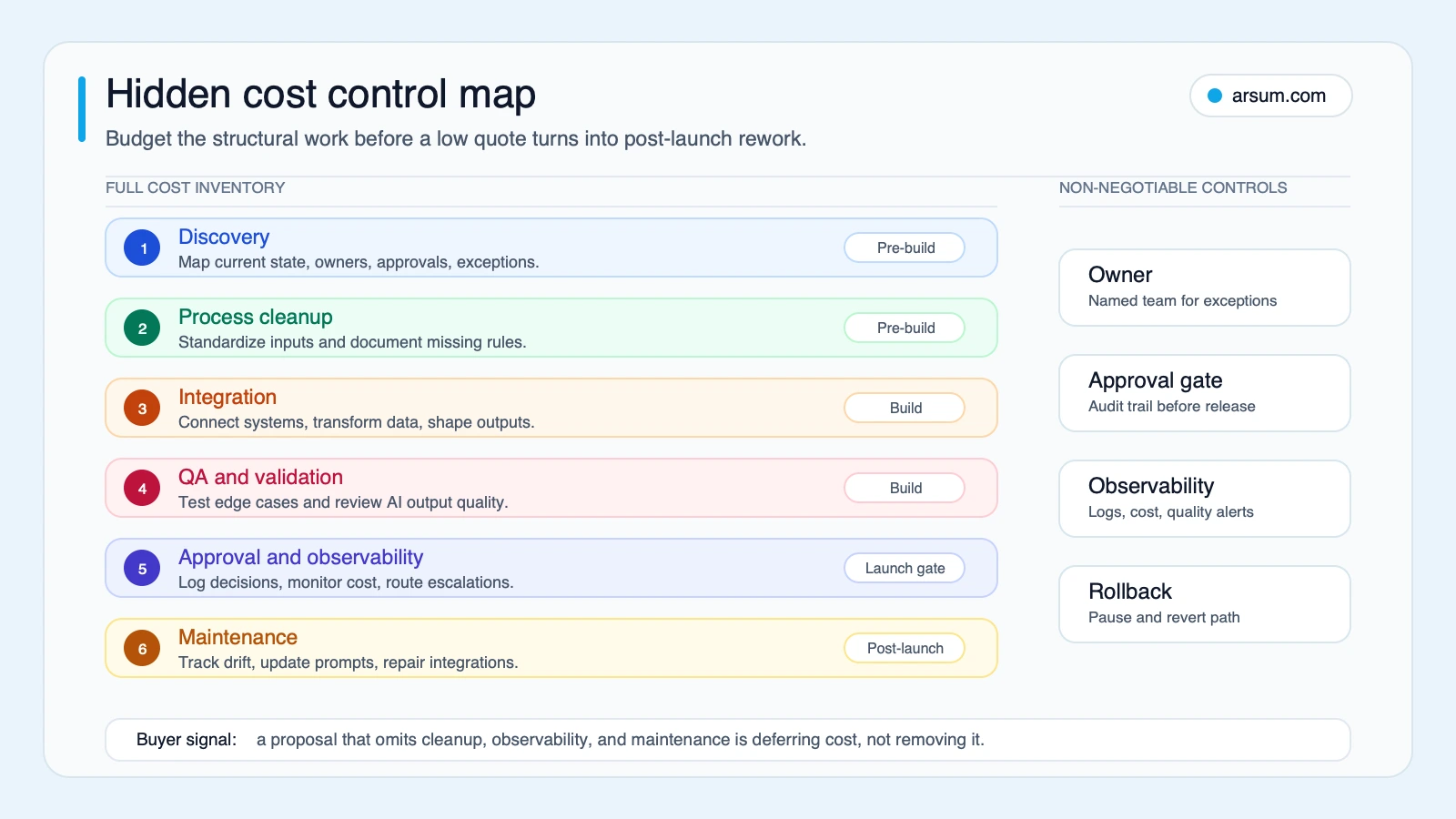
These categories are not evidence that every project requires the same level of effort. They are a proposal-review checklist. A low-complexity notification workflow may need modest controls; an AI workflow that writes to customer or financial systems needs a more rigorous design.
For buyers comparing a platform configuration with custom work, business workflow automation and AI integration services offer useful adjacent decision context.
Disqualifying Conditions and Common Failure Modes
Some processes should not move to autonomous execution yet. Pause or narrow the scope when:
- The team cannot identify the system of record or establish source lineage.
- Exceptions have no owner, no review capacity, or no service-level expectation.
- The action is consequential or irreversible and authorization is unclear.
- Baseline volume, handling time, and failure cost cannot be measured.
- The workflow depends on tribal knowledge that has not been converted into reviewable rules or examples.
- There is no safe manual fallback.
- External inputs can influence downstream actions without validation and permission controls.
Common failure modes follow from these gaps. A team may automate a painful process that is too variable to standardize, choose an agent because it appears flexible when fixed orchestration would suffice, or measure only throughput while ignoring review queues and correction cost. Another error is treating “AI from day one” and “AI only after workflow automation” as opposing doctrines. The better sequence is capability matching: use deterministic logic for stable rules, introduce bounded AI wherever interpretation is required, and grant autonomous tool use only after authority, permissions, evidence, and rollback have been designed.
For a focused comparison of implementation models, see business process automation consulting, AI automation consulting, and AI agent architecture patterns.
Make the 30-Day Decision Explicit
At the end of a pilot, do not ask only whether the automation worked. Ask whether it is authorized and economical to expand.
A 30-day review should answer:
- What proportion of eligible volume was handled within the approved boundary?
- How often did the workflow require review, correction, or manual fallback?
- Did review turnaround meet the operational requirement?
- What was the observed error-review cost relative to the baseline workload?
- Did logs, approvals, and rollback behave as designed?
- Did any security, policy, or customer-impact event require a pause?
- Which owner accepts ongoing responsibility for exceptions and maintenance?
Expand only when the evidence supports the next scope. If the pilot reduced handling time but created an unsustainable review queue, redesign the boundary. If it routed routine cases reliably but struggled with one exception class, keep that class manual. If the system cannot be paused and reconciled safely, do not increase autonomy.
Business process architecture earns its value by making these choices explicit before software makes them implicit. The goal is not maximum automation. It is a workflow whose throughput, authority, exception handling, and recovery path remain understandable to the people accountable for the outcome.
Ready to Automate Your Business?
Stop wasting time on repetitive tasks. Let AI handle the busywork while you focus on growth.
Schedule a Free Strategy Call →Written by:Arsum editorial team
- Reviewed by
- Arsum editorial team
- Published
- June 24, 2026
- Updated
- July 17, 2026
- How this was produced
- Arsum uses research packs, source checks, and human editorial review to prepare and update blog articles. Editors are responsible for the final page.
- Source policy
- Sources are linked in the article when used. Methodology and source notes are included on higher-risk or high-visibility pages and are being rolled out across the archive. Editorial policy.
- Why this page exists
- Help B2B operators evaluate AI automation, implementation scope, cost, risk, and build-vs-buy decisions with practical context.