
If you are approving budget for a ChatGPT app, the wrong question is “can we build one?” The right question is whether putting part of your workflow inside ChatGPT will create measurable business value that survives platform risk, privacy review, and the next model upgrade.
The real ChatGPT app store opportunity is not free distribution. It is the chance to place a narrow, high-intent workflow inside ChatGPT only when that workflow has clear ROI, low platform fragility, and a business outcome you can still control off-platform.
If you are comparing this against broader AI investments, read this alongside our guides to AI automation ROI examples and custom AI solutions for business. That is the right frame: not “should we launch a cool app?” but “is this the best way to improve revenue, workflow speed, or customer experience?”
Want to automate this for your business? Let's talk →
The Short Answer for Buyers
Most operators do not need a public ChatGPT app first.
| If your real goal is… | Your better first move is usually… | Why |
|---|---|---|
| Faster internal execution | Internal-only assistant | Lower privacy risk, faster rollout, easier adoption |
| Better customer self-service | ChatGPT app with actions or owned UI | Depends on where your users already work |
| Lead capture from high-intent search behavior | ChatGPT app, but only with off-platform conversion | Store visibility alone is not enough |
| Differentiated product IP | Owned UI plus API backend | Better control over UX, pricing, retention, and data |
| Commodity prompt wrapper | Probably neither | Easy for the base model or competitors to absorb |
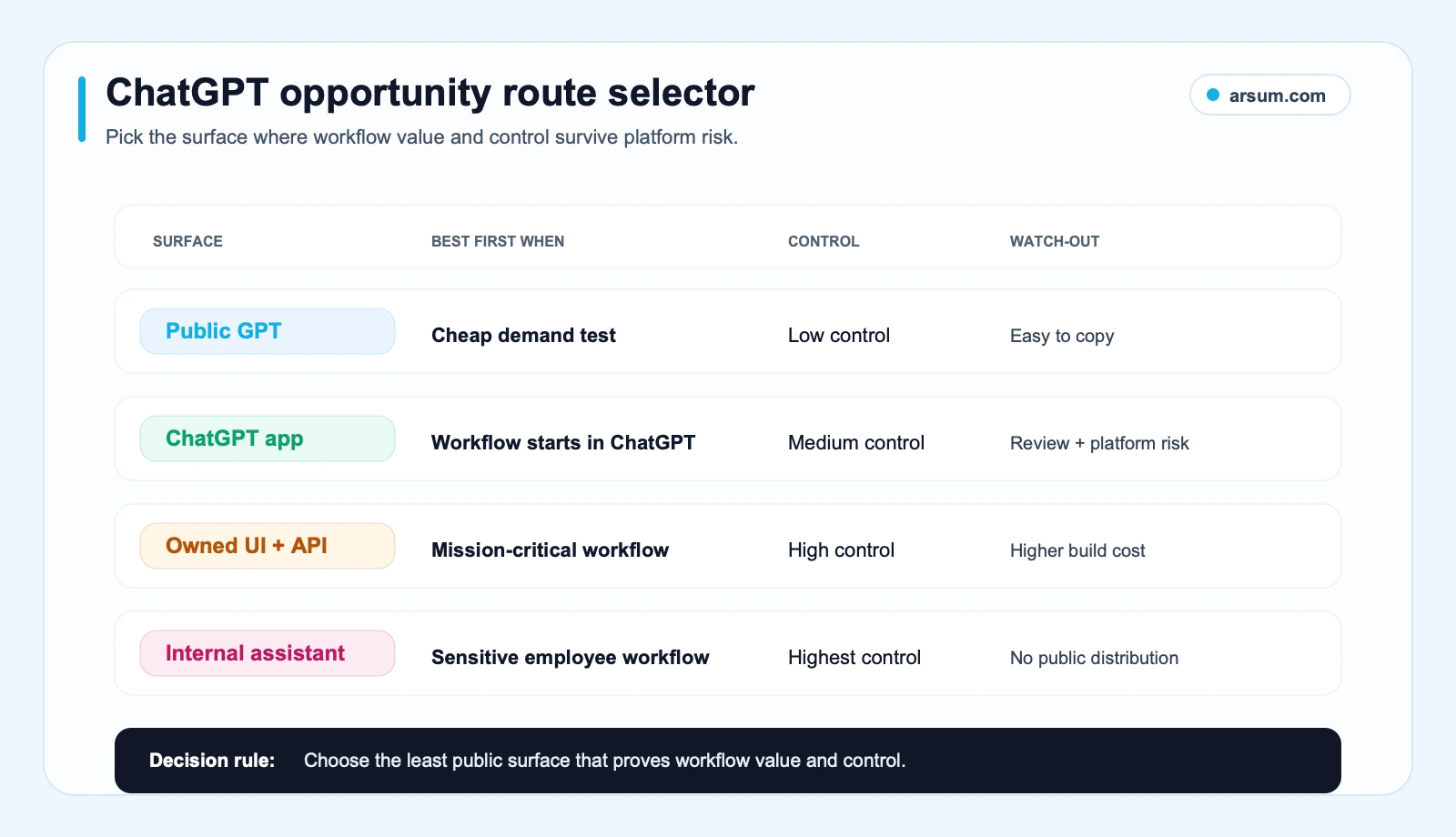
The route selector turns the buyer table into a practical first-choice screen: use the least public surface that still proves workflow value and control.
That is the core buyer insight most articles skip. The opportunity is not “ChatGPT has a store.” The opportunity is whether ChatGPT is the right surface for a specific business workflow.
What Most Guides Miss
Most coverage of the GPT Store or ChatGPT apps store stops at launch energy: new platform, huge user base, low-friction publishing. That is not decision support. Buyers need to know four harder things:
- Discoverability is not the same as durable demand.
- Platform-controlled monetization is weaker than owned monetization.
- Privacy and action requirements narrow what can safely be published.
- If the core value disappears when the model gets better, the product was never defensible.
OpenAI’s own launch materials explain the promise. When it introduced GPTs, it positioned them as searchable, no-code assistants that could eventually earn money based on usage. When it introduced the GPT Store, it said users had already created more than 3 million GPTs. That scale matters, but not in the way optimistic builders want. It means the bar for discovery and differentiation is higher, not lower. If you want a side-by-side buyer breakdown of the two surfaces, see GPT Store vs ChatGPT Apps.
Operator Note
If this initiative does not improve at least one of these within 90 days, it is probably not your next AI build:
- customer acquisition cost,
- activation rate,
- workflow cycle time,
- support load,
- or sales throughput.
If you cannot tie the app to one of those, you are funding platform curiosity, not a business outcome.
Market Signal: Interest Is Real, Operating Proof Is Thinner
The strongest external signal right now is attention, not proof. Reddit startup threads and Hacker News discussions keep framing ChatGPT apps as a rare distribution opportunity, but the argument usually leans on OpenAI’s audience size rather than hard evidence of repeat usage, conversion quality, or durable customer ownership. That matters because distribution without activation is just curiosity with a leaderboard.
The implementation friction is also more concrete than launch coverage suggests. OpenAI community threads regularly surface business verification issues, submission hiccups, metadata and test-account prep, and uncertainty around who owns the review queue after launch. Official monetization guidance makes the same point from a different angle: external checkout on your own domain is the generally available path today, which means pricing, attribution, support, and renewal logic still belong to you.
The practical buyer takeaway is simple. Treat ChatGPT discovery as a channel layer, not a full go-to-market plan. If you cannot explain the owned follow-up path, the failure mode when auth or an external API breaks, and the support model once real users show up, the opportunity is still too vague to fund confidently.
GPT Store vs ChatGPT App vs Owned Product
OpenAI’s Help Center documentation and Apps SDK docs point to a practical split that matters for buyers.
| Option | Best for | Main upside | Main risk | Buyer takeaway |
|---|---|---|---|---|
| Public GPT | Narrow prompt workflow, low engineering lift | Fast to test | Easy to copy, limited moat | Good for testing demand, weak as a long-term business by itself |
| ChatGPT app with actions | Structured workflow inside ChatGPT | Better utility, deeper integration | Review, privacy, platform dependency | Worth considering when user intent already starts in ChatGPT |
| Owned UI + API backend | Productized workflow with stronger retention | Better control over UX, pricing, and data | Higher build cost and slower launch | Usually best when the workflow becomes mission-critical |
| Internal-only assistant | Employee productivity and internal operations | Highest data control, fastest ROI proof | No public distribution upside | Often the smartest first step for operators |
OpenAI documents that GPT Store publishing can depend on plan and workspace permissions, and GPTs using actions may be blocked from publishing without a valid Privacy Policy URL or if they fail policy checks. That alone should stop buyers from treating the channel as a frictionless growth hack.
Commodity vs Non-Commodity Breakdown
This is where the business case becomes clearer.
| Commodity idea | Why it is weak | Non-commodity version | Why it is stronger |
|---|---|---|---|
| “A GPT that writes sales emails” | Easy for the base model to absorb | A sales workflow app connected to CRM, templates, approval rules, and handoff steps | Value lives in workflow and data, not text generation alone |
| “A GPT that summarizes contracts” | Crowded, easy to imitate | Contract intake app with clause extraction, risk tagging, and legal routing | Differentiation comes from process integration |
| “A GPT that creates marketing content” | Commodity output and thin retention | Content operations app with briefs, approvals, calendar logic, brand rules, and publishing workflow | Better operational ROI and harder to replace |
| “A GPT that answers finance questions” | Generic unless tied to real data | Finance assistant that connects to internal reports and turns questions into governed analysis | Trust and workflow control matter more than prompt quality |
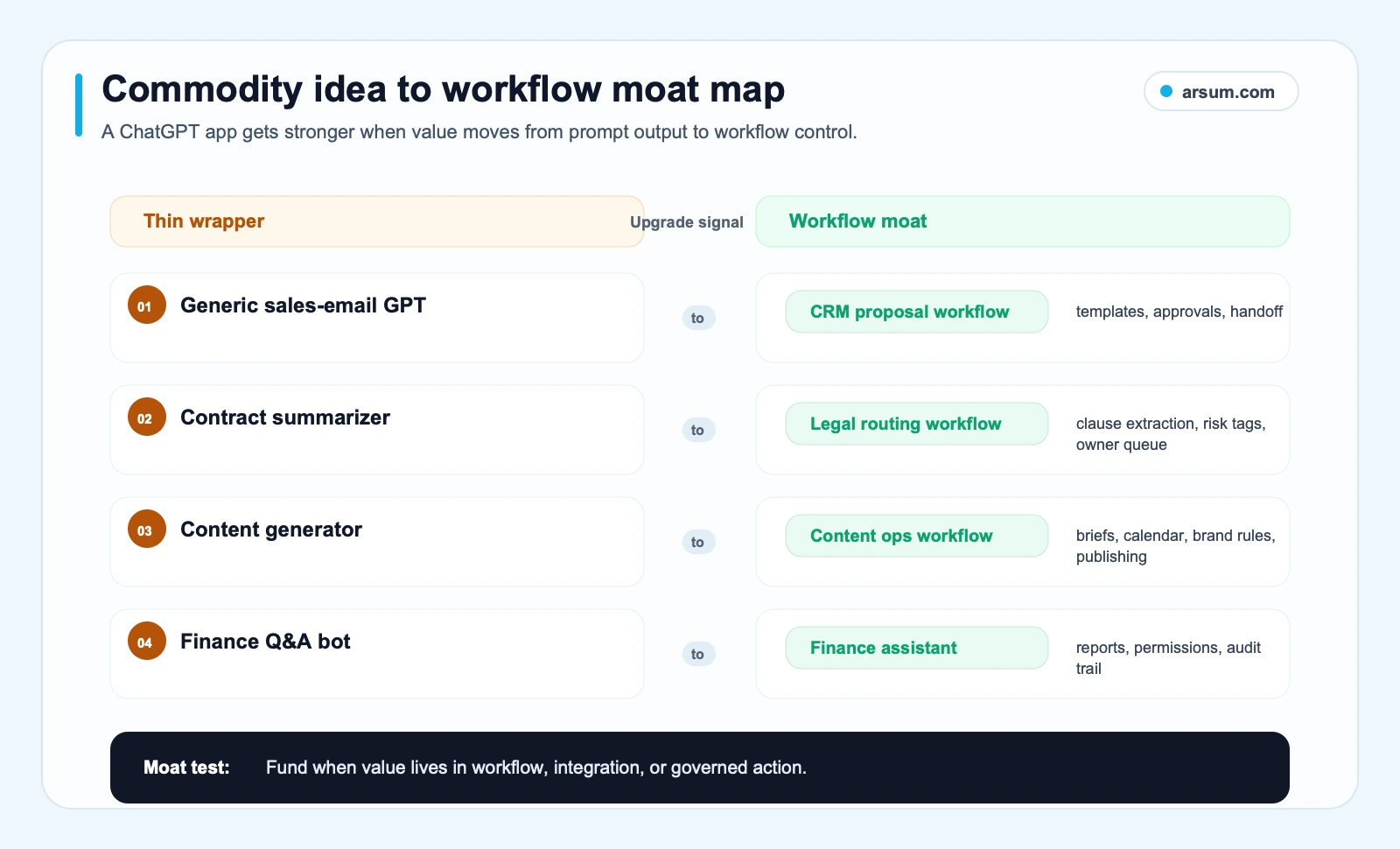
Use the moat map to pressure-test whether the idea is still just prompt output or has become a workflow asset with integration, governance, and retention logic.
The buyer rule is simple: if the main value is the model’s generic intelligence, you are building on rented land. If the main value is workflow, integration, proprietary data, or operational context, the opportunity gets more real.
💡 Arsum builds custom AI automation solutions tailored to your business needs.
Get a Free Consultation →Reusable Scorecard: Should We Build in ChatGPT?
Use this scorecard before approving scope. Rate each line from 1 to 5.
| Criterion | 1 | 3 | 5 |
|---|---|---|---|
| Discoverability advantage | Users are unlikely to start in ChatGPT | Some intent may start there | User intent naturally starts in ChatGPT |
| Monetization independence | Revenue depends on platform payout or weak upsell | Mixed | Strong off-platform conversion, subscription, or service revenue |
| Action depth | Mostly prompt output | Some structured workflow | Real integration with systems, approvals, or transactions |
| Retention loop | One-off use | Occasional repeat use | Repeated operational use with clear habit or workflow need |
| Replacement risk | Base model improvements likely erase value | Some risk | Value survives because it depends on process, data, or domain constraints |
How to read the score
- 21 to 25: strong candidate for a ChatGPT app
- 16 to 20: possible, but compare against an owned UI or internal pilot first
- 10 to 15: likely a test, not a business
- Below 10: do not fund as a platform play yet
Founder stress test
Ask one brutal question:
If OpenAI makes the base model better six months from now, does our advantage disappear?
If the answer is yes, pause. Your opportunity is probably not the app store. It is either a short-lived acquisition experiment or a feature looking for a product.
Decision Tree: Which Play Fits the Buyer Need?
Choose a public GPT first when:
- you need a cheap demand test,
- the workflow is lightweight,
- the value is mainly guidance or formatting,
- and you are comfortable with weak defensibility.
Choose a ChatGPT app with actions when:
- the user already starts with a natural-language problem,
- the workflow benefits from external systems,
- you need more than prompt instructions,
- and the app can feed leads, subscriptions, or service delivery you control.
Choose an owned product when:
- the workflow is mission-critical,
- data sensitivity is high,
- retention matters,
- the customer relationship needs to live outside OpenAI,
- or the experience itself is part of your moat.
Choose an internal assistant first when:
- the fastest ROI comes from team productivity,
- the workflow uses sensitive data,
- you need tight governance,
- or you want proof before externalizing the product.
For most B2B operators, the last two choices beat a public store bet.
Buyer Due-Diligence Checklist Before You Fund a Build
Before approving a ChatGPT-native build, get concrete answers to these seven questions:
- What exact user intent should trigger the app in ChatGPT? If the team cannot name the starting job clearly, discovery will not rescue the product.
- Which data leaves the customer’s systems, and which permissions are requested? Tight, explainable permissions are easier to approve and support.
- What happens if ChatGPT, the MCP server, auth flow, or an external API fails? A fallback path is part of the product, not a later ops task.
- Who owns app review, policy updates, support tickets, and bug-fix submissions? A public ChatGPT app is ongoing product work.
- How will adoption be measured without over-crediting directory impressions? Define activation and repeat-use metrics before launch.
- What is the monetization path if external checkout is required? Pricing and billing still need an owned workflow.
- What owned channel keeps the product viable if ChatGPT discovery is weak? The best ChatGPT apps still need an off-platform survival plan.
If those answers are fuzzy, the team probably needs a narrower pilot, an internal assistant, or an owned workflow product before it needs a public app listing.
Mini Experiment: A Modeled Before-and-After Example
Here is a realistic way to evaluate this without pretending you already have a hit app.
Scenario: a services company wants to speed up proposal intake.
Before a ChatGPT app:
| Step | Manual workflow | Time / friction |
|---|---|---|
| Lead explains need | Form, email thread, or sales call | Incomplete inputs |
| Team qualifies request | SDR or consultant triage | 20 to 40 minutes |
| Scope draft created | Manual template work | 30 to 60 minutes |
| Follow-up | Back-and-forth for missing details | Delays conversion |
After a narrowly scoped ChatGPT app:
| Step | App-assisted workflow | Time / friction |
|---|---|---|
| Lead explains need in ChatGPT | Natural-language intake | Lower initial friction |
| App gathers missing fields | Structured prompts + actions | Better qualification |
| Scope draft generated | Pulls pricing logic or template rules | Faster turnaround |
| Human review | Team edits before sending | Better control than full automation |
Modeled ROI, using explicit assumptions
Assume:
- 120 qualified inquiries per quarter
- 35 minutes of manual triage saved per inquiry
- loaded labor cost of $55/hour
- 15 extra qualified handoffs per quarter from better intake quality
That produces:
- about 70 hours saved per quarter
- about $3,850 in quarterly labor savings
- plus potential revenue lift if faster response improves close rate
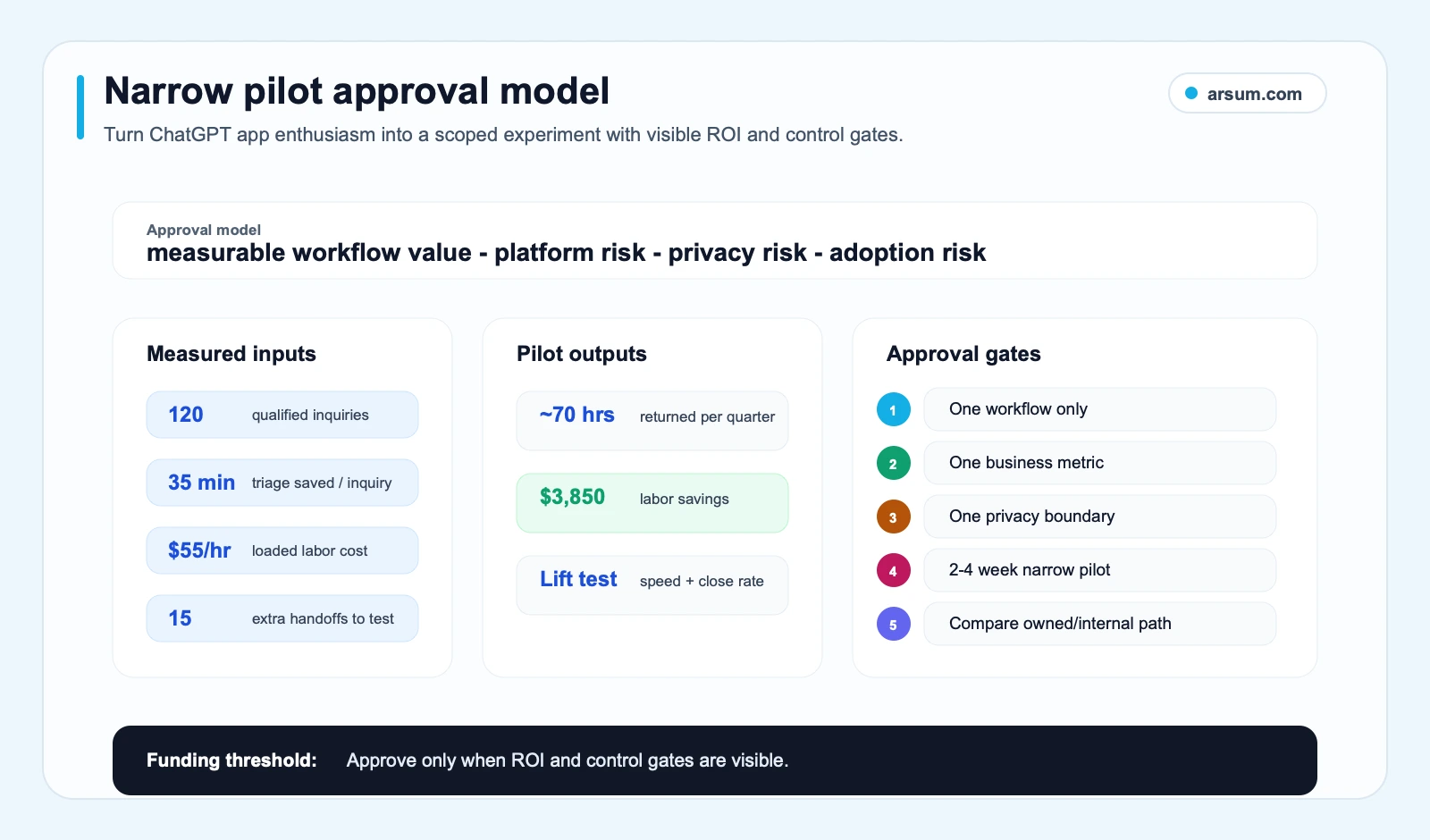
The pilot model keeps the business case concrete: approve a ChatGPT app only when the team can measure value, privacy risk, adoption risk, and the alternative build path.
That is not a universal result. It is a simple evaluation model. But it is the right kind of math. You do not need a giant platform thesis to justify a ChatGPT app. You need a workflow where time saved, conversion lift, or service capacity is visible. If your next question is whether to ship that workflow as a lightweight product, a full custom build, or an internal tool, our AI app development guide maps the cost and timeline tradeoffs.
If your use case looks more like productized workflow software than an acquisition toy, you may also want to compare it with our guides to AI app development and AI automation agency services.
Where These Projects Usually Fail
The buyer mistakes are surprisingly consistent.
1. Treating distribution as the product
Being listed is not the same as being chosen, retained, or monetized.
2. Building a wrapper with no workflow depth
If the app just repackages generic model output, it is exposed to copycats and platform improvements.
3. Ignoring privacy and review constraints
OpenAI’s documentation makes clear that publishing, permissions, and privacy expectations matter, especially when actions or external systems are involved.
4. Measuring vanity usage instead of business outcomes
A few thousand interactions do not matter if they do not create pipeline, reduce labor, improve activation, or deepen retention.
5. Starting public when internal would prove value faster
Many teams should validate the workflow inside the business before betting on external distribution.
Budget, Rollout Risk, and Adoption Risk
This is where a buyer should be practical.
| Decision area | Buyer question | Why it matters |
|---|---|---|
| Budget | Are we funding a channel experiment or a workflow asset? | Different approval logic, different success metrics |
| Privacy | What data will pass through ChatGPT or external actions? | May force internal-only design or owned UI |
| Rollout | Can we launch a narrow version in 2 to 4 weeks? | Shorter pilot cycles reduce strategic fantasy |
| Adoption | Will users actually start this workflow in ChatGPT? | If not, store distribution adds little value |
| Ownership | Where do retention, billing, and customer history live? | Long-term control matters more than launch novelty |
A good first phase is rarely “build the full thing.” It is usually:
- define one workflow,
- define one business metric,
- define one governance boundary,
- ship a narrow pilot,
- compare it against the internal-tool or owned-product alternative.
Work With Arsum
We help businesses implement AI automation that actually works. Custom solutions, not cookie-cutter templates.
Learn more →Google Risk Box: Thin Automation Is Not a Distribution Strategy
If your ChatGPT app strategy depends on mass-producing generic landing pages, boilerplate help content, or AI-generated SEO filler around the app, you are stacking risk on top of risk.
Google’s systems reward helpful, original, user-serving content, not scaled pages that exist only to capture query permutations. A thin wrapper plus thin content is not a moat. It is two weak assets pretending to be one strategy.
Use the app to create a better workflow or a better customer experience. Use content to explain that workflow with real detail, evidence, tradeoffs, and buying guidance. Do not confuse scaled output with defensibility.
Methodology Note
This article was refreshed for readers on 2026-07-05 using source review completed on 2026-06-18. We checked official OpenAI announcements, Help Center guidance, Apps SDK documentation, submission guidelines, and monetization docs, then compared those platform requirements with current SERP coverage and qualitative builder discussions on Reddit, the OpenAI Developer Community, and Hacker News. Community threads are used here as buyer-language and implementation-friction signal, not statistical proof.
Freshness Note
Last updated: 2026-07-05. Platform rules, review requirements, and monetization options can change quickly. Re-check OpenAI’s current documentation before committing roadmap or budget.
Author Note
Arsum covers AI automation decisions for operators, founders, and commercial teams. Our lens is simple: if the workflow, ROI path, and implementation risk are not clear, the automation opportunity is not clear either.
Frequently Asked Questions
Is the ChatGPT app store the same as the GPT Store?
No. GPTs are the lighter, instruction-based format. The ChatGPT apps store is tied to the Apps SDK and supports more app-like behavior, including deeper workflow logic and external actions.
Is the ChatGPT app store a real distribution opportunity?
Sometimes, yes, but mainly when the workflow naturally starts in ChatGPT and the business still controls monetization, follow-up, or service delivery elsewhere. Store presence alone is not a business model.
What is the best B2B use case?
Usually a narrow, high-intent workflow such as qualification, analysis, guided intake, proposal support, or customer self-service, especially when the app connects to systems you already run.
When should I avoid building for ChatGPT first?
Avoid it when the workflow is highly sensitive, when retention must live in your product, when the experience itself is your moat, or when the value is too easy for the base model to absorb.
Should we test a GPT before funding a full app?
Often yes. A GPT can be a cheap demand signal. Just do not mistake that signal for long-term defensibility.
Should we hire internally or use an agency for this?
If the workflow spans product thinking, integrations, rollout design, and ROI modeling, compare the build path carefully. Our guide to hiring AI developers vs agency support is a good next step.
The Practical Conclusion
For most B2B buyers, the ChatGPT app store is not “the biggest startup opportunity nobody is talking about.” That framing is too loose and too builder-centric.
The real opportunity is narrower and more useful: can you place a valuable workflow inside ChatGPT in a way that improves acquisition, service delivery, or operational speed without giving away control of monetization, customer relationship, or product moat?
If yes, a ChatGPT app can be a strong channel or workflow layer.
If no, the smarter move is usually an internal assistant, an owned product experience, or a more grounded automation project first.
Ready to Automate Your Business?
Stop wasting time on repetitive tasks. Let AI handle the busywork while you focus on growth.
Schedule a Free Strategy Call →