The chatgpt apps sdk business opportunity is real when ChatGPT is the natural working surface for a narrow, repeatable workflow that adds authenticated context, controlled actions, or a clearer interface than chat alone—and when the business case survives platform review, reliability work, and the possibility of weak discovery. It is not a reason to fund a generic assistant, grant broad system authority, or depend on an app directory for demand.
ChatGPT Apps Sdk Business Opportunity
Explore chatgpt apps sdk business opportunity: compare workflow fit, costs, risks, evidence, and practical next steps before you build, buy, or hire.

Table of Contents
- What most guides miss: capability is not authorization
- Choose the surface before you commit to the build
- Where the commercial opening is strongest
- A gated build-now decision tool
- Worked pilot: a composite CRM renewal assistant
- Model pilot economics before you call it ROI
- Failure modes that should change the decision
- Build, buy, or partner
- Pre-submission and pilot checklist
- Methodology and limits
- The practical next step
What most guides miss is that this is not primarily an SDK selection. It is a workflow-ownership decision. You need to decide whether the workflow belongs inside ChatGPT, who approves exceptions, what data and permissions it needs, how users recover when a tool fails, and whether the value remains if platform distribution changes.
OpenAI describes the Apps SDK as a framework for building apps for ChatGPT. Its submission guidance also sets a practical quality bar: apps need a clear purpose, reliable behavior, accurate tool metadata, and meaningful utility beyond native chat. Those constraints favor focused workflow products over broad “AI assistant” concepts.
What most guides miss: capability is not authorization
A model may be able to retrieve a CRM record, draft an escalation, or propose a next step. That does not mean the app should be authorized to act.
The strongest Apps SDK opportunities separate three layers:
- Information — retrieve approved data, explain policy, summarize records, or prepare a draft.
- Recommendation — rank options, flag missing information, or propose a next action for a human to review.
- Execution — create records, send messages, change account data, or trigger transactions.
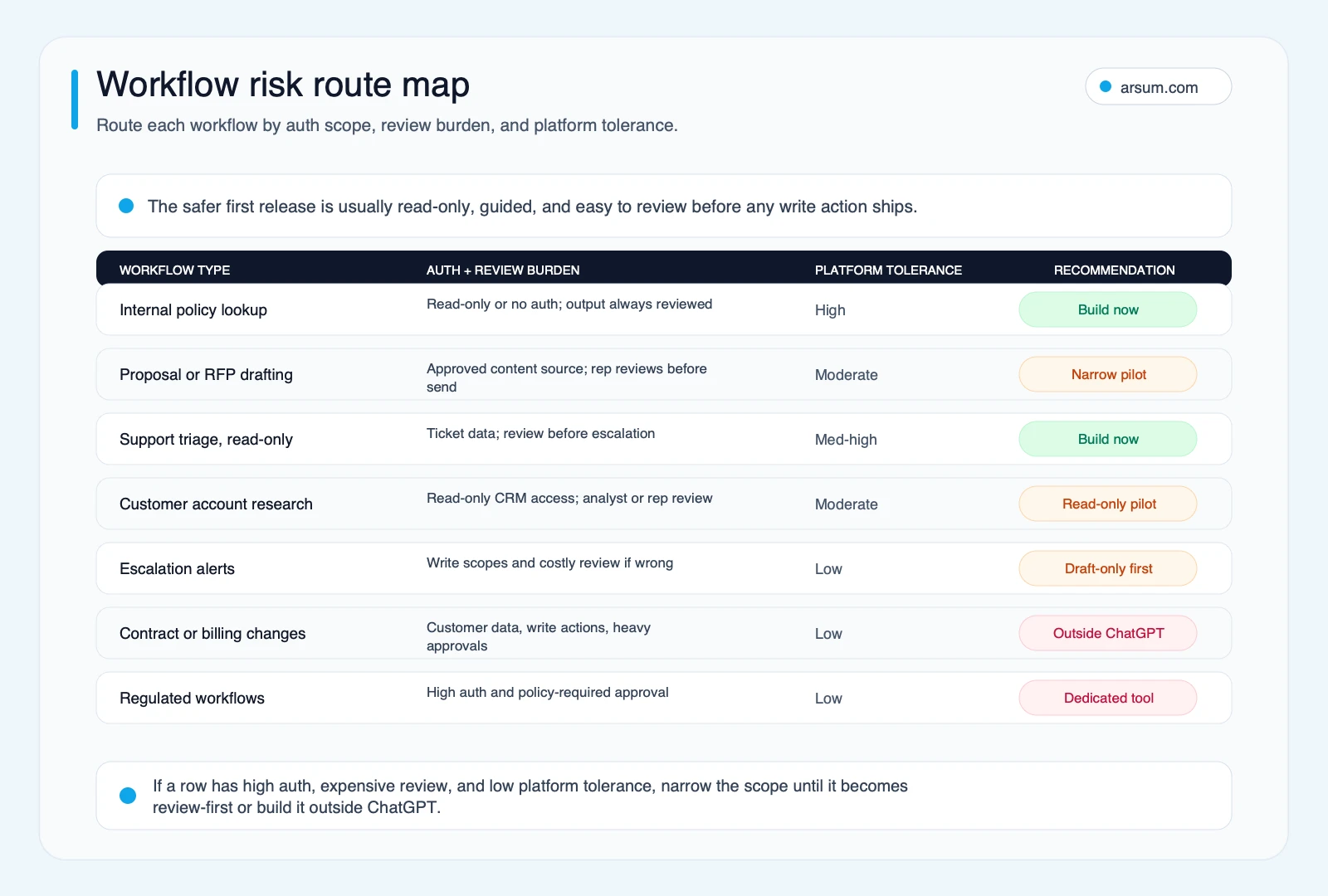
Version one should usually stop at information or recommendation. Execution needs a named approval owner, confirmed permissions, an audit trail, an exception route, and a rollback that does not depend on the model behaving perfectly.
This matters more than novelty. A ChatGPT-native app can reduce interface friction, but it does not remove product ownership, privacy review, support responsibility, or the cost of correcting a bad outcome.
For a broader foundation before choosing a surface, review AI workflow automation and AI automation ROI examples. The decision is stronger when the workflow economics come before the channel.
Choose the surface before you commit to the build
The Apps SDK is one route, not the default answer. Compare it with a lightweight GPT pilot and an owned application or workflow.
| Path | Best fit | First version | Main constraint | Decision rule |
|---|---|---|---|---|
| GPT Store or internal GPT | Drafting, lookup, low-risk experimentation | Prompted assistance with approved source material | Limited control over workflow depth and systems | Use when you need to test demand before integrating systems |
| Apps SDK | Guided, in-ChatGPT work with authenticated context or structured UI | Read-only retrieval, drafting, or review-ready recommendation | Submission, reliability, auth, and platform dependency | Use when users already work in ChatGPT and the workflow stays governable |
| Outside ChatGPT | Sensitive, high-control, or deeply embedded workflows | Owned portal, product feature, or system workflow | More interface and change-management work | Use when permissions, auditability, or system ownership outweigh in-chat convenience |
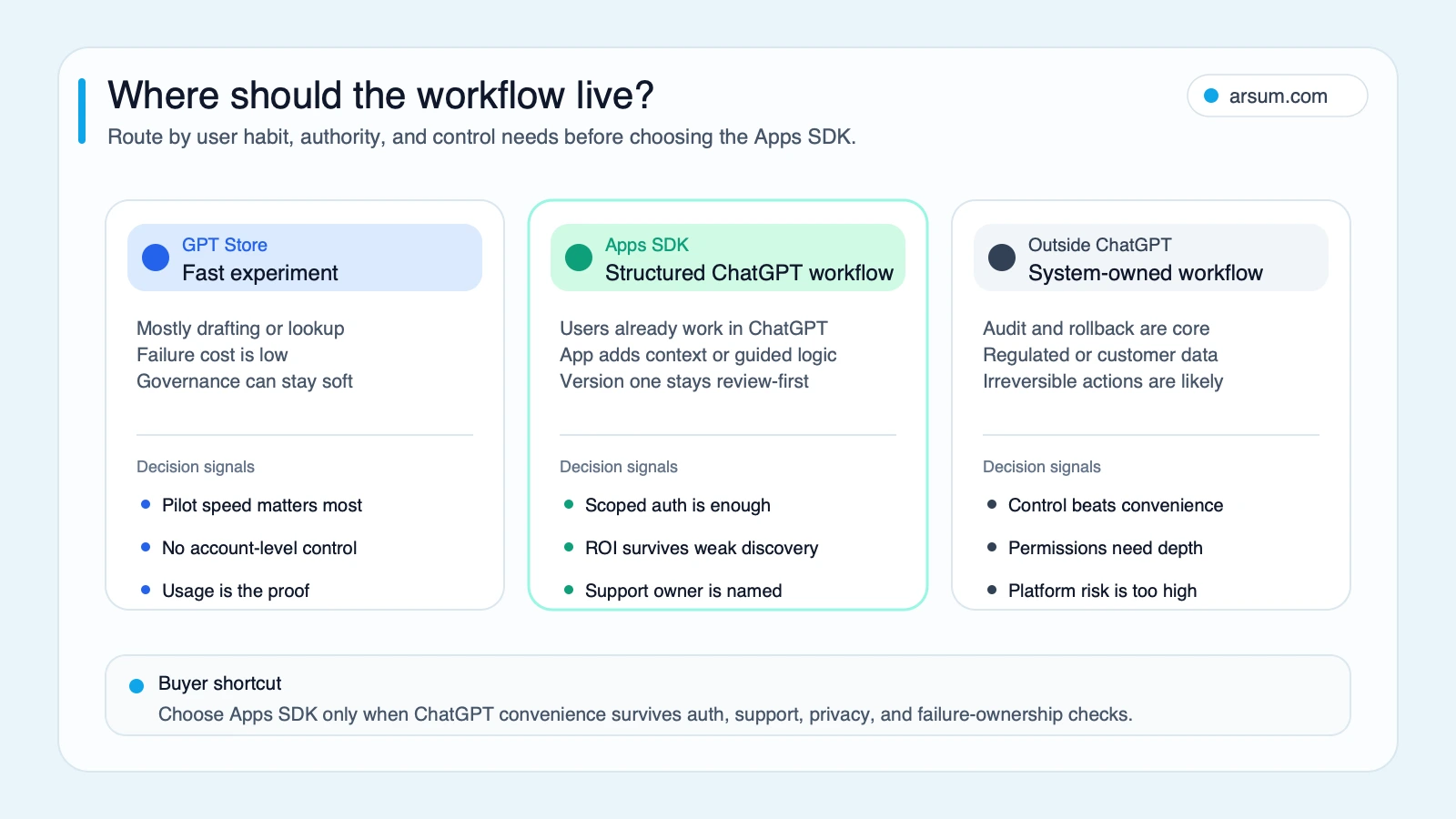
The route map should lead to a smaller first commitment, not a premature architecture decision. If a workflow only works with broad OAuth scopes, account-level writes, and several exception paths from day one, it is usually a candidate for an owned application—or for a narrower pilot first.
For the more direct product-surface comparison, see GPT Store vs. ChatGPT Apps SDK. For teams evaluating a custom product instead, AI app development services explains the delivery questions that remain outside the ChatGPT shell.
Where the commercial opening is strongest
The opportunity is rarely “build an app because the platform is new.” It is usually one of four business models with a specific workflow behind it.
Internal workflow wrapper
An internal app can give a team a controlled way to retrieve approved knowledge, prepare structured drafts, or assemble research from permitted systems.
Good candidates include:
- policy and procedure lookup from approved sources
- RFP or proposal first drafts using controlled boilerplate
- account research summaries from read-only CRM data
- onboarding guidance with links to approved setup materials
- support-triage preparation before a human escalates
The value comes from repeat demand, lower navigation overhead, and a more consistent starting point. It should be measured against the current manual process, not assumed from access to ChatGPT.
Proprietary-data utility
Apps can be more defensible when they expose permissioned context that base ChatGPT cannot know: product entitlements, approved documentation, account state, or internal process rules.
That value disappears if the integration is merely a thin wrapper around public information. A useful test is: would a competent team recreate the core experience quickly with public APIs and generic prompting? If yes, the work may be commodity. If it depends on a real permission model, domain rules, source lineage, and trustworthy UI, it is more likely to justify ongoing investment.
Productized vertical service
Agencies and product operators can package a narrow workflow for a repeated buyer type: for example, a research-and-review tool for one functional team with a defined integration pattern and control model.
The durable asset is not the demo. It is the reusable operating design:
- tool taxonomy tied to real user intent
- data connectors and permission boundaries
- failure handling and observability
- review and escalation rules
- implementation documentation
- a maintenance model when APIs, policies, or workflows change
That is closer to an implementation service than an app-store bet. Teams comparing approaches may find custom AI solutions for business and AI integration consulting useful here.
Commerce or consequential action workflow
An app that initiates a transaction, changes a record, or sends an external message can be valuable, but it is not a casual version-one build. OpenAI’s security and privacy guidance recommends least privilege, explicit consent, defense in depth, audit logging, and confirmation before irreversible or consequential actions.
Treat execution as a later-stage capability. The first question is not “can the tool call do it?” It is “who is allowed to approve it, and what happens when the proposed action is wrong?”
A gated build-now decision tool
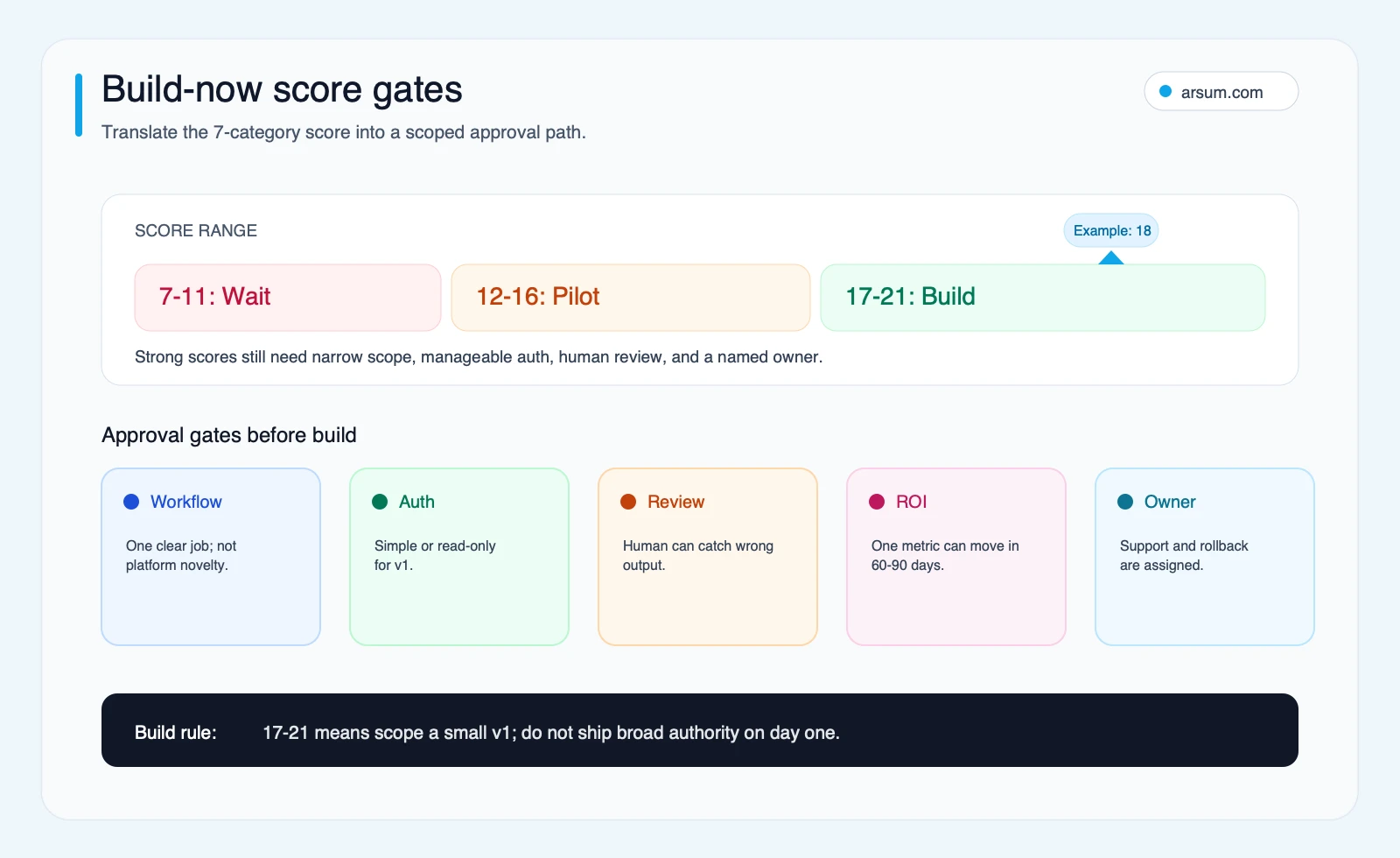
A score can help prioritize ideas, but it must never override a governance blocker. Start with gates, then score only the workflows that pass.
Approval gates
Do not approve an Apps SDK build until each statement is true:
| Gate | Required answer |
|---|---|
| Data | The team has identified the data entering the app, its source, retention expectations, and access boundary. |
| Authorization | Permissions are least-privilege, account linking is understood, and version one avoids unresolved broad scopes. |
| Consequential actions | Any write, send, transaction, or decision has explicit human confirmation and a named owner. |
| Rollback | The team can disable the tool or integration without corrupting records or blocking the underlying workflow. |
| Exception path | A user knows what to do when data is missing, a system is unavailable, or an output is uncertain. |
| Platform dependency | The business case still works if discovery, review timing, plan access, or distribution changes. |
Any unresolved gate is a block, regardless of the score. High failure cost and low reversibility should reduce autonomy, not increase it.
Opportunity scorecard
For a workflow that clears the gates, score each dimension from 0 to 2.
| Dimension | 0 | 1 | 2 |
|---|---|---|---|
| Proprietary or permissioned context | Public information only | Some useful internal context | Context is essential and access can be controlled |
| Real workflow utility | Generic chat response | Better preparation or structure | Clear, repeatable action or decision support |
| UI advantage | Plain text is enough | Structured output helps | In-chat UI materially improves completion or review |
| Frequency | Occasional task | Regular task for one team | Repeated, high-volume task |
| Adoption fit | Users do not work in ChatGPT | Mixed usage | Target users already use ChatGPT naturally |
| Reliability tolerance | Errors are costly or hard to catch | Review is possible | Output is easy to verify before use |
| Integration scope | Complex systems required immediately | One protected integration | Read-only or narrow integration first |
| Willingness to fund maintenance | No owner or budget | Pilot owner only | Clear owner and ongoing maintenance case |
Interpret the total only after the gates pass:
- 0–5: novelty or problem-definition work; do not build.
- 6–10: scoped internal pilot or service proof may be justified.
- 11–16: stronger candidate for a repeatable Apps SDK build, provided the economics clear a pilot threshold.
The dimensions are not claims about market outcomes. They are an Arsum editorial decision tool for exposing the tradeoffs that generic feature comparisons hide.
Worked pilot: a composite CRM renewal assistant
Composite scenario based on common implementation patterns; not a client performance claim or observed performance result.
A customer-success team wants a ChatGPT app to help prepare renewal reviews. The initial idea is broad: retrieve CRM data, score renewal risk, draft an escalation summary, and notify the account manager automatically.
That scope should not be approved as version one. It combines customer data, model judgment, notifications, and possible write actions. A wrong risk signal could create unnecessary escalation, while broad access creates a larger privacy and authorization review.
A safer pilot changes the workflow to:
- retrieve read-only account context for renewals due within 30 days
- generate a structured, cited draft summary
- require the account manager to verify the source fields and choose the next action
- create no CRM records and send no notifications
- show a clear fallback: use the existing CRM view and manual renewal-review process
Pilot scorecard
| Field | Illustrative planning assumption |
|---|---|
| Baseline | Measure current time from opening the account record to a review-ready renewal summary across a defined sample. |
| Pilot target | Reduce median preparation time while maintaining or improving reviewer acceptance against the existing process. |
| Quality metric | Percentage of drafts requiring material correction; percentage with missing or unsupported source references. |
| Exception metric | Number of failed retrievals, permission denials, stale records, or cases sent back to the manual path. |
| Owner | Customer-success operations lead owns workflow acceptance; system owner owns integration and rollback. |
| Review cadence | Weekly operational review during the pilot; review a defined sample of outputs, exceptions, and user feedback. |
| Stop condition | Pause the pilot if source lineage cannot be verified, access exceeds approved scope, or material-error rate exceeds the agreed threshold. |
| Rollback | Disable the app integration and return users to the existing CRM renewal-review checklist. |
This version does not prove that automated risk scoring is safe or valuable. It measures whether structured retrieval and drafting improve the preparation step enough to justify more complex scope.
Model pilot economics before you call it ROI
A time-saved claim is not investment-grade ROI. Include adoption, review, errors, implementation, and support.
Use this compact model for a 60–90 day pilot:
Gross monthly value
= monthly eligible volume
× verified minutes saved per completed workflow
÷ 60
× fully loaded hourly labor cost
× verified adoption rate

Net pilot value
= gross monthly value
− monthly support and maintenance cost
− review labor cost
− error-remediation cost
− allocated implementation cost
Every input should be measured or stated as an illustrative planning assumption.
For example, a team could test—not assume—whether a workflow with 80 eligible cases per month saves 15 verified minutes per completed case. If the fully loaded labor cost is $60 per hour and verified adoption is 70%, the gross monthly time value would be:
80 × 15 ÷ 60 × $60 × 0.70 = $840 per month
That is not a result, savings claim, or recommendation to build. It is a planning calculation. The buyer still needs to subtract review time, implementation cost, support, error remediation, and the cost of an owner maintaining the integration.
A practical 60–90 day go/no-go threshold should be agreed before launch. For example:
- enough completed workflows to make the sample meaningful for the team;
- verified adoption at or above the pre-agreed target;
- reviewer acceptance and exception rates within the team’s tolerance;
- no unresolved security, authorization, or source-lineage failure;
- a credible path for expected net value to exceed ongoing ownership cost.
If the pilot cannot meet its threshold, stop or narrow it. Do not expand authority to compensate for weak adoption.
If you want help turning one workflow into this kind of scope, control design, pilot metric, ownership model, and build-vs-buy recommendation, use the assessment conversation prompted below. It is intended for teams with a real process to evaluate—not for a generic app idea.
Work With Arsum
We help businesses implement AI automation that actually works. Custom solutions, not cookie-cutter templates.
Learn more →Failure modes that should change the decision
The app duplicates native ChatGPT
OpenAI’s guidance emphasizes utility that goes beyond native chat. If the proposal is mainly prompt packaging, public information, and a generic response, test it as a lightweight pilot before funding an Apps SDK product.
The workflow needs authority before it has evidence
A common failure is treating the app as useful only if it can write to systems, notify customers, or initiate a downstream process. That is usually a sign to isolate the valuable read-and-review step first.
Platform distribution is the business case
Public distribution and app availability are platform-controlled. The Apps SDK documentation notes that public distribution depends on the submission process, while self-serve publishing remains forthcoming. Do not model directory placement or contextual recommendation as committed demand.
The practical rule: own the customer relationship, underlying workflow logic, data governance, and fallback path outside the ChatGPT surface.
Reliability is treated as a final QA task
Tool descriptions, latency, connector behavior, error messages, and state handling are part of the product. OpenAI’s guidance on great ChatGPT apps favors specific capabilities the model can orchestrate to help users know, do, or see something they could not otherwise access. That only works when tools behave predictably enough for the user to trust the workflow.
Community signals become market claims
Practitioner discussion can expose useful concerns—platform concentration, tooling friction, and UI constraints—but it is not evidence of market size or adoption. For example, Hacker News discussion surfaces concern about walled-garden risk, while another discussion highlights React-first UI friction. Treat these as questions to test in your delivery plan, not statistics.
Build, buy, or partner
Choose based on the part you need to own.
| Choice | Best when | What you retain |
|---|---|---|
| Buy or configure | The workflow is standard and data/control requirements are light | Operational ownership and vendor oversight |
| Build internally | You have engineering capacity and the workflow is strategically differentiating | Product, integration, and maintenance ownership |
| Partner on a narrow implementation | The workflow is clear but you need help with scope, controls, architecture, and delivery | Business ownership while accelerating implementation decisions |
Do not buy a platform merely because it has a connector. Do not build custom software merely because the SDK exists. The relevant question is whether the workflow’s proprietary value, risk profile, and maintenance burden justify the ownership model.
For a wider architecture comparison, see AI agent architecture patterns, AI agent security, and AI agents for business.
Pre-submission and pilot checklist
Before approving budget, document the following in one page:
- The user, workflow, trigger, and expected output.
- The current baseline and a measurable pilot target.
- Every data source, permission, retention question, and system owner.
- The human reviewer, exception path, and action-approval boundary.
- The exact actions version one is prohibited from taking.
- The rollback switch and manual fallback.
- The acceptance threshold for 60–90 days.
- The support owner after launch.
- The reason this belongs in ChatGPT instead of a GPT pilot or owned application.
- The reason the business case survives without speculative distribution.
If you cannot complete that page, the work is not ready for implementation. Clarify the workflow first.
Methodology and limits
This article uses OpenAI’s Apps SDK documentation, app submission guidelines, security and privacy guidance, and OpenAI’s guidance on what makes a great ChatGPT app. Community material is used only as qualitative evidence of implementation questions and platform-risk concerns.
The scorecard, gates, and pilot model are editorial operating frameworks, not market forecasts or guarantees of approval, adoption, revenue, savings, or performance. Re-check current OpenAI documentation before committing budget because submission, distribution, monetization, and availability can change.
The practical next step
Build now only when the workflow clears the hard gates, version one is narrow and reviewable, and a 60–90 day pilot can test value against the real cost of ownership.
Wait when authorization, retention, rollback, or consequential actions remain unresolved. In those cases, a smaller read-only workflow or an owned application is usually the more honest next move.
Ready to Automate Your Business?
Stop wasting time on repetitive tasks. Let AI handle the busywork while you focus on growth.
Schedule a Free Strategy Call →Written by:Arsum editorial team
- Reviewed by
- Arsum editorial team
- Published
- June 26, 2026
- Updated
- July 6, 2026
- How this was produced
- Arsum uses research packs, source checks, and human editorial review to prepare and update blog articles. Editors are responsible for the final page.
- Source policy
- Sources are linked in the article when used. Methodology and source notes are included on higher-risk or high-visibility pages and are being rolled out across the archive. Editorial policy.
- Why this page exists
- Help B2B operators evaluate AI automation, implementation scope, cost, risk, and build-vs-buy decisions with practical context.