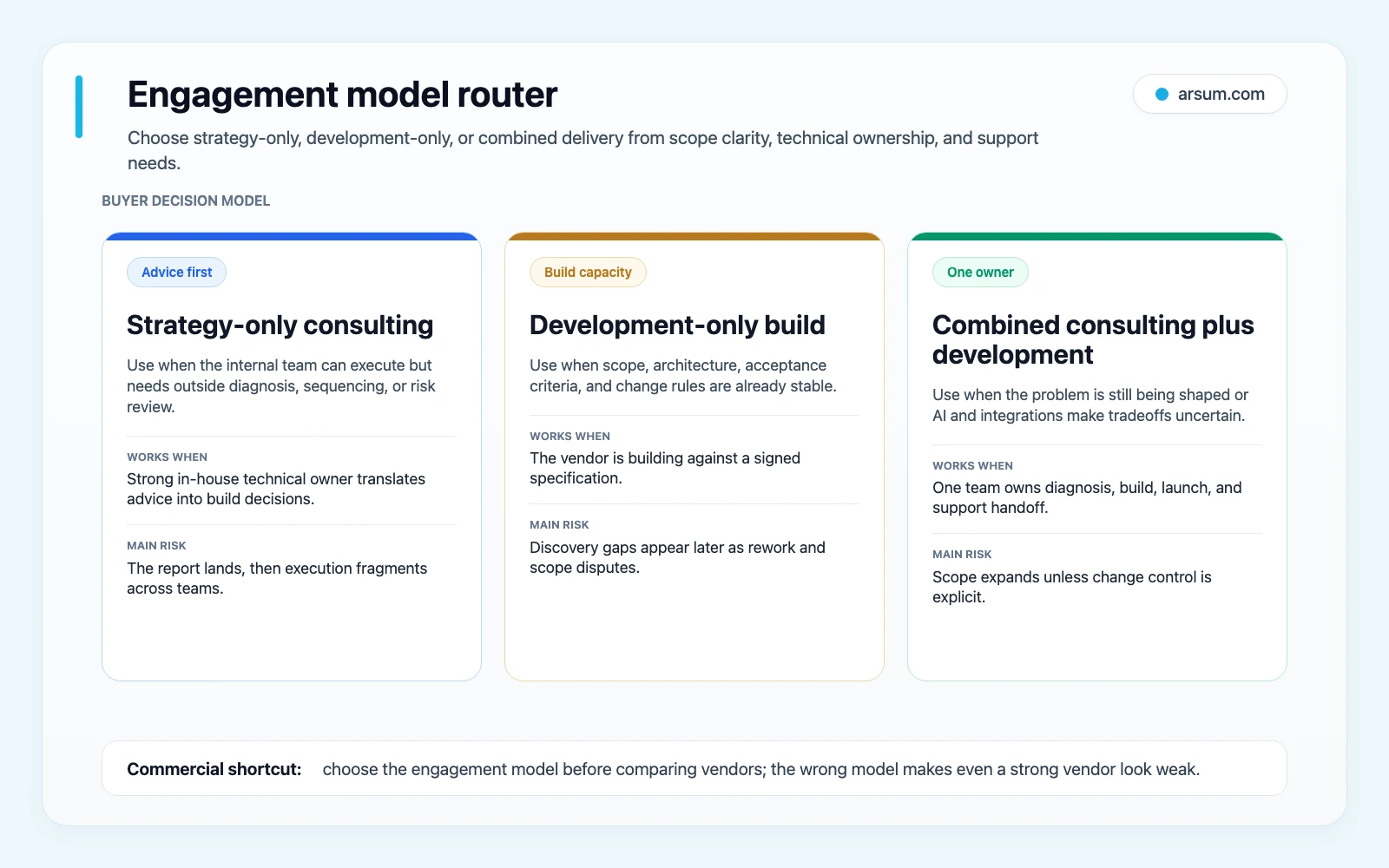
For a buyer, consulting and software development is not one purchase: it is a choice between paying for direction, paying for execution against a stable specification, or assigning one partner responsibility for both. Choose strategy-only consulting when your team can execute the resulting plan; choose development-only when requirements, approvals, and operating ownership are already clear; choose a combined engagement when the workflow, integrations, controls, and acceptance criteria must be defined before a safe build can begin.
Consulting And Software Development: Buyer Guide
Explore consulting and software development: compare workflow fit, costs, risks, evidence, and practical next steps before you build, buy, or hire.

Table of Contents
- What most guides miss: the engagement model is a control decision
- Compare the three engagement models before comparing vendors
- Engagement Selection Scorecard
- Design the pilot around authority, exceptions, and rollback
- Discovery is where accountability becomes testable
- Delivery artifacts the buyer should own or receive
- Contract questions that prevent avoidable ambiguity
- Intermediaries and handoffs: assess the seam, not the label
- When not to choose a combined engagement
- A note on the search landscape and evidence
- Make the decision with the workflow on the table
What most guides miss: the engagement model is a control decision
Service labels are weak signals. A firm can call itself a consultancy, development shop, or AI partner while leaving the important questions unanswered: who owns the specification, who authorizes a change, who reviews exceptions, who can stop the system, and who takes responsibility for support after launch.
That distinction matters most for automation that touches customer data, financial operations, regulated decisions, or business-critical systems. Technical capability does not authorize autonomous action. A workflow can be feasible to automate while still requiring a human approver, retained evidence, restricted data access, and a rollback path.
The practical decision rule is:
- Buy strategy-only consulting when the main uncertainty is diagnosis or sequencing and an internal owner can turn recommendations into a build plan.
- Buy development-only when a named internal product or technical owner already controls a stable specification, architecture decisions, acceptance testing, and ongoing operations.
- Consider combined consulting plus development when discovery and implementation are tightly coupled—but only if the contract preserves buyer control over scope, evidence, security, and handoff.
NIST’s Secure Software Development Framework is useful here because it gives software purchasers a common vocabulary for supplier acquisition and management; it does not tell you which commercial model to buy. NIST SP 800-218
Compare the three engagement models before comparing vendors
Strategy-only consulting
A strategy engagement should leave the buyer with a decision-ready package: a workflow map, problem definition, architecture options, risks, delivery sequence, and an implementation plan that an internal team or separate vendor can execute.
Use it when:
- The business problem is unclear or priorities conflict.
- You have internal product, engineering, security, or operations leaders who can own delivery.
- You need an independent assessment before committing to a platform, architecture, or build.
- You want to separate diagnosis from implementation procurement.
Do not use it as a substitute for delivery ownership. If no internal leader can turn the output into backlog decisions, integration work, acceptance tests, and operating procedures, the plan may become a document without an execution path.
Development-only execution
A development engagement is appropriate when the buyer can provide a stable, testable definition of the work. The vendor is primarily accountable for building, testing, and handing over the agreed system—not for discovering what the business should do.
Use it when:
- A named internal owner controls the requirements and priorities.
- Required integrations, data access, and technical constraints are known.
- Acceptance criteria are specific enough to test.
- The buyer has a post-launch owner and support model.
It is often the cleaner choice for a bounded enhancement, a known integration, or a product with an established architecture. Read agile software development consulting carefully if a vendor proposes “we will work it out in sprints”: agile refinement can be valid, but it does not eliminate the need for decision owners, a source of truth, and change control.
Combined consulting plus development
A combined engagement joins discovery, architecture, implementation, and usually launch support. It can be useful when the work cannot be scoped responsibly without technical investigation—for example, an AI workflow that must reconcile multiple systems, distinguish low-risk from high-risk cases, and fit an existing review process.
Use it when:
- Scope uncertainty is material and resolving it requires technical validation.
- Integration dependencies or data lineage are not yet understood.
- Human-review and escalation rules must be designed alongside the automation.
- No internal team can reliably bridge advisory recommendations into delivery.
- The same party will be responsible for early production support.
It is not automatically the better model. It concentrates knowledge and influence in one supplier. Counter that dependency with staged commitments, buyer-owned artifacts, independent acceptance criteria, transparent change approval, and a credible transition plan.
Engagement Selection Scorecard
This is an editorial decision heuristic, not market data or a vendor-ranking model. Score each factor from 0 to 2 before selecting an engagement model.
| Factor | 0 | 1 | 2 |
|---|---|---|---|
| Scope clarity | Stable, documented, and testable | Partially defined | Materially unclear or contested |
| Internal delivery ownership | Named technical and business owners can run delivery | Ownership exists but has gaps | No one can translate strategy into delivery decisions |
| Integration and data complexity | Known systems and interfaces | Some dependencies remain unknown | Multiple systems, sensitive data, or uncertain lineage |
| Change expected during delivery | Limited and governed | Some anticipated refinement | Policies, workflow, or stakeholders likely to change |
| Operating-control requirements | Low-consequence workflow with established support | Moderate review needs | High review, audit, security, or rollback requirements |
Add the five scores.
| Total | Working interpretation |
|---|---|
| 0–3 | Development-only can fit if the buyer supplies a complete specification and operating owner. |
| 4–6 | Use a short consulting or discovery phase first; decide separately whether the same party should build. |
| 7–10 | A combined model may be justified, provided the contract separates discovery gates from build authorization and protects buyer control. |
The threshold is deliberately a prompt for discussion, not a prediction of project success. A score of 8 does not mean “hire one vendor.” It means the buyer should not pretend the work is ready for a fixed build brief.
Worked scoring example: a consequential automation workflow
Assume an operations team wants to automate intake and routing for account-opening requests. This is an illustrative planning assumption, not an Arsum result.
The team receives 500 requests per month. Staff currently classify incoming documents, verify required fields, request missing information, and route complete cases to an approver. The pilot must not approve or reject an account autonomously.
| Factor | Score | Why |
|---|---|---|
| Scope clarity | 2 | Rules vary by request type and some decisions are undocumented. |
| Internal delivery ownership | 1 | Operations owns outcomes, but no internal technical owner owns integration decisions. |
| Integration and data complexity | 2 | The workflow touches intake, CRM, document storage, and an approval queue. |
| Change expected during delivery | 1 | Policy owners expect revisions during the pilot. |
| Operating-control requirements | 2 | Sensitive records, approval evidence, and rapid rollback are required. |
Total: 8/10. A combined discovery-and-build engagement could fit, but only if the buyer stages it. The first commitment should produce the workflow map, source-system inventory, data-handling design, exception taxonomy, approval rules, and pilot acceptance criteria. The buyer should authorize build only after reviewing those artifacts.
By contrast, a stable internal reporting dashboard with a defined dataset, established owner, documented fields, and existing deployment process might score 1 or 2. That is a reasonable development-only purchase; paying for broad strategy work may add little decision value.
For a wider automation-selection framework, see business process automation consulting and AI workflow automation.
Design the pilot around authority, exceptions, and rollback
A pilot is relevant when the buyer is evaluating a workflow with uncertain operating impact. It should test a narrow workflow, not prove that an entire function can be automated.
For the account-opening example above, a usable pilot scorecard could look like this:
| Pilot element | Defined decision |
|---|---|
| Baseline | 500 monthly requests; measure current handling time, completion rate, and manual rework before launch. |
| Pilot target | Route complete requests to the existing approval queue and flag missing fields; do not automate approval or rejection. |
| Quality metric | Compare automation output with reviewer decisions on an agreed sample; record false routing, missed missing-data flags, and reviewer overrides. |
| Exception metric | Track the share of cases sent to human review, the reason code, and time to resolve. A low exception rate is not inherently good if risky cases are being passed through. |
| Business owner | Head of Operations owns workflow policy and accepts or rejects operational changes. |
| Technical owner | Named internal engineering or systems owner approves integrations, access, and release decisions. |
| Human approver | Existing authorized reviewer remains responsible for consequential account decisions. |
| Evidence retained | Source record identifiers, retrieved documents, automation output, rules or model version, reviewer action, timestamp, and override reason. |
| Review cadence | Weekly pilot review with operations, technical, security, and compliance stakeholders where applicable. |
| Stop condition | Pause the pilot if output cannot be traced to source records, a required control fails, unauthorized action occurs, or error patterns exceed the buyer’s agreed tolerance. |
| Rollback path | Disable the automation, restore the manual queue, preserve logs for review, and assign a named owner to communicate the change. |
The numbers in the baseline are illustrative inputs. The acceptance threshold must be set by the workflow owner after considering error cost, review capacity, customer impact, and applicable policy. A system handling low-consequence lead routing may tolerate different errors from one preparing credit, claims, payment, or compliance cases.
This is why AI integration consulting should start with systems, permissions, and exception paths—not with a model demonstration. For architecture choices, AI agent architecture patterns can help teams distinguish an agentic workflow from a conventional rules-and-integration build.
💡 Arsum builds custom AI automation solutions tailored to your business needs.
Get a Free Consultation →Discovery is where accountability becomes testable
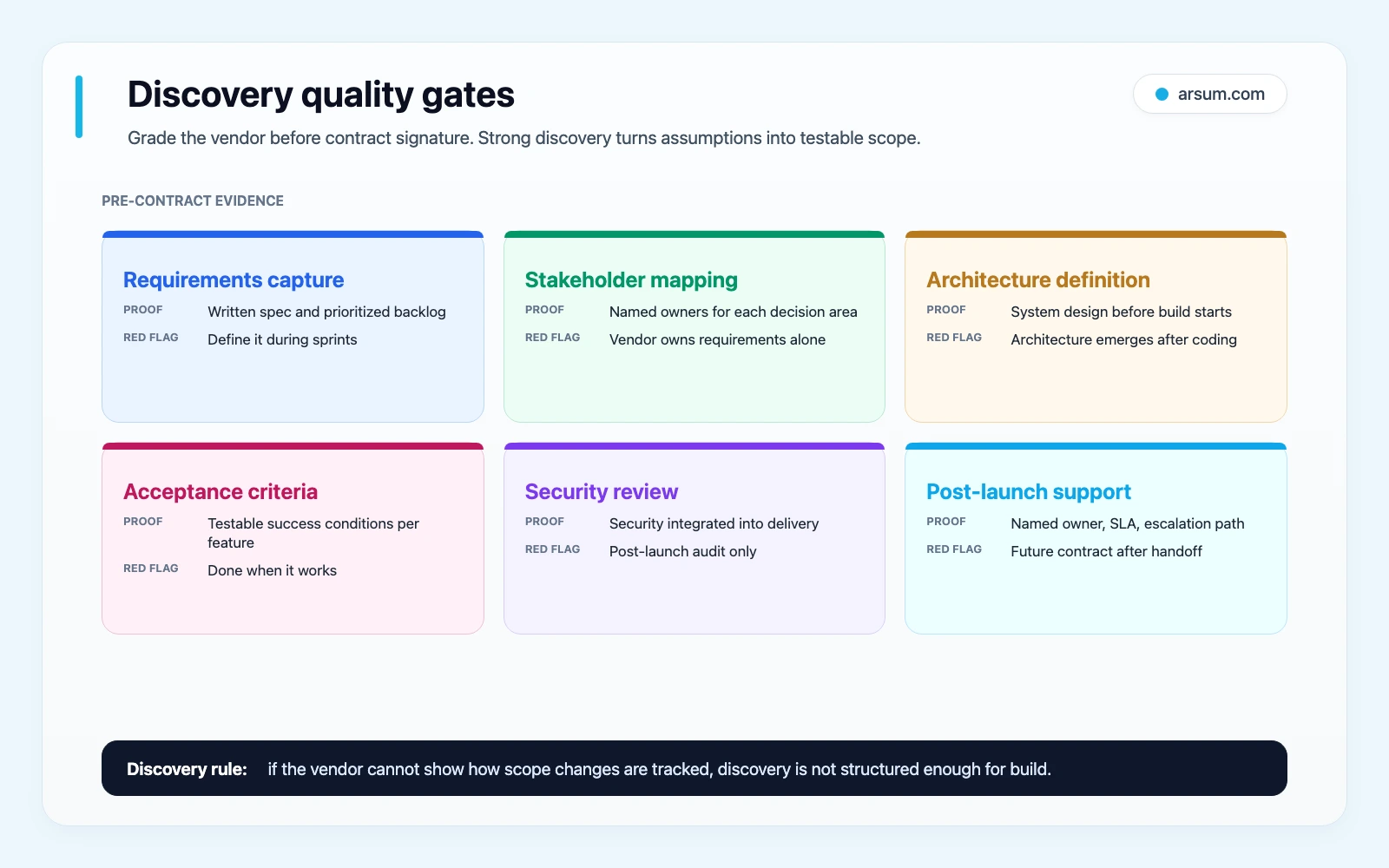
Discovery should not be a vague prelude to development. It is the phase in which the buyer decides what the vendor is actually authorized to build and operate.
A sound discovery package should identify:
- The workflow boundary: trigger, inputs, decision points, outputs, and handoffs.
- Source lineage: which system is authoritative for each field and how conflicting records are handled.
- Stakeholder map: business owner, technical owner, security or risk reviewer, approver, and escalation contact.
- Acceptance criteria: testable conditions for each milestone, including failure and exception handling.
- Architecture decisions: systems involved, integration constraints, environments, access model, and design assumptions.
- Change process: who may request, price, approve, and document a scope change.
- Operating model: monitoring, incident route, support coverage, model or dependency updates, and retirement path.
OWASP SAMM organizes secure software practices across governance, design, implementation, verification, and operations. It supports asking lifecycle questions rather than evaluating a supplier solely on coding output; it does not certify that a particular vendor or contract will be secure. OWASP SAMM
NIST SSDF similarly supports purchaser questions about secure-development practices. Ask how security requirements enter the backlog, how access is controlled, how issues are handled, and what evidence the supplier can provide—not merely whether the vendor says it “follows best practices.” NIST SP 800-218
Delivery artifacts the buyer should own or receive
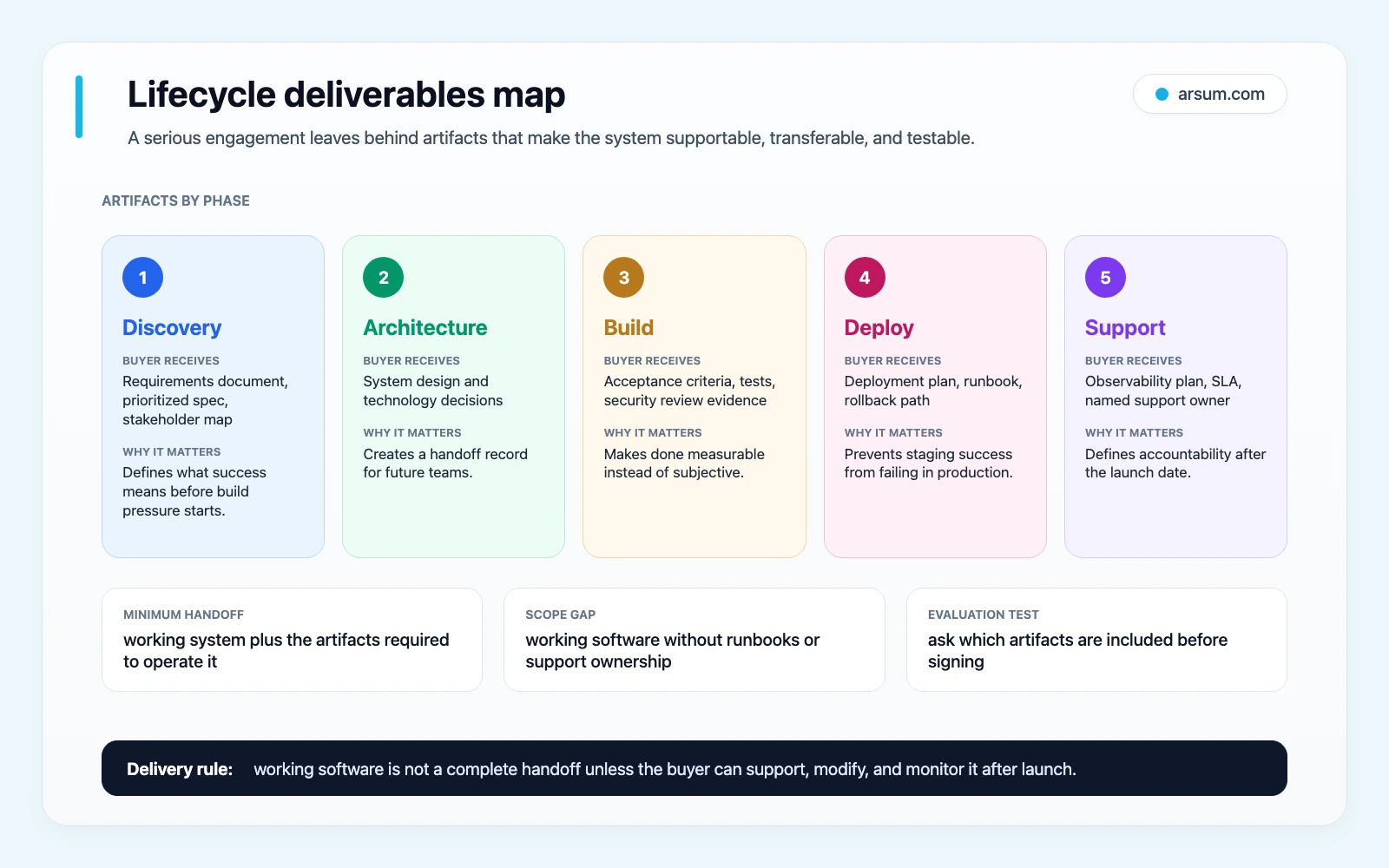
A good handoff is more than deployed code. The buyer should receive artifacts that allow a qualified internal team or future supplier to understand, operate, change, and retire the system.
| Phase | Minimum buyer-facing artifact |
|---|---|
| Discovery | Approved workflow map, requirements source of truth, stakeholder and decision-owner map |
| Architecture | System diagram, data-flow description, integration inventory, decision log |
| Build | Prioritized backlog, acceptance criteria, test evidence, change log |
| Deployment | Release plan, environment and access handover, rollback procedure, operational runbook |
| Support | Monitoring and alerting ownership, incident route, support boundaries, transition plan |
Microsoft’s operational-excellence guidance emphasizes standardized processes, observability, automation, and safe deployment practices. It supports treating operational readiness as part of delivery scope; it does not establish a universal support model or SLA. Azure Well-Architected Framework: Operational Excellence
Google Cloud’s framework emphasizes documented architecture, design for change, security, reliability, and operational concerns. That is a reason to require handoff-ready architecture documentation, especially when multiple functions will operate the system. Google Cloud Well-Architected Framework
Contract questions that prevent avoidable ambiguity
The following questions are useful whether you buy consulting, development, or both.
Data, access, and security
- What data will the supplier access, where will it be processed, and which environments are permitted?
- Who approves access, and how are credentials, service accounts, and vendor access removed at exit?
- What security practices, testing, and issue-management process apply to this engagement?
- What is the incident-notification process, who is contacted, and what evidence will the buyer receive?
- For AI-enabled functions, where are prompts, retrieved records, outputs, and model or rule versions logged?
Scope, acceptance, and change
- Where is the authoritative specification stored?
- Which acceptance criteria must be met before a milestone is accepted?
- Who can approve a change request, and how will its effect on scope and cost be documented?
- Can the buyer decline build work after discovery without losing the discovery artifacts?
Ownership and transition
- Who owns custom code, configuration, documentation, repositories, infrastructure definitions, and reusable deliverables?
- Will the buyer receive repository access and sufficient documentation throughout the engagement, not only at the end?
- What support hours, response expectations, and escalation path apply after launch?
- What does an orderly exit look like: access transfer, knowledge transfer, open-issue list, and transition assistance?
A combined engagement is not justified if a supplier will not provide these answers clearly. Likewise, a development-only engagement is not justified if the buyer cannot provide the decisions the vendor needs to build responsibly.
Intermediaries and handoffs: assess the seam, not the label
A strategy firm, implementation partner, and subcontracted development team can work together. The risk is not subcontracting by itself; the risk is an unexamined handoff.
Practitioner discussions are qualitative signals, not evidence of prevalence, but they repeatedly raise questions about concrete statements of work, agreed finish conditions, expectations, and scope presentation. Ask HN: Contracts for doing software consulting? and Ask HN: software consulting playbook
Before signing a multi-party structure, ask:
- Which party owns the specification and its current version?
- Can the actual build team speak directly with authorized business and technical decision-makers?
- Which party is accountable for security, test evidence, and production support?
- Is the downstream team disclosed, and are its responsibilities included in the contract?
- When the strategy, build, and buyer teams disagree, who has authority to decide?
Those questions expose whether the engagement has a working governance model or merely a chain of introductions.
When not to choose a combined engagement
A combined model can be excessive when:
- Your team already has a validated workflow specification and technical architecture.
- Internal engineering owns integrations, release management, and support.
- The project is a bounded implementation with known inputs and acceptance tests.
- You want independent strategy advice before selecting a builder.
- The supplier insists on controlling scope while refusing buyer access to documentation, repositories, or operational evidence.
In those cases, development-only or strategy-only can create cleaner accountability. The best model is the one that places each decision with the party able to own it—not the one with the broadest service description.
For buyers deciding whether the work is an automation engagement or a more conventional build, compare AI automation agency vs. AI development firm and AI implementation services.
A note on the search landscape and evidence
A live DuckDuckGo HTML review on June 27, 2026 for “consulting and software development” found a result mix dominated by vendor service pages, agency explainers, and listicles. This is a limited review of a changing search result page, not a claim about every ranking or buyer experience. Its useful implication is narrow: buyers should seek explicit delivery, control, and handoff information rather than relying on capability claims alone.
Google’s guidance on helpful, reliable content favors information created for people and asks whether content provides substantial value and clear evidence of expertise. That supports evaluating a supplier’s explanations and evidence, not treating search visibility as proof of delivery quality. Google Search Central: Helpful, reliable, people-first content
Make the decision with the workflow on the table
Bring strategy-only consulting into the process when you need independent diagnosis. Use development-only execution when your internal team can provide stable requirements and own the system after launch. Use a combined consulting-and-development engagement only when discovery, technical design, controls, and delivery genuinely need one accountable operating path—and structure it so the buyer can approve each gate.
If your score indicates combined ownership, bring a prospective partner the actual workflow, stakeholders, integrations, acceptance criteria, exception path, and support requirements. That creates a more useful assessment than asking for a generic proposal.
Ready to Automate Your Business?
Stop wasting time on repetitive tasks. Let AI handle the busywork while you focus on growth.
Schedule a Free Strategy Call →Written by:Arsum editorial team
- Reviewed by
- Arsum editorial team
- Published
- June 11, 2026
- Updated
- July 6, 2026
- How this was produced
- Arsum uses research packs, source checks, and human editorial review to prepare and update blog articles. Editors are responsible for the final page.
- Source policy
- Sources are linked in the article when used. Methodology and source notes are included on higher-risk or high-visibility pages and are being rolled out across the archive. Editorial policy.
- Why this page exists
- Help B2B operators evaluate AI automation, implementation scope, cost, risk, and build-vs-buy decisions with practical context.