Consulting web development is worth paying for when your website project changes a consequential workflow, system integration, or operating model—and the team needs a written decision on what is automated, what remains human-owned, where evidence is retained, and how the site will be operated after launch. The useful output is not a polished estimate; it is a discovery record that makes scope, platform choice, acceptance criteria, exceptions, and handoff ownership testable before code begins.
Consulting Web Development: Buyer Guide
Explore consulting web development: compare workflow fit, costs, risks, evidence, and practical next steps before you build, buy, or hire.

Table of Contents
- What most guides miss: discovery is a control mechanism
- CMS performance associations in the HTTP Archive corpus
- What a real discovery engagement should produce
- Turn quality promises into acceptance criteria
- Score the discovery package before you sign
- A worked pilot scorecard for an AI-enabled web workflow
- Require a client-operable handoff
- Disqualifying conditions and common failure modes
- How to compare partners beyond price
What most guides miss: discovery is a control mechanism
A website redesign can be straightforward execution. A template refresh, a landing page, or a tightly specified content update may not need a separate consulting engagement.
Consulting web development becomes valuable when the project has decisions that are expensive to reverse:
- A public site connects to a CRM, product database, identity provider, payments, or internal workflow.
- A CMS migration could affect existing URLs, content operations, or search visibility.
- AI features will summarize, route, draft, classify, or retrieve information for users or staff.
- Multiple stakeholders can request changes, but no one owns final scope approval.
- The client must operate the platform without depending on the delivery partner for routine edits, access, or incident response.
The key question is not “Do we need a new website?” It is: what operational decision will this project make easier, and what would failure cost to unwind?
For an AI-enabled workflow, technical capability is not authorization. A model may be able to draft a response or categorize an inbound request, but discovery must determine whether it may act automatically, which records it can access, who approves exceptions, and how the team can disable the feature. Teams comparing this broader boundary can use our guide to AI workflow automation alongside the web-development evaluation.
Readiness scorecard
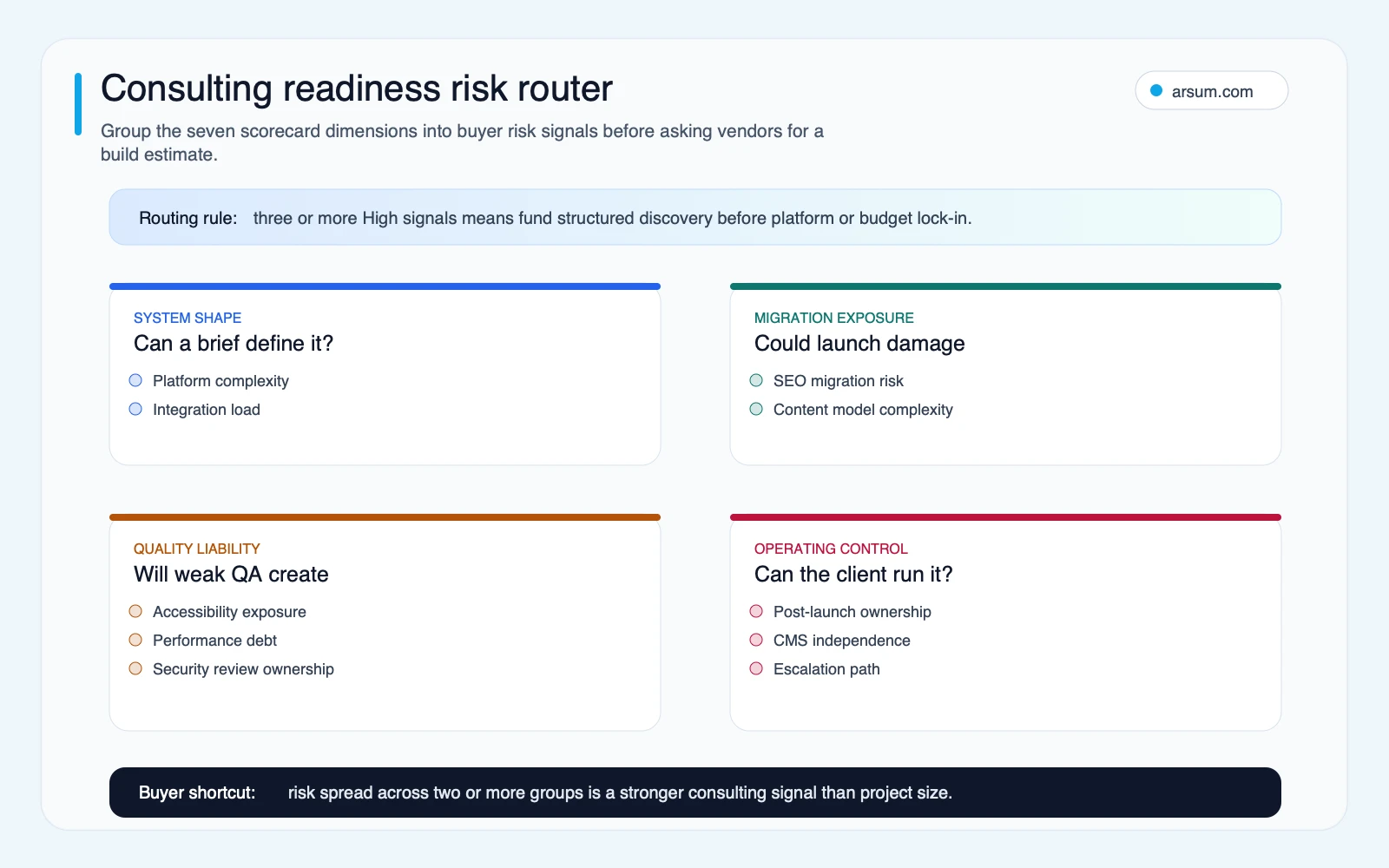
Use this as an Arsum buyer heuristic, not a project-outcome prediction. It helps decide whether a structured discovery phase is proportionate to the decision risk; technical review should still validate the findings.
| Dimension | Low | Medium | High |
|---|---|---|---|
| Platform complexity | Single CMS, no custom development | CMS with extensions or integrations | Custom or multi-system build |
| Integration load | No external systems | One or two stable integrations | Multiple APIs, identity, or real-time dependencies |
| Migration exposure | New site | Limited content or URL changes | Indexed site, complex content migration, or platform replacement |
| Workflow consequence | Informational pages | Lead capture or routine operations | Customer, regulated, financial, or high-cost operational workflow |
| Quality exposure | Low-impact internal use | Public-facing site | Accessibility, security, contractual, or regulated requirements |
| Content operations | Static content | Several content types | Permissions, localization, approvals, or structured publishing |
| Post-launch ownership | Vendor remains operator | Shared ownership | Client must independently operate and govern the system |
Three or more high-risk dimensions are a reasonable signal to fund discovery before accepting a build estimate. The reason is practical: estimates become less reliable when they are based on untested integration assumptions, vague migration boundaries, or unstated ownership.
Platform screening must include comparable-site validation
Platform selection should not be a preference contest between a CMS, framework, or site builder. Ask which operating requirements each option satisfies:
- Who can publish, approve, and roll back content?
- Can the platform represent the required content and permissions cleanly?
- What systems of record remain authoritative?
- What happens when an integration is unavailable or returns incomplete data?
- Who patches dependencies, monitors uptime, and owns credentials?
- Can the client export content and retain control of domain, repository, analytics, and hosting accounts?
The rendered evidence brief below is useful at this stage. It describes observed HTTP Archive and Chrome UX Report associations for relevant technology sets. Use it to form a platform-screening question—such as whether a prospective stack adds avoidable page weight or scripts—not as proof that a platform caused a specific performance result. Validate candidate implementations against comparable sites and the project’s own test plan.
What a real discovery engagement should produce
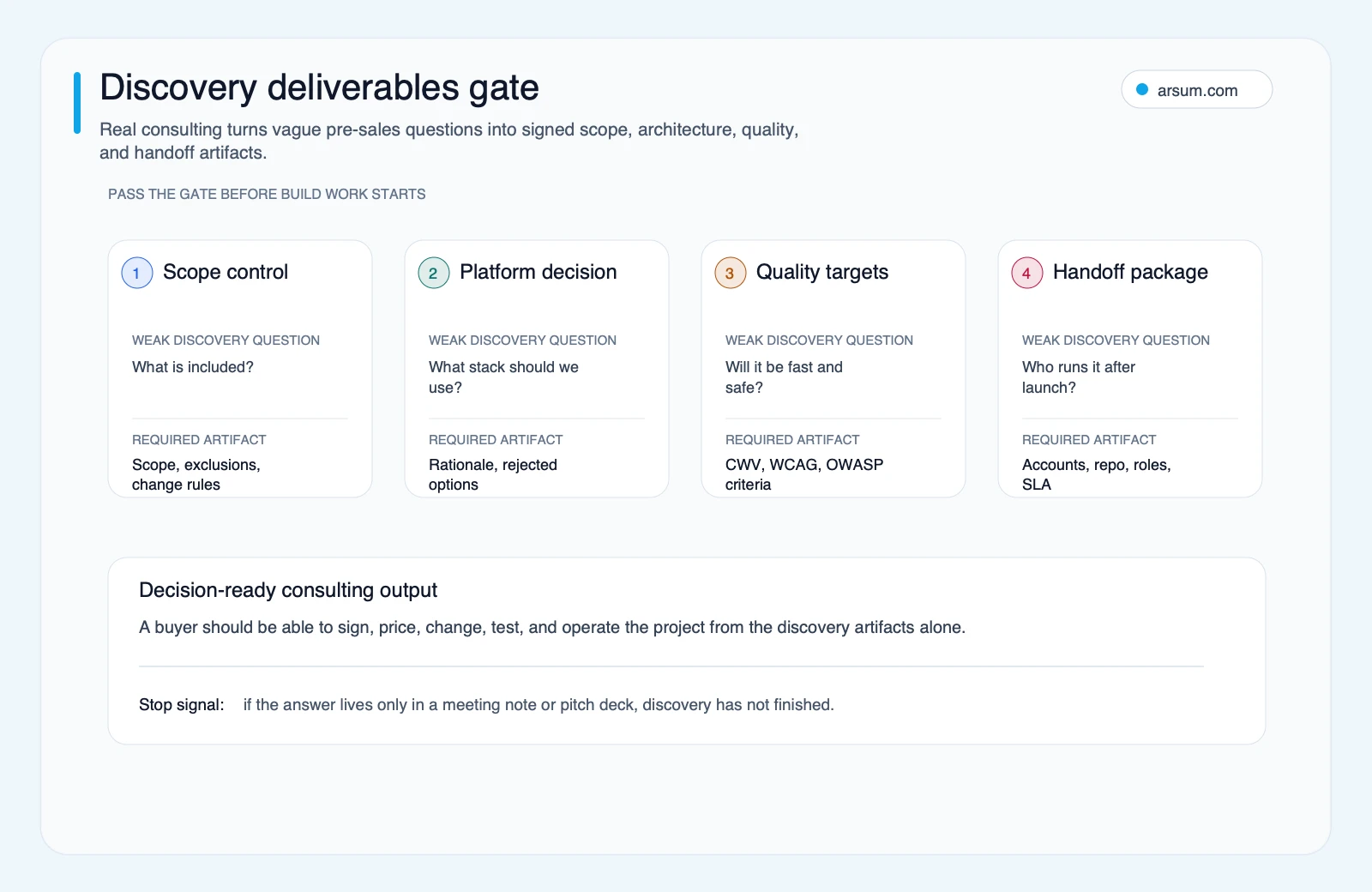
A discovery engagement should leave the buyer able to approve, reject, defer, or competitively procure the build. If its only output is a quote, it has not materially reduced decision risk.
1. A workflow and system-of-record map
The map should show the normal path and the exception path.
For example, if a site collects qualified leads and uses AI to prepare a sales brief, the discovery record should identify:
- The form fields and consent boundary.
- The CRM or database that is the system of record.
- The information the model may retrieve.
- The output it may draft versus an action it may take.
- The role that reviews incomplete, sensitive, or low-confidence cases.
- The retained evidence: input, source references, output, reviewer decision, and timestamp.
- The manual fallback if the integration or model is unavailable.
This is as relevant to a conventional web integration as to an AI feature. A lead-routing failure, broken consent capture, or unowned automation can be more consequential than an imperfect page layout.
2. Scope, exclusions, and change control
The scope document should name deliverables, but exclusions are equally important. A common failure mode in practitioner discussions is vague feedback—such as requests to make a design “pop”—turning into repeated design rounds without a defined boundary. A Project Management Stack Exchange discussion is a qualitative example, not evidence of prevalence.
Require these items in writing:
- Included templates, components, integrations, data migration, and environments.
- Explicit exclusions and assumptions.
- Number and type of included review rounds.
- Named client decision-maker for scope approval.
- Change-order triggers, approval path, and pricing method.
- Dependencies the client must provide, including content, access, legal review, and subject-matter approval.
3. Architecture alternatives and decision record
A consulting partner should compare at least the plausible options: extend an existing platform, buy a specialist tool, integrate existing systems, or build a narrow custom capability.
| Decision factor | Extend or configure | Buy a platform | Build a narrow custom workflow |
|---|---|---|---|
| Workflow fit | Good when the current platform already matches the process | Good when the workflow is standard | Good when the process is distinctive and bounded |
| Integration constraints | Depends on available connectors and APIs | Validate data export, APIs, and identity support | Requires explicit interface and failure handling |
| Human approval | Often configurable | Confirm approval and audit features | Can be designed around named review gates |
| Auditability | Depends on current logs and permissions | Verify vendor records and retention | Define source lineage, logs, and access controls |
| Maintenance ownership | Internal team or incumbent partner | Vendor plus internal administrator | Named client owner plus delivery/support model |
| Pilot economics | Measure configuration and change-management effort | Measure subscription, setup, and migration effort | Measure bounded build, integration, and review effort |
| Acceptance metrics | Operational adoption and quality | Fit, control, and exit conditions | Baseline-to-target workflow metrics and rollback test |
For AI-enabled capabilities, do not assume that faster code generation changes this decision by itself. Treat it as a discovery hypothesis: can a narrower custom implementation meet the required control, maintenance, and acceptance conditions at an acceptable total cost? Teams weighing the implementation path can also review AI app development cost and AI integration consulting.
Turn quality promises into acceptance criteria
“Fast,” “secure,” “accessible,” and “SEO-ready” are not acceptance criteria until the project names the target, test method, owner, and waiver process.
Google’s SEO Starter Guide supports planning crawlability and technical basics early, particularly for rebuilds and migrations. It does not guarantee rankings. Similarly, Google’s people-first content guidance supports building for users with original, trustworthy content; it is not a substitute for editorial review.
For performance, web.dev’s Web Vitals guidance provides project-usable metrics, including LCP, INP, and CLS. Set a target and measurement conditions—for example, the templates, device class, test environment, and third-party scripts included in the test. MDN’s performance guidance is helpful context: performance includes both measured and perceived responsiveness.
For security, the OWASP Web Security Testing Guide is a structured reference for defining a test scope. It does not mean every project requires every test. The agreement should say which tests apply, who performs them, what evidence is delivered, and who may accept a documented exception.
Launch-quality checklist
Treat this as a procurement checklist to tailor to your risk profile. It does not replace specialist accessibility, security, or migration review.
| Area | Require before acceptance |
|---|---|
| Performance | Named Core Web Vitals targets, test method, target templates, third-party-script inventory, and owner for remediation |
| Accessibility | Agreed standard and template/flow scope, test method, findings log, remediation owner, and exception process |
| Security | Defined OWASP-informed review scope, dependency and configuration responsibilities, evidence, and risk acceptance owner |
| Migration and crawlability | Redirect map, canonical rules, robots review, XML sitemap available and submitted where applicable, and post-launch indexing/coverage review |
| Analytics | Client-owned account, tested priority events, consent handling where applicable, and reporting owner |
| Operations | Backup and restore responsibility, incident escalation path, content-edit test, and credentials/role inventory |
A useful distinction: accessibility defects create user and legal/compliance risk; migration errors can affect crawlability and discovery; poor content can fail reader needs; and Core Web Vitals are measured experience signals. They may overlap in a project, but none should be used as a blanket claim about guaranteed SEO or business outcomes.
Score the discovery package before you sign
This original Arsum scorecard is a buyer-side heuristic. It is designed to expose missing delivery controls, not to certify a partner or predict project success. Tailor the rows and evidence standard to the project’s risk.
Give each row 0 points if absent, 1 if mentioned but not documented, and 2 if documented with an accountable owner.
| Discovery artifact | 0 | 1 | 2 |
|---|---|---|---|
| Scope and exclusions | No usable boundary | General scope only | Deliverables, exclusions, revisions, assumptions, and change triggers documented |
| Workflow and data map | Systems unclear | Systems named | Inputs, system of record, access boundary, exception path, and retained evidence mapped |
| Architecture rationale | Vendor preference | Recommendation without tradeoffs | Alternatives compared against operations, integration, security, and exit needs |
| Launch acceptance | Vague quality language | Generic checklist | Metrics, methods, owners, evidence, and waiver path defined |
| Handoff ownership | Training promised | Some access transfer | Domain, hosting, repository, analytics, CMS roles, credentials, and escalation owner documented |
| Pilot control | No pilot framing | Pilot mentioned | Baseline, target, review cadence, stop condition, rollback, and decision owner defined |
A score of 10–12 suggests the buyer has most core controls documented; 7–9 suggests material gaps remain; 0–6 suggests that the engagement may still be pre-sales discovery. These ranges are not validated thresholds—they are prompts to inspect missing artifacts before committing delivery budget.
💡 Arsum builds custom AI automation solutions tailored to your business needs.
Get a Free Consultation →A worked pilot scorecard for an AI-enabled web workflow
When discovery includes AI or automation, avoid approving a broad “AI website” program. Pilot one bounded workflow with a named owner and a reversible release.
This is an illustrative planning assumption, not an observed Arsum result. Consider an inbound-request triage workflow:
| Pilot element | Example definition |
|---|---|
| Workflow | Classify inbound requests and draft a routing recommendation for staff review |
| Baseline | Measure current weekly request volume, median handling time, rework rate, and reviewer time for two to four weeks |
| Target | Reduce staff handling time per eligible request while maintaining the agreed routing-quality threshold |
| Quality / exception metric | Track incorrect recommendations, low-confidence cases, missing-source cases, and percentage sent to human review |
| Owner | Operations lead owns workflow acceptance; technical owner owns integration reliability; risk/compliance owner approves data and review boundary where relevant |
| Review cadence | Weekly pilot review using sampled cases and an exception log |
| Stop condition | Pause the pilot if errors exceed the agreed threshold, source lineage cannot be verified, or review burden rises above baseline |
| Rollback path | Disable automation, preserve logs, return routing to the prior manual queue, and investigate before re-enabling |
To estimate whether the pilot is worth funding, use explicit inputs rather than a generic ROI promise:
illustrative weekly capacity value = eligible requests × minutes saved per accepted request ÷ 60 × fully loaded hourly cost
Then subtract the weekly cost of human review, exception handling, platform fees, and maintenance. The calculation is only credible if the baseline includes the work that automation creates: checking outputs, resolving exceptions, monitoring integrations, and maintaining prompts or rules.
For broader implementation sequencing, see AI implementation services and business process automation consulting.
Require a client-operable handoff
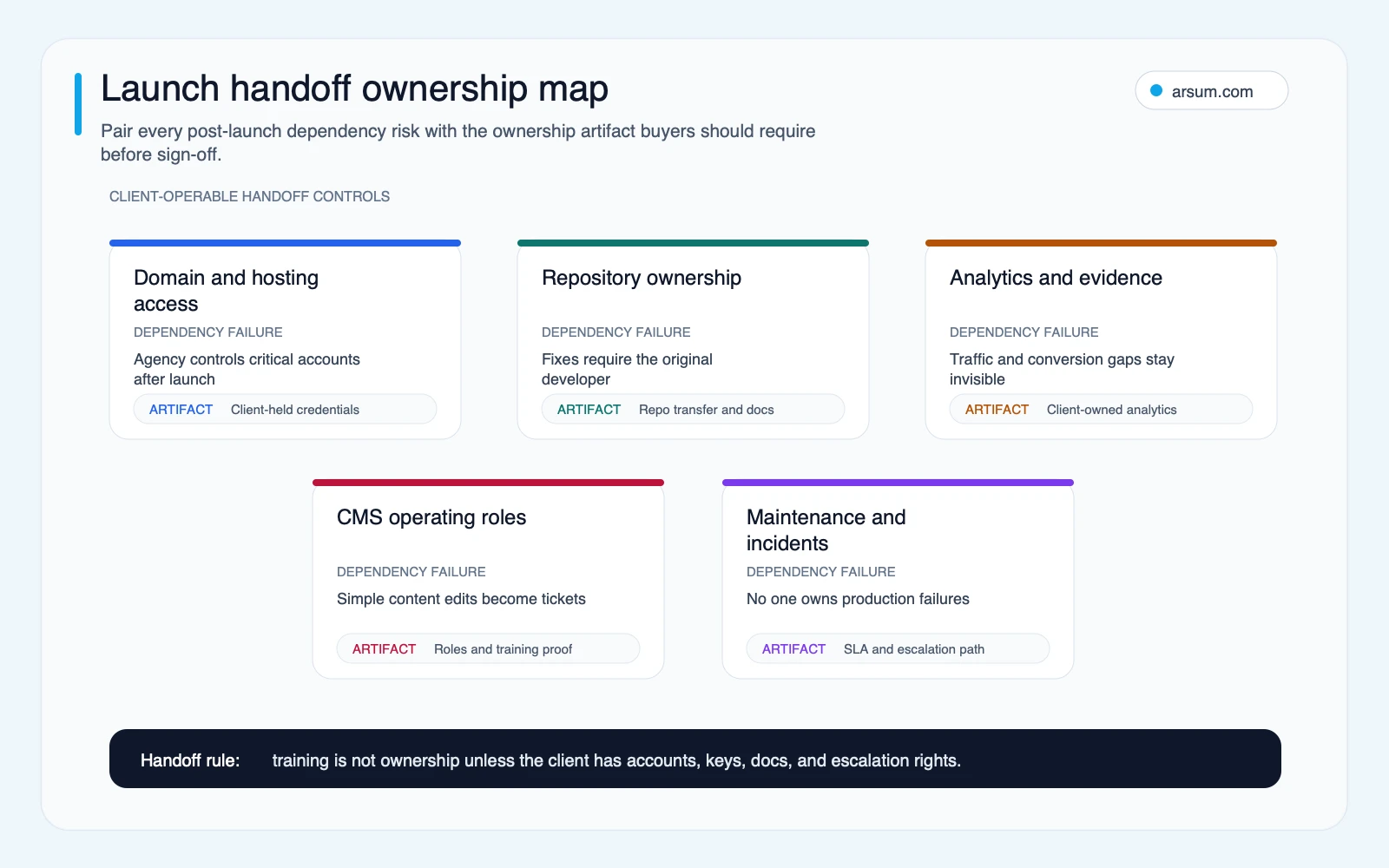
A finished site is not an operational handoff unless the client can access, operate, audit, and recover it.
Before launch approval, confirm ownership of:
- Domain registrar and DNS.
- Hosting, deployment, backups, and restore procedure.
- Source repository, design files, licenses, and environment documentation.
- Analytics, tag management, consent configuration, and key event definitions.
- CMS roles, publishing approvals, and content-edit workflow.
- API keys, credential rotation, secrets storage, and integration contacts.
- Maintenance responsibilities, response expectations, escalation contacts, and contract boundary.
Practitioner conversations include concerns about handing sites to non-technical clients without a workable editing path. Those comments are useful qualitative signals for this checklist, not a market-wide finding. The buyer’s test is more concrete: have a client operator complete a content change, find the relevant reporting, and follow the incident or rollback procedure before final acceptance.
Disqualifying conditions and common failure modes
Consulting should sometimes produce a decision not to build yet. Pause or narrow the project when:
- No business owner can define the workflow outcome or approve scope.
- The system of record, data access boundary, or consent basis is unresolved.
- The team cannot measure a baseline or name an acceptance metric.
- A consequential AI output has no human reviewer, exception route, or rollback path.
- The client will not own critical accounts, code, analytics, or credentials after handoff.
- The partner refuses to document exclusions, quality scope, or change control.
- Migration inventory, redirect ownership, and post-launch monitoring are deferred without a reasoned risk acceptance.
These conditions do not mean the initiative has failed. They mean the organization has not yet created the controls needed to fund it responsibly.
A good consulting partner makes this visible early. It may recommend a smaller pilot, a configuration-first approach, a purchase instead of a build, or a pause until ownership is resolved. That is more valuable than treating every ambiguous requirement as a reason to start development.
How to compare partners beyond price
Ask each prospective partner to respond to the same evidence-based prompts:
- What is the first workflow or operating outcome you will map?
- What will be delivered before build begins?
- Which systems are authoritative, and which integrations will be validated?
- What is automated, what requires approval, and what happens on exceptions?
- What acceptance criteria, test method, owner, and waiver path apply?
- What does the client own at handoff?
- What is the pilot’s stop condition and rollback procedure?
- Which assumptions could change the estimate?
A partner that answers with named artifacts, owners, and boundaries is giving you something evaluable. A partner that answers only with technology preferences, generic process language, or an early fixed estimate is leaving key decisions unresolved.
Methodology: this guide uses direct guidance from Google Search Central, web.dev, MDN, and OWASP, plus practitioner discussions as qualitative signals about vague scope and handoff concerns. The readiness and discovery scorecards, partner comparison, pilot scorecard, and ownership checklist are Arsum editorial decision tools. They are intended to help buyers audit a consulting engagement before work starts, not to provide universal benchmarks or predict outcomes.
Ready to Automate Your Business?
Stop wasting time on repetitive tasks. Let AI handle the busywork while you focus on growth.
Schedule a Free Strategy Call →Written by:Arsum editorial team
- Reviewed by
- Arsum editorial team
- Published
- June 27, 2026
- Updated
- July 6, 2026
- How this was produced
- Arsum uses research packs, source checks, and human editorial review to prepare and update blog articles. Editors are responsible for the final page.
- Source policy
- Sources are linked in the article when used. Methodology and source notes are included on higher-risk or high-visibility pages and are being rolled out across the archive. Editorial policy.
- Why this page exists
- Help B2B operators evaluate AI automation, implementation scope, cost, risk, and build-vs-buy decisions with practical context.