A team should hire custom AI agent development services when a workflow needs context-dependent decisions across business systems, but a simple no-code builder or deterministic automation cannot safely handle the exceptions. The buying decision is not “can a model do this?” It is whether you can define the data access, tool permissions, human approvals, evaluation set, owner, and rollback path required to operate it responsibly.
Custom AI Agent Development Services: Buyer Guide
Explore custom AI agent development services: compare workflow fit, costs, risks, evidence, and practical next steps before you build, buy, or hire.

Table of Contents
- What most guides miss: the agent is only one part of the operating system
- Choose the simplest architecture that can safely do the work
- The buy, build, or hire decision
- What a credible custom-agent engagement should deliver
- Use a pilot scorecard instead of promised outcomes
- Planning scope, cost, and timing without false precision
- Disqualifying conditions and common failure modes
- Questions to ask before signing
- A practical next step
What most guides miss: the agent is only one part of the operating system
A polished demo can show an agent classifying a request, retrieving a record, and drafting an action. That does not establish that it is ready to run inside your business.
The deciding question is: who owns the workflow when the agent is uncertain, wrong, unavailable, or presented with a case it was never evaluated against?
Custom development is justified only when the engagement produces an operating system around the model:
- A workflow map that identifies normal paths, exception paths, and handoffs
- Approved data sources and source lineage for each material output
- A permission map for every tool the agent can read from or write to
- Evaluation cases that represent the work you expect it to handle
- Human approval points for consequential actions
- Logs and traces that let an operator reconstruct a run
- A named owner for monitoring, model changes, prompt changes, and incident response
- A rollback path that returns work to the pre-agent process
This is why a custom agent should not be evaluated as a chatbot with integrations. OpenAI describes agents as systems that can use tools, coordinate multi-step work, and maintain state; that flexibility makes orchestration and controls part of the product, not implementation polish. OpenAI’s agent documentation is useful context for buyers assessing what an agent architecture actually introduces.
A recurring practitioner concern in public discussions is that demos hide the difficult parts: inconsistent data, changing authentication flows, unreliable integrations, edge cases, and the workload created by review queues. Those discussions are qualitative signals, not market statistics, but they point to a sensible procurement rule: do not fund autonomy before you have funded exception handling.
Choose the simplest architecture that can safely do the work
The word “agent” is frequently used for several different products. Start by separating them, because each has different costs, controls, and maintenance requirements.
Workflow automation
A workflow automation follows a known sequence: receive a form, validate fields, update a record, notify an owner, and create a task. It may use an LLM for extraction, classification, or drafting, but the process logic is defined in advance.
Use it when inputs are structured enough, the decision tree is stable, and exceptions can be routed to people. In many cases, agentic workflow automation is the better first move because it is easier to test and recover.
AI copilot
A copilot prepares information, recommendations, or drafts while a person remains responsible for the final action. It is a good fit when the work benefits from synthesis but the approval burden should remain with the employee.
Use it when an output affects a customer, payment, contract, regulated decision, or external communication and a human should review every instance.
Custom AI agent
A custom agent can choose between allowed steps at runtime: retrieve context, call a tool, assess the result, take another allowed action, or stop and escalate. That is valuable when cases vary enough that maintaining a complete ruleset is impractical.
Use it when the workflow has meaningful branching, cross-system context, and a designed exception queue. Do not use it merely because a workflow has more than one API call.
Embedded AI delivery team
An embedded team can be appropriate when you have a portfolio of workflows, internal engineering constraints, or a need to establish a reusable evaluation, observability, and governance foundation. This is a broader operating-model decision than buying a single agent.
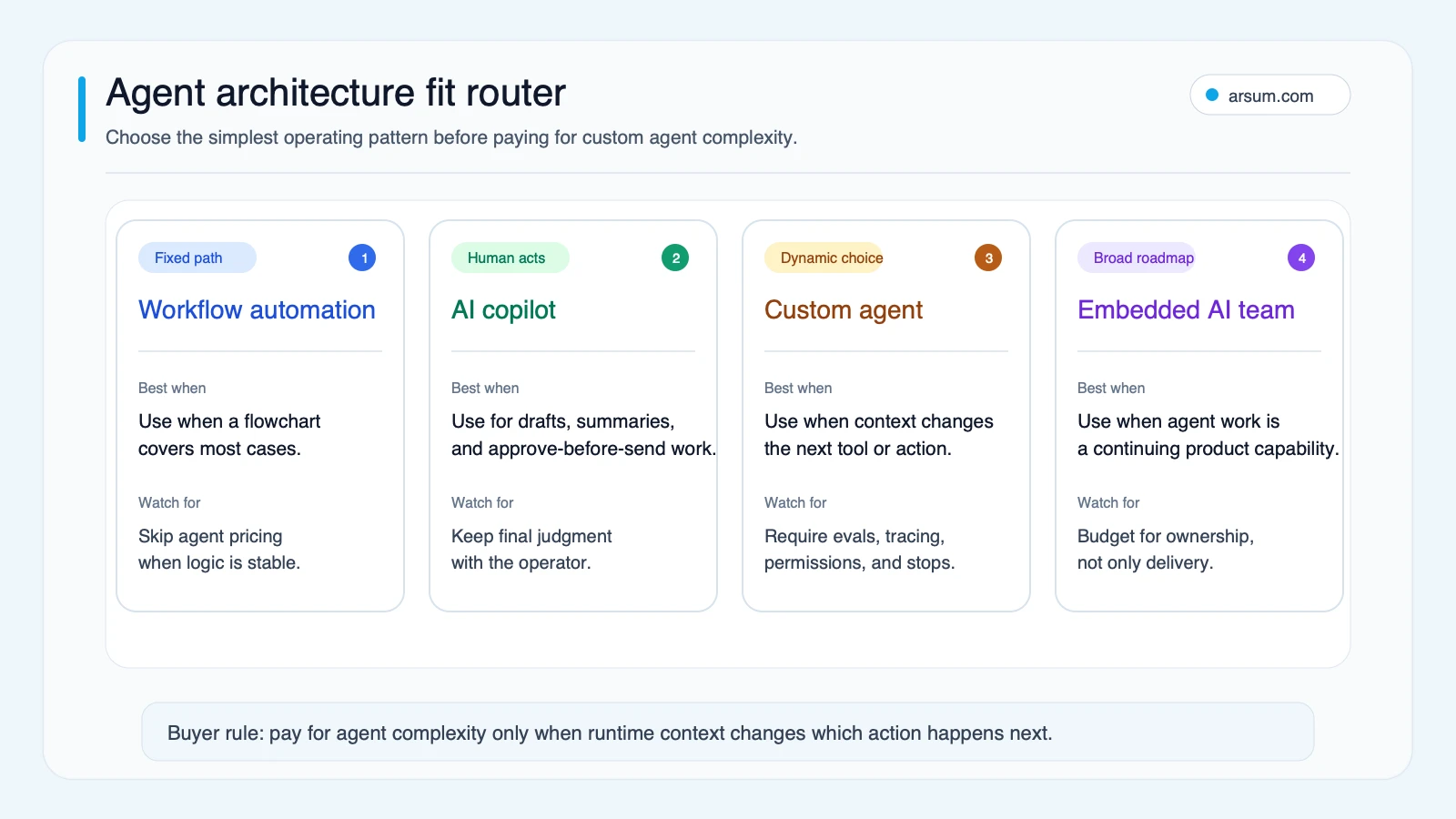
Use the router to eliminate unnecessary complexity before discussing models or frameworks.
| If this is true | Start with | Why |
|---|---|---|
| The path is known and reversible | Workflow automation | Fixed logic is easier to test, explain, and maintain |
| A person should approve every result | Copilot | Assistance is useful without delegating the action |
| The right next step depends on changing context across systems | Custom agent | Dynamic orchestration may be worth the additional controls |
| Several workflows need shared platform, security, and ownership standards | Embedded team or internal platform work | The problem is operating-model consistency, not one feature |
For a deeper look at the technical options, see AI agent architecture patterns and agentic AI frameworks compared. Framework selection should follow the workflow and control design; it should not be the starting point for procurement.
The buy, build, or hire decision
There is no universal answer. Use the decision below to make the tradeoff explicit.
| Path | Choose it when | You must still own | Weak fit when |
|---|---|---|---|
| No-code or low-code platform | The workflow is simple, connectors already exist, actions are reversible, and internal users can configure it | Data quality, permissions, exception handling, vendor configuration | You need complex business logic, unusual systems, sensitive permissions, or bespoke evaluations |
| Internal build | You already have engineering capacity, API access, security review processes, test infrastructure, and a long-term maintainer | Architecture, operations, incidents, model changes, vendor dependencies | The team lacks available owners or is building a one-off capability it cannot support |
| Custom AI agent development services | Business value depends on domain-specific orchestration, several systems, constrained permissions, or difficult exception handling | Workflow ownership, approvals, data access, acceptance decisions, ongoing business policy | The workflow is actually deterministic, has no owner, or cannot yet provide usable inputs |
| Off-the-shelf specialist software | The category is mature and its data model matches your process | Implementation, configuration, controls, user adoption | Your differentiator depends on proprietary process logic or fragmented internal systems |
A useful comparison is not “custom versus cheap.” It is:
- Can an existing product meet the workflow and control requirements?
- If not, can your internal team build and operate the missing capability?
- If not, is the workflow important enough to justify a partner who can deliver and document the system?
- Who will own it after delivery?
If the answer to the final question is unclear, pause. External development can accelerate implementation; it cannot permanently substitute for a business owner.
What a credible custom-agent engagement should deliver
A credible scope should be priced and reviewed as a set of operational deliverables, not as an open-ended promise to “build an agent.”
Discovery and workflow mapping
Discovery should identify:
- The trigger that starts the work
- Inputs, source systems, and source-of-truth records
- The normal path and known exceptions
- Decisions that may be automated, recommended, or must remain human-approved
- The measurable business outcome
- The team responsible for accepting or rejecting the pilot
Ask for a workflow map before committing to a build. It should show the handoff when the agent cannot proceed, not only the happy path.
Data and integration audit
The team should confirm whether each system can be accessed through an approved API, connector, file exchange, or controlled interface. It should document identity, authentication, rate limits, write permissions, data retention, and what happens when an integration fails.
An agent that can retrieve from a CRM but cannot reliably identify the right customer record is not ready for autonomous action. A data-quality problem should be treated as a scope constraint, not disguised as a prompting problem.
Permission and approval design
Every tool needs an explicit boundary:
- What may the agent read?
- What may it draft but not send?
- What may it write only after a human approval?
- What actions are prohibited?
- Who can change those policies?
- What evidence is retained for a review or incident?
OpenAI’s guidance covers automatic guardrails and human-in-the-loop approvals that can allow a run to continue, pause, or stop. Its guardrails and approvals guide is a useful primary-source reference for this pattern.
For financial, contractual, legal, customer-facing, or compliance-sensitive actions, capability is not authorization. High failure cost and low reversibility should reduce autonomy.
Evaluation, observability, and release criteria
A working prototype is not the acceptance criterion. The engagement should define:
- An evaluation set, its source, and who approves its labels
- Measurements for routing, extraction, policy adherence, and escalation
- In-threshold coverage: the portion of cases the agent is allowed to handle
- Trace retention for model outputs, tool calls, approvals, and failures
- Monitoring for cost, latency, errors, and anomalous tool use
- Release gates and a rollback procedure
OpenAI’s safety guidance specifically flags private-data leakage and unsafe tool or MCP exposure as risks that builders should address. Read the agent-builder safety guidance. OWASP also maintains agent-specific security guidance for systems that plan and act across workflows. OWASP’s Top 10 for Agentic Applications can help a security reviewer pressure-test the scope.
Post-launch ownership
The contract should distinguish implementation work from recurring operation.
Implementation responsibilities may include discovery, architecture, integration, evaluation design, security controls, deployment, and documentation. Recurring operating responsibilities may include model and tool usage, hosting, observability, alert response, evaluation maintenance, prompt or policy changes, integration maintenance, and periodic security review.
Clarify who owns:
| Responsibility | Buyer should name | Partner should define |
|---|---|---|
| Business outcome | Accountable functional leader | How reporting maps to the outcome |
| Workflow policy | Process owner | How policy becomes agent rules and approvals |
| Data access | System and data owner | Required interfaces and least-privilege design |
| Technical operation | Internal engineering or designated operator | Runbook, monitoring, and escalation procedure |
| Model changes | Accountable technical sponsor | Revalidation process before a material change |
| Exceptions | Queue owner and approver | Handoff context and evidence retained |
A vendor can maintain the system, but the buyer still needs accountable business and technical owners.
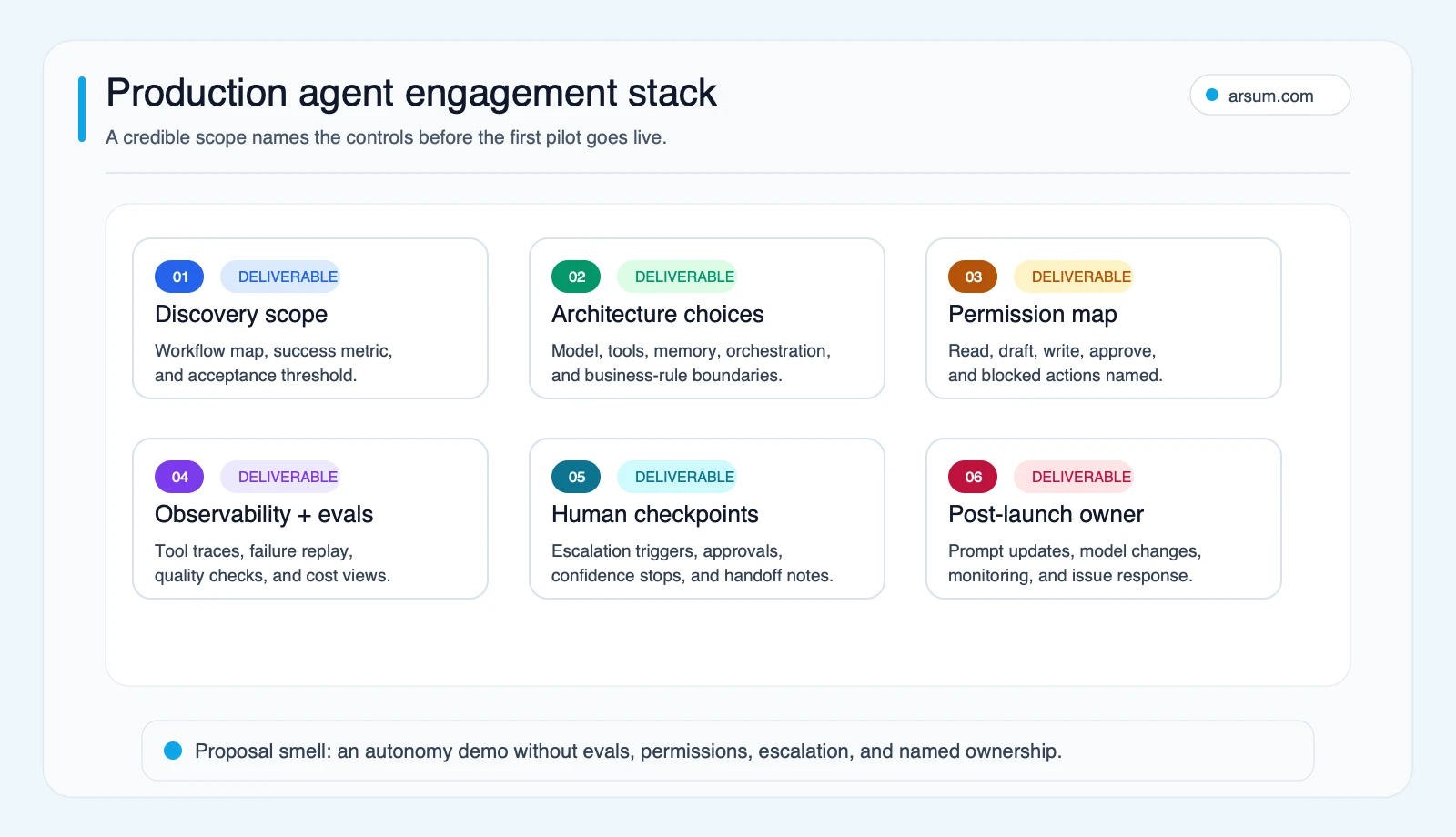
The production stack is a practical way to turn a broad services proposal into reviewable deliverables.
💡 Arsum builds custom AI automation solutions tailored to your business needs.
Get a Free Consultation →Use a pilot scorecard instead of promised outcomes
Do not accept a generic claim that an agent will save time, reduce cost, or operate autonomously. Build a pilot scorecard with the people who own the workflow.
The following is an illustrative planning template, not a benchmark or client result. Replace each field with your own measured baseline and approved target.
| Scorecard field | Illustrative planning input | Owner | Evidence retained |
|---|---|---|---|
| Workflow volume | Count eligible cases per week from the source system | Operations owner | Export or dashboard snapshot |
| Baseline handling time | Measure active human minutes per eligible case | Process analyst | Time-study method and sample definition |
| Eligible-case rate | Define the percentage of cases that meet input-quality and policy rules | Process owner | Eligibility rules and rejected-case reasons |
| Routing or task accuracy | Set a target against a labeled evaluation set | Quality owner | Labeled cases, scoring rubric, reviewer decisions |
| Escalation rate | Set an acceptable range rather than assuming zero escalation | Queue owner | Escalation reason codes and traces |
| Reviewer minutes per exception | Measure review effort separately from normal handling time | Team lead | Queue timestamps and sampling method |
| Unit cost | Calculate tool, model, infrastructure, and review costs per eligible case | Finance or technical owner | Usage records and cost allocation method |
| Rollback incidents | Define which failure types force the workflow back to manual handling | Technical sponsor | Incident record and rollback log |
A simple planning calculation can make the economics testable:
Illustrative planning assumption: weekly gross capacity value = eligible cases per week × (baseline human minutes − average human minutes after automation) ÷ 60 × fully loaded hourly cost. Net value must then subtract model, tool, infrastructure, vendor support, and reviewer costs. This is a planning model, not a realized-savings claim.
The important discipline is to include review cost. An agent that appears fast but routes a large share of difficult cases into an expensive review queue may not improve the workflow.
Acceptance gates for 30 and 60 days
Set gates before development begins.
At 30 days after controlled launch, review whether the workflow is operating only within the agreed permission boundary, whether evaluation results meet the target, whether exceptions are reaching the correct queue, and whether operators can understand the trace for sampled runs.
At 60 days, decide whether to expand, revise, hold, or roll back based on measured unit cost, quality, exception burden, unresolved incidents, and owner sign-off.
A reasonable stop condition might be: pause autonomous writes if a defined policy-breach category occurs, if traces are missing for material actions, or if the quality owner cannot verify results against the agreed evaluation method. The rollback path should route new work through the prior manual or deterministic workflow while the incident is investigated.
Planning scope, cost, and timing without false precision
A responsible vendor should not promise a universal implementation timeline or return before discovery. The work expands or contracts with the workflow, integration readiness, data access, evaluation scope, security requirements, procurement, and acceptance criteria.
For planning purposes, a narrowly bounded pilot may involve one workflow, one or two integrations, approved access, a defined evaluation set, and no unresolved procurement or security blockers. That is very different from connecting legacy systems, enabling external actions, handling regulated data, or building a platform for multiple business units.
Ask proposals to separate cost categories:
- Discovery and workflow mapping
- Integration and data-access work
- Agent orchestration and interface development
- Evaluation, red-team testing, and acceptance support
- Security review, identity, permissions, and audit logging
- Deployment and operational documentation
- Recurring model, tool, hosting, monitoring, and maintenance costs
- Change requests for new workflows, integrations, or policy changes
This makes comparison possible. A lower implementation estimate that excludes evaluation, monitoring, or post-launch ownership is not necessarily less expensive; it may simply move risk and effort to your team later.
For related budgeting questions, the cost of building an AI agent and AI automation pricing from a founder’s perspective offer useful framing. Use them to structure questions, not as a substitute for a workflow-specific scope.
Disqualifying conditions and common failure modes
Some workflows should not begin as autonomous-agent projects.
Disqualifying conditions
Pause or choose a simpler approach when:
- No functional leader owns the workflow outcome
- The process is not documented well enough to identify normal and exception paths
- Data access is not approved or source records are unreliable
- The desired action is irreversible and no approval model exists
- There is no safe fallback queue or manual process
- The team cannot provide representative cases for evaluation
- Nobody can own the system after launch
- The real need is a deterministic integration, reporting layer, or copilot
Failure modes to test before launch
Unrestricted tool access. The agent can perform actions broader than its task requires. Mitigate with least privilege, explicit approval gates, and separate read, draft, and write capabilities.
Prompt or tool manipulation. External content, user input, or tool output can influence the agent toward unsafe behavior. Treat untrusted content as data, constrain tool behavior, and test adversarial cases.
Silent source drift. A knowledge base, policy, CRM field, or integration changes while the agent continues to act as if it has reliable context. Track source lineage and set review triggers for material changes.
Evaluation blindness. The team tests compelling examples but not difficult, incomplete, conflicting, or policy-sensitive cases. Require an approved eval set and keep adding failure-derived cases.
Exception-queue overload. The agent technically works but creates too much reviewer work. Measure reviewer minutes and escalation reasons, not just completed runs.
Model-change regression. A provider, prompt, model, tool, or policy update changes behavior. Revalidate against the acceptance set before expanding permissions.
These risks do not mean agents are unsuitable. They mean autonomy should be designed as a controlled operating choice.
Questions to ask before signing
Use these questions to compare vendors on evidence rather than presentation quality.
- What workflow would you recommend we automate first, and why is a deterministic workflow or copilot insufficient?
- What discovery artifacts will we receive before implementation begins?
- Which systems will the agent access, and what can it read, draft, write, or send?
- Which actions require human approval, and who is the approver?
- How will you define the evaluation set and score quality?
- What trace will an operator see when the agent calls a tool, fails, or escalates?
- What conditions stop autonomous actions immediately?
- What is the rollback path, and who activates it?
- What recurring operating costs exist beyond implementation?
- Who owns prompts, policies, integrations, model changes, evaluations, and incident response after launch?
- Which assumptions in your proposal depend on our data access, security review, or procurement approval?
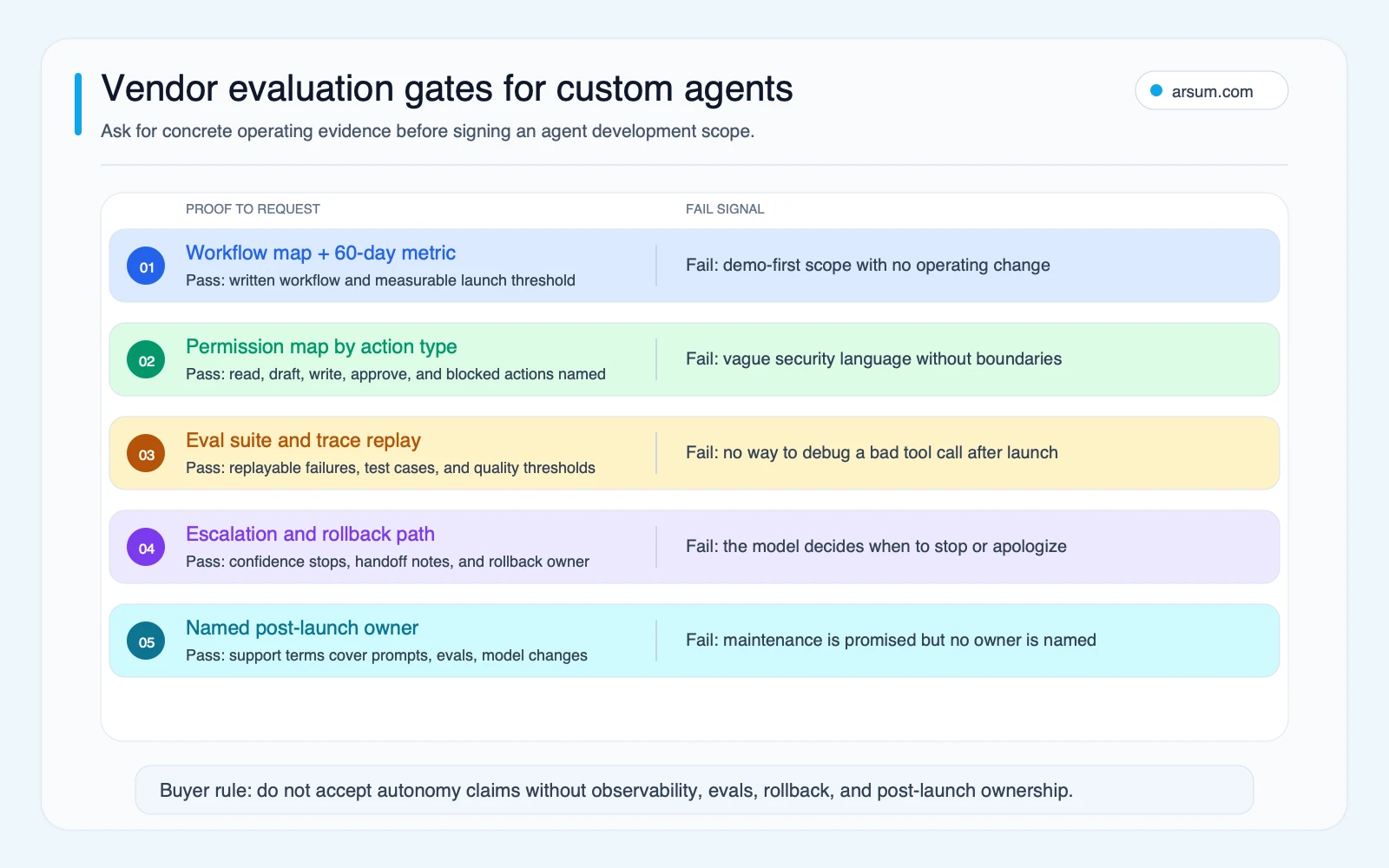
A vendor should be able to answer these questions with scope artifacts, control design, and acceptance criteria—not only a demo.
If you are deciding between an individual hire and an external team, hiring an AI developer versus an agency provides a useful companion comparison. For broader implementation planning, see AI implementation services and AI agent security considerations.
A practical next step
Start with one workflow that has measurable volume, a named owner, accessible source systems, and a safe exception route. Document the baseline, decide the permission boundary, assemble representative cases, and agree on the 30- and 60-day acceptance gates before selecting a builder or partner.
An Arsum workflow assessment can produce a workflow map, build-buy recommendation, permission boundary, acceptance scorecard, and ownership model for the people responsible for operations, technology, risk, and budget.
Ready to Automate Your Business?
Stop wasting time on repetitive tasks. Let AI handle the busywork while you focus on growth.
Schedule a Free Strategy Call →Written by:Arsum editorial team
- Reviewed by
- Arsum editorial team
- Published
- June 3, 2026
- Updated
- July 6, 2026
- How this was produced
- Arsum uses research packs, source checks, and human editorial review to prepare and update blog articles. Editors are responsible for the final page.
- Source policy
- Sources are linked in the article when used. Methodology and source notes are included on higher-risk or high-visibility pages and are being rolled out across the archive. Editorial policy.
- Why this page exists
- Help B2B operators evaluate AI automation, implementation scope, cost, risk, and build-vs-buy decisions with practical context.