For founders and operators, the future of agentic AI over the next 18 months is not full autonomy across the business. It is a practical decision about which bounded workflows can safely use AI to gather information, take permitted actions, route exceptions, and leave an evidence trail—without moving hidden review work or risk downstream.
Future of Agentic AI for Business
Explore future of agentic AI: compare workflow fit, costs, risks, evidence, and practical next steps before you build, buy, or hire.

Table of Contents
- What Most Guides Miss: Capability Is Not Authorization
- Use an ROI Filter Before You Evaluate Platforms
- What Breaks Between a Demo and Production
- Build, Buy, or Configure: Make the Tradeoff Explicit
- The 18-Month Readiness Framework
- Pilot, Govern, or Defer
- Failure Modes Worth Funding Against
- A 30-Day Acceptance Plan
- What to Do This Quarter
The useful planning horizon is therefore shorter and more concrete than most trend forecasts: identify a workflow that is repetitive, measurable, and reversible; prove that its controls work with live-like cases; then decide whether to expand, configure a platform, or stop. Official guidance from AWS on operationalizing agentic AI, Google Cloud’s agentic AI architecture overview, and the OpenAI Agents guide all point to the same operational concern: agents need architecture, evaluation, governance, and accountable ownership around the model.
What Most Guides Miss: Capability Is Not Authorization
An agent can be technically capable of reading a document, updating a record, drafting a response, or calling a tool. That does not mean the business should authorize it to do so without review.
The decision changes when you separate three levels of work:
| Level | Agent role | Appropriate boundary |
|---|---|---|
| Assist | Finds, summarizes, drafts, and prepares work | Human owns the decision and external action |
| Recommend | Produces a proposed classification, route, or next step | A named approver accepts or rejects material cases |
| Execute | Takes an action in a business system | Only for tightly scoped, logged, reversible actions with defined escalation |
That distinction is especially important when a workflow touches money, customer records, legal commitments, regulated decisions, or production systems. In those cases, technical capability should reduce the need for manual preparation—not erase business accountability.
NIST’s AI Risk Management Framework provides a useful lens: govern the risk in context rather than treating a model’s output as a self-validating answer. For an operator, that means documenting the allowed action, the required evidence, the approver, and the recovery path before a pilot begins.
A simple rule follows: increase autonomy only when the action is easy to reverse, the outcome is easy to validate, and the process owner can explain why the agent acted.
Use an ROI Filter Before You Evaluate Platforms
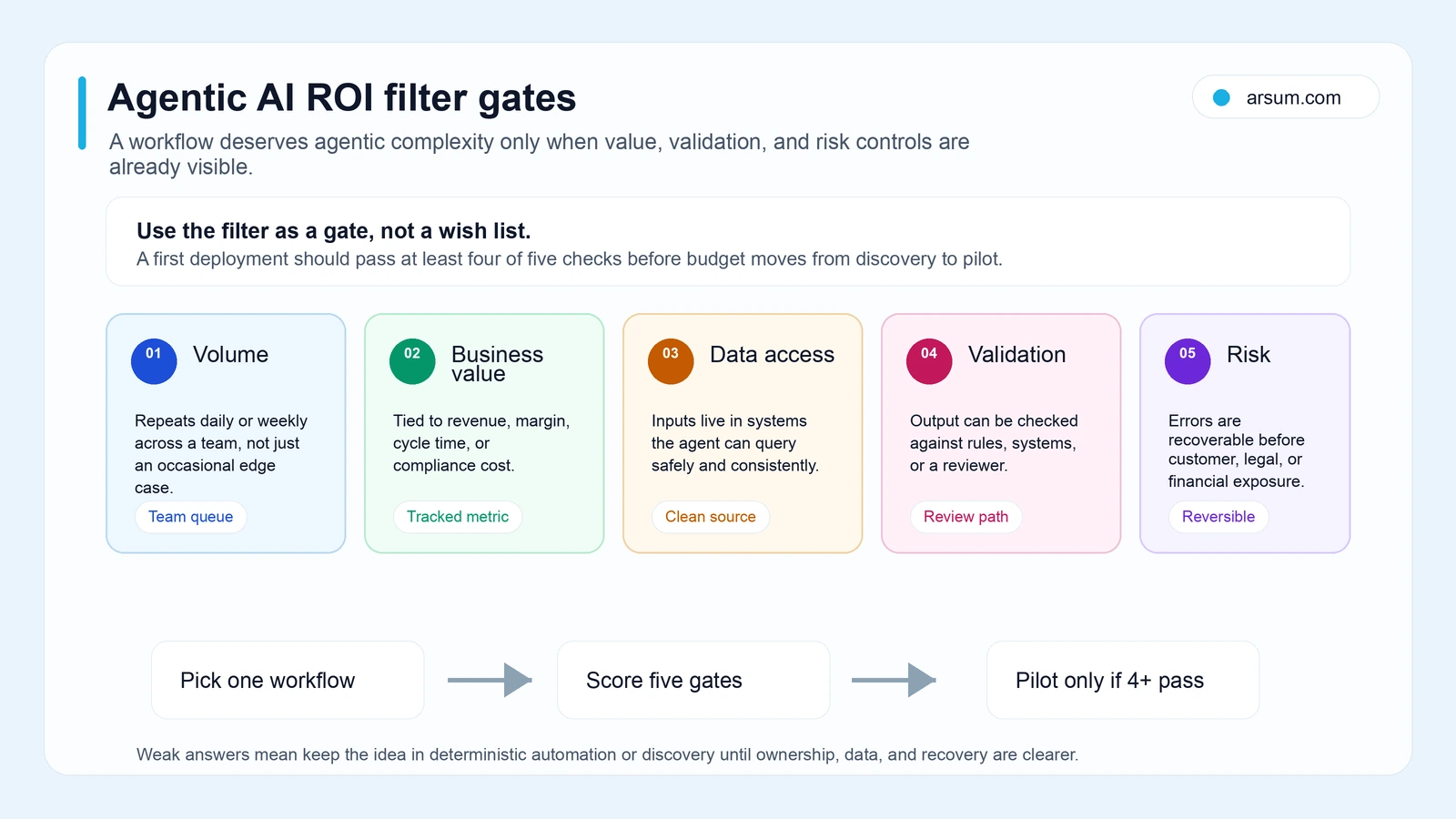
The first question is not “which agent framework should we use?” It is “does this workflow deserve an agent at all?”
Score a candidate workflow against these gates.
| Gate | Questions to answer | Pass condition |
|---|---|---|
| Volume | How many cases occur each week or month? | Enough repeated work to justify setup and review design |
| Value | What current metric changes if the process improves? | A measurable labor, cycle-time, revenue, service, or risk outcome |
| Data access | Which systems hold the required inputs? | Access is documented, permitted, and technically feasible |
| Validation | How will the output be checked? | Rules, source records, or a qualified reviewer can verify it |
| Exceptions | What does a non-standard case look like? | Known exceptions have a route, owner, and queue |
| Recoverability | What happens after an incorrect action? | The action can be reversed or is held for approval |
| Ownership | Who accepts pilot results and owns incidents? | One business owner is explicitly named |
A workflow does not need to be perfect to qualify. It does need to be legible. If no one can describe the normal path, the top five exceptions, and the definition of done, improve the process before adding an agent.
Worked example: compliance-document intake
Consider a compliance team receiving documents for customer onboarding. The agent’s job is not to approve a customer. Its bounded job is to:
- Read an intake queue.
- Classify the document type.
- Extract required fields into a review record.
- Check whether required documents are present.
- Flag missing, unreadable, conflicting, or out-of-policy cases.
- Prepare a reviewer packet with source links and confidence notes.
The pilot scorecard can look like this:
| Scorecard field | Illustrative planning assumption |
|---|---|
| Baseline volume | 400 intake packages per month |
| Current process | 18 minutes of analyst handling per package before approval review |
| Baseline to measure | Median cycle time, analyst minutes per package, rework rate, and exception volume |
| Agent boundary | Classification, extraction, completeness check, and draft review packet only |
| Approval owner | Compliance operations manager |
| Evidence retained | Original document reference, extracted fields, tool calls, reviewer decision, correction reason |
| Review cadence | Weekly sample review plus incident review within one business day |
| Target | Reduce preparation time while maintaining or improving the baseline reviewer-accepted rate |
| Stop condition | A material control failure, unexplainable extraction pattern, or exception backlog that the owner cannot absorb |
| Rollback path | Disable write actions, return packages to the existing queue, and retain pilot traces for review |
The arithmetic should be treated as a planning model, not a promised result. If preparation time is 18 minutes across 400 packages, the baseline is 120 analyst hours per month before accounting for rework. A pilot must also measure the new review minutes, corrections, and incident-handling time. The economic case is only real if avoided preparation work exceeds added review and operating cost.
This is the difference between a capability demonstration and a business case. For related workflow design, see agentic AI workflow automation and AI automation ROI examples.
What Breaks Between a Demo and Production
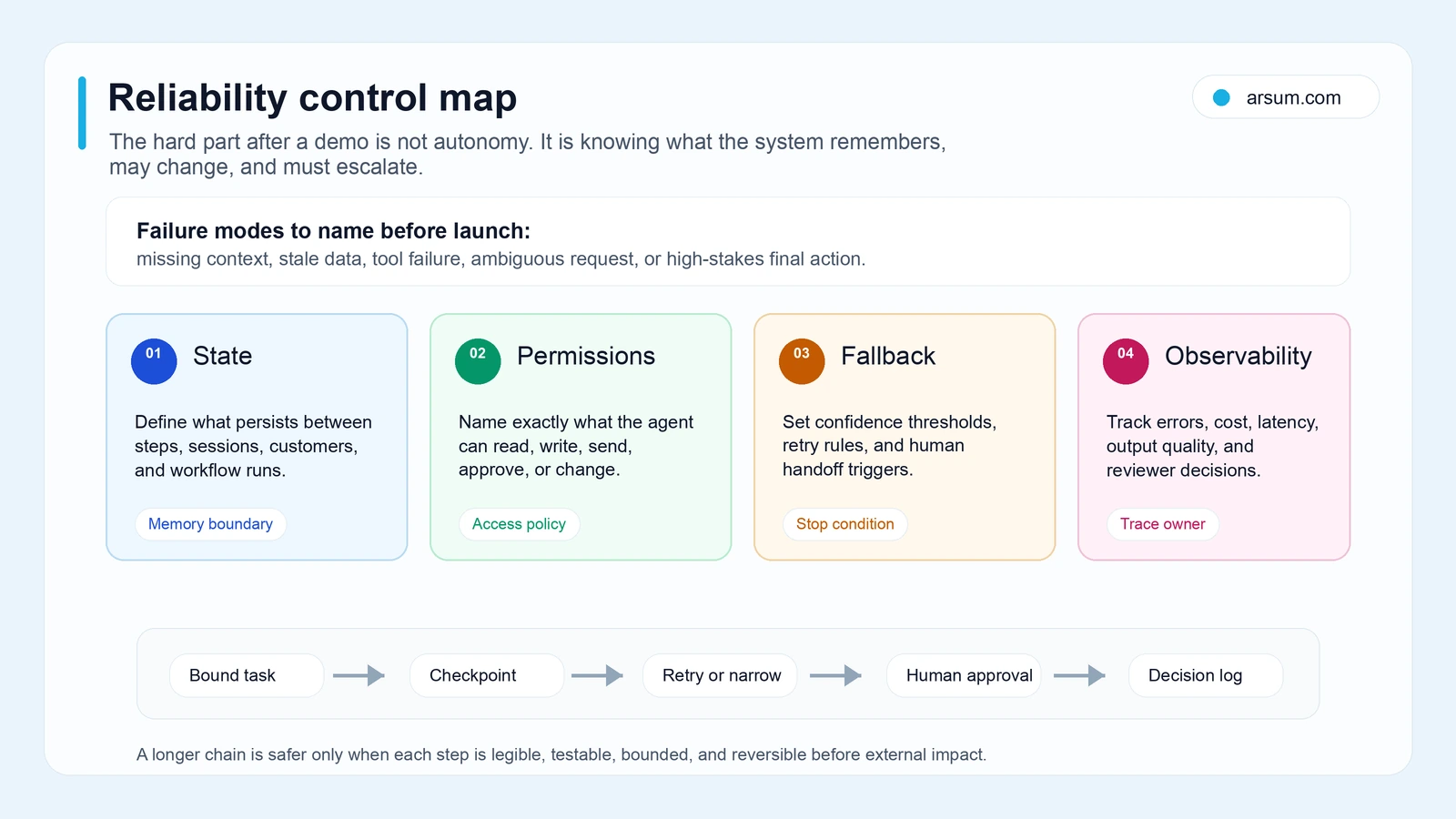
A demo usually has clean inputs, a short happy path, and a person watching closely. Production adds stale data, ambiguous requests, tool outages, permission errors, missing documents, conflicting records, and users who expect the system to know when it should stop.
OpenAI’s tracing documentation describes traces that can include model generations, tool calls, handoffs, guardrails, and custom events. That is a useful implementation requirement, not merely a developer feature. If a business cannot reconstruct the sequence behind a consequential result, it cannot reliably investigate an incident or improve the workflow.
The production-readiness checklist
Before enabling an agent beyond a controlled pilot, define:
- State: What task information persists between steps, and when does it expire?
- Source lineage: Which records, documents, and system responses informed the result?
- Tool contract: What can each tool read, write, send, or change?
- Permission scope: Which identity is used, and what is explicitly prohibited?
- Validation: Which outputs are automatically checked, sampled, or always reviewed?
- Fallback: What failure triggers a human handoff rather than another agent attempt?
- Rollback: How are changed records reversed, queued, or isolated?
- Observability: Who sees traces, error trends, latency, and exception backlog?
- Owner: Which process leader decides whether the system expands, narrows, or stops?
Qualitative practitioner discussions reinforce these operator concerns. A Hacker News discussion about monitoring production agents and a discussion of production-agent scaffolding are not survey evidence, but they reflect recurring questions about reconstructing actions, handling context, and securing tool use. Treat those discussions as failure-mode prompts, not proof of market-wide adoption or failure rates.
Build, Buy, or Configure: Make the Tradeoff Explicit
The future of agentic AI will include more platforms, prebuilt connectors, model-routing options, and orchestration tools. That lowers the cost of experimentation, but it does not remove the decision about where your organization should own the workflow.
| Decision factor | Buy a product | Configure a platform | Build a narrow custom workflow |
|---|---|---|---|
| Workflow uniqueness | Standard process with limited differentiation | Mostly standard, with a few business-specific rules | Core process has unique rules, queues, or decision logic |
| Integrations | Vendor supports required systems directly | Connectors exist but need controlled setup | Integrations, data flows, or tool contracts are proprietary |
| Data residency and access | Vendor terms and controls meet requirements | Platform can meet policy with correct configuration | Requirements demand specific infrastructure or isolation |
| Auditability | Vendor evidence is sufficient for the use case | Shared tracing plus custom evidence design | Full control over logs, records, retention, and review design |
| Portability | Acceptable dependence on vendor workflow and model choices | Moderate portability through interfaces and separation | Higher ownership, but more maintenance responsibility |
| Operating ownership | Business team can administer within vendor limits | Internal product or automation owner can run it | Engineering and process owners can support lifecycle changes |
| Time to first pilot | Often fastest | Fast when systems and roles are known | Slower, justified only by a meaningful workflow need |
| Ongoing cost | Subscription and implementation services | Platform usage plus internal operating time | Engineering, infrastructure, model, monitoring, and support cost |
Choose “buy” when the workflow is genuinely standard and the vendor can demonstrate required controls. Choose “configure” when the process is mostly standard but needs your permissions, evidence model, and system connections. Choose “build” when the workflow logic or data boundary is strategic enough that vendor constraints would create unacceptable operating risk.
Do not mistake multi-agent design for maturity. Google Cloud documents single-agent and multi-agent architecture patterns, but the right architecture is the smallest one that can complete the bounded workflow. Add another agent only when it has a clear role, distinct tool scope, and measurable benefit over a simpler flow.
For framework tradeoffs, review agentic AI frameworks compared before committing to implementation assumptions. For system design patterns, AI agent architecture patterns is a useful companion.
💡 Arsum builds custom AI automation solutions tailored to your business needs.
Get a Free Consultation →A useful workflow assessment should produce a process map, an exception inventory, a control design, pilot economics, and a build-buy-configure recommendation—not a generic agent roadmap.
The 18-Month Readiness Framework
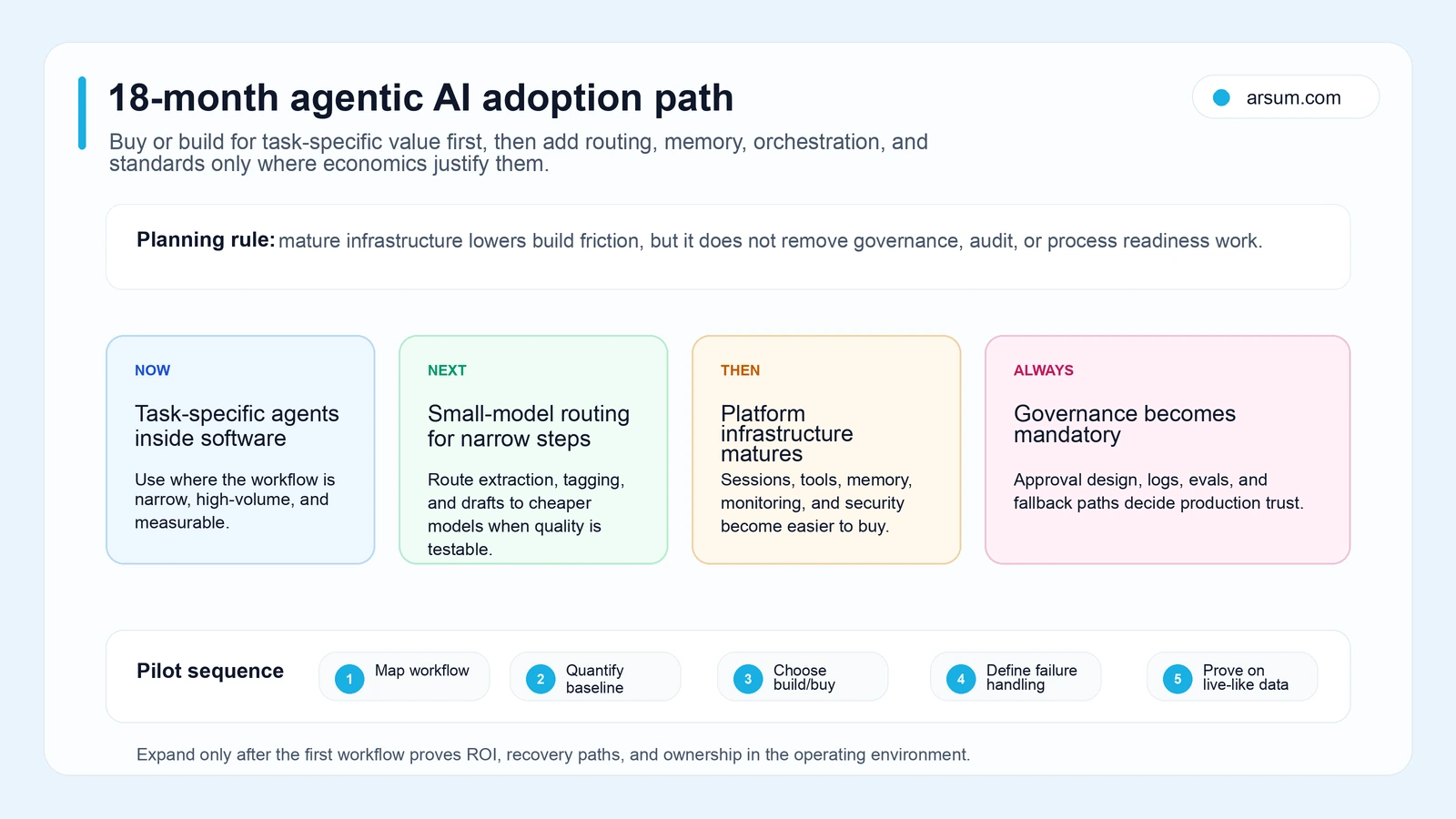
The next 18 months are best treated as directional changes in what becomes easier to implement, not as guaranteed outcomes. The pace will depend on model quality, integration maturity, vendor controls, internal data readiness, and applicable obligations.
| Directional change | What it means operationally | Pilot now | Wait or constrain |
|---|---|---|---|
| Smaller-model routing | Repeated classification, extraction, tagging, and routing steps may use narrower models where outputs are easy to validate | Low-risk, high-volume steps with clear checks | Policy interpretation, sensitive judgment, or irreversible decisions |
| Better agent infrastructure | Tracing, tool execution, session handling, and guardrails are increasingly productized | One workflow needing visible trace review | Broad rollout before ownership and evidence requirements are settled |
| More multi-agent patterns | Tasks can be split across specialist roles and handoffs | Clear handoffs with bounded tools | Overlapping roles or workflows that change case by case |
| Memory and retrieval | Agents can use controlled prior context and knowledge sources | Time-bounded retrieval with retention rules | Persistent memory where stale context could alter customer, legal, or pricing outcomes |
| Governance emphasis | Risk, approvals, logging, and accountability move into implementation design | Any workflow with customer, financial, legal, or production impact | Autonomous action where evidence and rollback are not defined |
NVIDIA Research argues in “Small Language Models are the Future of Agentic AI” that smaller models can be suitable for many agentic-system calls. The operational implication is not “replace frontier models everywhere.” It is to route bounded, repeatable steps to the least complex option that meets the validation requirement, while reserving stronger models or human review for ambiguity and high-consequence judgment.
The related research paper supports treating model size as an architecture tradeoff rather than a simple race toward larger systems. Test model routing against your actual cases, including edge cases—not only a curated demo set.
Pilot, Govern, or Defer
Use this decision tool before allocating implementation budget.
Pilot now
Run a bounded pilot when all of the following are true:
- The workflow occurs often enough to measure.
- Inputs are accessible through approved systems.
- A business owner can define success and exceptions.
- Outputs can be checked by rules or reviewers.
- Incorrect actions are reversible or held for approval.
- The team can review traces and exception patterns weekly.
Examples may include document-intake preparation, account-research packets, internal ticket routing, or structured data extraction. These are not automatically good use cases; they qualify only when their local data, controls, and economics pass the scorecard.
Govern before expansion
Do more control design before expanding when the agent will touch customer records, money movement, regulated decisions, contractual language, or production changes. AWS’s guidance on governing and architecting agentic AI at scale is useful here because it frames the challenge as managing diverse agents across teams and use cases, rather than adding a governance layer after deployment.
Require:
- Named approval thresholds
- Least-privilege credentials and tool scopes
- Retained decision records
- Incident ownership and response procedure
- Periodic evaluation against representative workflow cases
- A documented way to suspend or revert actions
Defer and redesign
Defer the agent when success criteria shift with every case, source data is unreliable, the exception path lives only in individual judgment, or a mistake cannot be safely undone. The right next step may be process documentation, data cleanup, or conventional automation—not an agent.
A simpler system can be the better business decision. If a fixed rule, form, integration, or generative drafting step solves the bottleneck, do that first. The distinction between agentic AI and generative AI helps prevent unnecessary complexity.
Failure Modes Worth Funding Against
The recurring implementation failures are usually operational, not mystical model failures.
| Failure mode | What it looks like | Control response |
|---|---|---|
| Scope creep | A narrow pilot becomes a general assistant with unclear permissions | Freeze the task boundary and add new actions only through change review |
| Silent source failure | The agent proceeds with stale, incomplete, or conflicting data | Record source status and route missing or conflicting inputs to review |
| Hidden review cost | Automation saves preparation time but creates long correction queues | Measure reviewer minutes and exception backlog beside agent throughput |
| Permission overreach | A tool can make changes broader than the workflow needs | Use least-privilege access and approval gates for external actions |
| Memory contamination | Old or irrelevant context affects a new case | Set retention, retrieval, and deletion rules; test with stale-context cases |
| Vendor lock-in | Workflow logic and evidence records cannot move | Separate business rules, data contracts, and exportable logs where practical |
| No accountable owner | Engineering owns the code but no one owns business acceptance | Name a process owner with authority to stop or expand the pilot |
Security conversations in communities such as r/AskNetsec are qualitative signals, but they raise a sound design question: are current permissions, secrets handling, and audit controls adequate when software can choose and execute tool calls? Answer that question in the workflow design, not after a production incident.
A 30-Day Acceptance Plan
A 30-day pilot is not a universal implementation schedule. It is a useful review cadence when a team can run enough representative cases to make a decision. Adjust the period for your workflow volume and risk.
| Review point | Required evidence | Decision |
|---|---|---|
| Before launch | Baseline metrics, test cases, permissions, exception taxonomy, rollback procedure, named owner | Approve a constrained pilot or return to process design |
| Weekly | Throughput, reviewer minutes, accepted outputs, corrections, trace samples, exceptions, incidents | Adjust scope, prompts, rules, or escalation thresholds |
| End of pilot | Comparison to baseline, review-cost change, quality trend, control performance, owner recommendation | Expand one boundary, continue learning, redesign, or stop |
The acceptance decision should not depend on a single automation-rate number. Review the entire operating result:
- Did cycle time improve on eligible cases?
- Did preparation time fall after including review work?
- Did quality meet the owner’s agreed threshold?
- Were exceptions detected and routed correctly?
- Could the team reconstruct each consequential action?
- Did any incident exceed the predefined tolerance?
- Can the organization support the workflow without an exceptional level of manual intervention?
If the answer is mixed, narrow the workflow rather than forcing scale. A useful pilot produces a reliable no-go decision as well as a viable production path.
What to Do This Quarter
Start with one workflow assessment, not a platform procurement exercise.
- Map the current path from trigger to completed outcome.
- Capture the normal path, the top exceptions, systems involved, and approval points.
- Establish a baseline for time, queue age, rework, quality, and incident exposure.
- Apply the ROI filter and identify the smallest permitted agent boundary.
- Choose buy, configure, or build based on integration ownership, controls, portability, and operating capacity.
- Define trace retention, review cadence, stop conditions, and rollback before launch.
- Run representative cases, including known ugly exceptions.
- Expand only when the accountable owner accepts both the business result and the control result.
For teams deciding whether external support is appropriate, agentic AI consulting services and agentic AI development services outline the kinds of planning and implementation work that should be scoped explicitly.
The future of agentic AI belongs less to organizations that chase broad autonomy and more to those that can operate bounded automation as accountable workflow infrastructure. The immediate question is not whether to wait for a perfect agent platform. It is whether one specific workflow is ready to be measured, controlled, and tested.
Ready to Automate Your Business?
Stop wasting time on repetitive tasks. Let AI handle the busywork while you focus on growth.
Schedule a Free Strategy Call →Written by:Arsum editorial team
- Reviewed by
- Arsum editorial team
- Published
- February 17, 2026
- Updated
- July 6, 2026
- How this was produced
- Arsum uses research packs, source checks, and human editorial review to prepare and update blog articles. Editors are responsible for the final page.
- Source policy
- Sources are linked in the article when used. Methodology and source notes are included on higher-risk or high-visibility pages and are being rolled out across the archive. Editorial policy.
- Why this page exists
- Help B2B operators evaluate AI automation, implementation scope, cost, risk, and build-vs-buy decisions with practical context.