Generative AI consulting services are worth paying for when they turn a defined business workflow into a controlled operating system: clear inputs, an evaluation method, human approval where consequences are material, measured operating costs, and a team that can own the result after handoff. They are not simply strategy sessions or polished demos; the useful engagement is the one that helps you decide whether to pause, buy, connect existing tools, or build a narrow workflow that can survive production.
Generative AI Consulting Services: Buyer Guide
Explore generative AI consulting services: compare workflow fit, costs, risks, evidence, and practical next steps before you build, buy, or hire.

What separates generative AI engagements that ship from ones that stall at the PoC stage.
Table of Contents
- What most guides miss: you are buying a production decision, not a model demo
- Choose the engagement scope that matches your readiness
- What a credible proposal should prove
- Measure net value before you discuss ROI
- Price the work as a budget model, not a market-rate claim
- Where engagements fail—and how to make failure visible early
- A pilot roadmap with decision gates
- Questions to ask before signing
- Sources and methodology
- The bottom line
What most guides miss: you are buying a production decision, not a model demo
A model can draft, summarize, classify, retrieve information, or propose the next action. That does not make it authorized to take that action. The buyer decision is whether a consultant can help your organization create a reliable workflow around those capabilities.
That distinction matters most after the demo. A production workflow needs a source of truth, a permission boundary, an exception path, an accountable business owner, monitoring, and a way to revert safely when the workflow changes or fails. NIST frames AI risk work around governing, mapping, measuring, and managing risk—not simply selecting a model. The NIST AI Risk Management Framework and its Generative AI Profile are useful procurement references because they make those operating questions visible.
Use this decision rule before comparing providers:
Do not fund implementation until one accountable owner can name the workflow baseline, the approval boundary, the failure owner, and the evidence required to call the pilot successful.
If nobody can name those things, advisory work may be useful. If the data, evaluation set, and ownership are already in place, you may be ready for a production-focused engagement. If an existing product already solves the workflow with acceptable controls, buying and configuring it may be the better choice.
Choose the engagement scope that matches your readiness
Generative AI consulting is a recognized category spanning planning and implementation, but proposals can bundle very different work under the same label. Gartner’s market category is a reminder to inspect the actual delivery scope rather than compare labels.
| Engagement scope | Use it when | Deliverables to expect | Do not accept |
|---|---|---|---|
| Advisory and prioritization | Leadership needs a business case, workflow ranking, or risk framing | Process inventory, opportunity criteria, risk register, build/buy recommendation | A list of use cases with no baseline or owner |
| Discovery and prototype | The workflow looks promising but data access, quality thresholds, or user acceptance are unknown | Process map, evaluation-set specification, prototype, pilot scorecard, go/no-go gate | A demo evaluated only by stakeholder reaction |
| Production implementation | The workflow, systems, reviewer pool, and launch owner are known | Architecture, integrations, access controls, test evidence, runbook, training | “Production-ready” without monitoring or recovery procedures |
| Governance and handoff | The organization needs operating controls and internal ownership | Approval matrix, audit-log design, incident process, documentation, transition plan | Documentation delivered at the end with no client participation |
| Managed optimization | Ongoing model changes, data changes, exception analysis, and operating reviews need an owner | Service-level responsibilities, monitoring cadence, change-control process, cost reporting | An open-ended retainer without a decision cadence |
A consultant may cover more than one phase, but each phase should have a distinct acceptance gate. That is the difference between a scoped delivery path and a broad promise to “transform” the organization.
For adjacent decisions, compare AI consulting services with AI implementation services, and use hiring an AI developer versus an agency when the question is internal hiring versus an external delivery team.
A quick fit check before vendor calls
| Check | Pass signal | Pause signal |
|---|---|---|
| Workflow boundary | A repeatable job has defined inputs, outputs, users, and exceptions | “Build an assistant that can help with anything” |
| Business baseline | Current volume, time, error/rework, and escalation path are known | Success is described only as “more AI” |
| Data access | The permitted sources, retention rules, and access owner are known | Teams assume production data will be available later |
| Review boundary | The system may draft or recommend; an authorized person approves consequential actions | The model is expected to approve, release, pay, deny, or commit on its own |
| Recovery | Retry rules, escalation owner, and rollback path are documented | The model decides when and how to recover |
| Handoff | An internal owner can attend design and acceptance reviews | Ownership starts after the consultant leaves |
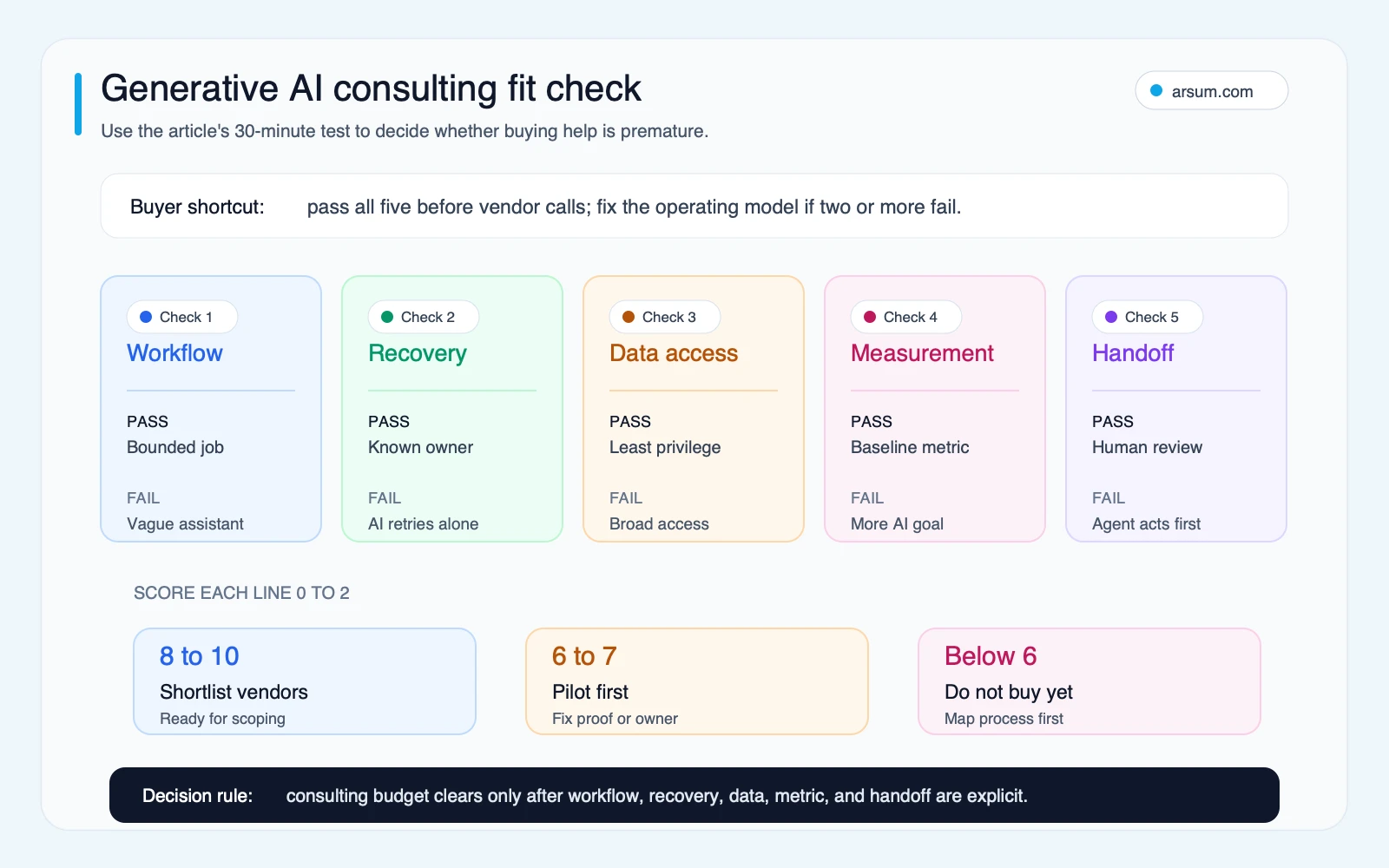
If two or more rows are unclear, spend on discovery or operating-model work before a full build. That is not a rejection of AI; it is a way to avoid treating technical capability as business authorization.
What a credible proposal should prove
A useful proposal does more than describe an architecture. It identifies what evidence will exist at each decision point.
| Scorecard criterion | Buyer question | Evidence to request |
|---|---|---|
| Problem clarity | Is this a measurable workflow rather than a general ambition? | Process map, user group, baseline period, volume definition, current exception path |
| Proof standard | What counts as correct, safe enough, or useful enough? | Evaluation-set specification, labeled examples, scoring method, acceptance threshold, kill criteria |
| Architecture fit | How will the system interact with data and tools? | System diagram, source lineage, tool allowlist, access matrix, fallback behavior |
| Risk controls | What happens when inputs are malicious, incomplete, or outside policy? | Threat model, prompt-injection test plan, approval matrix, audit-log design, incident runbook |
| Handoff | Who operates it when the engagement ends? | Monitoring dashboard, runbook, model-change procedure, transition plan, named client owner |
This is the practical version of the consulting engagement scorecard: compare evidence, not vocabulary.
For retrieval and tool-using applications, ask which parts are deterministic and which are model-mediated. Retrieval, tool use, and agent patterns can all be appropriate, but each adds a different control problem. AI agent architecture patterns and AI agent security can help a technical sponsor turn that distinction into review questions.
Procurement controls for consequential workflows
For workflows touching customer records, financial data, regulated processes, or operational commitments, require explicit answers to the following:
- Data classification: Which fields may enter prompts, retrieval indexes, logs, and evaluation sets?
- Provider terms: What are the data-use, retention, residency, encryption, and administrative-access terms? Check the provider’s current documentation; for example, OpenAI’s business data overview and API data controls guide describe controls buyers should validate for their own architecture and agreement.
- Access boundaries: Which system identities can read, create, change, or send records? Use least privilege and separate read access from action authority.
- Prompt-injection resistance: How will the team test untrusted documents, emails, webpages, and retrieved text that attempt to override instructions?
- Tool allowlists: Which tools may the system call, with what parameters, and who approves changes to that list?
- Approval gates: What may the model draft or recommend, and what requires an authorized human approval?
- Evidence retention: Which prompt, source, tool-call, reviewer-decision, and version records must be retained for audit or dispute handling?
- Incident response: Who disables the workflow, contacts affected teams, preserves evidence, and approves restoration?
- Model change: How will a new model version, provider change, or prompt change be evaluated before release?
- Rollback: Can the workflow return to the prior process without losing work or corrupting records?
These controls map closely to risk categories in the OWASP Top 10 for LLM Applications, including prompt injection, sensitive-information disclosure, and excessive agency. A consultant should translate those categories into your systems and acceptance tests, not present them as a generic security badge.
Measure net value before you discuss ROI
There is no reliable universal market price for generative AI consulting services. A written scope should define the work, assumptions, exclusions, and acceptance criteria. Budget discussions are more useful when they separate one-time implementation work from the cost of operating the workflow.
Start with a net-value model:
Net value over the measurement period =
avoidable workflow cost
+ measurable revenue or risk-reduction value, where attributable
− implementation cost
− integration and security work
− model and software usage
− monitoring and maintenance
− human-review time
− change-management and training cost
− expected remediation cost of material errors
Do not force every value into a single savings number. In many workflows, the first benefit is capacity recovery, faster response, more consistent routing, or a better audit trail. Finance and the business owner should decide which outcome can legitimately support a funding decision.
Worked pilot model: invoice-reconciliation assistance
The following is an illustrative planning assumption, not an Arsum client result or a benchmark.
Assume a finance operations team processes 1,000 invoices each month. The current baseline is 12 review minutes per invoice. The pilot proposes that the system extracts fields, matches supporting records, and drafts a reconciliation recommendation. An authorized reviewer approves any adjustment, payment release, or exception resolution.
| Metric | Illustrative baseline | Pilot target | Owner and evidence |
|---|---|---|---|
| Monthly workflow volume | 1,000 invoices | Same volume for comparison | Finance operations lead; source-system export |
| Review effort | 12 minutes per invoice | Measure reviewer minutes by outcome | Process owner; time sample and workflow logs |
| Evaluation coverage | None established | Representative labeled set, including known exception types | Controller or delegated domain reviewer |
| Quality | Manual process is baseline | Pre-agreed acceptance threshold by error severity | Controller; blind review records |
| Exceptions | Existing queue and escalation path | Track routed exceptions, unresolved items, and causes | Operations manager; queue report |
| False positives / false negatives | Define materiality before testing | Report separately by severity | Risk owner; sampled audit |
| Human review | All cases reviewed manually | Review remains required for consequential decisions | Authorized approver; approval log |
| Operating cost | Existing systems and labor documented | Track model use, software, reviewer time, maintenance, and support | Finance partner and technical owner |
| Decision date | Set before pilot launch | Go, revise, pause, or stop based on evidence | Executive sponsor |
For simple planning arithmetic, if the team establishes a credible reduction in review minutes, multiply the reduction by measured volume and the organization’s chosen fully loaded labor-cost assumption. Then subtract the implementation and operating costs above. Run a sensitivity range rather than treating one estimate as certain: volume may change, exception rates may rise, and reviewer time may not decline as expected.
The pilot should stop or return to manual processing if it creates a material control breach, exceeds the agreed severity threshold, cannot preserve source lineage, or fails to meet the pre-agreed economics after the defined evaluation period. The rollback path should restore the previous queue, preserve work-in-progress, disable tool access, and assign a named owner to reconcile any incomplete records.
For broader examples of how to structure automation economics without confusing technical opportunity with realized outcomes, see AI automation ROI examples.
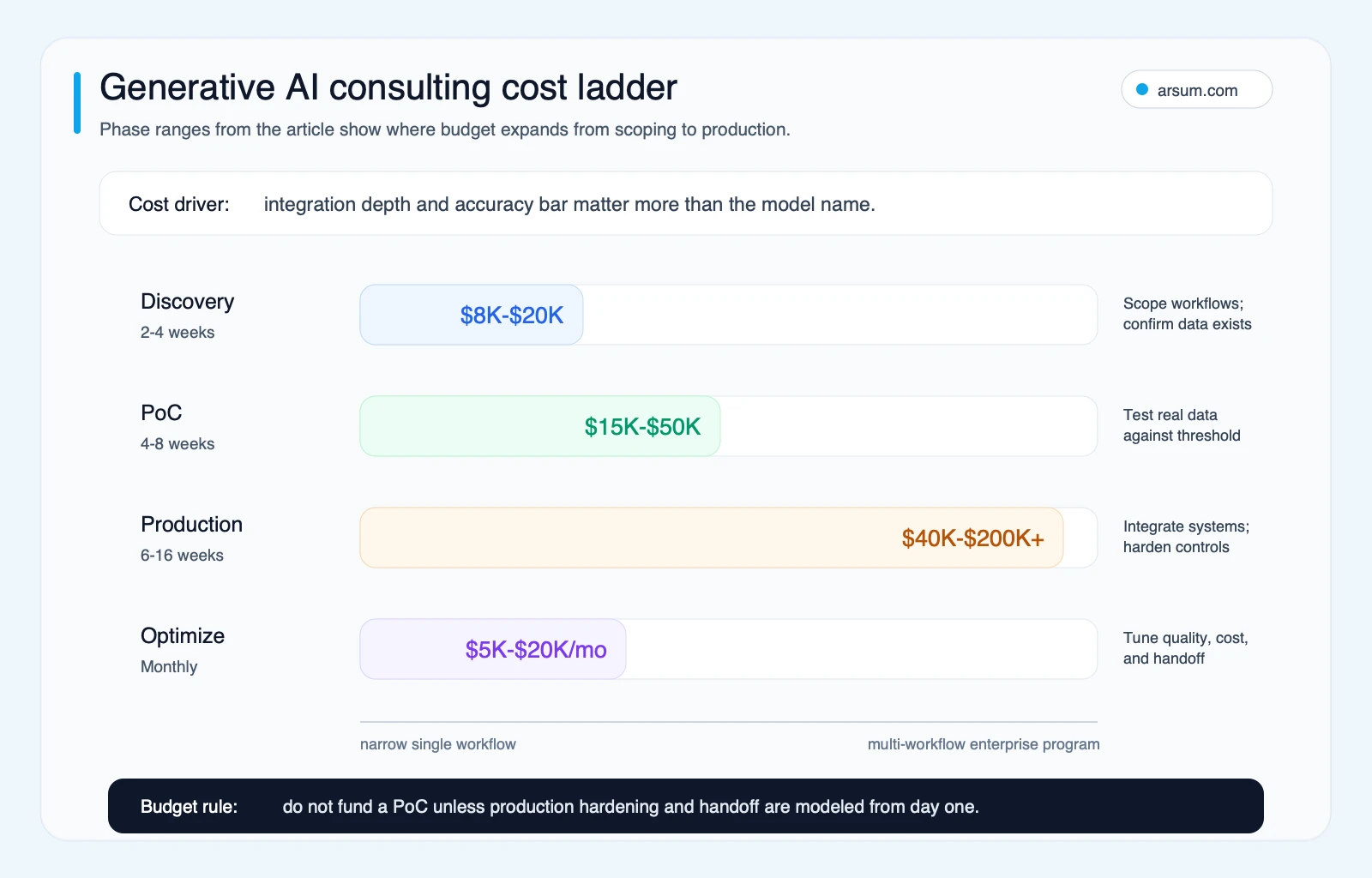
Price the work as a budget model, not a market-rate claim
Instead of accepting a fixed-looking range without context, ask the provider to break the budget into these components:
| Cost component | What changes it |
|---|---|
| Discovery and process design | Number of workflows, stakeholder availability, process documentation, data ownership |
| Evaluation design | Quantity and diversity of examples, labeling effort, domain-review time, severity rules |
| Application and integration work | Number of systems, authentication approach, API maturity, workflow complexity |
| Security and governance | Data classification, logging requirements, approval design, threat modeling, compliance review |
| Model and software usage | Volume, context size, retrieval, provider terms, fallback or multi-model design |
| Production hardening | Observability, load behavior, incident response, accessibility, testing, deployment controls |
| Change and adoption | Training, procedure updates, support coverage, internal ownership |
| Ongoing maintenance | Data changes, prompt/model changes, exception analysis, monitoring and review cadence |
A proposal should identify what is included in each component and what requires a change order. Ask for separate pricing or budget assumptions for discovery, pilot, production hardening, handoff, and ongoing support. That structure lets you decide whether a limited discovery engagement is enough evidence for a later build.
💡 Arsum builds custom AI automation solutions tailored to your business needs.
Get a Free Consultation →Where engagements fail—and how to make failure visible early
The recurring risks are operational patterns, not universal failure rates.
Undefined proof standard
If “good enough” has no evaluation set, label definitions, acceptance threshold, or severity rules, the team cannot make a defensible go/no-go decision. A stakeholder demo is not a substitute for an evaluation process.
Data access arrives too late
A prototype may work on a sample while production data is inaccessible, poorly classified, inconsistent, or owned by a team not participating in the engagement. Confirm access and ownership before treating the architecture as approved.
Autonomy exceeds the control design
A model may be able to send an email, update a CRM, route a claim, or recommend a financial action. The permission to do so must be designed separately. For high-impact outcomes, retain source lineage and require authorized human approval until the business owner explicitly changes that boundary.
Operating costs are omitted
A pilot can look inexpensive when the budget excludes inference, software, internal reviewer time, security review, maintenance, and remediation. The net-value model should include them from the beginning.
Handoff is treated as documentation
A repository and a slide deck are not an operating handoff. The client owner needs runbooks, access, monitoring interpretation, a change process, and a chance to handle real exceptions before the delivery team exits.
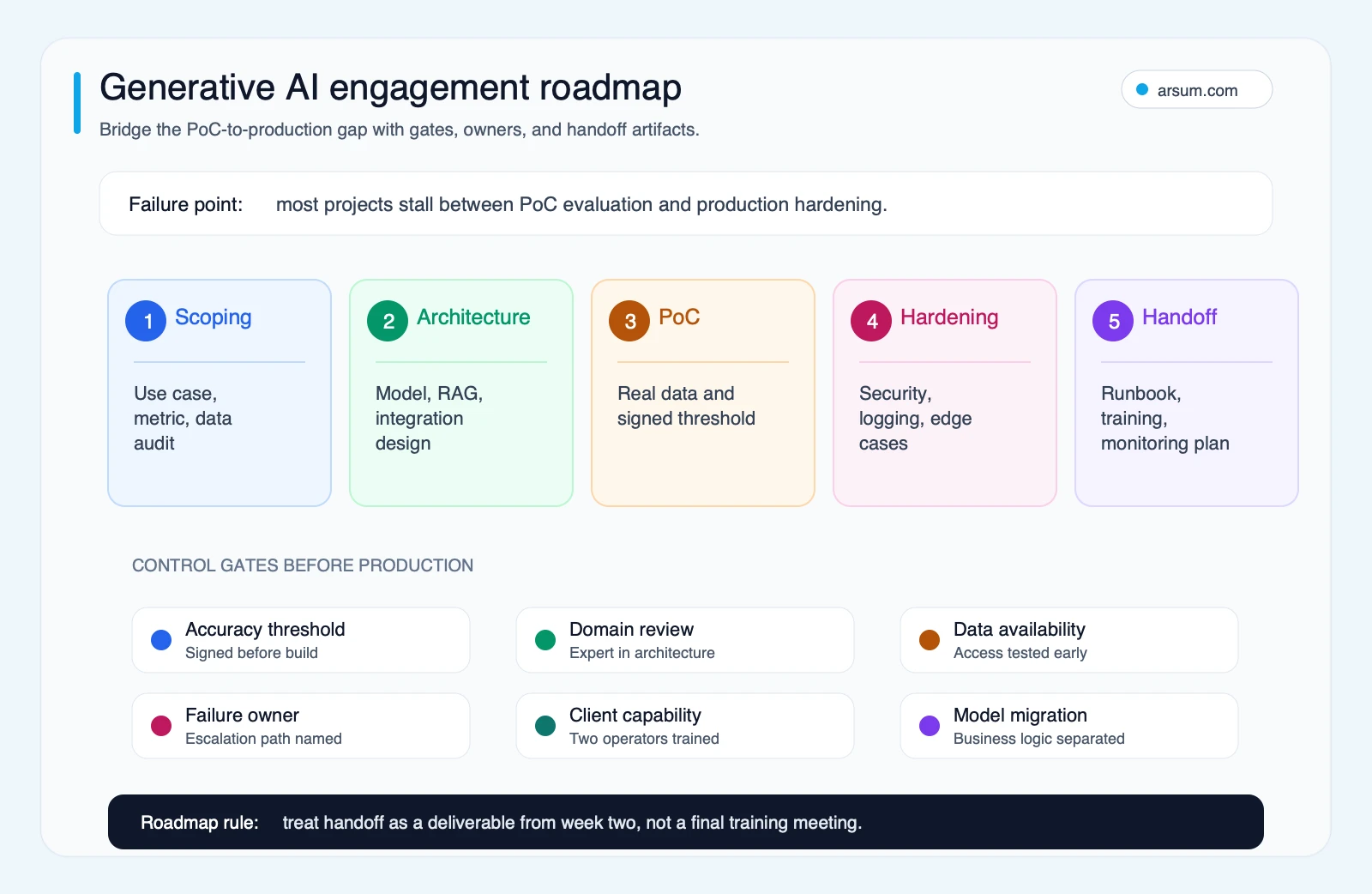
A pilot roadmap with decision gates
Scope the workflow. Name the user, trigger, input sources, output, exception types, approval boundary, and current baseline.
Design evaluation and controls. Build the evaluation set, define severity, document source lineage, create the access matrix, and agree on stop conditions.
Prototype the narrow path. Test the intended workflow with representative data. Avoid expanding scope before the normal path and ugly exceptions are observable.
Evaluate with domain reviewers. Record quality, exception routing, reviewer minutes, false-positive and false-negative severity, system cost, and unresolved issues.
Harden for production. Test permissions, audit logs, model/provider change procedures, prompt-injection controls, incident response, rollback, and integration failure handling.
Handoff or stop. At the pre-set decision date, scale only if the acceptance criteria are met and the named business owner accepts the operational responsibilities.
If the proposed scope relies on autonomous multi-step action, review agentic AI workflow automation and agentic AI versus generative AI before assuming that a generative AI pattern and an agentic pattern have the same risk profile.
Questions to ask before signing
Ask prospective providers for direct, reviewable answers:
- What workflow are we solving first, and what baseline will we measure?
- What evaluation set will be used, who labels it, and how are material errors classified?
- What can the system draft or recommend, and which actions require an authorized human approval?
- Which sources, prompts, tool calls, reviewer decisions, and model versions will be retained?
- How will you test prompt injection, permissions, tool use, and failure recovery?
- Who owns exceptions, monitoring, cost review, and incident response after launch?
- What is the rollback procedure, and when was it last tested?
- What artifacts will we receive at each acceptance gate?
- Which costs are outside the implementation estimate?
- When will we decide to scale, revise, pause, or stop?
A strong answer is specific to your systems and workflow. A generic assurance is not evidence.
Sources and methodology
Last updated: June 18, 2026. This buyer guide uses official guidance from NIST, OWASP, and OpenAI; category context from Gartner; and enterprise-adoption context from Deloitte’s State of AI in the Enterprise. Practitioner discussions were reviewed only as qualitative signals of buyer questions, including discussion about measurable benefits and what GenAI consulting includes; they are not market-wide evidence.
The scorecards and illustrative arithmetic in this article are editorial decision tools, not claims about customer outcomes, market prices, or adoption rates. Editorial/operator review is pending; no named reviewer has been assigned.
The bottom line
The right generative AI consulting engagement produces more than a prototype. It gives you a defined workflow, a control boundary, an evaluation method, a cost model, a named owner, and evidence for a scale-or-stop decision.
If you are evaluating a specific workflow, Arsum can help structure an assessment around the scorecard: baseline and economics, control boundary, pilot acceptance criteria, required delivery artifacts, and a build-versus-buy recommendation.
Ready to Automate Your Business?
Stop wasting time on repetitive tasks. Let AI handle the busywork while you focus on growth.
Schedule a Free Strategy Call →Written by:Arsum editorial team
- Reviewed by
- Arsum editorial team
- Published
- May 20, 2026
- Updated
- July 6, 2026
- How this was produced
- Arsum uses research packs, source checks, and human editorial review to prepare and update blog articles. Editors are responsible for the final page.
- Source policy
- Sources are linked in the article when used. Methodology and source notes are included on higher-risk or high-visibility pages and are being rolled out across the archive. Editorial policy.
- Why this page exists
- Help B2B operators evaluate AI automation, implementation scope, cost, risk, and build-vs-buy decisions with practical context.