Generative AI vs agentic AI difference comes down to the job you are authorizing: generative AI produces or transforms content, while an agentic application combines a model with orchestration, state, tools, permissions, policies, evaluation, and monitoring to pursue a bounded workflow goal. They are overlapping architectures, not mutually exclusive products. For most business processes, the real choice is between a reviewed generative feature, deterministic automation with AI steps, a bounded agent with approvals, or leaving the work human-owned.
Generative AI vs Agentic AI Difference: Comparison
Explore generative AI vs agentic AI difference: compare workflow fit, costs, risks, evidence, and practical next steps before you build, buy, or hire.

Table of Contents
- What Most Guides Miss: Tool Use Does Not Require an Agent
- The Four Choices in a Real Workflow
- Comparison: Model Capability Versus Operating Design
- A Workflow Scorecard for Choosing the Pattern
- Illustrative Workflow Patterns
- Production Readiness: Controls Before Autonomy
- Vendor Claim Audit: Ask for the Operating Details
- Disqualifying Conditions and Common Mistakes
- Sources and Limits
- FAQ
What Most Guides Miss: Tool Use Does Not Require an Agent
The useful distinction is not simply “generative AI writes” and “agentic AI acts.” A generative model can be connected to retrieval, a CRM, or a database by an application. A deterministic workflow can call tools, pull live data, and execute several fixed steps without giving a model discretion over what happens next.
Agentic design becomes justified when the system must select among permitted next actions, retain workflow state, respond to changing conditions, and recover or escalate within defined boundaries. Even then, technical capability is not authorization. A model that can draft a refund explanation is not automatically allowed to issue a refund; a system that can retrieve customer information is not automatically allowed to change it.
This distinction prevents two expensive mistakes:
- Paying for agentic orchestration when a fixed workflow and one reviewed AI step would solve the problem.
- Treating a capable model as permission to automate a consequential decision without an owner, approval gate, evidence trail, or rollback path.
AWS describes generative AI as creating content and agentic AI as taking actions toward tasks with less constant guidance; Stanford HAI similarly frames agentic systems around goals, planning, tools, feedback, and adaptation. Those definitions are useful starting points, but the buying decision should be made at the workflow boundary—not from a product label. See AWS’s overview of agentic AI and Stanford HAI’s definition of agentic AI.
The Four Choices in a Real Workflow
1. Generative feature: produce a reviewed output
Use a generative feature when the valuable output is a draft, summary, extraction, classification, explanation, or code suggestion—and a person already owns the next action.
Examples include:
- Summarizing a claim file for an adjuster.
- Drafting an internal sales follow-up for review.
- Extracting fields from a document into a proposed structured record.
- Producing a first-pass response to a support ticket.
The model may receive retrieved context, templates, and structured data. That does not make the feature agentic. The boundary is straightforward: the application asks for a bounded output, and a person or a fixed workflow decides what happens next.
2. Deterministic workflow with AI steps: execute known paths
Use deterministic automation when the business process has a stable sequence, predictable integrations, and explicit branching rules. The workflow can call a generative model at selected steps without allowing the model to invent the process.
A document-intake flow might:
- Receive a file.
- Extract candidate fields with a model.
- validate required values against system rules.
- Route missing or conflicting values to a reviewer.
- Create a record only after validation succeeds.
This is often safer than an agent because the permitted path is visible, testable, and easier to change when an upstream system changes. For adjacent implementation patterns, see AI business process automation and business workflow automation.
3. Bounded agent with approvals: choose among permitted actions
Use a bounded agent when a workflow has meaningful variation and the system must select from a constrained set of tools or next steps. The agent should have a narrow goal, named permissions, defined stop points, and an escalation path.
For example, an onboarding assistant may be allowed to:
- Check whether account setup is complete.
- Request missing information through an approved template.
- Create a task for the customer-success queue.
- Schedule an internal follow-up.
It may not be allowed to change contract terms, alter access roles, promise credits, or send external communications outside approved templates without a human approval gate.
4. Human-owned process: retain judgment and accountability
Keep the process human-owned when success is hard to define, evidence is incomplete, exceptions dominate the normal path, or an incorrect action creates material financial, legal, safety, privacy, or reputational consequences.
AI can still assist with research, drafting, retrieval, and documentation. The point is not to avoid AI; it is to keep decision authority where the organization can defend it.
Comparison: Model Capability Versus Operating Design
| Dimension | Generative feature | Deterministic workflow with AI | Bounded agentic workflow | Human-owned process |
|---|---|---|---|---|
| Primary job | Create or transform content | Complete fixed steps | Pursue a constrained goal through permitted choices | Apply judgment and accountability |
| Next-step selection | Person or application decides | Rules decide | System may choose from defined actions | Person decides |
| Tool access | Optional, often read-only | Known tools on a fixed path | Scoped tools and permissions | Human-operated systems |
| State | Session or application-provided context | Workflow state in the automation layer | Persistent task state with controls | Case record and human context |
| Approval | Output review where needed | Approval at defined stages | Required for high-consequence actions | Human approval throughout |
| Main failure mode | Incorrect or unsuitable output | Broken rule, integration, or data mapping | Unsafe action, poor escalation, or unreliable tool sequence | Slow or inconsistent handling |
| Best control | Source checks and review | Validation, retries, and exception queues | Least privilege, logs, evaluations, and rollback | Clear policy and review evidence |
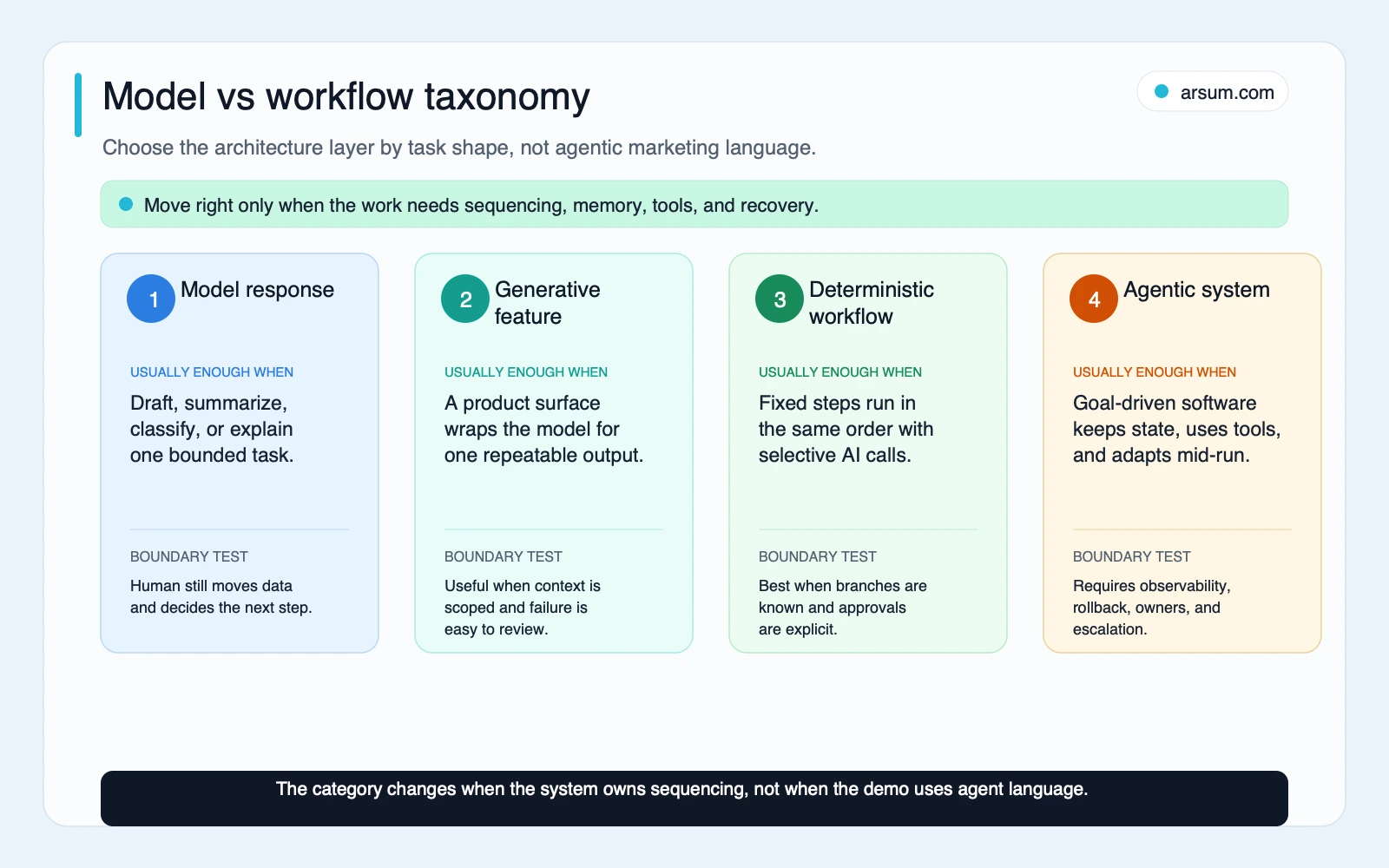
The practical implication is simple: live data, multiple steps, and tool calls may justify integration work, but they do not automatically justify autonomy. Start with the minimum automation pattern that can reliably produce the required business outcome.
A Workflow Scorecard for Choosing the Pattern
Before evaluating a vendor or commissioning a build, score the actual workflow rather than the AI category.
| Question | What to inspect | Decision effect |
|---|---|---|
| Is volume sufficient to measure? | Case count, backlog, cycle time, reviewer effort | Low volume may favor a reviewed feature or human process. |
| Is the normal path stable? | Inputs, rules, handoffs, integrations | Stable paths favor deterministic automation. |
| How much meaningful variation exists? | Exceptions, changing context, competing next actions | Variation may justify a bounded agent only if actions can be constrained. |
| What is the consequence of a wrong action? | Money, customer data, permissions, external messages, legal obligations | Higher consequence requires lower autonomy and stronger approval gates. |
| Are integrations stable and observable? | API contracts, authentication, schema changes, error responses | Unstable tools increase the need for fallbacks and may disqualify an agent pilot. |
| Who owns exceptions? | Named operations, risk, or functional owner | No owner means no production-ready automation. |
| Can the action be reversed? | Undo path, compensating transaction, queue hold | Low reversibility should reduce autonomy. |
| Can success be measured? | Completion, quality, review time, escalations, cost per completed task | Without a baseline and threshold, the pilot cannot be accepted or stopped. |
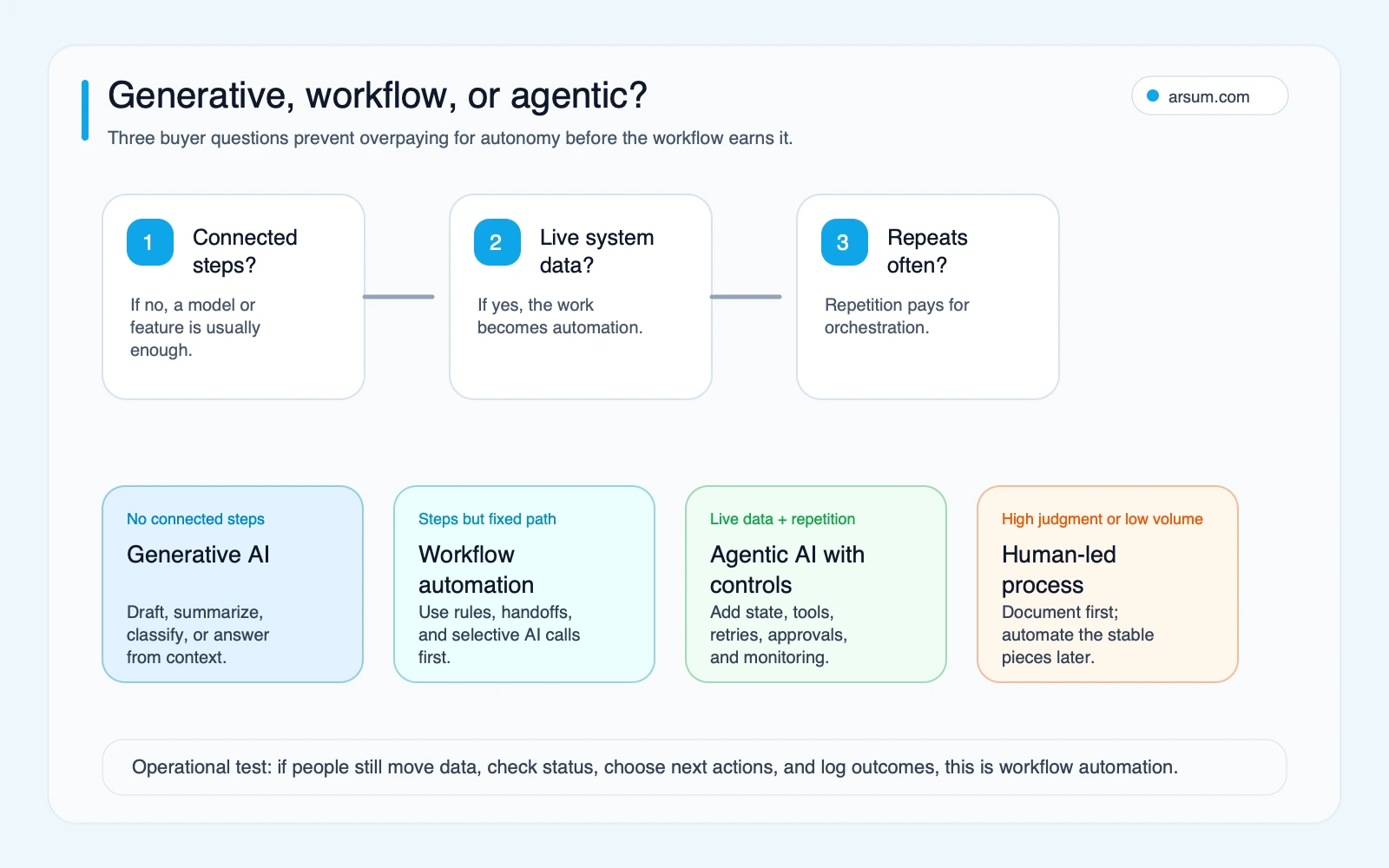
A useful decision rule follows:
- Choose a generative feature when a reviewed output is the outcome.
- Choose deterministic workflow automation when the path is known and exceptions can be routed.
- Choose a bounded agent only when action selection inside a defined tool and permission boundary adds measurable value.
- Keep the process human-owned when risk, ambiguity, or irreversibility exceeds the available controls.
For a broader operating model, see agentic AI workflow automation and AI agent architecture patterns.
Illustrative Workflow Patterns
These are planning patterns, not customer case studies or expected results. Use them to define a pilot boundary before claiming ROI.
Claims intake: reviewed generative extraction
Baseline to capture: time from document receipt to an adjuster-ready summary; percentage of files with missing information; reviewer correction effort.
Task boundary: extract candidate facts and generate a structured summary from the submitted materials.
Permitted actions: read the supplied case materials; write a draft summary into a review queue.
Human checkpoint: the adjuster verifies the source documents, resolves conflicts, and makes every coverage or payment decision.
Retained evidence: source-document identifiers, extracted fields, model output, reviewer edits, final disposition, and timestamped audit events.
Fallback: if source quality is poor, required fields conflict, or confidence checks fail, the file bypasses AI and enters the existing manual queue.
Pilot metric: compare reviewed completion time and correction rate with the current process for a defined sample. The target should be set by the operational owner after baseline measurement, not borrowed from another organization.
This is generally a generative feature or deterministic workflow. It does not need an autonomous agent merely because the source material varies.
Customer onboarding: bounded action with approvals
Baseline to capture: percentage of onboarding steps completed on time, queue age, manual handoffs, exception reasons, and time spent by the responsible team.
Task boundary: coordinate a defined onboarding checklist across approved systems.
Permitted actions: read account status; create internal tasks; send approved template reminders; update checklist state; escalate missing information.
Human checkpoint: a customer-success owner approves exceptions, commercial commitments, access changes beyond a preset role, and any message that departs from approved templates.
Retained evidence: triggering event, customer and workflow state, tools invoked, action payloads, approvals, failed calls, retries, and escalation outcome.
Fallback: pause the run, place the case in an exception queue, and resume manual onboarding from the last confirmed state.
Pilot metric: establish a baseline for on-time completion, escalation rate, review time, and cost per completed onboarding. Do not expand permissions until the workflow consistently meets agreed quality and rollback tests.
This may justify a bounded agent if the system truly must select among permitted next actions based on changing account state. If the sequence is fixed, deterministic automation is the more straightforward design.
💡 Arsum builds custom AI automation solutions tailored to your business needs.
Get a Free Consultation →An Arsum workflow assessment should produce more than a recommendation to “use agents.” It should map the current path, identify the minimum viable automation pattern, list permitted actions and approval gates, surface unstable integrations, and define the pilot scorecard your owner will use to accept, pause, or reject the design.
Production Readiness: Controls Before Autonomy
A demo proves that a model can produce an appealing output. A controlled workflow proves that the organization can operate the system when inputs are messy, a connector fails, or an action needs explanation.
AWS security guidance notes that agentic systems introduce a distinct control problem because they connect models to tools and APIs. OWASP identifies excessive agency as a risk when a system has more functionality, permissions, or autonomy than the task requires. Read AWS’s security principles for agentic AI systems and OWASP’s guidance on excessive agency.
Before approving a pilot, confirm all of the following:
- The workflow has a documented baseline.
- Inputs, source systems, and tool contracts are stable enough for a controlled test.
- Every permitted read, write, send, create, and update action is listed.
- Access follows least privilege; the system receives no broader permission than the task needs.
- High-consequence actions require a named human approver.
- Logs retain model requests where appropriate, tool calls, action results, state transitions, retries, and escalations.
- Source lineage is visible: reviewers can identify the record, document, or policy used for a proposed output.
- An operational owner monitors failures, integration changes, and exception queues.
- A tested rollback or compensating action exists for every action the pilot can take.
- A human can take over from the last confirmed workflow state.
Acceptance criteria for a pilot
Set thresholds before launch. The exact values should reflect the workflow’s current baseline and risk tolerance, but the scorecard should include:
| Measure | Why it matters | Owner |
|---|---|---|
| Completion rate | Shows whether intended cases reach a valid end state | Functional operations owner |
| Harmful-action rate | Tests safety, not just throughput | Risk or control owner |
| Escalation rate | Reveals whether the workflow is actually handling normal cases | Workflow owner |
| Review time per completed task | Captures hidden human burden | Team lead |
| Cost per completed task | Includes model, tool, and review effort | Finance sponsor |
| Source and audit completeness | Confirms each result can be investigated | Compliance or quality owner |
| Rollback test result | Demonstrates recoverability before broader autonomy | Technical owner |
A stop condition should be explicit: pause the pilot if an unsafe action occurs, if evidence cannot be reconstructed, if a critical integration fails without a safe fallback, or if review burden makes the proposed benefit unmeasurable. A rollback path should identify who disables the automation, what work is held, and how cases return to manual handling.
Vendor Claim Audit: Ask for the Operating Details
“Agentic” is not an acceptance criterion. Ask vendors to demonstrate the workflow controls you will need after the sales demo.
| Vendor claim | Proof to request | Generative or workflow equivalent | Agentic requirement | Risk if unverified |
|---|---|---|---|---|
| “It plans and reasons.” | A trace showing goals, state transitions, allowed choices, and escalation behavior | A fixed prompt sequence can appear thoughtful | The system selects among bounded actions under policy | Unobservable or unjustified autonomy |
| “It integrates everywhere.” | Named connectors, permission model, error handling, change-management process | A workflow may call known APIs on a fixed path | Agent tools must be scoped, authenticated, and monitored | Fragile tool use or excessive access |
| “It learns from your process.” | What data changes behavior, who approves updates, and how regressions are tested | Templates and rules can be updated manually | Any adaptation needs evaluation and governance | Silent behavior drift |
| “It reduces headcount.” | Baseline, measurement window, exception rate, reviewer effort, and full cost per completed task | A reviewed feature may reduce one task’s effort | An agent must show safe completed outcomes, not demos | Unsupported savings claim |
| “It is autonomous.” | Specific actions it may take alone, approval gates, rollback, and incident ownership | Automation can execute fixed actions | Autonomy must be constrained by permissions and policy | Material business or compliance exposure |
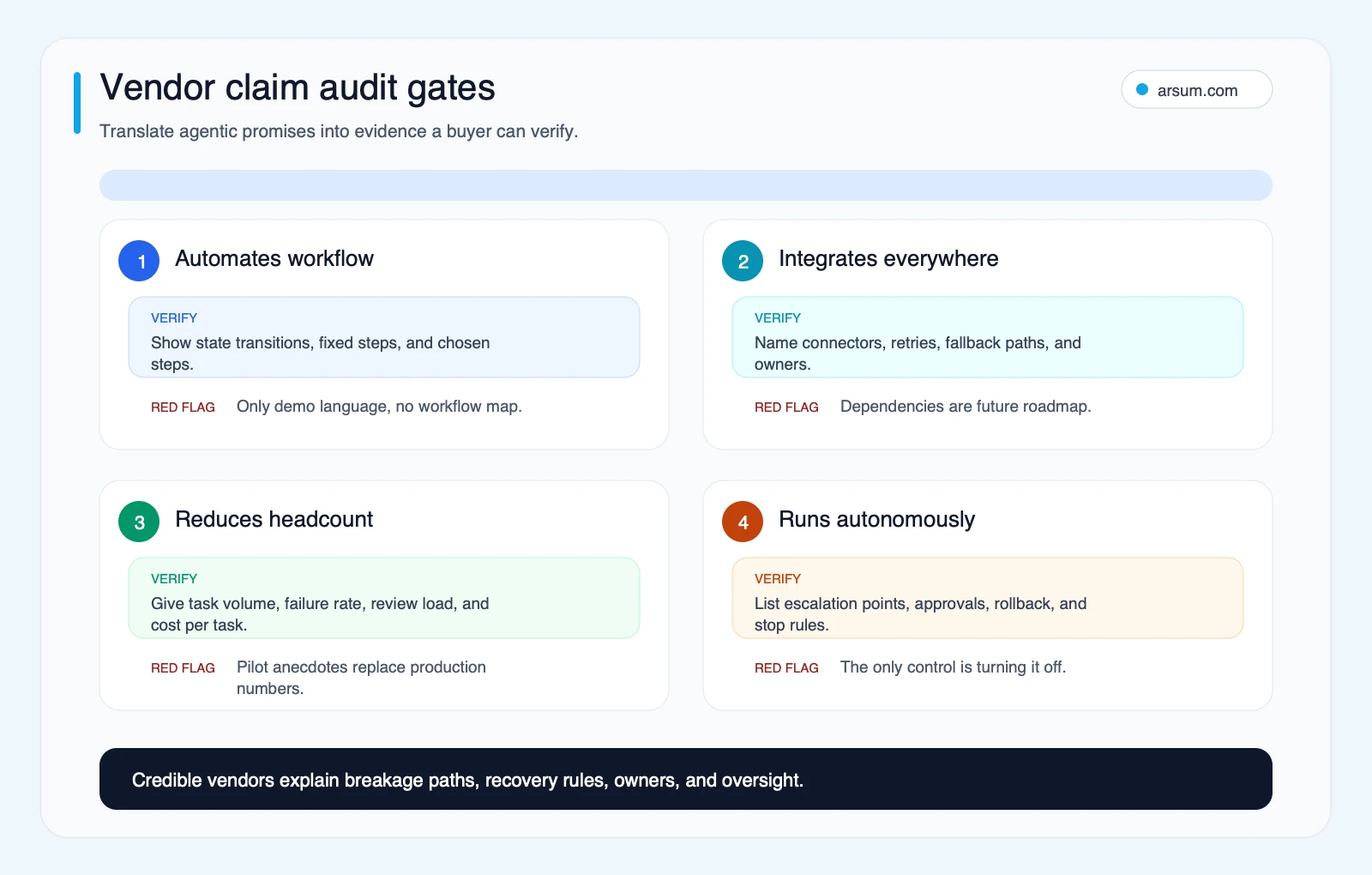
A credible provider can explain what happens when a tool returns an unexpected value, authentication expires, data is missing, a policy conflicts with a proposed action, or a reviewer rejects the result. If the answer is “the model will handle it,” the design is not yet specified.
For framework-level questions, compare agentic AI frameworks with a clear view of your tool, state, evaluation, and ownership requirements. If you are weighing custom implementation against packaged software, custom AI agent development services can help frame the delivery decision.
Disqualifying Conditions and Common Mistakes
Agentic AI is not the right first move when any of these conditions apply:
- The workflow has no measurable baseline or operational owner.
- The normal path is unclear because the process itself is being redesigned.
- Source systems are unreliable, undocumented, or inaccessible through stable interfaces.
- Exceptions are more important than routine cases and cannot be safely classified.
- The organization cannot define permitted actions or approval ownership.
- A wrong action is difficult to reverse.
- Logs cannot retain enough evidence to investigate an outcome.
- The expected value comes from a one-time draft rather than repeated execution.
Common mistakes follow from ignoring those conditions.
Buying agentic complexity for a content task
If the work ends with a summary, draft, classification, or proposed extraction that a person reviews, start with a generative feature. More orchestration does not automatically add value.
Treating live data as a reason for autonomy
Retrieval from a CRM, ERP, warehouse, or document store can be performed by a deterministic application. The need for fresh context is not the same as the need for an agent to decide what to do.
Confusing tool access with authorized action
A tool call is a technical capability. Authorization requires business policy, scoped permissions, approval ownership, and evidence retention.
Skipping deterministic automation
A known, repeatable sequence with explicit branches is often easier to audit, test, and maintain than an agentic loop. Use an agent only where its action selection changes the result enough to justify the additional control burden.
Launching without an exception route
An agent that cannot pause, explain, hand off, and resume from a known state is not production-ready. Reliability is an operating responsibility, not a model feature.
Sources and Limits
This page uses definitions and architectural context from AWS, Stanford HAI, IBM, and OWASP. AWS provides a useful comparison of traditional AI, software agents, and agentic AI; IBM also explains how agentic AI builds on generative AI. These sources support the conceptual distinctions and security framing, not a universal promise about ROI, accuracy, adoption, or implementation effort.
Public practitioner discussions can still reveal useful questions: concerns commonly center on fragile tool use, authentication, schema drift, scope creep, and the gap between a demo and an operated workflow. Treat those discussions as qualitative signals, not measured production reliability data. For example, this Reddit discussion on business usefulness is useful for surfacing buyer skepticism, but it is not evidence of market-wide outcomes.
FAQ
Can generative AI and agentic AI be used in the same system?
Yes. Many agentic applications use generative models for language, extraction, classification, or reasoning steps. The agentic layer is the surrounding operating design: state, tools, permissions, policies, evaluation, monitoring, and exception handling.
Does a multi-step workflow need agentic AI?
No. If the path and decision rules are known, deterministic workflow automation can execute multiple steps and use AI where language or unstructured data requires it. Agentic design is more appropriate when bounded action selection under changing conditions adds value.
When should a human approval gate be mandatory?
Keep approval for actions affecting money, customer data, permissions, legal obligations, regulated decisions, or external communications outside pre-approved boundaries. High failure cost and low reversibility should reduce autonomy.
Is agentic AI replacing RPA?
Not as a universal replacement. Rules-based automation remains useful for stable, explicit processes. Agentic components may help where inputs vary or a constrained choice is required, but they also add permissions, monitoring, and evaluation requirements.
What is the safest way to start?
Choose one measurable workflow, enumerate permitted actions and approval gates, run it in shadow mode or with human approval, retain evidence for every action, test rollback, and assess the pilot scorecard before increasing autonomy.
The practical choice is not generative AI or agentic AI as a category preference. It is whether the process needs a better output, a predictable automated path, a bounded action loop with controls, or continued human ownership.
Ready to Automate Your Business?
Stop wasting time on repetitive tasks. Let AI handle the busywork while you focus on growth.
Schedule a Free Strategy Call →Written by:Arsum editorial team
- Reviewed by
- Arsum editorial team
- Published
- February 18, 2026
- Updated
- July 6, 2026
- How this was produced
- Arsum uses research packs, source checks, and human editorial review to prepare and update blog articles. Editors are responsible for the final page.
- Source policy
- Sources are linked in the article when used. Methodology and source notes are included on higher-risk or high-visibility pages and are being rolled out across the archive. Editorial policy.
- Why this page exists
- Help B2B operators evaluate AI automation, implementation scope, cost, risk, and build-vs-buy decisions with practical context.