This guide evaluates generative seo guide through workflow fit, ownership, implementation risk, and measurable ROI. If you lead growth, operations, or a B2B business unit, generative SEO is not a content gimmick. It is an automation decision: can you turn a repeatable content workflow into qualified traffic, sales enablement, or support deflection without publishing generic pages that damage trust?
Generative SEO Guide: Practical Guide
Explore generative seo guide: compare workflow fit, costs, risks, evidence, and practical next steps before you build, buy, or hire.

Table of Contents
- Operator Note
- Social Listening Snapshot
- Information Gain Before Production
- Buyer Fit and Implementation Reality
- What is Generative SEO?
- How Generative SEO Works
- Generative SEO vs Traditional vs Agentic: The Complete Comparison
- Generative SEO vs Agentic SEO: The Critical Distinction
- ROI: When the Automation Is Worth It
- Cost Per Approved Page Model
- Original Data: Generative SEO Risk Classifier
- Decision Tree: What Should You Automate First?
- Benefits of Generative SEO
- Challenges and Solutions
- Commodity vs Non-Commodity Work in Generative SEO
- Google Risk Box
- Build vs Buy Options for Generative SEO
- Implementation Practices That Prevent Waste
- What to Watch Next
- Reusable Artifact: Pre-Publish Gate for AI-Assisted SEO Pages
- Methodology and Evidence Note
- Frequently Asked Questions
- Getting Started with Generative SEO
- Related Arsum Guides
Generative SEO uses large language models to draft search-optimized content at scale, while humans control strategy, source quality, approvals, and performance feedback.
The ROI case is strongest when content volume is blocking a commercial goal: product-led acquisition pages that never get written, comparison pages sales keeps requesting, long-tail support content that reduces tickets, or localization pages that are too expensive to produce manually.
It is weak when the job requires original executive point of view, sensitive claims, heavy legal review, or expert judgment that the business has not documented. In those cases, AI can still help research and structure content, but it should not own the workflow.
Operator Note
The useful question is not whether AI can draft a page. It is whether your team can keep that page specific, sourced, and commercially useful after the 20th or 200th page goes live.
Google’s guidance and the recurring confusion in SEO communities point to the same line: AI assistance is not the problem by itself. Thin, repetitive, unsupported content is. Generative SEO works when the workflow protects information gain, source discipline, and editorial judgment. It fails when speed becomes the product.
Social Listening Snapshot
Current practitioner conversations around generative SEO are less about prompt tricks and more about operating discipline.
Three recurring concerns show up across SEO and digital-marketing threads:
- “Is this just SEO with a new label?” Many teams still treat GEO, AI-search optimization, and generative SEO as separate channels when the practical overlap is still search intent, source quality, and usefulness.
- “How do we measure visibility in AI answers?” Marketers want a stable reporting model, but most teams are still combining standard organic metrics, manual citation checks, and assistant referral reviews.
- “How do we stop thin pages before they scale?” Technical SEOs keep coming back to the same problem: the workflow needs a visible gate for source support, original value, internal links, and human approval.
Treat those threads as qualitative signal, not proof. They are still useful because they show where buyers and operators get confused before the workflow is mature.
Information Gain Before Production
Most pages about Generative SEO Guide repeat the visible search results. That is not enough for a buyer or for durable SEO. The useful work is finding what the SERP leaves out: real objections, implementation constraints, proof requirements, and examples that change the decision.
Before drafting, the article should answer:
- What does every competing page already say?
- What does the buyer still not know after reading them?
- What evidence would make the recommendation credible?
- What practical next step should the reader take?
That research layer turns content production from summarizing into insight creation.
Buyer Fit and Implementation Reality
Use this guide when your team is deciding whether generative SEO can reduce cost, increase throughput, or remove an operational bottleneck this quarter. The useful test is not whether AI content sounds advanced; it is whether the workflow has enough volume, repeatability, and business value to justify implementation.
Before you commit budget, pressure-test three things:
- ROI: Which manual hours, delayed pages, lost opportunities, support tickets, or sales-cycle friction should change if this works?
- Implementation risk: Which source materials, CMS steps, approval paths, analytics events, and compliance rules must connect cleanly?
- Adoption: Who owns the workflow after launch, and what evidence will make the team trust it enough to keep using it?
If those answers are still fuzzy, start with a small pilot and a measurable success threshold. Arsum’s role is to make the workflow audit, build-vs-buy decision, and implementation roadmap clearer before another AI tool gets added to the stack.
What is Generative SEO?
Generative SEO uses AI language models to draft content designed for search intent, internal linking, and conversion goals. Unlike traditional SEO, where every article depends on a writer starting from a blank page, generative SEO turns repeatable content types into a controlled production workflow.
The useful version has four operating components:
Source library: Product details, customer language, sales notes, support tickets, approved claims, positioning, screenshots, and examples the AI is allowed to use.
Brief and prompt templates: Reusable instructions that define search intent, structure, brand voice, internal links, factual requirements, and what the model should avoid.
Quality-control workflow: Human review for accuracy, usefulness, compliance, tone, conversion fit, and whether the page adds value beyond the current search results.
Performance loop: Analytics that show which templates, topics, calls to action, and internal-link patterns produce qualified traffic or useful assisted conversions.
The key distinction: generative SEO drafts content. It does not autonomously choose every opportunity, approve claims, test variations, or make publishing decisions. Those decisions still require human judgment or a more advanced agentic system with guardrails.
How Generative SEO Works
The workflow matters more than the model. A strong implementation usually looks like this:
Opportunity Selection
Teams identify repeatable keyword groups and map each one to a business reason: pipeline creation, sales enablement, onboarding, support deflection, marketplace supply, or product education. A page that can rank but does not support a buyer or user journey should not be automated first.
Source Pack Creation
Before prompting, the team assembles the materials the model should rely on. This can include product docs, customer objections, pricing rules, screenshots, call transcripts, case notes, FAQs, and internal links. This step is where many projects fail: without approved source material, the model fills gaps with generic language.
Brief and Prompt Design
SEO, product, and commercial owners define the content template. A useful prompt specifies:
- Target intent and reader stage
- Required sections, examples, and internal links
- Approved claims and source material
- Brand voice and forbidden phrases
- CTA fit by page type
- Review criteria before publishing
A good prompt is closer to an operating procedure than a clever instruction. It should let a new editor understand what the page is supposed to accomplish.
Content Generation
The model produces a draft, but the draft is not the deliverable. It is a structured starting point that should already contain the right sections, internal links, examples, and claims to verify.
Human Review and Editing
This step separates useful automation from low-quality scale. Human reviewers:
- Verify factual accuracy
- Add business-specific examples
- Remove unsupported claims
- Strengthen buyer relevance
- Confirm internal links and CTAs
- Check compliance, brand voice, and search intent
Publishing and Monitoring
Once approved, content goes live through the normal CMS workflow. Teams track indexation, rankings, qualified traffic, assisted conversions, demo requests, support deflection, and content quality issues. The results should update the templates, not just the individual article.
Operationally, generative SEO changes the team model:
| Workflow area | What changes |
|---|---|
| Strategy | Humans choose content types, commercial goals, and acceptance criteria |
| Drafting | AI handles repeatable first drafts from approved source packs |
| Editing | Editors spend less time composing and more time verifying, differentiating, and improving conversion fit |
| Governance | Review checklists, versioned prompts, and approval rules become part of the system |
| Measurement | Performance data informs the next batch and the next prompt revision |
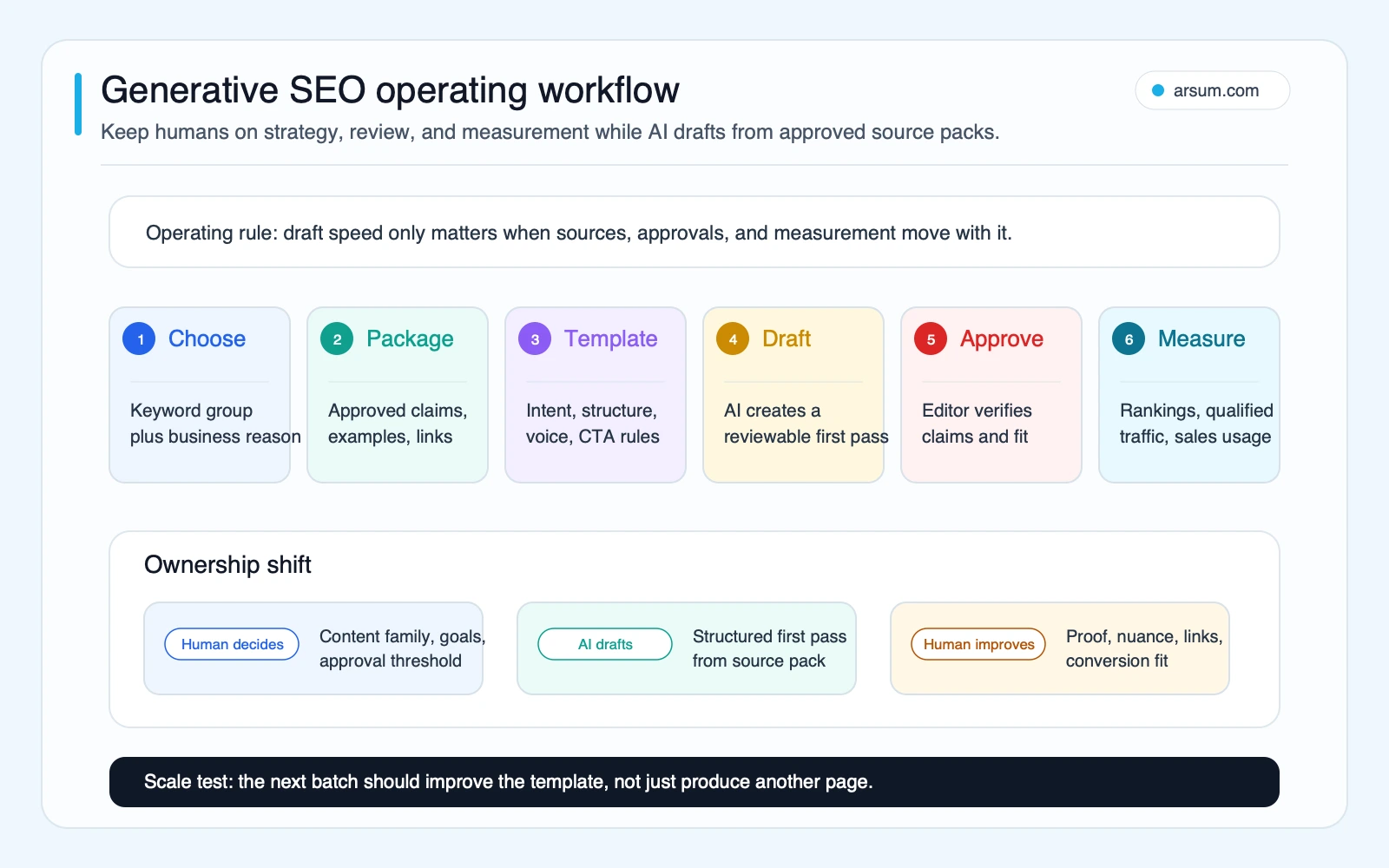
Use this workflow to keep drafting speed connected to source quality, approval ownership, and measurement before scaling the next content batch.
Generative SEO vs Traditional vs Agentic: The Complete Comparison
Understanding where generative SEO fits in the broader landscape is critical:
| Aspect | Traditional SEO | Generative SEO | Agentic SEO |
|---|---|---|---|
| Content Creation | Manual writing | AI draft + human editing | Automated workflow with human oversight |
| Best Operating Use | Executive POV, expert content, sensitive claims | Repeatable informational, comparison, support, and landing-page variants | Programmatic SEO and high-volume long-tail pages |
| Cost Driver | Writer and editor time | Source prep, prompt design, editing, QA | System design, integrations, monitoring |
| Quality Control | Writer skill + editor | Source pack + checklist + editor | Automated checks + sampling + exception review |
| Strategic Decisions | Human-driven | Human-driven | AI-driven with oversight |
| Implementation Risk | Slow throughput | Generic content if sources and review are weak | Silent scale of mistakes if guardrails fail |
| Human Involvement | High | Medium | Lower per page, higher system governance |
The reality: most successful content operations use all three. Traditional SEO handles strategic pieces, generative SEO scales informational content, and agentic workflows manage long-tail programmatic pages.
Generative SEO vs Agentic SEO: The Critical Distinction
This is where confusion often arises. Both use AI, but they’re fundamentally different approaches:
Generative SEO creates content based on prompts. A human defines the strategy, provides the prompt, reviews the output, and makes publishing decisions. The AI is a content production tool.
Agentic SEO creates content AND manages the entire optimization workflow autonomously. The system chooses keywords, generates content, publishes, monitors performance, and iterates without human intervention for each step.
Think of it this way:
- Generative SEO: AI is your writer
- Agentic SEO: AI is your entire SEO team
For a detailed breakdown of agentic SEO capabilities and when to deploy them, see our complete guide to AI-powered SEO strategies.
When to Use Each
Choose Generative SEO when:
- You need content volume but want editorial control
- Brand voice consistency is critical
- Budget allows for human review
- Topics require fact-checking
- You’re building initial content library
Choose Agentic SEO when:
- You need maximum automation
- Operating at extreme scale (1000+ pages)
- Content is relatively formulaic
- You have systems to monitor quality
- ROI justifies building custom workflows
Hybrid Approach:
Many businesses use both. Generative SEO handles core content where brand control and reviewer judgment matter. Agentic systems handle long-tail programmatic pages where the pattern is stable and exceptions can be monitored.
ROI: When the Automation Is Worth It
Use generative SEO when at least three of these conditions are true:
- Volume exists: You have dozens of pages, comparisons, FAQs, product explainers, local pages, or support articles that follow a repeatable structure.
- The bottleneck is real: The team already knows what should be published, but writing, editing, or CMS production slows it down.
- The content has a business path: The page can influence demos, trials, sales conversations, onboarding, retention, or ticket volume.
- Source material is available: Product knowledge, proof points, customer language, and approved claims can be packaged for the model.
- Review risk is manageable: An editor or subject-matter owner can approve content without creating a new bottleneck.
A simple pilot model:
| Question | What to measure |
|---|---|
| Can we reduce production cost? | Hours per approved page before and after the workflow |
| Can we increase throughput safely? | Approved pages per week without quality rework increasing |
| Can it support revenue? | Qualified traffic, assisted conversions, demo requests, or sales usage |
| Can it reduce operational load? | Fewer repetitive support questions or faster knowledge-base coverage |
Do not scale because the drafts are fast. Scale only when the pilot proves the workflow can produce useful pages, at a lower unit cost, without increasing brand, compliance, or review risk.
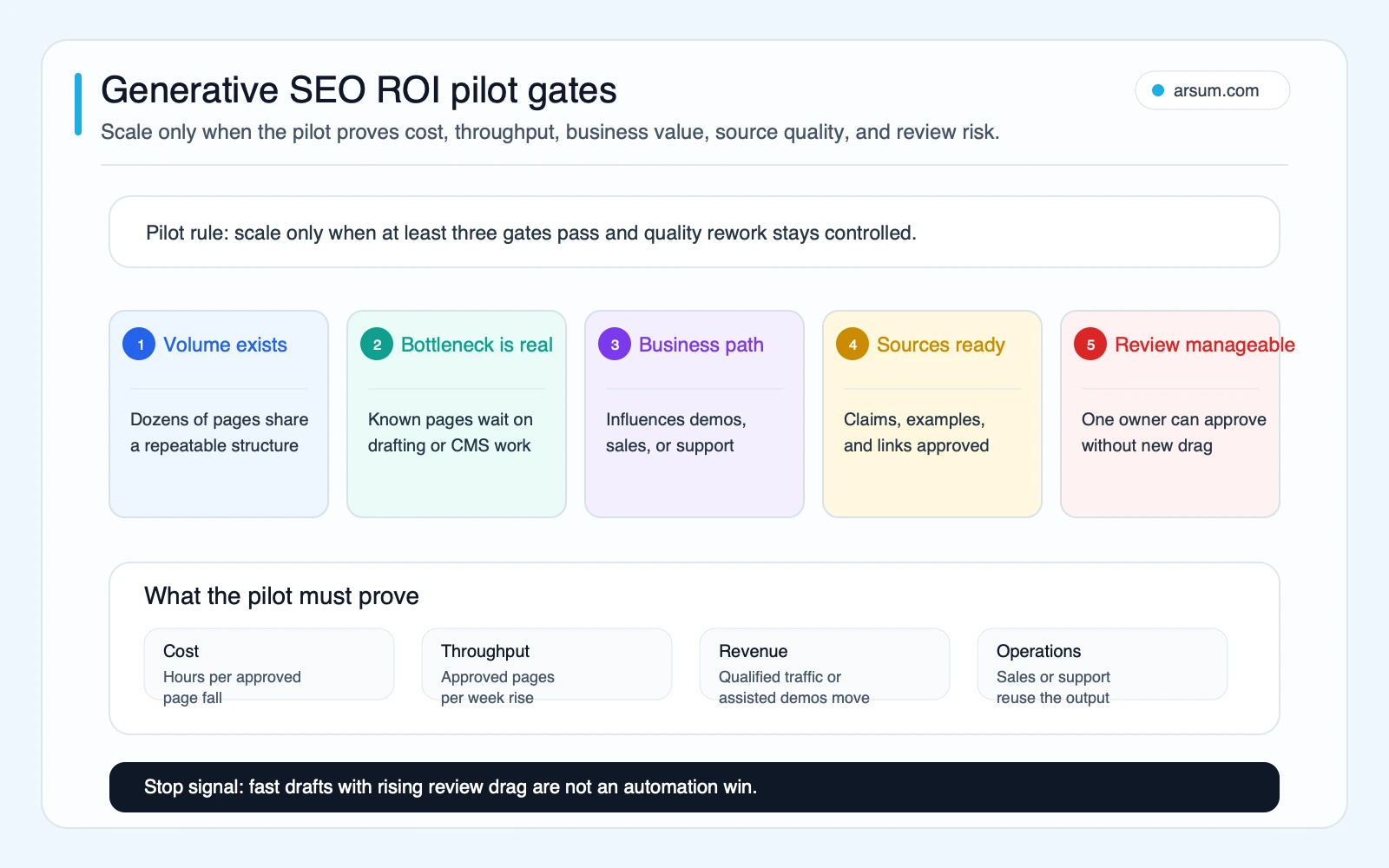
A generative SEO pilot should prove cost, throughput, revenue or operational reuse, and review capacity before the workflow expands.
Cost Per Approved Page Model
Raw drafting speed is a misleading KPI. The better unit is the cost of one page that actually clears review and goes live.
Use this simple model before you scale a template:
| Cost input | What to include |
|---|---|
| Briefing time | Keyword framing, search-intent mapping, source collection, and template setup |
| Model or platform cost | API usage, platform seats, enrichment tools, and prompt/testing overhead |
| Human edit time | Accuracy checks, rewriting, internal-link review, CTA fit, and formatting |
| Expert review time | Product, legal, compliance, or subject-matter approval when needed |
| CMS and publishing time | Uploading, QA, schema, images, and final publish checks |
| Post-publish monitoring | Ranking review, AI-answer citation checks, traffic quality, and refresh decisions |
If the approved-page cost still looks high after adding those inputs, the workflow is not really efficient yet. It is only moving work around.
Original Data: Generative SEO Risk Classifier
Use this scorecard before you automate a content family.
| Signal | Safe assist | Needs expert review | Do not publish at scale |
|---|---|---|---|
| Source material | Approved product facts, customer language, and internal links already exist | Some source material exists, but important claims still live in people’s heads | The model would need to invent examples, proof, or positioning |
| Information gain | The page can include a decision table, example, checklist, or comparison competitors do not have | The page can be useful, but only after a subject-matter owner adds specific proof | The page would mostly restate the search results |
| Review path | One editor can verify claims quickly | Multiple stakeholders need to approve claims, pricing, or compliance details | No one clearly owns accuracy or final approval |
| Scale risk | You are expanding one proven template slowly | You are testing a new template on mixed topics | You are planning many near-duplicate pages mainly to fill keyword inventory |
If two or more answers land in the rightmost column, do not scale that content family yet. Fix the source material, the review path, or the offer first.
Decision Tree: What Should You Automate First?
Use this routing logic before you add another AI content tool:
- Briefs only: If topic selection is still fuzzy, automate research summaries and outlines first, not full pages.
- Draft pages: If the content type is repeatable and the sources are approved, automate first drafts with human editing.
- Refresh existing pages: If rankings or AI-answer visibility are slipping on pages you already trust, automate refresh support before net-new production.
- Stay manual: If the topic depends on original executive judgment, sensitive claims, or undocumented expertise, keep the page human-led.
The safest first automation target is usually a repeatable content family with a clear business path and one accountable reviewer.
💡 Arsum builds custom AI automation solutions tailored to your business needs.
Get a Free Consultation →Benefits of Generative SEO
The benefits are operational, not just editorial:
Faster Coverage of Known Opportunities
Most teams have a backlog of pages they already know they need: comparison pages, product explainers, integrations, industry use cases, implementation guides, and help-center content. Generative SEO helps clear that backlog when the structure is repeatable and the inputs are documented.
Lower Cost Per Approved Page
The economic gain comes from shifting expensive human time away from blank-page drafting and toward source selection, expert review, and conversion improvement. If review time does not shrink, the workflow is not really automated.
Consistent Baseline Across Repeated Formats
Templates make quality easier to manage. A team can define exactly what a product comparison, integration page, FAQ article, or support guide must include, then improve that template over time.
Better Use of Expert Time
Subject-matter experts should not spend hours turning basic facts into first drafts. They should review claims, add nuance, flag risk, and strengthen examples. That is usually where their judgment creates the most value.
Faster Commercial Response
When sales, support, or product teams spot a recurring objection, generative SEO can turn that insight into a useful page quickly. The business value is not “more content”; it is faster coverage of buyer questions that already affect pipeline or retention.
For example, a B2B SaaS company with 60 integration pages stuck in backlog may not need a larger writing team. It may need one approved integration-page template, clean product inputs, an editor, and a CMS workflow that can publish ten quality-controlled pages per week.
Challenges and Solutions
Generative SEO usually fails for operational reasons, not because the model cannot write sentences.
Generic Content at Scale
The easiest failure mode is publishing pages that sound plausible but say nothing specific. This happens when prompts rely on public search results instead of business-specific source material.
Solution: Build source packs before drafts. Require customer language, product details, examples, screenshots, internal links, and approved claims. If a page cannot include something your competitors do not have, it probably should not be in the first automation batch.
Review Bottlenecks
Some teams automate drafting and accidentally move the bottleneck to legal, product, or executive review.
Solution: Define approval tiers. Low-risk support pages may need an editor only. Product comparison pages may need product marketing. Regulated claims may need compliance. Do not send every page through the heaviest path.
Hallucinated Claims and Weak Evidence
LLMs can invent statistics, overstate product capabilities, or cite sources that do not support the claim.
Solution: Keep claims in an approved library. Ask the model to use only provided inputs for factual statements. Make reviewers verify every statistic, product statement, compliance claim, and customer example before publishing.
Brand Voice Drift
Even accurate AI content can feel interchangeable if the prompt does not carry the company’s positioning, vocabulary, and point of view.
Solution: Maintain voice examples and “never say” rules. Review prompt outputs in batches so editors can catch drift and update the template instead of fixing the same issue page by page.
No Commercial Measurement
Traffic alone can make a weak project look successful. For B2B teams, the better question is whether the content helps buyers, sellers, support teams, or onboarding.
Solution: Define the business metric before production: assisted demos, trials, sales usage, qualified traffic, support deflection, implementation-readiness, or expansion education. Then review performance by template, not just by URL.
Work With Arsum
We help businesses implement AI automation that actually works. Custom solutions, not cookie-cutter templates.
Learn more →Commodity vs Non-Commodity Work in Generative SEO
Commodity work that AI can speed up:
- turning approved source material into first-draft structure
- producing repeated outlines, FAQs, internal-link suggestions, and variant intros
- converting one content family into a consistent template
Non-commodity work that still needs human ownership:
- deciding which topics deserve publication at all
- separating policy-safe scale from thin inventory expansion
- adding original examples, buyer nuance, and product truth
- deciding when a page needs expert review, legal review, or no publication
This is why generative SEO is usually an operating-system problem, not a writing-tool problem. The draft becomes cheaper. Judgment does not.
Google Risk Box
Google has been unusually consistent here. The risk is not that AI touched the draft. The risk is publishing scaled pages that add little value, borrow generic language, or make unsupported claims.
Treat these as red flags:
- dozens of near-identical pages with only keyword swaps
- pages that summarize ranking competitors without adding proof, examples, or buyer help
- fake freshness, invented stats, or citations nobody verified
- visible value hidden in metadata instead of the article body
A practical rule: if the page still feels generic after you remove the target keyword, it is probably too thin to scale.
Build vs Buy Options for Generative SEO
The tool choice should follow the operating model, not the other way around.
Internal API Workflow
Use an internal workflow when you need control over prompts, source packs, CMS integration, permissions, analytics, and approval logic.
Best fit: teams with engineering support, clear content operations, and enough volume to justify system design.
Tradeoff: more control, but more responsibility for maintenance, model changes, access control, and QA tooling.
Marketing Content Platform
Use a platform when the workflow is mostly drafting, brand voice management, and team collaboration. Teams comparing software options should review the current best AI SEO tools before committing.
Best fit: lean marketing teams that need a faster starting point and can accept platform constraints.
Tradeoff: faster setup, but less control over custom source logic, deeper CMS workflows, and business-specific quality gates.
Agency-Managed Workflow
Use an agency when you need strategy, content operations, and implementation capacity, but do not want to staff the whole function internally. If you are comparing managed delivery models, our guide to AI SEO services helps frame the tradeoffs.
Best fit: teams that have commercial urgency but limited in-house SEO, editorial, or AI workflow experience.
Tradeoff: faster execution and outside pattern recognition, but the business still needs an internal owner for approvals, source material, and performance review.
Custom AI Solution
For businesses with unique requirements, custom AI solutions offer the most control. Arsum builds quality-controlled generative workflows tailored to:
- Brand voice and positioning rules
- Product, sales, and support source materials
- Compliance and approval requirements
- CMS and analytics integrations
- Quality thresholds by content type
Best fit: teams where generative SEO is part of a larger revenue or operations automation roadmap, not just a content experiment.
The decision is rarely “Which AI writer is best?” The better question is: “Which operating model gets useful pages live with the least review drag and the clearest business measurement?”
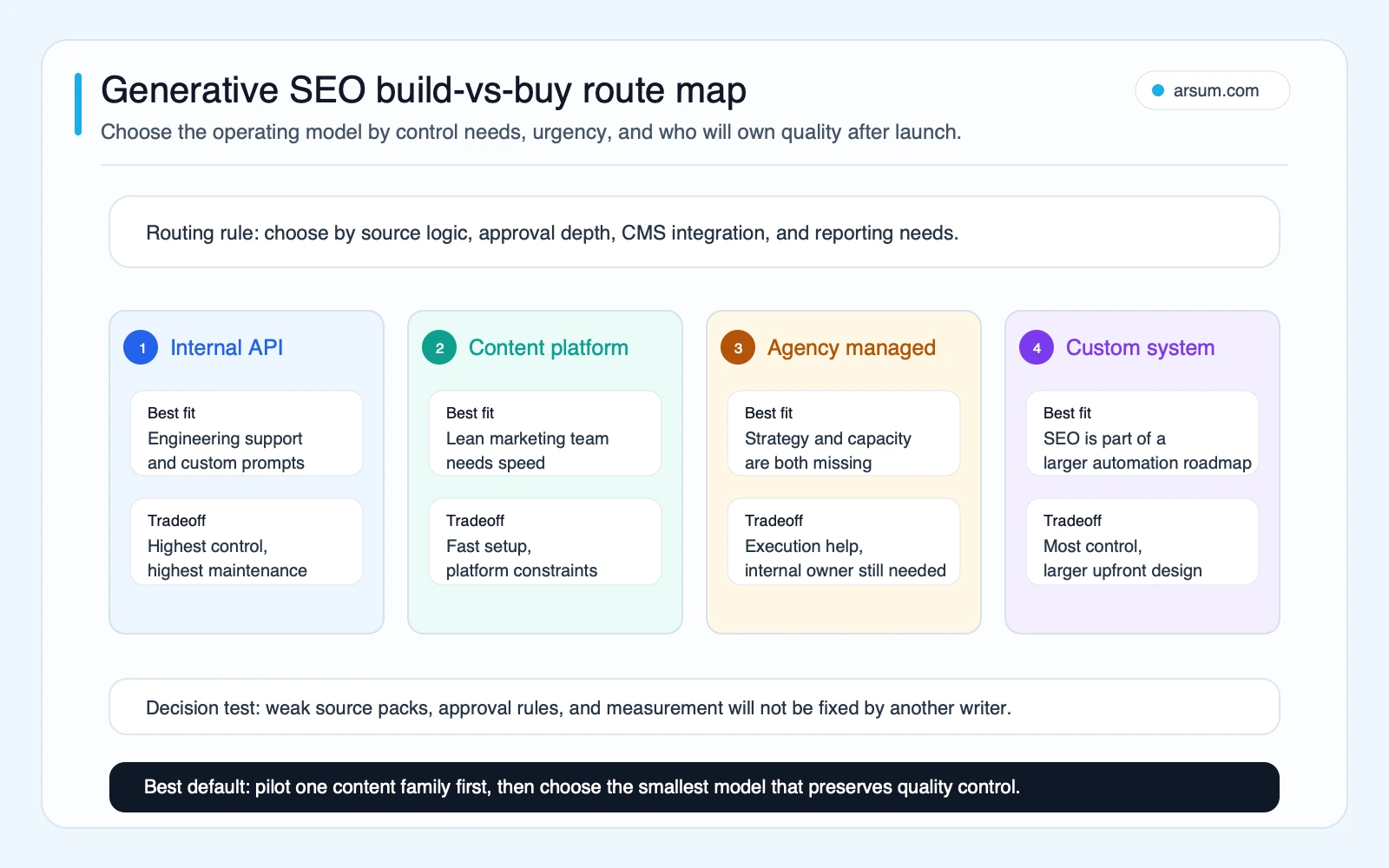
Choose the smallest operating model that preserves source control, approval quality, CMS integration, and performance measurement.
Implementation Practices That Prevent Waste
These patterns consistently separate useful generative SEO from expensive content noise.
Start with One Content Family
Pick one repeatable content type: integration pages, use-case pages, comparison pages, help articles, glossary pages, or implementation guides. Do not automate the whole content calendar on day one.
Build the Source Pack First
Collect approved claims, examples, screenshots, objections, customer language, product details, and internal links before drafting. If the source pack is thin, the output will be thin.
Define “Approved” Before Drafting
Your editors need clear criteria. Define what “publication-ready” means:
- Factual accuracy verified
- Business-specific example included
- Reader intent answered directly
- Internal links and CTA fit the page
- Unsupported claims removed
- Quality is stronger than the pages currently ranking
Version Prompts and Review Outcomes
Track prompt changes, review notes, publication dates, and performance. When a page works, codify why. When a batch underperforms, fix the template before producing more.
Keep SEO Fundamentals in the Workflow
Generative SEO accelerates content creation, but it does not replace keyword research, technical SEO, internal linking, site architecture, page speed, schema, or conversion paths.
Monitor Drift
Models, products, positioning, and search results change. Schedule recurring audits for factual accuracy, brand voice, link health, rankings, traffic quality, and conversion contribution.
Real-world pattern: A safe first pilot is often 10-20 pages from one content family, one approved source pack, one editor, and one business metric. If the pilot reduces production hours and produces pages that sales, support, or growth teams actually use, then scale the template.
What to Watch Next
Generative SEO is moving beyond article drafting, but the practical priority stays the same: better source material, clearer review, and tighter feedback loops.
AI Answer Engines
As buyers use ChatGPT, Claude, Gemini, Perplexity, and other answer engines for research, content must be structured enough to be cited, summarized, and trusted outside traditional search results. Specific examples, clean explanations, and strong entity context matter more than generic keyword repetition.
Automated Monitoring
More systems will flag outdated claims, broken internal links, ranking changes, and conversion drops automatically. That is useful only if someone owns the response process.
Richer Content Outputs
AI-assisted workflows will draft not just pages, but comparison tables, diagrams, summaries, schema, social snippets, and sales enablement assets from the same source pack.
Do not overbuy future capability before the current workflow works. The teams that win are the ones that turn AI into a reliable operating system for specific content jobs, not the ones with the longest tool list.
Reusable Artifact: Pre-Publish Gate for AI-Assisted SEO Pages
Before an AI-assisted page goes live, make sure the owner can answer yes to each check:
- Does the page use approved source material instead of model guesswork?
- Does it add at least three visible value modules, such as a comparison table, decision tree, checklist, example, or methodology note?
- Did a human verify every statistic, claim, and external reference?
- Is the CTA and internal linking tied to an actual buyer journey?
- Would this page still be worth publishing if it never ranked, because sales, support, or product could still use it?
If the answer is no to any of those, the workflow is not ready for scale. Fix the page or the process first.
Methodology and Evidence Note
This guide is based on direct review of Google’s helpful-content guidance, spam policies, and AI-features documentation, combined with qualitative signals from current SEO community discussions. Official Google sources support the policy and risk framing. Community threads are useful for spotting recurring confusion, not for proving outcomes on their own.
Frequently Asked Questions
What is generative SEO?
Generative SEO is the practice of using AI language models to draft search-optimized content at scale, combined with human oversight, approved source material, quality control, and performance monitoring.
Is generative SEO the same as AI SEO?
Not exactly. “AI SEO” is a broad term covering any use of AI in search optimization – including keyword research tools, rank tracking, and technical audits. Generative SEO specifically refers to using AI to create content. It’s a subset of AI SEO focused on content generation.
Does Google penalize AI-generated content?
The practical risk is not the creation method by itself. The risk is low-quality, thin, unsupported, or unhelpful content. Human editing, original examples, accurate claims, and clear usefulness matter more than trying to make AI involvement invisible.
How much does generative SEO cost?
Costs vary by operating model:
- Internal API workflow: model usage, engineering time, editorial time, CMS integration, and QA maintenance.
- Marketing platform: subscription costs plus strategy, source prep, editing, and approvals.
- Agency-managed workflow: strategy, production, review management, and reporting packaged as a service.
- Custom system: higher upfront design and integration cost, but more control over data, permissions, approvals, and reporting.
The ROI should be measured by approved-page cost, production cycle time, qualified traffic, assisted conversions, sales usage, or reduced support load.
Can generative SEO replace human writers?
No. It shifts human work from first-draft production to strategy, source selection, expert review, editing, quality control, and performance iteration. The human role becomes more operational and judgment-heavy, not less important.
What tools are used for generative SEO?
Common tools include:
- LLM APIs and model providers
- Marketing content platforms
- SEO research and optimization tools
- CMS and publishing integrations
- Quality-control checklists and review systems
- Custom workflows that connect source packs, prompts, approvals, and reporting
How is generative SEO different from agentic SEO?
Generative SEO creates drafts from human-defined briefs and requires human approval before publishing. Agentic SEO can manage more of the workflow itself, including keyword selection, generation, publishing, monitoring, and optimization.
Is generative SEO worth it for small businesses?
It depends on whether content volume is a real constraint. If you only need a few high-stakes thought leadership pieces, manual production is usually better. If you have repeatable pages, a clear conversion path, and enough review capacity, a small pilot can show whether automation is worth scaling.
How do I know whether to automate a content workflow?
Automate when the content type is repeatable, the business goal is measurable, the source material is available, and review risk is manageable. Do not automate first when the topic depends on original executive judgment, undocumented expertise, sensitive claims, or unclear ownership.
Getting Started with Generative SEO
If you’re considering generative SEO for your business, start with a scoped pilot:
Choose one business use case: Pick a content family tied to pipeline, sales enablement, onboarding, support, or product education.
Baseline the current workflow: Measure production hours, review time, cost per approved page, publishing delay, and the business metric you want to improve.
Build the source pack: Collect approved claims, product details, examples, customer language, internal links, screenshots, and compliance rules.
Design the prompt and QA checklist together: The prompt should produce what the checklist will evaluate.
Decide build, buy, or agency support: Choose based on control needs, internal capacity, integration complexity, and speed to value.
Launch 10-20 pages and review by template: Track quality issues, production time, rankings, qualified traffic, assisted conversions, and team adoption.
Scale only what proves useful: If the pilot reduces cost or cycle time while maintaining quality and business relevance, expand the template. If it creates review drag or generic output, fix the workflow before producing more pages.
Generative SEO works when it is treated as an operating system for a specific content job. The business case should be clear before implementation: what gets faster, what gets cheaper, what gets safer, and what commercial outcome the team will measure.
Ready to Automate Your Business?
Stop wasting time on repetitive tasks. Let AI handle the busywork while you focus on growth.
Schedule a Free Strategy Call →Related Arsum Guides
Continue with these closely related guides:
Written by:Arsum editorial team
- Reviewed by
- Arsum editorial team
- Published
- February 15, 2026
- Updated
- July 6, 2026
- How this was produced
- Arsum uses research packs, source checks, and human editorial review to prepare and update blog articles. Editors are responsible for the final page.
- Source policy
- Sources are linked in the article when used. Methodology and source notes are included on higher-risk or high-visibility pages and are being rolled out across the archive. Editorial policy.
- Why this page exists
- Help B2B operators evaluate AI automation, implementation scope, cost, risk, and build-vs-buy decisions with practical context.