If your team is already using ChatGPT every day, gpt store vs chatgpt apps becomes a practical buyer question fast: should you build a GPT, build a ChatGPT app, or keep this workflow somewhere else entirely?
GPT Store vs ChatGPT Apps
Explore gpt store vs chatgpt apps: compare workflow fit, costs, risks, evidence, and practical next steps before you build, buy, or hire.

For buyers, the real question is not just GPT Store vs Apps SDK. It is whether the workflow belongs inside ChatGPT at all.
Table of Contents
- Operator Note
- What Most Guides Miss
- GPT Store vs ChatGPT Apps SDK at a Glance
- Why This Matters to a Buyer
- Social Listening: What Builders Are Still Uncertain About
- What the GPT Store Is Actually Good For
- What the Apps SDK Is Actually Good For
- Mini Experiment: One Workflow, Three Different Surfaces
- Budget, Rollout Risk, and ROI Drivers
- Apps SDK Launch-Readiness Checklist for Buyers
- Data, Privacy, and Failure Ownership
- Commodity vs Non-Commodity Breakdown
- Google Risk Box: Thin App Surfaces and Thin Automation
- Reusable Artifact: ChatGPT Surface Fit Scorecard
- Common Buyer Mistakes
- Freshness Note
- Methodology Note
- FAQ
- What is the difference between the GPT Store and the ChatGPT Apps SDK?
- When is the GPT Store enough for a business?
- When is the Apps SDK worth it?
- Should we build inside ChatGPT at all?
- Is directory discovery a strong enough reason to build?
- What is the best next step if we are still unsure?
- Ready to Automate Your Business?
- Related Arsum Guides
That sounds like a platform question, but for a buyer it is really a workflow and risk question.
A lot of teams get pulled into the wrong conversation too early. They start comparing surfaces, directory listings, and developer features before they answer the harder business questions: what outcome are we trying to improve, who owns failure when the system is wrong, what data can leave our stack, and how will we know this is worth doing six months after launch?
The GPT Store is a lightweight publishing surface. The ChatGPT Apps SDK is a real application surface. Neither one is automatically the right answer for a business workflow.
If you are still pressure-testing whether the workflow is worth automating at all, start with AI automation ROI examples and AI implementation services. Those two guides help you evaluate the economics and delivery burden before you commit to a ChatGPT-native build.
Operator Note
This page is for B2B founders, operators, revenue leaders, and technical buyers deciding whether a ChatGPT-native surface makes business sense. It is not primarily for indie developers choosing where to ship their next product.
The useful buyer question is narrower: if a workflow is already happening inside ChatGPT or could naturally live there, should you use the GPT Store, the Apps SDK, or skip both and build somewhere you control more directly?
What Most Guides Miss
Most GPT Store vs Apps SDK pages are written from the builder’s perspective. They compare features, code requirements, monetization ideas, and launch mechanics.
That is not the buyer’s actual problem.
The buyer problem is operational:
- What changes after launch?
- Who owns permissions, support, monitoring, and rollback?
- Does this workflow actually belong inside ChatGPT?
- What happens when the model is wrong or the external system is unavailable?
- Is the goal discovery, internal productivity, customer self-service, or direct revenue?
If those questions stay blurry, the platform comparison does not help much. You can still end up building the wrong thing on the more impressive surface.
GPT Store vs ChatGPT Apps SDK at a Glance
| Dimension | GPT Store | ChatGPT Apps SDK | Buyer implication |
|---|---|---|---|
| What it is | Configured GPT inside ChatGPT | Full app surface inside ChatGPT | One is a publishing layer, the other is a software project |
| Build effort | Low | Moderate to high | Speed vs control is the first real tradeoff |
| Auth and permissions | Limited and lighter-weight | Better fit for authenticated, structured workflows | Sensitive business logic usually pushes you toward Apps SDK or outside ChatGPT |
| Workflow complexity | Simple to moderate | Moderate to high | Multi-step logic, approvals, and integrations increase delivery scope fast |
| Discovery | Native directory and sharing model | Emerging app distribution inside ChatGPT | Discovery exists, but it should not replace ROI logic |
| Operational ownership | Often underestimated | Explicit and unavoidable | Apps SDK forces you to think more like a product owner |
| Best fit | Lightweight assistants, pilots, top-of-funnel tools | Customer or team workflows that benefit from ChatGPT-native UI | The real question is whether users already live in ChatGPT |
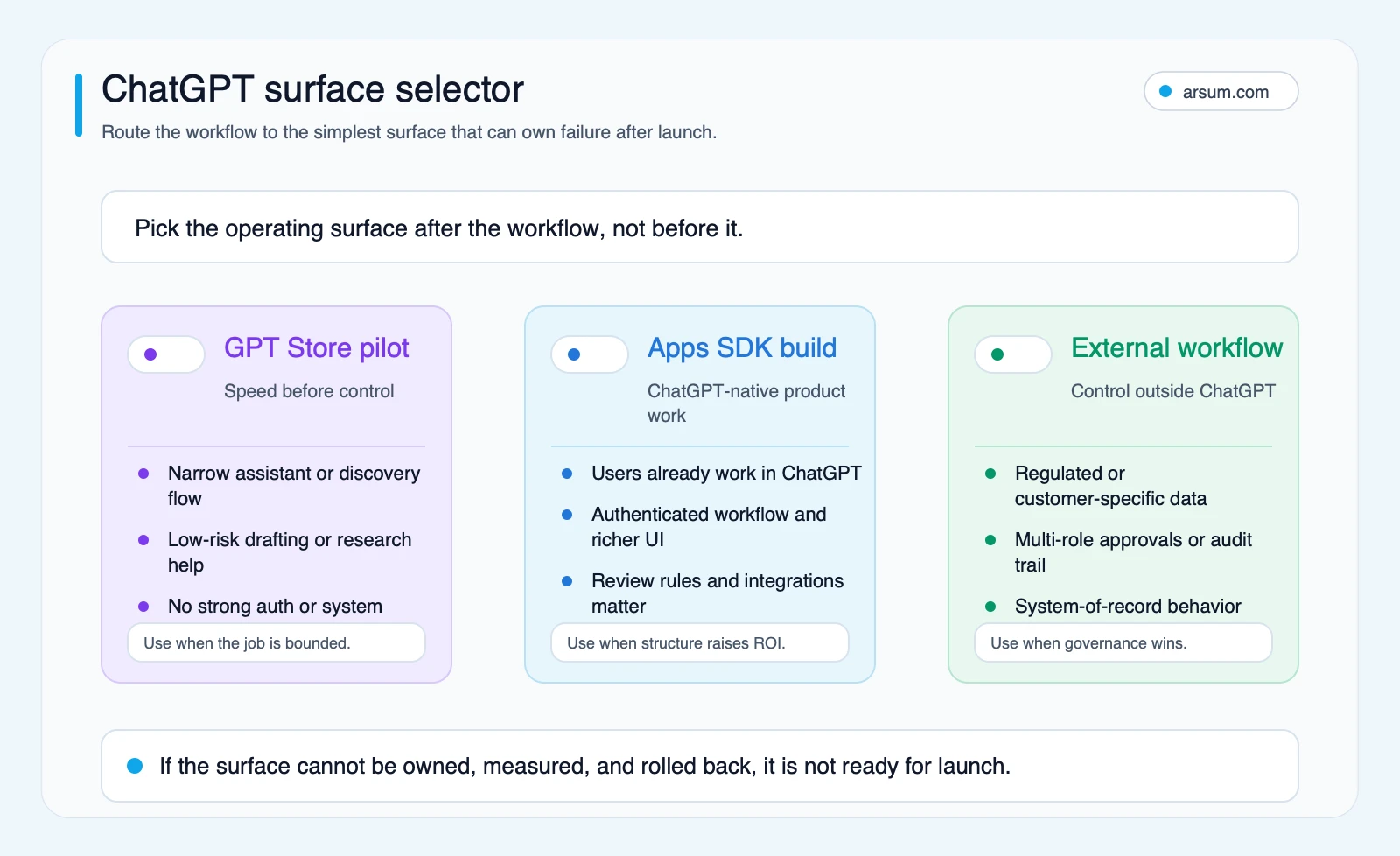
Use the surface selector to route the workflow by failure ownership, not by platform novelty.
Why This Matters to a Buyer
For operators, the difference is not academic.
If you choose the GPT Store for a workflow that needs authenticated user context, system integrations, review logic, and measurable business outcomes, you will hit the ceiling quickly.
If you choose the Apps SDK for a workflow that could have been handled by a simpler assistant or by an existing automation tool, you can spend months building a product-shaped answer to a small process problem.
That is why the highest-value question is not “which OpenAI surface is newer?” It is “what operating model does this workflow need after launch?”
A credible answer should cover:
- user access and identity,
- systems touched,
- review rules,
- exception handling,
- measurement,
- and who owns the workflow once it is live.
If you need help pressure-testing that operating model before committing to a build, AI automation platform guide and AI agent security are the right next reads.
Social Listening: What Builders Are Still Uncertain About
The market language around these surfaces is useful, even for buyers.
The clearest factual references are still OpenAI’s GPTs in ChatGPT guide, sharing and publishing GPTs guide, Apps SDK docs, and submission guide for Apps SDK apps. Those explain the official product boundaries. Public builder discussions are useful for a different reason: they show where rollout friction still appears in practice.
Four themes keep showing up in those discussions:
- Submission is real product work: Builders describe Apps SDK launch as a checklist with screenshots, demo flows, privacy and terms links, test prompts, and review artifacts, not a quick publish button.
- OAuth and tool scanning can become schedule risk: Community threads around MCP and app review show that authentication and tool verification are often where delivery timelines slip.
- Directory placement is not trust by itself: Public discussion around ChatGPT-native apps raises obvious buyer concerns about authentic apps, clear branding, and whether in-chat suggestions deserve the same trust as a vendor’s own product surface.
- GPT Store monetization is not a business case: Builder skepticism around GPT discovery and revenue means buyers should treat GPT Store visibility as distribution upside, not as the primary ROI model.
For a buyer, that matters because it changes how you should evaluate vendor claims. If builders are still working through auth, review flow, and runtime behavior, you should not accept vague promises about fast, low-risk delivery.
Treat ChatGPT-native builds like product work, not like a prompt-packaging exercise.
What the GPT Store Is Actually Good For
According to OpenAI’s help documentation on GPTs in ChatGPT, sharing and publishing GPTs, and configuring actions in GPTs, the GPT Store is designed for creating and sharing custom GPT experiences inside ChatGPT, with a lighter operational model than a full app.
For buyers, that makes it best suited to:
- internal knowledge helpers,
- lightweight research or drafting assistants,
- customer-facing discovery tools,
- lead-generation or demo experiences,
- fast pilot surfaces where the workflow risk is low.
The GPT Store is attractive when you need speed more than control.
That can be a smart choice if the job is narrow. For example, a sales enablement GPT that helps reps draft first-pass discovery questions, or a support FAQ assistant that helps customers understand policy language before they escalate.
It becomes a bad fit when the workflow needs:
- strong identity and permissions,
- audited system actions,
- multi-role approvals,
- durable state across steps,
- or clear production ownership.
In those cases, the GPT Store often works best as a lightweight discovery or pilot layer, not the system you rely on to run the workflow.
What the Apps SDK Is Actually Good For
OpenAI’s Apps SDK documentation, quickstart, and submission guide make the intent clearer: this is the surface for real applications inside ChatGPT, not just configured assistants.
For buyers, the Apps SDK becomes interesting when the workflow needs more structure, such as:
- authenticated user sessions,
- richer UI and data collection,
- controlled tool use,
- integrations with business systems,
- staged review or approval steps,
- and a clearer product lifecycle after launch.
This is why the Apps SDK is the more serious option for customer onboarding assistants, internal policy tools, proposal workflows, account research assistants, or guided self-service flows where the user is already likely to be working inside ChatGPT.
But it also comes with real delivery burden:
- product scoping,
- design for failure and fallback,
- system integration,
- testing,
- observability,
- support,
- and versioned maintenance.
That is a software project. Buyers should treat it like one.
💡 Arsum builds custom AI automation solutions tailored to your business needs.
Get a Free Consultation →Mini Experiment: One Workflow, Three Different Surfaces
Take a realistic workflow: a mid-market sales team wants a ChatGPT-native assistant that helps reps answer RFP questions, pull approved boilerplate, and draft a first-pass response.
Now compare three implementation paths.
| Path | What gets built | Upside | Main risk | Operator fit score |
|---|---|---|---|---|
| GPT Store | A custom GPT with approved documents, response guidelines, and basic prompting | Fast pilot, low complexity, useful for first-pass drafting | Weak governance if reps start treating it like a source of truth | 6/10 |
| Apps SDK | A ChatGPT app with authenticated access, structured answer generation, and connections to approved content sources | Better control, clearer usage model, stronger workflow fit | More build effort, more maintenance, more testing responsibility | 8/10 |
| External workflow or portal | An internal proposal assistant outside ChatGPT, connected directly to CRM, docs, approvals, and audit logs | Highest control and strongest enterprise fit | More change management and lower ChatGPT-native convenience | 9/10 for regulated teams, 5/10 for casual use cases |
The practical lesson is not that the Apps SDK always wins.
It is that the best surface depends on the workflow’s failure cost and the user’s actual working environment.
If the job is lightweight drafting, GPT Store can be enough.
If the job is authenticated, repeatable, and still naturally lives inside ChatGPT, Apps SDK is often the right middle ground.
If the job touches regulated data, approvals, billing logic, or core system-of-record behavior, you should seriously consider whether the workflow belongs outside ChatGPT entirely.
Budget, Rollout Risk, and ROI Drivers
This is where buyers usually underestimate the work.
The real cost is rarely “GPT vs app.” It is the operating model around the surface.
| Driver | GPT Store | Apps SDK | Buyer impact |
|---|---|---|---|
| Setup effort | Low | Moderate to high | Faster launch vs longer scoped build |
| Integration complexity | Low to moderate | Moderate to high | Every extra system increases test burden |
| Review design | Light | More explicit | Safer workflows require more design upfront |
| Maintenance | Easy to underestimate | Impossible to ignore | Apps SDK creates real product ownership |
| ROI clarity | Often soft | Easier to measure if instrumented well | The higher-control option usually supports better measurement |
For buyers, the best ROI questions are:
- Is the user already inside ChatGPT often enough for this surface to matter?
- Is the workflow valuable enough to justify the extra operating complexity?
- What metric improves if we launch this, time saved, conversion, deflection, quality, or cycle time?
- What is the rollback plan if usage is weak or output quality is uneven?
If those answers are fuzzy, slow down before choosing a surface.
Apps SDK Launch-Readiness Checklist for Buyers
Before you approve an Apps SDK build, ask the vendor or internal team to show you these artifacts:
- a public MCP endpoint plan and the person who owns deployment
- the authentication path, including test credentials and fallback behavior during review
- privacy policy, terms, and data-sharing language that match the real workflow
- tool-permission justifications and safeguards for destructive or customer-visible actions
- screenshots, demo prompts, and review artifacts needed for submission
- a support path for review rejection, OAuth issues, user confusion, and policy changes after launch
If those items do not exist yet, the project is probably earlier than the proposal makes it sound.
Data, Privacy, and Failure Ownership
This is where many “which should we build?” articles stay too shallow.
For operators, the most important questions are not feature questions. They are ownership questions.
Ask these before approving either path:
- What business data enters the tool?
- Is the content public, internal, customer-specific, or regulated?
- Does the workflow create or recommend actions, or actually execute them?
- Who reviews low-confidence output?
- Where do failures show up?
- Who owns updates after the first release?
If the workflow touches contracts, pricing, customer-specific records, internal policy, or regulated documents, your evaluation should move quickly from “which surface is easier?” to “which surface lets us govern this safely?”
That is where AI agent security and hiring AI developer vs agency become practical, not theoretical.
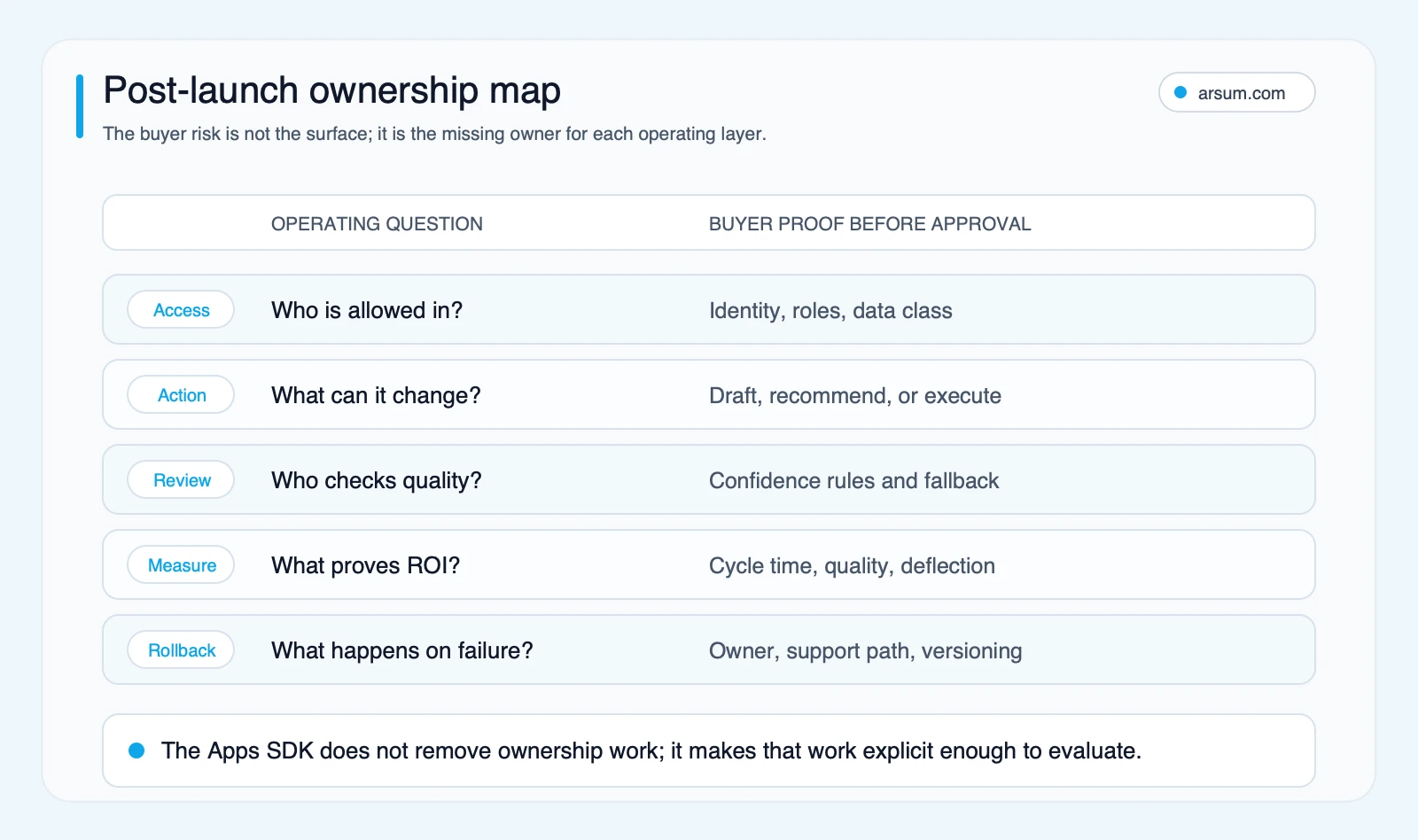
Use the ownership map to make access, review, measurement, and rollback explicit before approving a build.
Commodity vs Non-Commodity Breakdown
Some parts of this decision are becoming easier to buy. Others are still stubbornly non-commodity.
| Commodity layer | Why it is getting easier | Non-commodity decision | Why it still matters |
|---|---|---|---|
| Basic GPT creation | Publishing simple assistants is now straightforward | Workflow selection | You still need to choose a business problem worth solving |
| ChatGPT-native distribution | OpenAI is making discovery and submission easier | Failure ownership | Someone still owns support, rollback, and trust after launch |
| Prompted drafting | Many tools can draft a first pass | Review and approval design | Safe output depends on your internal operating rules |
| Surface comparison | Feature lists are easy to find | ROI measurement | Buyers need proof the workflow improved, not just that it shipped |
| Builder excitement | App-store narratives are easy to market | Workflow fit | A ChatGPT surface is only useful if users actually want to work there |
Strong buyers spend less time asking which OpenAI surface sounds more exciting and more time asking whether the workflow can be owned, measured, and governed after launch.
Google Risk Box: Thin App Surfaces and Thin Automation
Google’s public guidance on helpful content and scaled content abuse offers a good analogy here.
A page can look impressive and still be thin if it does not create visible usefulness.
The same is true of ChatGPT-native automation.
A company can launch a GPT or even a polished app and still ship something thin if the workflow is vague, the permissions are unclear, the output is unmeasured, and the post-launch owner is undefined. A flashy surface does not make a weak operating model strong.
For buyers, this is the practical filter: prefer the implementation that gives you clearer ownership, cleaner workflow boundaries, and measurable outcomes, not the one that simply looks more platform-native.
Reusable Artifact: ChatGPT Surface Fit Scorecard
Use this before you approve a build. Score each line from 1 to 5.
| Criterion | 1 means | 5 means |
|---|---|---|
| User behavior fit | Users rarely work in ChatGPT | Users already live in ChatGPT daily |
| Workflow complexity | Mostly informational, low-risk | Structured, valuable, but still manageable |
| Permissions clarity | Identity and access are undefined | User roles and access rules are explicit |
| Review design | “We will add guardrails later” | Clear human review and fallback path exist |
| ROI measurability | Benefits are vague | Time, quality, revenue, or deflection can be measured |
| Failure cost | Wrong output creates real downstream risk | Errors are bounded and recoverable |
| Surface necessity | ChatGPT is optional | ChatGPT is the natural working surface |
Interpretation
- 7 to 14: Do not build yet. Problem definition is too weak.
- 15 to 24: Consider a narrow GPT Store pilot or a very constrained proof of concept.
- 25 to 35: Strong candidate for Apps SDK or a more serious scoped build.
This scorecard is simple on purpose. If a vendor cannot walk through these categories clearly, they are probably still selling the surface rather than the operating model.
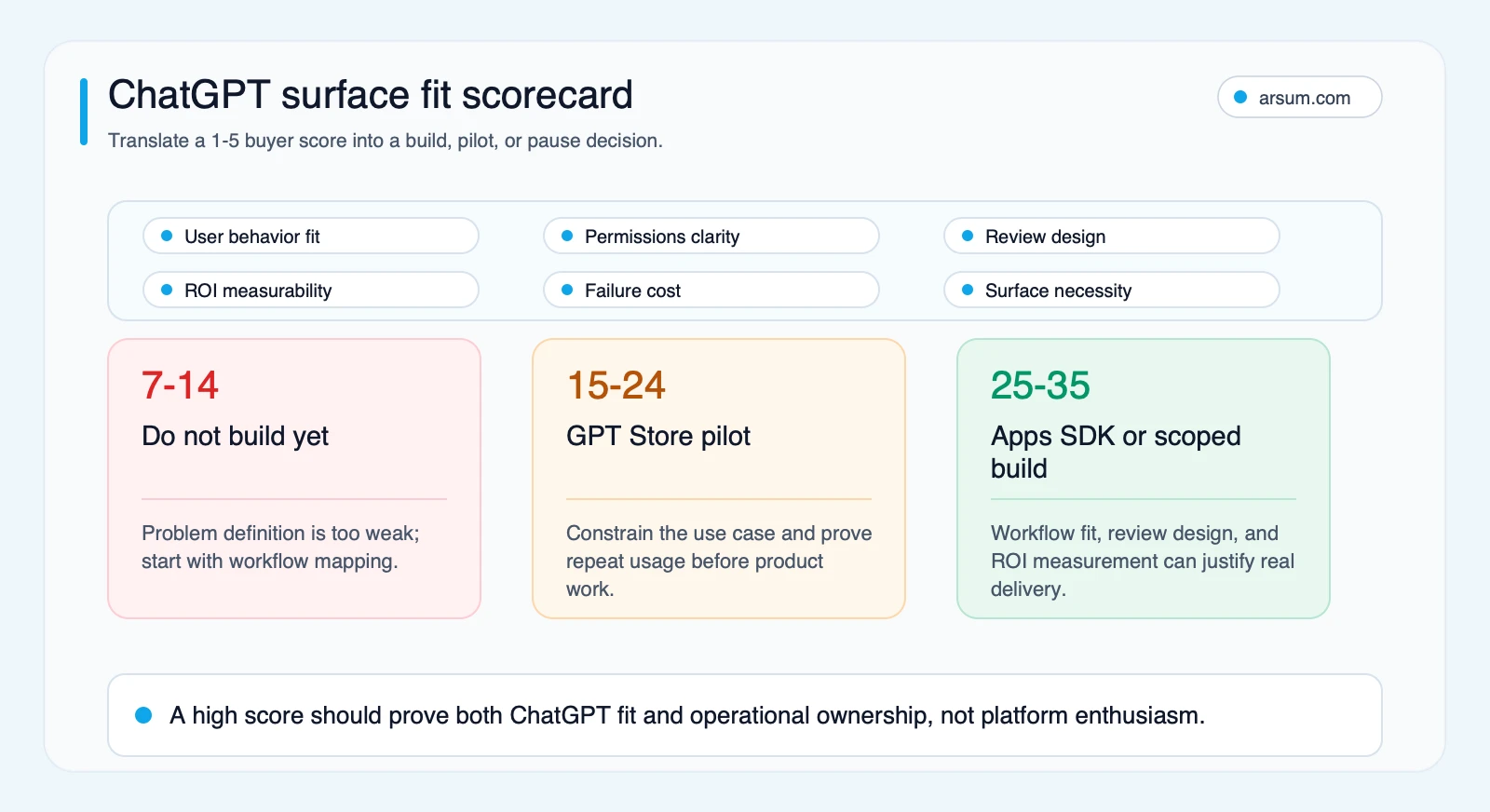
Use the scorecard to convert buyer-fit signals into a pause, pilot, or scoped-build decision.
Work With Arsum
We help businesses implement AI automation that actually works. Custom solutions, not cookie-cutter templates.
Learn more →Common Buyer Mistakes
Choosing the surface before choosing the workflow
This is the biggest one. Teams get excited about a new platform and then reverse-engineer a use case to fit it.
Confusing distribution with ROI
A directory or app surface can create attention. It does not automatically create a worthwhile business outcome.
Underestimating maintenance
A ChatGPT-native tool that touches real business logic still needs owners, updates, support, and measurement.
Treating internal usage like product-market fit
If a few employees try a tool once, that is not the same as a repeatable workflow becoming better.
Ignoring the “neither” option
Sometimes the right answer is not GPT Store or Apps SDK. It is a simpler external automation, or a workflow redesign before any AI surface gets built.
Freshness Note
Last reviewed in July 2026.
This category is moving quickly. OpenAI’s distribution mechanics, app review process, and commercial model may change faster than the underlying workflow economics do. Re-check current documentation, submission rules, action requirements, and product limitations before committing to a build.
Methodology Note
This article was refreshed against official OpenAI Help Center and developer documentation for GPTs, GPT actions, Apps SDK setup, and Apps SDK submission requirements, then pressure-tested with public builder discussions about submission friction, OAuth and tool scanning, app trust, and GPT monetization expectations. Official docs support the product facts here. Community threads are used only as qualitative implementation signal, not as prevalence data.
FAQ
What is the difference between the GPT Store and the ChatGPT Apps SDK?
The GPT Store is a lighter publishing surface for custom GPTs inside ChatGPT. The Apps SDK is a fuller application surface for structured, authenticated, and more product-like workflows inside ChatGPT. For buyers, the real difference is operational complexity and control after launch.
When is the GPT Store enough for a business?
Usually when the workflow is narrow, low-risk, and mostly about assistance rather than execution. Internal knowledge helpers, drafting assistants, and lightweight discovery tools can fit well. If the workflow needs strong auth, system integration, or explicit review rules, the GPT Store ceiling appears quickly.
When is the Apps SDK worth it?
When users already work inside ChatGPT, the workflow benefits from a ChatGPT-native experience, and the use case is valuable enough to justify real product work. The Apps SDK becomes more compelling when you need structure, integrations, state, and clearer operational ownership.
Should we build inside ChatGPT at all?
Not always. If the workflow touches sensitive systems, multi-role approvals, billing logic, or regulated data, an external workflow or internal app may be a better fit. The right question is whether ChatGPT is the natural working surface, not whether it is the newest one.
Is directory discovery a strong enough reason to build?
No. Discovery can help, but it is not the same as measurable ROI. For a buyer, the workflow still needs a clear owner, clear outcome, and clear reason to exist after the novelty wears off.
What is the best next step if we are still unsure?
Map one workflow, score it using the fit model above, and decide whether you are solving a light assistance problem, a ChatGPT-native product problem, or a broader automation problem. If the surface still looks promising but the delivery path is unclear, compare it against AI implementation services before choosing build, buy, or partner.
Ready to Automate Your Business?
Stop wasting time on repetitive tasks. Let AI handle the busywork while you focus on growth.
Schedule a Free Strategy Call →Related Arsum Guides
Continue with these closely related guides:
Written by:Arsum editorial team
- Reviewed by
- Arsum editorial team
- Published
- May 23, 2026
- Updated
- July 6, 2026
- How this was produced
- Arsum uses research packs, source checks, and human editorial review to prepare and update blog articles. Editors are responsible for the final page.
- Source policy
- Sources are linked in the article when used. Methodology and source notes are included on higher-risk or high-visibility pages and are being rolled out across the archive. Editorial policy.
- Why this page exists
- Help B2B operators evaluate AI automation, implementation scope, cost, risk, and build-vs-buy decisions with practical context.