To hire ai developer talent responsibly, start with a bounded workflow, approved data, a measurable outcome, and a named owner for exceptions; if any of those are missing, fund discovery or evaluate a platform before opening a role.
Hire AI Developer: Practical Guide
Explore hire ai developer: compare workflow fit, costs, risks, evidence, and practical next steps before you build, buy, or hire.

Table of Contents
- What most hiring guides miss: the hire is not the first decision
- Define the role you actually need
- Build, buy, freelance, partner, or hire internally
- A worked pilot scorecard for a consequential workflow
- What to test in the interview
- Contract and handoff requirements
- Disqualifying conditions and common failure modes
- The first 30, 60, and 90 days
- Methodology and limits
- What to do before you hire
- Related Arsum guides
What most hiring guides miss: the hire is not the first decision
Marketplaces can help you find candidates, but they cannot decide whether custom AI work is the right operating choice. Before comparing a freelancer, agency, or internal hire, determine whether the workflow is ready to be owned in production.
Use this five-part readiness diagnostic:
| Question | Ready answer | If unresolved |
|---|---|---|
| What workflow changes? | A bounded process, trigger, user, and handoff are named | Do discovery before hiring |
| What business metric matters? | Time, queue age, quality, conversion, or review cost has a baseline | Measure the current workflow first |
| What data can the system use? | Sources, permissions, retention, and source owner are documented | Do not give a developer broad access to “figure it out” |
| What happens when it is wrong? | A human approver, exception queue, and escalation path exist | Keep the work assistive or stop |
| Who owns it after launch? | A business owner and technical owner are named | Do not buy a handoff you cannot operate |
Score each item from 0 to 2: 0 means unresolved, 1 means partly known, and 2 means ready enough to scope. A total below 8 is a discovery problem, not a recruiting problem.
This changes the hiring route. A narrow, reversible workflow with clear review can suit a freelancer. A workflow spanning source systems, permissions, deployment, testing, and monitoring usually needs a delivery team. A standard workflow already covered by a mature product may not need custom development at all.
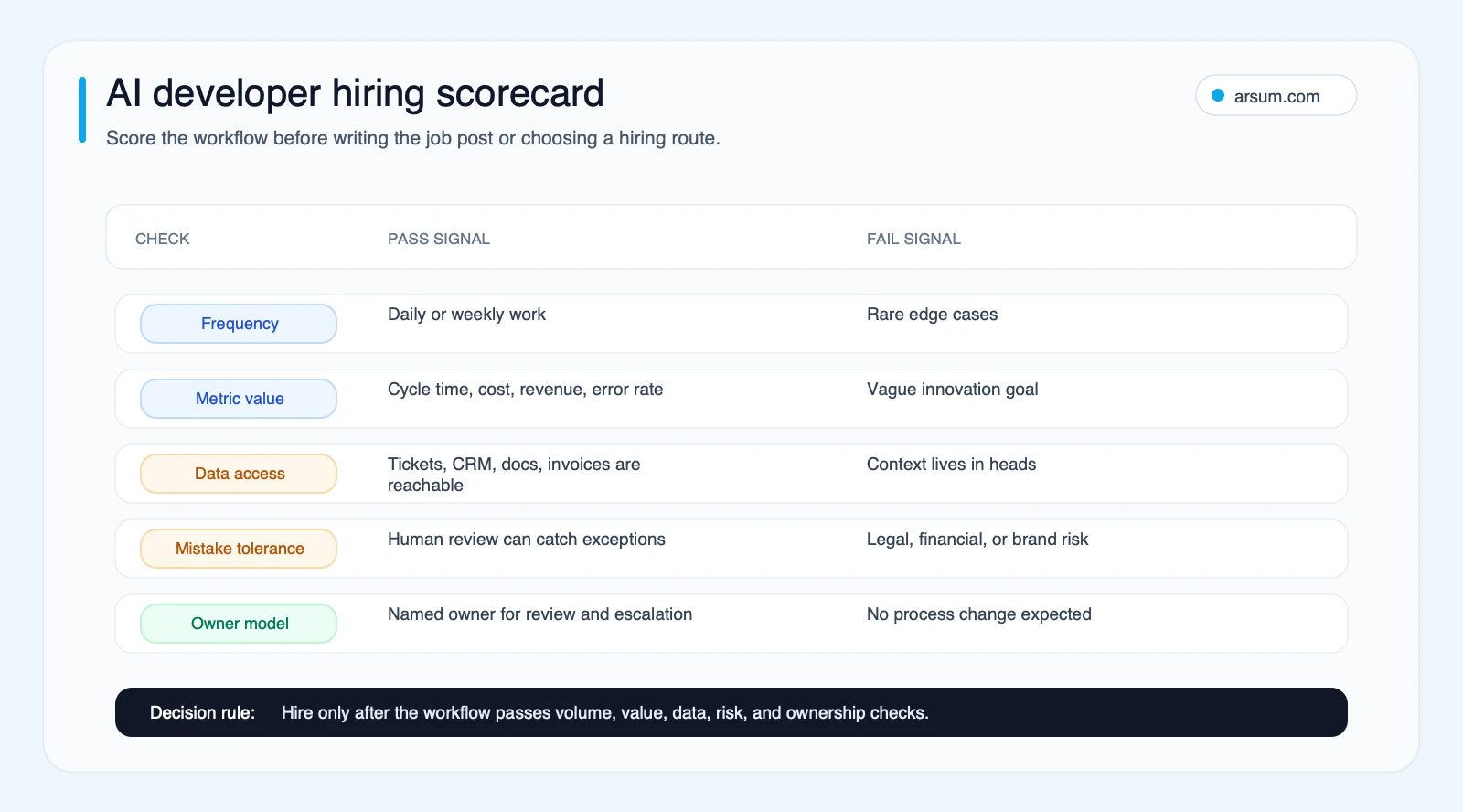
This is an editorial planning tool, not a benchmark study. Use it to decide whether the work is ready to hire for.
Define the role you actually need
“AI developer” covers several different jobs. A vague title produces vague proposals, demos that avoid the hard integrations, or a specialist whose skills do not match the operating problem.
| Primary need | Best-fit route | What they should own | Common mismatch |
|---|---|---|---|
| LLM workflow, retrieval, tool calls, testing, and deployment | Applied AI engineer / AI developer | Application logic, source grounding, evaluations, observability, and release controls | Hiring a prompt specialist for an integration-heavy workflow |
| Custom prediction, ranking, training, or model optimization | ML engineer | Training pipeline, experiments, data quality, and performance analysis | Hiring an ML specialist when existing models and workflow engineering are enough |
| Analysis, reporting, and business experimentation | Data scientist | Measurement, analysis, experiments, and decision support | Expecting a data scientist to own production infrastructure |
| Cross-functional pilot across AI, backend, QA, security, and operations | AI automation agency or implementation team | Delivery plan, integration, testing, release, documentation, and handoff | Treating a team engagement like one individual contractor |
| Common workflow with low data sensitivity | Buy a platform | Configuration, controls, vendor review, and operating ownership | Funding a bespoke build before checking vendor fit |
An applied AI engineer is usually the right label when you need an application built around existing models, rather than a new model invented. Their job is systems work: connect approved data, constrain what the model can do, test outputs against realistic cases, and leave behind an operable workflow.
For broader application delivery, review AI app development services. If the workflow truly needs controlled, multi-step tool use, agentic AI development services can help frame that scope. Do not request an “agent” because the term is fashionable; request it only when a sequence of bounded decisions and tool actions is better than a simpler automation.
Build, buy, freelance, partner, or hire internally
Use this matrix after the readiness diagnostic. It is editorial judgment based on scope and ownership requirements, not a market ranking.
| Route | Choose it when | Integration and data burden | Control tradeoff | Ongoing review cost | Ownership after handoff |
|---|---|---|---|---|---|
| Buy a platform | The workflow is common and a product covers most requirements | Usually lower, though identity and data mapping still matter | You accept vendor constraints and must review data terms | Internal operators review configured outputs and exceptions | Your team owns configuration; vendor owns product changes |
| Freelancer | The task is narrow, reversible, and reviewable by an internal technical lead | Moderate if systems are known and access is prepared | High implementation control; continuity risk stays with you | Your team needs capacity to review code and production behavior | Require repo access, documentation, and handoff terms |
| Agency / delivery partner | You need AI, integrations, QA, security review, and release coordination together | Higher, but planned across disciplines | Scope and contract control matter more than individual candidate control | Shared pilot review cadence is required | Require transfer of code, prompts, test assets, runbooks, and credentials |
| Direct hire | AI is durable product capability and you can retain technical leadership | Can grow with the product | Highest internal control; recruiting and management burden are yours | You fund ongoing engineering and operational review | Internal team owns the full system |
Speed, cost predictability, and ownership vary with geography, scope, procurement, contract structure, and the maturity of your technical leadership. Upwork’s AI developer marketplace and Toptal’s AI talent offering establish that hiring channels exist. They do not establish that a candidate can safely operate your workflow.
A practical rule:
- Buy when vendor fit is high and the workflow is not a differentiating capability.
- Use a freelancer when the build is bounded and a qualified internal reviewer can accept or reject work.
- Use a delivery team when the work crosses application, data, security, and operations boundaries.
- Hire internally when the system’s knowledge, iteration cycle, and product advantage must remain core capability.
If you are deciding between outside delivery and a permanent role, compare the tradeoffs in hiring an AI developer versus an agency.
A worked pilot scorecard for a consequential workflow
A serious candidate should improve this plan, not replace it with model names.
Consider a finance operations team that receives supplier-onboarding packets. The proposed system extracts fields, checks for missing documents, and prepares a reviewer summary. It does not approve a supplier, change payment details, or override policy.
The figures below are illustrative planning assumptions, not observed results:
- Baseline volume: 250 packets per month.
- Current handling time: 18 minutes per packet.
- Fully loaded reviewer cost: $45 per hour.
- Illustrative current monthly handling cost: 250 × 18 ÷ 60 × $45 = $3,375.
- Pilot scope: one packet type, an approved document repository, and a reviewer-facing draft only.
- Candidate target: reduce reviewer handling time to 12 minutes per eligible packet while retaining required evidence.
The target is not “automate 33% of the job.” It is a narrower operating claim: reduce preparation time while keeping a human responsible for the decision.
| Scorecard item | Pilot specification |
|---|---|
| Baseline metric | Median handling time, rework rate, and queue age measured for two weeks before pilot |
| Target | Median handling time at or below 12 minutes for eligible packets |
| Evaluation sample | Held-out, permissioned packets covering normal, incomplete, and contradictory documentation |
| Quality definition | Required fields cite a source document; uncertain fields are marked rather than inferred |
| Exception metric | Missing, conflicting, or low-confidence cases enter a reviewer queue; no silent completion |
| Human approval | Accounts-payable or onboarding reviewer approves every supplier record during the pilot |
| Evidence retained | Input identifiers, source excerpts, output, exception reason, reviewer correction, model/version, and timestamp |
| Named owner | Operations lead owns acceptance; technical lead owns changes; security or privacy owner approves access boundaries |
| Review cadence | Daily exception review in week one; weekly quality and cost review thereafter |
| Cost ceiling | A pre-agreed monthly model and tooling ceiling, compared with labor time actually avoided |
| Stop condition | Missing source citations, unauthorized data access, failed exception routing, or quality below the approved threshold |
| Rollback path | Disable the workflow trigger, preserve the manual queue, revoke credentials if necessary, and continue manual handling |
At day 30, decide whether the pilot is safe and useful enough to extend. At day 60, decide whether it can cover more eligible packet types. At day 90, decide whether to scale, redesign, buy a product instead, or stop.
The go/no-go rule should be explicit: proceed only if the handling-time target is met, the exception path operated as designed, reviewers can identify source lineage, spend remains inside the cost ceiling, and the named owner accepts the remaining review burden. Better output quality alone is not enough if review takes longer or no one can explain why the system produced an answer.
This is the distinction between technical capability and authorized autonomy. A system may be able to extract or recommend, yet remain unauthorized to approve a consequential financial decision. For related boundaries, see AI use cases in finance and AI automation for accounting workflows.
💡 Arsum builds custom AI automation solutions tailored to your business needs.
Get a Free Consultation →What to test in the interview
Ask for production evidence rather than tool familiarity. The Research Pack’s proposed interview exercise is deliberately small: use messy but non-sensitive documents, require a failure analysis before implementation, and assess whether the candidate can make the work reviewable.
Proposed interview scorecard
This is a proposed evaluation framework, not original research or benchmark data. Score each category from 1 to 5 and record the evidence behind the score.
| Category | Strong production answer | Weak signal |
|---|---|---|
| Shipped system | Explains the workflow, rollout, post-launch changes, and what they personally owned | Describes only a notebook, hackathon, or UI prototype |
| Evaluation | Names a test set, pass/fail criteria, regression checks, and how results changed a decision | “We looked at outputs manually” |
| Retrieval and source design | Explains source selection, permissions, citations, stale-content handling, and when retrieval is unsuitable | Treats RAG as a generic checkbox |
| Tool and action boundaries | Separates drafting from actions; explains approvals, retries, idempotency, and rollback | Lets the model trigger broad actions without controls |
| Security | Identifies prompt injection, data exposure, authorization, and logging concerns | Promises to “add guardrails later” |
| Cost and operations | Explains usage monitoring, latency, failures, and alert ownership | Cannot say how cost or quality drift is detected |
| Handoff | Provides repository access, test assets, architecture notes, and runbooks | Keeps operating knowledge in private messages or opaque tool accounts |
Ask each finalist to submit six artifacts:
- A workflow boundary explaining what the system will and will not decide.
- An evaluation plan with a small labeled set and acceptance criteria.
- A source-lineage approach for each output.
- A threat and failure list before implementation.
- A cost estimate that states assumptions and a plan to monitor spend.
- A rollback procedure and short operating runbook.
Usage-based model costs continue after launch. OpenAI API pricing is a useful reminder to include model calls, tokens, tool use, retries, and volume in the total-cost discussion. It is not a forecast for your workflow. Ask candidates to show their inputs and specify how actual spend will be reviewed.
AI coding tools can accelerate parts of implementation, but that does not eliminate architecture, testing, integration, or operational accountability. GitHub’s Copilot productivity research reports findings from a specific research setting; it should not be treated as proof that an AI-assisted developer can safely own production systems without experienced review.
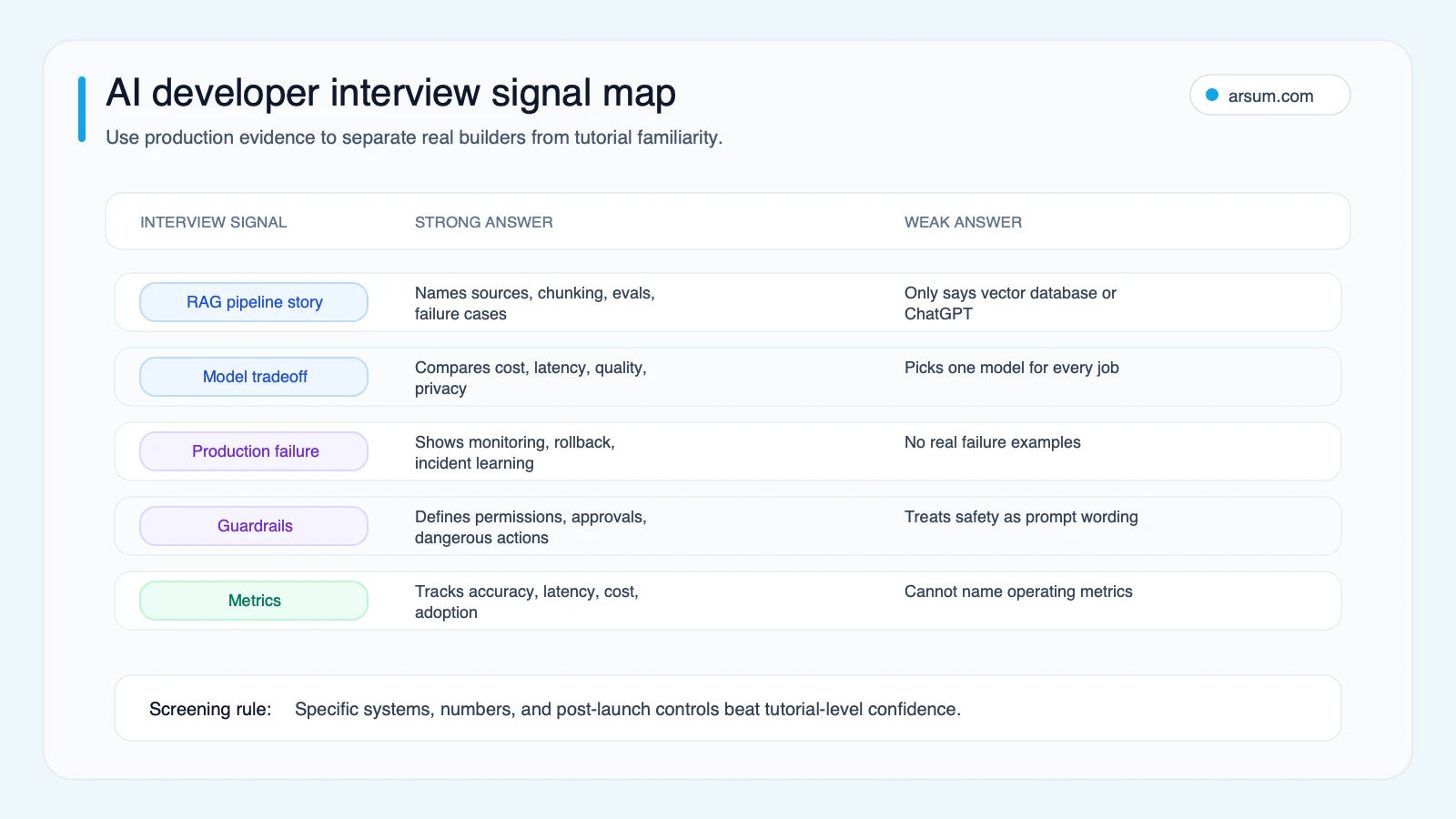
Use the signal map to compare production evidence across candidates instead of rewarding the most confident tool vocabulary.
Contract and handoff requirements
A capable developer can still create an expensive dependency if the agreement does not specify ownership. Put these requirements in the statement of work or employment plan:
- Your organization controls the source repository, deployment account, domain, data connections, and production credentials.
- Prompts, system instructions, evaluation sets, test scripts, infrastructure configuration, and monitoring dashboards are documented and transferred.
- The team defines approved data sources, retention rules, and access permissions before connecting systems.
- Production changes follow a review and release path with an identified approver.
- The agreement identifies who receives alerts, who handles exceptions, and who can disable the workflow.
- The final handoff includes architecture notes, known limitations, cost-monitoring instructions, and unresolved risks.
For a workflow that spans tools and business systems, AI integration services may be more relevant than a narrowly defined developer search. The buyer should still retain the operating assets and the ability to change or turn off the workflow.
Disqualifying conditions and common failure modes
Do not hire for production automation yet if any of these conditions apply:
- The workflow has no stable trigger, owner, or measurable baseline.
- The required data cannot be accessed lawfully, securely, or with understandable permissions.
- A harmful error cannot be caught before it affects a customer, ledger, regulated decision, or external system.
- No qualified person can review exceptions or accept changes after launch.
- The desired outcome is “replace a team” rather than improve a bounded process with evidence.
- A standard vendor product already solves most of the need with acceptable controls.
| Failure mode | What it looks like | Correct response |
|---|---|---|
| Demo-first scope | Impressive output but no operating metric | Re-scope around one workflow and acceptance criteria |
| Unbounded autonomy | The model can send, approve, or modify without appropriate review | Add approval gates or reduce the system to drafting |
| Hidden review cost | Staff spend as much time correcting output as before | Measure review time, correction rate, and exception load |
| Weak source lineage | Reviewers cannot locate the document or rule behind an output | Require citations and preserve evidence |
| Tool sprawl | Multiple agents and integrations appear before a simple path works | Prove the single-step workflow first |
| Orphaned handoff | The contractor leaves and nobody can change or debug the system | Require repo, runbook, credentials, and operating owner |
Community discussions can help discover questions to ask, but they are not labor-market evidence. A Reddit search result about hiring LLM engineers reflects one buyer’s difficulty naming the role. A Hacker News discussion about AI-assisted development and edge cases is a qualitative prompt to test context integration and failure handling. Neither supports a market-wide claim about scarcity, candidate quality, or outcomes.
The first 30, 60, and 90 days
Use the first quarter to earn expansion with operating evidence.
Days 1–30: establish the boundary
Map the workflow, document approved data and permissions, measure the baseline, identify vendor alternatives, define the evaluation sample, and agree on human approval and rollback. If this uncovers an unresolvable data or ownership issue, stopping is a valid outcome.
Days 31–60: prove the narrow path
Build a constrained prototype against representative cases. Test normal inputs, incomplete documents, conflicting data, unavailable tools, and unsafe instructions. Capture reviewer corrections. Do not add broad autonomy or multi-agent orchestration merely to make the demo look advanced.
Days 61–90: run the controlled pilot
Release only to the approved workflow segment. Review quality, exception handling, reviewer time, cost, and evidence retention on the agreed cadence. Scale only when the scorecard supports it.
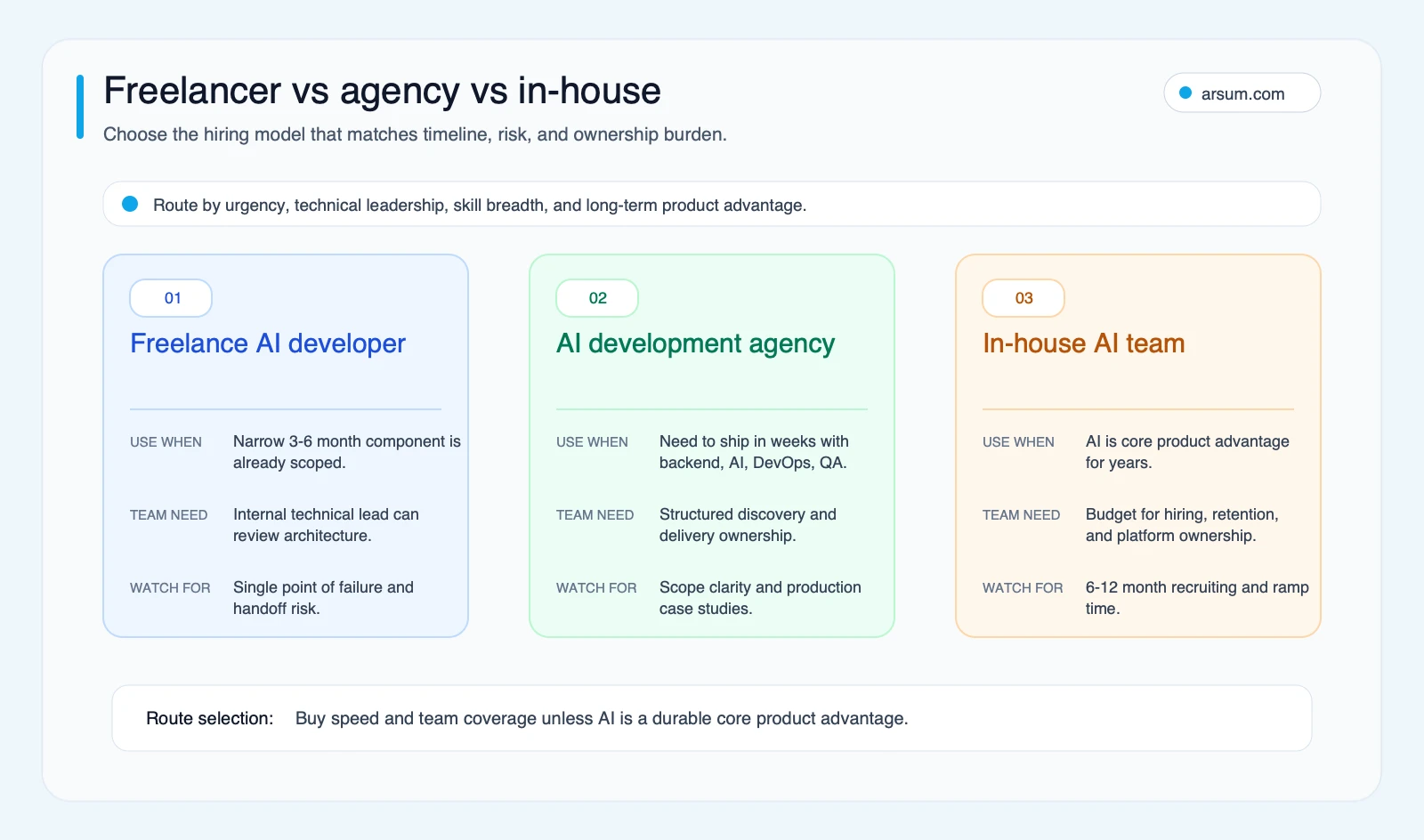
Choose the hiring route after defining the workflow and ownership model. Urgency alone is not a reason to outsource or hire permanently.
Methodology and limits
This guide uses an editorial-only evidence route because this is a hiring and implementation decision, not an occupation-statistics question. The Research Pack reviewed marketplace pages, official pricing and research material, public labor references, and qualitative community search results on June 19, 2026.
Marketplace pages establish that hiring channels exist, not that a provider or candidate will deliver a particular outcome. Community references are snippet-level or discussion-level signals used only to identify buyer questions and failure modes. No hiring-market statistics, adoption rates, or performance claims are inferred from them.
Before signing, re-check model pricing, vendor data terms, jurisdiction-specific requirements, and the actual conditions of your workflow.
What to do before you hire
Write a one-page brief with the workflow trigger, baseline, target, source systems, data permissions, human approval step, exception route, cost ceiling, owner, and rollback procedure. Then compare a platform, freelancer, agency, and direct hire against the same criteria.
If you need help translating that brief into a scoped pilot and a handoff model your team can operate, Arsum can assess the workflow before you commit to a role or vendor.
Work With Arsum
We help businesses implement AI automation that actually works. Custom solutions, not cookie-cutter templates.
Learn more →Related Arsum guides
- Hire AI engineers: salary, contractor, or agency
- AI automation agency services
- AI workflow automation
- AI agent security
- AI automation ROI examples
Ready to Automate Your Business?
Stop wasting time on repetitive tasks. Let AI handle the busywork while you focus on growth.
Schedule a Free Strategy Call →Written by:Arsum editorial team
- Reviewed by
- Arsum editorial team
- Published
- February 20, 2026
- Updated
- July 6, 2026
- How this was produced
- Arsum uses research packs, source checks, and human editorial review to prepare and update blog articles. Editors are responsible for the final page.
- Source policy
- Sources are linked in the article when used. Methodology and source notes are included on higher-risk or high-visibility pages and are being rolled out across the archive. Editorial policy.
- Why this page exists
- Help B2B operators evaluate AI automation, implementation scope, cost, risk, and build-vs-buy decisions with practical context.