
The short answer: If you have a defined revenue, operations, or workflow bottleneck, an AI automation agency is usually the faster way to prove ROI. Hiring an AI developer makes more sense when AI work is continuous, internally owned, and backed by technical leadership.
The mistake is treating this as a hiring question only. It is really an operating-model decision: what workflow needs to change, how quickly the project must pay back, and who will own exceptions, monitoring, and maintenance once the system is live.
TL;DR – At a glance:
| Model | Typical Cost | Time to First Result | Best For |
|---|---|---|---|
| Freelance AI developer | $80–$150/hr | 3–6 months (incl. ramp) | Narrow, well-scoped technical tasks |
| In-house AI hire | $180–$240K/yr fully-loaded | 6–12 months | Sustained internal AI product development |
| AI automation agency | $30K–$150K/project | 4–10 weeks | Defined operational problems, faster ROI |
Use this comparison as a sequencing tool, not just a vendor comparison. If the process, data sources, approval path, and success metric are already clear, a specialist can build quickly. If those basics are not clear, your first investment should be workflow discovery and a scoped implementation roadmap – not a blind hire.
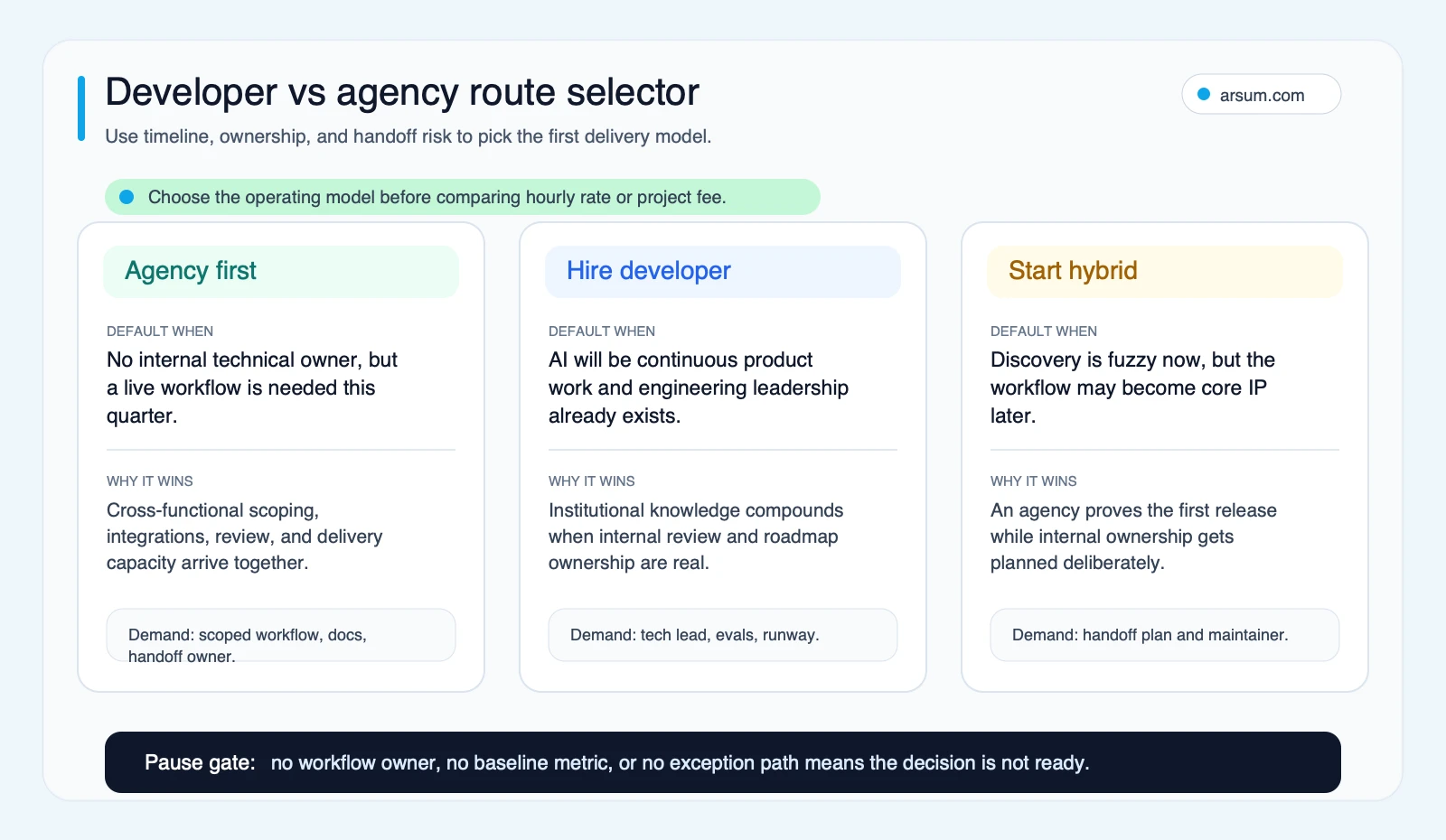
Use the route selector before comparing cost: timeline, technical ownership, and handoff risk should decide whether an agency, developer, or hybrid path belongs first.
Choose the matching staffing page
- Need the broader AI engineer salary and role breakdown? Go to Hire AI Engineers.
- Need framework selection before staffing? Go to AI Agent Frameworks.
- Need commercial delivery scope and pricing? Go to AI automation agency services and AI automation agency pricing.
Sources and Benchmarks
- U.S. Bureau of Labor Statistics — Software Developers (job outlook and pay)
- LinkedIn Economic Graph / Future of Work reports
- Stanford AI Index Report
Want to automate this for your business? Let's talk →
What Most Comparisons Miss
Most pages about Hire AI Developer vs Agency compare features, pricing, or popularity. A buyer needs a stricter filter: which option changes the workflow, who will maintain it, and what failure mode is acceptable after launch.
Before shortlisting anything, map:
- Workflow fit: what repetitive business process will actually change?
- Integration burden: which systems, permissions, and data sources must connect?
- Control: who can inspect, test, and correct the output when it is wrong?
- Switching cost: what gets hard to replace after the first rollout?
If those answers are unclear, the “best” option is still only a demo preference. The right choice is the one your team can operate safely after the novelty wears off.
What “Hiring an AI Developer” Actually Means
This page should own the developer vs agency comparison intent, while Hire AI Engineers owns the salary / rates / role definition intent. Making that split explicit helps both users and search engines choose the right page faster.
When companies say they want to hire an AI developer, they usually mean one of three things:
- A freelance AI engineer – a contract specialist hired through Upwork, Toptal, or direct sourcing to build a specific project.
- A full-time in-house AI hire – a permanent employee who owns AI development internally.
- An augmented team – a mix of internal headcount and contractors managed in-house.
Each model has different implications. A senior AI engineer with production experience commands $180,000–$240,000 per year in salary, not counting benefits, recruiting costs, and onboarding time. A freelancer may cost less per hour but typically requires a project-ready brief, strong technical oversight, and coordination overhead.
Finding qualified AI engineers has also become a meaningful challenge at the hiring stage. Demand for AI and machine learning roles has grown significantly faster than most technical disciplines over the past two years, pushing median time-to-fill for senior AI positions beyond four months at many companies. That’s four months before work begins – before ramp, before productive output.
The real cost of any individual hire extends beyond the invoice – it includes your own management time, the ramp period before they produce value, and the risk that a single person becomes a bottleneck or leaves.
What Working with an AI Agency Means
An AI automation agency is a team that specializes in designing, building, and deploying AI-powered systems for business clients. Unlike hiring a single developer, you engage a cross-functional team: engineers, solution architects, prompt engineers, and often project managers.
The engagement model typically looks like:
- Discovery and scoping – The agency maps your existing processes, identifies automation opportunities, and defines a clear project scope.
- Build – Development happens within the agency’s infrastructure, using their established tooling and review processes.
- Deploy and handoff – Systems go live in your environment. Some agencies include ongoing maintenance; others hand off with documentation.
Pricing is usually project-based (fixed scope, fixed fee) or retainer-based (ongoing builds and improvements). Most mid-market AI automation projects range from $30,000 to $150,000+, depending on complexity.
Role Boundaries Before You Compare Cost
A lot of bad buying decisions start with title confusion. “AI developer” can mean a software engineer who adds LLM features, an ML engineer who owns model deployment and monitoring, or a contractor who mainly assembles prompts and APIs. An agency is different again: you are buying a delivery system, not just one person’s hands.
| Option | Usually owns | Usually does not own by default |
|---|---|---|
| Freelance AI developer | A scoped build task, feature delivery, and some iteration inside a defined brief | Cross-functional discovery, stakeholder management, security review, or long-term operations unless you add that structure yourself |
| Senior ML or AI engineer hire | Ongoing technical ownership, deployment habits, and institutional knowledge | Fast cross-functional delivery if product management, design, or integration support is missing |
| AI agency | Discovery, architecture, integrations, delivery management, and handoff across multiple disciplines | Deep internal ownership after launch unless transition and support are planned explicitly |
| Hybrid pod | Faster launch plus a cleaner path to internal ownership | Cheap simplicity, because you are intentionally paying for both speed now and ownership later |
If you are buying because the workflow is still fuzzy, the real need is not a title. It is help defining the workflow, success metric, failure handling, and handoff boundary first.
💡 Arsum builds custom AI automation solutions tailored to your business needs.
Get a Free Consultation →What Founders and Operators Actually Worry About
The strongest signals in current buyer and practitioner discussions are less about headline hourly rate and more about ownership risk:
- Founders do not want to pay for generic tooling assembly. They want someone to translate a workflow into something reliable, maintainable, and specific to their business.
- Control and handoff matter as much as build speed. Buyers worry about how to tell a strong agency from a polished sales process, and how much knowledge disappears after launch.
- Agency speed and in-house depth solve different problems. Agency teams are attractive when you need cross-functional delivery quickly. Internal ownership matters more when the workflow becomes part of your operating core.
- End-to-end execution beats prompt experimentation. The valuable partner is the one who can scope with stakeholders, connect systems, review outputs, and own what happens after deployment.
Treat those as recurring qualitative patterns, not market-wide statistics. They are still useful because they point to the real decision criteria buyers keep running into.
Operator Note
If you cannot name the workflow owner, the system that must change, and who will maintain prompts, evaluations, integrations, and exception handling after launch, you are not choosing between an agency and a developer yet. You are still defining the job.
That is the operational breakpoint most comparison pages skip. A delivery model only looks cheap or expensive once the ownership boundary is clear.
What to Ask Before You Buy
These questions work whether you are interviewing an individual developer or an agency team:
- How will you evaluate output quality? Ask for the failure cases they expect, how they will test them, and what regression checks will exist after launch.
- What is the integration plan? They should be able to name the systems, data boundary, approvals, and exception paths that make the workflow real.
- Who owns maintenance? Prompts, evals, model choice, monitoring, and documentation need named owners after handoff.
- How do you handle security and governance? Sensitive workflows need a clear answer on permissions, logging, review, and data handling.
- What gets handed back to us? Documentation, prompt logic, deployment notes, and a practical runbook should not live only in someone else’s head.
Strong answers usually sound operational. Weak answers stay at the level of tools, model names, or “we’ll figure that out during the build.”
Mini Experiment: Three Common Buying Situations
| Situation | Best default fit | Why |
|---|---|---|
| No internal technical owner, but a live workflow is needed in under 8 weeks | Agency first | You need scoping, integration, review, and delivery capacity immediately |
| Product and engineering leadership already exist, and AI workflows will be iterated continuously | Hire a developer or fractional AI engineer | Long-term knowledge capture and ongoing maintenance matter more than launch speed |
| Discovery is still unclear, but the workflow could become core IP after the first release | Hybrid | Use an agency for discovery and first release, then transition ownership internally |
The Core Trade-offs
Speed to Value
An experienced agency can typically move from scoping to working prototype in 4–8 weeks. A new in-house hire, by contrast, needs 30–90 days of ramp time before producing anything independently – and for most senior AI roles, closer to 90 days is realistic. If speed matters – and for most AI automation projects, it does – the agency model has a structural advantage.
Breadth of Expertise
AI automation projects rarely require a single skill. A typical build touches LLM integration, data pipeline design, API orchestration, security and access controls, and prompt engineering. Few individual engineers cover all of these at a production level.
An agency brings a team with complementary specializations. You get a solution architect who’s seen 50 similar projects, not just someone working through the problem for the first time. For businesses evaluating custom AI solutions, this breadth of applied experience often matters more than any individual credential.
Cost at Scale
The agency model looks expensive at the invoice level. A $75,000 project engagement can feel steep compared to a $6,500/month contractor. But factor in:
- No recruiting fee (typically 20–25% of first-year salary for in-house hires)
- No ramp time cost (3–6 months of productivity loss before full contribution)
- No benefits, equity, or HR overhead
- No single point of failure if someone quits
At 12-month total cost of ownership, a focused agency engagement often compares favorably – especially for businesses running one or two AI projects per year rather than continuous development.
The calculus does shift for high-volume, long-term AI development programs. A company running four or five simultaneous AI workstreams, with a dedicated product roadmap, eventually reaches a crossover point where internal headcount is cheaper per output unit than ongoing agency engagements. That typically requires sustained 2–3 year investment before in-house scale justifies itself.
Control and Institutional Knowledge
This is where in-house hiring wins clearly. A dedicated internal developer builds deep familiarity with your systems, your data, and your team’s workflow. Over time, that institutional knowledge compounds in ways an external engagement can’t fully replicate.
For businesses planning sustained, high-volume AI development – where internal ownership of the roadmap matters – building an internal team makes sense. But that’s a 12–18 month investment before it pays off.
Long-Term Maintenance
AI systems need ongoing attention: model updates, edge case handling, prompt tuning, integration maintenance. In-house developers handle this as part of their role. Agencies typically offer ongoing support as a separate engagement, which adds cost but also flexibility – you’re not carrying headcount through quiet periods.
The key question to resolve before signing any agency contract: what’s covered post-deployment, how model updates and edge cases are handled, and what documentation you’ll receive at handoff. Businesses that clarify these terms upfront consistently get better maintenance outcomes than those who treat support as an afterthought. An AI automation service guide can help you understand what to look for in vendor contracts before committing.
Work With Arsum
We help businesses implement AI automation that actually works. Custom solutions, not cookie-cutter templates.
Learn more →Original Data: AI Build Ownership Scorecard
Score each option from 1 to 5 against the criteria below before you compare proposals.
| Criterion | What a high score means | Who it usually favors |
|---|---|---|
| Problem clarity | The workflow, baseline, and success metric are already defined | Developer or agency |
| Need for speed | The project must show useful output this quarter | Agency |
| Internal technical owner | Someone can review architecture, outputs, and handoff quality | Developer or hybrid |
| Data sensitivity | Privacy, permissions, and governance matter from day one | Stronger delivery partner, not the cheapest option |
| Integration complexity | Multiple systems, approvals, and failure paths must connect | Agency or senior developer |
| Expected iteration volume | The workflow will keep changing after launch | Developer or hybrid |
| Need for institutional knowledge | The workflow will become part of the company’s operating core | Developer or hybrid |
A practical reading of the totals: agency tends to win when speed and integration complexity are high but internal ownership is still thin. A direct hire wins when iteration volume and institutional knowledge are clearly high. Hybrid is usually the right default when the workflow may become core IP, but the first release still needs outside delivery muscle.
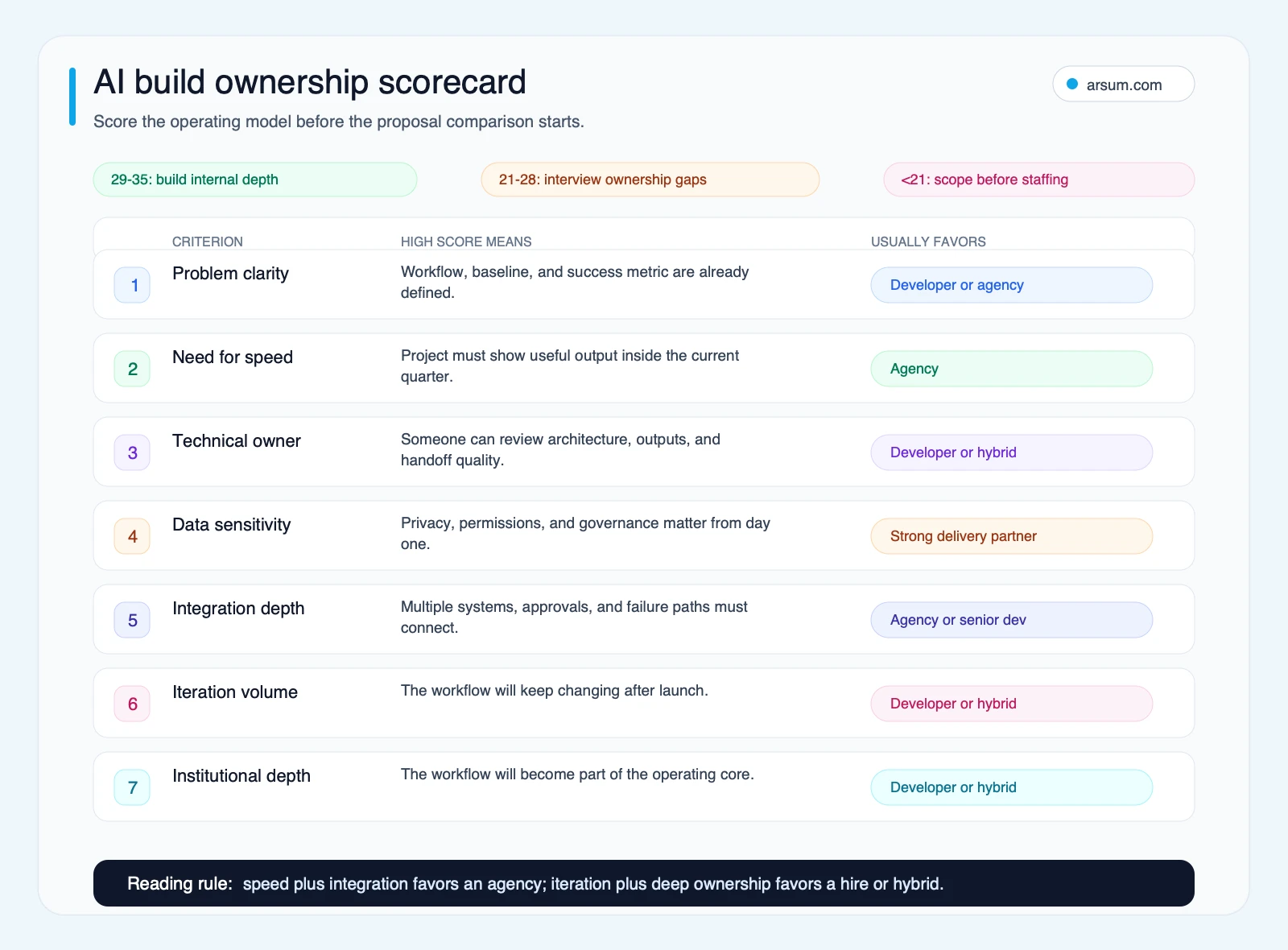
Treat the scorecard as an operating-model gate: speed and integration depth favor an agency, while iteration volume and deep ownership favor a hire or hybrid transition.
Comparison Table: Build Cost vs Run Cost vs Ownership Risk
| Option | Upfront build cost | Ongoing run cost exposure | Ownership risk after launch |
|---|---|---|---|
| Freelance or in-house developer | Lower invoice at the start, higher hiring and ramp cost | You carry model spend, tooling, eval upkeep, and monitoring directly | High if the workflow depends on one person |
| Agency | Higher invoice, but bundled discovery and delivery | Better when the agency actively manages runtime cost, guardrails, and observability | Medium if handoff and documentation are explicit |
| Hybrid | Two-step spend, but less rework risk | Lets you price initial speed separately from long-term maintenance | Lower when phase-one delivery and phase-two ownership are planned together |
The missing cost line in most articles is ongoing AI operating cost: model usage, tool and search charges, evaluation setup, security review time, monitoring, and the cleanup work that happens after the first demo ships.
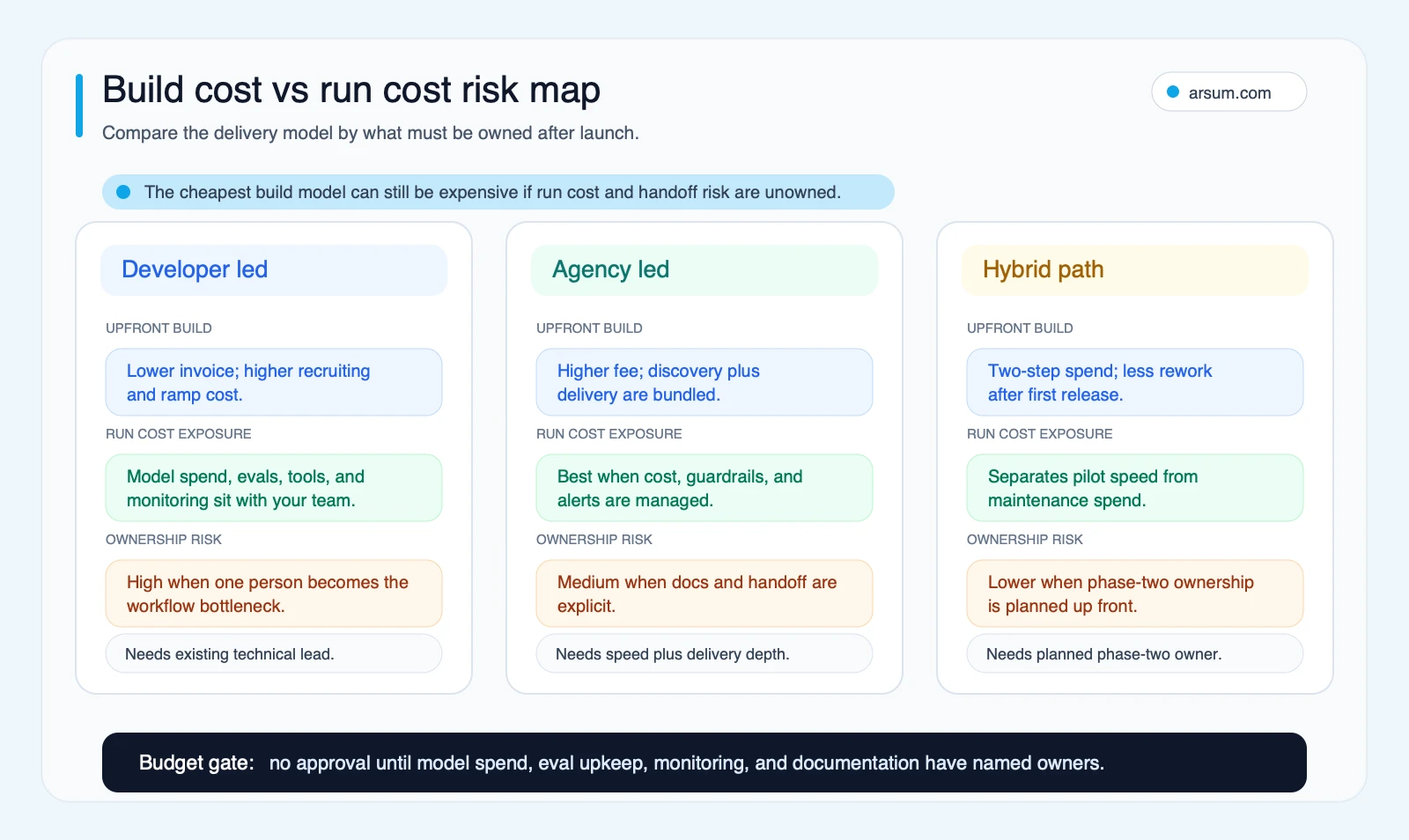
Use the risk map before approving budget: model spend, evaluation upkeep, monitoring, and documentation need named owners after launch.
Commodity vs Non-Commodity Breakdown
| If the proposal sounds like this | It is more commodity | If the proposal sounds like this | It is more non-commodity |
|---|---|---|---|
| “We will add AI to your workflow quickly” | Generic promise, weak ownership definition | “We will map the workflow, data boundary, evaluation path, and handoff” | Delivery is tied to your actual operating model |
| Pricing is framed only around build hours or retainer size | Cost discipline is shallow | Pricing also addresses runtime cost, guardrails, and support boundaries | The partner understands post-launch reality |
| Success is defined as a prototype or demo | Easier to sell, harder to operate | Success is defined as a measurable workflow change with exception handling | The work is closer to production ownership |
| Knowledge stays inside a black box | Replacement and maintenance risk stay high | Docs, prompts, eval logic, and ownership transfer are explicit | The output is harder to commoditize |
Decision Tree: Choose Agency, Developer, or Hybrid in Under 2 Minutes
- Start with an agency if you do not have an internal technical owner and need a live workflow in the next quarter.
- Hire a developer or fractional AI engineer if product and engineering leadership already exist and the workflow will keep evolving after launch.
- Choose hybrid if discovery is still fuzzy today but the workflow is likely to become core institutional knowledge later.
- Pause the decision if nobody owns the process, no baseline metric exists, or the team cannot explain what should happen when the model is wrong.
Google Risk Box: Thin Automation and Ownership Risk
Google risk box: if the proposed solution depends on thin prompt layering, mass content generation, or vague “agent” language without evaluation and monitoring, you are taking on both search risk and operating risk. The visible risk is weak content or brittle outputs. The hidden risk is rising model spend, unclear security boundaries, and no reliable way to debug the system after launch.
Ask every vendor or candidate the same five questions:
- How will outputs be evaluated before and after release?
- Which systems and data sources will the workflow touch?
- What happens when the model is wrong, unavailable, or too expensive for the task?
- How will prompt injection, privacy, and permission boundaries be handled?
- Who owns prompts, evals, integrations, and documentation after handoff?
When to Hire a Developer
- You’re running continuous AI development across multiple internal systems
- You have a technical lead already who can define scope and review work
- You’re building proprietary AI systems that require long-term internal ownership
- Your budget supports $200K+ per year in total engineering headcount
- You have 18+ months of runway before needing ROI on the investment
When to Work with an AI Agency
- You have a specific, scoped problem to solve – a bottleneck process, a reporting workflow, a customer-facing automation
- You want proven results in 60–90 days rather than hiring and ramping a team
- You lack in-house AI expertise to oversee a freelancer or evaluate technical proposals
- Your AI needs are project-based rather than continuous
- You want to pilot AI automation before committing to full internal infrastructure
If you’re evaluating options, reviewing leading AI automation companies by specialty can help you understand the range of engagement models available before you commit.
The Hybrid Approach
Many businesses start with an agency to build the foundation – standardized architecture, working integrations, documented systems – then hire an internal developer to maintain and extend what was built.
This sequence works well because the agency delivers a working system with clear documentation, and the internal hire inherits something functional rather than starting from scratch. It also lets you evaluate what internal AI development actually requires before making a headcount decision. Companies that pilot before scaling full internal capability tend to hit value faster than those that hire first and build second – the working reference implementation clarifies scope and reduces the ramp period for any eventual in-house developer.
Making the Decision
The right choice depends on three variables: your timeline, your internal technical capability, and how continuous your AI development needs are.
Use a simple filter:
- Hire if AI is becoming a permanent product or platform capability and you already have the leadership to manage technical quality.
- Use an agency if you need a measurable workflow improvement in the next quarter and want a team that can scope, build, deploy, and document the first system.
- Start hybrid if you expect to own AI internally later but need a working reference implementation before committing to headcount.
- Pause if the target process has no clear owner, no baseline metric, or no budgeted path to adoption. Those projects usually fail because the business case is vague, not because the model is weak.
If you need results in the next quarter on a specific operational problem, an agency is almost always the faster and lower-risk path. If you’re planning for 2–3 years of internal AI product development and already have engineering leadership, building an in-house team makes strategic sense.
For most mid-market businesses exploring AI automation for the first time, the agency model removes execution risk while delivering real systems – not a six-month hiring process with uncertain outcomes.
Common Mistakes Buyers Make
- Choosing the cheapest hourly rate before defining who owns evaluation, documentation, and post-launch fixes.
- Hiring the title before defining the workload. “AI developer” is too broad to be a real scope on its own.
- Treating a prototype as proof that the workflow is production-ready.
- Ignoring the run cost after launch, especially model spend, review time, monitoring, and security overhead.
- Letting handoff stay vague until the end of the project.
Expert Note
The role-boundary and ownership framing here is grounded in primary sources that describe production machine learning work as more than prompt assembly. Google Cloud and AWS both frame ML engineering around building, deploying, operating, and maintaining systems, not just prototyping them. BLS labor data is useful for the salary baseline, but it does not capture recruiting drag, management time, and ramp, which is why buyer-side total cost of ownership matters. NIST’s AI risk guidance is the reminder that governance work does not disappear just because the first build uses APIs instead of custom models.
Methodology Note
This comparison was built from three evidence layers: current search-result patterns around agency-versus-developer buying queries, qualitative practitioner discussion used only as buyer-language signal, and primary documentation from BLS, Google Cloud, AWS, Google for Developers, and NIST. The directly verified parts are the role boundaries, staffing expectations, and governance obligations around production AI systems. Community discussion was used only to surface recurring buyer concerns such as handoff risk, technical oversight, and how to separate generic tooling assembly from real workflow ownership.
Frequently Asked Questions
How much does it cost to hire an AI developer vs. use an agency?
A full-time senior AI developer runs $180,000–$240,000 per year in salary plus 20–30% for benefits, equity, and recruiting. A freelance AI engineer typically charges $80–$150/hr, but requires technical oversight. An AI agency project engagement typically ranges from $30,000 to $150,000+ depending on scope and complexity. At 12-month total cost of ownership – factoring in ramp time, recruiting fees, and overhead – a focused agency engagement is often cost-comparable to a single hire for businesses running one or two projects per year.
How long does it take to get an AI project live with an agency vs. an in-house hire?
An experienced AI agency typically goes from scoping to working prototype in 4–8 weeks and to production deployment in 8–12 weeks total. An in-house hire requires 30–90 days of ramp time before independent contribution, plus the recruiting timeline of 3–5 months for senior AI roles. If your deadline is within the next quarter, the agency model is structurally faster.
What happens after the agency builds my AI system?
Most AI agencies offer post-delivery support through ongoing maintenance retainers or time-and-materials agreements. It’s worth clarifying this before engagement – specifically: what’s covered in the build contract, how model updates and edge cases are handled, and what documentation you’ll receive at handoff. Some businesses use the agency for initial build, then hire a junior developer internally for ongoing maintenance.
Can an agency work alongside my existing in-house developer?
Yes – and this is increasingly common. Agencies often operate as an extension of internal teams, handling the architecture, integration, and build while your internal developer manages deployment and maintenance. This works best when roles and ownership are defined upfront. Your internal developer should be involved in discovery and handoff to avoid knowledge gaps.
Is it risky to use an external agency for sensitive business data?
Security depends on the agency, not the model. Reputable AI agencies operate under NDAs, data processing agreements, and GDPR/SOC 2-compliant infrastructure. When evaluating agencies, ask specifically about data residency, how training data is handled, and whether production data is used in model fine-tuning. These are the same questions you’d ask of any third-party SaaS vendor.
Should I hire first or pilot with an agency first?
For most businesses, piloting with an agency first is lower risk. It lets you see what AI development actually requires for your specific environment, what the real maintenance burden is, and whether the return justifies building an internal capability. Hiring before you have a working reference implementation often leads to scope drift, extended ramp times, and expensive course corrections.
Ready to Automate Your Business?
Stop wasting time on repetitive tasks. Let AI handle the busywork while you focus on growth.
Schedule a Free Strategy Call →