Making money with AI automation is realistic when the automation improves a repeatable workflow with visible economics—not when it merely produces impressive output. The durable opportunities are services, productized workflows, enablement, and narrow software, but each needs a defined data source, human-review boundary, owner, and way to contain failures before it can create reliable margin.
Making Money With AI Automation: Practical Guide
Explore making money with AI automation: compare workflow fit, costs, risks, evidence, and practical next steps before you build, buy, or hire.

Table of Contents
- What Most Guides Miss: Revenue Is Not the Same as Workflow ROI
- A Source and Confidence Ladder for Income Stories
- Four AI Automation Revenue Models
- The Workflow Automation Fit Gates
- Hypothetical Operating Model: A Reviewed Weekly Digest
- Pilot Scorecard: Stop, Fix, or Scale
- Build, Buy, or Partner
- Where AI Automation Offers Usually Fail
- Turn an Income Story Into a Controlled Business Roadmap
- Methodology and Limitations
What Most Guides Miss: Revenue Is Not the Same as Workflow ROI
A revenue screenshot or tool-stack demo does not show whether an AI automation business is healthy. It usually omits customer acquisition, input cleanup, permissions, reviewer time, exception handling, support, evidence retention, and maintenance after launch.
The decision rule is simple: do not start with “What can AI automate?” Start with “Does this unit of work create enough value after delivery, review, and failure costs?”
Map these items before choosing an offer:
- The recurring unit of work and its monthly volume
- The source-of-truth systems supplying the inputs
- What the automation can draft, classify, summarize, enrich, or route
- Which decisions require an accountable human approval
- How missing, contradictory, sensitive, or out-of-policy inputs are handled
- Who owns maintenance, evidence retention, and rollback
Practitioner discussions about ROI-positive automations tend to focus on narrow, repeatable work rather than broadly autonomous businesses. Treat that as a qualitative signal, not market evidence: this discussion on ROI-positive n8n automations can surface workflow ideas, but it cannot validate income claims. Likewise, a community discussion about AI ROI usefully highlights a recurring concern: time saved does not automatically become retained margin.
For a business buyer, the automation is worth funding only if it can be operated safely after the initial novelty fades. That is the difference between a capable demo and a commercial system.
A Source and Confidence Ladder for Income Stories
Exact searches for “making money with AI automation” are sparse, and many public examples are self-reported. Use the confidence level of an example before using it to forecast demand, pricing, savings, or profitability.
| Confidence level | Evidence available | Appropriate use |
|---|---|---|
| Verified vendor/customer story | Named organization, public workflow description, and published outcome | Learn a workflow pattern and validate it locally |
| Vendor-sourced case-study library | Public examples published by an automation platform | Identify use-case categories; treat outcomes as vendor-reported |
| Self-reported community case | Public post or thread with limited independent validation | Understand objections and offer ideas, not typical earnings |
| Editorial operating pattern | A framework based on workflow mechanics | Scope a service or pilot without claiming observed results |
| Hypothetical planning model | All inputs, assumptions, and formula disclosed | Test whether a pilot is worth running |
Zapier’s customer-story library and n8n’s case-study library are useful vendor-sourced libraries. They demonstrate that organizations publicly describe automation around integrations, routing, reporting, and operations work. They do not independently verify a creator’s income screenshot or establish that one buyer’s outcome will repeat elsewhere.
That distinction protects both buyer and provider. A named story can help frame discovery questions. It cannot prove that your workflow has the same volume, data quality, review burden, adoption, or economic value.
Four AI Automation Revenue Models
The following is an editorial operating framework, not original market data or a forecast of typical earnings.
| Model | What the buyer actually buys | Main delivery burden | First failure mode |
|---|---|---|---|
| Done-for-you implementation | Workflow mapping, integration, controls, QA, and support | Custom inputs, permissions, and exceptions | Scope creep |
| Productized niche workflow | Fixed-scope automation for one repeated problem | Standardizing inputs and onboarding | Edge cases overwhelm a low-price offer |
| Training and enablement | Capability, templates, governance, and practice | Ensuring the team can operate it afterward | No internal owner |
| Narrow software product | A repeatable product around one bottleneck | Product, security, and distribution investment | Sales and integration complexity |
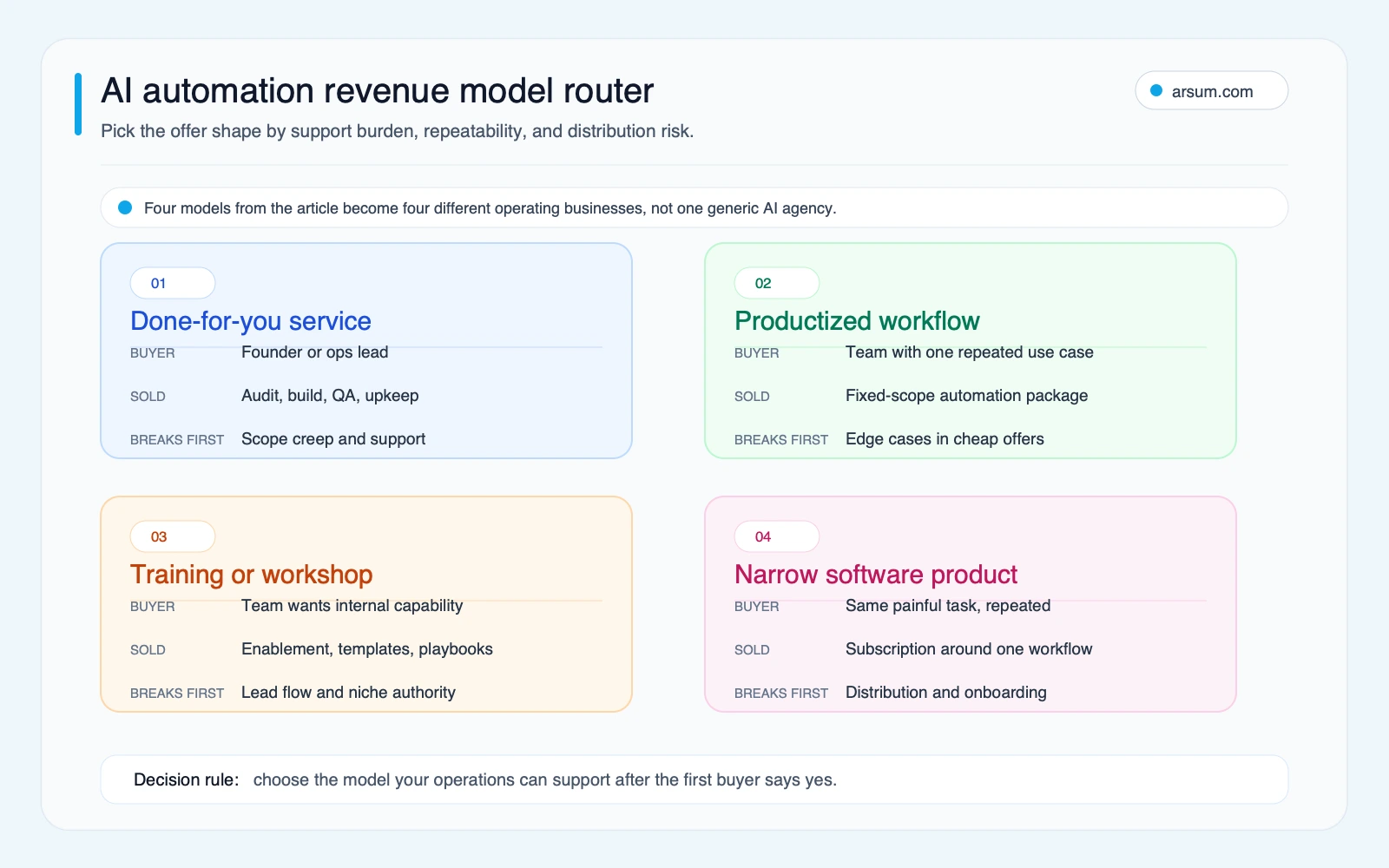
Use the router to distinguish the buyer, deliverable, and first operational constraint for each model.
Done-for-you workflow implementation
This is often the clearest starting point when you understand a specific operating problem. The buyer is not paying for prompts; they are paying for an implemented workflow with source-system access, field mapping, routing rules, review queues, logs, and an exception path.
Suitable candidates include account-management preparation, document-intake triage, recurring reporting, lead-routing support, and internal knowledge retrieval. The AI layer should have a defined job that rules alone do not handle well enough: summarizing unstructured notes, extracting provisional fields from documents, or drafting a response for review.
An automation can prepare a recommendation. An accountable employee should approve a customer commitment, payment action, eligibility determination, regulatory filing, or other consequential decision. That boundary should be explicit in the statement of work and architecture. See AI workflow automation for the operational distinction between a workflow and an unconstrained assistant.
Productized niche workflows
A productized offer turns a repeated implementation into a bounded package. It names the input, output, connected systems, exception path, and implementation limit.
“Weekly customer-feedback digest with source links, reviewer queue, and delivery to the account team” is operationally meaningful. “AI insights automation” is not. The first can be estimated, tested, and supported; the second invites unlimited custom work.
The strongest candidates have similar buyers, predictable data structures, and a common acceptance standard. If each customer requires bespoke data cleanup, permissions, terminology, and approval flows, it remains custom service work. Price it and staff it accordingly.
Training and enablement
Training is appropriate when the buyer wants internal capability and has someone who can own the process after the workshop. The deliverable should include a workflow map, approved data sources, use-case boundaries, review rules, and a named operator—not only a tool demonstration.
Training can be a commercially sensible offer for subject-matter experts who do not want to provide managed support. It also creates a useful handoff point: the buyer either has the ownership and process maturity to operate the workflow, or it has identified a gap that requires implementation help. A useful consulting engagement should end with that decision, as outlined in AI automation consulting.
Narrow software products
Software becomes attractive when the same painful task appears across many accounts and can be standardized without weakening controls. The product needs a narrow promise: a defined input context, output, review loop, and integration surface.
A generic assistant is difficult to differentiate. A product that pulls approved data from a specified system, creates a constrained work item, records reviewer disposition, and retains the relevant evidence can become part of an operating process.
Lower marginal delivery effort is the attraction after the product stabilizes. The tradeoff is higher upfront investment in product, security, integrations, onboarding, and distribution. If the workflow is materially unique to a single organization, building software first is usually premature.
The Workflow Automation Fit Gates
Before selling, buying, or building an automation, pass the workflow through these gates.
- Volume: Is there enough recurring work for savings or capacity to compound?
- Input quality: Are records, documents, and events available from identified source-of-truth systems?
- Process stability: Can the normal path be described clearly enough to test?
- Judgment boundary: What is automated, and what remains a human approval?
- Review cost: How many minutes does a reviewer spend per item, including exceptions?
- Failure containment: Can an incorrect result be stopped before it creates customer, financial, legal, or reputational harm?
- Ownership: Which role owns the metric, approval policy, maintenance backlog, and rollback decision?
- Evidence retention: Which input references, outputs, reviewer decisions, and escalation records must be retained?
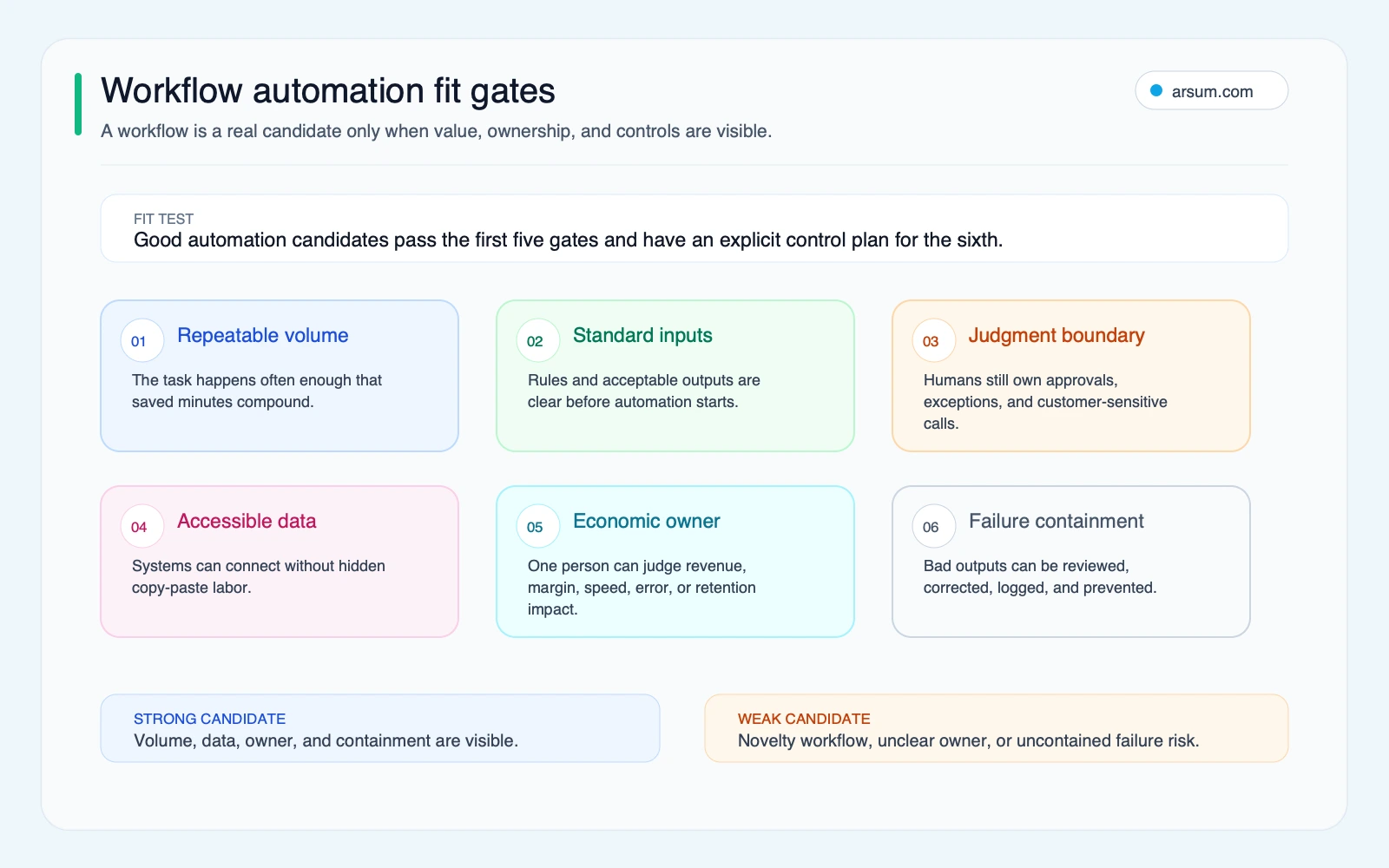
The workflow needs visible volume, accessible inputs, an accountable owner, and a contained failure path before it deserves automation investment.
A workflow that fails a gate is not necessarily a bad business problem. It may need process cleanup, policy clarification, improved data access, or a conventional rules-based solution first. A Hacker News discussion about agents and workflow automation raises a useful qualitative check: name the work, handoff, and error boundary before calling something agentic.
💡 Arsum builds custom AI automation solutions tailored to your business needs.
Get a Free Consultation →Hypothetical Operating Model: A Reviewed Weekly Digest
Consider a managed weekly feedback digest for a B2B team. This is a hypothetical planning model, not a reported customer result, price recommendation, or profitability claim.
Assume the following inputs:
| Input | Illustrative planning assumption |
|---|---|
| Feedback items per month | 400 |
| Manual baseline time per item | 4 minutes |
| Automated coverage after exclusions | 70% |
| Manual minutes avoided for covered items | 3 minutes |
| Reviewer time for covered items | 1 minute |
| Exception rate | 10% of covered items |
| Extra exception-review time | 6 minutes each |
| Loaded labor cost | $60 per hour |
| Monthly platform and model cost | $150 |
| Monthly maintenance and support | 8 hours |
| Setup effort | 30 hours |
| Sales/acquisition cost | Estimate separately for the chosen channel |
The gross monthly labor value before maintenance is:
400 items × 70% coverage × (3 minutes saved − 1 reviewer minute) ÷ 60 × $60 = $560
Exception-review cost is:
400 items × 70% coverage × 10% exception rate × 6 minutes ÷ 60 × $60 = $168
Monthly maintenance labor is:
8 hours × $60 = $480
Under these assumptions, the monthly economics are negative before setup recovery and acquisition cost:
$560 − $168 − $480 − $150 = −$238
That is a useful result, not a failed exercise. It shows why a low-price managed digest cannot be priced from raw tooling alone. The model would need more volume, greater time saved, lower maintenance, a higher-value business outcome, or a different delivery model.
Current OpenAI platform pricing can help estimate one model-cost input. It cannot establish total workflow cost. Integration, QA, support, sales, and failure handling belong in the calculation.
Pilot Scorecard: Stop, Fix, or Scale
Run a narrow pilot before treating an automation as a product line or enterprise program. The scorecard makes commercial and control assumptions testable.
| Field | Example pilot definition |
|---|---|
| Workflow | Weekly feedback intake, classification, and digest preparation |
| Scope | One team and one approved source-system set |
| Baseline | 400 monthly items; measure manual minutes, rework, and turnaround for four weeks |
| Target | Reduce preparation time while holding the existing quality standard |
| Source of truth | Named CRM, support platform, or approved export |
| Automation boundary | Extract, classify, draft, and route only |
| Human approval boundary | Team lead approves the final digest and any customer-facing follow-up |
| Quality metric | Reviewer-corrected outputs as a share of automated items |
| Exception metric | Items sent to manual handling, with reason codes |
| Review-cost metric | Reviewer minutes per item, including escalations |
| Accountable owner | Operations lead or functional manager |
| Technical owner | Person responsible for integrations, monitoring, and change control |
| Review cadence | Weekly quality review; formal decision on the agreed pilot end date |
| Retained evidence | Input reference, generated output, reviewer disposition, exception reason, and workflow version |
| Stop condition | A predefined quality, exception, review-cost, privacy, or containment threshold is missed |
| Rollback path | Disable automation, return routing to the prior manual queue, and preserve pilot records |
| Scale decision | Owner accepts measured value, quality, support burden, and controls |
Set thresholds before launch. A pass condition is not “the model seems useful.” It is a statement such as: outputs meet the existing review standard, reviewer time stays within the agreed limit, exceptions are traceable, and no unapproved action reaches a customer or system of record.
For finance, compliance, lending, insurance, and other consequential workflows, technical capability does not authorize autonomy. Higher failure cost should narrow the automation boundary and strengthen approvals. The same principle applies to the examples in AI use cases in finance.
Build, Buy, or Partner
| Decision factor | Buy a platform | Build internally | Partner for implementation |
|---|---|---|---|
| Workflow uniqueness | Common workflow with standard needs | Highly distinctive workflow with strategic value | Known workflow with organization-specific integration and controls |
| Integration complexity | Existing connectors fit the source systems | Internal engineering can sustain custom interfaces | Cross-system mapping is required, but a permanent product team is not justified |
| Data sensitivity | Vendor controls satisfy policy and procurement | Policy requires direct control over architecture and data handling | Controls need careful design around the existing process |
| Internal ownership | Business team can configure and operate it | Product and engineering ownership already exists | Functional owner exists, but implementation capacity is limited |
| Time to value | Fastest when configuration is enough | Slower, with greater long-term control | Moderate; depends on discovery and integration readiness |
| Required controls | Standard roles, logs, and approvals are sufficient | Custom audit, security, or workflow controls are necessary | Controls need to be designed and tested in the live process |
Choose buy when the workflow is common and platform controls fit. Choose build when the workflow is strategically distinctive and you can fund product, security, and maintenance ownership. Choose partner when the business has a clear owner and workflow but needs help with discovery, integration, controls, and pilot execution.
Compare service boundaries in AI automation agency services and assess long-term ownership through AI agent architecture patterns. The right choice is not the most sophisticated implementation; it is the one the organization can operate and govern.
Where AI Automation Offers Usually Fail
The common failures are operational, not model-related.
- Custom work sold at productized pricing: every integration and exception is bespoke, but the offer is priced as a package.
- No measured baseline: no one can show whether the workflow improved margin, turnaround, quality, or capacity.
- Missing source lineage: reviewers cannot identify the record or document behind an output.
- Human review treated as free: the automation saves drafting time but creates a difficult review queue.
- Vague approval ownership: people assume someone else owns a consequential decision.
- No exception service level: edge cases quietly accumulate until the workflow loses trust.
- Unpriced maintenance: source changes, access failures, prompt changes, and model changes are treated as one-time work.
- No distribution plan: a software product or service may work operationally but fail because the buyer and acquisition channel were never defined.
AI-assisted content operations need an additional caution. Google’s spam policies address abusive and low-value practices; they do not create a simple “AI versus human” rule. Content workflows still need source review, editorial accountability, and a clear reason a page helps the reader. See AI content automation with reviewed workflows for the operating implications.
Turn an Income Story Into a Controlled Business Roadmap
The same patterns used in small automation offers can translate to a business rollout when the company adds measurable ownership and controls.
- Choose one workflow with visible economics. Start with recurring volume, known delays, rework, or capacity constraints.
- Measure the current state. Capture volume, manual time, error or rework rate, turnaround, and escalation reasons.
- Map the normal path and ugly exceptions. Include missing data, conflicting data, sensitive records, and approval-dependent actions.
- Define the automation boundary. Specify what is drafted or routed automatically and what a person must approve.
- Run the scorecarded pilot. Retain evidence and measure reviewer time instead of assuming it disappears.
- Stop, fix, or scale deliberately. Scale only after the accountable owner accepts the economics, quality, exception rate, and rollback readiness.
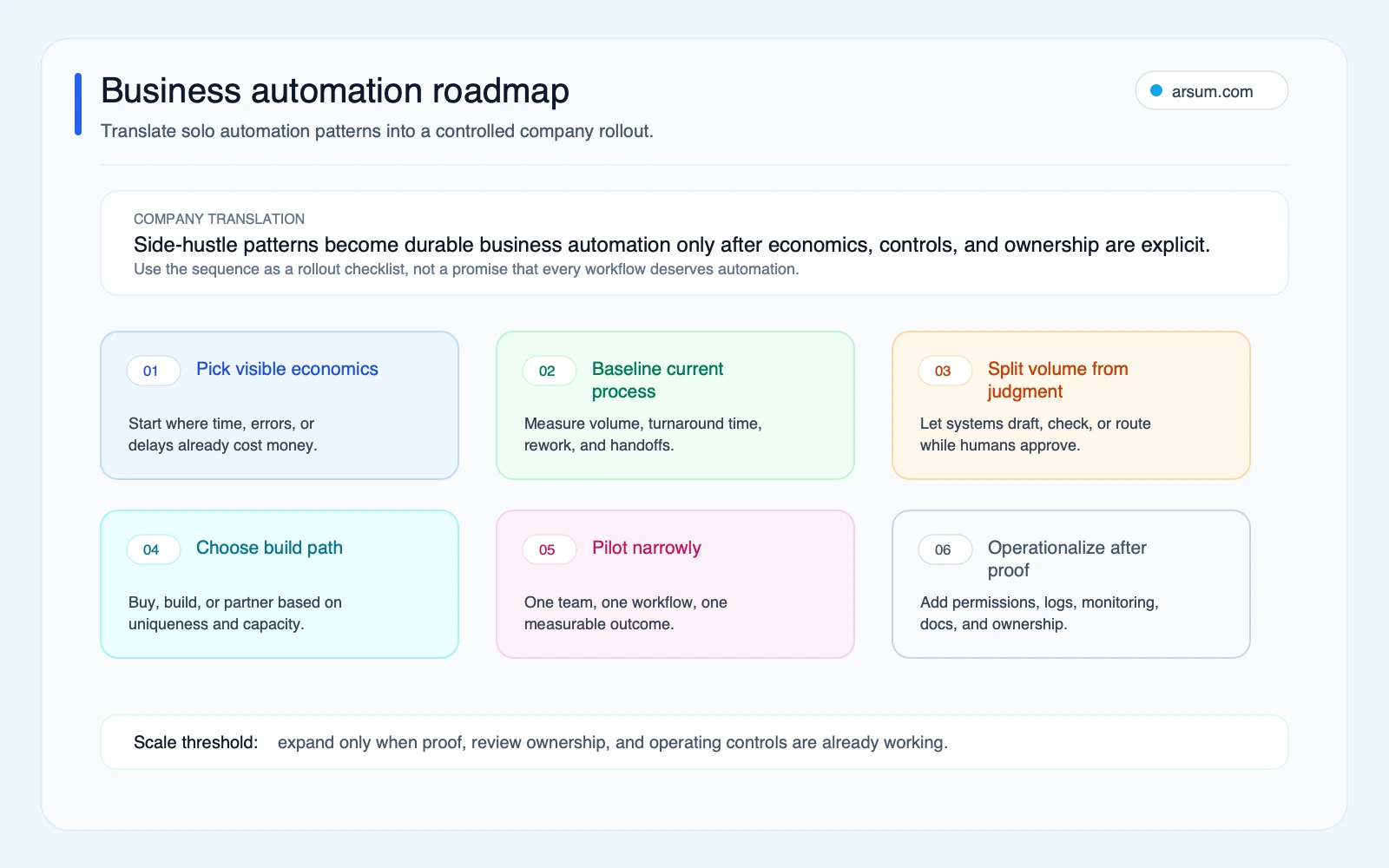
Use the roadmap to move from visible workflow economics to a controlled rollout with review ownership and rollback readiness.
The practical conclusion is simple: making money with AI automation depends less on finding a novel tool than on owning a narrow workflow with measurable value and an acceptable error boundary. If you cannot state the baseline, reviewer cost, exception path, accountable owner, and rollback condition, you do not yet have a decision-grade automation offer.
Work With Arsum
We help businesses implement AI automation that actually works. Custom solutions, not cookie-cutter templates.
Learn more →Methodology and Limitations
This article uses official documentation, vendor-published customer-story libraries, and public practitioner discussions. Vendor examples are labeled as vendor-sourced. Reddit and Hacker News material is qualitative only; it may surface useful questions but does not prove typical revenue, savings, adoption, or outcomes.
The hypothetical model is deliberately transparent so you can replace its assumptions with your own volume, labor cost, review time, maintenance burden, acquisition cost, and failure exposure. It is not a claim about the profitability of any client, platform, or automation business.
For related implementation decisions, see AI automation ROI examples, AI business process automation, and n8n versus Make versus Zapier.
Ready to Automate Your Business?
Stop wasting time on repetitive tasks. Let AI handle the busywork while you focus on growth.
Schedule a Free Strategy Call →Written by:Arsum editorial team
- Reviewed by
- Arsum editorial team
- Published
- March 27, 2026
- Updated
- July 6, 2026
- How this was produced
- Arsum uses research packs, source checks, and human editorial review to prepare and update blog articles. Editors are responsible for the final page.
- Source policy
- Sources are linked in the article when used. Methodology and source notes are included on higher-risk or high-visibility pages and are being rolled out across the archive. Editorial policy.
- Why this page exists
- Help B2B operators evaluate AI automation, implementation scope, cost, risk, and build-vs-buy decisions with practical context.