If you are searching for how to sell AI automations, the credible answer is to sell—or buy—one measurable workflow with explicit systems, approval limits, exception handling, and post-launch ownership, not a vague promise of “AI transformation.”
How To Sell AI Automations: Practical Guide
Explore how to sell ai automations: compare workflow fit, costs, risks, evidence, and practical next steps before you build, buy, or hire.

The best AI automation sales process sells one measurable workflow outcome, not a vague AI category.
Table of Contents
- What Most Guides Miss: You Are Selling an Operating Change
- Use a Gated Proposal Filter Before You Compare Price
- A Worked Pilot: Accounts-Receivable Exception Triage
- Choose the Operating Model That Fits the Workflow
- Price the Delivery Model Honestly: Project, Pilot, or Retainer
- Address Objections With Evidence, Not Reassurance
- Proposal-Triage Scorecard: A Heuristic, Not a Benchmark
- Disqualifying Conditions and Common Failure Modes
- Source and Method Note
What Most Guides Miss: You Are Selling an Operating Change
A strong AI automation proposal is buyer-safe because it makes the operating change inspectable. It names the trigger, inputs, decisions, actions, systems, human review path, evidence retained, and the person accountable when the workflow fails.
That matters whether you are the seller writing the proposal or the buyer evaluating it. The same checklist prevents a sales conversation from drifting into generic “agent” language.
A credible offer answers:
- Which workflow is changing, and where does it start and end?
- What is the current baseline: handling time, delay, backlog, error rework, missed follow-up, or another measurable constraint?
- Which records, documents, and systems are involved?
- What can the automation do without approval—and what must route to a person?
- Which exceptions stop the workflow?
- Who owns daily review, incident response, and changes after launch?
- What evidence will prove that any claimed benefit occurred?
The Federal Trade Commission advises businesses to substantiate AI-related claims rather than exaggerate what a product can do. That applies to accuracy, savings, revenue, and autonomy claims in an automation proposal. FTC guidance on AI claims is a useful standard: if the seller cannot explain the measurement method, treat the claim as an assumption—not a result.
For a broader view of the economics before choosing a vendor, review AI automation ROI examples and AI implementation services.
Use a Gated Proposal Filter Before You Compare Price
Price is meaningful only after the proposal clears basic operational gates. A lower quote that omits access design, exception handling, or ownership is not necessarily less expensive; it may simply defer the work to your team after launch.
| Gate | Evidence to request | Stop if |
|---|---|---|
| Workflow is bounded | Process map with trigger, inputs, actions, outputs, and owner | The seller is selling a category rather than a workflow |
| Baseline exists | Current volume, handling time, delay, quality issue, or other named metric | There is no way to tell whether the change helped |
| Systems and data are known | Named systems, permissions, fields, and data path | “We integrate with everything” replaces implementation detail |
| Approval boundary is explicit | List of automatic actions, review actions, and prohibited actions | Consequential actions are delegated without authorization |
| Failure path exists | Alerts, exception queue, fallback procedure, and rollback owner | The answer to failure is “we will optimize it” |
| Maintenance is priced and owned | Change-control scope, support responsibilities, reporting cadence | A retainer is proposed without recurring work |
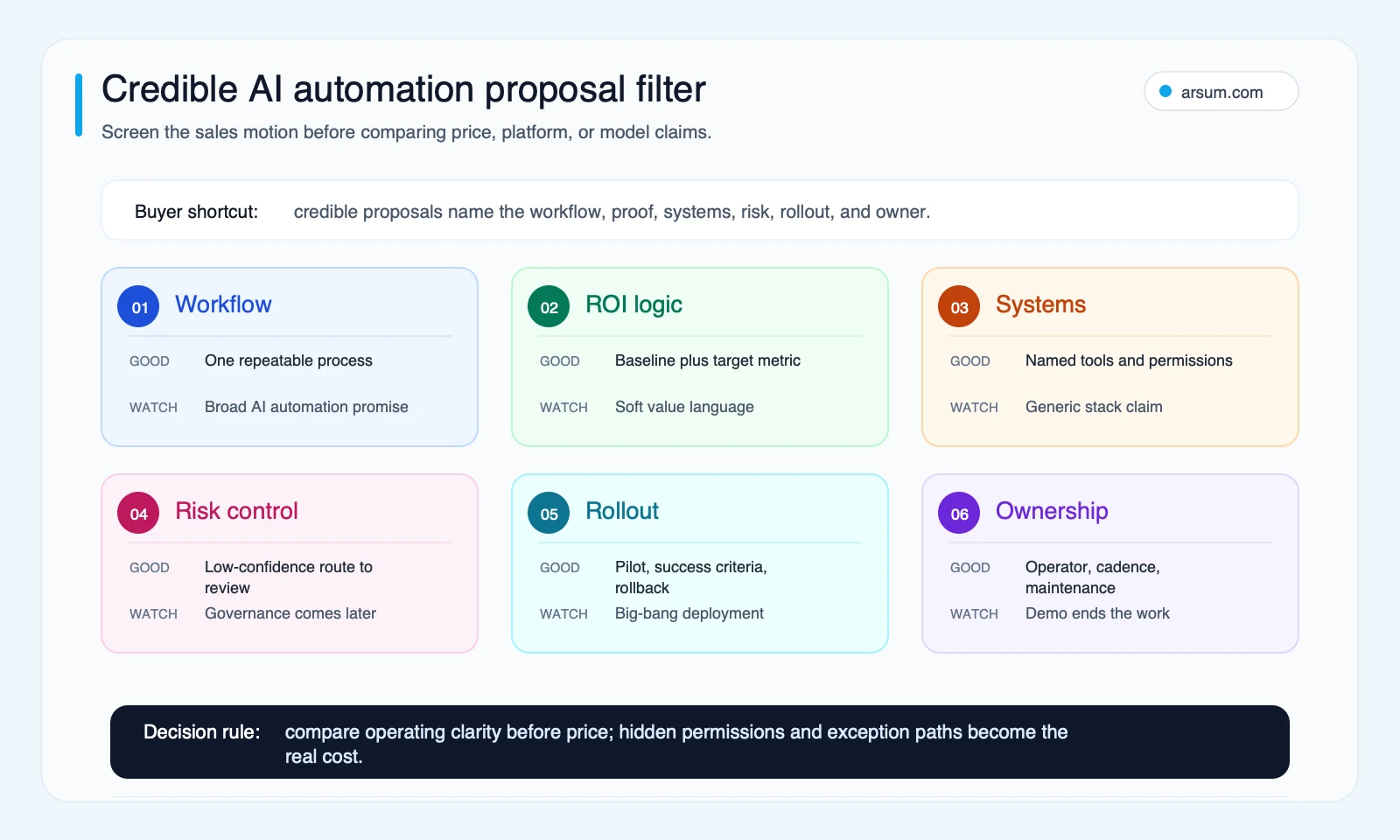
The first two gates establish value; the remaining gates establish whether that value can be delivered safely. A proposal that fails data access, authorization, or rollback should not advance on the strength of a polished demo or scorecard.
Conditional logic is not exotic engineering. Workflow platforms document ordinary filters and paths for routing items based on defined rules, which is why a seller should show the branches rather than simply promise “intelligent routing.” See Zapier’s filter and path rules.
A Worked Pilot: Accounts-Receivable Exception Triage
Consider a hypothetical pilot for an accounts-receivable team. This is an illustrative planning example, not an observed client result.
The workflow: incoming remittance emails and attachments are reviewed, linked to an invoice or account where possible, and routed either to a queue for posting or to a specialist for investigation.
Baseline and scope
Assume the team processes 500 remittance items per month. A finance operations lead measures the current manual process for two weeks and records:
- average handling time per item;
- percentage of items that cannot be matched cleanly;
- number of items requiring a billing, collections, or customer-data clarification;
- time from receipt to a ready-for-review record;
- rework caused by incorrect matching or incomplete documentation.
The pilot does not authorize posting cash, changing customer records, sending collection notices, or making credit decisions. It prepares a structured recommendation and preserves the underlying email, attachment reference, extracted fields, confidence signal, and routing rationale for a human reviewer.
This is deliberately narrower than “automate accounts receivable.” A relevant workflow may overlap with themes in accounts receivable automation, but the pilot earns expanded scope only after its controls work.
Systems, owners, and exception categories
The proposal should name the source inbox or document store, accounting or ERP environment, invoice data source, queue, and reporting location. It should also state which service accounts access each system and who approves those permissions.
Define exceptions before configuration begins:
| Exception | Automation action | Human owner | Evidence retained |
|---|---|---|---|
| Missing invoice reference | Route to exception queue | AR specialist | Source file, extracted fields, reason code |
| Multiple plausible invoice matches | Do not choose a match | AR specialist | Candidate matches and confidence information |
| Unreadable attachment | Flag and hold | AR specialist | File reference and extraction failure |
| Duplicate remittance | Hold for review | AR lead | Duplicate signal and linked records |
| Accounting system unavailable | Stop downstream actions | Workflow owner | Alert, timestamp, retry status |
The named business owner is the AR manager; the technical owner is the integration or systems lead. The seller may support both, but cannot replace the buyer’s accountability for approval rules.
Pilot acceptance scorecard
Set targets only after the baseline is measured. For example, the team might agree to assess whether the pilot:
- produces a structured review packet for a defined share of eligible items;
- reduces the time from receipt to reviewer-ready record for eligible items;
- maintains or improves the baseline quality measure after human review;
- routes every unmatchable, low-confidence, or policy-sensitive item to the exception queue;
- retains the agreed audit evidence for every processed item;
- allows the AR manager to disable the workflow without losing source records or manual processing capability.
Review results weekly during the pilot. The AR manager reviews quality and exceptions; the systems lead reviews workflow errors, permissions, and integration incidents; the seller provides a change log and resolves only approved changes.
The stop condition is not merely “the model made an error.” The stop condition is a control failure: an unauthorized action, inability to reconstruct what happened, repeated misrouting beyond the team’s agreed tolerance, or loss of the manual fallback. The rollback path is to disable automation actions, continue with the existing queue, preserve the pilot log, and investigate before re-enabling any step.
This is the operational detail a serious seller should attach to a proposal. It is also how a buyer distinguishes technical capability from authorized autonomy.
💡 Arsum builds custom AI automation solutions tailored to your business needs.
Get a Free Consultation →An Arsum workflow assessment should produce a process map, data and access inventory, exception-and-approval design, pilot acceptance scorecard, and a build-buy-partner recommendation—not just an AI opportunity list.
Choose the Operating Model That Fits the Workflow
The right implementation model follows workflow complexity and control needs, not the loudest product category.
| Model | Use it when | Buyer responsibility | Main limitation |
|---|---|---|---|
| Workflow-first tooling | Rules are stable, systems are standard, and actions are low consequence | Own configuration, permissions, and review | Can become fragile as exceptions multiply |
| Custom automation partner | Multiple systems, exceptions, data mapping, or audit requirements need design | Provide process owner and access decisions | Requires more discovery and internal coordination |
| More autonomous agent approach | Multi-step tool use is genuinely required and actions can be constrained | Define tool permissions, review policy, and escalation | Higher complexity does not justify broader authority |
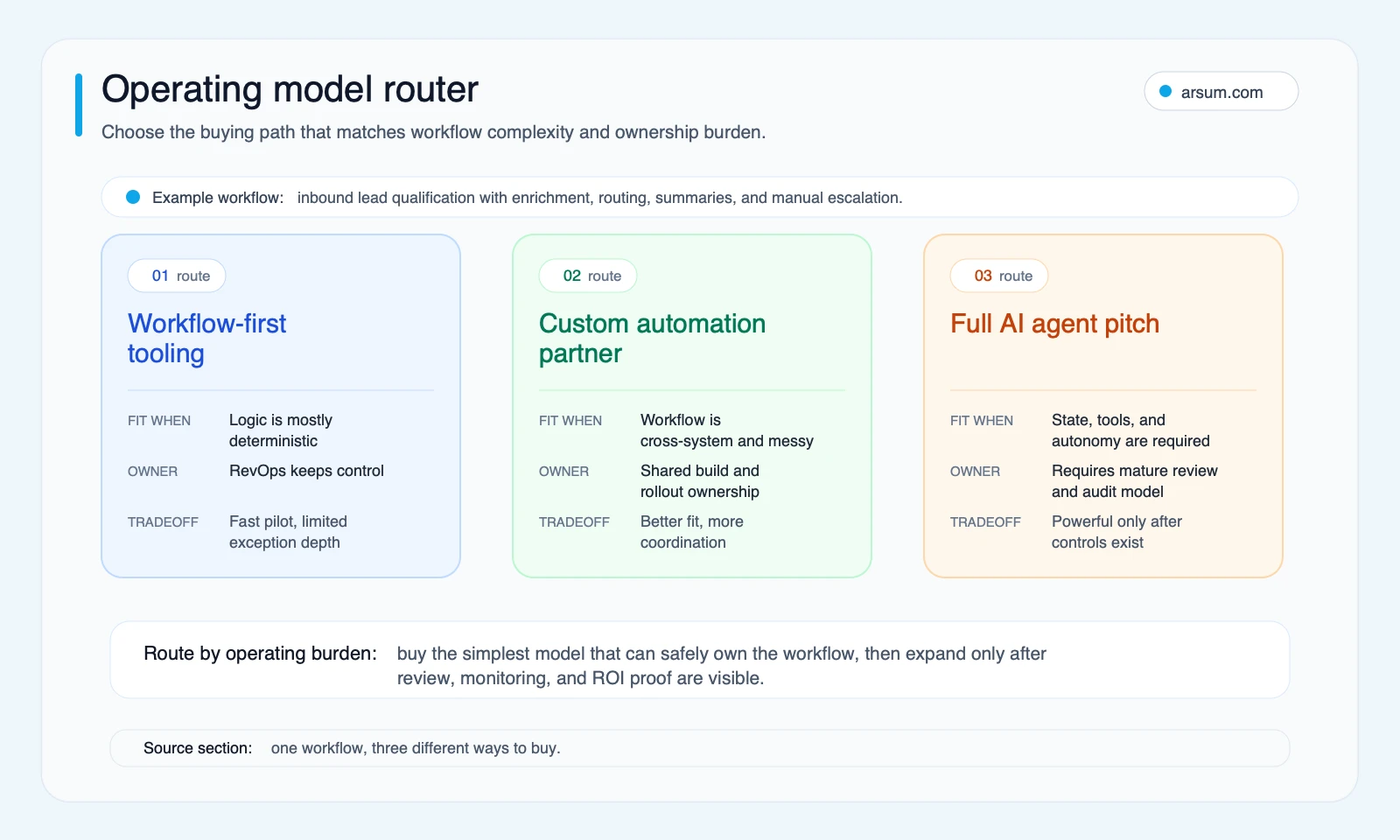
For example, routing a lead by territory and firmographic rules may be a workflow-first tooling problem. A workflow that reconciles CRM history, account context, documents, and specialist review may justify a custom implementation. A “full agent” pitch should only proceed when the additional state, tool use, and monitoring solve a real operating requirement.
Learn the practical distinction in agentic AI workflow automation and compare implementation ownership in hiring an AI developer versus an agency.
Price the Delivery Model Honestly: Project, Pilot, or Retainer
A buyer should not reject retainers automatically. They should reject retainers that cannot name recurring work.
Is the workflow stable, low-risk, and easy for your team to own?
├─ Yes → Fixed implementation project plus handoff.
└─ No
   └─ Is the workflow value plausible but baseline, exceptions, or data quality unproven?
      ├─ Yes → Short, bounded pilot with acceptance gates.
      └─ No
         └─ Does production require monitoring, incident response, reporting,
            tool/model updates, change control, or ongoing optimization?
            ├─ Yes → Retainer with named recurring deliverables.
            └─ No → Do not accept a vague recurring fee.
A legitimate retainer can cover monitored workflow health, incident response, connector or credential changes, approved prompt and rule updates, monthly exception analysis, documentation maintenance, and periodic performance reporting. It should specify what is included, response expectations, what changes require separate approval, and when the buyer can take ownership.
Practitioner discussions about selling automation services commonly raise the question of what remains valuable after the initial build. Treat that as a qualitative signal—not market-wide proof—that buyers should require an answer about post-launch obligations. The Make documentation community discussion on scenario documentation reinforces a practical requirement: the buyer should receive understandable workflow documentation, not a black box.
For scope and pricing questions, AI automation agency pricing and AI automation agency services provide useful comparison context.
Address Objections With Evidence, Not Reassurance
A seller earns trust by treating reasonable objections as design inputs. A buyer can use this matrix during vendor evaluation.
| Buyer objection | Weak seller answer | Credible seller answer | Evidence to request |
|---|---|---|---|
| “What ROI will this produce?” | “AI saves hours everywhere.” | “Here is the baseline, the target, the measurement window, and which assumptions remain unproven.” | Baseline worksheet, pilot metric definitions, benefit calculation |
| “Where does our data go?” | “It is secure.” | “Here is the data path, vendors, retention setting, access model, logs, and sensitive-field handling.” | Architecture diagram, vendor terms, permission inventory |
| “Can it take actions on our behalf?” | “It is autonomous.” | “These actions are automatic; these require approval; these are prohibited.” | Approval matrix, test cases, rollback plan |
| “What happens when it is wrong?” | “The model is highly accurate.” | “Low-confidence and exception cases route here, and this owner reviews them on this cadence.” | Exception taxonomy, queue design, audit samples |
| “Who owns it after launch?” | “We provide support.” | “Here is the buyer owner, seller responsibility, change process, and handoff material.” | RACI, support scope, runbook |
| “Why is there a monthly fee?” | “Continuous optimization.” | “The fee covers these recurring operational tasks, reports, and response duties.” | Monthly deliverables and change log |
Privacy claims should be checked at the product and contract level. For example, OpenAI’s business-data information and enterprise privacy documentation describe relevant controls and practices, but they do not eliminate the need to map your own data path, configuration, access, and retention requirements.
For workflows involving sensitive records or consequential system actions, use AI agent security as an additional diligence lens.
Proposal-Triage Scorecard: A Heuristic, Not a Benchmark
Score each category from 1 to 5. This is an Arsum editorial proposal-triage heuristic, not a validated market benchmark. Calibrate the weighting and threshold to the workflow’s risk, budget, and reversibility.
| Criterion | Weight | What a 5 requires |
|---|---|---|
| Workflow specificity | 2 | Exact trigger, inputs, systems, actions, output, and owner |
| Baseline and benefit evidence | 2 | Named baseline, target, measurement method, and assumptions |
| Data handling and access | 3 | Data path, permissions, retention, sensitive fields, and logs |
| Approval and decision boundary | 3 | Automatic, reviewed, and prohibited actions are explicit |
| Exception and rollback design | 3 | Exception owner, alerts, fallback, stop condition, and rollback |
| Delivery and maintenance ownership | 2 | Named buyer owner, seller scope, cadence, documentation, handoff |
| Claim support | 2 | Claims are pilot-backed or visibly labeled as assumptions |
Multiply each score by its weight. Do not calculate a total until all four non-negotiable gates pass:
- Named baseline metric.
- Named exception owner.
- Tested rollback path.
- Evidence supporting any performance or ROI claim.
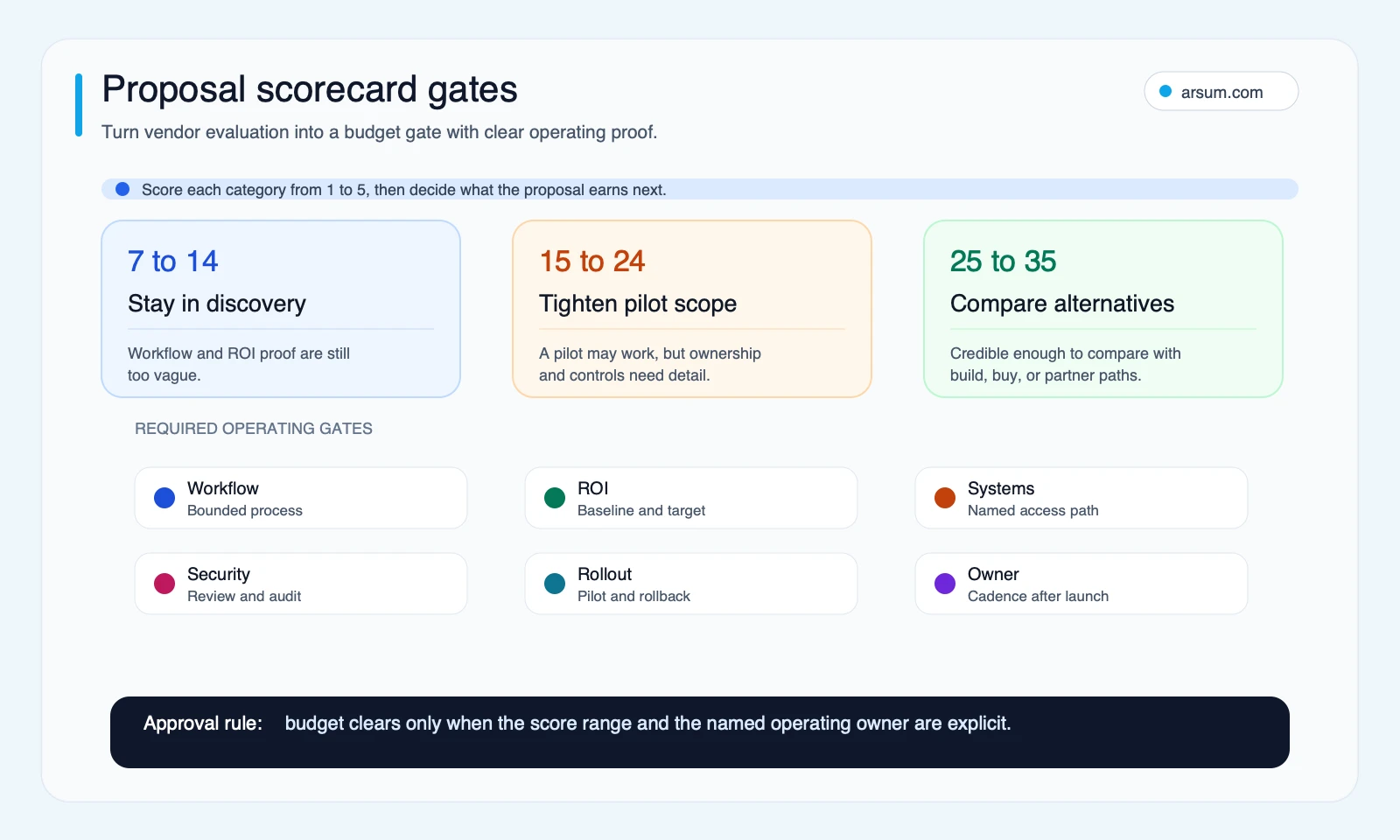
Use the score only after the gates. As an editorial triage rule, a low score means stay in discovery; a middle score may justify a tightly bounded pilot; a high score means compare the proposal against internal, tool-based, and partner alternatives. A proposal with weak data handling, unauthorized consequential actions, or no rollback fails regardless of its total.
Disqualifying Conditions and Common Failure Modes
Do not proceed when the seller cannot identify the data path, has no buyer-side owner, cannot explain the manual fallback, or asks for broad authority before proving a narrow workflow.
Other common failure modes include:
- Selling “AI automation” as the scope instead of one process.
- Treating a demo as proof of integration readiness and operational adoption.
- Measuring only speed while ignoring review cost, rework, and exception volume.
- Hiding maintenance work inside undefined “optimization.”
- Granting access before documenting systems, fields, and permissions.
- Expanding autonomy when the failure cost is high and reversibility is low.
- Failing to document workflow logic, operational handoff, and change history.
The seller-side lesson is straightforward: define one workflow, baseline it, state the approval boundaries, separate implementation from recurring operations, and attach pilot acceptance criteria. That is how to sell AI automations without selling a vague package that fails after the demo.
Source and Method Note
This guide uses official FTC guidance for AI-claim discipline, OpenAI business privacy materials for data-path questions, and Zapier and Make materials for ordinary workflow-control and documentation concepts. Practitioner discussions were used only as qualitative signals of recurring buyer questions around vague claims, retainers, and maintenance; they are not evidence of adoption rates, outcomes, or market-wide failure patterns.
Before signing, verify current product capabilities, retention settings, integrations, support terms, and security commitments directly with the vendor.
Ready to Automate Your Business?
Stop wasting time on repetitive tasks. Let AI handle the busywork while you focus on growth.
Schedule a Free Strategy Call →Written by:Arsum editorial team
- Reviewed by
- Arsum editorial team
- Published
- May 22, 2026
- Updated
- July 6, 2026
- How this was produced
- Arsum uses research packs, source checks, and human editorial review to prepare and update blog articles. Editors are responsible for the final page.
- Source policy
- Sources are linked in the article when used. Methodology and source notes are included on higher-risk or high-visibility pages and are being rolled out across the archive. Editorial policy.
- Why this page exists
- Help B2B operators evaluate AI automation, implementation scope, cost, risk, and build-vs-buy decisions with practical context.