To start an AI automation agency, begin with one controlled, repeatable workflow in a vertical you understand—not a promise to “automate anything.” This guide helps founders design a credible first offer and helps buyers evaluate it: prove the inputs, exceptions, owner, economics, and production responsibilities before proposing a build. A viable agency sells accountable workflow ownership, not a no-code demo.
How To Start AI Automation Agency: Buyer Guide
Explore how to start ai automation agency: compare workflow fit, costs, risks, evidence, and practical next steps before you build, buy, or hire.

Table of Contents
- What Most Guides Miss
- Choose a Narrow Offer, Not a Broad Category
- Run a Workflow Audit Before Proposing a Build
- Design a Pilot That Produces a Go/No-Go Decision
- Sell Discovery, a Pilot, a Retainer, or No Build
- Choose SaaS, Internal Build, or an Agency
- Build Buyer Trust Through Access and Control Design
- Failure Modes That Should Change the Scope
- A Practical First 30 Days
- Methodology and Limits
- FAQ
- Next Step
What Most Guides Miss
The first decision is not whether you can connect a model to a workflow platform. It is whether the workflow can be operated responsibly after it touches real records, customer messages, or business systems.
That is the practical answer to how to start ai automation agency work: choose a narrow workflow where a buyer can measure the current process, authorize the proposed actions, and own exceptions after launch.
A credible first offer has these conditions:
- A clear business event triggers the work.
- Inputs come from known systems and can be inspected.
- A named client-side owner can answer exceptions and approve changes.
- The workflow has enough volume or consequence to justify implementation.
- Uncertain outputs route to a person rather than silently taking consequential action.
- The buyer can measure whether the pilot improved the process.
- Access, credentials, monitoring, support, and rollback are defined before launch.
If those conditions are not clear, sell a workflow audit or recommend no build. That is not a weak sales outcome; it prevents an agency from inheriting an unowned process disguised as an AI project.
For buyers, this is the evaluation rule: ask whether the agency can map the normal path, the ugly exceptions, approval rules, retained evidence, and support responsibility—not merely show a model connected to an app.
Choose a Narrow Offer, Not a Broad Category
“We automate anything” creates a discovery problem on every engagement. You must repeatedly learn new process language, systems, risk tolerances, approval rules, and acceptance criteria. A vertical and workflow focus makes the service easier to scope and easier for a buyer to assess.
Examples of bounded starting offers include:
- Document intake and routing for brokerage operations
- Invoice or receipt intake for accounting teams
- Support-ticket classification and escalation
- Lead qualification with human approval before CRM updates
- Employee onboarding coordination across HR, IT, and payroll
- Loan or account-opening document collection with exception routing
These are workflow categories, not outcome promises. A workflow can still be a poor fit when source data is inconsistent, exceptions dominate the normal path, or the client cannot assign an accountable owner.
A useful positioning statement names the buyer, workflow, and operating boundary:
We help brokerage operations teams route incoming policy documents into the right queue, with human review for incomplete or uncertain cases.
That is more credible than promising autonomous agents across an entire business. For the broader category definition, see what an AI automation agency does, but keep the first offer narrower than the category.
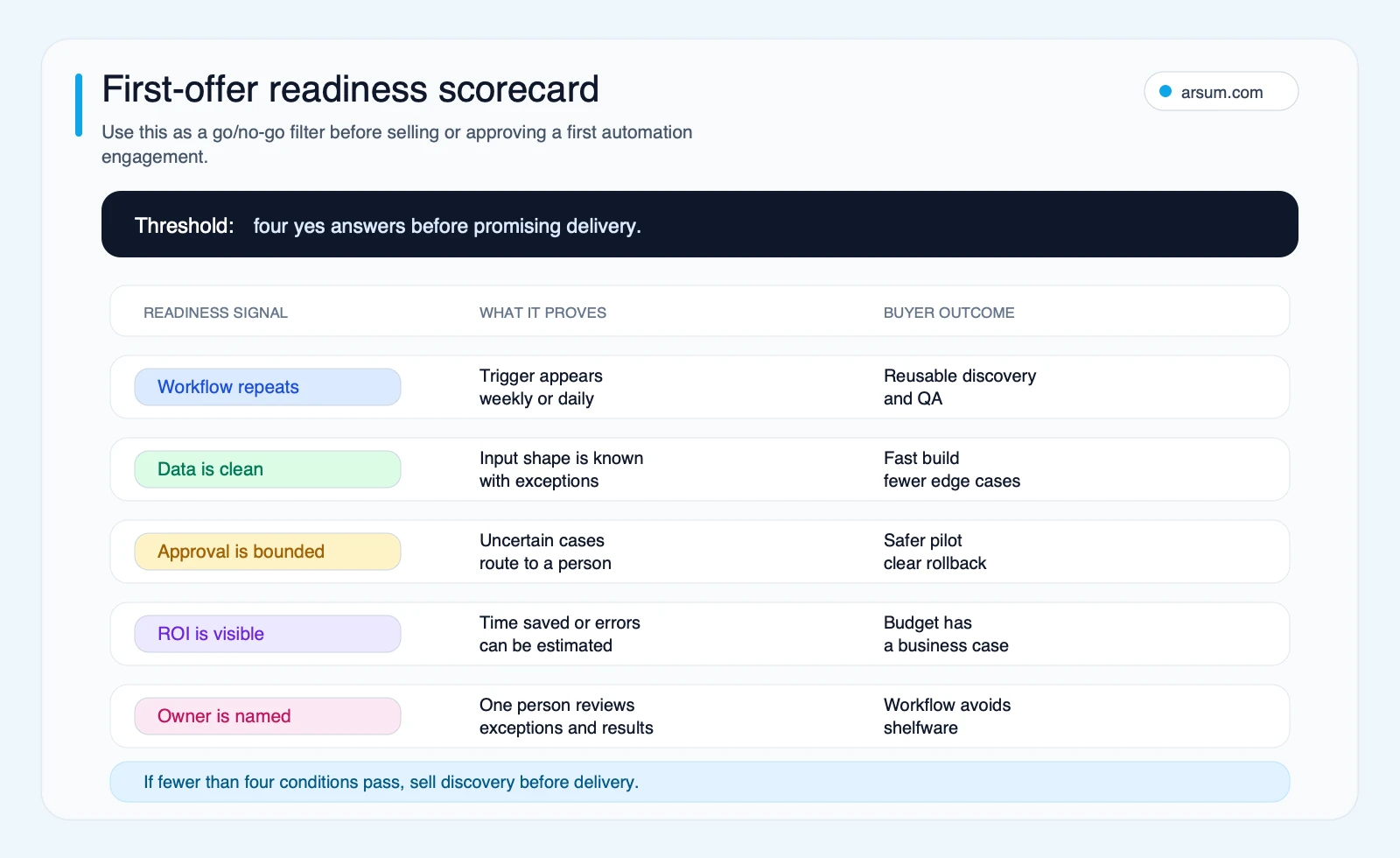
The first-offer readiness scorecard
Use this scorecard during discovery. Mark each dimension clear, unclear, or blocked. It is an editorial planning tool, not a market benchmark or prediction of project success.
| Dimension | What “clear” means | Why it matters |
|---|---|---|
| Vertical familiarity | You understand the workflow terms, systems, and constraints. | Reduces avoidable discovery mistakes. |
| Repeatable workflow pain | The same handoff or decision occurs regularly. | Makes a scoped build and test set possible. |
| Measurable baseline | Time, backlog, rework, delay, or error can be measured. | Gives the buyer a decision basis. |
| System access | Required apps, APIs, and approvers are known. | Prevents access from stalling delivery. |
| Input quality | Historical examples can be reviewed and classified. | Reveals whether automation will create excessive exceptions. |
| Exception design | Uncertain or prohibited cases have a human route. | Limits unsafe autonomy. |
| Client-side owner | One role owns approvals and post-launch decisions. | Prevents unresolved alerts and shelfware. |
| Support need | Monitoring, connector maintenance, and change requests are defined. | Distinguishes handoff work from operations work. |
When several rows remain unclear, the next offer should be paid discovery, not a fixed-fee implementation promise.
Run a Workflow Audit Before Proposing a Build
A workflow audit turns “we need AI” into a decision a buyer can approve, reject, or sequence. It should produce a working operating document, not a generic strategy deck.
Capture the following fields:
| Field | Question to answer |
|---|---|
| Trigger event | What starts the workflow? |
| Inputs and source systems | Which inboxes, forms, databases, or applications provide the information? |
| Current manual steps | What does the operator do today, in order? |
| Monthly volume | How often does the work occur? |
| Baseline cost | What labor time, delay, rework, or error is currently incurred? |
| Systems touched | Which systems are read from and written to? |
| Credentials required | What permissions are needed, who grants them, and who can revoke them? |
| Approval points | Which actions require a person to approve before they occur? |
| Exception path | What happens when input is incomplete, ambiguous, or out of policy? |
| Acceptance test | Which evidence will show the pilot worked? |
| Operating owner | Who handles alerts, changes, and business decisions after launch? |
The audit should identify one workflow to test first, one reason it is worth testing, and one condition that would make it unsuitable.
For example, an accounting team may receive invoices through several channels and need to route them for coding and approval. A suitable first pilot may classify incoming documents and extract a proposed vendor or invoice reference for review. It should not create accounting entries or release payments without separately authorized controls. The baseline might be the current queue age, handling time, rework, and number of incomplete submissions. The exception measure is the share that must be reviewed manually because the document is missing data, conflicts with source records, or falls outside the policy.
That example does not establish a typical result. It shows the level of specificity required before an agency can responsibly claim that it has a workable scope.
Public practitioner discussions about agency saturation, first-client access, and retainers are useful only as qualitative signals: builders regularly encounter unclear permissions, vague scope, and support obligations after a demo. They do not establish market-wide conversion rates, income, fees, or delivery timelines.
💡 Arsum builds custom AI automation solutions tailored to your business needs.
Get a Free Consultation →Design a Pilot That Produces a Go/No-Go Decision
A pilot is not a smaller version of “automate everything.” It is a bounded test with a baseline, approval owner, review cadence, stop condition, and rollback path.
Consider an inbound-support triage workflow. The automation may classify the request, extract an account identifier, propose urgency, and route the case. It should not silently send customer-facing replies, change account data, or close tickets unless those actions have separately earned authorization.
Worked pilot scorecard
This is an illustrative planning model. Replace each assumption with buyer-verified inputs before using it in a proposal.
| Item | Illustrative planning assumption | Owner |
|---|---|---|
| Workflow | Triage inbound support tickets | Support operations lead |
| Baseline | Measure current handling time and misroutes over a defined historical sample | Process analyst |
| Target | Reduce manual triage work while maintaining agreed routing quality | Support operations lead |
| Test set | Historical tickets plus a monitored live sample | Agency delivery lead |
| Quality measure | Reviewer checks classification, extraction, and routing against an agreed rubric | QA reviewer |
| Exception measure | Track the share sent to human review and the reason | Support operations lead |
| Evidence retained | Input reference, model output, final disposition, reviewer correction, and execution log | System owner |
| Review cadence | Review pilot results at an agreed weekly cadence | Agency and client owners |
| Stop condition | Pause if quality falls below the agreed threshold, exceptions overload reviewers, or unauthorized actions occur | Client approval owner |
| Rollback path | Disable the automated routing or write action and return work to the documented manual queue | System owner |
| Go/no-go date | Set before implementation begins | Executive sponsor |
Baseline arithmetic should be explicit. If a buyer processes 300 items per month and each currently takes 12 minutes, the current manual workload is 60 hours per month. That is an illustrative planning assumption, not realized savings. The proposal must still verify volume, handling time, loaded labor cost, error impact, review burden, operating support, and change-management cost.
For a broader way to structure the business case, see AI automation ROI examples.
Production responsibility is part of the offer
A demo proves that a sequence can run. A production offer must explain what happens when it does not.
For workflow platforms, n8n’s error-handling guidance and execution documentation show why failed runs and execution records need an explicit handling path. n8n’s credential documentation also makes the operational point: client automations commonly depend on private credentials, so ownership, sharing, revocation, and least-privilege access belong in scope.
For model-dependent steps, define a test set and acceptance rubric rather than relying on subjective demo review. OpenAI’s evaluation guidance supports defining evaluations before relying on model output in a workflow. Its agent safety guidance emphasizes constrained tools, structured outputs, and caution with untrusted inputs.
An agency should be able to state:
- Which system records are read and which may be written.
- Which credentials are client-owned and how access is revoked.
- Which outputs require human review.
- How a failed execution creates an alert and who receives it.
- Which changes require retesting before release.
- How the workflow returns to manual operation if the pilot is paused.
Sell Discovery, a Pilot, a Retainer, or No Build
The commercial model should follow the actual operational obligation.
| Offer | Use when | Buyer receives | Do not use when |
|---|---|---|---|
| Workflow audit | Workflow value, data, owner, or systems are unclear | Process map, risk register, baseline plan, and recommended next step | The buyer expects a working production system immediately. |
| Fixed-fee pilot | One workflow has clear boundaries and a measurable test | Discovery confirmation, implementation, testing, documentation, and agreed handoff | Access and approval ownership remain unresolved. |
| Managed operations retainer | A live workflow needs monitoring, evaluation updates, connector maintenance, or backlog ownership | Defined alerts, response process, change control, reporting, and support scope | The workflow is low-risk, rarely used, and fully owned by the client after handoff. |
| Productized vertical workflow | The same problem and controls repeat across similar buyers | Configuration-led implementation with stated constraints | The buyer’s exception path or systems are materially different. |
| No-build recommendation | Low volume, high ambiguity, irreversible actions, or absent ownership makes automation unsuitable | A documented reason to defer, simplify, buy existing software, or fix process data first | You are using “no build” to avoid normal discovery work. |
Do not invent a retainer because recurring revenue sounds attractive. It is justified only when it funds real work: monitoring failed executions, triaging alerts, maintaining connectors, reviewing model quality, updating prompts or policies, managing security changes, or owning an improvement backlog.
A one-time handoff may be more appropriate for a low-risk workflow that the buyer can safely own after documentation and training. The decision should be visible in the proposal.
Choose SaaS, Internal Build, or an Agency
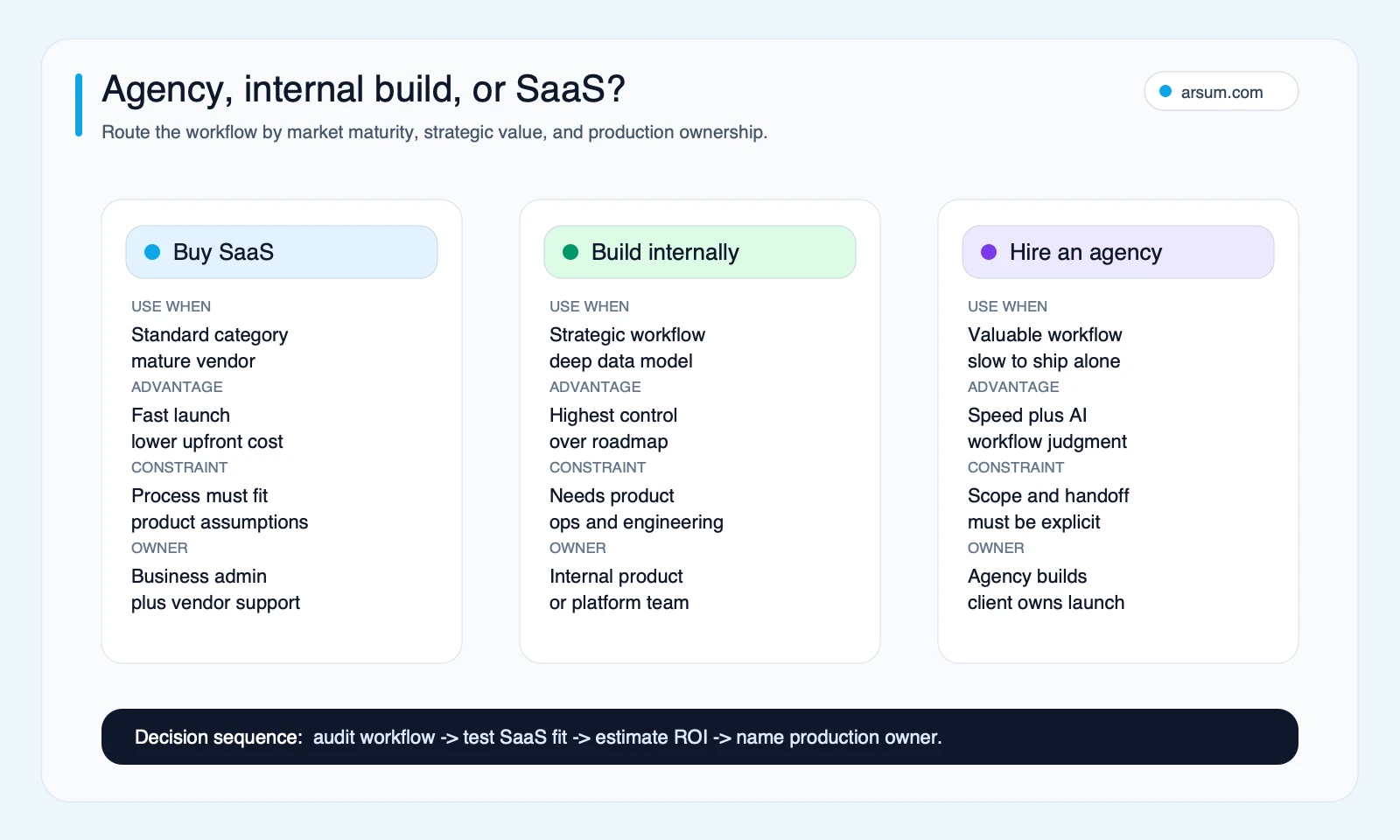
An agency is not automatically the right answer. Use the workflow audit to select the delivery path.
| Decision criterion | Buy SaaS | Build internally | Hire an agency |
|---|---|---|---|
| Workflow maturity | Common and well-supported by existing products | Differentiated and central to the business | Valuable, specific, and not well-served by existing products |
| Data sensitivity | Vendor controls and contractual terms meet requirements | Internal controls are required and capacity exists | Agency can work within the required access, hosting, and control model |
| Integration complexity | Limited to standard connectors | Internal engineering can maintain custom integrations | Integrations need delivery expertise but do not justify a permanent internal build team |
| Internal ownership | Business team can configure and operate it | Product, engineering, security, and operations can own it | Client has a business owner but lacks near-term implementation capacity |
| Support burden | Vendor owns most support | Internal team can own runtime support | Support scope is explicitly included and commercially viable |
| No-go signal | Product forces unacceptable process changes | No technical capacity after launch | Agency cannot explain controls, evidence, and escalation ownership |
SaaS may fit a standard workflow. Internal development may fit a strategically differentiated process when a team can own it over time. An agency fits when tailored implementation matters and the buyer needs focused delivery capacity.
Use AI workflow automation guidance to separate workflow design from model hype, and compare AI automation platforms before assuming custom work is necessary. Where the scope becomes a durable product or complex integration program, custom AI agent development services or AI implementation services may be a better fit than a lightweight automation engagement.
Build Buyer Trust Through Access and Control Design
A serious buyer should ask:
- Which workflow would you refuse to automate first, and why?
- What exact metric and evidence decide whether the pilot worked?
- Which credentials do you need, and how will each permission be scoped?
- Who owns credential revocation and secrets storage?
- How are failed runs detected and escalated?
- Which inputs are untrusted, and how are they prevented from changing tool behavior?
- What actions require human approval?
- What happens if a connector, prompt, model behavior, or source schema changes?
- Which ongoing operational tasks are included after launch?
These questions are not bureaucracy. OWASP’s Top 10 for LLM applications identifies risks including prompt injection and excessive agency, which are reasons to limit tool permissions and treat external content as untrusted. The NIST AI Risk Management Framework supports managing trustworthiness through design, deployment, and use rather than treating risk review as a one-time pre-launch task.
Technical capability is not business authorization. High failure cost, sensitive data, or low reversibility should reduce automation autonomy and increase review requirements.
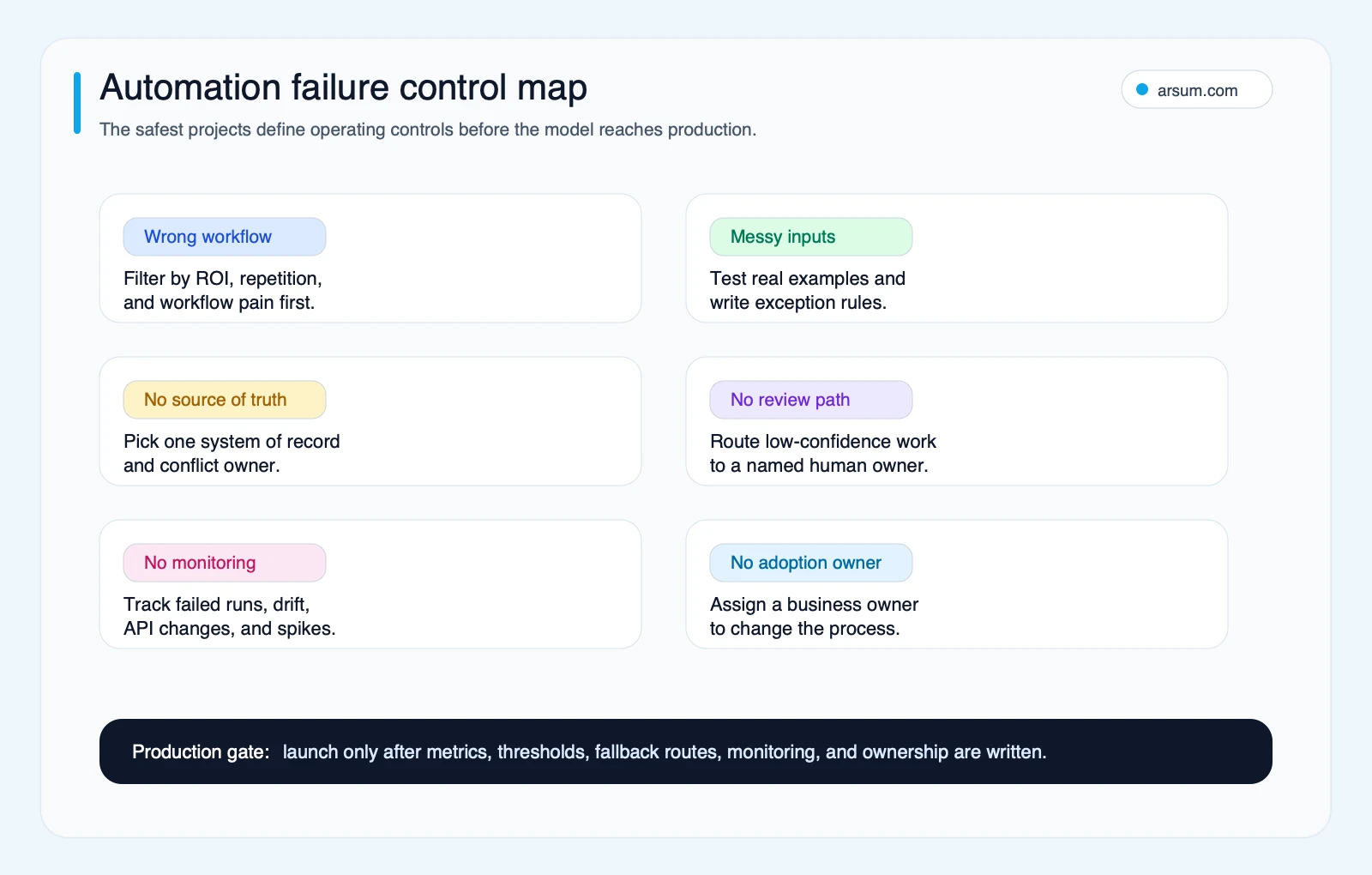
Failure Modes That Should Change the Scope
Do not attempt to solve these conditions solely with better prompts.
- No stable source of truth: Conflicting records create unclear writes and reconciliation risk.
- No historical examples: You cannot construct a useful acceptance test or identify common exceptions.
- Exception-heavy work: Human correction may consume more effort than the workflow removes.
- Unapproved access: Broad admin credentials, shared secrets, or unclear revocation are unacceptable foundations.
- Irreversible action: The system can send payments, make regulated decisions, alter records, or contact customers without a defined approval gate.
- No business owner: Alerts and exceptions accumulate without someone authorized to resolve them.
- No operational budget: A production workflow may require monitoring and maintenance after the initial build.
The appropriate recommendation may be manual process improvement, a SaaS trial, data cleanup, a limited read-only pilot, or a deferred project. That protects the buyer and makes the agency’s scope more credible.
A Practical First 30 Days
For an agency founder, the early objective is not a polished stack. It is evidence that you can identify and scope a safe, useful workflow.
- Pick one vertical where you can hold credible process conversations.
- Interview operators about a recurring handoff, not their general AI strategy.
- Use the workflow-audit fields to map inputs, systems, approvals, and exceptions.
- Create a sample pilot scorecard with every assumption clearly labeled.
- Build a demonstration only after the workflow and failure path are understood.
- Offer discovery when readiness is unclear; offer a pilot only when decision criteria are written down.
- Define the handoff or managed-operations boundary before the buyer signs.
Methodology and Limits
This article uses the Editorial Research Pack collected on 2026-06-20: exact-query and variant SERP review, qualitative public practitioner discussions, and official documentation from n8n, OpenAI, OWASP, and NIST. Community material is used only to surface recurring questions about scope, credentials, support, and agency positioning; it is not evidence of market size, client-acquisition speed, pricing, income, adoption, or performance outcomes.
There are no independent benchmarks here for agency earnings, typical fees, close rates, savings, delivery timelines, or retention. Any pilot arithmetic is an illustrative planning assumption requiring buyer-specific inputs and review.
FAQ
Do I need to code to start an AI automation agency?
Not necessarily for a bounded workflow using existing integrations. But you need enough technical judgment to understand APIs, permissions, errors, data flow, testing, and the point at which a custom integration or security requirement needs engineering support. No-code tooling does not remove production responsibility.
Should I specialize in one vertical?
Start with a vertical or tightly defined workflow category when it improves discovery quality and makes the offer repeatable. Specialization is not a guarantee of sales outcomes; it reduces the process context you must recreate for each engagement.
When should I offer a retainer?
Offer one only when there is defined ongoing work, such as monitoring, incident response, connector maintenance, evaluation review, change control, security updates, or an improvement backlog. If the client can safely own a low-risk workflow after documentation and handoff, a retainer may not be appropriate.
What should a buyer ask before hiring an AI automation agency?
Ask for the workflow audit, baseline, acceptance test, exception route, named approval owner, evidence retained, credential model, support scope, stop condition, and rollback path. A proposal that cannot answer those questions is not yet a production plan.
When should we avoid AI automation altogether?
Avoid or defer it when the workflow is low-volume, undefined, highly exception-driven, irreversible, unsupported by clean source data, or missing an accountable business owner. Fixing the operating process may create more value than adding automation.
Next Step
A defensible AI automation agency begins with a workflow that can be measured, controlled, and owned after launch. If you are designing or evaluating an offer, start with the audit and pilot scorecard—not an agency revenue promise or a model demo.
Ready to Automate Your Business?
Stop wasting time on repetitive tasks. Let AI handle the busywork while you focus on growth.
Schedule a Free Strategy Call →Written by:Arsum editorial team
- Reviewed by
- Arsum editorial team
- Published
- April 5, 2026
- Updated
- August 12, 2026
- How this was produced
- Arsum uses research packs, source checks, and human editorial review to prepare and update blog articles. Editors are responsible for the final page.
- Source policy
- Sources are linked in the article when used. Methodology and source notes are included on higher-risk or high-visibility pages and are being rolled out across the archive. Editorial policy.
- Why this page exists
- Help B2B operators evaluate AI automation, implementation scope, cost, risk, and build-vs-buy decisions with practical context.