
If you’re a founder, operator, or commercial leader evaluating AI automation, the first question is not which vendor has the best demo. It is whether the business problem needs a targeted AI automation build or a full hyperautomation program. Choose the wrong scope and the cost difference can be measured in quarters, headcount, and executive patience.
Most businesses that struggle with automation do so because they’re solving the wrong problem. Some spend 18 months building enterprise governance infrastructure before proving the AI layer works. Others deploy a single workflow tool and call it a hyperautomation strategy. Both paths waste significant money and time.
Hyperautomation and AI automation are related but distinct – and the distinction determines which one your organization actually needs right now.
Hyperautomation is a coordinated program that combines tools like RPA, AI, workflow orchestration, and process discovery to improve business and IT processes at scale. AI automation is one capability inside that broader program.
The practical distinction: hyperautomation is a strategy. AI automation is a capability. You can deploy AI automation without committing to hyperautomation. You cannot do hyperautomation without AI automation.
Want to automate this for your business? Let's talk →
What Most Comparisons Miss
Most pages about Hyperautomation vs AI Automation compare features, pricing, or popularity. A buyer needs a stricter filter: which option changes the workflow, who will maintain it, and what failure mode is acceptable after launch.
Before shortlisting anything, map:
- Workflow fit: what repetitive business process will actually change?
- Integration burden: which systems, permissions, and data sources must connect?
- Control: who can inspect, test, and correct the output when it is wrong?
- Switching cost: what gets hard to replace after the first rollout?
If those answers are unclear, the “best” option is still only a demo preference. The right choice is the one your team can operate safely after the novelty wears off.
Operator Note: Scope Lies Before Tool Choice
The most common buying mistake in this category is assuming the tool label answers the operating question. It does not. Teams usually get in trouble when they buy for the demo, then discover later that the real work lives in exception handling, permission design, and long-term ownership. If those are still undefined, the stack choice is premature.
Social Listening: Where Scope Confusion Shows Up
Public operator discussions around RPA, AI agents, and workflow automation keep surfacing the same scope problem: teams want concrete examples, trust rules-based flows more for structured work, and start worrying about governance as soon as AI touches messy inputs. That matters because the buying mistake usually happens before implementation. People compare labels before they define who owns the workflow, the exceptions, and the data quality.
- Practitioners still ask for plain-language examples of hyperautomation versus intelligent automation, which is a sign that the category language is still muddy.
- Rules-based automation is usually treated as safer for stable, structured tasks, while AI-heavy flows are treated as useful but in need of tighter review loops.
- Data governance keeps showing up as the hidden dependency. Faster automation does not fix weak process ownership or bad source data.
Treat those threads as directional implementation signal, not market-wide statistics. They are still a useful warning that scope discipline matters before stack selection.
TL;DR: Hyperautomation vs AI Automation
| Hyperautomation | AI Automation | |
|---|---|---|
| What it is | Enterprise-wide automation strategy | Process-level AI capability |
| Scope | Dozens to hundreds of processes | One to several targeted processes |
| Typical cost | $500K–$5M+ | $25K–$250K per solution |
| Timeline | 12–36 months | 8–16 weeks |
| Best fit | Large enterprise (1,000+ employees) | Mid-market and growing enterprise |
| Starting point | Requires RPA + governance foundation | Can start from scratch |
| Risk | High (org change, vendor lock-in) | Moderate (scoped, reversible) |
What Is Hyperautomation?
IBM describes hyperautomation as a broad approach to streamlining business and IT processes by combining multiple automation technologies instead of betting on one tool or one workflow. That framing matters because it keeps the focus on program scope. Hyperautomation is not a chatbot, one approval bot, or a single extraction workflow. It is the coordinated effort to discover, prioritize, automate, and govern many processes across the business.
A typical hyperautomation stack can include:
- RPA (Robotic Process Automation), for deterministic, rules-based execution in structured workflows
- AI and ML, for classification, extraction, summarization, and decision support when inputs are messy or variable
- Process mining, for discovering where the bottlenecks and automation candidates actually are
- BPM and workflow orchestration, for approvals, exception routing, and human-in-the-loop control
- Low-code or integration tooling, for connecting systems without rebuilding every workflow from scratch
- Monitoring and analytics, for measuring business impact and catching failures after launch
The defining trait is not the ingredient list alone. It is the operating model around the list: process discovery, ownership, exception design, governance, and cross-team coordination.
When Hyperautomation Makes Sense
Hyperautomation is appropriate for organizations that:
- Have enough process volume and cross-team handoffs that isolated automation wins are no longer enough
- Already run several automation workflows and need shared governance, auditability, and prioritization
- Need process discovery, orchestration, and exception routing across departments, not just one workflow
- Have executive sponsorship for a multi-quarter program with integration and change-management work
- Can staff ongoing ownership for model evaluation, access control, and maintenance
💡 Arsum builds custom AI automation solutions tailored to your business needs.
Get a Free Consultation →What Is AI Automation?
AI automation is narrower in scope. It uses AI models – large language models, computer vision, NLP, or specialized ML models – to automate tasks that require some form of intelligence. The key distinction from traditional automation: AI automation handles ambiguity.
Traditional RPA breaks when inputs vary. An invoice formatted differently, a field in a different column, a new vendor template – each of these can cause RPA to fail. AI automation adapts because it understands content, not just structure.
The impact usually shows up when the workflow includes invoices, contracts, support queues, forms, or other unstructured inputs that break brittle rule sets. In those cases, the AI layer can classify, extract, summarize, or route work that would otherwise require manual review.
Examples of AI automation in practice:
- A document classification model that routes insurance claims or support tickets based on the content inside them
- An LLM extracting structured data from vendor invoices that do not share the same layout
- A predictive model flagging unusual AP transactions before payment is released
- An AI assistant reviewing contract language and routing obligations for human approval
- A natural language interface that lets operations staff query internal systems in plain English
For a deeper look at what AI automation looks like in specific business functions, see intelligent process automation examples.
When AI Automation Is the Right Scope
AI automation without a full hyperautomation program is the right approach when:
- You have a specific, high-value process consuming significant manual hours
- The process involves unstructured inputs – PDFs, emails, images, or voice
- You need demonstrable ROI within one quarter, not 18 months
- You’re not ready for enterprise-wide transformation governance
- Your organization is under $200M revenue or doesn’t yet have a dedicated automation team
Operationally, AI automation changes the work before it changes the org chart. The process owner still owns the workflow, but their job shifts from manual throughput to exception handling, data quality, and performance monitoring. The best first projects have clear baselines for cycle time, error rate, labor hours, SLA misses, and cost per transaction, so the ROI discussion stays concrete instead of becoming a model-performance debate.
Expert Note: Governance Is the Real Divider
IBM’s hyperautomation and intelligent-automation framing, UiPath’s explanation of intelligent automation, OpenAI’s production and eval guidance, and governance frameworks from NIST and OWASP all point in the same direction: the real dividing line is not whether AI appears in the stack. It is whether the business can safely operate the workflow after launch. If the hard part is output evaluation, access scopes, billing controls, prompt-injection risk, audit logs, and cross-team exception handling, you are already making a governance decision, not just a tooling decision.
Should This Be AI Automation or Hyperautomation?
Use this quick decision tree before you let a vendor category decide for you:
- Is the pain concentrated in one repetitive workflow? If yes, start by treating it as an AI automation candidate.
- Does the process cross multiple systems, approvals, or departments? If yes, you are already drifting toward hyperautomation territory.
- Are the outputs probabilistic enough that people still need to review exceptions? If yes, plan for orchestration, checkpoints, and monitoring, not just a model call.
- Do you need auditability, role-based access, and clear maintenance ownership from day one? If yes, the governance layer matters as much as the automation itself.
Quick read: if only the first answer is yes, AI automation is usually the honest scope. If the last three start turning into yes as well, you are probably planning a hyperautomation program whether you call it that or not.
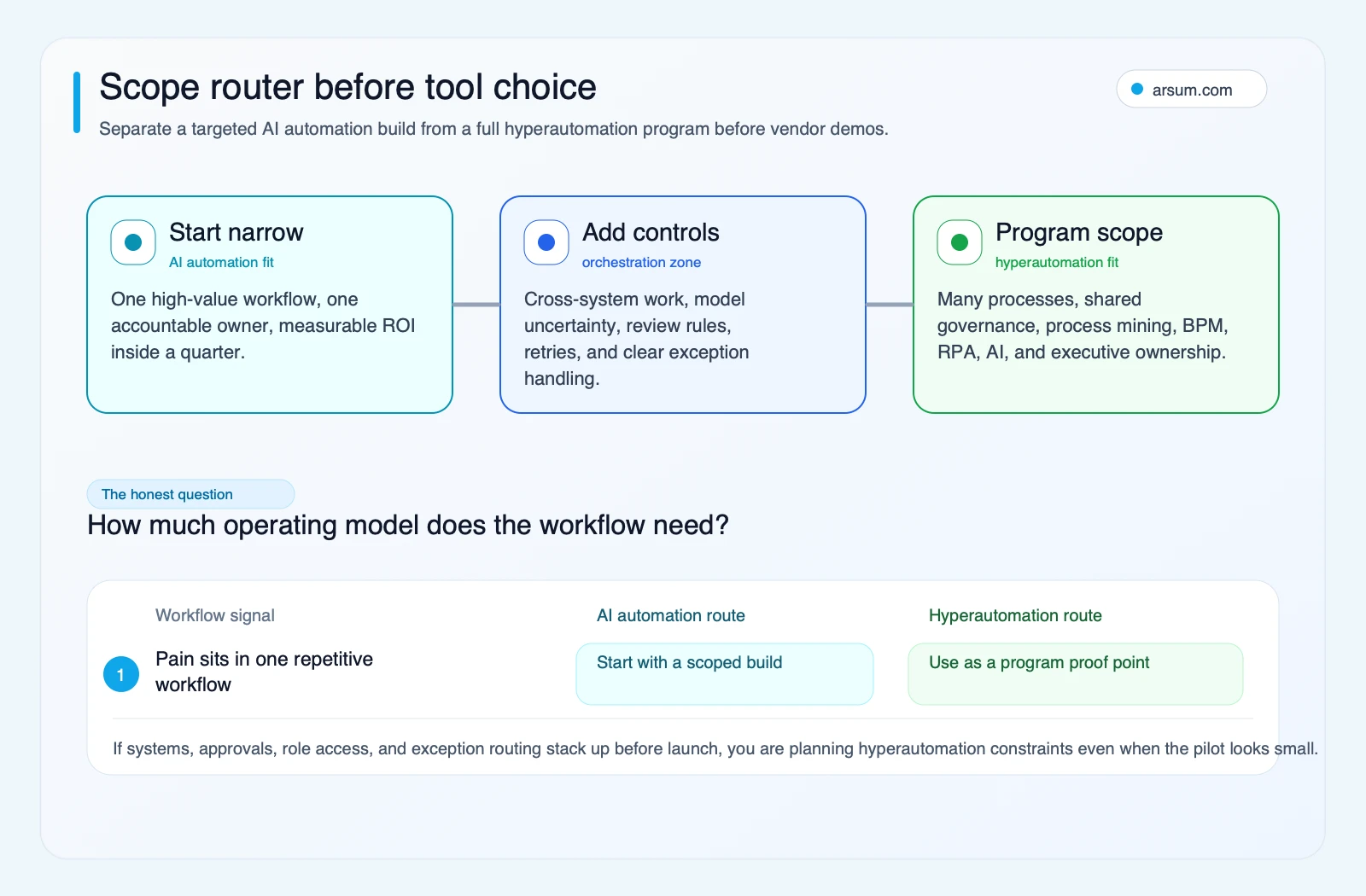
Use the router as a quick scope check before vendor demos: the more ownership, approvals, permissions, and exceptions stack up, the more the project needs a program model instead of a point build.
Hyperautomation vs AI Automation: Key Differences
| Dimension | Hyperautomation | AI Automation |
|---|---|---|
| Scope | Enterprise-wide strategy | Process-level capability |
| Technologies | RPA + AI + BPM + process mining + analytics | AI/ML models, LLMs, NLP, computer vision |
| Driver | Strategic transformation | Tactical process improvement |
| Typical timeline | 12–36 months | 8–16 weeks |
| Typical cost | $500K–$5M+ programs | $25K–$250K per solution |
| Best fit | Large enterprise (1,000+ employees) | Mid-market and growing enterprise |
| Risk profile | High (org change, governance, vendor lock-in) | Moderate (scoped, reversible) |
7-Factor Scorecard
Use this as a buyer-side scoring model before you compare tools. The point is not to produce a fake precision score. The point is to make the workflow shape visible.
| Factor | AI automation is usually enough when… | Hyperautomation is usually the better fit when… |
|---|---|---|
| Process scope | One workflow or one team owns the outcome | Multiple teams share ownership across a longer process |
| System count | The work touches one to three systems | The work spans several systems plus approvals or handoffs |
| Data quality sensitivity | Inputs vary, but the source systems are still understandable | Broken or inconsistent upstream data affects several downstream steps |
| Permission risk | Narrow scopes can be granted safely | Access design is broad enough to require formal governance |
| Exception volume | A human can review the edge cases inside the existing team | Exceptions need routing, SLAs, and explicit accountability |
| Human review burden | Review stays light and localized | Review load becomes part of the operating model |
| Maintenance ownership | One process owner can maintain it after launch | A program team or shared ops function has to own ongoing change |
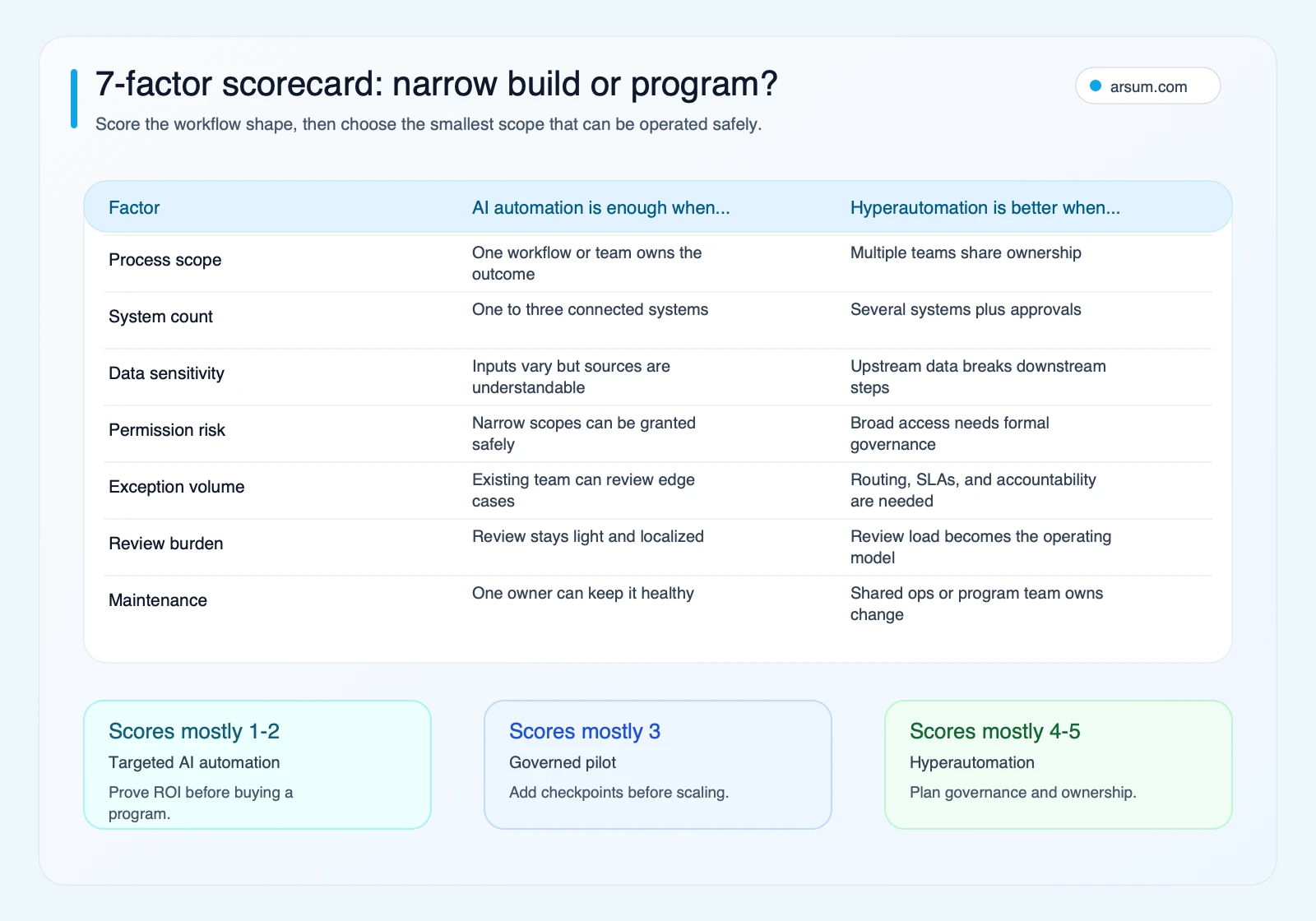
The useful score is not a fake precision number. It is the pattern: mostly low scores support a scoped AI automation build, while high scores mean governance and ownership need to be designed before rollout.
Commodity vs Non-Commodity Breakdown
| Work shape | More commodity, usually a fit for scoped AI automation | More non-commodity, usually a fit for hyperautomation or a governed program |
|---|---|---|
| Workflow design | Standard intake, classification, summarization, or routing | Custom approvals, cross-team handoffs, proprietary exception logic |
| System pattern | One team, a few integrations, narrow permissions | Several systems, shared data dependencies, and role-sensitive access |
| Review burden | One owner can spot-check outputs | Multiple people must review, route, or approve exceptions |
| Maintenance load | A local operator can maintain prompts, rules, and thresholds | Ongoing program ownership is needed to manage change across teams |
Commodity work can often start as a narrow AI automation build. Non-commodity work usually pushes you toward orchestration, governance, and a broader automation program because the competitive value sits in the workflow design, not the model call.
What Breaks First in Each Model
| Model | Failure mode that shows up first | What to check before rollout |
|---|---|---|
| AI automation | Prompt or output reliability, brittle integrations, overbroad app permissions | Access scopes, retry paths, fallback logic, and who reviews exceptions |
| Hyperautomation | Governance drag, integration backlog, and change-management overhead | Process inventory, executive ownership, and whether the program can absorb cross-team coordination |
A Practical Decision Framework
Use four filters before choosing a path:
- Process value: If the workflow burns 20+ hours per week, creates revenue leakage, delays customers, or blocks sales and operations teams, it is worth evaluating. If the pain is occasional inconvenience, automation will be hard to justify.
- Input ambiguity: If the work involves PDFs, emails, contracts, voice notes, messy CRM fields, or judgment calls, AI automation is likely relevant. If every input is structured and rules-based, RPA or workflow software may be enough.
- Governance load: If you need one process fixed this quarter, start with AI automation. If you need to coordinate dozens of processes across departments, vendors, compliance, and internal automation standards, hyperautomation is the more honest label.
- Build-vs-buy fit: Buy when the process is standard and the vendor already owns the integrations. Build when the workflow crosses internal systems, contains proprietary logic, or creates a direct margin or revenue advantage. Use an AI automation partner when you have the process owner and data access but not the implementation bench.
The wrong answer is usually visible early: a “hyperautomation” project with no process inventory is premature, and an “AI automation” project with no accountable process owner is likely to stall.
Where They Overlap
AI automation is an essential component of hyperautomation. Process mining uses ML. Document processing uses NLP. Decision automation uses AI models. Hyperautomation without AI is just a collection of RPA bots – brittle, limited, and unable to handle the unstructured inputs that make up the majority of enterprise workflows.
But you can have AI automation without hyperautomation. In fact, that’s how most successful enterprise automation programs begin – with a single high-impact AI automation project that proves the approach before committing to a full program.
Think of it this way: hyperautomation is the architecture of a city. AI automation is the electrical grid inside it. You can build a reliable grid in one building before redesigning the city. Most businesses should start there.
In practice, many teams do better starting with one expensive, messy workflow, proving the review loop, and only then expanding into a broader enterprise AI automation strategy. That sequence turns governance from a slide-deck promise into something tested on real exceptions, permissions, and ROI baselines.
Mini Experiment: Pressure-Test One Workflow Before You Scale It
Before you approve a platform decision, take one real workflow and run this 30-minute scoring exercise with the process owner, the ops lead, and whoever owns security or systems access.
- Name the workflow in one sentence. Example: invoice intake, contract review, onboarding approvals, support triage.
- List every system it touches. Include email, docs, CRM, ERP, ticketing, and approval layers.
- Mark where judgment still happens. If a person still has to interpret messy inputs or approve exceptions, call that out explicitly.
- Score each category from 1 to 5.
| Category | 1 means… | 5 means… |
|---|---|---|
| Scope | One team, one workflow | Multi-team process with shared ownership |
| System count | One or two connected systems | Several systems plus approvals or exports |
| Exception handling | Rare edge cases | Constant routing, retries, and human review |
| Permission sensitivity | Narrow, low-risk access | Broad or high-risk access with governance needs |
| Maintenance burden | One owner can keep it healthy | Ongoing program management is required |
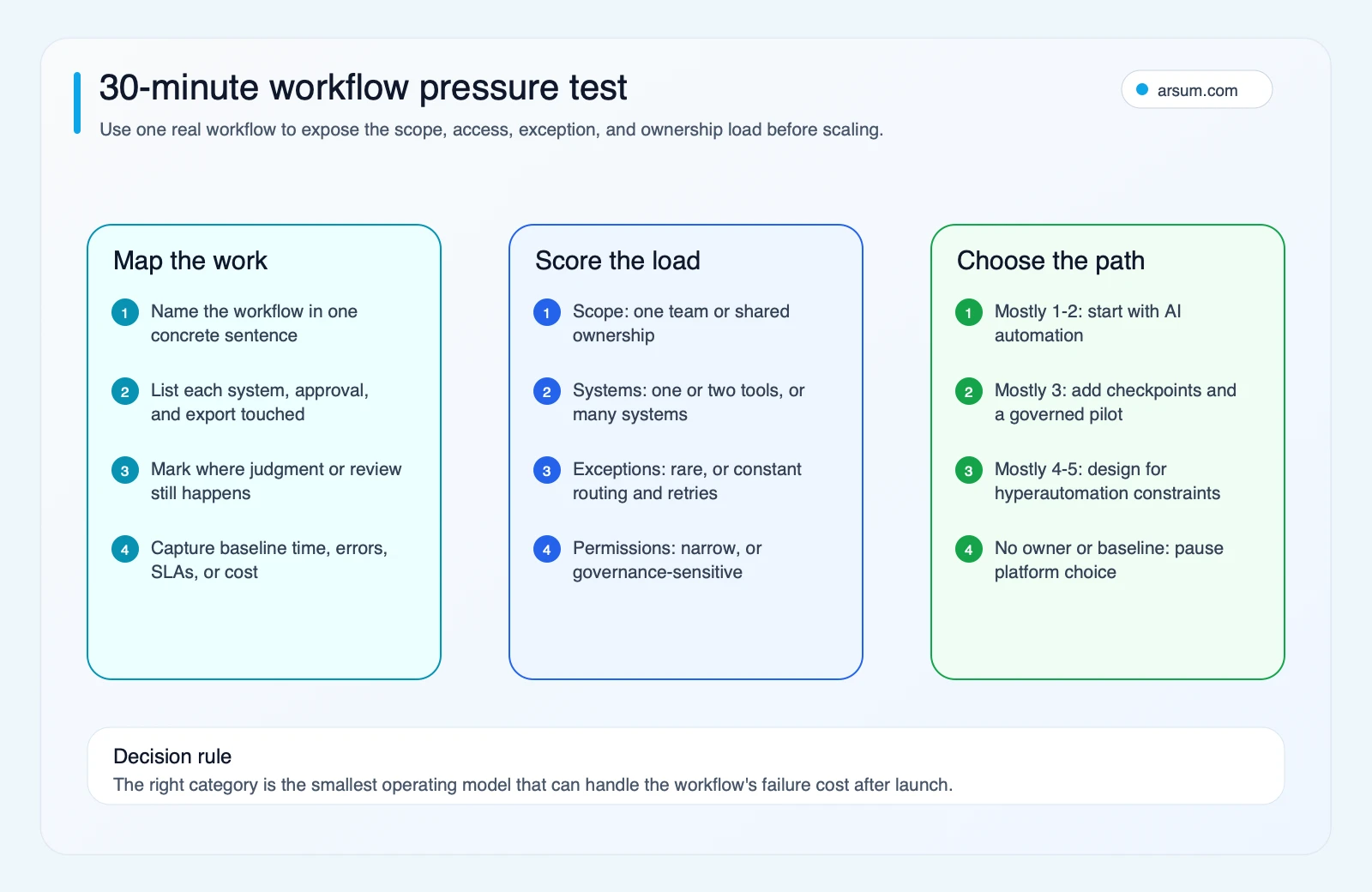
Run this pressure test on one real workflow before approving platform scope. It forces the team to expose whether the hard part is the model call, the connected operating model, or the lack of a clear owner.
If the scores cluster around 1 or 2, start with AI automation and keep the rollout narrow. If they cluster around 4 or 5, you are already dealing with hyperautomation constraints even if the first use case looks simple.
Governance Checklist Before You Call It Hyperautomation
Before a team upgrades the label from AI automation to hyperautomation, verify these basics:
- There is a named process inventory, not just a wishlist of ideas.
- Each workflow has an accountable owner after launch.
- Data owners approved the systems and fields the workflow will touch.
- Exceptions have a routed destination, not an implied human cleanup step.
- Logs exist for inputs, outputs, approvals, and failures.
- The AI layer has evaluation criteria, not just anecdotal satisfaction.
- Integration and access changes have runbooks, not tribal knowledge.
- Someone owns rollback if the workflow behaves unexpectedly.
If several of those are still TBD, the project is probably still a scoped AI automation build, not a mature hyperautomation program.
Work With Arsum
We help businesses implement AI automation that actually works. Custom solutions, not cookie-cutter templates.
Learn more →Which Approach Is Right for Your Organization?
Start with AI automation if:
- You have a specific bottleneck consuming 20+ hours per week of manual work
- You want to prove ROI in one quarter before committing to a broader program
- Your organization lacks process automation governance infrastructure
- You’re at $10M–$200M revenue and need targeted wins, not enterprise transformation
For details on what a scoped AI automation build typically costs and what drives the variance, see cost of building an AI agent.
Consider a hyperautomation program if:
- You’ve already deployed RPA in three or more departments
- You have executive sponsorship for a multi-year automation transformation
- Your process landscape has been mapped and you have 20+ automation candidates queued
- You’re managing 1,000+ employees with cross-departmental process dependencies
For how to structure an enterprise automation program, see enterprise AI automation strategy and AI workflow automation tools.
Google Risk Box: Thin Automation Content vs Real Operating Guidance
If you publish or buy based on scaled comparison pages that only restate tool categories, you get thin guidance: the same feature lists, no ownership model, no exception policy, and no access design. Search engines increasingly discount pages that summarize vendor language without adding operational evidence or a decision framework.
The equivalent buyer mistake is internal. If your automation plan is still just a demo plus a glossary, you do not yet know who will maintain the workflow, measure failure, or approve risky access. Treat those as first-order requirements, not implementation details.
Three Mistakes to Avoid
Mistake 1: Calling a point solution a hyperautomation strategy. Deploying one AI automation tool and labeling it hyperautomation is cargo-culting the term. Hyperautomation requires governance, process discovery, and orchestration across technologies – not just replacing a single manual workflow.
Mistake 2: Buying hyperautomation infrastructure before proving AI automation works. Some enterprises skip directly to purchasing a $2M+ hyperautomation platform before validating that their AI can handle the core document types and decision logic they need automated. Prove the capability before scaling the program.
Mistake 3: Assuming RPA vendors’ “AI-enhanced” offerings equal modern AI automation. Legacy RPA vendors have co-opted the hyperautomation term to sell upgraded bot configurations. These are not the same as native AI automation built on LLMs, modern ML pipelines, and agentic architectures. The intelligence layer matters – especially for unstructured data processing, which now represents the majority of enterprise automation opportunities.
Most failed automation projects do not fail because the model cannot summarize a document. They fail because the team never defined exception rules, data access was blocked by security review, the process owner was not accountable for adoption, or the ROI baseline was built on guesses. Treat those as implementation requirements, not afterthoughts.
Methodology Note
This comparison draws on four evidence types: official definitions of hyperautomation and intelligent automation from IBM and UiPath, operational guidance from OpenAI on production controls and evals, governance frameworks from NIST and OWASP, and public operator discussions that surface where scope confusion and reliability concerns show up in practice. The public discussion layer is useful for implementation signal, but it is directional, not market-share data.
Freshness note: refreshed in July 2026 to keep the article anchored in governance, exception handling, evaluation, and maintenance ownership rather than glossary-style category definitions.
Last Updated Note
This article was refreshed in July 2026 after reviewing IBM and UiPath definitions, OpenAI production and evaluation guidance, NIST risk-management guidance, OWASP LLM application risks, and qualitative operator discussions about permissions, data quality, and exception handling.
The Bottom Line
Hyperautomation and AI automation are complementary, not competing. For most organizations, the right sequence is: start with AI automation on a specific high-impact process, prove the ROI, and use that proof to build the case for a broader hyperautomation program.
The worst outcome is spending 18 months building an enterprise automation governance program only to discover the AI layer doesn’t perform on your actual documents. Build the capability first. Then build the strategy around what works.
Frequently Asked Questions
Is hyperautomation the same as intelligent process automation (IPA)? No. IPA refers specifically to combining RPA with AI to handle more complex, unstructured inputs – it’s one component within a hyperautomation stack. Hyperautomation is broader: it includes process mining, BPM platforms, analytics, low-code tools, and a governance program for discovering and scaling automation candidates enterprise-wide. See intelligent process automation examples for what IPA looks like in practice.
How long does a hyperautomation program take to implement? Enterprise hyperautomation programs typically run 18–36 months for full deployment across multiple departments. Phase 1 (foundation and first two to three processes) usually takes 6–9 months. The extended timeline reflects the governance, change management, and vendor integration work – not the technical build itself.
Do you need RPA to do hyperautomation? Not strictly, but most hyperautomation programs include RPA for deterministic, rules-based tasks and layer AI on top for unstructured or exception-heavy work. Organizations that skipped RPA entirely and went straight to AI automation can still build a hyperautomation program – the coordination and governance layer is what defines hyperautomation, not the specific toolset.
Can mid-market companies ($50M–$300M revenue) do hyperautomation? Rarely in the traditional enterprise sense. Mid-market organizations typically lack the process volume, governance capacity, and dedicated automation teams that hyperautomation requires. For this segment, a scoped AI process automation approach – targeting two to four high-impact processes – usually delivers faster, more reliable ROI.
What’s the difference between hyperautomation and digital transformation? Digital transformation is the broader initiative: shifting business models, customer experiences, and technology infrastructure. Hyperautomation is a specific program within digital transformation focused exclusively on automating business processes. A company can run a hyperautomation program without a wider digital transformation effort – and often should, since hyperautomation is more tractable and ROI-measurable.
Ready to Automate Your Business?
Stop wasting time on repetitive tasks. Let AI handle the busywork while you focus on growth.
Schedule a Free Strategy Call →