Compare LangChain and LangGraph for application orchestration, and LlamaIndex for data and retrieval needs. Their capabilities overlap, so the choice depends on your workflow and source corpus. Evaluate retrieval quality, permissions, persistent state and recovery with the same examples before choosing one stack or combining them.
LangChain vs LlamaIndex: Agents, RAG and Search
Compare LangChain and LangGraph orchestration with LlamaIndex retrieval. Evaluate source quality, access controls and workflow behavior on your own data.

Table of Contents
- Separate application orchestration from retrieval
- Start with a framework-selection worksheet
- Where LangGraph fits—and where it does not
- Where LlamaIndex fits—and where it does not
- A bounded hybrid: separate the orchestration and retrieval contracts
- Run a two-week evaluation before standardizing
- Worked pilot scorecard: contract-review assistant
- Disqualifying conditions and common failure modes
- Limits of this comparison
- Apply this to your product
Separate application orchestration from retrieval
The familiar split is useful but incomplete: LangGraph is designed for low-level orchestration of long-running, stateful agents, while LlamaIndex provides retrieval- and data-oriented building blocks alongside agents and event-driven workflows. Those are documented capabilities, not neutral proof that either option will perform better for your case. LangGraph’s overview describes persistence, durable execution, streaming, and human-in-the-loop patterns; LlamaIndex’s RAG guide describes loading, indexing, querying, and evaluating private data.
The decision changes when you name the work that remains after a successful demo:
- Who owns workflow state when a tool fails halfway through a run?
- Which role approves a write-back, payment-related action, policy decision, or customer-facing output?
- Where are source documents, prompt versions, traces, feedback, and exceptions retained?
- What must be measured before the team standardizes on framework-specific abstractions?
- Can ordinary application code, a managed platform, or no automation solve the problem with less operational risk?
Start with a framework-selection worksheet
Use this worksheet before treating either framework as an architectural default. It replaces generic ratings with evidence your own team can inspect.
| Decision area | Evidence to collect | Accountable owner | Acceptance threshold | Decision consequence |
|---|---|---|---|---|
| Workflow state and recovery | A run that pauses, retries after a failed step, and resumes without duplicating a side effect | Engineering lead | State, retry policy, and resume behavior are visible and testable for every critical step | If not, use explicit application state or evaluate LangGraph for the workflow boundary |
| Tool risk and permissions | Tool inventory, least-privilege credentials, approval path, audit event, failure simulation | System or security owner | No consequential action can execute outside its stated permission and approval boundary | If not, keep the action manual or behind a managed workflow |
| Retrieval quality | Representative questions, expected sources, top-k results, reviewer notes | Data or knowledge owner | The agreed source-recall and reviewed-answer thresholds are met on the real corpus | If not, fix data and retrieval before adding autonomous tools |
| Observability | Trace for a successful run, failed run, approval, and exception | Platform or engineering owner | A reviewer can reconstruct input, sources, tools, state, and final disposition | If not, do not expand the pilot |
| Review and exceptions | Queue design, reviewer SLA, escalation categories, disposition log | Operations owner | Every low-confidence or policy-sensitive case reaches a named queue | If not, reduce autonomy or stop |
| Migration exposure | List of framework-specific code, interfaces, eval assets, and portable domain logic | Tech lead | Core business rules and test cases are separable from framework adapters | If not, avoid broad standardization |
| Maintenance capacity | Named owners for data ingestion, workflow changes, model updates, and incidents | Functional sponsor | Owners accept a recurring review cadence and change process | If not, keep the project in discovery |
The result should be an architecture choice, not a popularity result:
- Select LangGraph-first when recovery, branching, long-lived state, tool permissions, and approvals are the difficult part.
- Select LlamaIndex-first when ingestion, document representation, metadata filtering, retrieval, and grounded answers are the difficult part.
- Select a hybrid only when each layer passes independently and the interface between them is explicit.
- Select plain application code or a managed platform when the flow is narrow, deterministic, low-variance, and does not require agentic planning or framework-owned state.
- Select no automation yet when the workflow has no accountable owner, no stable source data, or too high a consequence for the available review capacity.
Use the AI agent architecture patterns guide to turn that selection into explicit boundaries for state, tools, review, and recovery.
Where LangGraph fits—and where it does not
LangGraph is a reasonable starting point when the agent must coordinate actions across systems and preserve control through branches, loops, interruptions, and recovery. Its documentation positions it as a low-level orchestration framework and runtime for stateful agents, including persistence, debugging, streaming, and human-in-the-loop controls. That makes it relevant for workflows such as account research followed by CRM drafting, support triage followed by approval-gated updates, or internal operations that require an auditable sequence of tool calls.
LangSmith is a separate consideration, not a reason to choose an orchestration architecture by itself. Its observability documentation describes tracing, debugging, monitoring, dashboards, feedback collection, alerts, and evaluation workflows across LLM applications. Test whether its traces answer your own incident and review questions, including for applications that do not otherwise use LangChain.
Use explicit workflow control when the action matters
A LangGraph-first design is appropriate when a run needs to:
- Call internal or external systems with defined permissions.
- Stop before a consequential action and request approval.
- Retry a bounded, idempotent operation after a schema or provider failure.
- Resume from known state without repeating a write-back.
- Preserve a clear trace of inputs, state changes, tool calls, and human decisions.
The orchestration failure test
For a tool-heavy prototype, simulate a malformed tool argument, an unavailable dependency, and a rejected approval. Then inspect:
- Whether the system records the failure and relevant state.
- Whether retry behavior is deliberate rather than an unbounded loop.
- Whether a rejected approval prevents the side effect.
- Whether an operator can replay or resolve the case without guessing.
- Whether the business rule lives in code and policy rather than only in a prompt.
If the team cannot show those answers, a polished conversational demo is not evidence of production readiness.
Before granting tool access, apply the permission, approval, and audit checks in the AI agent security guide.
Where LlamaIndex fits—and where it does not
LlamaIndex is a reasonable starting point when the useful output depends on finding, filtering, and synthesizing the right internal information. Its RAG documentation frames the work as loading, indexing, storing, querying, and evaluating data; it also documents retrievers, routers, node postprocessors, and response synthesizers. Those are useful components when retrieval behavior—not a chain of system actions—is the principal product risk.
LlamaIndex also documents event-driven, step-based Workflows, where steps can retrieve, call an LLM, request human input, update shared state, branch, loop, or dispatch concurrent work. Its agent documentation describes agents that combine an LLM, memory, and tools. These capabilities make it viable for more than document question answering; they do not eliminate the need for permissions, evaluations, or operational ownership.
Retrieval is a data-quality problem before it is a framework problem
A retrieval-heavy system should not be selected by asking which framework “wins RAG.” Measure whether it retrieves the right source material from your corpus under real conditions:
- PDFs with imperfect extraction.
- Near-duplicate policies or versions.
- Sparse metadata and permission boundaries.
- Structured records mixed with unstructured documents.
- Questions whose correct response is “not found” or “needs human review.”
- Documents that become stale or are removed.
Measure top-k source recall and reviewed answer quality
For each representative question, record the expected source document or accepted evidence criteria. Then measure:
- Top-k source recall: did the expected source appear in the selected retrieval set, such as the top three or top five results?
- Reviewed answer quality: did a qualified reviewer judge the answer supported, complete enough for the use case, and appropriately uncertain?
- Unsupported-answer rate: how often did the system answer without adequate source support?
- Exception rate: how often did it need a human because retrieval, permissions, or source quality was insufficient?
Do not declare a default framework winner without applying the same corpus, configuration discipline, and review rubric to both options.
Planning an implementation? See what an Arsum build can include →
A bounded hybrid: separate the orchestration and retrieval contracts
A hybrid can be sensible when one workflow truly needs both deep retrieval and approval-controlled actions. In that design, LangGraph can own workflow state and action sequencing, while a LlamaIndex retriever or query engine is called through a defined interface. Combining tools is not inherently superior; each component needs a limited responsibility, measurable acceptance criteria, and a replaceable boundary.
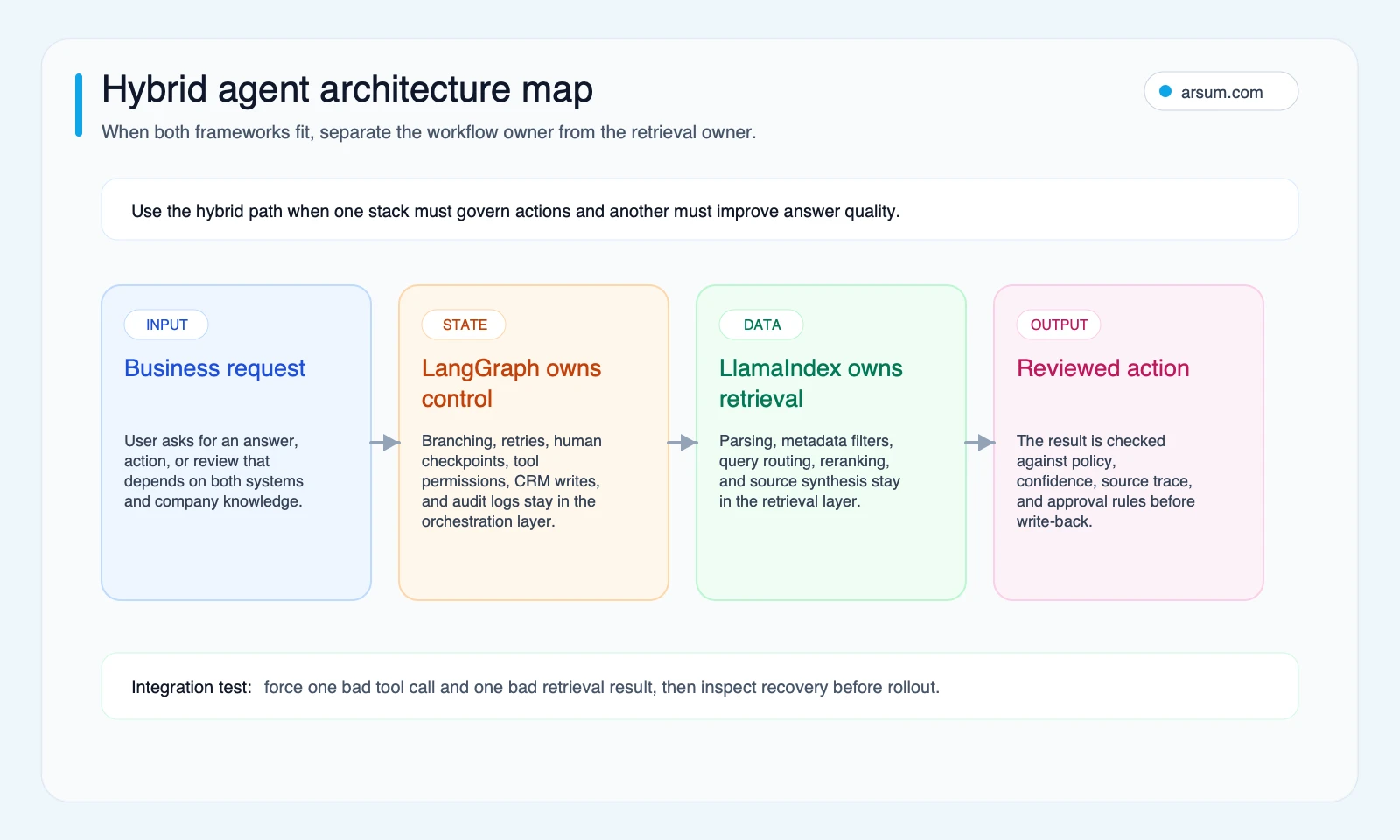
Proposed allocation of application responsibilities; access controls and integrations still require implementation. Select the diagram to view it at full size.
A practical contract between layers should specify:
- The retrieval request and response format.
- Required source identifiers, timestamps, and access checks.
- Whether the retrieval response is advisory or can support a downstream action.
- Evidence rules that send a case to review.
- Timeout, fallback, and error behavior.
- Trace fields retained across both layers.
Run a two-week evaluation before standardizing
A short evaluation should expose the hardest failure mode rather than reward the fastest hello-world build. The following protocol is an implementation decision tool, not a claim about delivery speed or expected ROI.
Days 1–3: define representative cases and boundaries
Select 20–30 real user queries from the intended workflow. For each one, define expected source documents, acceptable answer criteria, and whether the correct response is escalation or refusal. Also select 3–5 tool workflows that each include:
- At least one side effect or proposed side effect.
- A failure path, such as an invalid schema, timeout, unavailable dependency, or denied permission.
- A human approval before the action is committed.
- A clear final disposition: completed, rejected, escalated, or rolled back.
Remove sensitive data where necessary, but do not replace the evaluation set with unusually clean examples.
Days 4–8: build the smallest comparable paths
Build a LangGraph-first and LlamaIndex-first path that can process the same cases. “Comparable” does not mean forcing identical abstractions. It means holding the business inputs, source corpus, tool permissions, model choices where feasible, and review rubric steady enough to see where each approach adds or hides complexity.
Include an explicit plain-code comparison if the workflow is mostly deterministic. A framework is justified only if the added state, retrieval, observability, or control requirements outweigh its abstraction and maintenance cost.
Days 9–12: review evidence, not demos
For each run, retain:
- Input and relevant source identifiers.
- Retrieved results and top-k source-recall outcome.
- Output and reviewer disposition.
- Tool calls, approval decisions, retries, and exception path.
- End-to-end latency and cost per approved review.
- Engineering notes on trace readability and rewrite effort.
Observability is not limited to one vendor. LlamaIndex’s observability guide documents input/output views, indexing and query traces, OpenTelemetry integration, and LlamaTrace. Test whether the chosen tooling lets your owners answer the questions that matter in an incident.
Days 13–14: make a pass, narrow, or stop decision
Choose the smallest architecture that clears the agreed thresholds. If retrieval passes but tool control does not, keep the use case advisory and do not automate the action. If workflow controls pass but retrieval does not, limit the agent to structured sources or stop until data quality improves. If neither path passes, do not scale the pilot simply because the frameworks support the feature in documentation.
Worked pilot scorecard: contract-review assistant
Contract review is a useful example because it combines retrieval, variable document quality, approval ownership, and a high cost of an unsupported conclusion. The following values are planning fields your team must set; they are not performance claims.
| Pilot element | Definition |
|---|---|
| Scope | A bounded set of NDAs, MSAs, or SOWs and a limited set of clause questions |
| Baseline | Record current reviewer time, escalation reasons, and evidence retained for the same type of review |
| Target | An illustrative planning assumption: reduce time spent locating candidate clauses while preserving or improving reviewer-approved outputs |
| Retrieval metric | Set a top-k source-recall target for expected clauses on the held-out evaluation set |
| Quality metric | A legal or policy owner reviews outputs for source support, correct uncertainty, and escalation when evidence is insufficient |
| Approval owner | Named legal reviewer or delegated policy owner approves any final recommendation or external workflow action |
| Exception queue | Missing source, low-confidence retrieval, conflicting clauses, unsupported answer, permission failure, and tool error |
| Evidence retention | Store source references, retrieved passages, output, reviewer decision, trace ID, and versioned prompt or workflow configuration under the organization’s retention policy |
| Cost metric | Measure cost per approved review: model and infrastructure cost divided by reviews accepted under the agreed rubric |
| Review cadence | Daily review during the pilot; a scheduled decision meeting at the end of the time box |
| Stop condition | Stop if unsupported conclusions, permission failures, or unreviewable traces exceed the threshold set by the legal and engineering owners |
| Rollback path | Disable write-backs and route all cases to the existing human review process; preserve pilot evidence for diagnosis |
This scorecard changes the framework question. A retrieval-first prototype may be the right way to prove source recall. A LangGraph-controlled path may be the right way to prove approvals and recovery. The production decision should follow the constraint that fails first, not a generic claim about framework maturity.
Disqualifying conditions and common failure modes
Do not standardize on LangChain, LangGraph, LlamaIndex, or a hybrid when any of these conditions applies:
- The workflow owner cannot name the source of truth, approval authority, or exception queue.
- The action is consequential and no human review capacity exists.
- Permissions cannot be limited, logged, and revoked.
- The corpus has unresolved access-control or freshness problems.
- The proposed gain depends on vague “agent productivity” rather than a measurable workflow baseline.
- A narrow deterministic integration would meet the need with conventional code.
- The team has no plan for traces, evaluations, incident handling, or migration boundaries.
Limits of this comparison
Official documentation is useful for understanding intended capabilities and integration patterns. It is not a neutral benchmark of retrieval quality, observability maturity, cost, reliability, or implementation effort across your organization. LangChain’s own comparison resource presents its product positioning and should be read as first-party context, not independent scoring evidence.
This comparison does not claim that most teams converge on a hybrid, that either framework reliably outperforms the other, or that a framework choice alone creates savings. Those outcomes depend on the corpus, systems, model, reviewer process, workload, and operating discipline.
The source capabilities cited here were checked on June 23, 2026. Framework features, documentation, integrations, and pricing can change; recheck them before a procurement or architecture decision.
Can we switch frameworks later?
Yes, but switching becomes more expensive once prompts, state schemas, tool adapters, ingestion logic, traces, and evaluation workflows depend on one framework’s abstractions. Keep domain policies, test cases, source identifiers, and business rules portable where possible. A short comparative pilot reduces the chance of migrating after broad rollout.
Which framework is faster to prototype with?
The useful answer is conditional. A tool-and-approval prototype may surface its risks faster in a LangGraph-first design; a document retrieval prototype may surface its risks faster in LlamaIndex. Speed only matters if the prototype tests the failure mode that could block production.
Is one more production-ready?
Both provide production-oriented capabilities. LangGraph documents stateful orchestration and human-in-the-loop patterns; LlamaIndex documents RAG, workflows, agents, and observability. Production readiness depends on your permissions, evaluation set, review operations, reliability needs, and ability to reconstruct a failed case.
How should we evaluate retrieval before choosing?
Use 20–30 representative questions from your own corpus, define expected sources or evidence criteria, measure top-k source recall, and have qualified reviewers score answer support and escalation behavior. Do not assume a framework is better at retrieval without running that controlled evaluation.
What about other agent frameworks?
Other tools may be appropriate when the main decision is multi-agent collaboration, managed runtime capabilities, or a specific cloud environment. Compare them at the layer they own rather than treating every framework as a substitute. Our AI agent frameworks guide and AutoGen vs CrewAI guide provide useful adjacent context.
Apply this to your product
Arsum scopes AI product development and intelligent search and data systems. Bring one workflow, its intended users, permitted data sources and representative examples. The first implementation decision is the smallest useful scope that can be tested and handed over with a named owner.
Discuss your AI product or search system
Bring the intended users, data sources, workflow, and budget. We can define a focused first phase and the responsibilities after launch.
Discuss your project →Published by:Arsum
- Published
- February 27, 2026
- Updated
- September 6, 2026
- How this was produced
- These guides are prepared and updated with AI assistance. Linked documentation, proposed evaluation methods, and illustrative calculations are distinguished from reported project results. No independent human review is implied by the byline.
- Source policy
- Technical references are linked where used. Planning figures and suggested scorecards are assumptions, not market benchmarks or measured client outcomes. Editorial policy.
- Why this page exists
- Help product and technical teams scope AI applications and intelligent search, compare delivery options, and define acceptance and ownership.