Making money with n8n comes from solving a painful, owned business process—not from selling workflow diagrams or chasing passive-income claims. The durable paths are client delivery, retained reliability work, a narrow productized offer, internal ROI, or enablement; each works only when the workflow has a clear owner, measurable before-and-after condition, and a safe exception path.
How to Make Money with n8n: A Business ROI Guide
Explore make money with n8n: compare workflow fit, costs, risks, evidence, and practical next steps before you build, buy, or hire.
Table of Contents
- What Most Guides Miss: n8n Is Not the Product
- Five Monetization Lanes, With a Real Decision Rule
- Editorial Packaging Assessment: Which Offer Is Worth Taking to Market?
- The Workflow Readiness Screen
- A Reusable 30-Day Pilot Scorecard
- Scope, Hosting, and Tool Choice
- Commodity Work Versus Defensible Work
- Where n8n Offers and Implementations Fail
- Choose the Ownership Model Before You Build
- Methodology and Freshness
- Frequently Asked Questions
What Most Guides Miss: n8n Is Not the Product
The usual question is, “What can I automate with n8n?” The commercial question is, “What operational result will someone fund, operate, and keep paying to protect?”
That distinction matters whether you are a solo consultant looking for a first offer or an operator considering an implementation. n8n can connect systems, route work, transform data, and coordinate tool calls. It does not create a business case by itself.
Choose your path early:
- Consultants and agency founders: sell a defined operational change, then retain responsibility for reliability, reporting, and agreed improvements.
- Business buyers: fund a narrow workflow only after naming the baseline, process owner, approval boundary, exception queue, and rollback path.
Community discussions about earning with n8n repeatedly surface skepticism about “passive” income and the practical burden of client delivery and maintenance. Treat that as qualitative signal, not evidence of market-wide earnings: r/n8n discussion and a passive-income thread point toward the same reality. The billable work is usually process discovery, integration design, testing, change management, and support.
Five Monetization Lanes, With a Real Decision Rule
1. Fixed-scope client automation
This is the clearest route when a client has one repeatable bottleneck: lead routing, onboarding handoffs, reporting consolidation, document intake, or support triage.
Sell a bounded outcome. “Connect our form to the CRM” is a task. “Route complete inbound requests to the accountable owner, show failures, and send incomplete records to review” is an operating change.
A first proposal should specify:
- The trigger and source systems
- The systems of record
- What the automation can do without approval
- What it must queue for review
- Who resolves exceptions
- What gets tested before release
- What happens if the workflow is disabled
For adjacent implementation choices, see AI workflow automation and business process automation consulting.
2. Managed support and improvement
A one-time build may create value, but it does not remove the need for ownership. Forms change, credentials expire, APIs evolve, teams add fields, and exceptions accumulate. A recurring agreement should pay for operating the workflow—not merely for leaving it switched on.
The scope should separate monitoring, fixes, requested changes, and new delivery work. That protects both the provider and the buyer from treating an open-ended backlog as “maintenance.”
| Scope area | Define before signing |
|---|---|
| Monitoring | Which workflows are checked, how failures are detected, and who receives alerts |
| Bug fixes | What counts as a defect versus a process or integration change |
| Small changes | A defined allowance or approval path for field, notification, and routing updates |
| New workflows | Separately scoped discovery, build, testing, and release work |
| Incident response | Business-hours coverage, escalation contact, and excluded emergencies |
| Reporting | Run volume, failure categories, exception trends, and review cadence |
This is the practical core of an n8n automation agency business model: the recurring value is reliability and iteration, not a promise of effortless automation.
3. A productized vertical workflow
Productize only after you have a repeatable process boundary. A vertical offer may serve a common stack and workflow—for example, lead qualification for a particular sales motion or document intake for a defined operations team—but it still needs room for client-specific rules and approvals.
Good candidates share:
- Similar source systems and data structures
- A stable trigger
- Repeated business rules
- A recognizable exception pattern
- A clear owner at each client
Avoid claiming that the tenth deployment will be “easy.” Repetition may reduce discovery and QA burden, but each client can introduce new permissions, data quality issues, integrations, and approval rules.
4. Internal ROI
For an operator, “making money” with n8n may mean recovering capacity, reducing rework, improving speed-to-lead, or preventing a reporting bottleneck. That is indirect value, not revenue booked by the tool.
Use a business-case model before building:
monthly value = (monthly volume × minutes reduced per item ÷ 60 × fully loaded hourly cost) + avoided rework or delay value − monthly support and review cost
The final terms matter. If automation creates extra review, error correction, infrastructure work, or support dependency, include them. A workflow that appears cheap in a demo can become expensive to operate.
For examples of how to frame automation economics without assuming a specific result, see AI automation ROI examples and AI process automation.
5. Enablement, templates, and education
Templates, training, and community products can be useful, but they are usually weaker first monetization paths than a real operational offer. Generic workflows are easy to copy. The defensible value is domain understanding, documentation, QA patterns, implementation support, and judgment about exceptions.
Enablement is appropriate when the client has a capable internal owner and accepts responsibility for maintenance. It is not appropriate when nobody can own credentials, releases, security, or failures after handover.
Editorial Packaging Assessment: Which Offer Is Worth Taking to Market?
This is an editorial judgment framework, not original market data or a prediction of margins. Score each proposed offer from 1 to 5 on each criterion. A low score is a signal to keep it as an internal experiment, tighten the scope, or decline the work.
| Criterion | Score 1 | Score 5 |
|---|---|---|
| Pain frequency | Rare inconvenience | Repeated operational bottleneck |
| Manual effort | Minimal effort | Meaningful recurring handling or rework |
| Revenue proximity | No commercial consequence | Directly affects lead response, retention, delivery, or cash flow |
| Data readiness | Unclear sources and inconsistent fields | Known systems of record and usable data |
| Integration reliability | Fragile, inaccessible, or ownerless systems | Supported access, credentials, and accountable system owners |
| Buyer urgency | Curious but unfunded | A named sponsor wants a measurable change |
| Support burden | Unbounded and poorly understood | Known failure modes and a scoped support path |
A possible screening rule is to total the seven scores:
- Under 20: map the process or run an internal experiment first.
- 20–27: consider a narrow pilot with strict controls.
- 28 or higher: suitable for a fixed-scope proposal if ownership and approvals are confirmed.
The point is not the number itself. It is to force a conversation about what the workflow changes, what can fail, and who pays to keep it healthy.
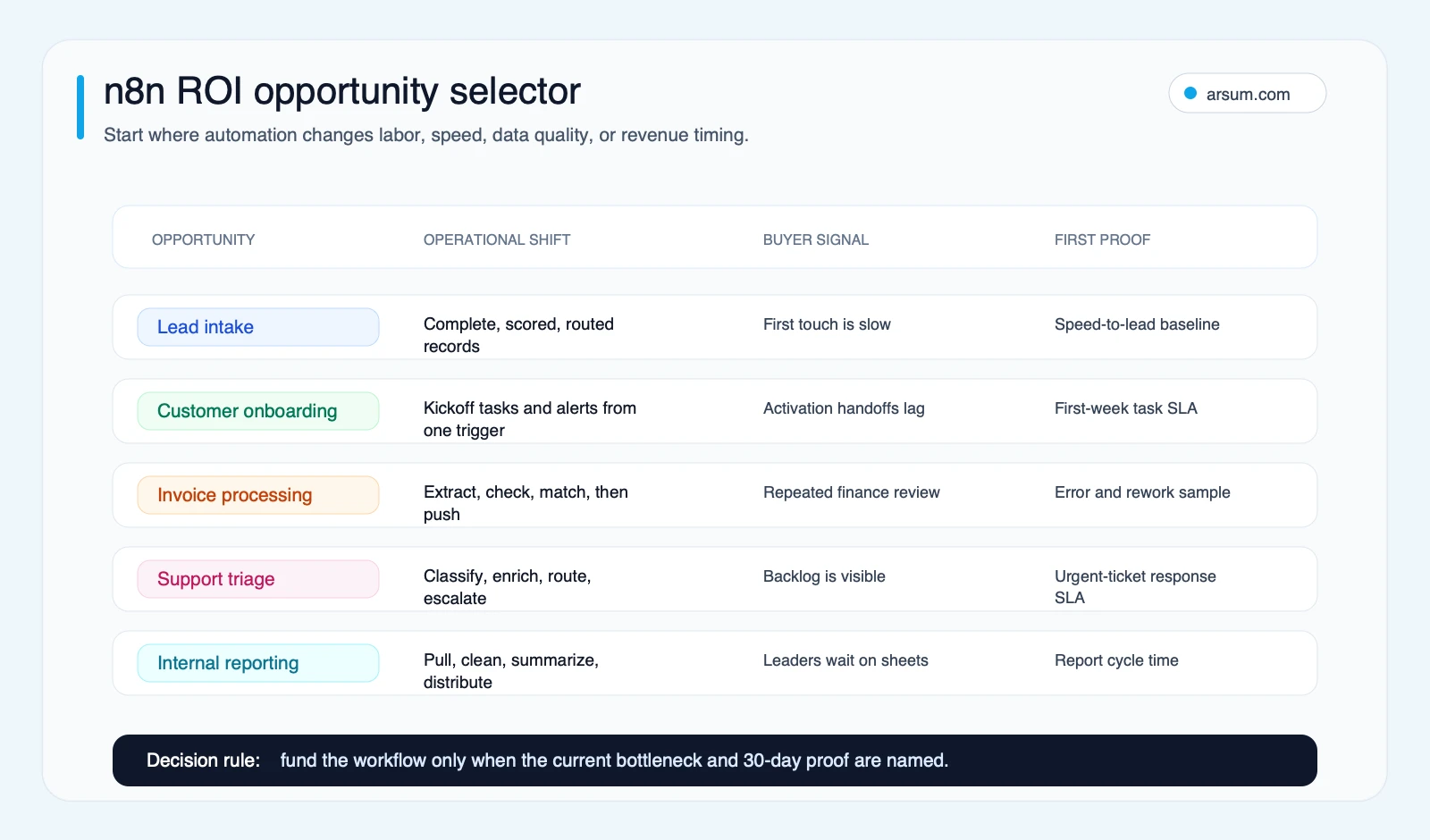
Choose an opportunity only when its bottleneck, accountable owner, and first proof metric are clear.
The Workflow Readiness Screen
A workflow can be technically possible and still be commercially unsuitable. Use these five gates before promising an automation outcome.
| Gate | Greenlight condition | Slow-down condition |
|---|---|---|
| Volume | Work occurs often enough to measure | It happens too rarely to establish value |
| Repeatability | Inputs, rules, and normal exceptions are known | Each case requires fresh expert judgment |
| Value | It affects capacity, revenue operations, quality, or risk | It removes only a minor annoyance |
| Integration access | Permissions, APIs, and source systems are confirmed | Critical systems are blocked or unstable |
| Ownership | A named person owns the process and exception queue | Nobody will operate it after launch |
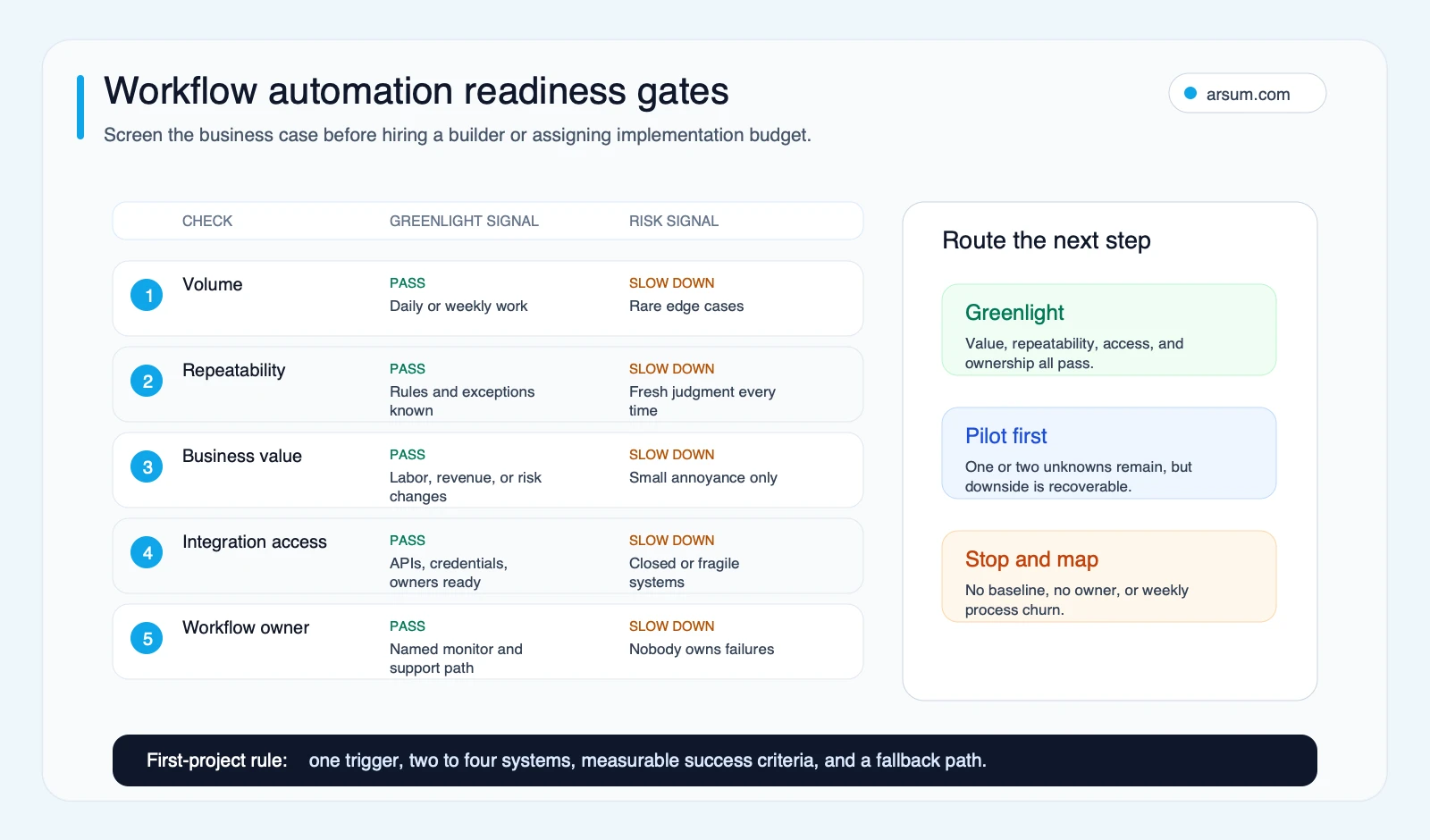
Greenlight only workflows with measurable value, known systems, and a named operational owner.
A good first build has one trigger, a small number of connected systems, real samples for testing, and a manual fallback. It does not try to automate every edge case.
If an AI Agent is part of the workflow, treat it as a tool-using component with connected sub-nodes, not as authorization to make consequential decisions. n8n’s AI Agent documentation describes that implementation boundary. Use confidence thresholds, review queues, and explicit escalation rules where outputs affect customers, money, compliance, or sensitive data.
💡 Arsum builds custom AI automation solutions tailored to your business needs.
Get a Free Consultation →A Reusable 30-Day Pilot Scorecard
Do not sell or buy a first n8n implementation without a pass/fail agreement. The scorecard below is a planning artifact; fill it with observed baseline data before build. It is not a claim about typical results.
| Field | What to record |
|---|---|
| Workflow and sponsor | One process and the functional leader accountable for its outcome |
| Source systems | Systems of record, credentials owner, and required permissions |
| Baseline | Weekly volume, average handling minutes, current error or rework rate, and current delay |
| Automation boundary | Steps that run automatically, steps requiring approval, and prohibited actions |
| Exception metric | Percent or count routed to humans, plus review minutes per exception |
| Quality target | Required completeness, correct routing, or other verifiable output condition |
| Pilot target | A specific 30-day target, such as reduced manual handling while maintaining the quality condition |
| Evidence retained | Run logs, input/output samples where appropriate, exception reasons, approvals, and change history |
| Owner and cadence | Named workflow owner; weekly review during the pilot and a 30-day decision review |
| Stop condition | A defined failure condition, such as unacceptable misrouting, unresolved security issue, or review cost erasing value |
| Rollback | Disable trigger, return work to the manual queue, preserve logs, notify the named owner |
| Ongoing support | Hosting, monitoring, fixes, review responsibilities, and monthly cost approved separately |
Illustrative planning model—not a client result
Suppose an intake workflow processes V items each month. The current handling time is M minutes per item, and the pilot expects to remove R percent of that handling. The fully loaded labor cost is C per hour.
gross monthly capacity value = V × M ÷ 60 × R × C
Then subtract:
monthly net value = gross monthly capacity value − implementation amortization − hosting/support cost − exception review cost − error remediation cost
Run at least three cases:
| Case | Assumption approach |
|---|---|
| Conservative | Lower time reduction, higher exception rate, higher review/support allowance |
| Base | Measured baseline and the expected acceptance target |
| Stress case | Integration disruption, changed business rules, or elevated manual review |
Do not label the result “savings” unless the organization can actually remove, redeploy, or avoid the cost. Often the more accurate term is recovered capacity.
Scope, Hosting, and Tool Choice
n8n’s Cloud and self-hosted options create different operating responsibilities. The deployment-choice guidance and hosting documentation make clear that self-hosting requires technical capability. Scope backups, updates, access control, security, and incident ownership accordingly.
For a consultant, that means the proposal should answer: is the client buying a hosted workflow, an internal handoff, or managed operations? For a buyer, it means low-code does not mean no-operations.
Cost comparisons should also use the relevant billing unit and governance needs, not only a plan name. n8n describes Cloud billing around workflow executions on its pricing page. Zapier documents task usage and rates on its pricing page, while Make’s pricing information includes its own scenarios, credits, governance, and feature considerations. Compare your expected volume, complexity, audit needs, access model, and support burden before selecting a platform.
For a broader tool-selection framework, read n8n vs Make vs Zapier and AI workflow automation tools.
Commodity Work Versus Defensible Work
| Work type | Easier to commoditize | More defensible delivery |
|---|---|---|
| CRM routing | Standard form-to-CRM mapping | Deduplication, ownership logic, enrichment, QA, and exceptions |
| Document intake | Basic field extraction | Approval queues, reconciliation, audit evidence, and correction workflows |
| Content distribution | Posting approved content | Review logic, source governance, fallbacks, and performance feedback |
| AI classification | A single model call | Thresholds, validation, escalation, and error analysis |
The more consequential the workflow, the less appropriate it is to market autonomy as the feature. In finance, customer operations, recruiting, or compliance, technical capability must remain separate from authorized action. A high failure cost should reduce autonomy and increase review—not justify a more ambitious automation claim.
Where n8n Offers and Implementations Fail
| Failure mode | What it looks like | Better response |
|---|---|---|
| Selling nodes instead of an outcome | The buyer cannot connect the build to an operating problem | Start with the process, metric, and owner |
| Automating a broken process | Faster handoffs amplify bad data or unclear rules | Simplify the workflow before automating it |
| No exception owner | Failures accumulate in an unattended queue | Name the queue owner and escalation contact |
| Undefined support | Every client request becomes “maintenance” | Separate bugs, changes, and new work contractually |
| Overbuilt first release | The project stalls under edge cases | Pilot one bounded flow with a rollback path |
| No baseline | Nobody can evaluate the result | Measure volume, time, quality, review, and delay first |
| Unsupported income claims | The offer sounds like side-hustle marketing | Use transparent scope and buyer-specific economics |
Choose the Ownership Model Before You Build
Build internally when the team has process knowledge, technical ownership, and time to maintain workflows. Use a specialist when the workflow spans critical systems, needs stronger integration or control design, or would distract internal teams from their core work. Choose enablement when internal capability is the outcome. Use a productized offer when the process and stack are genuinely repeatable.
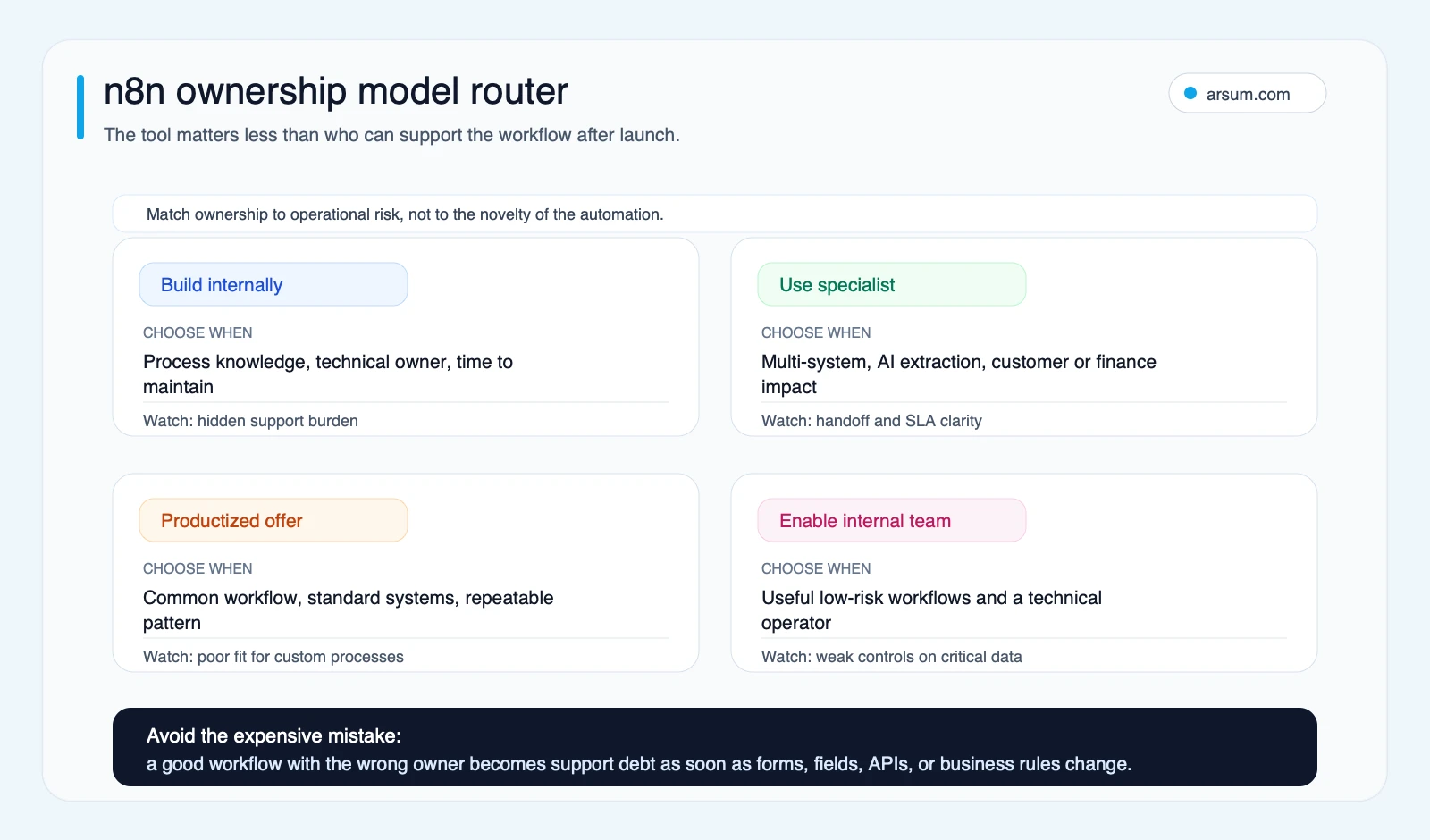
Choose the delivery model your team can operate when systems, fields, and business rules change.
The expensive error is usually not choosing the wrong workflow tool. It is choosing an ownership model that leaves nobody responsible when the automation needs review, repair, or change.
For complex implementations, compare AI automation agency services with AI integration consulting based on whether you need delivery capacity, operating support, or internal capability transfer.
Methodology and Freshness
This guide uses an editorial decision framework, current n8n documentation, and qualitative community signals about packaging and maintenance. Community material is not proof of earnings, demand, or typical pricing. No client outcomes, market rates, or performance benchmarks are asserted here.
Documentation and pricing can change. Verify current product limits, hosting responsibilities, execution billing, and support terms before using any scope or estimate in a live proposal.
Frequently Asked Questions
Can n8n create passive income?
Not by itself. A template or educational product may create less direct delivery work, but durable value still depends on finding a real problem, maintaining useful materials, and earning distribution and buyer trust. Client delivery and managed support are more direct routes when you can diagnose and own an operational workflow.
Do you need to code to make money with n8n?
Not for every workflow. Native integrations can cover straightforward cases. API design, JavaScript, SQL, security, and production operations become more important as workflows involve custom systems, sensitive data, high volume, or consequential decisions.
How do you find a first paying n8n client?
Start with a process you understand. Offer a workflow assessment that maps the current process, source systems, exception path, baseline, owner, and pilot acceptance criteria. That is more credible than offering generic “AI automation.”
Is n8n better than Zapier or Make for a business?
It depends on workflow complexity, execution volume, deployment needs, governance, data sensitivity, and who will support the system. Evaluate the operating model and billing mechanics alongside integration coverage.
Ready to Automate Your Business?
Stop wasting time on repetitive tasks. Let AI handle the busywork while you focus on growth.
Schedule a Free Strategy Call →Written by:Arsum editorial team
- Reviewed by
- Arsum editorial team
- Published
- March 22, 2026
- Updated
- August 10, 2026
- How this was produced
- Arsum uses research packs, source checks, and human editorial review to prepare and update blog articles. Editors are responsible for the final page.
- Source policy
- Sources are linked in the article when used. Methodology and source notes are included on higher-risk or high-visibility pages and are being rolled out across the archive. Editorial policy.
- Why this page exists
- Help B2B operators evaluate AI automation, implementation scope, cost, risk, and build-vs-buy decisions with practical context.