A micro saas with ai is worth buying or building only when it improves a stable, repeated workflow with measurable value, clear approval ownership, and a controlled failure path; otherwise, the right answer is usually to improve the process first or use an existing system feature.
Micro SaaS With AI: Practical Guide
Explore micro saas with ai: compare workflow fit, costs, risks, evidence, and practical next steps before you build, buy, or hire.

Table of Contents
- What Most Guides Miss: The Product Is Not the Workflow
- Use an Explicit Build, Buy, or Skip Decision Tree
- A Worked Example: RFP and Proposal Drafting
- Pilot the Workflow Before You Approve a Rollout
- Use the Buyer Scorecard as a Screening Tool, Not a Benchmark
- Turn Vendor Questions Into Non-Negotiable Buying Gates
- Common Failure Modes
- Methodology and Limits
- FAQ
- Related Arsum Guides
Most guides approach this topic as a fast path to launching a product. That is useful to a builder, but it skips the B2B buyer’s decision: whether a narrow AI product will reduce real operational work without creating a fragile dependency, a new review queue, or a support problem nobody owns.
The useful question is not, “Can a model produce this output?” It is:
“Can this product improve a defined workflow while preserving the records, approvals, exceptions, and economics we need to operate it?”
A small tool can be the right answer. It can also be an expensive detour around a process that is undocumented, changing too often, or better solved inside software your team already uses. Before choosing a product, use AI automation ROI examples to establish the business case and AI workflow automation tools to see where a standalone tool may be unnecessary.
What Most Guides Miss: The Product Is Not the Workflow
A narrow AI product may look simple because its interface is simple: upload a document, ask a question, generate a draft, classify a request. But the production workflow behind that interface is rarely simple.
The buyer needs to know:
- What starts the work and where the authoritative input comes from.
- Which source records the product is allowed to use.
- What output is useful versus merely plausible.
- Who approves the output and who owns exceptions.
- What evidence is retained for a customer, manager, auditor, or future reviewer.
- What happens when the system is unavailable, slow, wrong, or changed by a model provider.
- Whether the value remains if an existing platform adds a similar feature.
This changes the category. An AI micro-SaaS is not automatically a small software business with low operational risk. It is a potentially narrow workflow system, and its fit depends on how much of the real workflow it can safely own.
A practical distinction is between three product types.
| Type | What it provides | Where it can fit | Primary buyer risk |
|---|---|---|---|
| Thin wrapper | A prompt, chat interface, or generation layer on a general model | Low-stakes, individual work where users can verify output | Little value beyond what the base model or platform may provide |
| Workflow micro-SaaS | A narrow system with sources, rules, integrations, review, and records | Repeated operational work with a clear owner and bounded exceptions | Hidden support and maintenance burden |
| Embedded AI feature | AI assistance inside a system users already use | Work already centered in a CRM, service desk, finance system, or content platform | Limited flexibility or shallow workflow coverage |
| No new software yet | Templates, documented steps, source cleanup, or process redesign | Unstable workflows or unclear quality standards | No immediate automation benefit, but avoids automating disorder |
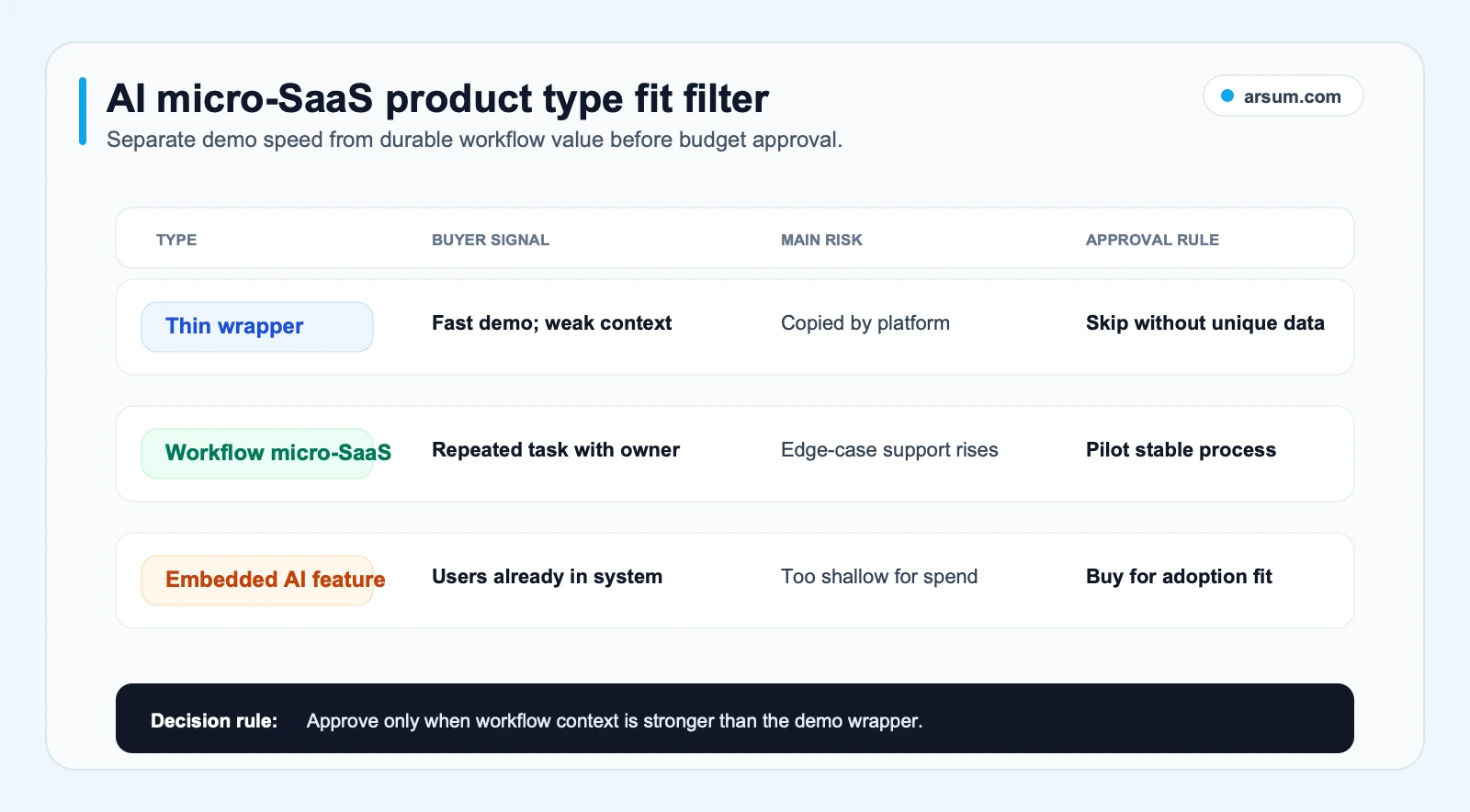
The decision rule is straightforward: buy or build only when the software can own meaningful workflow context without taking unauthorized control of a consequential decision.
For example, an AI assistant can draft a response from approved material. That technical capability does not authorize it to approve contract language, publish a regulated statement, or override a process owner. The higher the cost of a bad outcome and the lower the reversibility, the more human review and evidence retention the workflow needs.
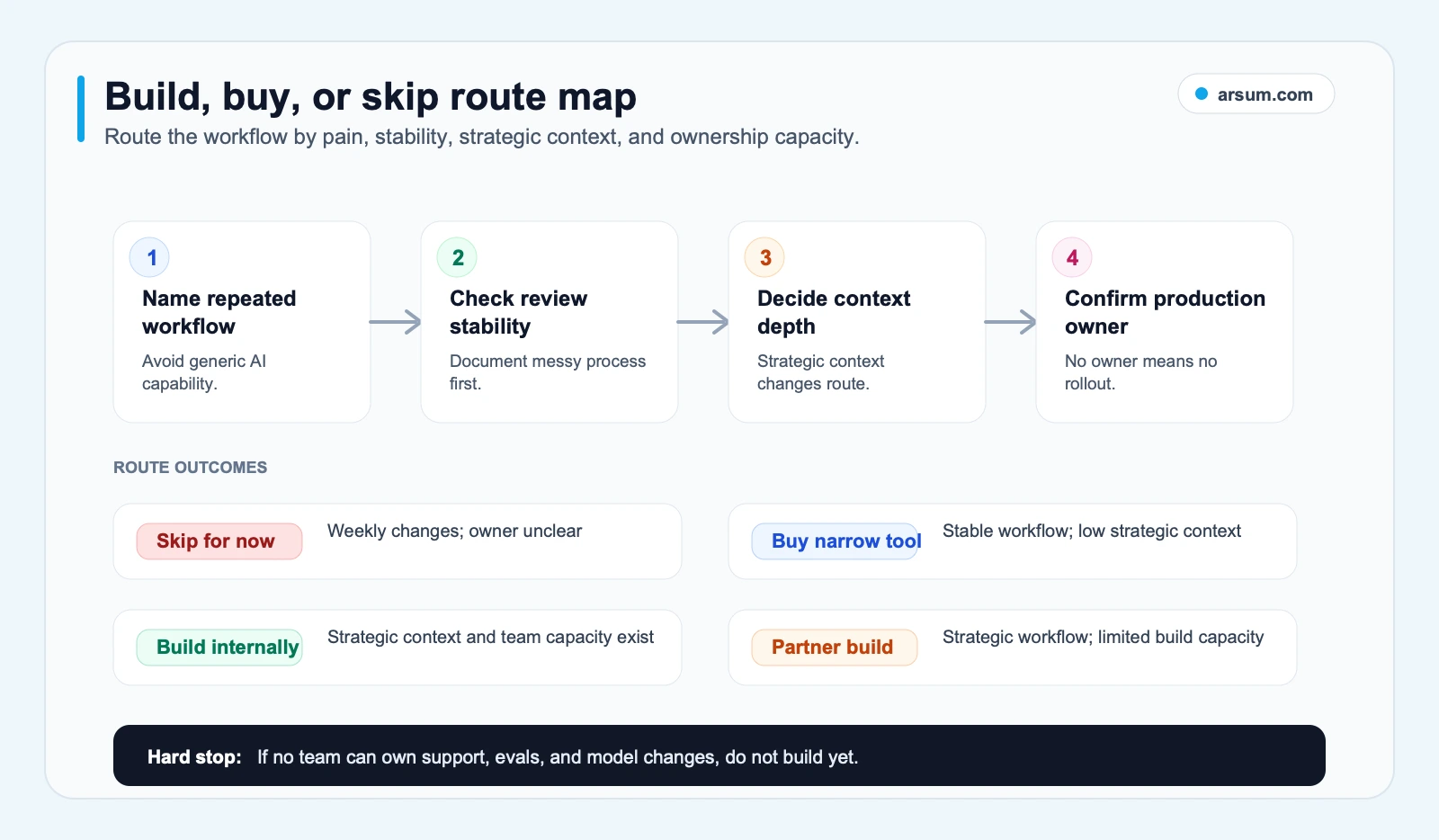
Use an Explicit Build, Buy, or Skip Decision Tree
Do not start with product demos. Start with the workflow.
Step 1: Is the workflow stable enough to automate?
Choose skip for now if any of these are true:
- Teams handle the same request differently because no standard exists.
- The relevant source material is scattered, stale, or disputed.
- No one agrees what a correct output looks like.
- The volume is too low to justify new workflow ownership.
- The real constraint is upstream data quality, missing policy, or unclear handoffs.
In this case, document the process, define approved sources, create templates, and establish an owner. That work is not a failed automation project; it is often the prerequisite for one.
Step 2: Can an existing platform solve it with less change?
Choose an embedded AI feature when users already work in a system of record and the job can remain inside that system’s permissions, data model, and approval flow.
For example, if account research already happens in a CRM, a separate AI micro-SaaS may create duplicate records, extra logins, and unclear responsibility. A feature inside the CRM might be less flexible but operationally safer.
This is where an AI automation platform guide can help distinguish a platform extension from a separate workflow product.
Step 3: Is the workflow strategically differentiated?
Choose build when the workflow depends on internal data, proprietary process logic, or customer-specific orchestration that a vendor cannot reasonably provide without recreating your operating model.
Building is justified only if your organization can own:
- Product and workflow decisions.
- Integration maintenance.
- Evaluation criteria and model-change testing.
- Security, access, and data-retention controls.
- Support, escalation, and rollback.
If the main advantage is internal context, but you lack the operating capacity to maintain a production system, a scoped partner arrangement may be more realistic than asking one internal developer to own a business-critical tool. See custom AI solutions for business and hiring an AI developer versus an agency for that decision.
Step 4: Is a vendor product genuinely productized around the workflow?
Choose buy when a vendor can demonstrate that it has more than a prompt interface. It should show source handling, permissions, review, exceptions, monitoring, support ownership, exportability, and a credible transition path if the relationship ends.
If its value disappears when a user opens a general chat tool, it is not necessarily useless. It is simply a weak candidate for an operationally important workflow.
A Worked Example: RFP and Proposal Drafting
Consider a sales team that repeatedly answers RFP questions and prepares first-pass proposal drafts. This is a plausible AI micro-SaaS use case because the work is repetitive, source-heavy, and often time-sensitive. It is not automatically safe to automate end-to-end.
The normal path
A controlled workflow looks like this:
- A coordinator creates a request from the approved RFP file.
- The system retrieves only approved source material: current product descriptions, security responses, legal clauses, case-study language, and answer libraries.
- The system produces a draft with citations or links back to the source records it used.
- A sales or proposal owner reviews completeness, tone, and alignment with the opportunity.
- A subject-matter owner approves answers involving security, legal terms, pricing, product commitments, or compliance.
- The approved answer is saved with its source lineage, reviewer, timestamp, and final disposition.
The AI is helping with retrieval and drafting. The accountable person still authorizes the commercial or factual claim.
The ugly exceptions
A useful product must handle more than clean inputs. Ask what it does when:
- The RFP asks for a capability that does not appear in approved sources.
- Two approved documents conflict.
- A source is expired or lacks a current owner.
- The request includes prohibited customer information.
- The draft includes a claim unsupported by a source.
- A model response is incomplete, delayed, or unavailable.
- A reviewer rejects an answer after the draft is already shared internally.
The right behavior is not to invent a confident response. The product should flag insufficient source coverage, route the item to a named owner, preserve the unresolved state, and prevent automatic progression to an approved answer.
What the audit trail should retain
For consequential use, retain the operational evidence needed to understand what happened:
- The request identifier and submitted input.
- The approved sources retrieved and their versions.
- The generated draft.
- Confidence or coverage flags, if the product uses them.
- Reviewer actions, comments, and approvals.
- Final answer, owner, and approval timestamp.
- Escalations, rejected content, and the fallback path used.
This is not bureaucracy for its own sake. It turns a generative feature into a workflow that can be reviewed, improved, and safely operated.
💡 Arsum builds custom AI automation solutions tailored to your business needs.
Get a Free Consultation →Pilot the Workflow Before You Approve a Rollout
A scorecard alone should not authorize a purchase. Use it to decide whether a workflow deserves a controlled pilot.
The following is an illustrative planning example, not an observed result or universal benchmark. Replace every assumption with your own baseline.
Illustrative RFP pilot scorecard
| Pilot field | Illustrative planning assumption | Decision use |
|---|---|---|
| Workflow | First-pass RFP answers and proposal sections | Defines scope; excludes final commercial approval |
| Baseline volume | 40 eligible questions per week | Establishes the unit of work |
| Current cycle time | 18 minutes per question | Measures current effort before the pilot |
| Loaded labor cost | $60 per hour | Converts verified time changes into planning value |
| Approved sources | Current answer library, security docs, product documentation, approved templates | Defines retrieval boundary and source lineage |
| Draft target | Reduce first-pass drafting and retrieval time while preserving required-source coverage | Avoids treating speed alone as success |
| Quality sample | Weekly review of a defined sample of completed items | Tests output against criteria, not impressions |
| Quality criteria | Correct source use, completeness, no unsupported commitments, correct escalation | Makes “good output” testable |
| Exception metric | Count items with missing, conflicting, stale, or insufficient sources | Reveals process gaps and AI limits |
| Reviewer time | Track review minutes separately from drafting minutes | Prevents moving work from drafter to reviewer without net benefit |
| Workflow owner | Head of proposal operations or equivalent functional owner | Owns operating decision and acceptance |
| Approval authority | Named legal, security, product, and commercial approvers | Prevents unauthorized autonomy |
| Review cadence | Weekly operating review; formal decision at 30–60 days | Creates a fixed learning loop |
| Stop condition | Unsupported claims, material source-lineage failure, unacceptable reviewer burden, or inability to operate safely | Stops expansion before the tool becomes embedded |
| Rollback path | Return to the existing answer library and manual draft process; disable the AI draft stage | Keeps reversal practical |
A simple planning formula is:
Estimated weekly time value = (baseline minutes − pilot minutes − added reviewer minutes) × weekly task volume ÷ 60 × loaded hourly cost
For the illustrative inputs above, this formula should be calculated only after you measure pilot-time drafting and review. Do not count avoided effort that has merely shifted into review, source cleanup, or exception handling.
A pass/fail rule matters more than a polished demo
Set the decision date before the pilot begins. A pilot passes only when all of the following are true:
- The workflow owner confirms the product addresses a real, repeated bottleneck.
- The sampled output meets defined quality criteria with appropriate human approval.
- Required source lineage is retained for evaluated outputs.
- Reviewer time does not erase the useful reduction in task time.
- Exceptions are identifiable, routed, and resolved by named owners.
- The fallback process works when the AI step is disabled.
- The vendor or internal team can explain how model, prompt, retrieval, and source changes are evaluated before release.
If a score is high but one control fails, do not roll out. Fix the workflow or the product first.
Use the Buyer Scorecard as a Screening Tool, Not a Benchmark
Score each proposed AI micro-SaaS from 1 to 5. These score bands are editorial heuristics for structuring a discussion, not benchmarked market data or a prediction of business results.
| Criterion | 1 | 3 | 5 |
|---|---|---|---|
| Workflow pain | Nice-to-have task | Repeated inconvenience | Costly, repeated bottleneck with a clear owner |
| Workflow stability | Steps vary materially | Some standardization | Defined inputs, outputs, and exception paths |
| Distribution access | No defined users | Likely team adoption | Known users already work in the relevant system |
| Defensibility beyond the model | Prompt packaging | Some templates or integration | Valuable data, workflow logic, approvals, and system context |
| Margin durability | Usage costs and pricing assumptions are unclear | Usage is monitored | Vendor can explain metering, limits, and viable unit economics |
| Support burden | Broad edge cases and unclear support | Defined support model | Bounded exceptions, named escalation, clear responsibility |
| Evaluation readiness | No acceptance criteria | Informal reviews | Test set, error taxonomy, and model-change evaluation |
| Platform-capture risk | Base platform could replicate most value | Some workflow differentiation | Value depends on deep operational context and integration |
Interpret the total as a starting point:
- 7–14: Skip software for now; redesign, document, or clean the process.
- 15–24: Consider a constrained pilot, but do not commit to rollout until control and economics gaps close.
- 25–35: Candidate for formal vendor evaluation or a scoped build, subject to the pass/fail gate above.
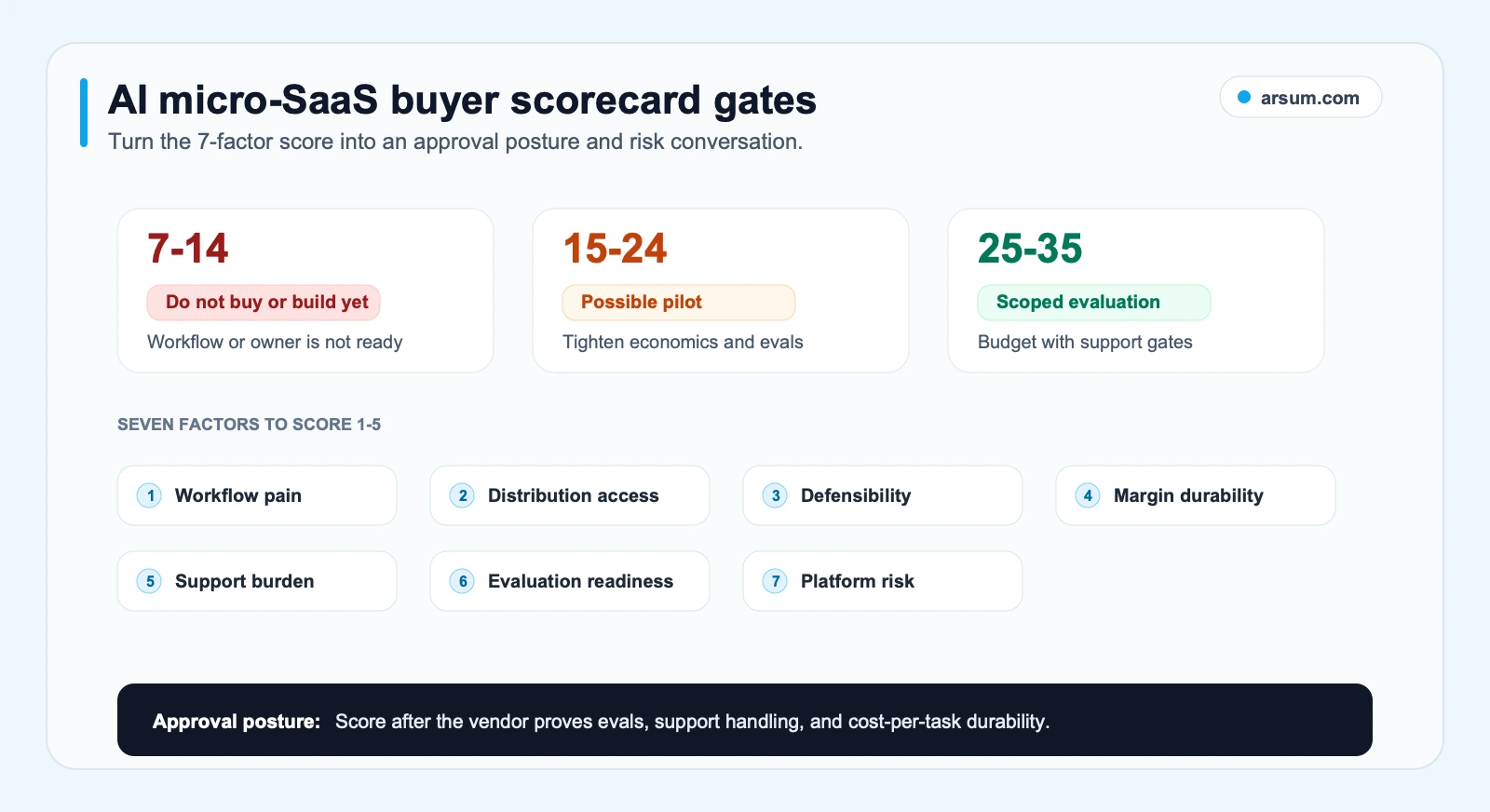
A low score is useful. It may show that the best investment is source cleanup, policy definition, or process redesign—not a software subscription.
Turn Vendor Questions Into Non-Negotiable Buying Gates
Good questions are not enough. Convert the answers into explicit gates in your evaluation and contract process.
Data handling and retention
Require the vendor to state:
- What customer data is sent to which subprocessors or model providers.
- Whether data is retained, logged, or used for service improvement.
- How data is deleted at termination.
- How access is controlled, reviewed, and revoked.
- What records you can export, including source links, prompts where relevant, outputs, approvals, and workflow history.
If the workflow involves sensitive or regulated information, the buyer must confirm that the architecture and contractual terms match the organization’s requirements. A product’s technical capability does not substitute for an authorized data-handling decision.
Model changes and evaluations
Require a documented process for changes to models, prompts, retrieval behavior, and key workflow logic.
OpenAI’s evals guide describes evaluation as part of testing model behavior, particularly when trying or upgrading models. For a vendor, the operating implication is clear: “the model got better” is not a sufficient reason to change production behavior.
Ask for:
- The test cases that must pass before a material change.
- The error categories they track.
- Who approves a release that affects your workflow.
- Whether you can opt out of material changes while you evaluate them.
- How the vendor rolls back a harmful change.
Service degradation and throughput
External model services can impose rate limits. OpenAI’s official rate-limits guide explains that API access is limited within defined periods. That does not mean every vendor will fail under load; it means buyers should ask what the vendor does when demand exceeds normal service capacity.
Require answers on:
- Queueing and user communication during delays.
- Retries, timeouts, and idempotency for workflow actions.
- Degraded-mode behavior.
- Whether users can complete the task manually.
- Incident notification and support ownership.
Economics, metering, and repricing
AI usage costs are not equivalent to fixed SaaS infrastructure costs. OpenAI publishes usage-based API pricing and developer pricing documentation that covers model and tool-related usage dimensions.
That supports a basic buyer requirement: understand the commercial model behind your subscription.
Ask about:
- Usage caps, overages, and monitoring.
- Which activities create variable cost.
- Whether retrieval, file processing, web search, or retries are metered.
- How pricing changes are communicated.
- What happens if the vendor changes model providers or limits high-cost features.
Do not demand a vendor reveal proprietary margins. Do require enough clarity to understand whether the proposed usage pattern is likely to remain supportable.
Support, transition, and termination
A small vendor may be a strong fit. Size is not the issue; ownership is.
Your agreement and rollout plan should identify:
- Support channels, escalation path, and named responsibilities.
- A service-level expectation appropriate to the workflow’s importance.
- Export formats and transition assistance.
- Who owns configuration, source libraries, integrations, and custom logic.
- The operational plan if the product is discontinued or no longer meets requirements.
Common Failure Modes
Automating an undefined process
If the organization cannot specify approved sources, acceptance criteria, and escalation owners, the tool will formalize inconsistency rather than remove it.
Treating review as an afterthought
A fast draft with a slow, anxious review process may not improve the workflow at all. Measure reviewer time, exception volume, and approval friction—not just generation speed.
Buying a thin wrapper for a strategic workflow
A chat-like interface may be useful for personal productivity. It is a weak foundation for a workflow that needs integration, authorization, source lineage, and reliable handoffs.
Ignoring platform-capture risk
A larger platform may add similar generation capabilities. The relevant question is what remains: workflow-specific data mapping, approvals, integration, auditability, and support discipline are more durable than prompt packaging alone.
Allowing AI to approve what it should only recommend
For high-impact outputs, AI should identify, retrieve, draft, or triage. A named person should approve material decisions, commitments, or exceptions.
For a broader view of controlled operational use, see AI agents for business and AI agent security.
Methodology and Limits
This guide uses an editorial buyer framework rather than an in-body dataset because the decision is product- and workflow-specific. The scorecard and pilot arithmetic are decision tools, not market benchmarks, adoption forecasts, or savings claims.
The guidance on API economics, rate limits, production operations, and evaluations is grounded in first-party OpenAI documentation: pricing, production best practices, and evals. Community discussions can be useful qualitative signals that builders worry about wrapper value, API costs, and reliability after a demo, but they are not evidence of market-wide behavior.
Last updated: June 22, 2026.
FAQ
When should we buy a micro-SaaS with AI?
Buy when a narrow workflow is stable, repeated, measurable, and owned by a team that can review outputs and manage exceptions. Require a pilot with source controls, acceptance criteria, a rollback path, and a fixed pass/fail date.
When should we build instead?
Build when internal workflow logic, data context, or integration requirements create strategic value that an external vendor cannot provide. Building also means owning evaluation, change management, support, and incident response.
When is “skip” the right decision?
Skip software when the process is unclear, source data is unreliable, the task volume is low, or the main problem is lack of policy, templates, or ownership. Process redesign can be the highest-value outcome.
What is the most important vendor question?
Ask the vendor to show the entire operating path: approved inputs, generated output, human approval, exceptions, retained evidence, model-change evaluation, support escalation, and transition ownership. If that path is vague, the product is not ready for a consequential workflow.
Ready to Automate Your Business?
Stop wasting time on repetitive tasks. Let AI handle the busywork while you focus on growth.
Schedule a Free Strategy Call →Related Arsum Guides
Written by:Arsum editorial team
- Reviewed by
- Arsum editorial team
- Published
- May 22, 2026
- Updated
- July 7, 2026
- How this was produced
- Arsum uses research packs, source checks, and human editorial review to prepare and update blog articles. Editors are responsible for the final page.
- Source policy
- Sources are linked in the article when used. Methodology and source notes are included on higher-risk or high-visibility pages and are being rolled out across the archive. Editorial policy.
- Why this page exists
- Help B2B operators evaluate AI automation, implementation scope, cost, risk, and build-vs-buy decisions with practical context.