An n8n automation agency business model can make money only when it sells a bounded, governed operational outcome and prices the responsibilities that continue after launch. For an agency operator, that means scoping discovery, build, testing, handoff, monitoring, changes, and support instead of selling “AI automation” by the workflow. For a buyer, it means choosing a provider that can prove who owns exceptions, credentials, incidents, and rollback—not merely demonstrate an n8n flow.
n8n Automation Agency Business Model: Buyer Guide
Explore n8n automation agency business model: compare workflow fit, costs, risks, evidence, and practical next steps before you build, buy, or hire.

Table of Contents
- What Most Guides Miss: The Business Model Is Decided After the Demo
- Choose the Engagement Model From the Buyer’s Risk
- Build an Offer Ladder Before You Quote
- Worked Fictional Quote: Intake Routing With Human Review
- Delivery Readiness Determines Whether a Retainer Is Earned
- Decide: Project, Retainer, Productized Package, or No Sale
- Disqualifying Conditions and Common Margin Traps
- A Proposal Structure That Protects Both Sides
- Methodology and Limits
- FAQ
- Related Arsum Guides
What Most Guides Miss: The Business Model Is Decided After the Demo
The happy path is usually straightforward: receive a form, transform fields, update a CRM, and notify a team. The commercial risk appears later—when a source field changes, a credential expires, a webhook is replayed, a workflow stalls, or an employee asks why one record never reached the downstream system.
That is why an n8n agency should be evaluated as an operating partner or a bounded implementation provider, not as a seller of nodes and integrations. The underlying question is simple:
After launch, who owns the workflow’s exceptions, evidence, changes, and recovery?
If the answer is unclear, the buyer is likely to inherit delivery risk and the agency is likely to absorb unpriced support work.
A credible engagement has four visible parts:
- A workflow with material volume, a recurring bottleneck, or a defined service-level problem.
- Inputs, outputs, and source systems that can be described before the build begins.
- A business owner who can approve rules and resolve exceptions.
- A support model proportionate to the consequence of failure.
If a prospect cannot identify the current process, data sources, exception types, and acceptable failure outcome, do not promise hands-off automation. Sell discovery, process mapping, or a constrained pilot first. This is the same boundary that separates a useful AI automation agency service from a generic tool demonstration.
For agency operators: a practical first-offer rule
Start with a workflow assessment or one tightly bounded workflow build. Use a retainer only when the client needs ongoing monitoring, controlled changes, credential maintenance, or incident response.
The main margin traps are unpaid discovery, vague acceptance criteria, unowned exceptions, hosting obligations hidden inside a project fee, and “small changes” that become continuous support. The commercial model should follow the workflow’s operating burden—not the agency’s preference for recurring revenue.
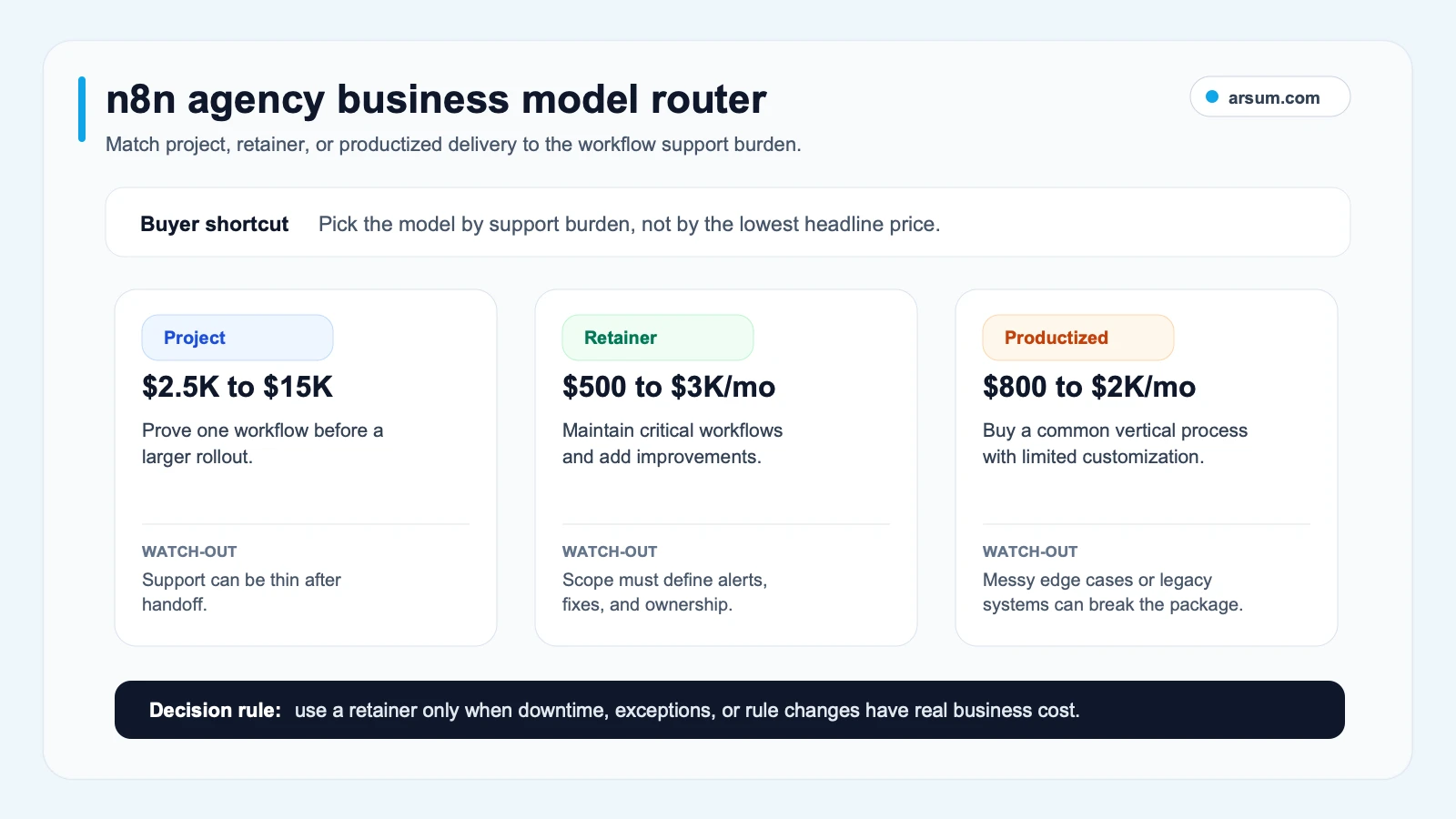
Choose the commercial model by ownership and support burden, not by the lowest headline price.
Choose the Engagement Model From the Buyer’s Risk
The title may attract solo consultants and small agencies, but the strongest agency business model is built around buyer confidence. A buyer should be able to distinguish a fixed implementation, an expert advisory engagement, a managed service, and a repeatable package before signing.
Community discussions about n8n agencies repeatedly raise first-client uncertainty, pressure to use “AI agency” branding, and skepticism about passive-income claims. These are qualitative practitioner signals, not evidence of typical earnings, demand, or profitability. They do, however, point to a useful commercial discipline: make the work, ownership, and exclusions legible.
| Positioning | What is sold | Best fit | Delivery and margin risk |
|---|---|---|---|
| Automation specialist | Diagnosis, process design, and implementation expertise | The client has a clear operational problem but has not chosen a solution | Discovery expands without a paid boundary |
| Project-based agency | One defined workflow with acceptance criteria | Stable process and limited post-launch support needs | Handoff, revisions, and edge cases are treated as “included” |
| Managed automation provider | Monitoring, controlled changes, incident handling, and reporting | Business-important workflows that change over time | The provider becomes an unpriced help desk |
| Productized workflow offer | A repeatable package for a specific process and stack | Similar systems, triggers, approval rules, and outputs across clients | A messy process is forced into an unsuitable template |
| Expert consultant | A decision, architecture, or vendor-selection recommendation | The client needs clarity before implementation | Advice is mistaken for delivery ownership |
No one model is universally best. These are editorial decision categories, not claims that the market has standardized around them. A buyer comparing providers should also understand the distinction between an AI automation agency and an AI development firm: n8n can be an effective workflow layer, but it may not be the right answer when the scope needs custom application logic, a new product surface, or deeper engineering ownership.
A buyer-side vendor evaluation checklist
Before selecting an n8n provider, require the proposal to answer these questions in writing:
| Proposal evidence required | What the buyer should verify |
|---|---|
| Workflow boundary | The trigger, source records, downstream systems, and exact outcome are named |
| Standard path | The provider shows which cases proceed automatically and why |
| Exception design | Missing data, duplicates, retries, ambiguous inputs, and business-rule conflicts have a route |
| Acceptance criteria | The proposal defines what must pass before launch and what is excluded |
| Ownership commitments | A business owner, technical owner, and incident contact are named |
| Credential model | The proposal states who creates, holds, rotates, revokes, and offboards each credential |
| Monitoring and recovery | Alerts, response expectations, replay controls, reconciliation, and rollback are specified |
| Change control | The provider distinguishes included changes from new scope and identifies approvers |
| Handoff evidence | Documentation, access, training, and client continuity are included where appropriate |
A provider that cannot answer these questions may still be able to build a prototype. That does not establish readiness for a business-critical workflow.
Build an Offer Ladder Before You Quote
An offer ladder prevents an agency from selling managed operations before it has earned the right to manage anything. Each rung should have a distinct deliverable, acceptance condition, and support boundary.
| Offer rung | Deliverable | Acceptance condition | Excluded unless added |
|---|---|---|---|
| Workflow assessment | Current-state process map, systems inventory, exception map, and pilot recommendation | Client confirms the workflow owner and decision rules | Production implementation |
| Single workflow build | One bounded automation with documented test cases | Standard-path cases pass and exceptions route correctly | Open-ended process redesign |
| Integration sprint | Several connected workflows inside one operating boundary | Interfaces, ownership, and handoff are accepted together | Ongoing incident response |
| Managed automation retainer | Monitoring, defined changes, reviews, and an incident process | Alerting and response ownership are agreed | Unlimited feature work |
| Automation operations partner | Portfolio governance across multiple workflows | Prioritization, controls, and review cadence exist | Replacing the client’s operational owner |
This ladder gives a prospect a lower-risk entry point when the process is not ready for a full build. It also gives an agency a way to earn recurring work through real operating responsibility rather than through an arbitrary subscription.
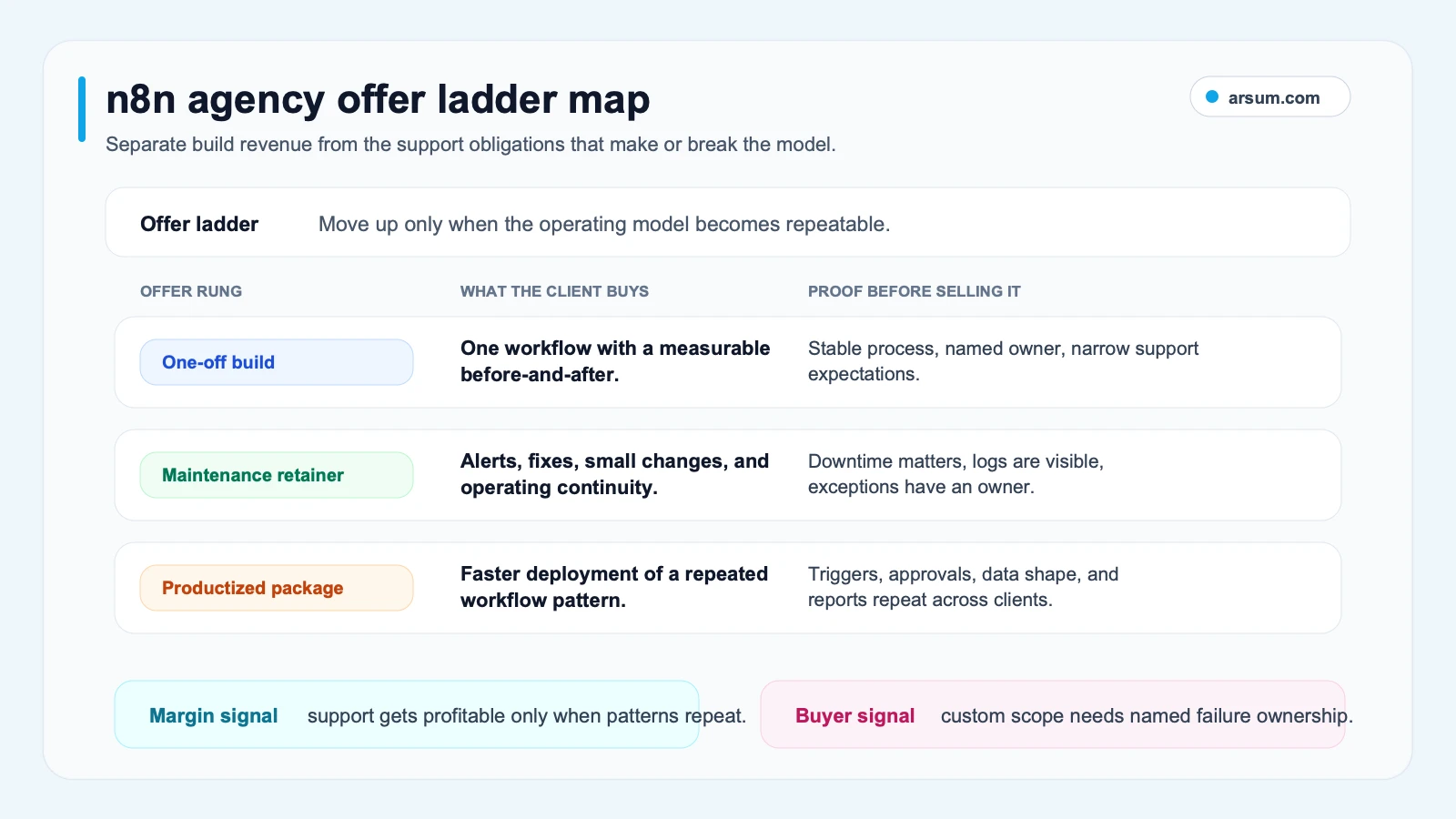
The offer ladder separates a sellable implementation from an operating commitment that needs ongoing ownership.
Price responsibilities, not unsupported market ranges
There is no approved evidence here for universal n8n agency rates, margins, or profitability. A responsible quote should therefore be a planning model based on actual delivery responsibilities.
For a project, list the inputs:
quoted project amount = discovery + build + testing + monitoring setup + documentation + training + contingency
For a managed engagement, list the recurring inputs separately:
monthly service amount = monitoring review + agreed change capacity + incident reserve + reporting + infrastructure administration
These are illustrative planning assumptions, not observed market rates. State explicitly whether the quote includes n8n plan charges, self-hosted infrastructure, third-party SaaS subscriptions, AI or API usage, emergency support, security review, and client-side process ownership.
For a companion scope framework, see AI automation agency pricing.
Worked Fictional Quote: Intake Routing With Human Review
The following scenario is fictional and uses illustrative planning assumptions. It is not a market benchmark, a client outcome, or a recommended price.
A service business receives prospect intake forms and designated inbound emails. Staff currently read each item, copy details into a CRM, assign an owner, and chase missing information. The proposed pilot does not authorize AI to make consequential customer or financial decisions. It uses automation to preserve, validate, normalize, and route information, while uncertain cases go to a human queue.
Scope and exclusions
The pilot includes:
- One intake form and one designated inbox.
- One CRM destination.
- Required-field validation and format normalization.
- A duplicate-check rule agreed with the client.
- Routing to named queues.
- A review queue for missing, ambiguous, or duplicate-prone cases.
- A workflow log containing the original submission, result, and exception reason.
- Documentation, a client handoff session, and a rollback procedure.
The pilot excludes:
- Redesigning the client’s full sales process.
- Creating new CRM objects or changing unrelated business rules.
- Autonomous acceptance, rejection, pricing, credit, or compliance decisions.
- Unlimited revisions after acceptance.
- Ongoing on-call support unless separately agreed.
Illustrative effort model
Assume the agency and client agree the following planning inputs:
| Workstream | Illustrative assumed effort or responsibility |
|---|---|
| Discovery | Map the current process, systems, owner, exceptions, and acceptance rules |
| Build | Configure the bounded workflow and agreed integrations |
| Testing | Exercise standard, missing-data, duplicate, replay, and failed-delivery cases |
| Monitoring setup | Configure agreed alerts and a workflow-result log |
| Documentation and training | Record workflow ownership, access, operating instructions, and recovery steps |
| Client responsibilities | Provide source and CRM access, nominate approvers, review exceptions, and confirm acceptance |
| Exclusions | New workflows, unbounded process redesign, additional integrations, and ongoing support |
The quote should show these components rather than hiding them in a single opaque build amount. If the buyer requests a lower fee, the appropriate response may be to reduce scope, reduce support commitments, or move back to an assessment—not to silently remove QA and recovery work.
Pilot scorecard
| Measure | Baseline to record before launch | Pilot target | Owner | Review cadence | Stop condition | Rollback |
|---|---|---|---|---|---|---|
| Processing time | Manual minutes from receipt to CRM-ready record | Target set by the client from its baseline | Operations lead | Weekly | Delays become worse than the manual process | Disable trigger; return work to the manual queue |
| Standard-path completion | Number of clean cases completed manually | Defined share of eligible cases reaches the correct queue | Workflow owner | Weekly | Incorrect routing exceeds agreed tolerance | Disable downstream write; retain intake log |
| Exception quality | Reason codes and review time for incomplete or duplicate cases | Exceptions are visible and resolvable by the owner | Operations lead | Twice weekly during pilot | Exceptions cannot be explained or reprocessed | Route every case to review |
| Duplicate safety | Current duplicate handling and correction effort | No duplicate downstream actions from replayed events | Technical owner | After each release | A replay creates a duplicate action | Pause workflow; reconcile from preserved source records |
| Change burden | Number and type of business-rule changes | Track changes rather than suppress them | Client process owner | Weekly | Core rules change faster than testing can keep up | End pilot and return to process design |
The go/no-go decision is not “did the workflow run?” It is whether the client can verify the outcome, own the exception path, and recover safely when the workflow does not behave as intended.
Illustrative break-even arithmetic
Let:
V= eligible items per monthM= manually observed minutes per item before automationA= human-review minutes per reviewed item after automationR= fraction of items requiring reviewC= fully loaded internal cost per minute, supplied by the clientS= monthly service amountI= monthly infrastructure and third-party usage cost
Then:
monthly capacity value = V × (M - R × A) × C
monthly net contribution = monthly capacity value - S - I
This is an illustrative planning assumption, not realized savings. It excludes quality effects, supervision outside the workflow, opportunity cost, and the cost of an error. If one bad routing decision has material customer, financial, or compliance consequences, reduce autonomy and budget for review even if the arithmetic appears attractive.
If you need to assess one workflow’s readiness, ownership, exceptions, and pilot economics before committing to a provider or delivery model, Arsum can help structure that decision.
💡 Arsum builds custom AI automation solutions tailored to your business needs.
Get a Free Consultation →Delivery Readiness Determines Whether a Retainer Is Earned
A retainer is not justified because an agency wants recurring revenue. It is justified when ongoing operational work exists and both parties agree who owns it.
Official n8n documentation covers workflow execution, integrations, credentials, and other operating concepts that need deliberate configuration. Its hosting guidance shows that self-hosting introduces responsibilities beyond building a workflow. Its pricing page should be reviewed where execution needs and plan choices affect operating design. Its credential documentation makes clear why credential custody belongs in the commercial and governance boundary.
Use this readiness gate before offering managed automation:
| Gate | Question to settle in writing |
|---|---|
| Idempotency | Can a replayed event create duplicate records, emails, charges, or tickets? |
| Retry behavior | Which failures retry automatically, and when does a case become a human task? |
| Alerting | Who receives a failed or stalled-workflow alert, and through which channel? |
| Audit trail | Can the team reconstruct what happened from source record to outcome? |
| Credential custody | Does the client or agency own each credential, rotation task, and offboarding step? |
| Change control | Who approves edits to routing logic, prompts, field mapping, and production releases? |
| Handoff | Can the client operate the workflow if the agency is unavailable or the engagement ends? |
| Rollback | What can be disabled safely, and how are in-flight records reconciled? |
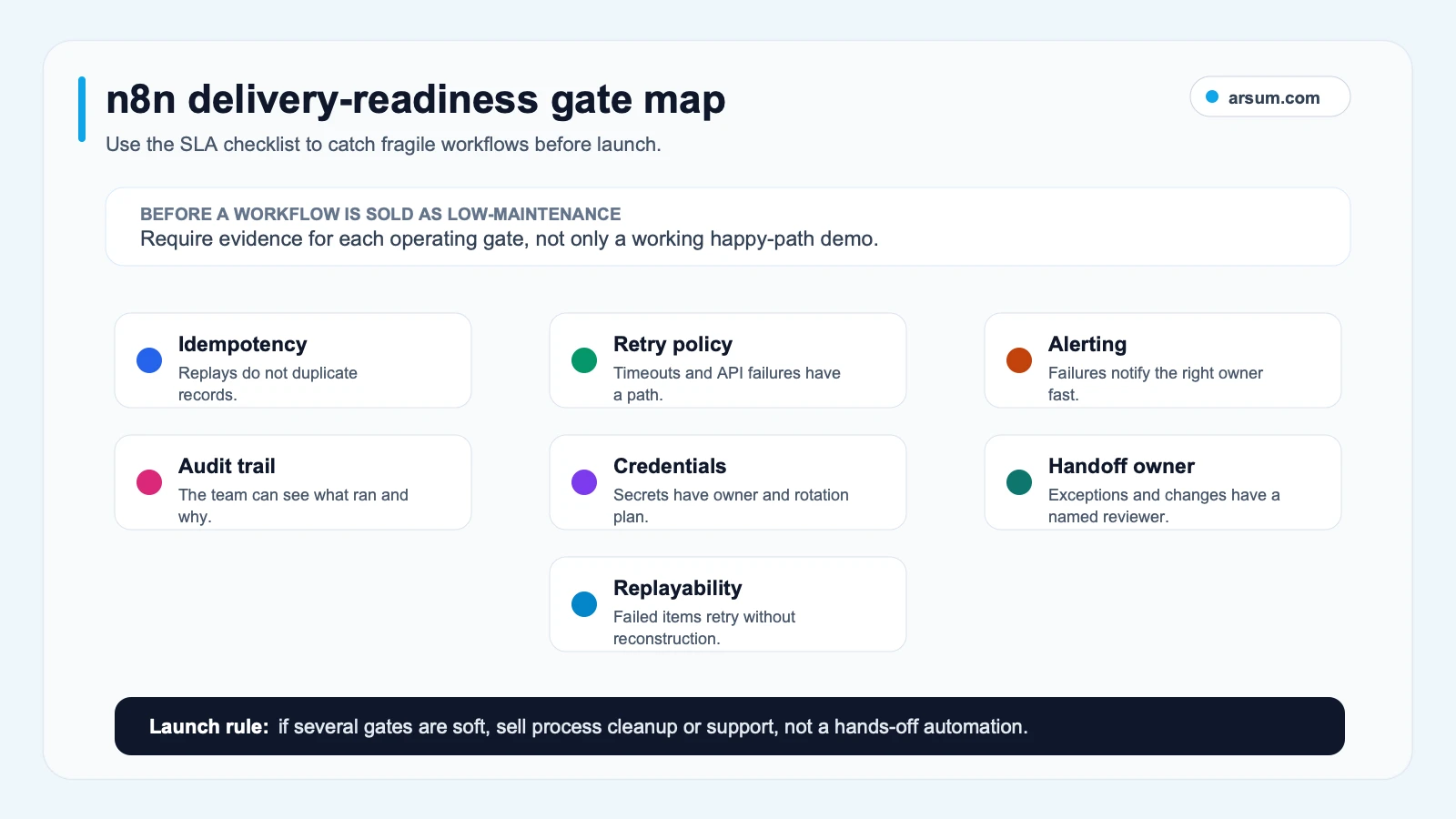
Soft readiness gates indicate that the engagement needs discovery or managed support—not a low-maintenance promise.
A thin handoff can be appropriate for a stable, reversible workflow where a missed execution has low consequence. A retainer is more defensible when integrations change, business rules evolve, or failures need timely detection and controlled recovery.
Decide: Project, Retainer, Productized Package, or No Sale
Use workflow characteristics to choose the model:
| If this is true | Prefer | Why |
|---|---|---|
| One stable workflow, low consequence, client can operate it | Project with handoff | The client mainly needs implementation and documentation |
| Workflow changes regularly or failure disrupts a core operation | Managed retainer | Monitoring, changes, and incident ownership are real work |
| Multiple clients share the same systems, data shape, and approval rules | Productized package | Reuse is plausible without concealing exceptions |
| Process is unclear, source data is unreliable, or no owner exists | Assessment or no sale | Automation would encode uncertainty and create support debt |
| Scope needs custom logic or a broader product surface | Development engagement | A workflow platform may be only one component |
For a platform-selection decision, the buyer may need a comparison of n8n, Make, and Zapier instead of an agency proposal. That recommendation can be the right outcome. Credibility improves when a provider does not force every workflow into its preferred tool.
Where the prospect is considering multi-step reasoning or agent behavior, use an AI workflow automation framework to define review and rollback. Higher uncertainty and higher consequence should reduce autonomous action, not increase it.
Disqualifying Conditions and Common Margin Traps
Walk away, narrow the scope, or sell discovery when any of these conditions apply:
- No named process owner exists.
- The workflow is being redesigned continuously.
- Source data is inaccessible, inconsistent, or legally restricted without a clear access path.
- A single incorrect action could create a material financial, customer, or compliance outcome, but no reviewer is available.
- The prospect expects unlimited revisions inside a fixed build.
- The agency would hold credentials without agreed custody, rotation, and offboarding.
- The client wants AI to make a consequential decision without defined evidence, thresholds, or human approval.
Common traps follow from the same missing boundaries:
- Selling a prototype as production automation.
- Treating exception review as someone else’s problem.
- Hiding hosting and third-party costs inside a build fee.
- Promising response commitments without alerting, access, and an incident path.
- Measuring node count or execution count instead of process outcomes.
- Productizing before a workflow has repeated across genuinely comparable clients.
Practitioner discussions about n8n agencies include skepticism toward hype-heavy positioning and passive-income narratives. Treat that as a qualitative reminder to show the work: workflow boundary, controls, acceptance criteria, and ownership. It is not evidence about typical agency income, demand, or success rates. See the discussions on getting started and finding clients, agency versus expert positioning, and agency-model hype concerns.
A Proposal Structure That Protects Both Sides
A proposal should make the delivery boundary easy to approve and difficult to misunderstand:
- State the workflow and the business event that starts it.
- List source systems, downstream systems, and data owners.
- Define the standard path and named exception categories.
- Name the business approval owner and technical owner.
- Specify discovery, build, QA, documentation, training, and launch responsibilities.
- State hosting, credential custody, monitoring, change-control, and incident responsibilities.
- Attach the pilot scorecard, stop condition, and rollback path.
- Separate future workflow expansion from the current acceptance criteria.
That structure protects agency margin and client continuity. It also makes an agency easier to compare with internal hiring. For that adjacent ownership decision, see hiring an AI developer versus an agency.
Methodology and Limits
This editorial guide uses official n8n sources for platform, hosting, pricing, and credential considerations: n8n documentation, pricing, hosting, and credentials.
Practitioner discussions are used only as qualitative signals about positioning and delivery concerns. They are not evidence of market size, typical rates, agency revenue, profitability, or client outcomes.
The offer ladder, readiness gate, proposal checklist, and pilot scorecard are Arsum editorial frameworks based on the delivery responsibilities that must be made explicit in a controlled automation engagement. The pricing and break-even examples are planning models requiring discovery inputs; they do not predict profit, demand, adoption, savings, or the cost of an error.
FAQ
Can an n8n-focused agency be profitable?
Potentially, but no general profitability claim can be supported without the agency’s own inputs. The practical test is whether discovery, build, QA, documentation, support, infrastructure, and incident work are scoped and priced deliberately. A workflow build with indefinite support obligations is not a reliable business model.
What should an n8n agency sell first?
Start with a workflow assessment or one tightly bounded workflow where the owner, inputs, outputs, exception path, and acceptance criteria are visible. Avoid broad automation-transformation promises before repeatable delivery evidence exists.
When should an agency offer a retainer?
Offer a retainer when monitoring, controlled changes, credential maintenance, incident response, or regular optimization are necessary. If the workflow is stable, low-risk, and easy for the client to operate, a documented handoff with limited support may be more appropriate.
Should an agency host n8n for a client?
Only if infrastructure ownership, security responsibilities, credential custody, updates, access, monitoring, and offboarding are explicitly agreed. Self-hosting changes delivery responsibility; it is not merely a deployment preference.
Ready to Automate Your Business?
Stop wasting time on repetitive tasks. Let AI handle the busywork while you focus on growth.
Schedule a Free Strategy Call →Related Arsum Guides
Written by:Arsum editorial team
- Reviewed by
- Arsum editorial team
- Published
- March 25, 2026
- Updated
- August 12, 2026
- How this was produced
- Arsum uses research packs, source checks, and human editorial review to prepare and update blog articles. Editors are responsible for the final page.
- Source policy
- Sources are linked in the article when used. Methodology and source notes are included on higher-risk or high-visibility pages and are being rolled out across the archive. Editorial policy.
- Why this page exists
- Help B2B operators evaluate AI automation, implementation scope, cost, risk, and build-vs-buy decisions with practical context.