This sidera ai marketing automation case study is a founder-reported 30-day implementation review of a bounded marketing workflow, not independent proof that AI content produced traffic, conversions, or revenue. Its useful lesson is narrower: automate repeatable draft, scheduling, and monitoring work only when a named human retains publishing judgment, can inspect the evidence, and can stop the system without losing control of the brand or channel.
Sidera AI Marketing Automation Case Study
Explore sidera ai marketing automation case study: compare workflow fit, costs, risks, evidence, and practical next steps before you build, buy, or hire.

Table of Contents
- What most guides miss: output is not marketing value
- The observed performance profile of marketing scripts
- The bounded Sidera pilot
- A 30-day pilot scorecard that does not confuse activity with ROI
- Build, buy, connect existing tools, or defer
- Content quality and channel trust controls
- Failure modes and disqualifying conditions
- What to do next
- Methodology and limitations
What most guides miss: output is not marketing value
Most AI marketing automation guides stop at generated posts, scheduled pins, or a working agent. Those are production outputs. They do not establish qualified demand, channel trust, lower total cost, or a sound decision to build.
The decision rule for Sidera was therefore not “can an agent produce content?” It was:
- Is the task frequent enough to justify setup and review?
- Can a reviewer assess the output before it reaches a customer or public channel?
- Is the action reversible if the model, integration, or source material is wrong?
- Is the cost of leaving the task manual visible in time, missed follow-up, or delayed publishing?
If fewer than three answers are yes, keep the work manual or semi-manual. A capable model is not permission to automate a consequential action.
The Sidera workflow was framed around owned publishing and draft production rather than autonomous community activity. That distinction matters. Blog drafts and Pinterest queue items can be held for review; a poor Reddit reply or indiscriminate engagement can damage trust, violate community norms, or create a moderation problem that is harder to reverse.
| Work type | Suitable first automation boundary | Keep human-led |
|---|---|---|
| Content operations | Brief assembly, draft generation, metadata, internal-link suggestions, queue preparation | Claims, positioning, final editorial approval |
| Pinterest distribution | Draft pin concepts, image briefs, titles, descriptions, scheduled queue | Account access, final publish permission, style changes |
| Search maintenance | Broken-link checks, source-freshness flags, content inventory | Material updates, evidence verification, topic prioritization |
| Social listening | Monitor public discussions and prepare a relevance queue | Replies, votes, follows, direct outreach, promotional posting |
| Strategy | Research summaries and scenario preparation | Offer design, audience judgment, channel allocation, risk acceptance |
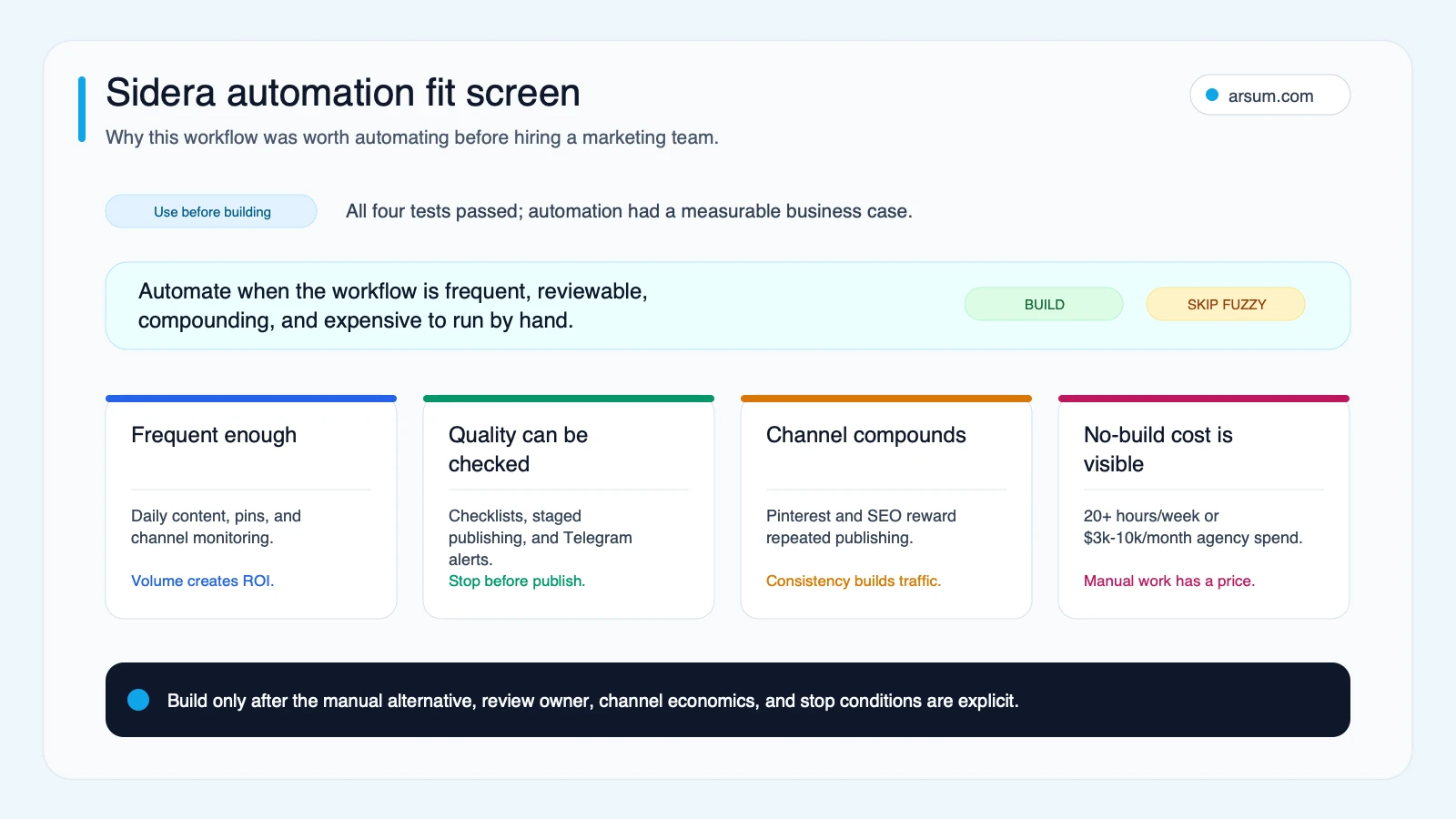
The screen is a planning artifact, not outcome evidence. It is useful because it forces a buyer to document frequency, reviewability, channel sensitivity, and the cost of delay before funding an agent workflow.
The technology brief above serves a separate platform-selection purpose. It describes observed HTTP Archive and Chrome UX Report associations for relevant technology sets; it does not show that Sidera’s automation caused a performance, traffic, or conversion result. Use it before adding scripts, embedded tools, or a heavier marketing stack: if the selected stack has an unfavorable mobile page-weight or Core Web Vitals profile, set a performance budget, defer nonessential tags, and test the implementation on representative pages.
The bounded Sidera pilot
Sidera AI is a sidereal astrology planning app. The implementation described here used OpenClaw, an open-source personal AI assistant and automation framework with channels, sessions, cron jobs, and tools. That supports a factual description of the substrate; it does not validate the business outcome of any specific agent configuration.
The bounded pilot should be understood as one workflow:
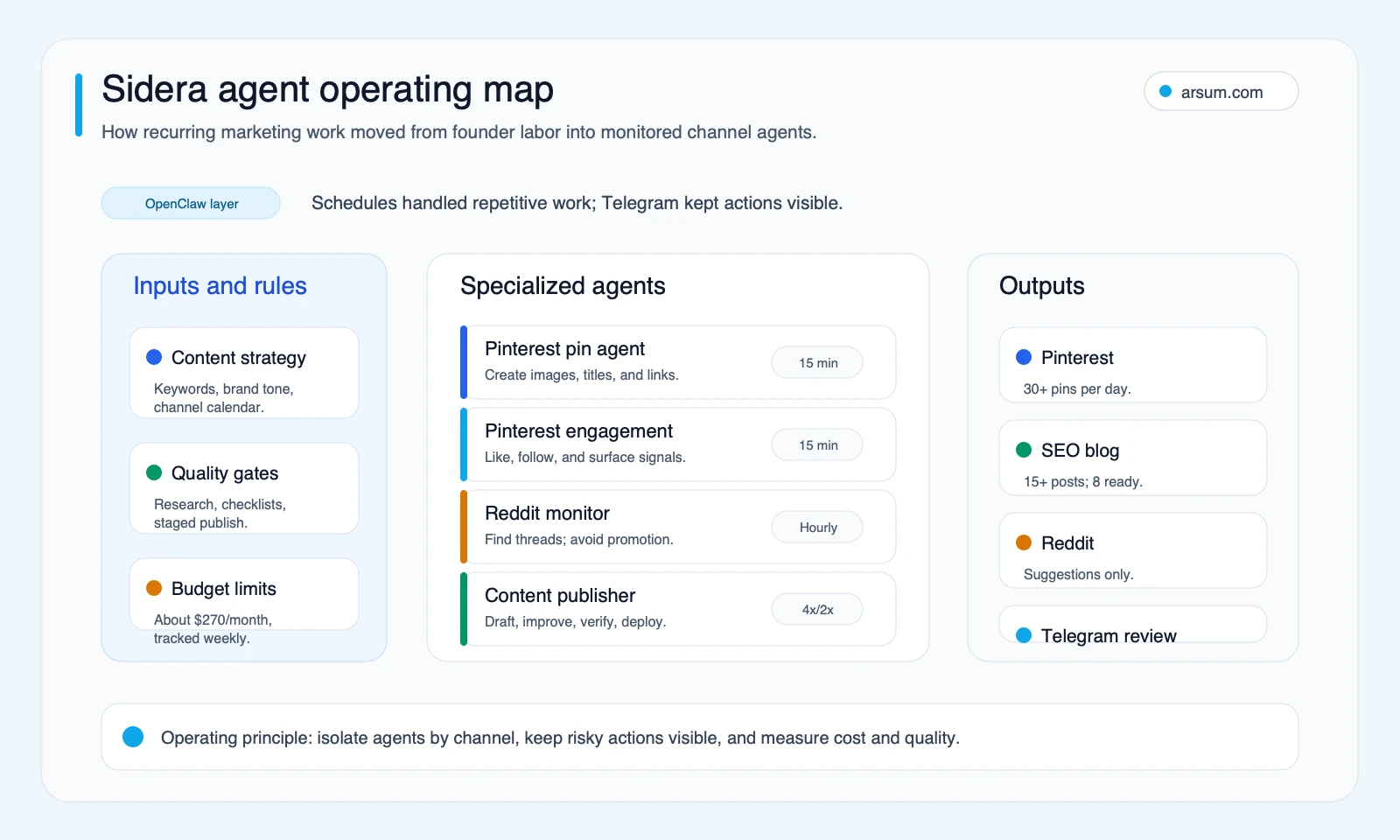
Approved topic brief → sourced draft and metadata → reviewer queue → explicit approval → owned-channel publish or schedule → job record and weekly review.
The pilot did not authorize an agent to decide the brand’s positioning, make product promises, autonomously comment in communities, or engage with users under the brand’s identity. These are business-authorization decisions, not merely technical tasks.
Control plane and permissions
| Step | System input | Agent may do | Human owner | Evidence retained |
|---|---|---|---|---|
| Topic intake | Approved editorial brief, product facts, source list | Assemble a working outline and identify missing inputs | Content owner | Brief version, source links, timestamp |
| Draft production | Approved brief and source material | Draft copy, suggest metadata and internal links | Editor | Draft revision history and source lineage |
| Quality review | Draft plus claim checklist | Flag unsupported claims, stale sources, duplication, broken links, or missing disclosures | Editor or subject-matter reviewer | Checklist outcome and reviewer decision |
| Publishing queue | Approved final asset | Create a staged queue item | Publishing owner | Approval state, target URL, asset IDs |
| Publish action | Explicit publish approval | Execute only the approved queue action | Publishing owner | Job ID, timestamp, deployment result |
| Monitoring | Public channel or system logs | Identify issues and send a report | Channel owner | Alert, incident ticket, resolution |
Telegram may be used as an alert route, but it is not an approval policy by itself. The accountable owner needs an agreed response time, a way to pause scheduled jobs, and a record of what they approved. If the owner does not respond within the chosen service level, the safe default is to hold the item rather than publish it.
Exceptions, escalation, and rollback
A system is controlled only when its exception path is more specific than “the founder gets notified.”
- Hold the item if a required source cannot be verified, a factual claim lacks lineage, the draft conflicts with an approved brief, or the integration returns an ambiguous result.
- Escalate immediately to the publishing owner for an accidental public post, account-access anomaly, policy warning, duplicate publish, or material brand-risk concern.
- Treat social listening as read-and-report unless the channel owner explicitly approves a discrete response. The agent must not autonomously vote, follow, comment, message, or post.
- Record failed jobs separately from successful ones. A silent failure makes “scheduled automation” impossible to evaluate.
- Roll back by pausing the scheduler, revoking the affected integration token or account permission, removing queued items, reverting the published asset where possible, and documenting the incident and corrective action.
This boundary reflects a recurring practitioner concern. In a public Hacker News discussion, one founder described a Google Sheets approval step as crucial because fully automated publishing felt too risky for brand voice. That is a qualitative signal, not a market statistic, but it matches the practical control requirement: a human must approve the external act, not merely inspect an alert afterward. Read the discussion.
A 30-day pilot scorecard that does not confuse activity with ROI
The available case materials show workflow artifacts and screenshots, but they do not provide a reproducible analytics export, invoice set, time-tracking record, or attribution analysis for the claimed period. The correct treatment is to label traffic, qualified sign-ups, conversions, pipeline, revenue, cost per qualified outcome, review time, and publishing incidents as unavailable until source records are attached.
Use this scorecard for the next 30-day run. It separates observed production from the business result that would justify expansion.
| Metric | Counting rule | Baseline | Pilot result | Evidence source | Owner | Next decision |
|---|---|---|---|---|---|---|
| Approved items published | Count only externally published items with recorded approval | Establish during prior 30 days | Not independently available | CMS and scheduler export | Publishing owner | Continue only if approval evidence is complete |
| Drafts created | Count completed drafts, excluding duplicates and rejected retries | Establish during prior 30 days | Not independently available | Draft repository | Content owner | Diagnose if output overwhelms review |
| Review and rework hours | Record editor and founder time, including corrections | Establish from timesheet | Not independently available | Weekly time log | Editor | Compare total operating burden, not production volume |
| Publishing errors | Count wrong URL, duplicate, factual correction, formatting issue, or unauthorized action | Establish from incident log | Not independently available | Incident register | Publishing owner | Stop if errors exceed agreed threshold |
| Channel incidents | Count policy warning, account limitation, complaint, or moderation issue | Establish from account history | Not independently available | Channel log | Channel owner | Pause channel automation after any material incident |
| Organic sessions | Use one documented analytics property and fixed date range | Establish from analytics export | Not independently available | Analytics export | Growth owner | Do not infer causation from publication volume |
| Qualified sign-ups | Define qualification before the pilot | Establish from CRM export | Not independently available | CRM export | Revenue owner | Compare only to the same qualification rule |
| Conversion or pipeline | Link source, campaign, and conversion event rules | Establish from CRM/analytics | Not independently available | Attribution report | Revenue owner | Expand only when outcome evidence supports it |
| Total cost of operation | Infrastructure + model use + setup amortization + review + rework + incident work | Establish planning model | Not independently available | Invoices and time log | Finance owner | Compare like-for-like alternatives |
A 30-day scorecard is not expected to prove long-term SEO performance. It is expected to prove whether the workflow can run safely, whether review work is manageable, and whether the team can collect the evidence needed for a longer decision.
Illustrative planning arithmetic
Use assumptions rather than claims when invoices and time tracking are incomplete. For example:
| Input | Illustrative planning assumption |
|---|---|
| Weekly review and rework | 3 hours |
| Fully loaded reviewer cost | $60 per hour |
| Monthly review cost | 3 × 4.33 × $60 = $779 |
| Monthly infrastructure and model usage | $300 |
| Incident allowance | $100 |
| Total monthly operating model | $1,179 |
This is not Sidera’s observed cost or a savings claim. It shows why a “low API bill” is not a total-cost-of-operation model. The comparison must use like-for-like scope: equivalent editorial quality, approvals, creative direction, analytics, community management, and accountability.
💡 Arsum builds custom AI automation solutions tailored to your business needs.
Get a Free Consultation →Build, buy, connect existing tools, or defer
A marketing automation system is not automatically a custom-agent problem. The right route depends on integration needs, ownership capacity, and how much control the workflow requires.
| Option | Best when | Ownership requirement | Integration and control profile | Pilot acceptance gate |
|---|---|---|---|---|
| Buy a platform | Workflow is standard: scheduling, CRM sequences, reporting, basic approval flows | Functional owner can configure and govern it | Lower engineering burden; verify permissions, logs, exportability, and approval controls | Platform handles a bounded queue without manual workaround growth |
| Connect existing tools | Team already uses CMS, analytics, DAM, CRM, and scheduler with usable APIs | Operations owner plus technical sponsor | Moderate complexity; preserve identity, source, and approval records across tools | One workflow crosses systems with reliable status and rollback |
| Build a narrow custom workflow | Differentiating logic, unusual state, or control requirements cannot fit existing tools | Named product/operations owner and engineering support | Highest design burden; strongest opportunity to encode rules, audit records, and exceptions | Scorecard shows safe operation and outcome evidence before adding scope |
| Defer | Inputs are stale, ownership is unclear, quality cannot be checked, or channel impact is hard to reverse | Process owner first | Improve the process and measurement before adding AI | Resolve workflow ambiguity and establish a baseline |
For teams comparing providers, AI workflow automation is the broader operating model; AI marketing consulting is useful when the real gap is channel strategy and operating ownership; and AI integration services matter when the blocker is connecting existing systems rather than generating another draft.
A custom build is justified when it changes a real workflow decision. It is not justified merely because a model can call a browser, scheduler, or content API. For a practical comparison of implementation paths, see this guide to AI automation agency services and the buyer-oriented framework for AI automation ROI examples.
Content quality and channel trust controls
Google states that using generative AI for content is not inherently prohibited, while using automation to create pages at scale without adding value can violate spam policies. The relevant standard is usefulness and compliance, not whether a draft began with a model. Review Google’s guidance on generative AI content and its policy on scaled content abuse before expanding an automated publishing system.
Replace formulaic quotas such as a fixed word count, arbitrary number of statistics, or mandatory FAQs with gates that address the actual risk:
- The article has a distinct audience question and an original answer.
- Material claims have a source link, a clear limitation, and an editor decision.
- Product facts and offers are verified against an approved source of truth.
- The draft adds useful synthesis, analysis, or experience beyond generic restatement.
- A reviewer signs off before publishing and can identify the exact revision approved.
- A material correction has a visible rollback and update record.

The blog screenshot is an implementation artifact. It does not establish ranking, traffic, conversion quality, or independent editorial quality.
Pinterest and owned distribution
Pinterest can be a candidate for a controlled queue because it is an owned account with queued assets and a reversible publishing path. That does not mean a volume target is a success metric. Evaluate whether assets were approved, whether links work, whether the account receives incidents, and whether referral sessions and qualified outcomes can be measured under a predeclared attribution rule.
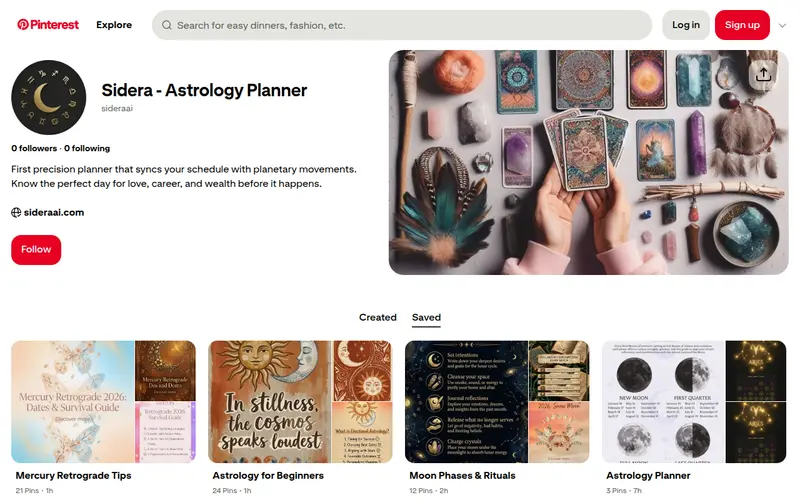
Do not assume that AI-generated images outperform templates, that a specific style resonates, or that a niche is underserved without channel and outcome evidence. Treat those as hypotheses to test with a controlled creative review and a documented analytics window.
Community channels require a stricter boundary
Public discussions highlight the tension between efficient discovery and authentic engagement. A builder of a social-listening product described the challenge as balancing automation with authentic engagement. That discussion is qualitative evidence only, but it supports a conservative control: monitor and prepare context; leave public engagement to a responsible human.
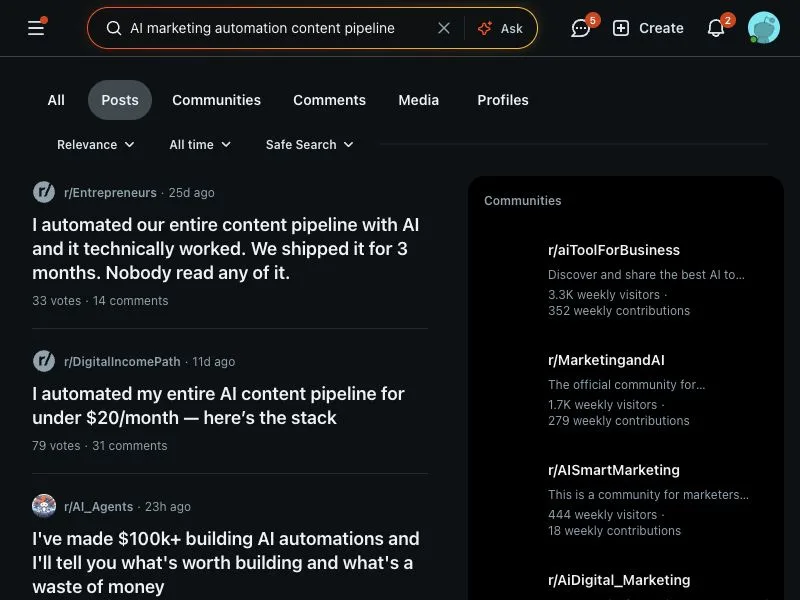
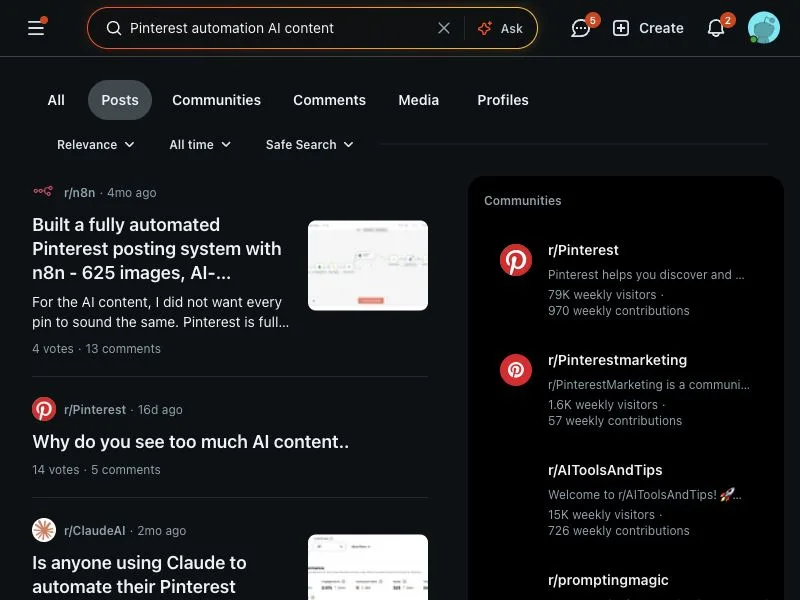
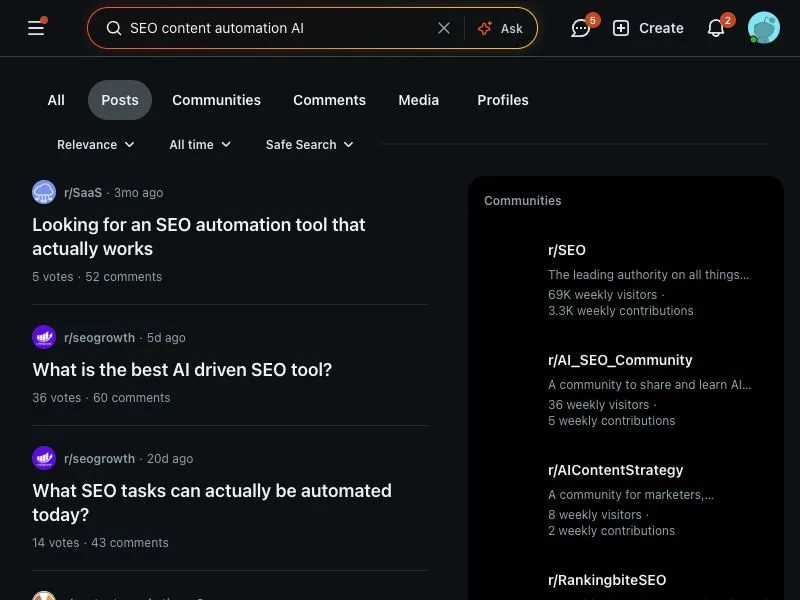
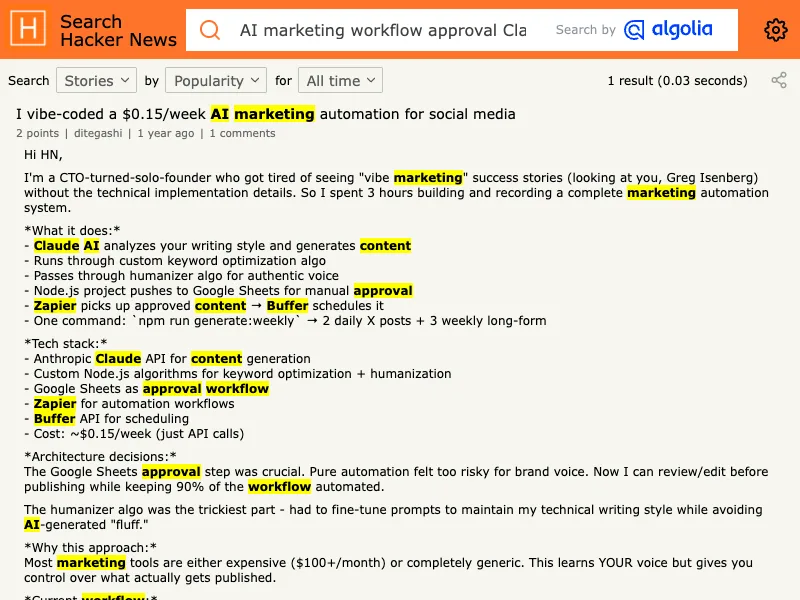
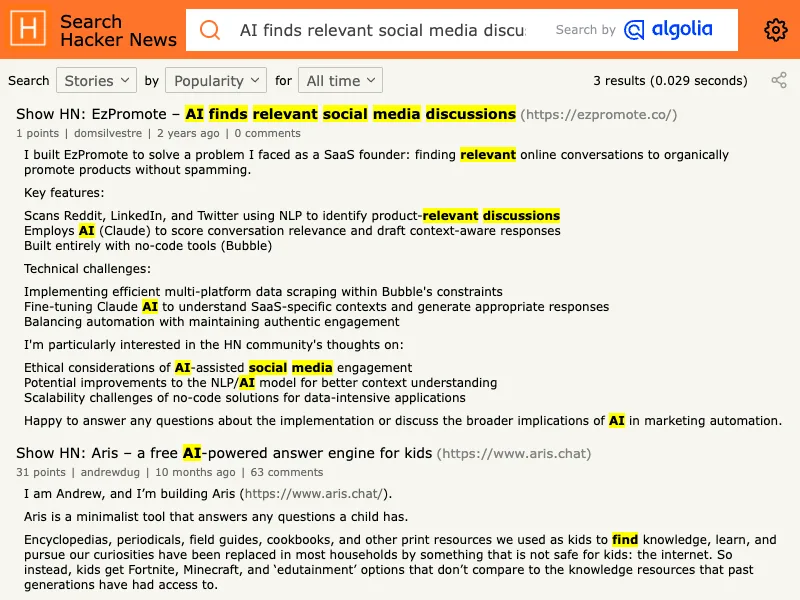
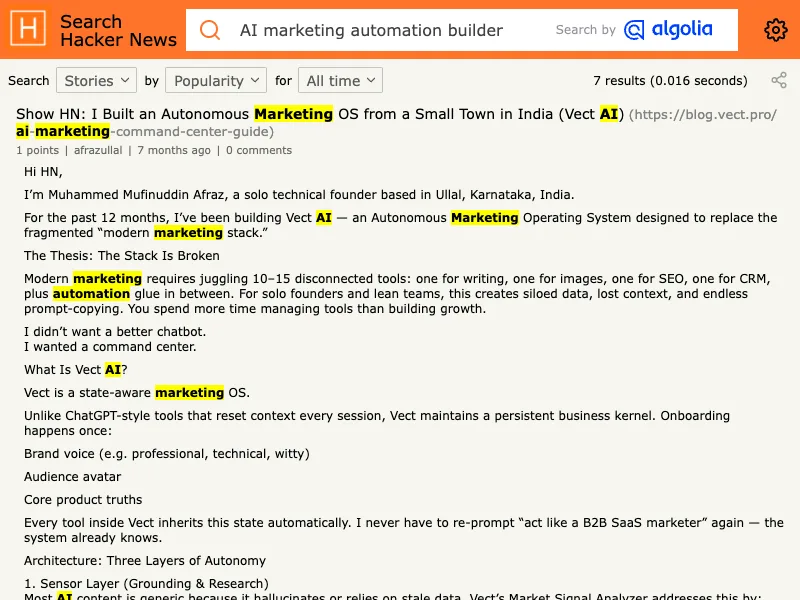
The screenshots and linked discussions are source-discovery and qualitative operator context, not evidence of market-wide adoption, safe behavior, or marketing returns.

The engagement report should be treated as a monitoring artifact. The approved policy is: report candidate discussions, preserve the context and suggested rationale, and require human approval for any account action. No autonomous posting, commenting, voting, following, or direct outreach.
Failure modes and disqualifying conditions
Do not launch this kind of automation if any of these conditions apply:
- No person owns final approval, platform access, incident response, and the authority to pause the system.
- The workflow’s inputs are not reliable enough to support claims, pricing, compliance statements, or product facts.
- The team cannot measure reviewer effort, rework, failures, and the business outcome it expects to improve.
- The channel penalizes inauthentic or unsolicited engagement and there is no human review before the action.
- A publish error cannot be corrected quickly, or the integration cannot be disabled cleanly.
- The proposed automation is actually a strategy problem: unclear positioning, weak offer, no measurement design, or no source-of-truth data.
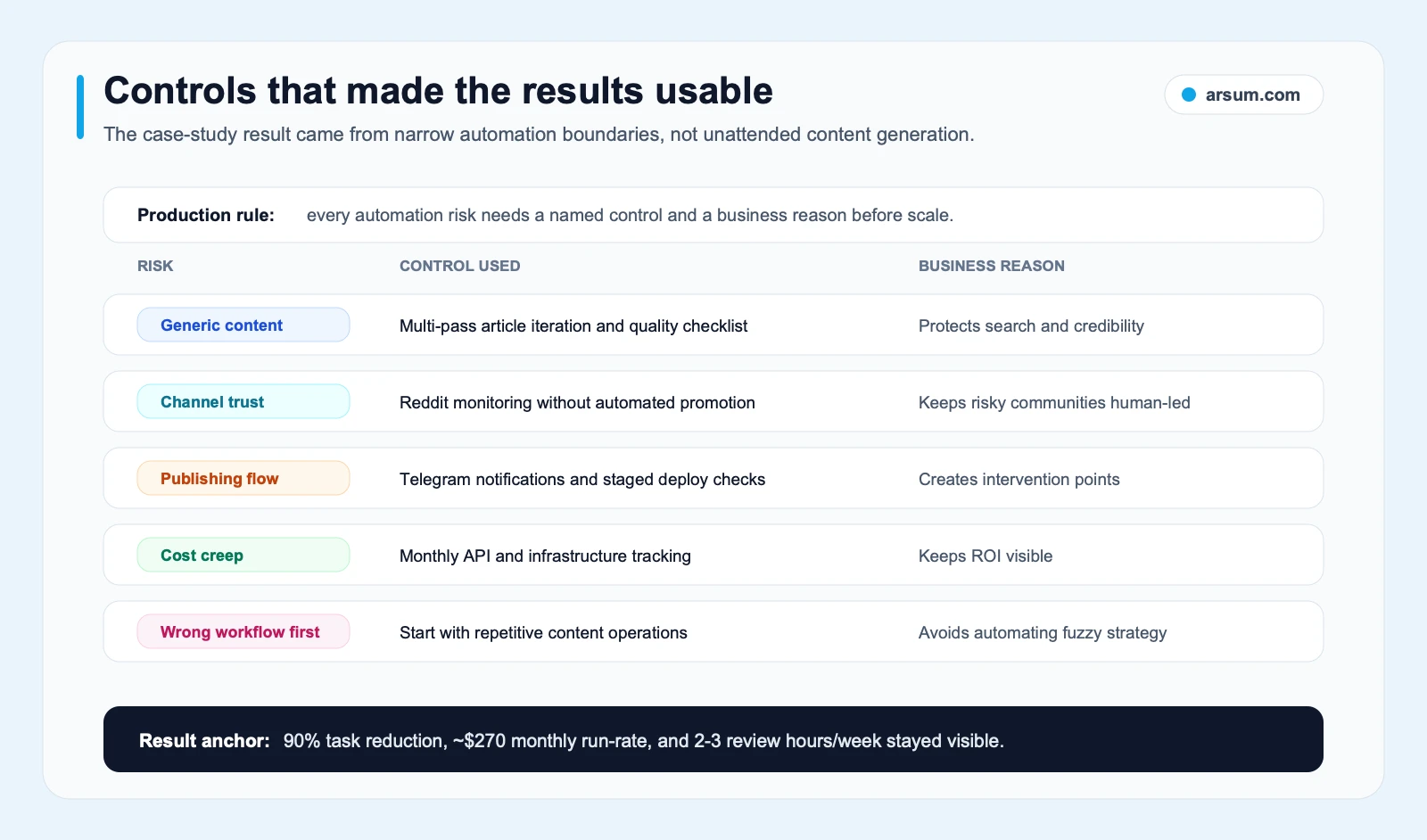
The useful outcome of the control map is not “more autonomous marketing.” It is a smaller authorized surface area: drafts and reports can move quickly, while public publication, community judgment, and strategic changes remain accountable human decisions.
What to do next
Start with one workflow, one owner, one 30-day scorecard, and one rollback path. For most teams, a sensible first scope is draft-to-review-to-queue for owned content—not autonomous social engagement and not a broad promise to replace marketing operations.
If you need a more technical operating model, review AI agent architecture patterns before choosing an agent framework, and use agentic AI consulting services to pressure-test the ownership, exception, and integration design.
A workflow assessment should produce the same artifacts used here: the task boundary, inputs and systems, approval owner, allowed actions, exception queue, evidence retained, total-cost model, pilot scorecard, stop condition, and build/buy/connect/defer recommendation.
Work With Arsum
We help businesses implement AI automation that actually works. Custom solutions, not cookie-cutter templates.
Learn more →Methodology and limitations
This page reviews a founder-reported Sidera implementation and visible workflow artifacts. It does not present independent verification of traffic, qualified sign-ups, conversions, revenue, cost savings, channel performance, model quality, or time savings. Those measures require dated analytics exports, CRM definitions, invoices, time logs, approval records, and incident records under a stated counting method.
OpenClaw’s public repository supports the description of the automation framework. Google Search Central supports the content-quality and scaled-content risk framing. Public Hacker News discussions are used only as qualitative signals about approval layers, authenticity concerns, and fragmented marketing stacks. One builder described a value in “stateful workflows that retain context across tasks and campaigns”; that supports the architecture question, not the success of Sidera’s implementation. Read the discussion.
AI-content policy and channel moderation practices can change. Recheck current platform terms, permissions, and Google guidance before enabling any public action.
Ready to Automate Your Business?
Stop wasting time on repetitive tasks. Let AI handle the busywork while you focus on growth.
Schedule a Free Strategy Call →Written by:Arsum editorial team
- Reviewed by
- Arsum editorial team
- Published
- February 3, 2026
- Updated
- July 7, 2026
- How this was produced
- Arsum uses research packs, source checks, and human editorial review to prepare and update blog articles. Editors are responsible for the final page.
- Source policy
- Sources are linked in the article when used. Methodology and source notes are included on higher-risk or high-visibility pages and are being rolled out across the archive. Editorial policy.
- Why this page exists
- Help B2B operators evaluate AI automation, implementation scope, cost, risk, and build-vs-buy decisions with practical context.