Vibe coding SaaS can create validation revenue when it helps a founder test one painful workflow with real buyers; it becomes durable SaaS revenue only when the product also has an owner, controlled data access, support coverage, cost-to-serve visibility, and a maintainable path beyond the prototype.
Vibe Coding SaaS: Practical Guide
Explore vibe coding saas: compare workflow fit, costs, risks, evidence, and practical next steps before you build, buy, or hire.

Table of Contents
- What Most Guides Miss: A Demo Is Not a Revenue Model
- Start With the Workflow, Not the Tool
- The Durability Scorecard: Decide What Happens Next
- A Worked Controlled-Pilot Scorecard
- Revenue Evidence: What You Can and Cannot Infer
- Build, Buy, Harden, or Stop
- The Pre-Launch Hardening Gate
- Community Signals: Useful Questions, Not Statistics
- When Controlled Implementation Is the Better Choice
- Method and Editorial Scope
What Most Guides Miss: A Demo Is Not a Revenue Model
AI-assisted building can reduce the effort required to produce a first version of software. It does not establish that customers will buy, renew, receive reliable support, or trust the product with their data.
The decision is not “Can I build this with AI?” It is:
Can we validate a narrow buyer problem cheaply, then earn the right to harden the product before customer promises outgrow its controls?
Use vibe coding for discovery when one knowledgeable operator can define the workflow, judge the output, and speak directly with prospective users. Do not treat a working interface as proof of a sellable business.
A credible path has two separate tests:
| Test | Evidence required | Decision it supports |
|---|---|---|
| Validation revenue | A buyer has paid, committed to pay, or completed a clearly defined pilot | The problem may be worth solving |
| Durable SaaS revenue | Retention, support, delivery cost, product reliability, and operating ownership can be measured | The product may be worth scaling |
The second test is where many “built in a weekend” stories stop being useful. A fast build is an input to discovery; it is not evidence of distribution, margin, customer trust, or maintainability.
IBM’s overview of vibe coding describes the approach as expressing an intended outcome in natural language and using AI to generate executable code. That is useful shorthand, but generated code still needs to become maintained software before it carries a business dependency.
Start With the Workflow, Not the Tool
A good vibe-coded SaaS candidate has a narrow job, clear inputs and outputs, and an owner who can explain what “correct” means. A poor candidate has ambiguous policy, high-consequence decisions, or unknown integration and support requirements.
A practical qualification screen
Before choosing a builder or writing prompts, answer these questions:
- Is there a specific buyer who experiences the workflow often enough to care?
- Can you document the normal path, exceptions, and human decision points?
- Can a domain owner review the first outputs without relying on the AI to judge itself?
- Can you name a baseline: time per task, manual touches, missed follow-up, conversion, or support volume?
- Can you explain what the buyer will replace, avoid, or gain if the product works?
- Does an existing vendor already solve most of the problem?
If an existing product handles most of the workflow, buy or integrate first unless the remaining gap is strategically important. A custom build is most defensible where the workflow, data model, or approval logic is genuinely distinctive. The same principle applies to internal systems: AI workflow automation is valuable when it improves an owned operating process, not when it merely adds another interface.
Tool choice is a validation question
Do not select a platform based on claims that it is universally “production ready” or “prototype only.” Deployment options, pricing, security controls, and portability change. Evaluate each route against your requirements.
| Route | Useful when | Validate before committing |
|---|---|---|
| Visual app builder | You need a buyer-facing workflow prototype and fast feedback | Exportability, authentication, data ownership, deployment controls, and handoff options |
| Code editor with AI assistance | Someone can inspect changes and own the repository | Test workflow, code review, environment management, and integration ownership |
| Terminal-based coding agent | The team needs deeper repository work or refactoring | Technical sponsorship, approval of changes, secrets handling, and rollback discipline |
| Hosted development environment | You need a contained experiment or collaborative prototype | Deployment controls, observability, support process, and portability |
Use a vibe coding tools comparison to shortlist interfaces, but make the final selection with the workflow owner and technical reviewer in the room.
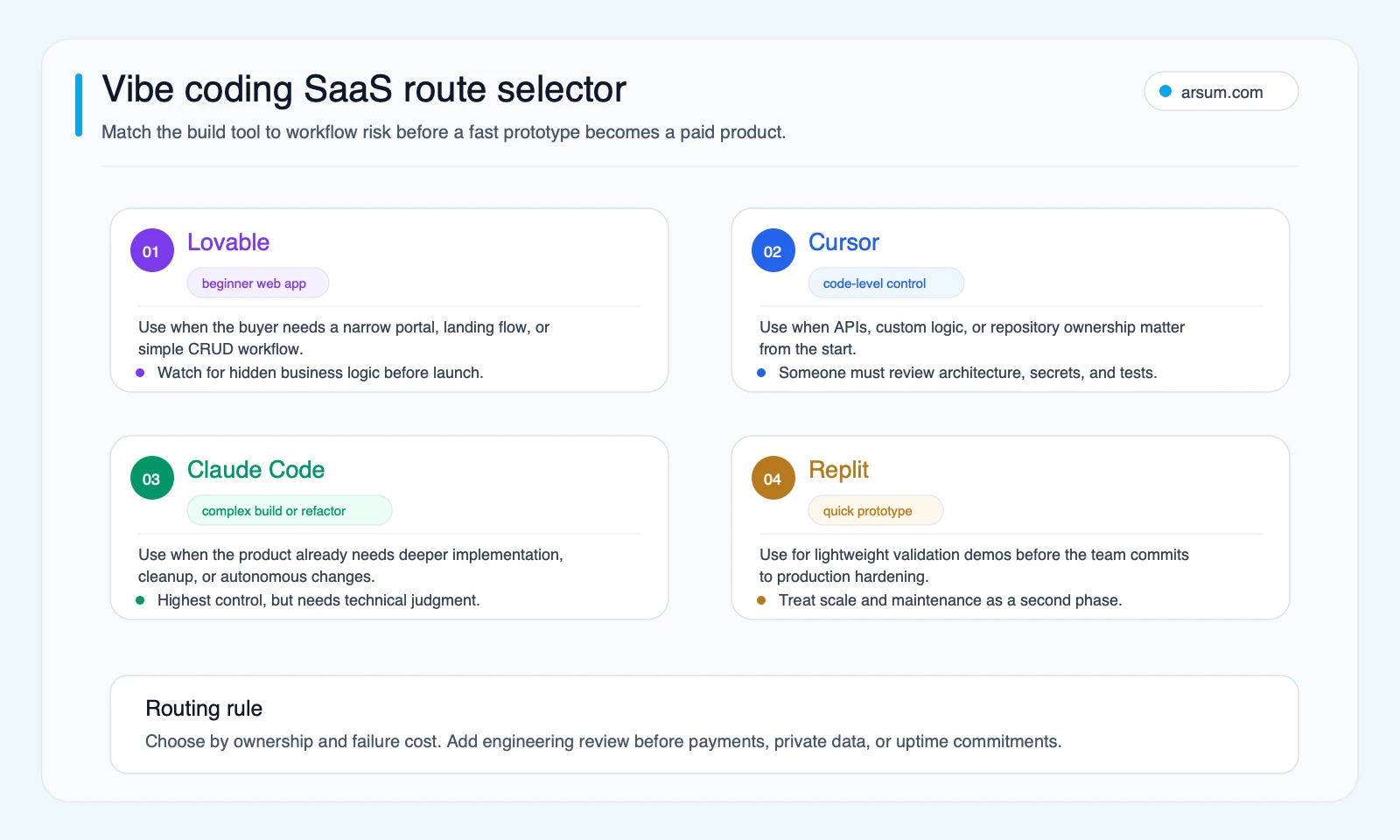
The selector should guide a delivery route, not replace due diligence. The higher the failure cost, the more review, documentation, and change control the product needs.
The Durability Scorecard: Decide What Happens Next
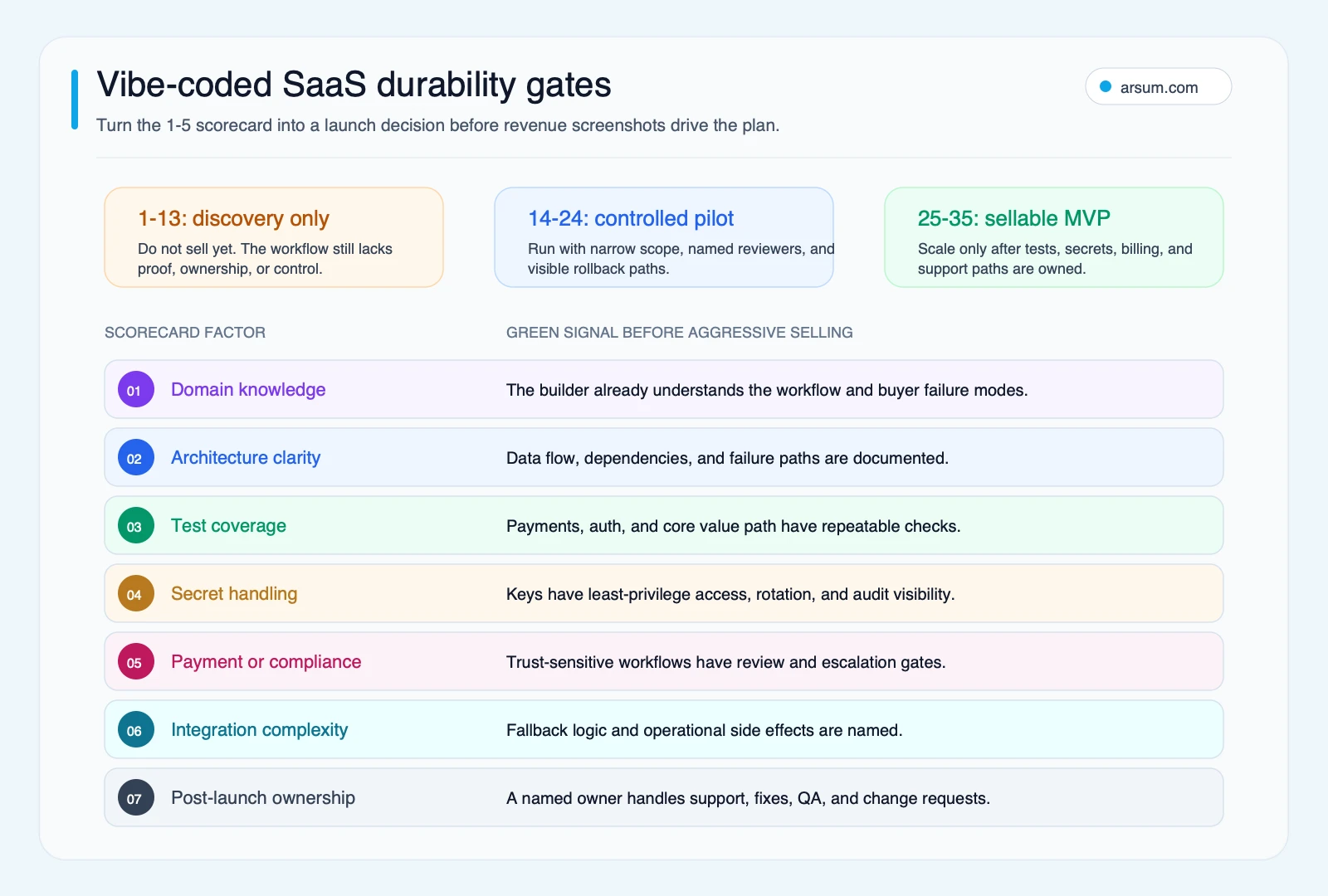
Score each category from 1 to 5. This is an editorial planning tool, not a benchmark or prediction of commercial success.
| Factor | 1 | 3 | 5 |
|---|---|---|---|
| Buyer knowledge | Trend-led idea | Some interviews and workflow knowledge | Repeated firsthand knowledge of the buyer’s work |
| Workflow definition | Vague feature list | Normal path documented | Inputs, outputs, exceptions, and approvals documented |
| Architecture clarity | Prompt history is the specification | Main services understood | Data flows, dependencies, and failure paths documented |
| Quality control | Ad hoc clicking | Manual checks for critical flows | Repeatable tests or documented review procedures |
| Data and secrets | Unclear access or storage | Basic separation | Least-privilege access, rotation process, and evidence trail |
| Operating ownership | Nobody owns failures | Shared but informal ownership | Named support, product, and technical owners |
| Commercial evidence | Assumed demand | Active discovery or pilot conversations | Paid or committed buyer with a defined use case |
Add the seven scores.
| Total | Default decision |
|---|---|
| 7–17 | Stay in discovery. Do not sell broad promises or connect sensitive systems. |
| 18–25 | Run a controlled pilot with limited users and an explicit reviewer. |
| 26–30 | Harden the core workflow before broader selling. |
| 31–35 | A sellable MVP may be reasonable, subject to the mandatory gates below. |
Three conditions override the total score: customer payment handling, sensitive personal or business data, and regulated or consequential workflows. Any one requires explicit approval ownership, access controls, testing, logs, and a rollback plan before live use. Technical capability is not permission for autonomous operation.
A Worked Controlled-Pilot Scorecard
Consider an illustrative planning example: a founder wants to sell a narrow client-intake product to a service business. It gathers structured information, prepares a draft intake summary, and routes incomplete submissions to staff. It does not approve applications, make eligibility decisions, or send binding communications without review.
This is not an observed Arsum result. The arithmetic below is a planning assumption that must be replaced with the team’s own baseline.
| Pilot field | Example decision |
|---|---|
| Workflow | Intake collection, draft summary, and staff routing |
| Baseline | 40 submissions per week × 12 staff minutes per submission = 480 minutes per week |
| Target | Reduce staff handling time by 30% while preserving the current approval process |
| Quality metric | At least 95% of required fields captured; all exceptions routed to staff |
| Exception metric | Track missing information, duplicate records, incorrect routing, and manual correction |
| Commercial metric | Number of pilot users who continue after the agreed pilot period; do not substitute sign-ups for payment intent |
| Product owner | Founder or operations lead accountable for workflow decisions |
| Technical owner | Named person accountable for repository, deployments, secrets, and incident response |
| Data permissions | Restricted pilot access; only approved records and roles enter the system |
| Review cadence | Review pilot outputs and exceptions twice each week |
| Evidence retained | Input record, generated draft, reviewer decision, correction reason, and release/change log |
| Pilot budget | Explicitly list builder subscriptions, hosting, model/API usage, technical review, support time, and payment-processing costs |
| Stop condition | Pause if a material privacy issue occurs, required review is bypassed, or quality stays below threshold for two reviews |
| Rollback | Disable automation, preserve the manual intake path, revoke affected credentials, and notify pilot users if needed |
| Graduation criteria | Target time reduction achieved, review remains usable, no unresolved material control issue, and owners accept support load |
For AI features inside the product, model and tool usage can create variable operating cost. OpenAI’s API pricing is one primary source to use when building a margin model; use current provider pricing and actual usage measurements rather than a generic assumption that AI is cheap.
The point is not to make the pilot bureaucratic. It is to prevent a promising prototype from becoming an unowned production system.
💡 Arsum builds custom AI automation solutions tailored to your business needs.
Get a Free Consultation →Revenue Evidence: What You Can and Cannot Infer
Revenue screenshots and platform-growth stories should not all carry the same weight. Use this evidence ladder before putting an example in a forecast, investor update, or product plan.
| Level | Evidence | Appropriate use |
|---|---|---|
| 1 | Verified public company or platform revenue from an official disclosure | Market context only; not proof your product will sell |
| 2 | Founder-posted revenue tied to an identifiable product and timeline | Directional case study; investigate acquisition, retention, support, and costs |
| 3 | Community anecdote with incomplete verification | Buyer-language signal, not a forecast |
| 4 | Vendor marketing claim, idea list, or hypothetical projection | Discovery input only |
This article does not present verified revenue cases for individual vibe-coded SaaS products. That restraint matters: the available search layer mixes company claims, founder posts, platform revenue, and anecdotes. Treating them as equivalent would create false confidence.
Before calling a result “real revenue,” ask:
- Who paid, for which defined outcome?
- How did they discover the product?
- Did they renew or continue after the first use?
- What did support, hosting, payments, and model usage cost?
- Did the founder need manual work to deliver the value?
- What happens when the first serious bug, refund, or data request arrives?
Vibe coding can lower creation cost. It does not automatically lower distribution cost, trust-building cost, or cost to serve.
Build, Buy, Harden, or Stop
A useful operating decision has four possible outcomes.
Keep vibing
Continue with the current approach when the product is still learning whether a problem exists. Keep scope narrow: one persona, one workflow, limited data, and an easy manual fallback.
Harden with technical review
Choose this route when a buyer is engaged and the current product needs basic operational controls. Typical work includes code ownership, test coverage for core paths, environment separation, monitoring, documented secrets handling, and a support handoff.
This is often the right step before adding billing, integrations, or a larger customer set. A team evaluating the wider implementation model can compare AI app development services with an internal technical hire after the scope is clear.
Rebuild or refactor
Refactor when changes repeatedly break existing features, the founder cannot trace a failure through the system, or critical logic is spread across prompts and undocumented patches. The prototype may have succeeded at its actual job: proving demand. Preserve that learning, then rebuild the foundations needed for the next stage.
Stop or buy
Stop when discovery does not reveal payment intent, the operating process cannot be defined, or the custom gap is too small to justify ownership. Buy when a mature product handles the majority of the workflow and integration is cheaper than permanent custom maintenance.
For a broader decision framework, see custom AI solutions for business and AI integration consulting.
The Pre-Launch Hardening Gate
Before a vibe-coded SaaS handles payments, private data, or customer-visible workflow execution, answer these questions in writing:
- Who owns customer support, bug triage, and release approval?
- Where are secrets stored, who can rotate them, and how will a leaked credential be contained?
- Which roles can access which records?
- What does the system do when an integration fails, a model response is unusable, or required data is missing?
- Which actions require human approval?
- What test or review procedure covers authentication, billing, permissions, and the core customer outcome?
- What logs will help reconstruct a failure?
- How can the team switch back to the prior manual or vendor workflow?
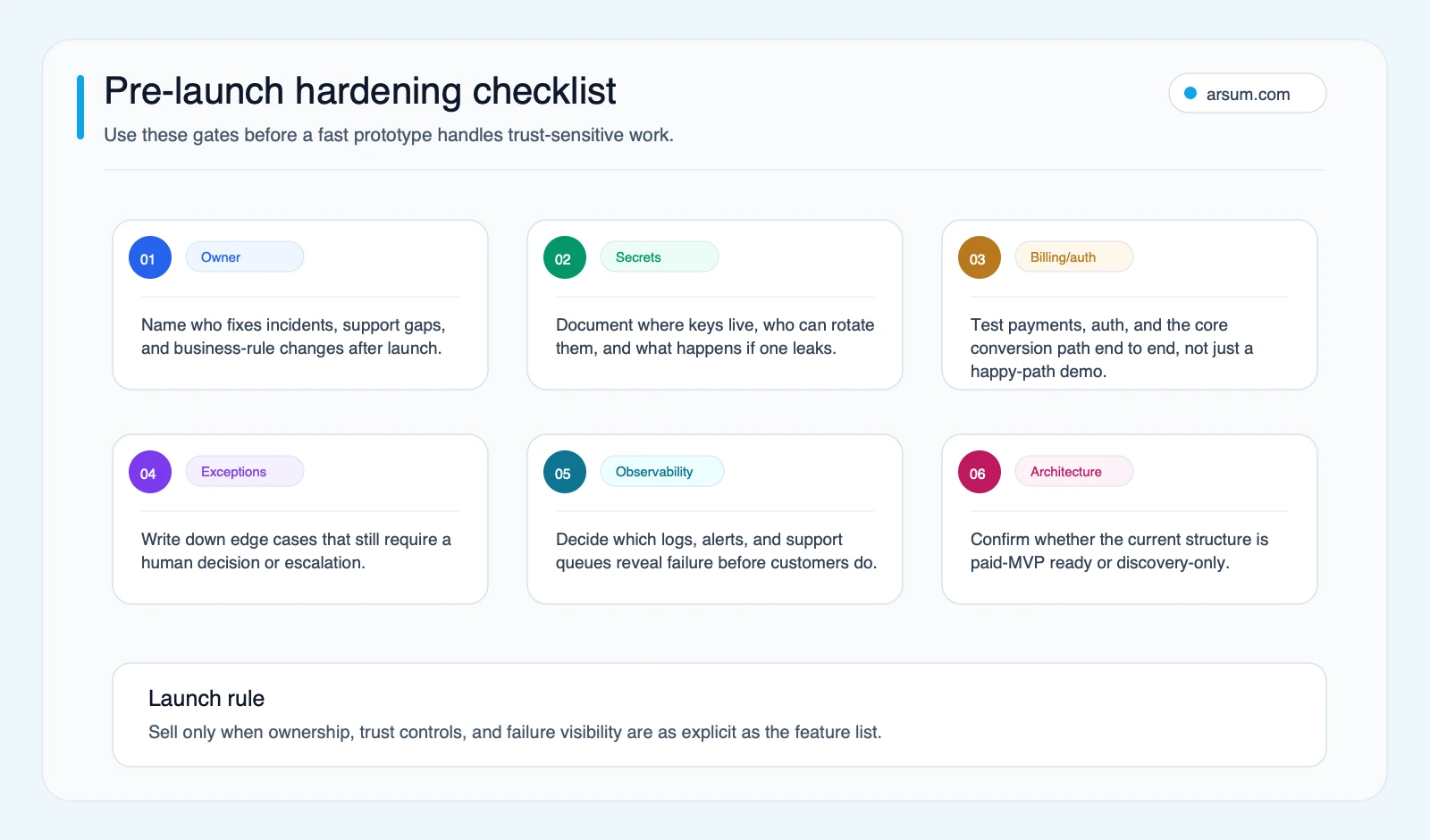
A product with no defined answer should remain a prototype, even if the interface looks complete.
Community Signals: Useful Questions, Not Statistics
Public founder and developer conversations are helpful for locating failure modes, but they are not representative market data or independently verified revenue evidence.
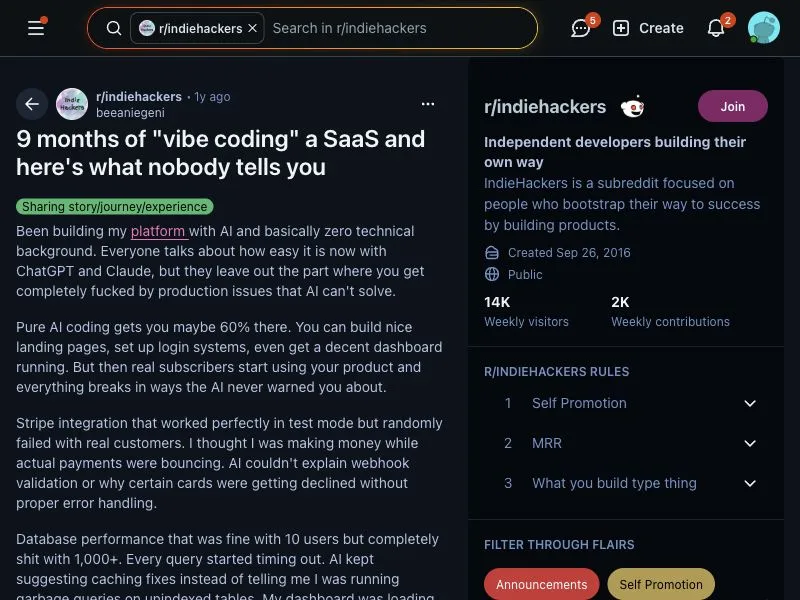
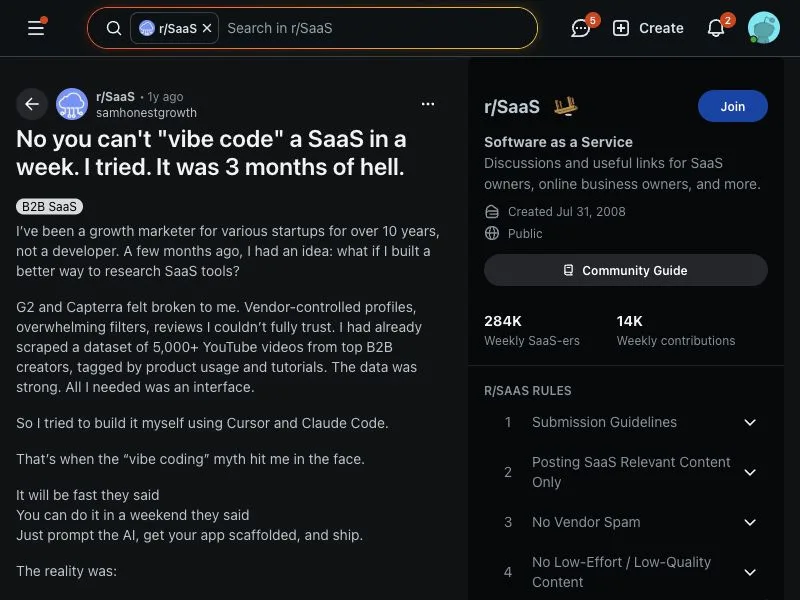
The linked Reddit discussion is a qualitative founder signal about what happens after launch.
A separate Reddit thread reinforces a practical point: schema, roles, and operating assumptions deserve planning before speed claims.
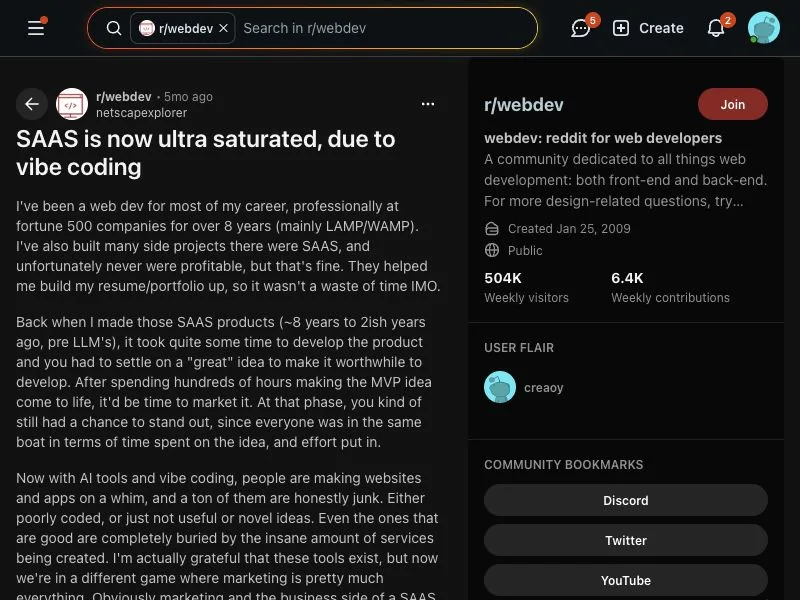
The community discussion on saturation is not market measurement, but it usefully separates low creation cost from the harder work of differentiation and distribution.
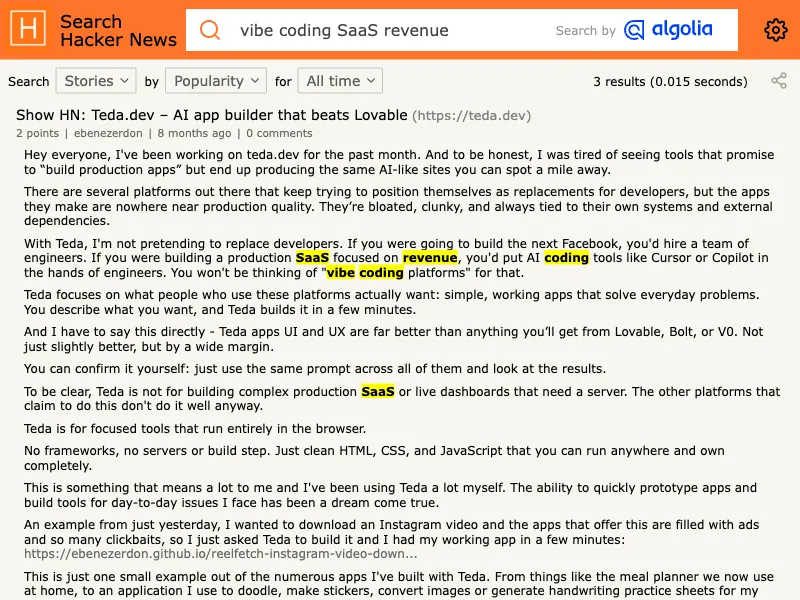
The Hacker News discussion is qualitative evidence of maintenance concerns, not proof that all AI-generated code becomes unmaintainable.
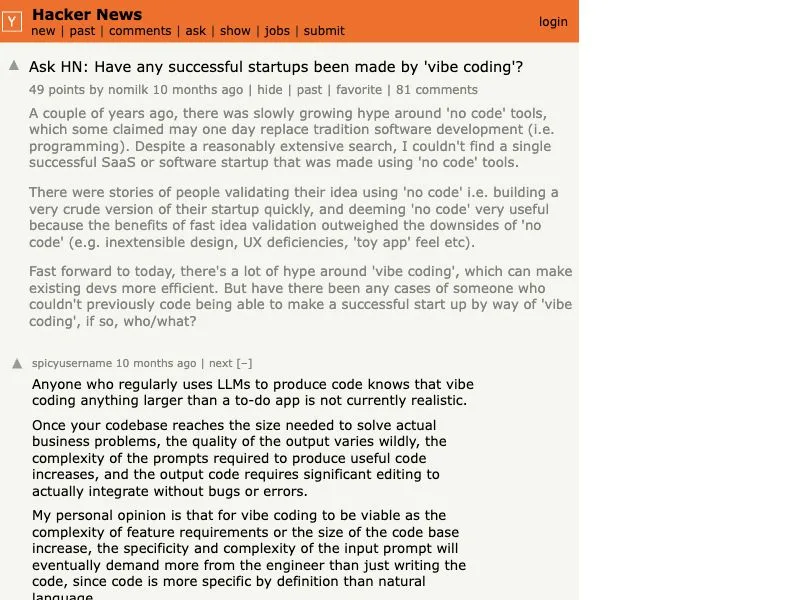
The Ask HN thread is most useful for its demand for specific outcomes rather than broad tool enthusiasm.
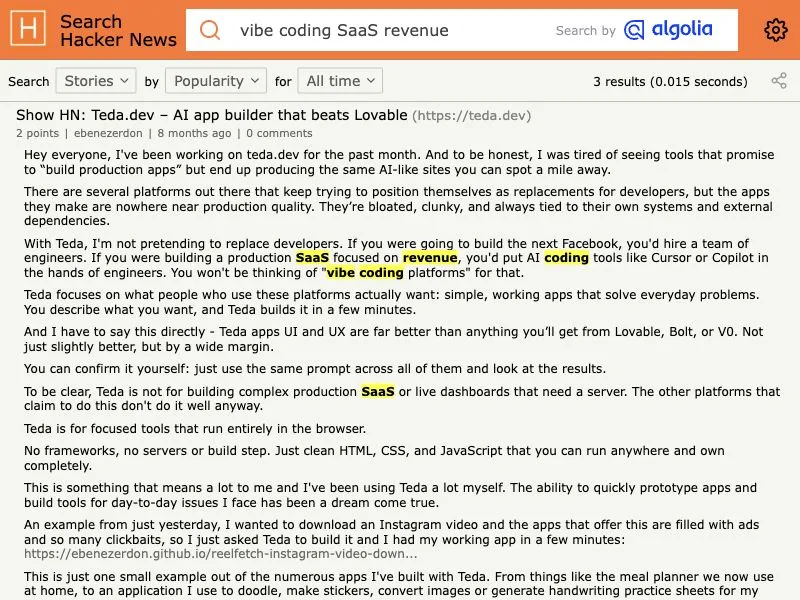
The Hacker News search layer is discovery context only. Recheck claims found there before using them in commercial materials.
When Controlled Implementation Is the Better Choice
If the SaaS will influence credit, employment, insurance, healthcare, compliance, or another high-consequence outcome, do not use prompt-driven speed as a reason to increase autonomy. Use it, at most, to accelerate supervised internal development under clear controls.
In these cases, define source lineage, reviewer authority, exception handling, retained evidence, and rollback before releasing a workflow. AI agent security and AI agent architecture patterns are useful starting points for the design questions that arrive after the prototype.
A founder with a clear workflow and a paid validation opportunity can use vibe coding well. A risk owner with sensitive data or consequential decisions needs a controlled implementation plan first.
Method and Editorial Scope
Written by Johnny Kartakov. Editorial review: Arsum Editorial Team. Last updated June 19, 2026.
This is an editorial synthesis of exact-keyword research, public community discussions, GitHub’s Copilot productivity research, IBM’s definition of vibe coding, and current provider-pricing sources. Community material is used only as qualitative evidence of concerns and questions. The scorecard, revenue ladder, and graduation model are Arsum editorial decision tools, not audited benchmarks or predictions.
Vibe coding is a credible way to test whether a SaaS workflow deserves investment. Real SaaS revenue requires the additional work: buyer evidence, distribution, unit economics, support ownership, security controls, and a maintainable path forward.
Ready to Automate Your Business?
Stop wasting time on repetitive tasks. Let AI handle the busywork while you focus on growth.
Schedule a Free Strategy Call →Written by:Arsum editorial team
- Reviewed by
- Arsum editorial team
- Published
- April 9, 2026
- Updated
- July 7, 2026
- How this was produced
- Arsum uses research packs, source checks, and human editorial review to prepare and update blog articles. Editors are responsible for the final page.
- Source policy
- Sources are linked in the article when used. Methodology and source notes are included on higher-risk or high-visibility pages and are being rolled out across the archive. Editorial policy.
- Why this page exists
- Help B2B operators evaluate AI automation, implementation scope, cost, risk, and build-vs-buy decisions with practical context.