Agentic AI is software that can observe a defined business state, choose a next step, and use approved tools to work toward an objective; in plain terms, what is agentic ai matters less as a label than as a decision about how much authority a workflow can safely give to software.
What Is Agentic AI? Business Guide to ROI and Risk
Explore what is agentic ai: compare workflow fit, costs, risks, evidence, and practical next steps before you build, buy, or hire.

Table of Contents
- What Most Guides Miss: Capability Is Not Authorization
- Chatbot, Automation, Agent, and Agentic System
- How an Agentic AI System Works in a Business Workflow
- Where Agentic AI Can Create Measurable Value
- Arsum Pilot-Readiness Framework: Go, Hold, or Stop
- Readiness Gates Before Autonomy
- Common Failure Modes and When to Avoid Agentic AI
- Build, Buy, or Partner?
- Next Step: Scope the Smallest Controlled Workflow
- Related Arsum Guides
Unlike a chatbot that waits for a person to ask a question, an agentic system can respond to events, gather context from connected systems, decide among permitted paths, and either act or pause for approval. Stanford HAI, MIT Sloan, AWS, and Google Cloud each describe goal-oriented systems that can coordinate multi-step work with varying degrees of human involvement. For an operator, the important addition is ownership: every action needs a source of truth, permission boundary, exception path, reviewer, and rollback condition.
What Most Guides Miss: Capability Is Not Authorization
Most definitions explain that agentic AI can plan and act. They do not answer the budget question: should this workflow receive that autonomy at all?
A model may be technically capable of classifying a customer request, choosing a next action, and calling an API. That does not make it authorized to issue a refund, change a credit decision, alter a contract, or notify a regulator. The higher the failure cost and the harder an action is to reverse, the lower the system’s autonomous authority should be.
Use four gates before treating a workflow as an agentic AI candidate:
- Volume: Does the decision recur often enough for improvement to matter?
- Value: Does faster or more consistent handling affect revenue, cost, cycle time, risk, or service quality?
- Control: Can low-confidence or high-impact cases be routed to a named human owner?
- Measurement: Can the team compare the pilot with a baseline rather than judging it by a demo?
If any gate is weak, start with reporting, deterministic automation, or an AI assistant. Agentic complexity is justified when context changes often enough that fixed rules break down, while the business can still state what the system may do.
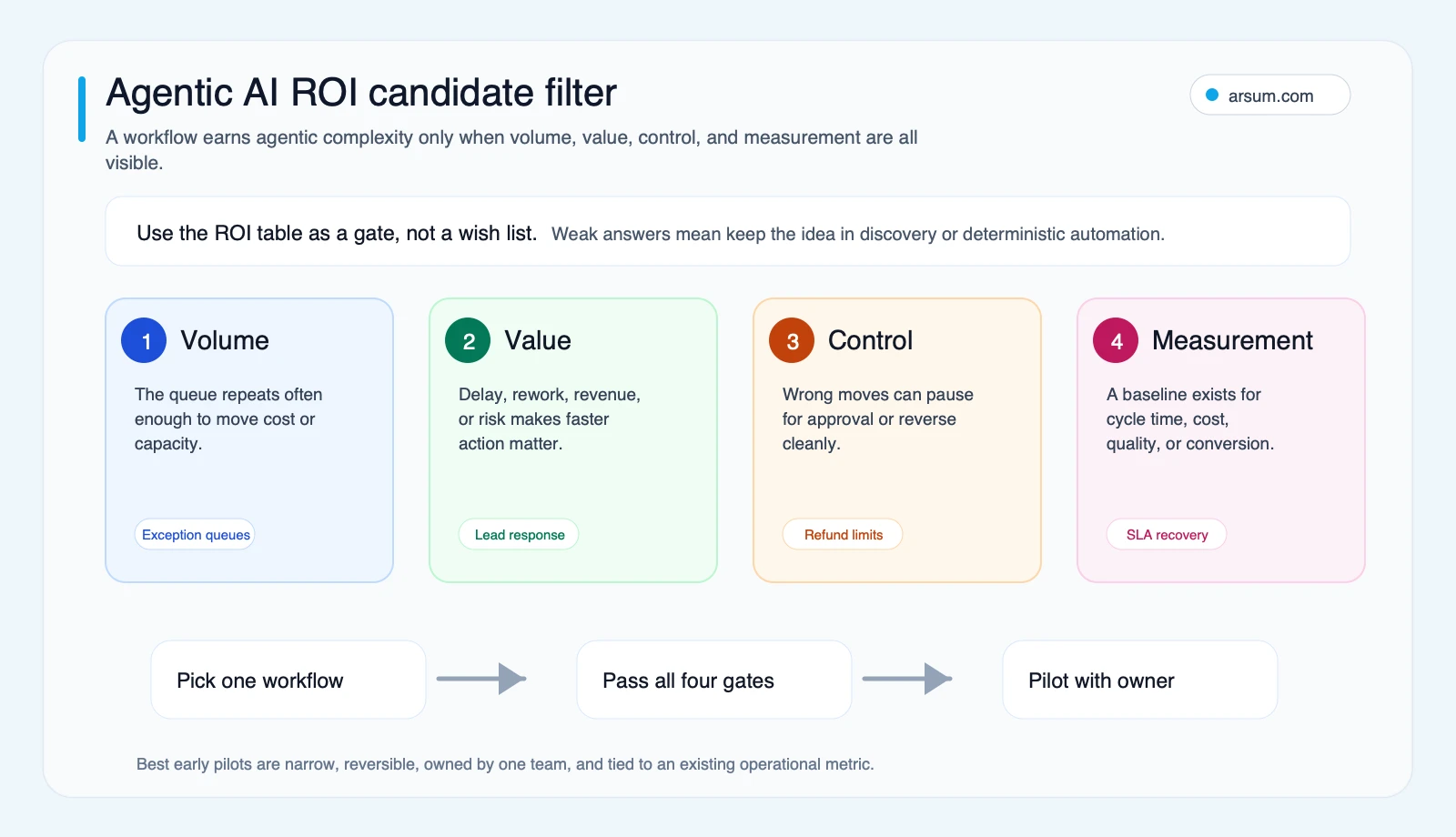
A useful first pilot is not “automate customer operations.” It is “assemble evidence and route low-risk billing exceptions, while a support operations manager approves any customer commitment above the agreed threshold.”
Chatbot, Automation, Agent, and Agentic System
The terms overlap, but the operating model does not. A team can avoid expensive overbuilding by choosing the simplest system that handles the real work.
| System type | What it does | Best use | Control requirement | Weak-fit warning |
|---|---|---|---|---|
| Chatbot or copilot | Responds to a human prompt | Drafting, search, summaries, internal guidance | Human decides and acts | Output does not change workflow execution |
| Deterministic automation | Runs predefined logic after an event | Record updates, notifications, routing, scheduled follow-up | Rules and exception handling | Real cases vary beyond the rule map |
| AI agent | Uses tools to pursue a bounded task | Research, enrichment, first-pass triage | Scoped tools and review | Tool access exceeds the task boundary |
| Agentic system | Monitors state and coordinates actions toward an outcome | Exception management and cross-system orchestration | Approval tiers, logs, rollback, ownership | The business cannot explain the allowed actions |
For a deeper terminology comparison, see AI agents vs. agentic AI and agentic AI vs. generative AI.
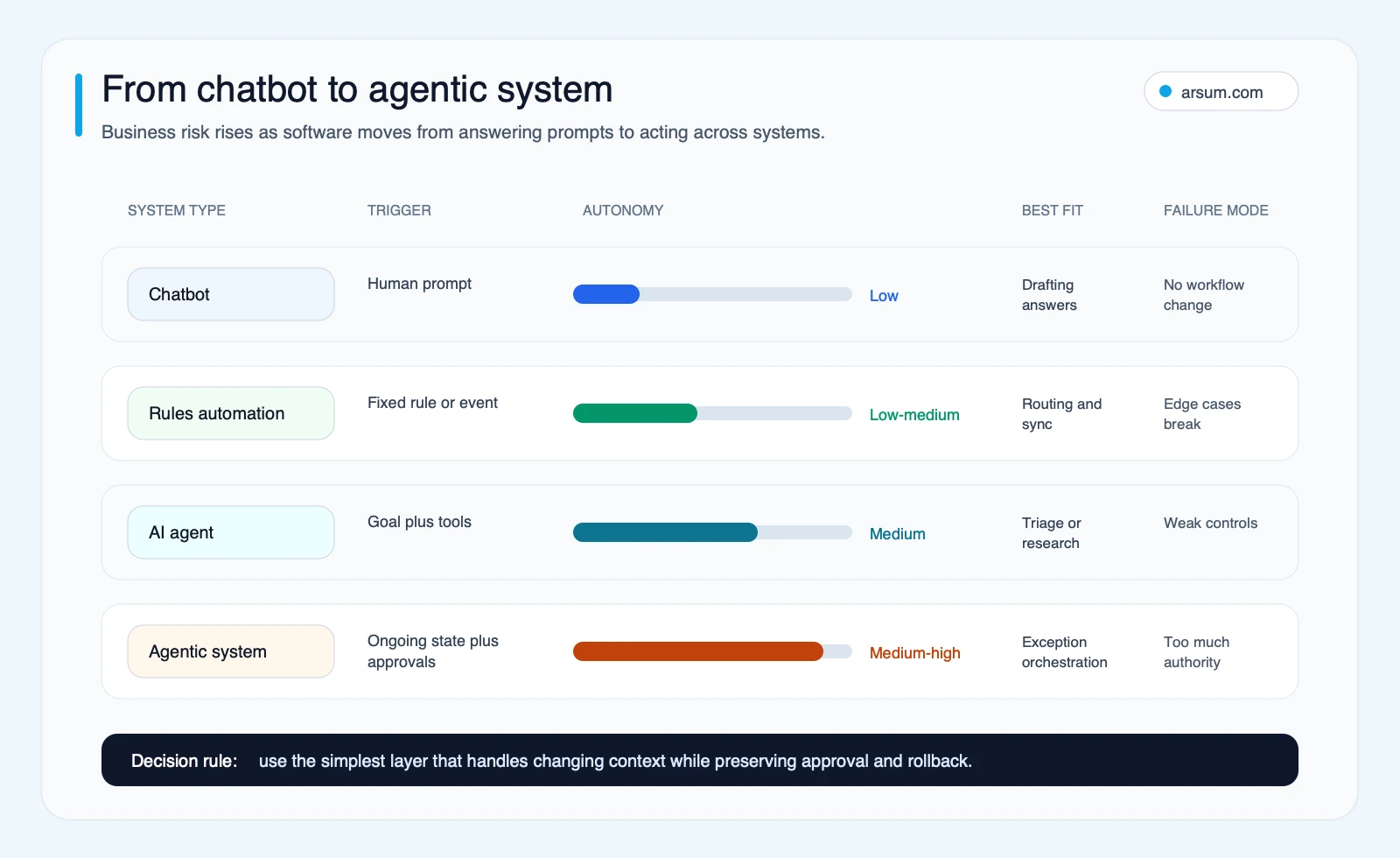
The practical rule is simple: if a stable flowchart handles the work, use rules first. Add an agent only where changing context requires interpretation or path selection. Add ongoing agentic behavior only where that interpretation must lead to repeated, controlled action across systems.
How an Agentic AI System Works in a Business Workflow
An agentic system is not just a language model with a prompt. The model may interpret unstructured information and propose a plan, but the surrounding workflow determines whether the result is reliable and governable.
The operating loop
A bounded system typically follows this sequence:
- Observe: Receive an event and retrieve only the records needed to assess it.
- Interpret: Classify the case, identify missing facts, and apply policy.
- Choose: Select an allowed next action, request more information, or escalate.
- Act: Call a tool with limited permissions, such as creating a task or updating a case.
- Record: Keep the inputs, decision, action, approval, and outcome available for review.
- Recover: Retry safely, hand off to a person, or reverse an action when a defined condition is met.
This is why workflow design matters more than a broad promise of autonomy. The system needs a reliable identity model, current data, narrow permissions, idempotent actions where possible, and a way to distinguish an expected result from an exception.
The control plane around the model
The model should not hold unrestricted access to CRM, billing, banking, code deployment, or production infrastructure. OWASP’s GenAI Security Project identifies risks including prompt injection, insecure output handling, sensitive-information disclosure, and excessive agency. Those risks become more consequential once a system can take actions rather than merely generate text.
A sensible control plane includes:
- Read access separated from write access.
- A policy service that checks limits before each consequential action.
- Approval thresholds owned by a business role, not buried in a prompt.
- Logs that connect source records, proposed action, approval, execution, and outcome.
- A tested fallback path when a tool fails, data conflicts, or confidence is inadequate.
For implementation options, see AI agent architecture patterns and AI agent security.
Where Agentic AI Can Create Measurable Value
The strongest use cases are usually exception-heavy workflows. Routine work is often better automated with rules; edge cases often require humans; the opportunity sits between them, where people repeatedly gather context, apply a known policy, and update multiple systems.
| Workflow characteristic | Why agentic design may help | Example |
|---|---|---|
| Changing context changes the next step | The system can retrieve facts and select among approved paths | A service case differs based on account status, payment history, and entitlement |
| Multiple systems contain the necessary evidence | The system reduces manual context gathering | CRM, billing, product usage, and support records must be reconciled |
| A defined policy constrains decisions | The system can propose or take bounded actions | Route, request documents, create a case, or draft a response |
| Exceptions are visible and reviewable | Humans can supervise the hard cases | Missing data, conflicting records, policy exceptions, high-value customers |
| The outcome can be measured | The pilot can be expanded or stopped on evidence | Resolution time, rework, backlog age, review cost, SLA performance |
A finance-sensitive example makes the boundary clearer. Consider an accounts-receivable exception queue. A system could collect invoice status, payment history, dispute notes, and customer ownership; classify the next step; draft a follow-up; and create a collections task. It should not independently waive a balance, change credit terms, or make a legal representation unless policy explicitly permits it and the designated owner approves.
Related workflow detail is available in accounts receivable automation and agentic AI use cases in finance. The value case is not that an agent replaces an occupation. It is whether the workflow resolves more eligible cases with acceptable quality and review cost while people retain authority over consequential exceptions.
💡 Arsum builds custom AI automation solutions tailored to your business needs.
Get a Free Consultation →Arsum Pilot-Readiness Framework: Go, Hold, or Stop
This is an Arsum planning framework, not a benchmark or prediction. Score each dimension from 1 to 5, where 1 means the condition is absent and 5 means it is operationally ready.
| Dimension | 1 | 3 | 5 | Required pilot condition |
|---|---|---|---|---|
| Decision frequency | Rare, ad hoc | Weekly queue | Daily or continuous queue | At least 3 |
| Action reversibility | Hard to undo | Can be corrected with effort | Easily reversed or safely escalated | At least 4 |
| Data readiness | Missing or contradictory | Partial, manually checked | Current, identified, accessible records | At least 4 |
| Control boundary | No stated authority | Informal review | Written action and approval policy | At least 4 |
| Measurement | No baseline | One rough metric | Baseline and outcome metrics available | At least 4 |
| Ownership | No owner | Shared interest | Named business and technical owners | At least 4 |
A candidate should not proceed to autonomous actions if any required condition is below its threshold. Disqualify the first pilot when the action is irreversible, the source data cannot be reconciled, no one owns approval policy, or the team cannot restore the prior workflow.
Completed illustrative example: billing-support exception triage
This is an illustrative planning assumption, not an observed Arsum result.
| Pilot item | Example setup |
|---|---|
| Workflow | Support cases involving a payment failure, duplicate-charge concern, or account-status question |
| Baseline period | Four weeks of current handling data |
| Baseline metrics | Median time to resolution, cases per analyst hour, rework rate, and backlog age |
| Allowed autonomous actions | Retrieve approved records, classify the case, draft a response, create a task, route low-risk cases |
| Approval owner | Support Operations Manager for credits, refunds, or customer commitments |
| Quality target | Maintain or improve the current audited-quality rate; define the accepted threshold before launch |
| Exception target | Track the share of cases escalated, overridden, and reopened; investigate material increases against baseline |
| Review cost | Record reviewer minutes per case, not only model or API spend |
| Evidence retained | Input record identifiers, policy version, proposed action, final action, approval, override reason, and outcome |
| Review cadence | Daily operational review in week one; weekly pilot review afterward |
| Stop condition | Pause autonomous routing if audited quality falls below the agreed threshold, an unauthorized action occurs, or rollback cannot be completed |
| Rollback path | Disable write permissions, return routing to the existing queue, preserve logs for root-cause review |
| Expand gate | Expand only after the agreed measurement period shows target performance without a material increase in exceptions or review burden |
The arithmetic for ROI should remain explicit. For example, estimated gross time capacity equals eligible cases per period multiplied by measured minutes saved per eligible case. That number is only useful after subtracting reviewer time, implementation and maintenance effort, model and infrastructure costs, rework, and the cost of errors. It is a planning model, not a savings claim.
Readiness Gates Before Autonomy
A good pilot can begin with recommendation-only mode. The system gathers context and proposes an action while a human accepts, edits, or rejects it. That mode exposes policy gaps and data-quality failures before the system receives write access.
| Gate | Question to answer before write access | Evidence to retain |
|---|---|---|
| Data lineage | Which system is authoritative for each decision input? | Record source, timestamp, and conflict handling |
| Permissions | Which exact tools and actions are allowed? | Role, scope, and denied-action logs |
| Approvals | Who can authorize which outcomes? | Thresholds, approver, decision time |
| Observability | Can an operator reconstruct what happened? | Trace, policy reference, tool calls, outcome |
| Rollback | How is a bad action undone or contained? | Tested recovery procedure and owner |
| Security | What happens if inputs attempt to manipulate the system? | Validation, isolation, policy checks, incident path |
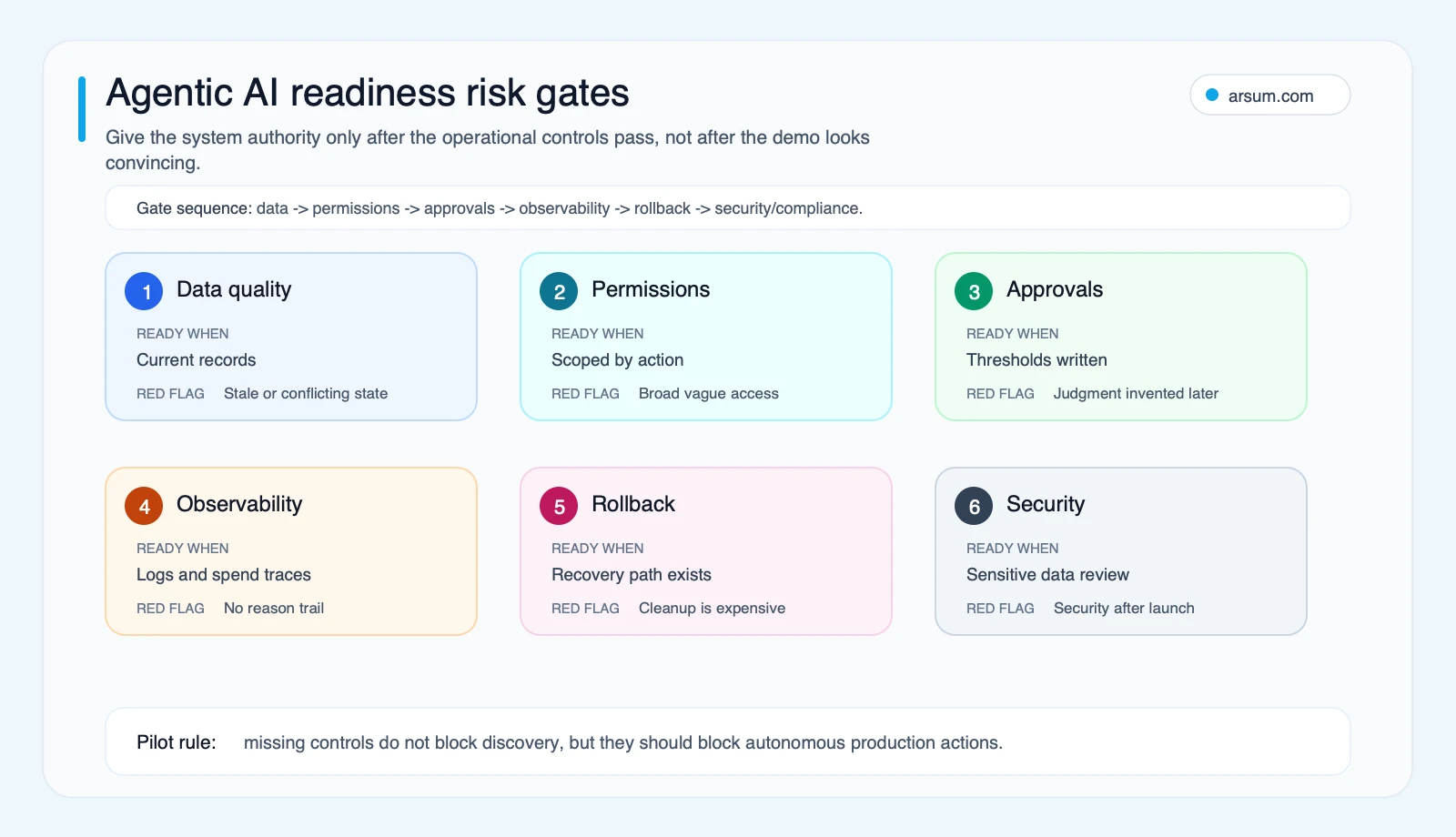
The controls should operate continuously, not only at launch. The team needs to review model behavior, permissions, tools, and downstream process outcomes together. A secure prompt alone cannot make an unsafe business authority model acceptable.
Common Failure Modes and When to Avoid Agentic AI
Do not use agentic AI merely because a workflow feels manual. The following conditions usually mean the project should remain human-led or rules-led for now.
The policy is not actually defined
If experienced staff resolve similar cases differently and the business cannot decide which interpretation is correct, an agent will surface the ambiguity rather than solve it. First document the policy, authority levels, and exception categories.
The data is stale or conflicts across systems
An agent can make a bad decision quickly when CRM, billing, and operational records disagree. Establish authoritative sources and conflict handling before granting action rights.
The action has high downside and weak reversibility
Credit decisions, regulated determinations, material pricing changes, irreversible data deletion, and legal commitments may benefit from AI-assisted preparation, but they should not receive broad autonomous execution without a stronger control design.
The team measures only output volume
More closed tickets or more generated messages are not enough. Track audited quality, reopens, overrides, reviewer time, customer impact, and cost per successfully resolved eligible case.
The pilot adds coordination work
If analysts spend more time checking the system than they spent doing the original work, the design has not earned expansion. Narrow the action set, improve the evidence bundle, or return to deterministic automation.
Selected Reddit and Hacker News discussions surfaced qualitative concerns about whether agentic projects create value or simply introduce technical debt and new security exposure. Those discussions are signals about buyer questions, not evidence of market prevalence or measured failure rates. The right response is to make value, control, and maintenance costs visible in the pilot.
Build, Buy, or Partner?
The right delivery path depends on workflow specificity and control requirements, not on whether a platform has an agent feature.
| Decision factor | Buy or configure a platform | Build a custom workflow | Use an implementation partner |
|---|---|---|---|
| Workflow | Common, repeatable category | Core to a differentiated operating model | Important but internal team lacks delivery capacity |
| Integrations | One or two standard systems | Several proprietary or legacy systems | Existing systems need workflow and control design |
| Controls | Standard roles and logs suffice | Custom approval and evidence requirements | Governance needs to be designed alongside integration |
| Ownership | Internal operations team can administer it | Engineering can maintain it | Business and technical owners need a shared operating model |
A hybrid route is common: use established model and infrastructure providers, then customize the workflow, data access, approval logic, and measurement around the actual business process. Compare options with agentic AI frameworks, review practical platform choices in the AI agent platform guide, and assess what a production partner should own through agentic AI development services.
Next Step: Scope the Smallest Controlled Workflow
Start with one queue where people already gather context, make repeatable decisions, and update systems. Set a baseline before changing the process. Name the business owner who defines approved actions and the technical owner who maintains integrations, logs, and rollback. Start in recommendation mode, then grant narrow autonomous actions only after the evidence supports it.
Agentic AI is valuable when it helps a controlled workflow handle changing context without hiding the decision, the authority, or the consequence of being wrong.
Ready to Automate Your Business?
Stop wasting time on repetitive tasks. Let AI handle the busywork while you focus on growth.
Schedule a Free Strategy Call →Related Arsum Guides
Written by:Arsum editorial team
- Reviewed by
- Arsum editorial team
- Published
- February 9, 2026
- Updated
- July 7, 2026
- How this was produced
- Arsum uses research packs, source checks, and human editorial review to prepare and update blog articles. Editors are responsible for the final page.
- Source policy
- Sources are linked in the article when used. Methodology and source notes are included on higher-risk or high-visibility pages and are being rolled out across the archive. Editorial policy.
- Why this page exists
- Help B2B operators evaluate AI automation, implementation scope, cost, risk, and build-vs-buy decisions with practical context.