An AI automation agency is an implementation partner that helps a business design, build, test, and operate a specific AI-enabled workflow across its existing systems. For a buyer asking what is ai automation agency, the useful question is not whether the agency can produce an AI demo; it is whether it can make one bounded process measurably better while preserving approvals, evidence, exception handling, and a safe fallback.
What Is AI Automation Agency: Buyer Guide
Explore what is ai automation agency: compare workflow fit, costs, risks, evidence, and practical next steps before you build, buy, or hire.

Table of Contents
- What most guides miss: the buyer decision is not the agency-business decision
- What an AI automation agency actually does
- Start with workflow fit, not a vendor shortlist
- A worked pilot: invoice intake with controlled review
- How to evaluate an agency against SaaS, engineering, and internal teams
- The vendor scorecard: questions that expose delivery depth
- What the operating model should include after launch
- Common failure modes and their controls
- How agencies structure commercial work
- A practical next step
- Methodology and limitations
What most guides miss: the buyer decision is not the agency-business decision
Search results often mix two separate questions:
- “How do I start an AI automation agency?”
- “Should my company hire one?”
The first is about selling services. The second is about operational risk, ownership, and whether a workflow justifies change. This guide focuses on the buyer decision.
An agency may be useful when your team already knows the operational problem but lacks the time or capability to connect systems, configure workflow logic, test edge cases, and support the result. It is not automatically the right answer just because a process includes documents, email, or repetitive work.
Use this rule before a vendor call:
| Your actual problem | Better first move |
|---|---|
| Nobody agrees which workflow should receive budget | Map the workflow and establish a baseline internally or with advisory support |
| The workflow is clear, but systems, rules, and approvals are disconnected | Evaluate an automation agency or implementation partner |
| A mature product already covers the standard process | Buy and configure SaaS rather than commission a custom workflow |
| You need a customer-facing product, proprietary capability, or deep platform integration | Use an internal engineering team or software development partner |
| The process has high consequence and no named reviewer or fallback | Defer automation until controls and ownership exist |
An AI automation agency is therefore not a category of “AI magic.” It is a service model for operational implementation. The output should be a controlled workflow with an accountable owner—not a collection of prompts.
What an AI automation agency actually does
A capable agency usually works across five layers:
| Layer | What should be defined |
|---|---|
| Workflow design | Trigger, inputs, decision points, outputs, exception path, and business owner |
| System integration | Which inboxes, CRMs, ERPs, document stores, or help desks connect—and under whose credentials |
| AI-assisted processing | Extraction, classification, drafting, routing, or summarization with constrained instructions |
| Controls | Validation rules, confidence thresholds, human approval, logs, alerts, and access controls |
| Operating model | Monitoring, incident response, change process, support scope, documentation, and handoff |
Tools such as n8n and Make provide triggers, integrations, workflow logic, and visual orchestration. Their documentation illustrates an important buyer reality: an AI workflow is usually a sequence of events, system actions, tool calls, and rules—not a single model prompt. n8n’s AI workflow tutorial similarly shows that agent-style workflows combine triggers, tools, configuration, and downstream actions.
That does not mean every engagement is low-code. A production workflow may still require custom engineering for authentication, data transformation, security controls, performance, reliability, user interfaces, or integration limits. The right agency should identify that boundary early instead of presenting orchestration tools as a substitute for engineering.
For a broader view of the service category, see AI automation agency services and this guide to AI implementation services.
Start with workflow fit, not a vendor shortlist
A workflow is a stronger automation candidate when it passes five gates:
- Sufficient volume: It occurs often enough for process improvement to matter.
- Visible current cost: You can measure handling time, rework, delay, error exposure, or service-level impact.
- Usable inputs: Documents, forms, emails, records, and rules are accessible and reasonably consistent.
- System access: Required systems can connect through approved APIs, exports, or controlled alternatives.
- Exception ownership: A person or team is assigned to review uncertain, missing, or disallowed cases.
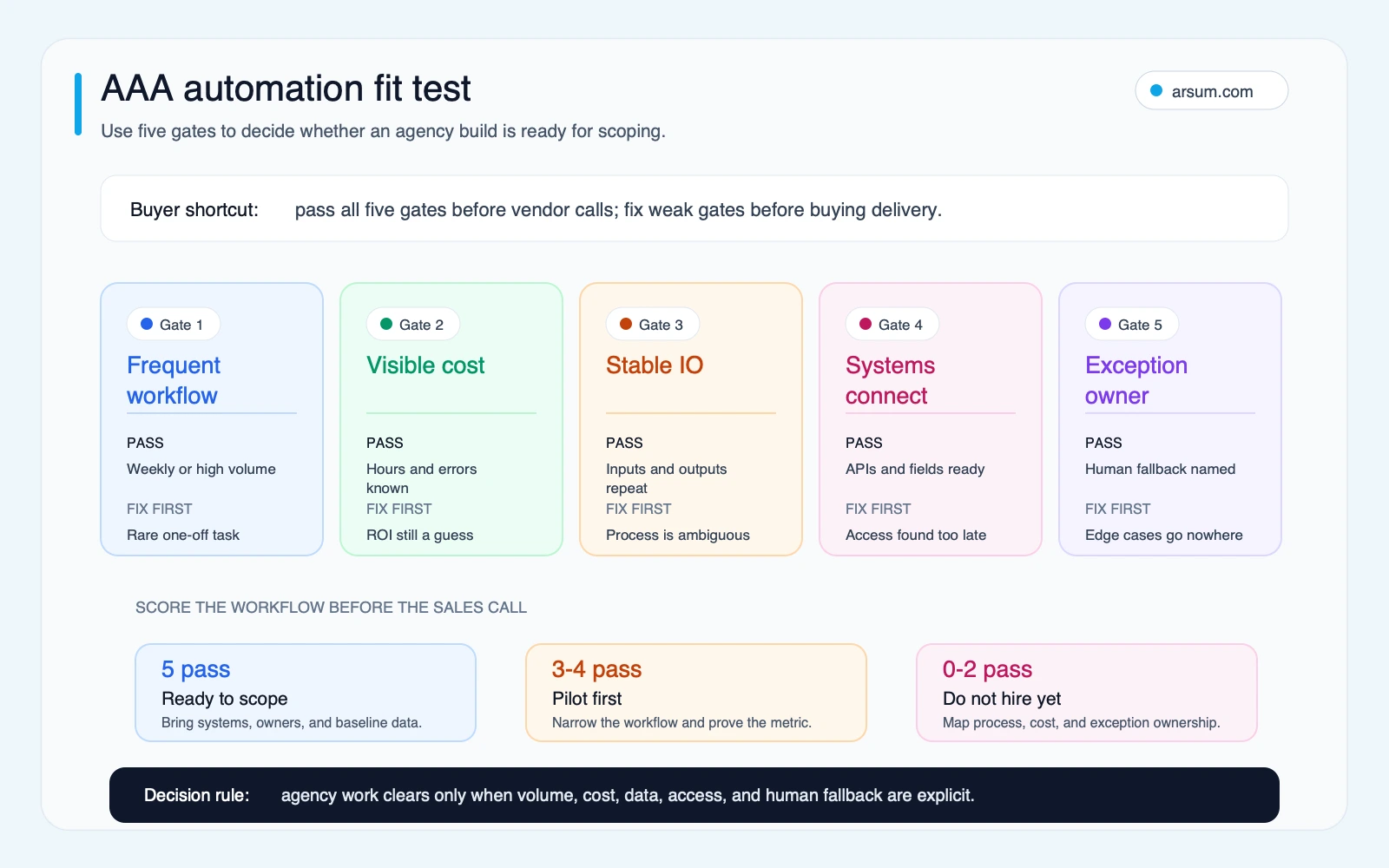
A “yes” on technical capability is not enough. The autonomy level should decline as failure cost rises or reversibility falls. For example, extracting fields from a vendor invoice into a review queue can be a suitable assisted workflow. Automatically paying an invoice or changing a supplier record without approval is a different risk class.
Disqualifying conditions
Do not start with an agency build if several of these are true:
- The process changes week to week and no one can state the current rule set.
- The team cannot access the source systems or obtain approved credentials.
- The expected outcome cannot be measured against a baseline.
- A wrong outcome could create financial, legal, customer, or safety harm and there is no approval gate.
- The workflow happens infrequently enough that the learning and support burden outweighs the likely value.
- Stakeholders expect the agency to “own AI” without naming an internal process owner.
These are not permanent noes. They are signs that workflow definition, governance, or product selection must happen before implementation.
A worked pilot: invoice intake with controlled review
Consider invoice intake as an illustrative planning example, not a claimed client result. The goal is to test whether an agency can reduce manual handling without weakening accounts-payable controls.
Normal path
- A supplier invoice reaches a designated inbox or document store.
- The workflow records the original file and run identifier.
- AI-assisted extraction proposes fields such as supplier, invoice number, date, line items, amount, and purchase-order reference.
- Deterministic checks validate required fields, duplicate risk, supplier match, arithmetic, and policy rules.
- High-confidence, valid cases are sent to the accounting system as drafts or review-ready records.
- A designated AP reviewer approves the record under the company’s existing authority rules.
The automation prepares and routes work. It does not authorize payment.
Exception path and evidence retained
The workflow should route an item to human review when:
- A required field is absent or inconsistent.
- The supplier or purchase order cannot be matched.
- A duplicate check flags a possible conflict.
- The extracted total does not reconcile.
- The document is unreadable or outside the expected format.
- A policy rule requires a specific approver.
For each run, retain the source-document reference, extraction output, validation result, route taken, reviewer action, timestamps, and error details according to the company’s retention policy. This is what makes later audits, corrections, and incident analysis possible.
Pilot scorecard
Set the scorecard before building. The following inputs are deliberately adjustable.
| Measure | Illustrative planning assumption | Owner | Review cadence |
|---|---|---|---|
| Monthly invoice volume | 400 invoices | AP manager | Weekly during pilot |
| Baseline handling time | 12 minutes per invoice | AP manager | Weekly during pilot |
| Baseline exception/rework rate | Measured from a sample before launch | AP manager | Weekly during pilot |
| Pilot scope | One entity, one inbox, selected suppliers | Finance systems owner | Daily for first week |
| Quality target | No increase in approved-record correction rate versus baseline | AP manager | Weekly |
| Automation target | A buyer-defined share of invoices reaches review-ready status without manual rekeying | AP manager | Weekly |
| Technical owner | Named agency lead and internal systems owner | Both | Per incident |
| Stop condition | Material control failure, unapproved system action, or quality below the pre-agreed threshold | Finance sponsor | Immediate |
| Rollback | Disable the workflow and return intake to the existing manual queue | Internal systems owner | Tested before launch |
A simple illustrative break-even calculation should include all inputs:
monthly value = (monthly volume × minutes avoided ÷ 60 × fully loaded hourly handling cost) − monthly tool and support cost
For example, if a pilot validates that 400 invoices each avoid 6 minutes of rekeying, and the buyer uses a planning labor-cost assumption of $35 per hour, the gross monthly capacity value is:
400 × 6 ÷ 60 × $35 = $1,400
That is not savings, ROI, or a forecast. It excludes implementation cost, review time, exceptions, tool usage, internal change effort, and any quality cost. It is the starting point for deciding what must be true for the pilot to justify expansion.
💡 Arsum builds custom AI automation solutions tailored to your business needs.
Get a Free Consultation →A workflow assessment should produce this baseline, the control design, the implementation boundary, and a written go/no-go recommendation—not merely a proposal for an AI tool.
How to evaluate an agency against SaaS, engineering, and internal teams
The agency model is one route among several. The difference is primarily scope and ownership, not whether one option uses AI and another does not.
| Option | Best fit | Buyer should verify |
|---|---|---|
| AI automation agency | Defined cross-system workflow that needs implementation and operational controls | Workflow mapping, integrations, testing, support, and handoff |
| SaaS product | Standard process with a mature product and acceptable configuration | Feature coverage, data model, permissions, exportability, and vendor support |
| Software development partner | Product-grade requirements, custom UX, deep integrations, scale, or proprietary logic | Architecture, security, engineering ownership, maintenance, and roadmap |
| Internal team | Capability and capacity already exist, with strong process ownership | Opportunity cost, systems access, testing discipline, and post-launch support |
| Freelancer | Narrow, low-consequence task with clear requirements | Availability, documentation, credential ownership, and escalation coverage |
A custom build may be necessary even where the core workflow uses n8n, Make, or an LLM API. Conversely, a mature SaaS product may be preferable even if an agency can assemble a similar solution. The decision turns on workflow specificity, integration difficulty, control requirements, and who must operate the result.
If you are choosing between an implementation partner and a custom engineering engagement, compare this with AI automation agency vs. AI development firm and hiring an AI developer versus an agency.
The vendor scorecard: questions that expose delivery depth
Ask every shortlisted agency for a written response to these items.
| Evaluation area | Required answer |
|---|---|
| Current-state workflow | A step-by-step map including the normal path, handoffs, and exceptions |
| Success metric | Baseline, target, measurement method, and pre-agreed review date |
| Integration constraints | Systems, APIs, rate limits, data formats, permissions, and dependencies |
| Data lineage | Where data enters, where it is stored, where it is sent, and how outputs are linked to source records |
| Credentials | Whether accounts belong to the client, how access is limited, and how rotation works |
| Test set | Representative normal and ugly cases, expected results, and approval criteria |
| Confidence thresholds | What signals trigger review, what can proceed, and what may never act automatically |
| Monitoring | Run logs, failure alerts, usage/cost visibility, and the named recipient of alerts |
| Incident response | Who investigates, expected communication path, and when the workflow is disabled |
| Handoff | Documentation, workflow exports, prompts/configuration, SOPs, and training |
| Exit terms | What the client receives if support ends and how the workflow can be transferred or retired |
A strong vendor will sometimes say that a requested automation should remain assisted rather than autonomous. That is useful judgment, especially in finance, compliance, customer commitments, and irreversible operations.
For a related framework on safer AI workflow design, read agentic AI workflow automation and AI agent security.
What the operating model should include after launch
The first launch is not the finish line. Automation changes when source systems, forms, business rules, model behavior, and access permissions change.
At minimum, agree on:
- Internal process owner: accountable for business rules and acceptance decisions.
- Technical owner: accountable for credentials, integrations, configuration, and rollout changes.
- Exception queue owner: accountable for work that cannot safely proceed.
- Review schedule: a defined cadence for quality, exceptions, run volume, tool usage, and unresolved issues.
- Change process: how prompts, routes, rules, and fields are requested, tested, approved, and released.
- Fallback plan: a documented manual procedure and a tested way to disable the workflow.
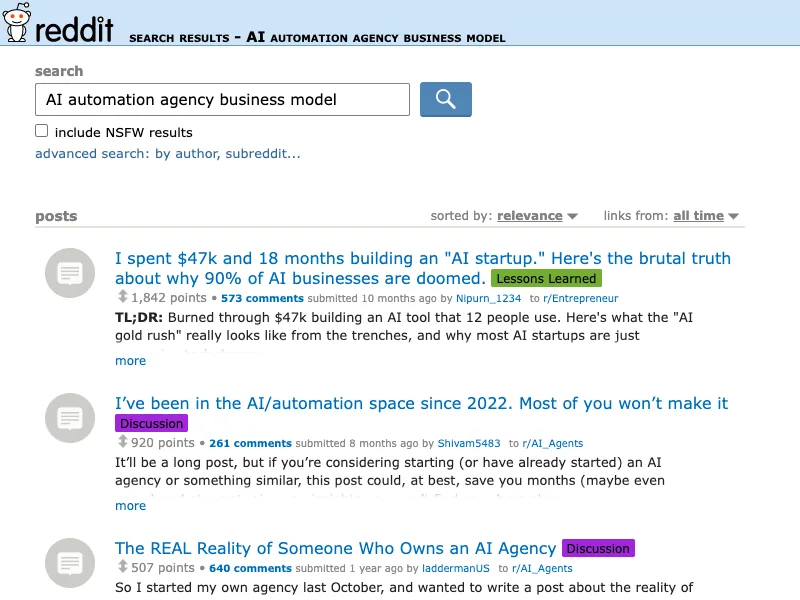
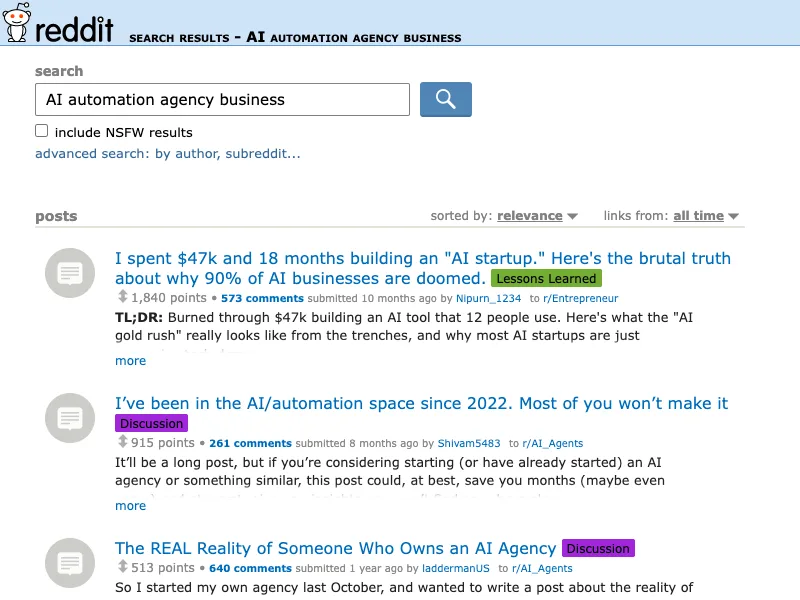
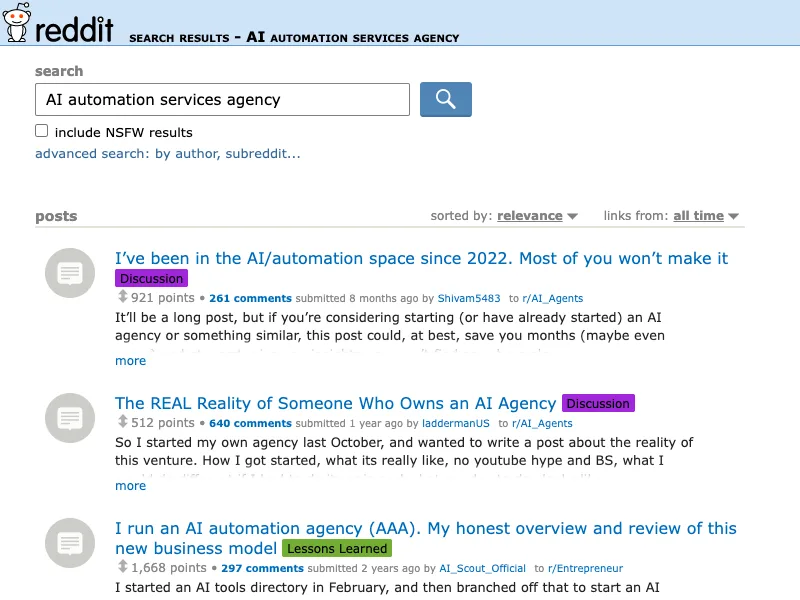
Public practitioner discussions support this as a qualitative concern, not a market statistic. One Reddit discussion describes clients leaving when automation value was difficult to see; another centers on ongoing workflow pricing and costs. Those signals suggest that buyers should demand visible run logs, before/after measures, and explicit treatment of maintenance and usage costs. See the client-value discussion and n8n pricing-and-cost discussion. They are practitioner context, not proof of typical outcomes.
Common failure modes and their controls
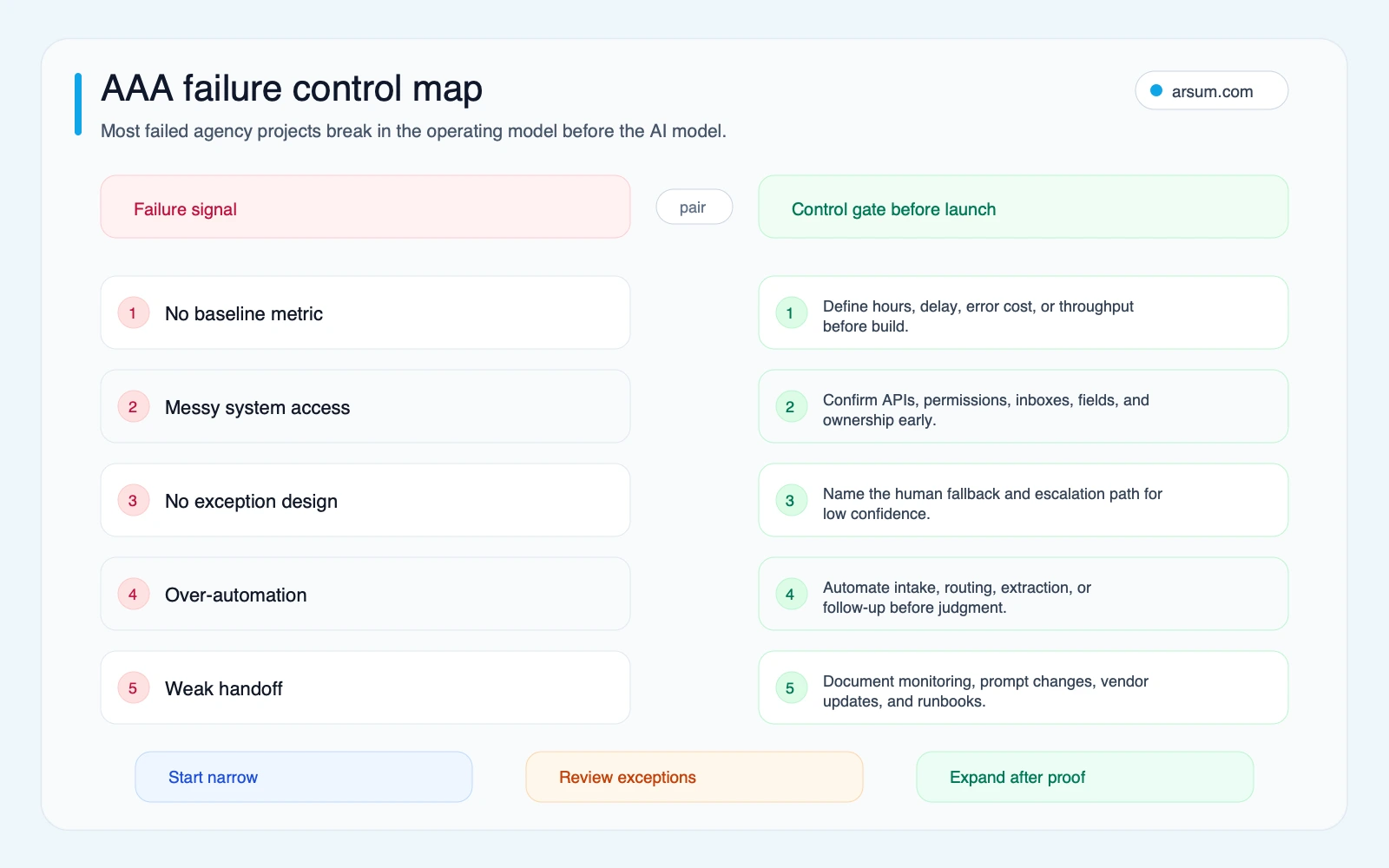
Most failures are not model failures alone. They are gaps in the operating design.
| Failure mode | Control to require |
|---|---|
| No baseline, so value cannot be evaluated | Record volume, handling time, rework, delays, and quality before launch |
| A demo is mistaken for a production workflow | Test representative cases, integrations, permissions, and rollback before go-live |
| Low-confidence outputs proceed silently | Use validation and a human exception queue |
| Credentials are controlled only by the vendor | Use client-owned accounts, least privilege, and documented rotation |
| Tool or API costs surprise the business | Separate implementation, support, and usage costs; review them regularly |
| A workflow breaks after a source-system change | Monitor failures, assign alerts, and define incident ownership |
| Nobody knows how to alter or retire the workflow | Require handoff materials, change controls, and exit terms |
The same principle applies across use cases. In accounts receivable automation, routing and follow-up can be automated while credit, dispute, and customer-relationship decisions remain accountable to people. In AI automation for compliance officers, evidence handling and review design matter more than a claim of full autonomy.
How agencies structure commercial work
Buyers should evaluate commercial structure by ownership horizon rather than by headline price.
| Commercial layer | What it should cover |
|---|---|
| Discovery | Workflow map, baseline, scope boundary, systems assessment, control design, and pilot criteria |
| Build | The agreed workflow, integrations, tests, documentation, and launch preparation |
| Support | Monitoring, break/fix work, controlled changes, and routine operational review |
| Usage | Clearly identified platform, hosting, API, or other consumption costs |
| Expansion | A separate decision after the first workflow meets its acceptance criteria |
Avoid a single vague “AI automation” fee that obscures whether discovery, build, support, and usage are included. Ask what is excluded, what happens when requirements change, who pays for third-party tools, and what you retain at handoff.
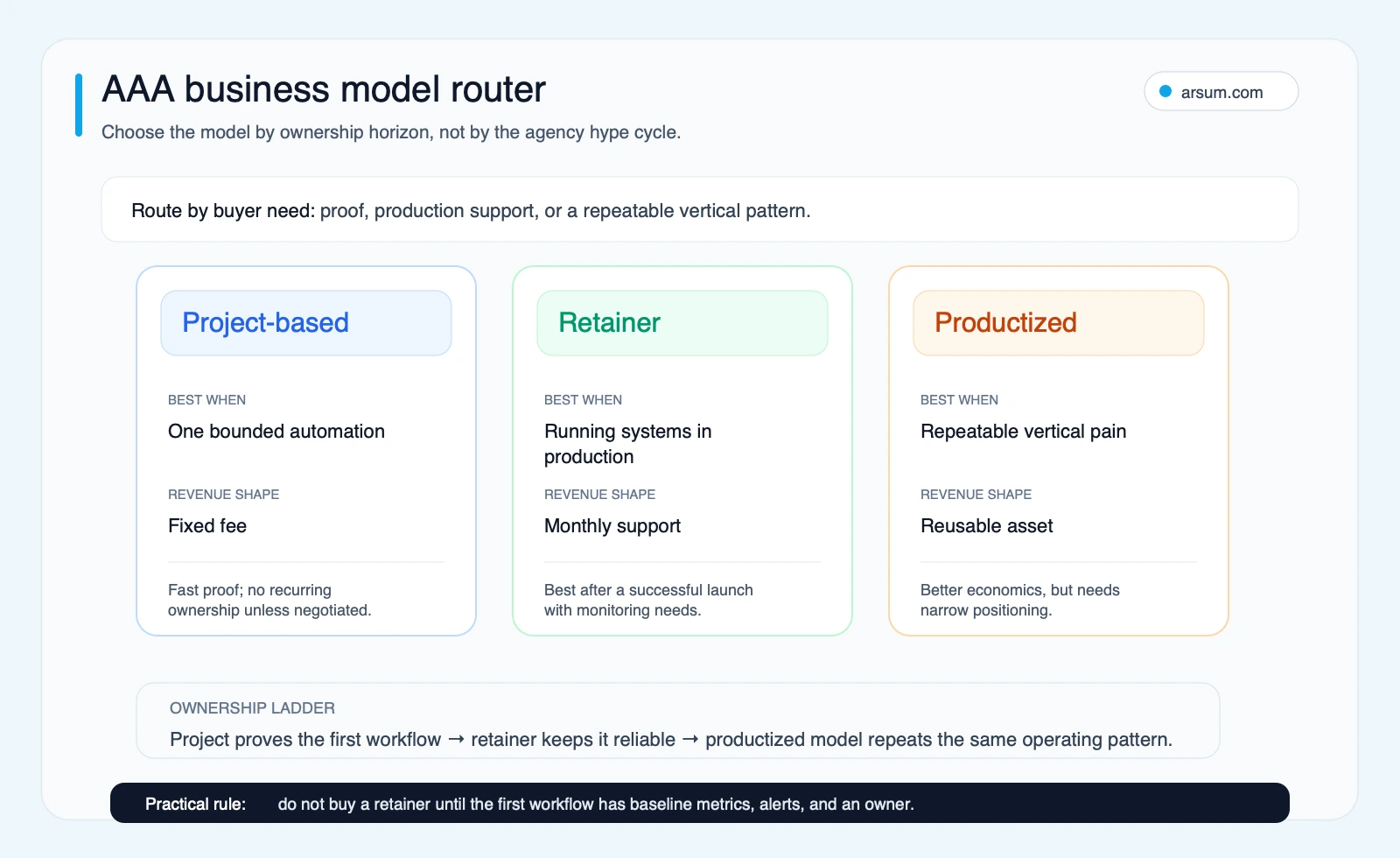
The familiar project, retainer, and productized-agency models matter more to service operators than buyers. For buyers, the relevant distinction is simpler: are you paying for a one-time implementation, ongoing production ownership, or a standard product? Only buy ongoing support if it corresponds to a real need for monitoring, changes, and accountability.
A practical next step
An AI automation agency is a good fit when you have a bounded process, measurable baseline, usable systems, and a named person who can own exceptions. It is a poor fit when the project is still an abstract AI ambition, a standard product already solves the problem, or the business cannot authorize safe operation.
Before signing, ask the agency to turn one workflow into a pilot charter with:
- Current baseline and a target metric
- System and data map
- Normal path and exception queue
- Named approval and rollback owners
- Test cases and acceptance threshold
- Run-log and monitoring plan
- Go/no-go review date
- Handoff and exit terms
Work With Arsum
We help businesses implement AI automation that actually works. Custom solutions, not cookie-cutter templates.
Learn more →Methodology and limitations
This is an editorial buyer framework, not a proprietary performance dataset or a claim about typical agency outcomes. Official workflow-tool documentation was reviewed to support the description of orchestration capabilities: n8n documentation, n8n’s AI Workflow Builder documentation, and Make. Community material is used only as qualitative evidence of recurring questions around visibility, pricing, maintenance, and delivery—not as statistical proof.
No page-level market-size, cost, delivery-time, savings, adoption, or accuracy benchmark is asserted here. Any financial model should use the buyer’s own volume, handling-time, labor-cost, implementation-cost, quality-cost, and tool-usage inputs.
Ready to Automate Your Business?
Stop wasting time on repetitive tasks. Let AI handle the busywork while you focus on growth.
Schedule a Free Strategy Call →Written by:Arsum editorial team
- Reviewed by
- Arsum editorial team
- Published
- March 23, 2026
- Updated
- July 7, 2026
- How this was produced
- Arsum uses research packs, source checks, and human editorial review to prepare and update blog articles. Editors are responsible for the final page.
- Source policy
- Sources are linked in the article when used. Methodology and source notes are included on higher-risk or high-visibility pages and are being rolled out across the archive. Editorial policy.
- Why this page exists
- Help B2B operators evaluate AI automation, implementation scope, cost, risk, and build-vs-buy decisions with practical context.