A youtube automation ai business 2025 can be a real business only when AI supports an owned content operation: a defined audience and offer, source-backed editorial work, rights and disclosure controls, human approval, and a measurable path from videos to revenue or qualified demand. If the plan is simply to publish inexpensive faceless videos and hope for ad revenue, do not fund it yet.
Youtube Automation AI Business 2025: Practical Guide
Explore youtube automation ai business 2025: compare workflow fit, costs, risks, evidence, and practical next steps before you build, buy, or hire.
Table of Contents
- What most guides miss: automation is not the business model
- Start with channel viability, not a tool stack
- What AI can automate—and what must remain owned
- YouTube policy risk belongs in the workflow
- A worked 30-day pilot scorecard
- Workflow demo versus a channel operating system
- Build, buy, or use a hybrid model
- Failure modes that justify stopping
- The 30-day decision sequence
- Method and source note
What most guides miss: automation is not the business model
Most guides start with tools for scripts, voiceovers, visuals, editing, thumbnails, and scheduling. Those tools can reduce production effort. They do not establish that a channel has an audience, an original point of view, permission to use its assets, or a commercial reason to exist.
The decision rule is simple: automate repeatable production steps only after you can explain the value created at each human decision point.
For a B2B company, that value may be qualified site visits, demo requests, newsletter subscribers, product education, or sales enablement. For an operator building a media channel, it may be affiliate, sponsor, membership, or product-funnel value. Ad revenue can be part of the model, but it should not be the only reason the workflow exists.
This also separates YouTube from internal automation. A channel is an audience and distribution bet; internal AI workflow automation is typically a capacity, speed, or error-reduction bet with a more visible operating baseline. Treating both as “AI automation” without distinguishing their economics leads to poor investment decisions.
Start with channel viability, not a tool stack
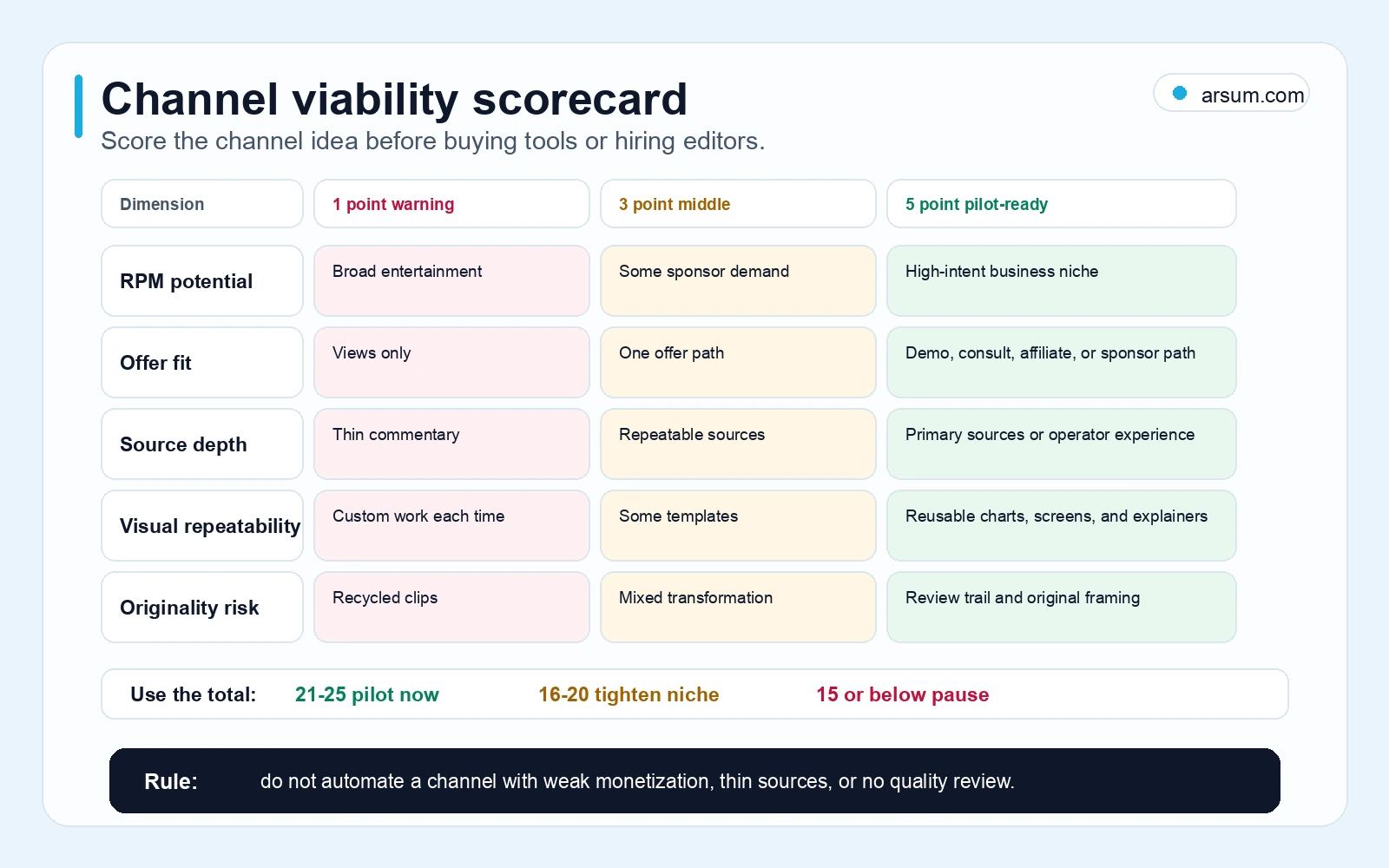
Use this editorial decision framework before paying for tools, contractors, or a large content calendar. Score each dimension from 1 to 5. The score is not research or a prediction; it is a way to expose the assumptions that need an owner.
| Dimension | 1: weak fit | 3: workable but unproven | 5: strong pilot fit |
|---|---|---|---|
| Commercial path | Views are the only goal | One possible offer or affiliate path | Clear product, service, sponsor, or buyer journey |
| Topic depth | A few vague ideas | Some repeatable themes | At least 30 source-backed buyer questions or angles |
| Source advantage | Generic summaries | Mix of public and internal knowledge | Primary sources, product expertise, or credible operator insight |
| Production repeatability | Every video is custom | Some reusable formats | Repeatable briefs, visual templates, and review gates |
| Originality and rights control | Recycled clips or generic synthesis | Controls exist but are informal | Clear transformation, rights log, and approval evidence |
| Owner capacity | No weekly owner | Owner is shared and inconsistent | Named owner can review, decide, and maintain the backlog |
A channel is ready for a narrow pilot when its commercial path, source advantage, and review ownership are all at least “workable.” A high total score does not rescue a weak score in those three areas. A channel that cannot verify claims or explain where its assets came from is not ready to scale.
Disqualifying conditions
Pause or redesign the project when any of these apply:
- No one can approve factual, legal, medical, financial, or product claims before publishing.
- The plan depends on copied clips, lightly rewritten scripts, or a generic voice and visual package with no editorial transformation.
- The team cannot identify an offer, buyer journey, or other business value beyond views.
- The channel has no source of subject-matter advantage and will compete only on publishing volume.
- The owner cannot sustain a weekly review and analytics cadence.
- The expected benefit requires full autonomy over a high-reputation or high-failure-cost decision.
AI capability is not authorization. The higher the cost of being wrong, the more review, evidence retention, and human approval the workflow needs.
What AI can automate—and what must remain owned
The useful boundary is not “AI versus human.” It is production assistance versus accountable decisions.
| Workflow stage | AI may assist with | Human owner must decide |
|---|---|---|
| Audience research | Topic clustering, competitor summaries, draft questions | Whether the audience has commercial value and a credible need |
| Briefing | Outline options, source organization, title variations | Editorial thesis, sources, claim boundaries, and angle |
| Script drafting | First drafts, structure, transcript cleanup | Accuracy, voice, examples, citations, and final claims |
| Voice and visuals | Draft narration, rough cuts, captions, asset ideas | Rights, pacing, disclosure, transformation, and quality |
| Packaging | Thumbnail concepts, descriptions, metadata drafts | The promise made to viewers and whether it is truthful |
| Analytics | Performance summaries and pattern detection | What to repeat, revise, stop, and connect to revenue |
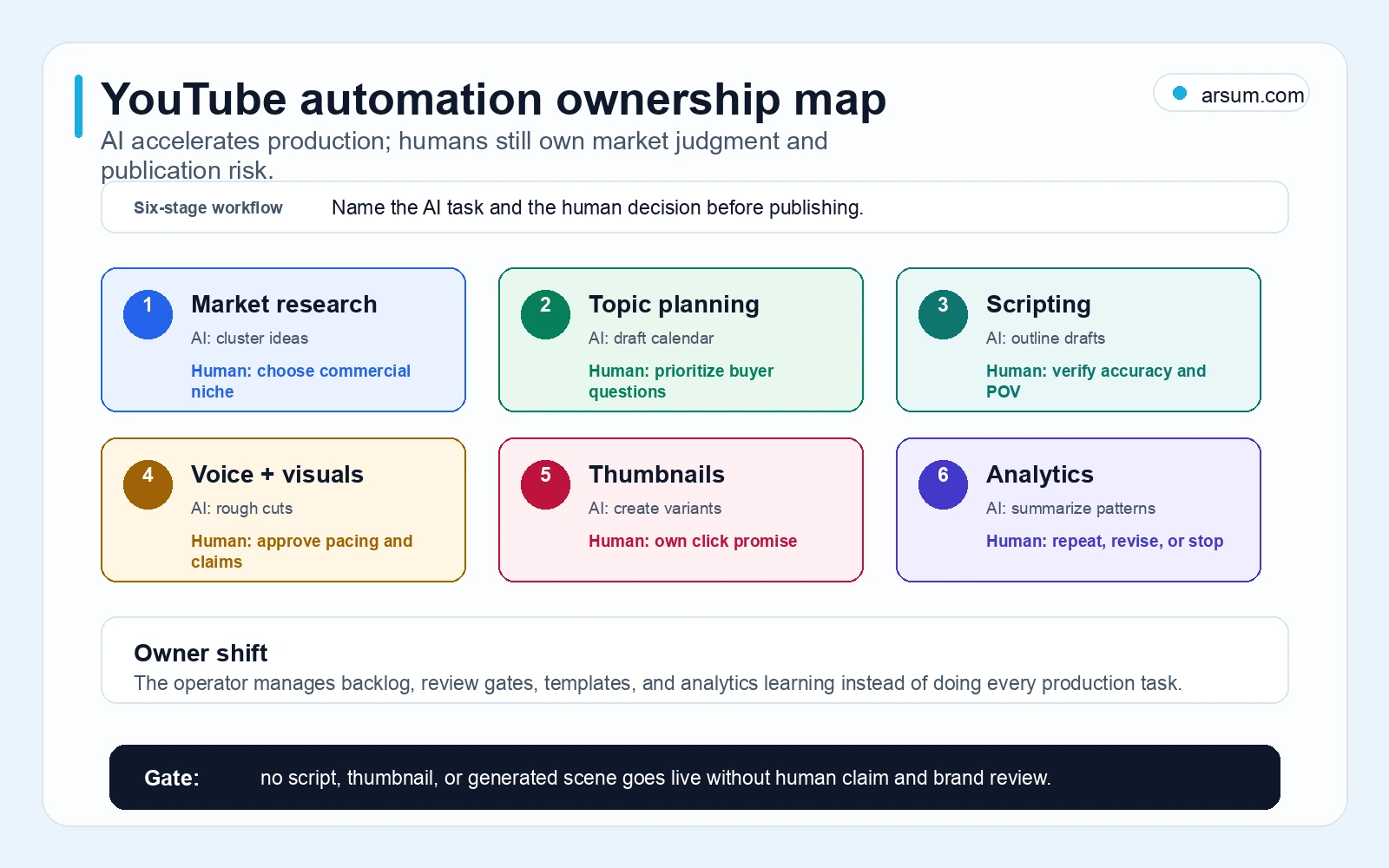
This is why “fully automated channel” is usually a misleading buying category. AI can accelerate first passes. The scarce work is selecting worthwhile topics, retaining a point of view, approving claims, preserving audience trust, and using results to choose the next batch.
For example, a consultancy could turn recurring client questions into videos on implementation choices, risk controls, and common mistakes. AI can assemble a first brief from approved source material. A subject-matter owner still decides whether the advice applies, whether an example exposes confidential information, and whether the call to action matches the viewer’s problem. This is closer to a managed AI content automation business process than a one-click publishing system.
YouTube policy risk belongs in the workflow
Policy should be a production requirement, not a cleanup task after a channel starts growing.
YouTube’s monetization policies focus on original and authentic content; channel review can consider the channel as a whole, including its videos and how the content demonstrates meaningful creator contribution. Read the current YouTube channel monetization policies before designing the format.
YouTube also requires disclosure in specified cases for realistic altered or synthetic content that a viewer could mistake for a real person, place, scene, or event. The current disclosure guidance is available in YouTube Help, with additional context in YouTube’s announcement on altered or synthetic content. Disclosure does not replace accuracy, rights clearance, or editorial judgment.
YouTube Policy Risk Box
| Workflow step | Risk | Required control | Accountable owner |
|---|---|---|---|
| Topic selection | Trend chasing without an original angle | Brief includes an editorial thesis and source map | Channel owner |
| Script generation | Unsupported, stale, or generic claims | Source notes, fact check, and approval record | Editor or subject reviewer |
| Voice and visuals | Ambiguous synthetic media or untracked rights | Asset ledger, disclosure check, and final visual review | Producer |
| Clip use | Reused or minimally transformed material | License or use rationale, transformation notes, commentary review | Producer |
| Upload and packaging | Misleading title, description, or commercial promise | Title-description alignment and final publishing checklist | Channel manager |
Keep a lightweight evidence log for every published video: brief version, primary sources, reviewer, asset-rights status, disclosure decision, final title, publish date, and corrections. This is not bureaucracy for its own sake. It makes it possible to trace a complaint, correct a claim, and show that the channel has an editorial process.
YouTube’s general creator policies and guidelines also make clear that monetization depends on meeting the relevant program and policy requirements, not just accumulating audience metrics. Check the current YouTube Partner Program eligibility route in YouTube’s official materials when making a monetization plan; requirements and available paths can change by location and program status.
A worked 30-day pilot scorecard
Do not begin with a six-month publishing commitment. Run a controlled pilot in one topic cluster, with enough structure to decide whether the workflow is viable.
The following is an illustrative planning model, not a claim about typical results. Replace every baseline and threshold with your own current capacity, niche, and commercial target.
| Field | Illustrative pilot definition |
|---|---|
| Audience and offer | One defined buyer audience; one relevant next step, such as an assessment, demo, newsletter, or affiliate offer |
| Topic cluster | Six videos answering connected buyer questions from one source-backed backlog |
| Baseline production time | Record the current hours required to brief, draft, produce, review, publish, and revise one video |
| Target cadence | Publish the agreed six videos during the pilot only if review quality holds |
| Quality threshold | No uncorrected material claim errors after approval; every video has a completed source and rights record |
| Review threshold | Named reviewer returns approval, revision, or rejection within the team’s agreed service level |
| Audience signals | Track retention by topic cluster, comments that reveal intent, qualified clicks, and relevant subscriber response |
| Commercial signals | Track landing-page visits, form starts, qualified inquiries, affiliate clicks, or another pre-defined value signal |
| Review cost | Record reviewer hours and revision rounds; this is part of unit economics, not overhead to ignore |
| Evidence retention | Preserve brief, sources, reviewer decision, disclosure decision, and asset ledger for each video |
| Owner | Channel owner is accountable for the weekly decision; producer owns production controls; reviewer owns claim approval |
| Review cadence | Weekly operating review with a written scale, revise, or stop decision |
A workable stop rule might be: stop if the team cannot meet the source-and-rights log requirement, cannot obtain timely review, or cannot produce a consistent format without accumulating unresolved claim corrections. Revise if the workflow ships cleanly but the topic cluster produces weak audience or commercial signals. Scale only when the production standard is stable and the next topic cluster has a documented reason to exist.
Pilot arithmetic: make the assumptions visible
Use a fill-in model rather than borrowed RPM, tool-cost, or labor ranges:
| Input | Your value |
|---|---|
| Videos planned | ____ |
| Hours per video: research and script | ____ |
| Hours per video: review and revision | ____ |
| Hours per video: production and upload | ____ |
| Internal hourly cost or contractor cost | ____ |
| Tool and asset costs for the pilot | ____ |
| Rights, licensing, or review reserve | ____ |
| Qualified actions expected to justify continuation | ____ |
| Estimated gross-margin value per qualified action, if applicable | ____ |
Illustrative formula:
Pilot cost = (total production and review hours × fully loaded hourly cost) + tools + assets + rights/review reserve
Commercial contribution = attributable qualified actions × estimated gross-margin value per action
If attribution is immature, do not pretend the channel has proven ROI. Use the pilot to establish whether you can publish safely, whether the audience engages with the right topics, and whether the next measurement step is worth funding.
This is the point at which an implementation partner can be useful. A scoped workflow assessment should cover niche economics, source governance, review controls, evidence retention, production design, and a build-versus-buy recommendation—not merely recommend more AI tools.
💡 Arsum builds custom AI automation solutions tailored to your business needs.
Get a Free Consultation →Workflow demo versus a channel operating system
| Area | Workflow demo | Channel operating system |
|---|---|---|
| Topic selection | Prompts generate popular ideas | Backlog reflects buyer questions, source depth, and a commercial thesis |
| Scripting | One model output becomes a video | Brief, source notes, human rewrite, and claim approval precede production |
| Visuals | Generic stock or reusable clips | Asset rights, transformation, brand standards, and disclosure are reviewed |
| Publishing | Upload is the finish line | Packaging, comments, retention, and conversion inform the next batch |
| Scaling | Increase volume | Increase volume only when quality controls and owners can keep up |
| Reporting | Views and subscribers only | Production cost, review cost, quality, retention, and commercial actions are reviewed together |
The maturity path is straightforward:
- AI supports ideas and rough outlines.
- AI assists with research briefs and competitor scans.
- AI drafts, while humans rewrite and fact-check.
- Production uses templates, but rights, policy, and QA gates are explicit.
- The channel operates with a maintained backlog, analytics review, policy log, style guide, and human approval before publication.
A team does not need to reach the final stage before it begins. It should not claim scale readiness before the relevant controls exist.
Build, buy, or use a hybrid model
Choose the ownership model based on the constraint, not the appeal of outsourcing.
| Situation | Likely fit | Reason |
|---|---|---|
| Deep internal expertise, weak production process | Hybrid | Keep strategy and approvals in-house; obtain workflow or production support |
| No owner for weekly decisions | Pause or assign ownership first | An agency cannot supply internal judgment about priorities and claims |
| Technical, regulated, or reputation-sensitive topics | In-house-led | Final review authority should remain close to accountable experts |
| Need to test a format with controlled scope | Consultant-assisted pilot | Useful for workflow design without committing to a full production machine |
| Existing content team and stable approval process | In-house | AI may improve throughput without changing accountability |
For one channel, prove the lean editorial workflow before buying a broad automation platform. For a multi-channel operator, invest in source governance, style systems, rights tracking, and reporting before adding volume. For an agency, sell the operating controls and quality process, not a promise of generic AI output.
If you are deciding whether the core need is a content workflow, an agent system, or operational automation, compare the distinction between agentic AI and generative AI and the practical patterns in AI agent architecture. The relevant question is where a system may act independently and where it must hand work back to a named person.
Failure modes that justify stopping
The common failures are operational rather than technical:
- The channel targets broad attention but has no commercial thesis.
- AI drafts are published with no source, claim, or brand review.
- Production volume increases before the team learns from retention, comments, and conversion behavior.
- A generic CTA is attached to education that does not lead naturally to the offer.
- Rights and disclosure checks are inconsistent because they were never designed into the workflow.
- The channel owner disappears, leaving drafts, approvals, and analytics without a decision-maker.
- Contractors are measured on output count rather than quality, correction rate, and policy evidence.
Community discussions about “cash cow” channels and one-click automation are useful as qualitative evidence of buyer skepticism, not proof of a market-wide outcome. The practical lesson is still clear: a channel earns trust through original value and consistent editorial control, not through its tool stack.
For teams that want measurable automation benefits sooner, it may be more rational to prioritize an internal process such as accounts receivable automation or a revenue-operations workflow. A YouTube channel can still be valuable, but it should be funded as a controlled audience-building experiment with slower and less certain feedback.
The 30-day decision sequence
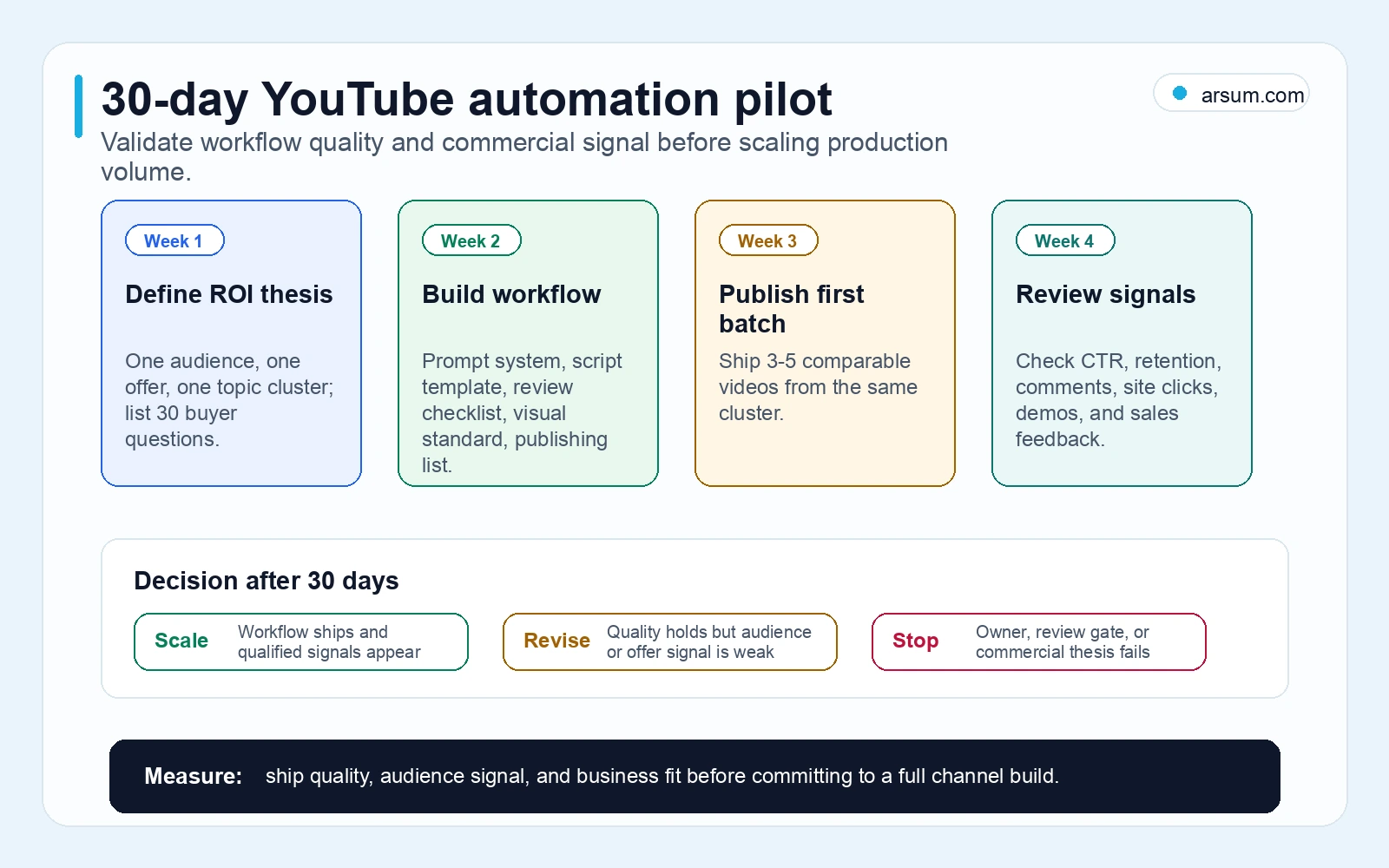
Week 1 — define the business case. Select one audience, offer, and topic cluster. Build the source map and assign the channel owner, producer, and reviewer. Record your current production baseline.
Week 2 — build one repeatable format. Create the brief template, script checklist, source log, rights ledger, disclosure decision field, visual standard, and publishing checklist. Produce one test video and resolve every approval bottleneck.
Week 3 — publish the controlled batch. Publish the planned videos only when their evidence records are complete. Do not add unrelated topics merely to increase volume.
Week 4 — conduct the operating review. Review production hours, revision burden, claim corrections, rights-log completion, review turnaround, retention by topic cluster, qualified clicks, and commercial response. Make one documented decision: scale, revise, or stop.
Method and source note
This guide uses a decision-framework route rather than a proprietary dataset. The policy-dependent guidance is based on official YouTube Help, YouTube creator policy, and YouTube AI-disclosure resources linked above. Community discussions are used only as qualitative signals about skepticism and failure modes, not as performance statistics.
Your own economics will vary by geography, niche, cadence, production standard, asset-rights needs, whether labor is in-house or contracted, and the value of the offer behind the channel. Record those inputs before approving a scale decision.
A YouTube automation AI business is worth pursuing when the channel can repeatedly create original, reviewable content for an audience connected to a real commercial outcome. Build the controls first, run a narrow pilot, and scale only after quality, ownership, and evidence hold under real production.
Ready to Automate Your Business?
Stop wasting time on repetitive tasks. Let AI handle the busywork while you focus on growth.
Schedule a Free Strategy Call →Written by:Arsum editorial team
- Reviewed by
- Arsum editorial team
- Published
- April 1, 2026
- Updated
- June 19, 2026
- How this was produced
- Arsum uses research packs, source checks, and human editorial review to prepare and update blog articles. Editors are responsible for the final page.
- Source policy
- Sources are linked in the article when used. Methodology and source notes are included on higher-risk or high-visibility pages and are being rolled out across the archive. Editorial policy.
- Why this page exists
- Help B2B operators evaluate AI automation, implementation scope, cost, risk, and build-vs-buy decisions with practical context.