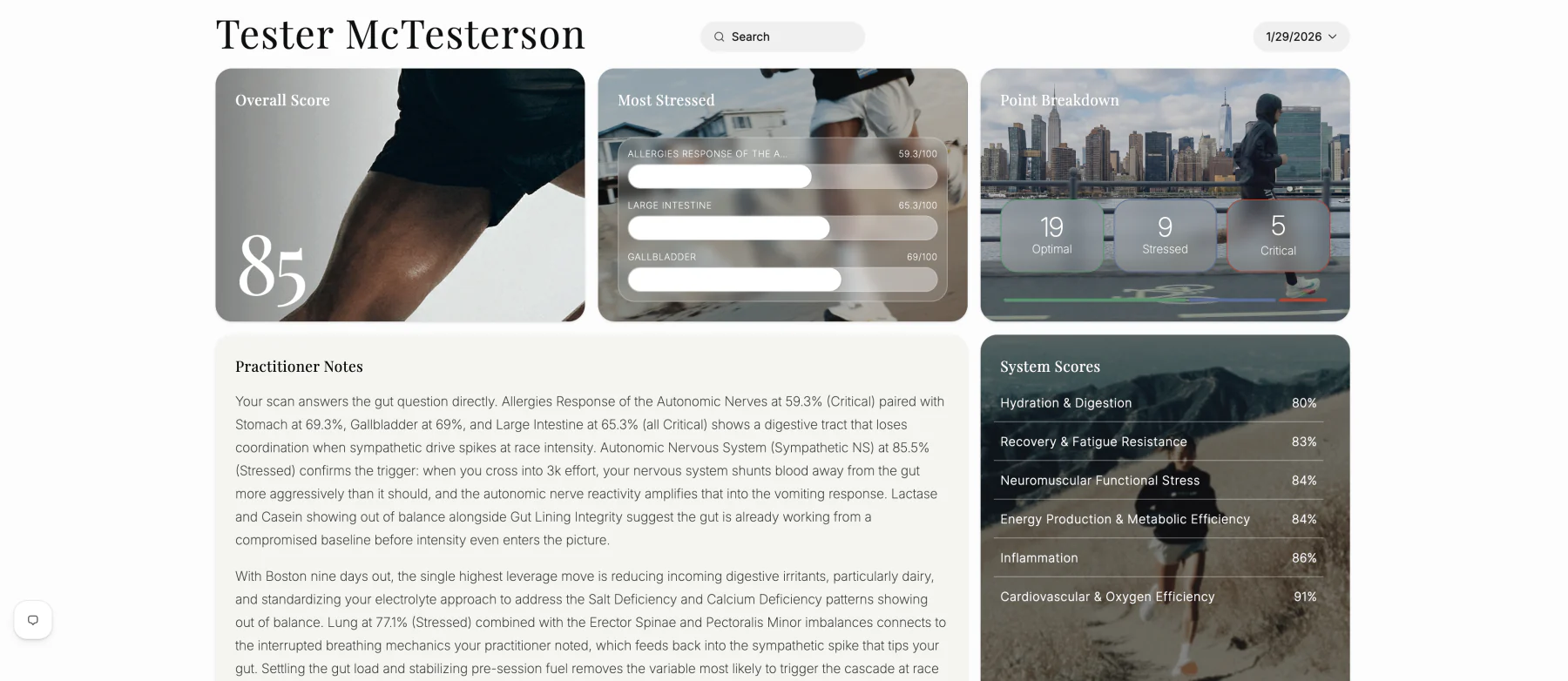
Keep purchase, account, and results in one journey
Attuned Health already operated a Shopify-based business serving wellness and endurance customers. Purchasing a testing product was only the first part of the experience. Customers also needed a place to receive their results, understand the different sections, and return to earlier scans through their existing account.
The client approached Arsum after an earlier working relationship on ProjectMe. The initial brief focused on implementing new designs for customer profiles and scan-results pages. Arsum’s founder describes a close, iterative collaboration: implementing the client’s visual direction while suggesting how the product could work better. That meant connecting the interface to the information and processes behind it.
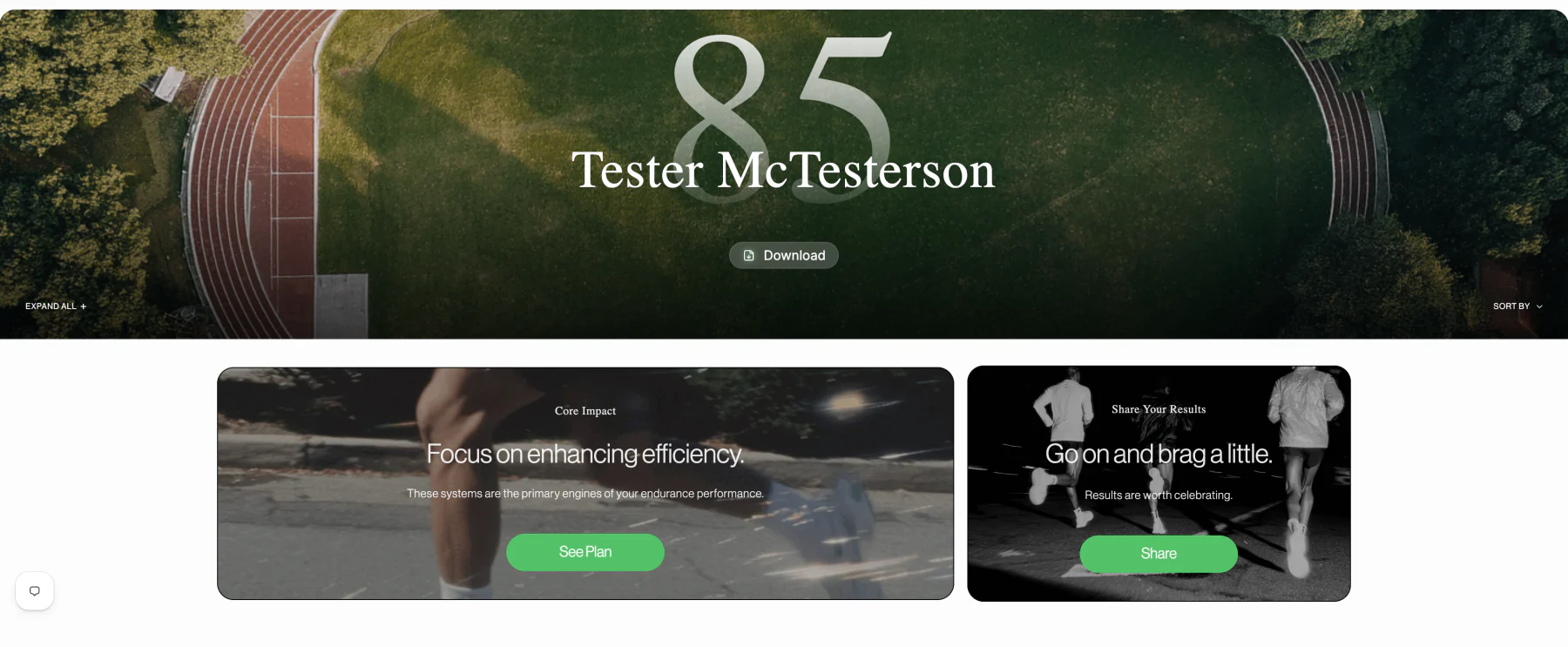
The product decision was to keep that experience on the main Shopify-powered site. Sending customers to a disconnected portal would have separated the purchase from the product they were buying. Arsum built a custom application around the existing journey, while retaining the client’s storefront, design direction, and product definitions.
“You buy a product and you get it delivered on the same domain, on the same site.”
 View full size
 The application around the report
Arsum implemented the customer profile and scan-results interfaces in React, integrated with Shopify and Shopify App Bridge. A Node.js and Express application layer, SQL storage, and AWS infrastructure support the workflow behind the customer experience. The interface and the back end were treated as parts of the same product.
The application brings together Shopify order information, customer-submitted form information, and laboratory results. Laboratory results remain the source for measured test data; AI is used to prepare structured report content around those inputs. The report experience includes summaries, explanatory text, charts, and scan-specific sections rather than a single block of generated prose.
Arsum’s implementation scope extended to the AI workflow, the review and regeneration path, automated tests, deployment procedures, and ongoing production support. Attuned Health and its partners supplied the business, visual direction, testing process, source information, and domain knowledge. The work connected those inputs into a customer-facing application; it did not replace the laboratory process or invent the underlying health interpretation rules.
From source inputs to approved results
Source inputs
Shopify orders · customer forms · laboratory results
Prepare & generate
Application data preparation and multi-stage AI report generation
Assemble the report
Structured summaries, explanations, charts, and scan sections
Practitioner review
Review the result; approve it or request regeneration
Customer access
Approved results in the Shopify-linked account experience
Generate a long report in bounded stages
Two challenges shaped the build: integrating the application into Shopify and generating long reports within model output limits. The founder recalls reports with many sections, each requiring usable content. Some sections explain information, others summarize it, and others supply structured content for the interface. Dividing the work into smaller parts became an engineering decision about how the complete report would be assembled.
The delivered workflow divides report generation into multiple stages. Prepared information and instructions are used to generate individual parts, which are then assembled into the complete results experience. OpenAI and Anthropic models are used within that workflow. The public account describes this pattern without exposing prompts, private analysis instructions, model-routing rules, or an unverified exact stage count.
This separation also makes the engineering problem visible. Content generation, report assembly, customer presentation, and approval are different responsibilities. A model returning text does not mean that a customer report is ready to publish. The application still has to bring the sections together and provide a way for a person to review the result.
“Every section that we do, we split it into different parts of the app.”
The implementation stack
- Customer application
- React · Shopify · App Bridge
- Application & data
- Node.js · Express · SQL
- AI workflow
- OpenAI · Anthropic
- Infrastructure
- AWS · Amazon S3
- Operations
- Grafana · Loki · Node.js tests
Automate preparation. Keep approval with the practitioner.
The earlier workflow involved manual information transfer and report preparation. The new application automates that preparation, but it does not give the model ownership of the final release. A practitioner reviews the generated result before it becomes available to the customer.
An internal reviewer can inspect the output and trigger regeneration when it is incomplete or unsuitable. That makes review an actual step in the product—not a disclaimer attached to an otherwise automatic publication process. The boundary is straightforward: the system prepares the report; the practitioner decides whether the result is ready to share.
The implementation also accounts for model and provider failures. Requests can fail, providers can be unavailable, and responses can arrive in an unexpected structure. Retry behavior and reviewer-triggered regeneration provide ways to continue the workflow without assuming that every model call succeeds. These are the controls described in the interview, not a claim of formal clinical validation or a scored AI evaluation program.
“The judgment is human judgment.”
A results product customers can return to
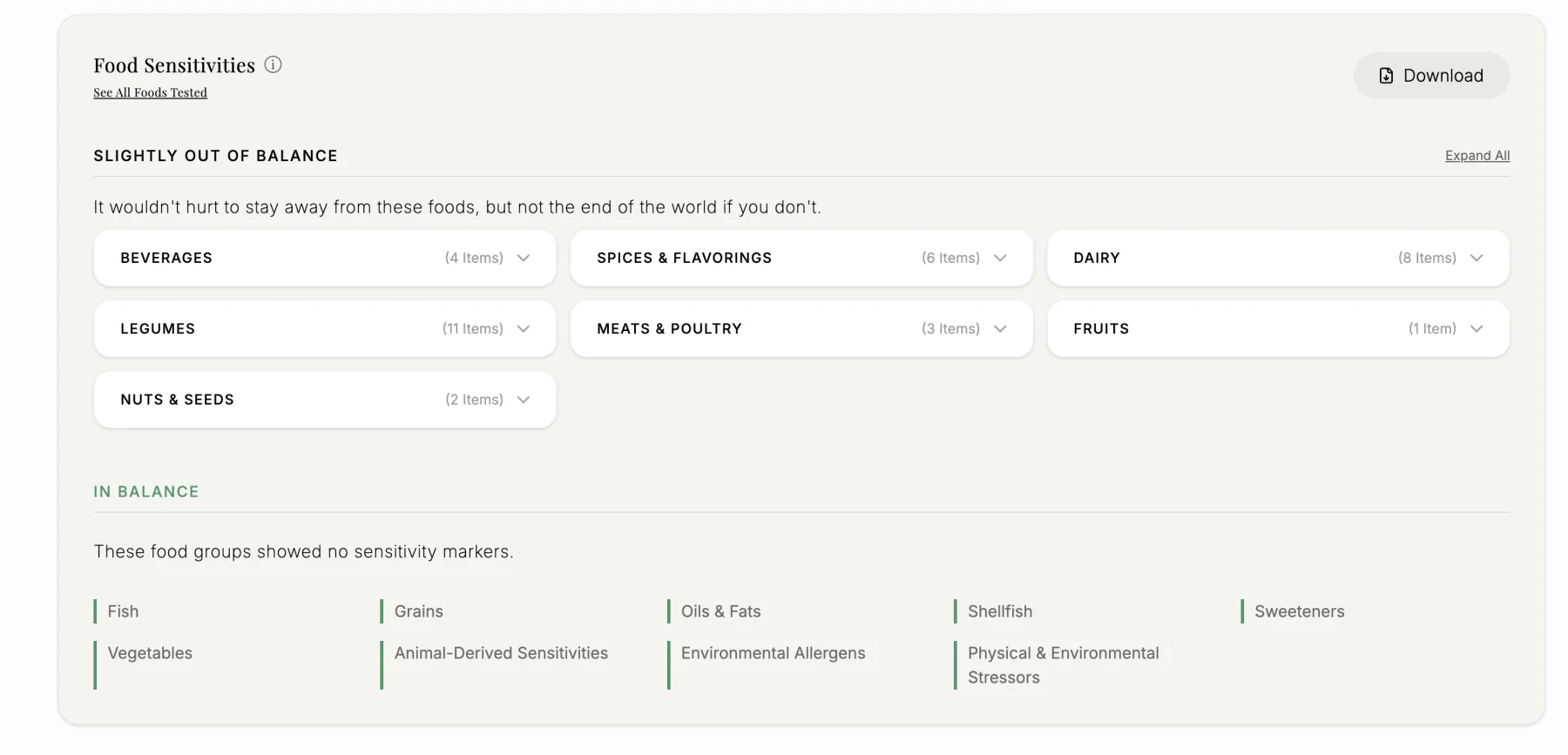
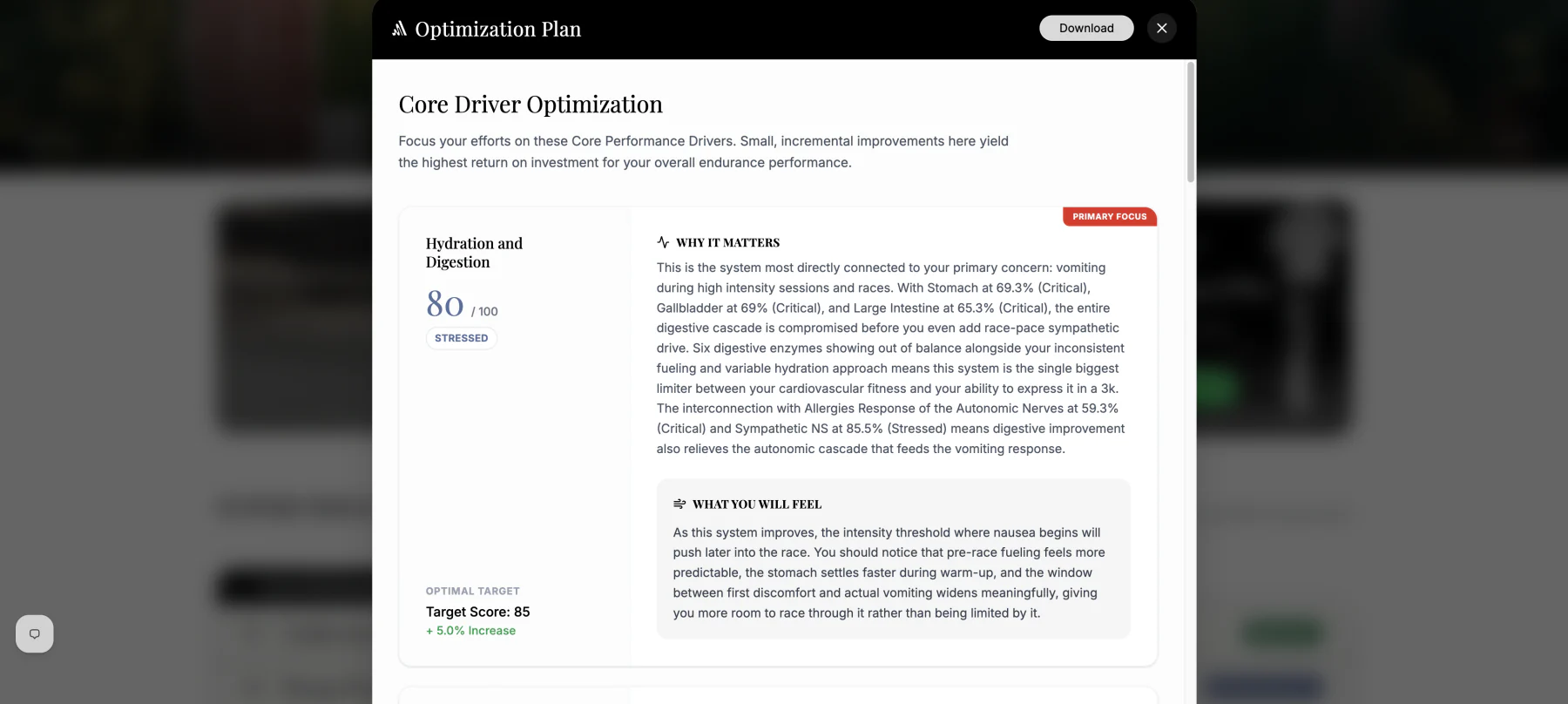
After approval, the report is available through an authenticated, Shopify-linked customer experience. Customers can move from the product they purchased to summaries, charts, explanations, and the sections associated with their scan, while remaining in the same website and account journey.
The custom interface accommodates long results and different scan types. It also lets customers return to available past results and compare progress where repeat scans exist. The product work is in how those pieces fit together: account context, stored reports, navigation, presentation, and access to earlier information.
That is why the engagement grew beyond the initial profile and results-page brief. The visible pages are the point where application logic, source information, generated content, and human approval meet. Rebuilding them required work across the system, not only a new front-end layout.
 View full size
  View full size
 Delivery includes operating the live system
The project is live and ongoing. Arsum’s role continues through monitoring, maintenance, and further product development. The founder and client team retain product direction and customer communication, while Arsum reviews technical issues and makes engineering changes.
The delivery interview records automated tests before builds using Node.js’s built-in test runner. Grafana and Loki support monitoring and log investigation, with operational signals reaching Arsum. Server logs use rotation, and database backups are created daily and stored in Amazon S3. S3 also stores user-generated assets. Deployment scripts provide a documented way to deploy or redeploy the application.
Those controls matter because the report workflow depends on more than the code that produces a page. It also depends on external providers, persisted information, and the ability to investigate failures after release. The work described here includes those operational responsibilities without attaching an unsupported uptime, recovery-time, or response-time guarantee.
“Me. I still continue to look at the project.”
From manual assembly to a live, reviewed workflow
Attuned Health now has a connected path from Shopify purchase and source inputs through AI-assisted preparation, practitioner review, and customer access. The application is shipped and continues to receive upgrades. That live capability is the central outcome of the engagement.
According to the delivery interview, manual preparation steps were removed and staff effort shifted toward reviewing information rather than assembling reports. This is a qualitative account of the workflow change. Time saved, error reduction, processing volume, and commercial impact have not been measured for this case study.
Arsum delivered the engagement through one hands-on engineer working with the client’s founder and design direction. Implementation decisions, deployment support, and later improvements remained connected instead of ending at a page handoff. The project shows how a custom AI feature can become part of an existing product: by designing the data flow, interface, review boundary, failure handling, and ongoing ownership together.
Purchase, approved results, and access to earlier scans.
Generated reports can be inspected and regenerated.
Monitoring, maintenance, and continued product development.
Based on Arsum’s September 4, 2026 delivery interview, with founder excerpts checked against the supplied project transcript. Quotes are Arsum’s founder speaking about the work, not client testimonials; capitalization and punctuation are lightly edited. This case study describes shipped software and reported workflow changes, not measured business or clinical outcomes. Screenshots show demonstration data approved for public display, not real patient records or evidence of clinical outcomes. Private health logic is not published.