Move from a property lookup to a useful research starting point
Ejendomsindex began as a product partnership exploring what could be built from available Danish property information. Its intended users are investors and companies looking to expand a commercial-property portfolio in and around Copenhagen. They need to identify sites worth investigating for development, conversion, or expansion, then assemble enough context to decide where to spend further attention.
Existing property-search products were already part of that landscape. The opportunity described in the interview was richer qualification: bringing additional property, planning, ownership, and company information into the search experience. A location on a map is a starting point. Understanding what surrounds that location is what makes a research tool useful.
Arsum’s scope covered the web product, data integration, recurring comparisons, map interface, enrichment, deployment, and supporting website content. The engagement was a product partnership. The engineering story is how those parts were connected around a research workflow, with further investigation and acquisition decisions remaining with people.
“So you can easily get what fits for you when you have more filters and things that fit you best.”
Bring different public records into the same view
The product connects several kinds of information that describe different aspects of a property. The interview and public source inventory identify Matriklen, BBR, Plandata, DKJord, EJF, and CVR. Together, the source categories span parcels, buildings, planning, environmental context, ownership, and companies. External enrichment services in the Apify category supply further company and person context where available.
The founder identifies combining the sources as the hardest part of the work: understanding which APIs could provide the needed context and how records from different sources could work together. A building record, a parcel, and a company describe different things. Bringing them into the same research experience required decisions about how to connect the information, beyond simply collecting more of it.
The delivery interview confirms SQL storage and VPS hosting. It does not establish the exact matching rules or record-precedence logic, so the diagram below stays at the level of supported components and information flow. The source inventory explains the breadth of the integration; it is not a claim that every source has complete coverage or refreshes at the same time.
“It was more into correlating multiple sources of data so they work properly together.”
 View full size
 From public records to property research
- 01
Public records
Property, building, planning, environmental, ownership, and company sources
- 02
Integration and storage
Bring source information together in the application and SQL data layer
- 03
Recurring comparisons
Daily processing and comparison with earlier data, with manual import checks
- 04
Search and investigation
Map, filters, property context, and change monitoring for the researcher
Additional company and person enrichment · case-by-case administrative review
Make a large property dataset usable on a map
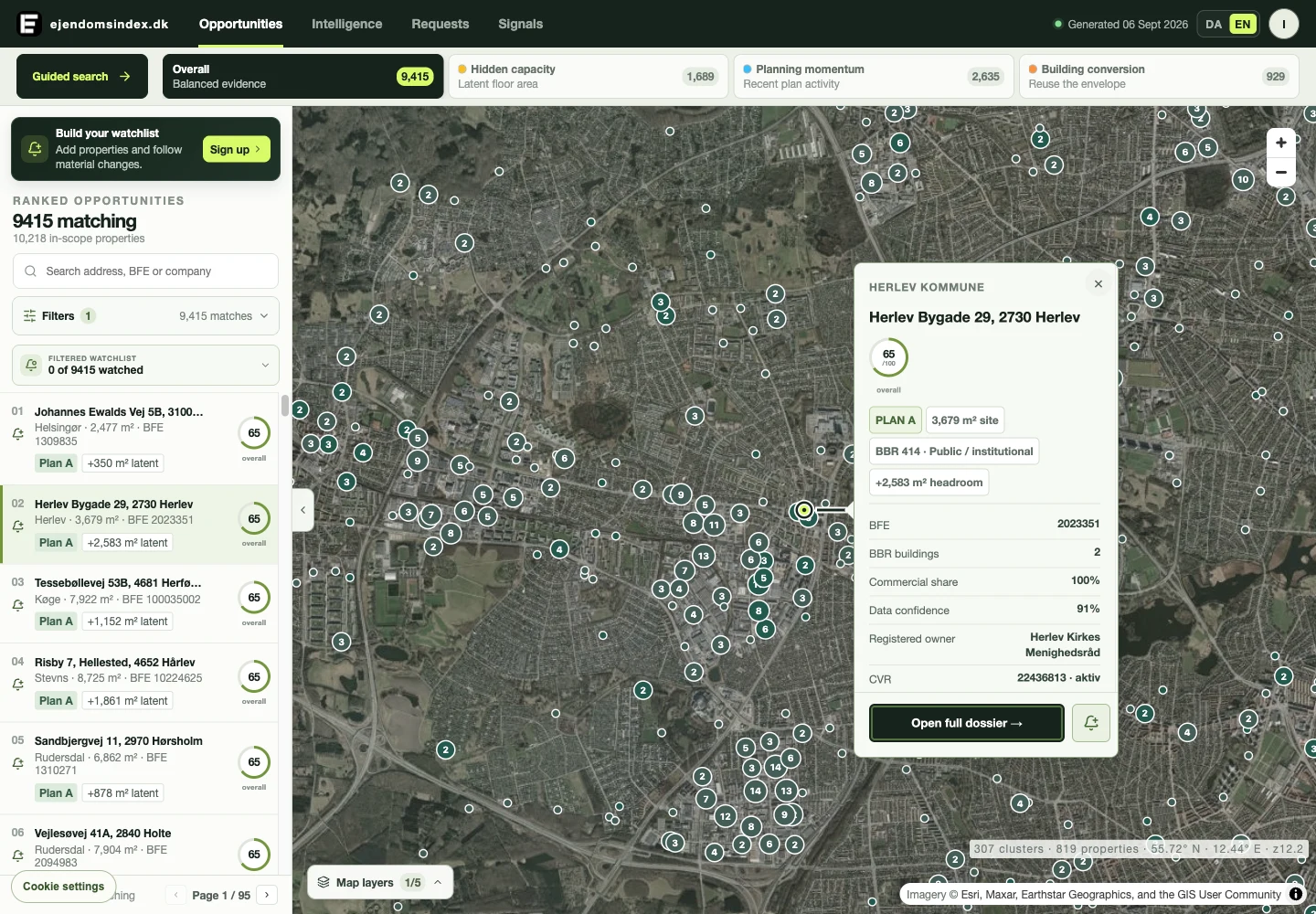
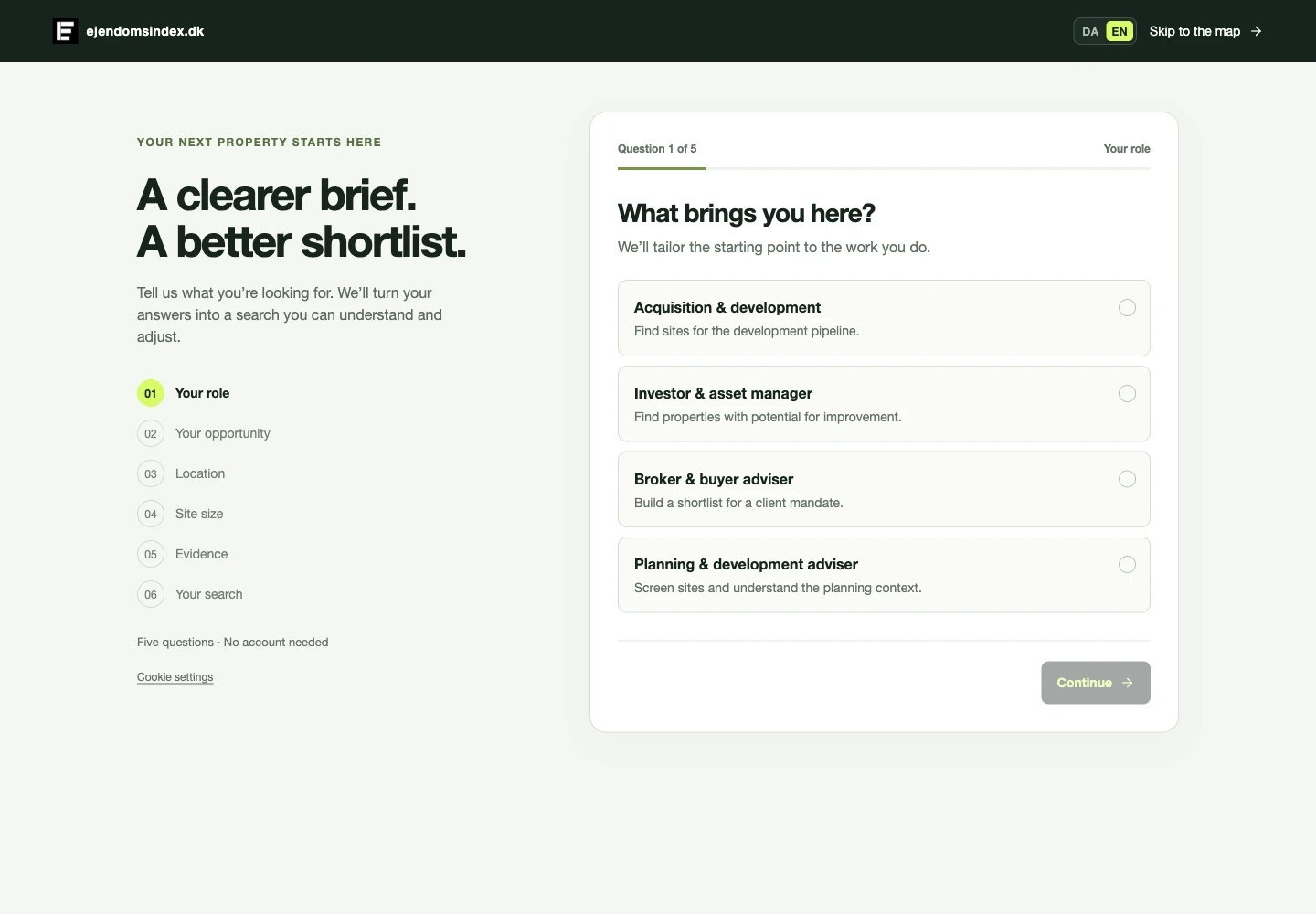
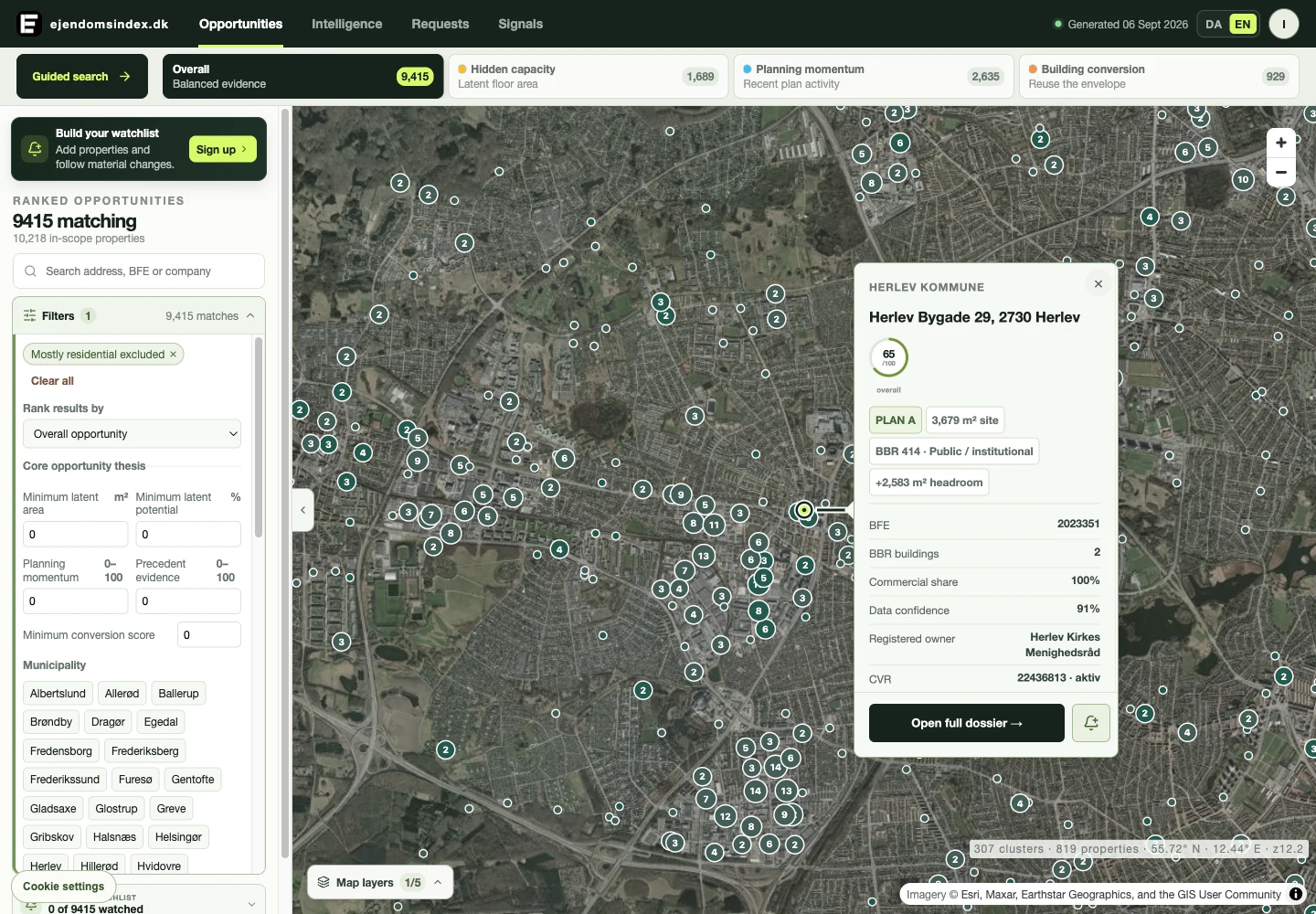
The second major challenge was browser presentation. A property research product must help users move between an area-level view and an individual candidate without overwhelming them with information. Ejendomsindex combines search and filters with a map, including property counts and presentation that changes as the user zooms.
This makes interface design part of the data problem. The user needs enough geographic context to navigate, enough filtering to narrow the question, and a route into the details of a promising property. Showing more records at once would not, by itself, make that task easier.
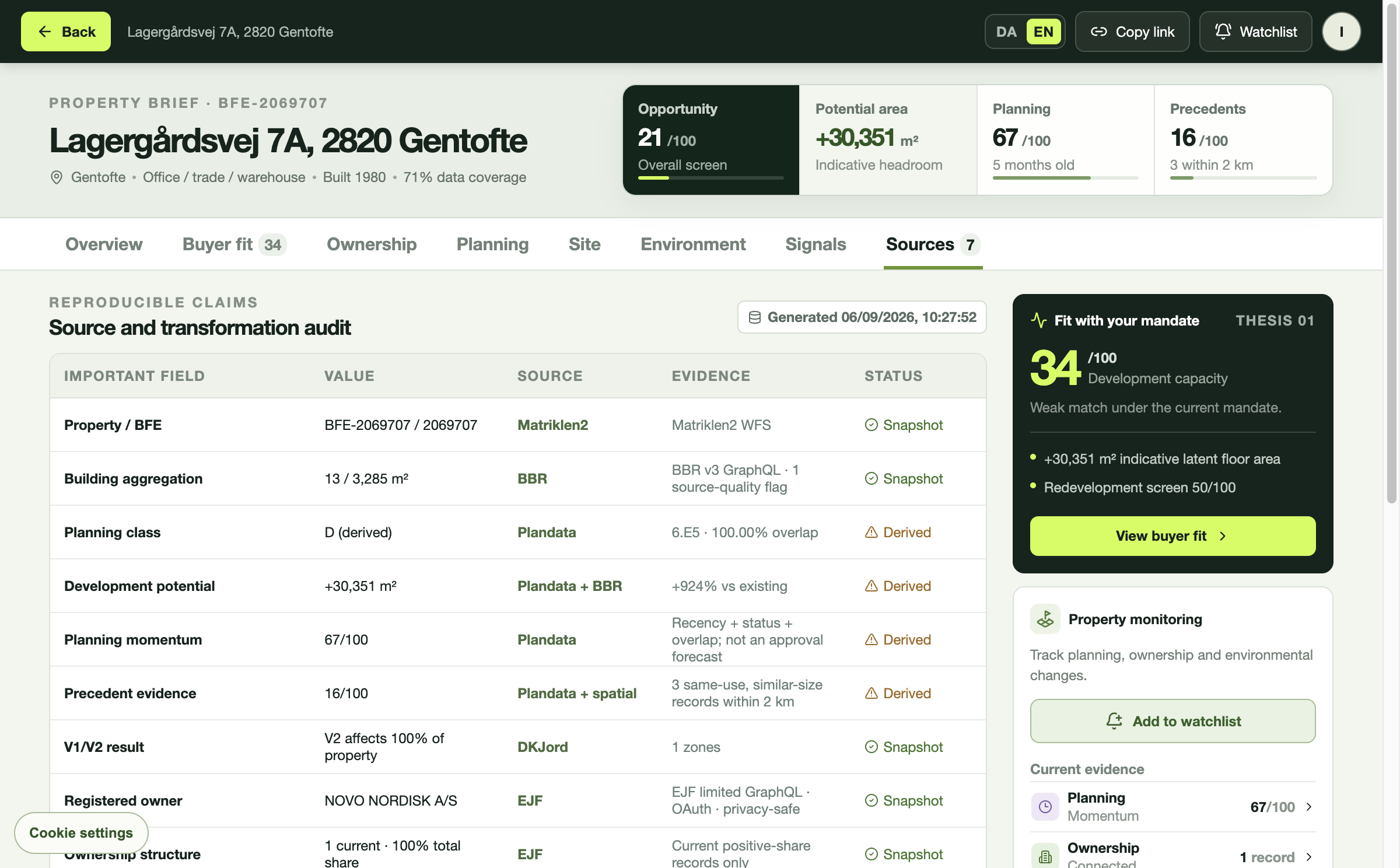
The public application reviewed for this case study also provides a guided starting point. It asks about the visitor’s role and outlines questions about opportunity, location, site size, and evidence. Guided search was discussed as a future direction in the interview; this later public interface shows that the onboarding surface is now available. The screenshot documents what can be observed on that surface, without assuming how the underlying qualification rules are implemented.
 View full size
  View full size
 Give a changing record a place in the workflow
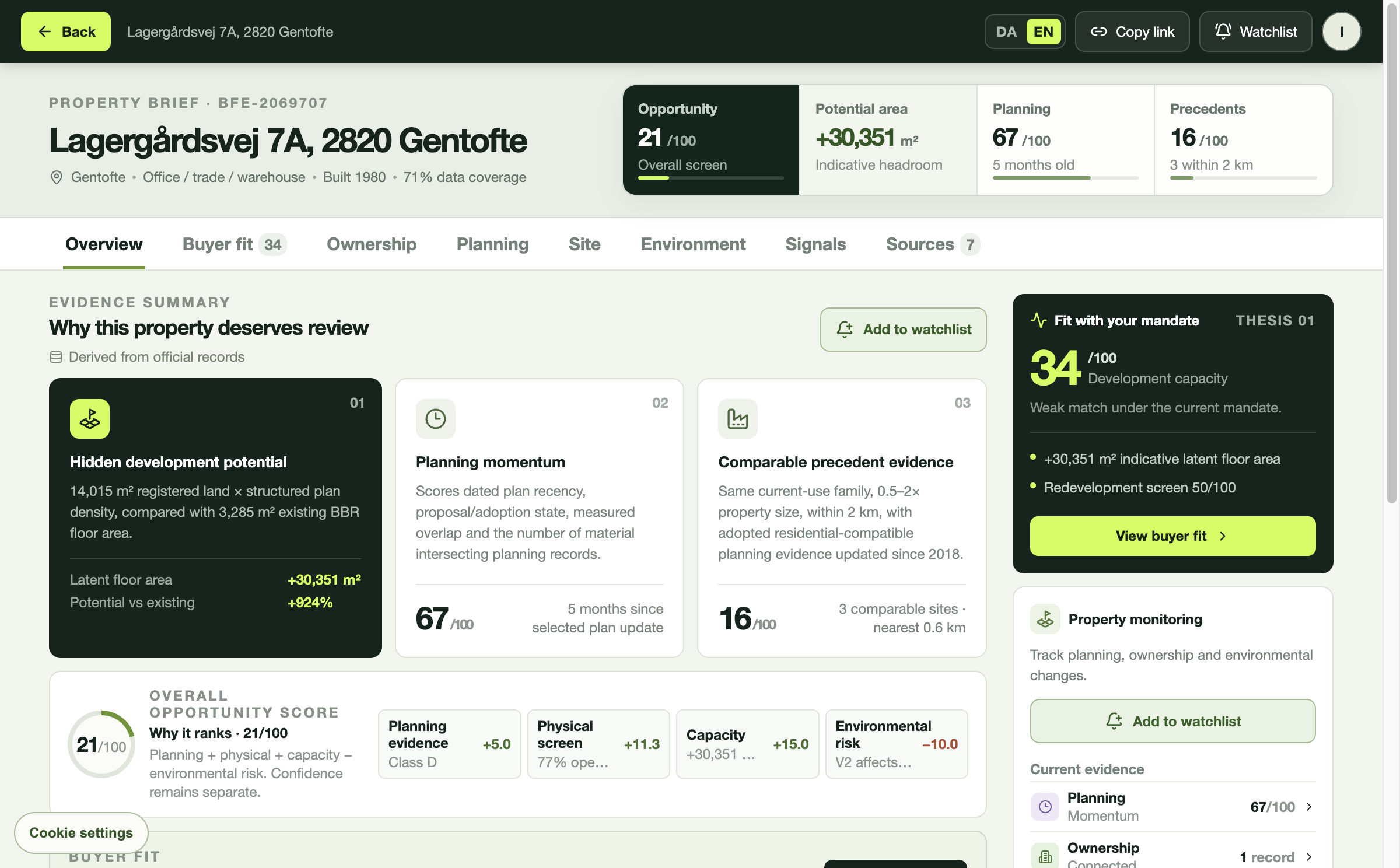
A property that does not warrant further attention today may become relevant when its context changes. Planning activity, ownership, status, and company information were among the categories discussed in the interview. Ejendomsindex includes recurring data processing and comparison with earlier information, alongside a way to watch relevant entities.
The reported processing cadence is daily. That describes the application’s recurring work, rather than a guarantee about when an upstream registry publishes a change or when every enrichment field is refreshed. A useful change signal leads the researcher back into the available context and toward the next question to investigate.
This extends the product beyond a one-off lookup. Search helps identify a candidate; recurring comparisons provide a reason to return. The software supports research continuity while the user decides whether a change warrants deeper screening, due diligence, or contact.
 View full size
 Connect property context to the people and companies around it
Property information often leads to questions about the owner, associated companies, other holdings, and possible contacts. The enrichment work described in the interview helps a researcher explore that surrounding context, using additional external sources where available.
An administrator reviews enrichment-related requests case by case. That review is a separate product responsibility from importing public property records. It gives the workflow a human decision point around an enrichment request; it should not be confused with proof that every source record is correct or that a complete legal compliance program has been established.
The next action remains a research task for the user. Additional context may help someone decide whom to contact or what to investigate, but the case study does not treat company changes, an owner’s age, or ownership duration as validated predictions of willingness to sell.
“Case by case.”
Keep the integration work visible after deployment
The application runs on a VPS with SQL storage, and the interview describes manual checks on imports and missing information. These operational checks matter because a research interface depends on what arrives from its sources, not only on whether a page loads.
At interview time, additional internal tools and monitoring were still being discussed. This account therefore distinguishes the reported daily processing and manual checking from future operational improvements. It does not attach an unsupported uptime target, data-freshness guarantee, or automated recovery claim to the product.
Supporting website content was also part of the scope. The public website gives visitors an entry point into the research product and explains the available information. Its displayed portfolio figures are snapshots of the product’s presentation, rather than measured evidence of investor returns or engineering performance.
A connected property research product
The delivered capability brings public-data integration, geographic search, recurring change checks, external enrichment, and administrative review into one web product. Users can begin with a search area, investigate the available context, and follow relevant changes over time.
The builder described the workflow as making research and change tracking easier. No matching before-and-after study, investor outcome, or commercial-impact dataset was supplied for this case study, so the result is presented through the working product and the scope of engineering delivered.
For teams commissioning real estate data platform development, Ejendomsindex illustrates the work between connecting sources and supporting a real user decision. Data correlation, browser presentation, recurring processing, and review each solve a different part of the problem. Arsum’s contribution was bringing those parts into a research experience people can use.
Public records and external enrichment in the same product.
Search, filters, map navigation, and property context.
A research workflow that can be revisited as information changes.
Based on Arsum’s project interview and a public-interface review on September 6, 2026. Founder quotes were checked against the supplied raw transcript and lightly edited for punctuation and speech fillers; they are firsthand recollections, not investor testimonials. The account documents engineering scope and observable product surfaces; it does not claim measured investment returns, time savings, or a shipped LLM or autonomous research agent.